[California Gold Rush]. Phillips, GS G SBiblio.com
511 résultats
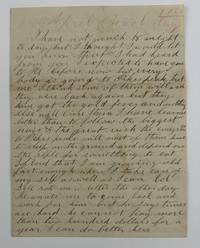
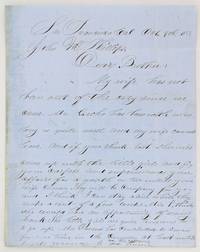
18522473San Francisco: October 4 1852. Very good. 2pp. with integral address leaf. Old folds mild staining and soiling three-inch closed tear to address leaf. An interesting letter documenting the family side of the California Gold Rush in which a San Francisco man writes to his brother offering to send his wife and daughters to Placerville as helpers. Interestingly at first Phillips addresses the letter to his brother in Ohio then scratches it out and writes in "Cal;" this most likely indicates the Phillipses hailed from Ohio and trekked to California along with scores of others in hopes of untold riches in the California gold fields. In his letter Phillips writes that his wife who has long been in San Francisco looking after a sick friend can now leave as he is better "And if you think best she will come up with the little girls and fix your carpets and superintend your affairs for a month or two untill your wife comes." The formerly sick friend Mr. Gardner could also accompany them apparently as "He is coming up to P. and he wants you to give him work for a short time. Mr. G. is a good sailsman sic having been in the dry goods business." While not overtly concerned with gold mining the correspondence is nevertheless interesting for providing details on family routines during the Gold Rush era when numerous families uprooted their lives and moved not only to places like San Francisco and Placerville but between such locations during the years of speculation. A nice example of history from below particularly notable for its domestic implications during the time of the great California Gold Rush. October 4 unknown
18604105Missouri: April 1 1860. Very good. 4pp. on a single folded sheet. Original mailing folds minor toning. An informative letter written by Charles H. Cram in Missouri to a friend in New England dated "April Fools Day 1860" in red pencil at the top of the first page. Cram mentions hoop skirts Pike's Peak and slavery while trying to decide whether to continue westward during the latter years of the California Gold Rush. Cram's letter reads in part: "Everybody is going to Pikes Peak but me. I think some of them will wish they were back again but they have got the gold fever and nothing else will cure them. I have learned better than to follow the biggest nois and the great rush. The emigrants to Pikes Peake will most of them will have to sleep on the ground and depend on the rifle for something to eat. I may start for Santa Fe about the first of June. I can git 15 dollars a month to drive a teem to Santa Fe. If I do cross the plains I shall go to California but if I have good health I shall stay here though I do not like to live in a slave state."<br /> <br /> In another portion of his letter Cram addresses his correspondent's question of whether slaves and freedpersons wore hoop skirts in Missouri. Cram writes: "You wanted to know if niggers wore hoops. Some do and some don't some slaves in broadcloth and silk and some go nearly naked. Slaves have there stent to do so much & if they do more they are payed for it. Most of them have a piece of ground that they call their own. What time they get they work on it. That is how they git their fine cloths. There is not a nigger in Missouri that works as hard as I do but I have consolation that I can work only when I am a mind to. You tell Albert not to start out among strangers as I did for he will find the people different in the country from them in New England."<br /> <br /> Cram then speaks to the emigrant populations he encounters out west as well as the agricultural bounty and animal life of Missouri: "The greatest difficulty I had was to learn the French and German language. I have been for weeks where I could not understand a word but now I can understand anything that comes along. But now for something else. The peach trees are in flower and the woods look green. Cattle and horses pick their living here the year round. I have not seen a barn in the country. The way to feed a horse is to tie him up to a tree and throw him a few ears of corn on the ground. I cannot rite to day much for there is half a dozen in the room talking about pikes peak or some young lady and how many negroes her father owns etc."<br /> <br /> Cram ends his letter with some advice for his friends back east: "Tell Mr. Bosworth that if he can rais $500 that he had better go to Cansas Kansas and go to farming. If you can persuade Andrew Marshall to go west it will be a good lesson for him."<br /> <br /> A mid-19th century manuscript letter with informative observations on the clothing of slaves and with notable observations of western life in Missouri. April 1 unknown
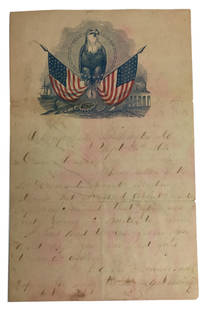
1862916131862. Poor. 20 cm x 25 cm single sheet folded to make 4 handwritten pages. Large patriotic color Illustration of a bald eagle with 2 U.S. flags occupies top third of first page of stationery. Two horizontal fold mark. Split halfway across on a fold on the last two pages. Pinkish color to much of the letter suggesting old damping. Ink quite faded and generally difficult to read. Many words are so indistinct that it was impossible for us to read them and some other words or phrases are just gone. Her letter is addressed to an otherwise unidentified cousin. Jones does not seem to show on standard lists of Civil War Nurses but the information in this letter suggests that she should. Here is our effort to transcribe this difficult-to-decipher letter: "Your letter of the 21st came to hand in due time but I had about made my mind that you was not going to write to me. I was glad to hear from you and hope that you will not fail to write again. I am well. Hoping you enjoy the same good blessing. We are situated on the same ground we occupied a part of last Fall and Winter. We have been here about four weeks. After spending the summer on the peninsula we are very glad to obtain old ground which seems almost like home. You want to know why I am in the hospital. It is not because I am sick but because others are sick and need care. I am what is termed nurse. My wages are $26.50 per month. The business is by no means delightful but I get along very well. We have got one fellow who is very sick I fear he will not recover. On the Peninsula my health became very poor but now I am well. I wish that I could hear that Grandmother is on the gain but fear I never shall. Tell hear I think of her nearly all of the time and and want to see but if I fail to see her I expect to see her in Heaven. I have wrote to your father. I presume he has received my last letter before now. I do not know that I can tell you anything about the war that would amount to anything more than you already know. As we are at present we are retired from the active field I am not as well posted as when we were aamid the turmoils of battle. I have not heard a battle sound since we came across the river. Apparently all seems quiet which seems good. top two lines at top of 4th page too indistinct to decipher My hospital service is every other day. Every other day and night. I have to work taking care of the sick of our regiment then I am idle twenty-four hours. . several lines gone or indistinct here and the I will have a chance to eat army rations wear army cloths and a few moremostly indistinct lines ." She ends the letter by requesting that her cousin write to her at Hospital 50th NY Engineer Regiment Washington D.C. Online information reports that the regiment composed mostly of men from New York and a small number from Pennsylvania lost by death 10 killed in action 7 from wounds received and 214 from disease and other causes. unknown
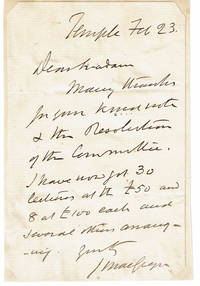
186096259Temple London February 23 circa 1860's 1860's. Very good. - Approximately 30 words penned on 6 inch high by 3-7/8 inch wide creamy white paper. MacGregor writes thanking the recipient for her "note & the Resolution of the Committee". He goes on to outline the numerous lectures he is scheduled to give at the price of 50 pounds and 100 pounds each. Signed "J. MacGregor". Once folded for mailing the corners are clipped and the note has been mounted with glue from the verso onto a slightly larger sheet of paper. Very good. <p>Nicknamed "Rob Roy" after his famous relative John MacGregor 1825-1892 was a Scottish sportsman explorer and travel writer. He is said to have practically invented the "sport" of kayaking then known as canoeing through his travels books and magazine articles. MacGregor worked as a barrister in London specializing in patent law and pursued his passion to travel throughout several parts of the world. Introduced to canoeing while visiting the U.S. and Canada MacGregor designed a double-ended canoe decked in cedar covered with rubberized canvas. Much as with modern kayaks MacGregor's canoe has an open cockpit in the center and was propelled by a double-bladed paddle. He named his canoe the "Rob Roy" after his famous or infamous relative. He undertook canoe trips through Scandinavia Jordan Egypt and the Baltic some of which he featured in his book "A Thousand Miles in the Rob Roy Canoe on Rivers and Lakes of Europe". A gifted artist he illustrated his own books. MacGregor founded the British Royal Canoe Club in 1866 and the American Canoe Association in 1880. Temple, (London), February 23, circa [1860's] unknown
18756056031875. "Faithfully yr friend Joaquin Miller Nov. 2 1875" in black ink on small leaf 4 7/8" x 2 1/2". Very good old tape in top margin from previous mounting. Together with a vintage sepia photograph. 3 3/4" x 5 1/4". Signed by Authors. No Binding. Very Good. unknown
1893ZB416753Berlin: Siegfried Cronbach 1893. Vietes Tausend; small octavo 183 1 pp later half cloth rubbed and worn with one corner taped front hinge broken light general age toning with age spotting in early leaves good. - If you are reading this this item is actually physically in our stock and ready for shipment once ordered. We are not bookjackers. Buyer is responsible for any additional duties taxes or fees required by recipient's country. Berlin: Siegfried Cronbach, hardcover
1900GITh978Paris Maison Didot, Firmin-Didot et Cie sans date vers 1900. In-12 XX 254pp 1 feuillet non chiffré table. Pleine toile noire, dos lisse avec le titre en lettres dorées, reliure de l'époque. Orné d'une carte hors texte. Sans la page de faux-titre, complet de son texte et de la carte, intérieur frais, reliure austère solide.
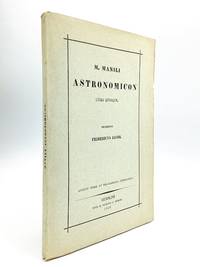
184676915Berolini: Typis et Impensis G. Reimeri 1846. Wraps. Very good. The earliest work on astrology that is extensive comprehensible and mostly intact Marcus Manilius' Astronomica circa AD 30-40 describes celestial phenomena and in particular the zodiac and astrology. Octavo: xxiv 225 p. with 4 folding tables. Original printed paper wrappers. Uncut. Just a hint of foxing to the top edge with some light toning along the extremities of the wrappers; else very good or better. Typis et Impensis G. Reimeri unknown
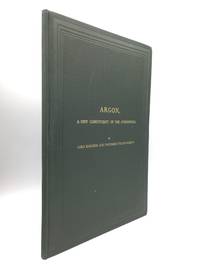
189673529Washington D.C.: Smithsonian Institution 1896. First Edition. Hardcover. Near fine. The first American edition of this important scientific memoir describing the manner in which the authors succeeded in extracting the previously unknown element argon in pure form and in analyzing its properties. For this discovery Lord Rayleigh 1842-1919 was awarded the 1904 Nobel Prize in Physics. Smithsonian Contributions to Knowledge Volume XXIX Number 1033. Quarto: 2ff 43 1 p. Original green cloth binding with gilt titles. Near fine. Smithsonian Institution hardcover books
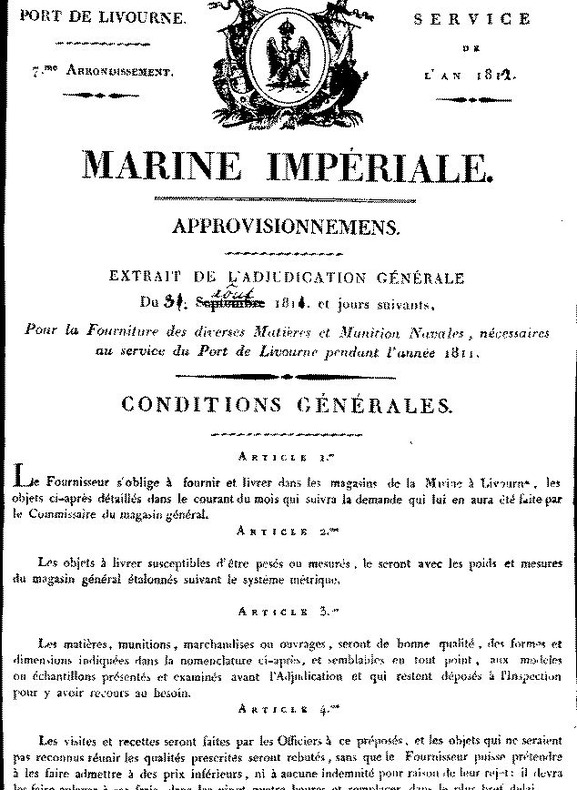
1812ZB421672Paris: Imprimerie imperiale 1812. . pour servir de suite au Traite pub. sur cette matiere; avec une notice historique et chronologique du corps sucrant; par A. A. Parmentier first edition iv 452 pp library book plate and markings later quarter leather rubbed and lightened at spine front hinge cracked after title and blank becoming loose general age toning with occasional age spotting overall a sound good copy; Parmentier eponymous with potato dishes in French food circles presents the further results of his work on developing a palatable sweet syrup from grapes to replace the cane sugar made scarce by the English blockade. - If you are reading this this item is actually physically in our stock and ready for shipment once ordered. We are not bookjackers. Buyer is responsible for any additional duties taxes or fees required by recipient's country. Photos available upon request. Paris: Imprimerie imperiale, hardcover
1853014362Bruxelles - Livourne - Leipzig Meline, Cans et Compagnie 1853 Pleine reliure.
1810Sq41818London: Longman Hurst Rees and Orme Paternoster-Row 1810. The Seventh Edition Corrected. Very Good. three volume set of the anecdotes of the life of chatham william pitt. printed in 1810 seventh edition by longman hurst rees orme. each have some spine wear but nothing major. minor writing on the first few pages of each from prev owner. otherwise unmarked and in great shape = rw Longman, Hurst, Rees, and Orme, Paternoster-Row unknown
1831R43089Mechliniae, P.-J. Hanicq 1831 xxxii + 432 pp.+ 1 enfolding plate (39x33cm.), Editio nova in locis innumeris emendata, text in latin, full-leather binding (title on spine in gilt imprint, tips bit chipped, corners sligthly rubbed, hinges partially broken and repaired, marbled covers), some foxing in text, [cfr. De Backer & Sommervogel, I-1106-48, BECANUS M. = VERBEECK Martin, born +/- 1561 at Hilvarenbeeck (Brabant), died on January 22th 1624]
184725050John Murray 1847. First Edition. Hardcover. Fair Condition/No Dust Jacket. Academics have yet to clearly establish the identity of the author. Sometimes attributed to Theophilus Presbyter sometimes to Roger of Helmarshausen. The book allows detailed insights into the techniques used in the applied arts in the high Middle Ages. The work is divided into three books. The first covers the production and use of painting and drawing materials painting techniques paints and ink especially for illumination of texts and painting of walls. The second deals with the production of stained glass and techniques of glass painting while the last deals with various techniques of goldsmithing and other metalwork. It also includes an introduction into the building of organs. Translation and notes by Robert Hendrie. An ex-library copy in publisher's blind-stamped green cloth gilt lettered. Text block is clean and sound although quite shaken. Binding is frayed along part of the rear joint but board remains firmly attached. Spine with patchy fading around the foot external library shelf mark neatly removed. li 447 pages 2 chromolitho plates a frontispiece and an extra title . index. Size approx. 9" by 6". Quantity Available: 1. Category: Art & Design; Pictures of this item not already displayed here available upon request. Inventory No: 25050. . John Murray hardcover
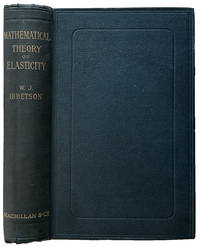
1887LV1834London & New York:: Macmillan 1887. 1887. 8vo. xiii 3 515 pp. Index. Original dark green blind and gilt-stamped cloth. INSCRIBED BY THE AUTHOR to "Prof. J.J. Thomson F.R.S. with the Author's kind regards Ap. 20th 1887." PROVENANCE: Harold I. Levine 1922-2017 Stanford University Dept. of Mathematics. PROVENANCE: 1 Sir Joseph John Thomson 18 December 1856 – 30 August 1940 was an English physicist who received the Nobel Prize in Physics in 1906. 2 Harold I. Levine 1922-2017 Stanford University Dept. of Mathematics. Ibbetson B.A. F.R.A.S. was associated with Clare College where he was a Senior Scholar who worked at the Cavendish Laboratory in 1885 placing him in contact with J.J. Thomson. See: A History of the Cavendish Laboratory 1871-1910 London 1910. Macmillan, 1887. hardcover
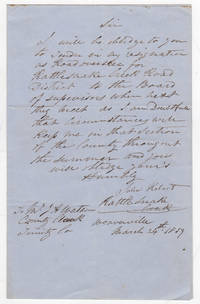
185944772Weaverville CA 1859. Very good minor creasing along edges and folds minor soiling contents clean. 1 pp. Bifolium. 5 x 8 inches. March 24th 1859. Gold Rush era letter from John Hobart to Trinity County Clerk J.A.Watson resigning from his post in Weaverville California . "I will be obliged to you to tender in my resignation as Road overseer for Rattlesnake Creek Road District to the Board of Supervisors when next they meet as I am doubtfull that circumstance will keep me in that section of the County throughout the summer." <br /> <br /> Weaverville California founded in 1850 was a Gold Rush town and once had a population of nearly 2500 Chinese goldminers. In 1855 the Weaverville Trinity Times called attention " the large and rapidly increasing number of Chinese among us.crowding themselves into every vacant spot they can find." unknown
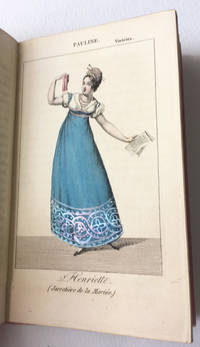
1818Flo136<p>Very rare complete set of all 8 volumes of this review of French theatre in the years 1818-1824.</p><p>All eight years of publication complete with 8 handcolored engraved title pages and over 90 finely handcolored engraved portraits of actors actresses opera singers ballet dancers and comedians in costumes of their famous roles.</p><p>"Very interesting almanac attributed to Charles Malo or Francois-Adolphe Loeve-Weimars giving a summary of Parisian and provincial theaters reviews on the plays and their performers notes on debuts repertoires etc." Grand-Carteret<em> Les almanachs français</em></p><p>Includes portraits of sopranos Mme. Gavaudan and Angelica Catalini tenors Jean-Blaise Martin and Simon Cheard ballet dancers Emilie Bigottini Genevieve Gosselin Antoine Paul and Mlle. Clotilde child actress Leontine Fay actors Francois-Joseph Talma and Charles-Gabriel Potier and many more. Odd volumes turn up occasionally but it is very rare to find the complete set of this intriguing anecdotal overview of Parisian theatre from the first quarter of the 19th century.</p><p>Condition: All volumes in their pastel card slipcases paper bindings holding some spots of foxing to a few plates but overall very good with tissue guards. Complete with all engravings and calendars at end.</p><p>Charles Malo 1790-1871 was a French author editor and translator whose books included a series of gift books for women illustrated by Pancrace Bessa almanacs city guides battlefield guides etc.</p> Louis Janet paperback
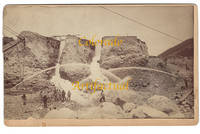
188583<b>ALMA PLACER </b><b>SOUTH PARK </b><b>COLORADO</b><b><br /></b><b>On the South Fork of the </b><b>South Platte</b><b><br /></b><b>Circa 1885</b><b><br /></b><b>Unattribted photographer possibly T. C. Miller or James McNutt</b><b><br /></b><b>Boudoir-card size i</b><b>mage dimensions:</b><b>7-3/4 inches by 4-1/2 inches</b><b><br /></b><b>Condition: very good plus to near fine; strong tones and contrasts fine detail; no significant wear.<br />Alma Colorado gold mining<br />COLORADO ARTIFACTUAL<br /><br /></b><br /><br /><br /> paperback
1900182551900 LA PLUME 1900 IN4 broche,couverture illustre,12p.+ table,350 reproduction en noir,d’affiches par tous les maitres de l’epoque,avec les dimensions.numero complet,tres rare
18992287ALondon, Pearson, 1899. 8°. X, 315 Seiten. Mit zahlr. Fototafeln und 1 farb. gefalt. Karte. OLn. Bis auf wenige Fleckchen gut erhalten. Vorsätze erneuert. 1. Auflage.
1852at082.001Brunsvigae Impesnis Fr Vieweg et Filii 1852. LATIN TEXT. Top oif tilte page cut way above aurhor's bame. Clean tight tetx but intermittent noticeable spotting mostly to first and last few leaves. Halftitle. Bound in boards covered with a marbeld paper. Old leather title label on spine. Minor pencil annotation. Name of owner at front of book. Book is in very good minus condition with minor but noticeable signs of wear and/or age. . Hardback. VG-/No DW. Brunsvigae Impesnis Fr Vieweg et Filii Hardcover
18953752Berlin, Dietrich Reimer, 1895. 21 Illustrationen im Text, 9 Tafeln (davon 1 Frontispiz), 1 Übersichtskarte der Goldvorkommen in Afrika mehrfach gefaltet in 2x4 Segmenten, XVIII, 191 S., 1 Karte Leinenband der Zeit mit goldgeprägtem Rückentitel, Vorsatz mit Buchbinder-Blindprägung, dreiseitiger marmorierter Schnitt, Lesebändchen. Zustand 1.
1811204391811 IN FOLIO,marges courtes,texte recto verso ,1811
1891134556Paris: Imprimerie F. Pichon 1891. Hardcover. Good. Octavo boards 233 p. notes errata. Afonso Celso de Assis Figueiredo also known as Visconde de Ouro Pret 1836 -1912 was a Brazilian politician and professor of law. Recently rebound in red paper covered boards with distinctive white tips. Imprimerie F. Pichon hardcover
185519819London 1855. Very good overall. Engraved trade advertising letterpress advertising the services of Thomas Beck Wholesale Stationer Engraver Printer Lithographer Die Sinker and Manufacturer of Copying Machines 81 Cheapside Two Doors West of Old Jewry London. A London newspaper advertisement for Thomas Beck Co. appeared in December 1846. With an engraved vignette of dock workers at an English/Australian dock sealing crates marked "Gold" "Tallow" and "Wool" with tall masted ships & a steamship visible in the distance; elaborate engraved borders. Printed on laid paper blank at verso. 4 1/4 x 4 3/4". Slightly marked. unknown