5 365 résultats
197086612University of Arizona Press. As New. 1970. Hardcover. FREE UPGRADE to Courier/Priority Shipping Upon Request - IN STOCK AND IMMEDIATELY AVAILABLE FOR SHIPMENT - AS NEW THE TEXT BLOCK IS PRISTINE CLEAN UNMARKED AND IN EXCELLENT CONDITION - - Corresponds to ASIN: B000P97Y28. TWO 2 VOLUME SET. 891 pages with many illustrations. Catalogue Raisonné Catalogue Raisonne Catalog Raisonnee Complete Works University of Arizona Press hardcover
197086611University of Arizona Press. As New. 1970. Hardcover. 0816502668 . FREE UPGRADE to Courier/Priority Shipping Upon Request - IN STOCK AND IMMEDIATELY AVAILABLE FOR SHIPMENT - AS NEW THE TEXT BLOCK IS PRISTINE CLEAN UNMARKED AND IN EXCELLENT CONDITION - - Corresponds to ASIN: B002L487QC and ISBN: 0816502668. TWO 2 VOLUME SET. 891 pages with many illustrations. Catalogue Raisonné Catalogue Raisonne Catalog Raisonnee Complete Works University of Arizona Press hardcover
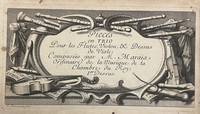
16922792Paris: Chez L’Author; Hurel; Bonneuil; Foucault 1692. First edition. Engraved entirely with a title page illustrated by C. Simonneau a dedication A Mademoiselle Roland a poem Aux Muses an excerpt from the privilege and the score engraved by Bonneuil. In contemporary leather. Supra ex-libris of M.lle Bourret. Gilt spine and edges. Tinted edges. Binding rubbed at the extremities small damages to the corners and joints. The title vignette on the spine missing. Paper tanned. Stains occasionally. Overall in very good condition. First edition. Engraved entirely with a title page illustrated by C. Simonneau a dedication A Mademoiselle Roland a poem Aux Muses an excerpt from the privilege and the score engraved by Bonneuil. In contemporary leather. Supra ex-libris of M.lle Bourret. Gilt spine and edges. Tinted edges. 114 p. <br> <br /> Extremely scarce first edition of Marais’ Pièces en Trio the earliest Frech collection of trio sonatas.<br /> Pièces en Trio is Marin Marais’ second work to be published and considered the first collection of trio music to appear in France. <br> <br /> <br /> The present volume pardessus de viole part belonged to “M.lle Bourret†Anne Élisabeth Bourret b. 1693 the daughter of a lawyer at the Parliament and later the wife of Antoine Scott de la Mézangère the King’s Maître d’Hôtel. Mme de la Mésangère was a harpsichordist herself considered François Couperin’s best pupil and a gifted composer to whom Louis Antoine Dornel dedicated his 1711 book of violin sonatas Sonates à violon seul. She was celebrated for her acting and teaching skills among many others Simon Simon was among her protegés. <br> <br /> <br /> Marin Marais 1656–1728 was a French baroque composer and a master of the viol a pupil of Jean-Baptiste Lully.<br> <br /> <br /> Any of Marais’ works are extremely rare on the market. <br> <br /> <br /> RISM M 387. Chez L’Author; Hurel; Bonneuil; Foucault unknown
1970C86611University of Arizona Press. As New. 1970. Hardcover. 0816502668 . FREE UPGRADE to Courier/Priority Shipping Upon Request - IN STOCK AND IMMEDIATELY AVAILABLE FOR SHIPMENT - AS NEW THE TEXT BLOCK IS PRISTINE CLEAN UNMARKED AND IN EXCELLENT CONDITION - - Corresponds to ASIN: B002L487QC and ISBN: 0816502668. TWO 2 VOLUME SET. 891 pages with many illustrations. Catalogue Raisonné Catalogue Raisonne Catalog Raisonnee Complete Works -- with a bonus offer-- - May be EITHER: out of print OOP and extremely rare in this pristine condition; signed by author or contributor; or a first or special edition; inquire for details . University of Arizona Press hardcover
1970C86612University of Arizona Press. As New. 1970. Hardcover. FREE UPGRADE to Courier/Priority Shipping Upon Request - IN STOCK AND IMMEDIATELY AVAILABLE FOR SHIPMENT - AS NEW THE TEXT BLOCK IS PRISTINE CLEAN UNMARKED AND IN EXCELLENT CONDITION - - Corresponds to ASIN: B000P97Y28. TWO 2 VOLUME SET. 891 pages with many illustrations. Catalogue Raisonné Catalogue Raisonne Catalog Raisonnee Complete Works -- with a bonus offer-- - May be EITHER: out of print OOP and extremely rare in this pristine condition; signed by author or contributor; or a first or special edition; inquire for details . University of Arizona Press hardcover
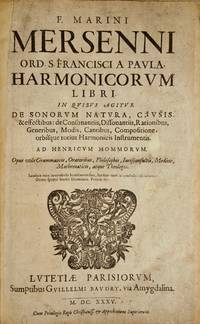
163639451Paris: Guillelmi Baudry 1636. Two parts bound in one. Folio. Early full dark brown panelled leather. With 21 fine engraved illustrations and more than 100 woodcut illustrations mainly of musical instruments; numerous musical examples some in lute tablature and diagrams throughout; occasional woodcut head- and tailpieces ornaments and decorative initials. Typeset. Text in Latin.<br /> <br /> Part I<br /> 1f. recto title verso blank 1f. dedication 4ff. preface 184 pp.<br /> <br /> Bound with:<br /> Part II. Harmonicorum Instrumentorum. 168 pp. <br /> <br /> Provenance<br /> From the collection of Sir Frederick A. Gore Ouseley 1825-1889 English church musician composer professor of Music at Oxford University and collector of music and music theory books with his signature in pencil to free front endpaper. Some early notation in pencil to Vol. I most likely in Ouseley's hand.<br /> <br /> Binding slightly worn rubbed and bumped; restored and rebacked; endpapers slightly browned at margins. Slightly worn and browned; light to moderate dampstaining throughout; title slightly trimmed soiled and with small holes to blank areas minor chips to margins laid down to backing sheet; Part II with small hole to pp. 67/68 just touching illustration to p. 67 and affecting several letters of text to p. 68; lower outer corner of pp. 159/160 lacking just touching lower outer corner of illustrative plate; occasional minor defects. Part I lacking signatures R and X4 pp. 125-132 and 153-160 as is often the case in early issues; lacking pp. 163-166; pages 43-46 mispaginated. Part II lacking pp. 35-38; pages 148 149 and 167 mispaginated. First Edition. Charbon The Hague Gemeentemuseum I p. 95. Cortot p. 135. Gregory-Bartlett pp. 178-79 with pp. 126-31 and 154-59 lacking in Vol. I. Hirsch I 405. Wolffheim I 836. Wood Harvard 988. RISM Écrits Imprimés p. 572. <br /> <br /> Part I contains the earliest examples of music engraving in France. <br /> <br /> Part II is an important study of musical instruments of the late Renaissance and early Baroque. <br /> <br /> Mersenne was a "French mathematician philosopher music theorist and savant. He was one of the leading French thinkers of the 17th century and his work is central to the academic and scientific movements of the second quarter of the century; an important part of it is devoted to the science theory and practice of music. He was a transitional figure at a crucial confluence of Renaissance and Baroque ideas in France summing up the accomplishments of the past and posing the difficult questions for the future inherent in the new attitudes of his own time." Albert Cohen in Grove Music Online<br /> <br /> "An examination of the Harmonicorum will at once show how much it was in advance of anything published up to that time and it is the first in which the science of acoustics is applied practically to the study of Music. Perhaps to us in the present day the greatest interest is in the last four Books treating of the various instruments known at that time divided into stringed and wind instruments the organ having a book to itself and instruments of percussion as bells and drums. These are illustrated profusely with woodcuts as well as with engravings on copper both printed in the text. It is worthy of notice that in treating of the organ several schemes are given for dividing the octave into more than twelve semi-tones so as to be able to use it in the keys impossible with unequal temperament." Matthew: The Literature of Music p. 53. <br /> <br /> Mersenne also authored an early and influential work on music theory Harmonie Universelle published in Paris 1636-37 addressing the relationship between music and mathematics and containing the earliest presentation of what have become known as "Mersenne's Laws" describing the harmonics of vibrating strings; he is thus often referred to as the "father of acoustics."<br /> <br /> A cornerstone of the literature. Guillelmi Baudry unknown
1780342628En Madrid : Por Don Joaquin Ibarra 1780. New edition. Hardcover. Full contemporary gilt-bordered aniline calf worn. Hinges starting gutters worn. Crudely re-cased with the original boards retained. Inner gilt dentelles. Prelim plates detached. All edges gilt. Wide margins with the text remaining in uncommonly good condition; scans and additional bibliographic detail on request. Physical description plates : ill. ; fol.Notes; Added title-page engraved; engraved head- and tail-pieces; initials; vignettes. Preliminary matter v. 1 p. i-ccii includes; Prólogo de la Academia; Vida de . Cervántes Saavedra y anälisis del Quixote por Vicente de los Ríos; Plan cronológico del Quixote; Pruebas y documentos que justifican la Vida de Cervántes. Plates by Antonio Carnicero José del Castillo José Brunete Bernardo Barranco Pedro Arnal Gerónimo Gil and Gregorio Ferro; engraved by Fernando Selma Manuel Salvador y Carmona Gerónimo A. Gil Pedro Pasqual Males J. Joaquín Fabregat Joaquín Ballester Juan de la Cruz Francisco Muntaner and Juan Barceló. Referenced by: Palau y Dulcet 2nd ed. 52024. Language; Spanish. En Madrid : Por Don Joaquin Ibarra hardcover
16631752Paris: Jean du Puis/Widow of Langlois 1663. Scarce edition of this important treatise on perspective by the most scientifically rigorous of 17th-century French theorists of particular interest for its contention that the illustrations to earlier treatises were often defective Millard thus making it the first work on the subject to treat the problem of didactic illustration in a deliberate and self-conscious manner. A comprehensive textbook Book I gives basic geometrical definitions and an introduction to perspective construction; Book II treats simple and deformed perspectivenamely the curved or irregular surfaces found in vaulted ceilings niches etc. and examines the necessary surface distortion anamorphosis to bring a picture painted on such a surface into perspective; Book III deals with more complex cases of anamorphosis such as reflections on flat cylindrical and conical surfaces; and Book IV covers the use of dioptrics for placing figures on flat surfaces. The sections of books II and III dealing with anamorphosis were particularly important whether in Nicerons own practice as a painter or for later artists or theorists see the chapter on Niceron in Baltruaitis and according to Mahoney DSB the discussion of refraction in Book IV possibly contains the first published reference to Descartes derivation of the law of refraction X.104. The work first appeared in French in 1638; reprinted in 1646 and 1651 in the latter with the first appearance of Mersennes treatise. This edition is a second edition of that reprint. Millard French 124 1663; Wiebenson III.b.18; Kemp The Science of Art pp. 129ff.; Baltruaitis Anamorphosis 51ff. Folio 35 x 22.5 cm engraved frontispiece signed Daret 6 ff. including half-title and title engraved portrait of Niceron signed M. Lasne 191 1 pp. with 7 woodcut diagrams in text and 50 numbered plates 49 full-page 1 double page; 6 ff. 134 pp. Note: plates bound at back. Bound in contemporary calf covers ruled spine with raised bands elaborately gilt; covers abraded and some small chips to spine on bands; former ownership stamp on verso of title; spotting and even toning or light browning on scattered leaves often seen in this work; wormhole in margin of plates 27 and following repaired extending into printed surface generally only printed border. Otherwise very good. Jean du Puis/Widow of Langlois hardcover books
16631752Paris: Jean du Puis/Widow of Langlois 1663. Scarce edition of this important treatise on perspective by the most scientifically rigorous of 17th-century French theorists of particular interest for its contention that the illustrations to earlier treatises were often defective Millard thus making it the first work on the subject to treat the problem of didactic illustration in a deliberate and self-conscious manner. A comprehensive textbook Book I gives basic geometrical definitions and an introduction to perspective construction; Book II treats simple and deformed perspectivenamely the curved or irregular surfaces found in vaulted ceilings niches etc. and examines the necessary surface distortion anamorphosis to bring a picture painted on such a surface into perspective; Book III deals with more complex cases of anamorphosis such as reflections on flat cylindrical and conical surfaces; and Book IV covers the use of dioptrics for placing figures on flat surfaces. The sections of books II and III dealing with anamorphosis were particularly important whether in Nicerons own practice as a painter or for later artists or theorists see the chapter on Niceron in Baltruaitis and according to Mahoney DSB the discussion of refraction in Book IV possibly contains the first published reference to Descartes derivation of the law of refraction X.104. The work first appeared in French in 1638; reprinted in 1646 and 1651 in the latter with the first appearance of Mersennes treatise. This edition is a second edition of that reprint. Millard French 124 1663; Wiebenson III.b.18; Kemp The Science of Art pp. 129ff.; Baltruaitis Anamorphosis 51ff. Folio 35 x 22.5 cm engraved frontispiece signed Daret 6 ff. including half-title and title engraved portrait of Niceron signed M. Lasne 191 1 pp. with 7 woodcut diagrams in text and 50 numbered plates 49 full-page 1 double page; 6 ff. 134 pp. Note: plates bound at back. Bound in contemporary calf covers ruled spine with raised bands elaborately gilt; covers abraded and some small chips to spine on bands; former ownership stamp on verso of title; spotting and even toning or light browning on scattered leaves often seen in this work; wormhole in margin of plates 27 and following repaired extending into printed surface generally only printed border. Otherwise very good. Jean du Puis/Widow of Langlois hardcover
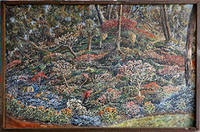
51-1804San Francico: 1955. Oil on canvas. Hand made frame. 26 x 40 inches. Signed and dated lower right.A California painter and poet affiliated with San Francisco's North Beach and the San Francisco Beat Movement. His small paintings were in an exuberant figurative or abstract style. He was an instructor at the San Francisco Art Institute and at the San Francisco Creative Art Center which he co-founded. Often collaborating with Beat poet Ruth Weiss he illustrated her book of poetry Gallery of Women and was immortalized in one of her poems.From the collection of the late San Francisco artist Vesta Kirby 1936-2016 who was a designer at SOM and the studio and restoration assistant and to Gordon Onslow Ford 1981-1992. San Francico: 1955 unknown
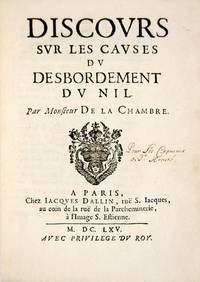
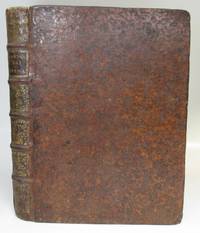
166541178Paris: Jacques Dallin 1665. The Blackmer copy First edition of this scarce treatise concerning the causes of the flooding of the Nile for the first time published separately previously included in his Pensées of 1634 and 1662; from the celebrated library of Henry M. Blackmer II with his bookplate. This could perhaps be a presentation copy as in addition to the gilt supralibros there is an inked inscription "Pour les Capucins de St. Honoré" to the title page. The Capuchin convent adjoined the Tuileries gardens. Cureau was Louis XIV's doctor the monarch apparently having been impressed by his ability to judge character from outward appearance. A precursor of Lavater Cureau was indeed best known for his work in the area of physiognomy but he also published on physics - the nature of light on rainbows - the occult and philosophy the final paper here being a study of the divine in Platonic philosophy. The critic Jean Chapelain his contemporary said of him: "C'est un excellent philosophe et dont les écrits sont purs dans le langage justes dans le dessein soutenus dans les ornements et subtils dans les raisonnements". Quarto 252 x 183 mm. Engraved map of the topography of the Nile to the text title page vignette historiated initials engraved head and tailpieces. Contemporary calf raised bands to spine compartments gilt with floral lozenges within double ruled panels presentation gilt stamp to front cover "Aux Capuchins de St. Honoré". Covers a little rubbed joints lightly chafed light browning. A very good copy. Blackmer 171; Ibrahim-Hilmy p. 351; just 6 copies on WorldCat three of them in the US. hardcover
51806Paris. Bertier.1644.In-8 relié contenant ces 2 textes en latin.140 et 95 pages.Bois gravés.Pour le second texte,Mechanicorum, manque de page de titre.Rare.Marin Mersenne (1588-1648),était un religieux,ami des Descartes,mathématicien, astronome, philosophe,traducteur de Galilée.Reliure à la Dusseuil au dos orné à 5 nerfs.Bel exemplaire malgré des coins émoussés, de petits manques de cuir aux coiffes,et les mors légèrement ouverts. (lois de Mersenne.Lois sur la chute des corps.)
1648262348Paris: Pierre Rocolet 1648. First. hardcover. near fine. Printer's device on title and some other decorative woodcut initials and headpieces throughout. 8 30 10 390 pages. Short 4to full contemporary calf with gilt spine. Paris: Chez Pierre Rocolet; Jacques Langlois Imprimeur du Roy 1648. First edition. Scarce. A near fine copy with clean pages and wide margins.<br/> <br/> An uncommon title on animal psychology. The author a doctor from Le Mans who was the personal physician of the Chancelier Seguier and founding member of the Academie Francaise examines the likely relationships of animals and classifies them under the broad categories of love and hate. In terms of intelligence he concludes that animals indeed have feelings and are able to express them. OCLC lists 21 copies including those at Harvard Cambridge National Library of Medicine & Bibliotheque Nationale de France.<br/> <br/> Pierre Rocolet unknown
1648262348Paris: Pierre Rocolet 1648. First. hardcover. near fine. Printer's device on title and some other decorative woodcut initials and headpieces throughout. 8 30 10 390 pages. Short 4to full contemporary calf with gilt spine. Paris: Chez Pierre Rocolet; Jacques Langlois Imprimeur du Roy 1648. First edition. Scarce. A near fine copy with clean pages and wide margins.<br/><br/> An uncommon title on animal psychology. The author a doctor from Le Mans who was the personal physician of the Chancelier Seguier and founding member of the Academie Francaise examines the likely relationships of animals and classifies them under the broad categories of love and hate. In terms of intelligence he concludes that animals indeed have feelings and are able to express them. OCLC lists 21 copies including those at Harvard Cambridge National Library of Medicine & Bibliotheque Nationale de France.<br/><br/> Pierre Rocolet unknown books
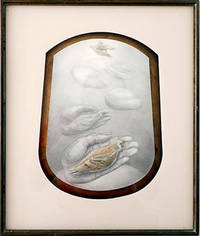
51-1807San Francisco: 1971. Gouache pastel and colored pencil on board in a special cut-out mat framed11 x 7.5 inches. Signed in pencil lower left. Annotated on tthe verso with the title and "An S Marin '71 proverb 'on a thumbnail format.' "A California painter and poet affiliated with San Francisco's North Beach and the San Francisco Beat Movement. His small paintings were in an exuberant figurative or abstract style. He was an instructor at the San Francisco Art Institute and at the San Francisco Creative Art Center which he co-founded. Often collaborating with Beat poet Ruth Weiss he illustrated her book of poetry Gallery of Women and was immortalized in one of her poems.From the collection of the late San Francisco artist Vesta Kirby 1936-2016 who was a designer at SOM and the studio and restoration assistant and to Gordon Onslow Ford 1981-1992. San Francisco: 1971 unknown
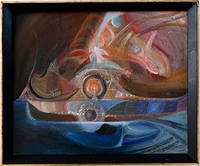
51-1806San Francisco: 1971. 14 x 18 inches. Oil on board. Framed. Signed lower right. Titled signed and dated on paper the verso. A California painter and poet affiliated with San Francisco's North Beach and the San Francisco Beat Movement. His small paintings were in an exuberant figurative or abstract style. He was an instructor at the San Francisco Art Institute and at the San Francisco Creative Art Center which he co-founded. Often collaborating with Beat poet Ruth Weiss he illustrated her book of poetry Gallery of Women and was immortalized in one of her poems.From the collection of the late San Francisco artist Vesta Kirby 1936-2016 who was a designer at SOM and the studio and restoration assistant and to Gordon Onslow Ford 1981-1992. San Francisco: 1971 unknown
1777115583Paris: Nyon and Stoupe 1777. The invention of ball bearings making possible one of the great engineering feats of the 18th century First edition of this account of this remarkable feat the first practical use of ball bearings in engineering. Charged with designing the bronze equestrian statue of the Russian emperor Peter the Great that remains a celebrated landmark of St Petersburg the French sculptor Etienne Falconet decided that the traditional pedestal for equestrian statues would be too mundane. Only a massive rock would suffice. Eventually an enormous piece of granite was located in a marsh near the Gulf of Finland. The Thunder Stone as it was dubbed was estimated to be 40 feet long 25 feet side and 21 feet tall and weighed some 1800 tons: about 1300 tons more than any of the obelisks moved by the ancient Egyptians or Romans. Most engineers declared its removal impossible but Catherine the Great turned to Carburi a Greek of dubious moral reputation who had banished himself from his native island of Cephalonia and had come to Russia where he found favour with the empress. To move the giant rock Carburi devised a gigantic sled moving on a system of rails and six-inch bronze ball bearings. Although ball bearings had been shown in earlier sketches by both Leonardo da Vinci and Agostino Ramelli Carburi's feat was the first practical demonstration of their use. It predated the first modern recorded patent on ball bearings that awarded to Philip Vaughan a British inventor and ironmaster who created a design for a ball bearing in Carmarthen in 1794 by more than two decades. The project invited comparison to the moving of the Vatican obelisk by Fontana in the 16th century which Carburi here argues must have been easier because it was a shorter distance. Folio 423 x 280 mm. With 12 folding engraved plates most double-page by Sellier and d'Elvaux after Blarenberg. Contemporary mottled calf red morocco label spine gilt in compartments marbled endpapers red edges. Armorial bookplate of Henry Tronchin. Skilful and unobtrusive repairs to joints and tips final two plates with a couple of very light red paint marks occasional variable light browning and offsetting overall a pleasing copy of this handsome folio. Berlin Kat. 1794. unknown
1717768941717. MARIN Pieter. DICTIONNAIRE COMPLET HOLLANDOIS ET FRANCOIS. COMPLEET NEDERDUITSCH EN FRANSCH WOORDENBOEK. Amsterdam printed for the author in de Wye-Capelsteeg and also to be found at the Widow Gysbert de Groot and Pieter de Coup 1710 and 1717. Quarto. Two volumes. xl12084; xx1062pp. First edition with both volumes signed by the author on the "copye van de Privilegie" page. The first volume published in 1710 has French to Dutch vocabulary; the second 1717 is Dutch to French. Both have engraved allegorical titlepages explained in Dutch on a separate printed leaf. The author promises to follow the usage of the French Academy and to include terms of the "necessary arts curious notes historical remarks and other items encouraging a taste for good literature." In early vellum dried broken and soiled. Volume I is detached from its covers with the 20 leaves of prelims disbound with some staining and tattering but no loss to printed area. Volume II clings to its covers by two cords shows dampstaining to last quarter of text with two final blanks detached and key to frontispiece torn. Clearly in need of and worthy of a binder's help. This important dictionary was reprinted in 1720 1728 1730 and 1743. Both the OCLC and the Cordell Collection list only later editions. See Vancil p.159. unknown books
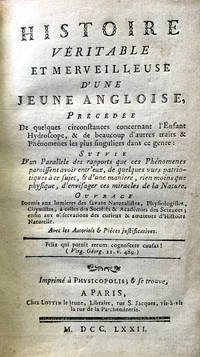
177218306Paris: Lottin 1772. FIRST EDITION. Contemporary half calf over speckled boards spine and label gilt edges sprinkled blue. Fine internally fresh. First edition a descriptive account of two teenagers with super-human powers. The first a Provençal shepherd boy possessed the ability to detect subterranean waters. The second was an English girl who could see through earth and bodies to what lies beneath. The author supports the veracity of their abilities with similar accounts taken from scientists and natural historians eyewitness testimonies and a letter from one Lord Norton who was acquainted with the English seer transcribed in full.<br /> François Marin 1721-1809 was a French journalist author and censor. This work is attributed to him because he first reported on the dowsing gifts of the shepherd boy in the Gazette de France.<br /> There are no copies of this first edition in the U.S.<br /> Ellis The Divining Rod: A History of Water Witching with a Bibliography p. 33; not in Barbier Caillet or Dorbon. Lottin unknown
1993185959Bogotá: Arte dos Gráfico 1993. First edition. Paperback. Fine. 6 prints wrps. Myths of creation by Matilde MarÃn is an edition of the Alvaro Castagnino gallery in Buenos Aires and Arte Dos Gráfico in Bogota Colombia. This work a limited edition numbered 30 out of 100 consists of six original prints in etching and aquatint as well as five original silk screens. Both the zinc and copper plates and the silk screen matrixes were made entirely by the artist. The work also contains a metal frontispiece and a series of original vignettes. The texts were composed manually in Bodoni typography; the papers used are BFK Rives from Arjomari of France as well as paper handmade by Fabripapel of Bogota Colombia. The design is by Luis Angel Parra and Matilde MarÃn and the English translation by Andrew Reid. The myths from different cultures were selected by the artist; the prologue is by Nelly Perazzo member of the Academia Nacional de Bellas Artes of Argentina. Alina Molinari and Ãlvaro Navarro oversaw a number of aspects of the project. The printing was carried out in the studios of Arte Dos Gráfico in Bogota Colombia; it was completed on the night of September 22 1993 under a waxing moon. Rare only four holdings on WorldCat. Arte dos Gráfico paperback
17392092902141700270Not Available 1739. Soft Cover. Fine. Volume: 1 Not Available paperback
178330521Paris: printed by François-Ambroise Didot l'ainé published by Alexandre Jombert jeune 1783. Large quarto. 11 1/2 x 8 1/4 inches. Half-title title with wood-engraved vignette letterpress dedication with engraved armorial headpiece printed in colours. 11 engraved plates 10 folding printed in colours "en manière de pastel" by Louis-Marin Bonnet "premier Graveur en ce genre" each plate hinged to the upper margin of the relevant caption leaf as issued. Contemporary tree calf covers bordered in gilt flat spine divided in compartments with gilt roll tools red morocco lettering piece in the second the others with a repeat decoration in gilt marbled endpapers<br/> <br/>The first edition of a work of great importance to the history of the development of colour printing.<br/> <br/>One of the most successful eighteenth century experiments in colour-printing this is the only book illustrated by Bonnet the inventor of pastel manner engraving or "gravure en maniere de pastel." The crayon manner technique for reproducing chalk drawings in three-colour prints had been invented by J.C. François in 1757 and Bonnet was his pupil. Bonnet extended the technique to suggest tone and printed additional colours calling his new method the pastel manner. This technically demanding process allowed Bonnet to produce colour prints of the highest quality and paved the way for the great French illustrated works of the late-18th and early-19th century. The text is the work of the French military engineer Charles-Louis de Fossé and divides naturally into two sections. The first dealing with the strategies to be employed when attacking or defending a small military outpost manned by between 30 and 300 men; the second dealing with the correct use of colour when drawing military maps and plans and touching on perspective drawing as applied to military plans. This second part is illustrated using Bonnet's plates. Apart from the colour printing another unusual feature of this beautifully produced work is that the plates are all attached along the upper margin of the descriptive associated caption leaves: this allows for individual plans to be folded out whilst the relevant text in the body of the book is studied.<br/> <br/>Brunet II1354; cf. V. Carlson & J. Ittmann Regency to empire: French Printmaking 1715 - 1814 Baltimore Museum of Art 1984; Colorful Impressions: The Printmaking Revolution in Eighteenth-Century France. Washington: National Gallery of Art 2003-2004 no. 46; Jean Fürstenberg Das französische Buch im 18 Jahrhundert p. 121; Graesse II:620; Jacques Herold Louis-Marin Bonnet catalogue de l'Oeuvre grav. Paris: 1935 p.28; Joseph Marie Quérard La France littéraire ou Dictionnaire bibliographique des savants Paris: 1829 III p.173 'ouvrage estimé'. printed by François-Ambroise Didot l'ainé, published by Alexandre Jombert, jeune unknown books
193184100T. Spencer Hutson. As New. 1931. Hardcover. FREE UPGRADE to Courier/Priority Shipping Upon Request - IN STOCK AND IMMEDIATELY AVAILABLE FOR SHIPMENT - AS NEW THE TEXT BLOCK IS PRISTINE CLEAN UNMARKED AND IN EXCELLENT CONDITION - - 37 pages text; 30 plates folio. T. Spencer Hutson hardcover
165037850Paris: Pierre Rocolet 1650. 4to. 9 1/4 x 7 inches. 6 340 6pp. Engraved printer's device on title-page engraved head-piece and initial on the dedication leaf 26 engraved illustrations including one full-page. Contemporary mottled calf expertly rebacked to style spine gilt with raised bands red morocco lettering piece<br/> <br/>First edition of an important work of optics and the musical nature of the refraction of color.<br/> <br/>La Chambre a protege of Cardinal de Richelieu served as physician to Chancelier Seguier and Louis XIII and entered the Academie Royale in 1666. The present work was instrumental in the development of French mathematician Pierre de Fermat's eponymous principle as well as the experiments by Newton which led to his publication of Opticks in 1704. Following Aristotle in deriving a link between the color specturm and musical theory La Chambre theorized all colors being encompasses within white light and arranged colors over two octaves with the seven colors of Aristotle at successive fourths fifths and octaves. Thus arranged symmetrically the "scale" could be read in either direction both up and down with white as the highest or lowest notes. La Chambre hoped to establish a universal theory of color and musical harmony; i.e. if a musical interval was dissonant the colors it represented would similarly clash. In Newton's Opticks this parallel between the color spectrum and a musical scale was further refined. A second edition of this work would be published in 1662; the first edition is scarce.<br/> <br/>Krivatsy 3017; Brunet III 726; Grasse IV 62; Cioranescu 22651. Pierre Rocolet unknown books
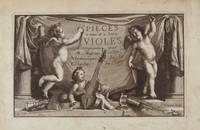
168640526Paris: Chez l'Autheur Ruë du jour proche St. Eustache du costé de la ruë Montmartre. Et ean Huret faiseur d'Instruments pour la musique du Roy ruë des Arcis a l'Image St. Pierre 1686. Oblong folio. Full contemporary dark brown mottled calf. 4-5 "Avertissement" 6 "Extrait du Privilege du Roy" 7-119 pp. music.<br /> <br /> The fine engraved illustrated title incorporating a viol lute sheet music putti and drapery has been laid down to the verso of the upper board and an elaborate engraved illustration from another publication "Sonate o partite ad una o due viole da gamba con il basso continuo" D'Augusto Kühnel Cassel 1698 of two men playing viols accompanied by a woman at the harpsichord etc. laid down to the recto of the lower board. <br /> <br /> Binding considerably worn rubbed and bumped with loss to portions of leather; spine lacking; boards nearly detached. Light uniform browning somewhat heavier in spots; some internal wear soiling and small stains; 17 leaves defective with tears and abrasions resulting in loss to text to "Avertissement" and notation on pp. 21 44 45 59 63 75 91 and 95; tear to pp. 70/71 79 111 repaired with archival tape; p. 120 following blank and dedication leaf lacking; engraving to recto of lower board worn and browned trimmed lacking upper inner and lower outer corners. Lacking 7 leaves pp. 1-3 42/43 48/49 98-101 and 120. First Edition. Rare. Lesure p. 412. BUC p. 647. RISM M383 3 copies in the U.S. at Yale Eastman and the Library of Congress. <br /> <br /> Marais was a French composer and viol player. "He is one of the outstanding figures in French music of the Baroque period. . A viol virtuoso Marais was one of the first French instrumentalists to make his mark as a soloist. Gifted with a remarkable technique he developed it adding new complexities. His pleasing tone had a rare power thanks to an 'airy' style of playing which made full use of open strings and their harmonics. However his virtuosity always took second place to his musicality. His performances full of charm and 'fire' captivated his contemporaries who said that he played 'like an angel'. Composer and performer were closely linked for at this time soloists concentrated almost exclusively on playing their own works at concerts. Between 1686 and 1725 Marais published five books of pieces for viol and continuo and several suites for two and three viols - a total of 596 pieces grouped into 39 suites two of them for three viols." Jérôme de La Gorce and Sylvette Milliot in Grove Music Online<br /> <br /> Works of both the artist Antoine Pezey 16-16 and the engraver Antoine Trouvain 1656-1708 of the title page are held in major museum collections.<br /> <br /> The present work constitutes the first published music for viola da gamba by Marin Marais the greatest viol-player of the Baroque era. Chez l'Autheur Ruë du jour proche St. Eustache du costé de la ruë Montmartre. Et ean Huret faiseur d'Instruments pour la musi unknown