Cervantes Saavedra, Miguel de (1547-1616). Ibarra y Marin, Joaquin (1725-1785) [publisher]Biblio.com
71 résultats
1780342628En Madrid : Por Don Joaquin Ibarra 1780. New edition. Hardcover. Full contemporary gilt-bordered aniline calf worn. Hinges starting gutters worn. Crudely re-cased with the original boards retained. Inner gilt dentelles. Prelim plates detached. All edges gilt. Wide margins with the text remaining in uncommonly good condition; scans and additional bibliographic detail on request. Physical description plates : ill. ; fol.Notes; Added title-page engraved; engraved head- and tail-pieces; initials; vignettes. Preliminary matter v. 1 p. i-ccii includes; Prólogo de la Academia; Vida de . Cervántes Saavedra y anälisis del Quixote por Vicente de los Ríos; Plan cronológico del Quixote; Pruebas y documentos que justifican la Vida de Cervántes. Plates by Antonio Carnicero José del Castillo José Brunete Bernardo Barranco Pedro Arnal Gerónimo Gil and Gregorio Ferro; engraved by Fernando Selma Manuel Salvador y Carmona Gerónimo A. Gil Pedro Pasqual Males J. Joaquín Fabregat Joaquín Ballester Juan de la Cruz Francisco Muntaner and Juan Barceló. Referenced by: Palau y Dulcet 2nd ed. 52024. Language; Spanish. En Madrid : Por Don Joaquin Ibarra hardcover
1777115583Paris: Nyon and Stoupe 1777. The invention of ball bearings making possible one of the great engineering feats of the 18th century First edition of this account of this remarkable feat the first practical use of ball bearings in engineering. Charged with designing the bronze equestrian statue of the Russian emperor Peter the Great that remains a celebrated landmark of St Petersburg the French sculptor Etienne Falconet decided that the traditional pedestal for equestrian statues would be too mundane. Only a massive rock would suffice. Eventually an enormous piece of granite was located in a marsh near the Gulf of Finland. The Thunder Stone as it was dubbed was estimated to be 40 feet long 25 feet side and 21 feet tall and weighed some 1800 tons: about 1300 tons more than any of the obelisks moved by the ancient Egyptians or Romans. Most engineers declared its removal impossible but Catherine the Great turned to Carburi a Greek of dubious moral reputation who had banished himself from his native island of Cephalonia and had come to Russia where he found favour with the empress. To move the giant rock Carburi devised a gigantic sled moving on a system of rails and six-inch bronze ball bearings. Although ball bearings had been shown in earlier sketches by both Leonardo da Vinci and Agostino Ramelli Carburi's feat was the first practical demonstration of their use. It predated the first modern recorded patent on ball bearings that awarded to Philip Vaughan a British inventor and ironmaster who created a design for a ball bearing in Carmarthen in 1794 by more than two decades. The project invited comparison to the moving of the Vatican obelisk by Fontana in the 16th century which Carburi here argues must have been easier because it was a shorter distance. Folio 423 x 280 mm. With 12 folding engraved plates most double-page by Sellier and d'Elvaux after Blarenberg. Contemporary mottled calf red morocco label spine gilt in compartments marbled endpapers red edges. Armorial bookplate of Henry Tronchin. Skilful and unobtrusive repairs to joints and tips final two plates with a couple of very light red paint marks occasional variable light browning and offsetting overall a pleasing copy of this handsome folio. Berlin Kat. 1794. unknown
1717768941717. MARIN Pieter. DICTIONNAIRE COMPLET HOLLANDOIS ET FRANCOIS. COMPLEET NEDERDUITSCH EN FRANSCH WOORDENBOEK. Amsterdam printed for the author in de Wye-Capelsteeg and also to be found at the Widow Gysbert de Groot and Pieter de Coup 1710 and 1717. Quarto. Two volumes. xl12084; xx1062pp. First edition with both volumes signed by the author on the "copye van de Privilegie" page. The first volume published in 1710 has French to Dutch vocabulary; the second 1717 is Dutch to French. Both have engraved allegorical titlepages explained in Dutch on a separate printed leaf. The author promises to follow the usage of the French Academy and to include terms of the "necessary arts curious notes historical remarks and other items encouraging a taste for good literature." In early vellum dried broken and soiled. Volume I is detached from its covers with the 20 leaves of prelims disbound with some staining and tattering but no loss to printed area. Volume II clings to its covers by two cords shows dampstaining to last quarter of text with two final blanks detached and key to frontispiece torn. Clearly in need of and worthy of a binder's help. This important dictionary was reprinted in 1720 1728 1730 and 1743. Both the OCLC and the Cordell Collection list only later editions. See Vancil p.159. unknown books
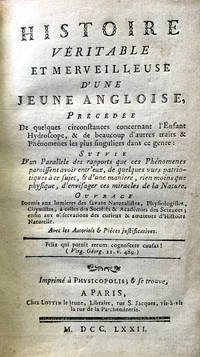
177218306Paris: Lottin 1772. FIRST EDITION. Contemporary half calf over speckled boards spine and label gilt edges sprinkled blue. Fine internally fresh. First edition a descriptive account of two teenagers with super-human powers. The first a Provençal shepherd boy possessed the ability to detect subterranean waters. The second was an English girl who could see through earth and bodies to what lies beneath. The author supports the veracity of their abilities with similar accounts taken from scientists and natural historians eyewitness testimonies and a letter from one Lord Norton who was acquainted with the English seer transcribed in full.<br /> François Marin 1721-1809 was a French journalist author and censor. This work is attributed to him because he first reported on the dowsing gifts of the shepherd boy in the Gazette de France.<br /> There are no copies of this first edition in the U.S.<br /> Ellis The Divining Rod: A History of Water Witching with a Bibliography p. 33; not in Barbier Caillet or Dorbon. Lottin unknown
17392092902141700270Not Available 1739. Soft Cover. Fine. Volume: 1 Not Available paperback
178330521Paris: printed by François-Ambroise Didot l'ainé published by Alexandre Jombert jeune 1783. Large quarto. 11 1/2 x 8 1/4 inches. Half-title title with wood-engraved vignette letterpress dedication with engraved armorial headpiece printed in colours. 11 engraved plates 10 folding printed in colours "en manière de pastel" by Louis-Marin Bonnet "premier Graveur en ce genre" each plate hinged to the upper margin of the relevant caption leaf as issued. Contemporary tree calf covers bordered in gilt flat spine divided in compartments with gilt roll tools red morocco lettering piece in the second the others with a repeat decoration in gilt marbled endpapers<br/> <br/>The first edition of a work of great importance to the history of the development of colour printing.<br/> <br/>One of the most successful eighteenth century experiments in colour-printing this is the only book illustrated by Bonnet the inventor of pastel manner engraving or "gravure en maniere de pastel." The crayon manner technique for reproducing chalk drawings in three-colour prints had been invented by J.C. François in 1757 and Bonnet was his pupil. Bonnet extended the technique to suggest tone and printed additional colours calling his new method the pastel manner. This technically demanding process allowed Bonnet to produce colour prints of the highest quality and paved the way for the great French illustrated works of the late-18th and early-19th century. The text is the work of the French military engineer Charles-Louis de Fossé and divides naturally into two sections. The first dealing with the strategies to be employed when attacking or defending a small military outpost manned by between 30 and 300 men; the second dealing with the correct use of colour when drawing military maps and plans and touching on perspective drawing as applied to military plans. This second part is illustrated using Bonnet's plates. Apart from the colour printing another unusual feature of this beautifully produced work is that the plates are all attached along the upper margin of the descriptive associated caption leaves: this allows for individual plans to be folded out whilst the relevant text in the body of the book is studied.<br/> <br/>Brunet II1354; cf. V. Carlson & J. Ittmann Regency to empire: French Printmaking 1715 - 1814 Baltimore Museum of Art 1984; Colorful Impressions: The Printmaking Revolution in Eighteenth-Century France. Washington: National Gallery of Art 2003-2004 no. 46; Jean Fürstenberg Das französische Buch im 18 Jahrhundert p. 121; Graesse II:620; Jacques Herold Louis-Marin Bonnet catalogue de l'Oeuvre grav. Paris: 1935 p.28; Joseph Marie Quérard La France littéraire ou Dictionnaire bibliographique des savants Paris: 1829 III p.173 'ouvrage estimé'. printed by François-Ambroise Didot l'ainé, published by Alexandre Jombert, jeune unknown books
1730R300124904JOANNES VAN BRAAM / GERARD ONDER DE LINDEN / HERMANUS UYTWERF A WOR. 1728-1730. In-8. Relié plein cuir. Etat d'usage, Plats abîmés, Dos à nerfs, Quelques rousseurs. 1208 pages + 1064 pages - contre plats jaspés - dos à 5 nerfs - titre et caissons dorés sur le dos - ouvrage en français et en hollandais - textes sur deux colonnes - coins très abîmés - petit manque de cuir sur les plats - une gravure en noir et blanc en début d'ouvrage dans les deux volumes - 6 photos disponibles.. . . . Classification Dewey : 840.05-XVIII ème siècle
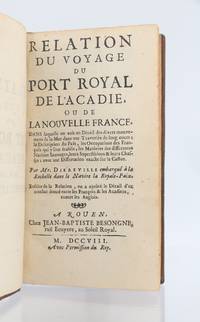
170888653Rouen: Jean-Baptiste Besongne 1708. Fine. Jean-Baptiste Besongne Rouen 1708 9.5 x 16.8 cm Relié Rare first edition of this curious travel account originally written entirely in verse 7500 lines though the authoron the advice of friendsagreed to intersperse it with prose narrative retaining 2500 lines of verse; see Sabin 20128 Gagnon 1134 1710 edition and Dionne II.Contemporary full brown calf binding spine with five raised bands gilt compartments decorated with gilt floral tools cherry red morocco label gilt roll tooling at head and foot double black fillet border on covers gilt fillets on board edges sprinkled yellow edges with red mottling.Lower right corner of upper cover restored; some spots and minor scuffs to the boards; occasional light foxing otherwise internally fresh and appealing.Unlike the second edition of 1710 this copy was not issued with a frontispiece. Almost nothing is known about the life of Dières de Dièreville a surgeon possibly born around 1670 who embarked in August 1699 aboard the Royale Paix from La Rochelle for a trading mission to Acadia. He arrived on 13 October and remained in the region for a year studying both the Acadians and the Indigenous peoples while also collecting plant specimens for the Jardin du Roi in Paris. His return voyage took place from 6 October to 9 November 1700 after which he settled as a surgeon in Pont-l'Évêque. At the request of Michel Bégon Intendant of La Rochelle he wrote the account of his travels. He was still alive in 1711 but nothing further is known of his life. Jean-Baptiste Besongne hardcover
1726013796London: J. Darby A. Betteswort &c 1726. Second Edition. Hardcover. Neat contemporary ink inscription to first title very small worm tracks to upper corner of about half of the pages. Lovely plates very clean. Near Fine. Tall Folio 8-3/4" x 14-1/2" bound in full calf leather neatly rebacked. Two parts in one volume lacking the printed title page as seems often to be the case. Text in French and English. Translated by Thomas Manington Gibbs. Illustrated with two engraved title pages a frontispiece a portrait and 103 engraved plates all nearly full page along with engraved head- and tail-pieces. <br/><br/> [J. Darby, A. Betteswort &c] hardcover
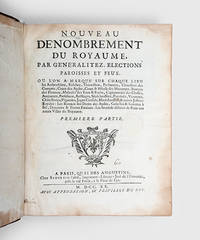
1709169590Paris: Chez Claude Saugrain 1709. Population in the ancien régime First edition of this census of France in the last years of Louis XIV. Saugrain's work provides the number of households in virtually every town and commune: the work "allows one to estimate with only a small margin of error the population of France and its distribution" Pounds p. 93 Claude-Marin Saugrain 1679-1750 seems to have been primarily employed in the Paris book trade. Although his census was not financed by the government Saugrain drew heavily on the individual population reports of Louis's Intendants forerunners of the modern French préfets. 2 vols duodecimo 164 x 95 mm pp. xx 408; xiv 342. Woodcut ornament to title pages head- and tailpieces. Contemporary sprinkled calf spines ruled and decorated with fleur-de-lys device in gilt and with raised bands and red morocco labels marbled endpapers edges red green silk bookmarkers. Extensive contemporary ink annotations to both vols. 19th-century engraved bookplate of "Marande" to front pastedown of both vols. Light rubbing and scoring several ink splashes to covers joints and extremities neatly restored minor browning and foxing to endpapers and contents: a very good copy. Norman John Greville Pounds An Historical Geography of Europe 1500-1840 1979. hardcover
170888653Jean-Baptiste Besongne | Rouen 1708 | 9.5 x 16.8 cm | Relié
1720171149Paris: Saugrain l'aîné 1720. Population in the ancien régime Second and revised edition of this census of France following the death of Louis XIV. Saugrain's work provides the number of households in virtually every town and commune: the work "allows one to estimate with only a small margin of error the population of France and its distribution" Pounds p. 93 Claude-Marin Saugrain 1679-1750 seems to have been primarily employed in the Paris book trade. Although his census was not financed by the government Saugrain drew heavily on the individual population reports of Louis's Intendants forerunners of the modern French préfets. The first edition was published in 1709. 2 vols in 1 quarto 241 x 192 mm. Woodcut vignette to title pages woodcut initials head- and tailpieces engraved armorial headpiece to p. 3. Recently rebound using old mottled calf spine panelled and with tooled ornamentation in gilt raised bands and brown morocco label covers with triple-rule panel in blind edges red. Later annotations in pencil and orange crayon to contents. Contemporary ink shelf mark to front free endpaper and title page. Neat paper repair to title page replacing library stamp not touching text. Light rubbing minor browning and foxing to endpapers and contents small hole to head of front free endpaper: a very good copy. Goldsmiths' 5629. Norman John Greville Pounds An Historical Geography of Europe 1500-1840 1979. hardcover
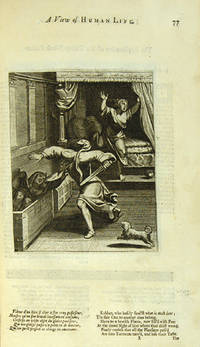
1721BTETM0002582London: E. Bell J. Darby A. Bettesworth F. Fayram J. Pemberton J. Hooke C. Rivington F. Clay J. Batley and E. Symon 1721. 1st Edition. Hardcover. Good/No Jacket. folio fo 12 נ19 in 305 נ483 mm . Pierre Daret. Please email for Photographs or further information. Good - First English edition 2 parts in 1 translated by T. M. Gibbs with engraved frontispiece additional engraved title title vignette 103 copper engravings engraved initials and headpieces. Contemporary calf rubbed and edge-worn with bumping to corners and extremities; hinges cracked but the volume remains a substantial visually impressive and honest folio copy. Hole to front free endpaper; scattered faint spotting chiefly marginal; general age-toning and signs of handling as expected in a large illustrated book of this date. A characterful and desirable copy of a scarce English emblem book retaining the qualities collectors look for in an early illustrated folio. Please see photos as part of the condition report. Binding: Hardcover folio Collation: 4 6 viixi 1 211 1 p. 2 parts in 1. With engraved frontispiece additional engraved title title vignette 103 copper-engraved plates engraved initials and headpieces. Complete. Please see Photos as part of condition report. References: ESTC N008945 WorldCat/OCLC 642232769 HathiTrust 012315037 1721 1st English Edition THE DOCTRINE OF MORALITY or A View of Human Life. According to the Stoick Philosophy. Exemplify'd in One Hundred and Three Copper Plates Done by the Celebrated Monsieur Daret Engraver to the Late French King. With an Explanation of each Plate : Written Originally in French by Monsieur De Gromberville for the Use of the Said Prince. Translated into English by T.M. Gibbs late of Hart-Hall Oxon. A scarce and imposing first English edition of Gombervilles celebrated moral emblem book translated by T. M. Gibbs and illustrated with 103 copper-engraved plates by Pierre Daret. Issued as a substantial folio in 2 parts bound in 1 this is one of the most visually striking early eighteenth-century English moral / philosophical books combining emblematic imagery Stoic reflection and explanatory text in a grand illustrated format. With engraved frontispiece additional engraved title title vignette engraved initials headpieces and numerous full-page plates. A highly decorative and intellectually ambitious book equally appealing for its emblematic programme engraved work and sheer shelf presence. By Marin Le Roy de Gomberville Author Bio: Marin le Roy sieur de Gomberville 16001674 was a French novelist moralist and man of letters. His La Doctrine des Moeurs first appeared in seventeenth-century France and became one of the best-known emblematic moral works of its kind admired for the union of philosophical instruction and richly engraved illustration. Illustrated By: Pierre Daret Illustrator Bio: Pierre Daret was a French engraver and portrait painter whose work is closely associated with important seventeenth-century illustrated books. His plates for Gombervilles moral emblem text are central to the books enduring appeal. Synopsis: Work / historical context: Gombervilles Doctrine of Morality belongs to the great tradition of the emblem book in which moral and philosophical teaching is conveyed through images as much as through text. Drawing on Stoic thought and courtly didactic literature it presents human conduct vice virtue prudence ambition and self-command through a long sequence of engraved moral exempla. The 1721 English edition is an especially handsome survival of that tradition: a large folio translation by T. M. Gibbs illustrated after Pierre Daret and designed to impress as much visually as intellectually. Part moral manual part emblem book part engraved anthology of conduct and reflection it remains one of the most attractive English-language embodiments of early modern ethical literature. Format: Hardcover folio fo 12 × 19 in 305 × 483 mm Note: Binding/size selection follows standard bibliographic conventions and is approximate; exact measurements may vary. Language: English Published By: E. Bell J. Darby A. Bettesworth F. Fayram J. Pemberton J. Hooke C. Rivington F. Clay J. Batley and E. Symon London Condition Report: Dust Jacket: No Jacket Dust Jacket Condition: No Jacket Good - First English edition 2 parts in 1 translated by T. M. Gibbs with engraved frontispiece additional engraved title title vignette 103 copper engravings engraved initials and headpieces. Contemporary calf rubbed and edge-worn with bumping to corners and extremities; hinges cracked but the volume remains a substantial visually impressive and honest folio copy. Hole to front free endpaper; scattered faint spotting chiefly marginal; general age-toning and signs of handling as expected in a large illustrated book of this date. A characterful and desirable copy of a scarce English emblem book retaining the qualities collectors look for in an early illustrated folio. Please see photos as part of the condition report. Binding: Hardcover folio Collation: 4 6 viixi 1 211 1 p. 2 parts in 1. With engraved frontispiece additional engraved title title vignette 103 copper-engraved plates engraved initials and headpieces. Complete. Please see Photos as part of condition report. References: ESTC N008945 WorldCat/OCLC 642232769 HathiTrust 012315037 SKU: BTETM0002582 Shipping Info: Approximate Package Dimensions H: 12.5 L: 30 W: 25 Units: cm W: 3Kg Tracked Shipping Insurance Coverage as per Customer Request E. Bell, J. Darby, A. Bettesworth, F. Fayram, J. Pemberton, J. Hooke, C. Rivington, F. Clay, J. Batley, and E. Symon hardcover
177710110London: F. Vivares in great Newport Street 1777. Colour-printed mixed method engraving. Printed on laid paper. In excellent condition with the exception of being trimmed within the platemark. Small tear in lower left corner and another small tear on bottom margin. Image size: 10 9/16 x 8 1/4 inches. A lovely impression of this famous print by Louis-Marin Bonnet one of the most celebrated masters of French colour-printing.<br/> <br/>The son of a Parisian stocking manufacturer Louis-Marin Bonnet 1736-1793 trained with the engravers Louis-Claude LeGrand and Jean-Charles François the latter the inventor of the chalk-manner technique of printmaking. Throughout his career Bonnet developed Francois's printing technique producing some of the most beautiful prints of the period. Bonnet's chalk-manner prints became immensely popular with collectors seeking images that imitated the subtle effects of drawing but he also experimented with various forms of colour printing as seen in this charming print of a young lady playing the guitar. During the late 1770s and 1780s Bonnet's success as a color printmaker was unrivaled and hence he counted among his patrons the wealthiest Parisian collectors of the time. This spectacular print exemplifies the single plate colour printing technique developed in England but quickly adopted by French engravers. The effect is achieved by inking a single plate with several different colours by using a rag stump this process is known as a la poupée. These English colour prints became very popular in Paris and threatened to affect the market for French prints. In an effort to capitalize on this vogue for English prints a few clever French engravers printed their own colour prints with London addresses. This charming image is just such a print; Bonnet published it with F. Vivares's address in London although it was probably published in Paris. He also uses a different variation on his name and lists himself as L. Marin instead of Louis-Marin Bonnet. This is not only an exquisite image from one of the most renowned French engravers but a fascinating glimpse at the practices of the print market in France.<br/> <br/>Le Blanc Manuel de L'Amateur D'Estampes No. 386. F. Vivares in great Newport Street unknown books
177710110London: F. Vivares in great Newport Street 1777. Colour-printed mixed method engraving. Printed on laid paper. In excellent condition with the exception of being trimmed within the platemark. Small tear in lower left corner and another small tear on bottom margin. Image size: 10 9/16 x 8 1/4 inches. A lovely impression of this famous print by Louis-Marin Bonnet one of the most celebrated masters of French colour-printing.<br/> <br/> The son of a Parisian stocking manufacturer Louis-Marin Bonnet 1736-1793 trained with the engravers Louis-Claude LeGrand and Jean-Charles François the latter the inventor of the chalk-manner technique of printmaking. Throughout his career Bonnet developed Francois's printing technique producing some of the most beautiful prints of the period. Bonnet's chalk-manner prints became immensely popular with collectors seeking images that imitated the subtle effects of drawing but he also experimented with various forms of colour printing as seen in this charming print of a young lady playing the guitar. During the late 1770s and 1780s Bonnet's success as a color printmaker was unrivaled and hence he counted among his patrons the wealthiest Parisian collectors of the time. This spectacular print exemplifies the single plate colour printing technique developed in England but quickly adopted by French engravers. The effect is achieved by inking a single plate with several different colours by using a rag stump this process is known as a la poupée. These English colour prints became very popular in Paris and threatened to affect the market for French prints. In an effort to capitalize on this vogue for English prints a few clever French engravers printed their own colour prints with London addresses. This charming image is just such a print; Bonnet published it with F. Vivares's address in London although it was probably published in Paris. He also uses a different variation on his name and lists himself as L. Marin instead of Louis-Marin Bonnet. This is not only an exquisite image from one of the most renowned French engravers but a fascinating glimpse at the practices of the print market in France.<br/> <br/> Le Blanc Manuel de L'Amateur D'Estampes No. 386. F. Vivares in great Newport Street unknown
1750CAT000506Paris: Prault 1750. Second Edition. Hardcover Full Leather. Very Good Condition. 3 volumes in contemporary sponged calf hinges cracked wear at edges heavier to volume one. A made up set volume one is the 1750 edition two and three the 1758 the 1758 was a reprint of the 1750. xlviii 490pp; 2 490pp; 2 534 3pp. Volumes 2 and 3 from the cookery collection of John Hodgkin FLS with his bookplate.<br/><br/>First published in 1742 though it confusingly bears the same name as Marin's 1739 work on seasonal menus Les Dons de Comus is one of the major 18th century works of French cookery. Size: 8vo. 3-volume set complete. Previous owner's book-plate on endpaper. Quantity Available: 1. Shipped Weight: Under 1 kilo. Category: Cooking Wine & Dining; Inventory No: CAT000506. Prault hardcover books
1740CAT000505Paris: Prault 1740. Second Edition. Hardcover Full Leather. Very Good Condition. Full contemporary sponged calf corners worn spine worn hinges cracked but securely held by cords. Minor scattered foxing. The 1739 edition had a frontispiece there is not one present here. xxxvi 302 i.e. 304pp. 262-263 repeated. Cagle 301 Bitting 307 Vicaire 284 Simon 1001 Oberle 108 all for the 1739 ed. From the cookery collection of John Hodgkin FLS with his bookplate.<br/><br/>The second printing of a list of seasonal menus and discussion of sauces originally published in 1739. In 1742 it would change into a more usual cookbook and be expanded to three volumes - in this latter form it was reprinted a number of times. The 1739 first edition is uncommon this 1740 edition considerably scarcer - it features a shortened preface and the addition of the Lettre d'un pâtissier anglois by Desalleurs and the Apologie Desmodernesou by way of response. The letter was first published a year earlier and the response in pamphlet form in 1740 - both are part of an argument over whether modern French cuisine in its reduction of foods to their essence was destroying national identity. Size: 8vo. Previous owner's book-plate on endpaper. Quantity Available: 1. Shipped Weight: Under 1 kilo. Category: Cooking Wine & Dining; Inventory No: CAT000505. Prault hardcover books
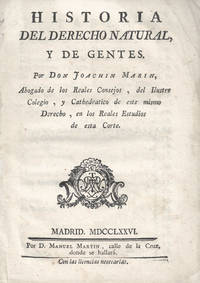
177612873Madrid: Manuel MartÃn 1776. 201x153mm. 8x6". Madrid Manuel MartÃn 1776. En 4º 201 x 153mm. 4 60 pp. la última blanca. Guardas de papel. Primera edición de este famoso opúsculo tocante al derecho natural y de gentes. El derecho natural es el que se aplica a todos los animales incluido el hombre en lo que tiene de animalidad; el derecho de gentes es el que se ejerce sobre los hombres en tanto que racionales. JoaquÃn MarÃn y Mendoza 1727-1782 fue abogado de los Reales Consejos académico de la Historia y alcalde del Crimen. La obra de JoaquÃn MarÃn interesa sobre todo como "exponente de una situación que predominaba en los cÃrculos dirigentes y en las capas cultas de la España del siglo XVIII con respecto al derecho natural racionalista" Manuel GarcÃa Pelayo. Una vez creada la nueva disciplina de Derecho Natural y de Gentes en los Reales Estudios de San Isidro de Madrid con el objeto de demostrar la unión necesaria de religión moral y polÃtica MarÃn quiso ofrecer un epÃtome de su origen y progreso de los autores y sus doctrinas y de sus sistemas y métodos principales presentando una "guÃa segura" a los que buscaban conocer los primeros elementos de esta ciencia. Con claridad y sencillez acertó a difundir esta ciencia nueva europea forjada en los siglos xvii y xviii en la lÃnea divulgativa de la época emprendida por Vattel Burlamaqui o Almici. Buen ejemplar. Manuel Martín unknown
176621550Paris, Pierre-François Didot, le Jeune, 1766 ; in-12, veau marbré, dos lisse à faux nerfs dorés, décoré et doré, pièce de titre grenat, tranches rouges (reliure de l’époque) ; [8], 392 pp.
17581601120066Paris Tilliard 1758-01-01. First Edition. Hardcover. Very Good. 2 volume set. First edition. Collated: 4 xvi 464 pp.; iv 518 pp. with three folding maps and plans. Full contemporary mottled calf bindings. Gilt stamping to spines. Solid bindings some rubbing to covers. Edges red. Marbled end pages. Very good internally. Refs: Ibrahim Hilmy II 17; Gay 2132; Brunet 28372; and Mayer 2075. Atabey 768. Stanley Lane Poole's "Saladin and the Fall of the Kingdom of Jerusalem". speaks very highly of Marin's Historie de Saladin. Paris, Tilliard hardcover
177362396Abraham Blusse En Zoon 1773. 1773 Edition. Hardback. Finely bound in modern aniline calf over marble boards. Gilt-titled spine raised bands with gilt-decoration. An exceptional copy - scans and additional bibliographic detail on request. ; 816 pages; Subjects: MARIN Pieter. Abraham Blusse En Zoon hardcover
17251802070043Paris: Guillaume DeLisle Quai de l'Horloge 1725. First Edition. Map. Very Good. Original hand colored map. Crease at center fold of map. 62 x 47.5 cm. Scale: 1300000. Engraved by Marin. <br> "The second largest Caribbean island known to the Spanish as Hispaniola or Espanola and to the French as Saint Domingue was first explored by Christopher Columbus in 1492 and became the center of Spanish rule in the 16th century. While the Spanish settlements were concentrated on the eastern two thirds of the island buccaneers occupied the western third during the 17th century. Consequently in 1697 Spain ceded the western third to France. Although the French name is applied to the entire island on this 1725 map by the noted French geographer Guillaume Delisle the Spanish presence on the eastern part of the island is acknowledged with the designation "Quartiers des Espagnols" while the French area is labeled "Quartiers du Nord " and "Quartiers du Sud." Delisle's rendition of the island is based on a 1722 map prepared by the French engineer Amedee Frezier." <br> "DeLisle is important as the first "scientific" cartographer who incorporated the most current information on exploration and topography into his maps. . Lloyd Brown states that DeLisle "undertook a complete reform of a system of geography that had been in force since the second century and by the time he was twenty five he had very nearly accomplished his purpose." - David Rumsey Historical Map Collection. <br> Refs: Tooley Mapping of America 59. Paris: Guillaume DeLisle, Quai de l'Horloge unknown
1773R300315229Abraham Blusse en Zoon. 1773. In-8. Relié demi-cuir. Etat d'usage, Couv. légèrement passée, Dos frotté, Rousseurs. 816 pages. Texte sur deux colonnes. Texte en néerlandais. Tampon ex libris en page de garde. Plats passés, tachés. Coins émoussés. Dos cuir à 5 nerfs, dos frotté.. . . . Classification Dewey : 840.05-XVIII ème siècle
1765034366PARIS FRANCE: COMPAGNIE DES LIBRAIRES. SMALL LEATHER BOUND TWO VOLUMES FRENCH TEXT. MARBLED ENDPAPERS FIRST VOLUME FRONT INNER HINGE STARTING CLEAN COPIES. . VG. Hardcover. First Edition. 1765. COMPAGNIE DES LIBRAIRES hardcover
178223562Avignon/ Paris/ Marseille, Leclerc - Jean Mossy, 1782 in-12 demi basane havane, dos lisse, double filet doré en place des nerfs, fleurons dorés, pièce de titre orange, petits coins vélin, plats de papier saumon moucheté. VIII-194 pp. (Reliure début XIXe).