[DESSINS DE MODE/FASHION DRAWINGS] HENRY (Renée).Livre Rare Book

1 541 résultats
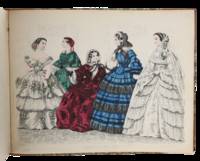
18906155SLND [Paris, circa 1890]. 1890 1 vol in-folio ( 315 x 240 mm ) de 91 ff de 1 à 4 dessins originaux par page exécutés au crayon, à l'aquarelle et à la gouaches, signés "Renée Henry" et montés sur onglets. Demi-basane bordeaux, dos lisse orné de filets titré à l'or "Gravures de mode", plats recouverts de papier marbré. (Usures et défauts d'usage).
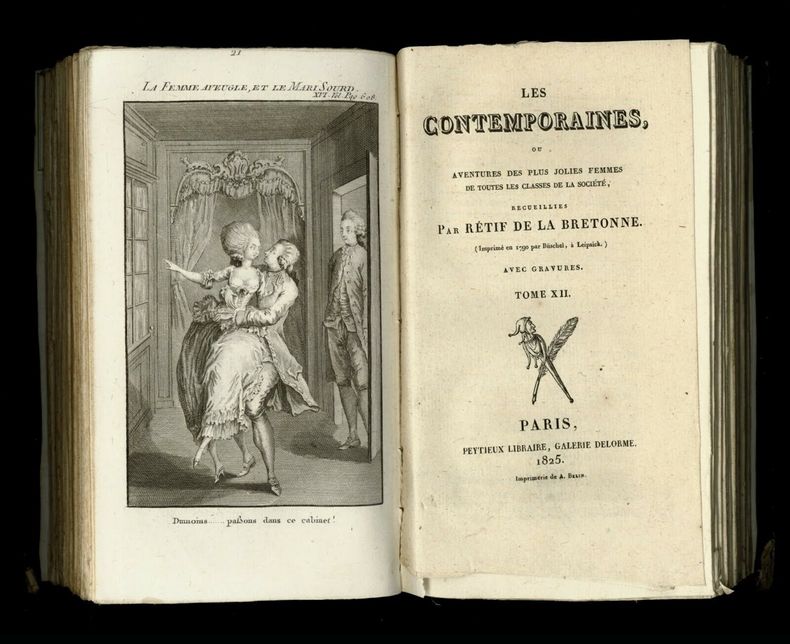
1825AMO-3553Paris, Peytieux libraire, Galerie Delorme, 1825 [i.e. 1781-1792] 38 tomes reliés en 19 volumes in-12. Reliure de l'époque plein cartonnage papier bleu nuit à la bradel. Pièce de titre de cuir rouge : "LES CONTEMPORAINES". Filets horizontaux dorés aux dos. Numéro de volumes au dos (double numéro " 23-24" etc. Exemplaire relié sur brochure, non rogné, tranches ébarbées. De nombreux cahiers restés encore non coupés. Le tirage des gravures présentes dans les 38 tomes sont la plupart d'un tirage assez médiocre assez pâle. Ex libris malheureusement gratté présent dans tous les volumes. Description de l'exemplaire : LES // CONTEMPORAINES, // OU // AVENTURES DES PLUS JOLIES FEMMES // DE TOUTES LES CLASSES DE LA SOCIÉTÉ. // recueillies // Par RÉTIF DE LA BRETONNE. // (Imprimé en 1790 par Büschel, à Leipsick.) // AVEC GRAVURES. // TOME I. (à XXXVIII) // PARIS, // PEYTIEUX LIBRAIRE, GALERIE DELORME. // 1825. // Imprimerie de A. Belin. Description sur l'exemplaire (*) ------------------------------- VOLUME 1. TOME 1-2. 1 feuillet de titre (Peytieux, 1825) tome I. I. Vol. paginé (3) à 290. + 1 feuillet de titre (Peytieux, 1825) tome II. II. Vol. paginé (291) à 552. VOLUME 2. TOME 3-4. 1 feuillet de titre (Peytieux, 1825) tome III. III. Vol. paginé (3) à 292. + 1 feuillet de titre (Peytieux, 1825) tome IV. IV. Vol. paginé (295) à 600. VOLUME 3. TOME 5-6. 1 feuillet de titre (Peytieux, 1825) tome V. V. Vol. paginé (3) à 343. + 1 feuillet de titre (Peytieux, 1825) tome VI. VI. Vol. paginé (347) à 672. VOLUME 4. TOME 7-8. 1 feuillet de titre (Peytieux, 1825) tome VII. VII. Vol. paginé (3) à 264. + 1 feuillet de titre (Peytieux, 1825) tome VIII. VIII. Vol. paginé (291) à 655-(5). [Il manque à cette remise en vente les parties IX, X, XI et XII] (**). Le libraire Peytieux n'a pu en disposer (volumes alors épuisés). VOLUME 5. TOME 9-10. 1 feuillet de titre (Peytieux, 1825) tome IX. XIII. Vol. paginé (3) à 370-(14). + 1 feuillet de titre (Peytieux, 1825) tome X. XIV. Vol. paginé (387) à 672. VOLUME 6. TOME 11-12. 1 feuillet de titre (Peytieux, 1825) tome XI. XV. Vol. paginé (3) à 364-(12). + 1 feuillet de titre (Peytieux, 1825) tome XII. XVI. Vol. paginé (371) à 734-(22). VOLUME 7. TOME 13-14. 1 feuillet de titre (Peytieux, 1825) tome XIII. XVII. Vol. paginé (3) à 318-(42). + 1 feuillet de titre (Peytieux, 1825) tome XIV. I & XVIII. Vol. paginé (3) à 326-(54). VOLUME 8. TOME 15-16. 1 feuillet de titre (Peytieux, 1825) tome XV. II. & XIX. Vol. paginé (9) à 208-(112). + 1 feuillet de titre (Peytieux, 1825) tome XVI. III. & XX. Vol. paginé (291) à 579-(21). VOLUME 9. TOME 17-18. 1 feuillet de titre (Peytieux, 1825) tome XVII. IV. & XXI. Vol. paginé (3) à 346-(14). + 1 feuillet de titre (Peytieux, 1825) tome XVIII. V. & XXII. Vol. paginé (355) à 666-(26). VOLUME 10. TOME 19-20. 1 feuillet de titre (Peytieux, 1825) tome XIX. VI. & XXIII. Vol. paginé (3) à 264-(24) puis paginé 265 à 280. + 1 feuillet de titre (Peytieux, 1825) tome XX. VII. & XXIV. Vol. paginé (283) à 541-(11). VOLUME 11. TOME 21-22. 1 feuillet de titre (Peytieux, 1825) tome XXI. VIII. & XXV. Vol. paginé (3) à 278-(10) + 1 feuillet de titre (Peytieux, 1825) tome XXII. IX. & XXVI. Vol. paginé (291) à 648. VOLUME 12. TOME 23-24. 1 feuillet de titre (Peytieux, 1825) tome XXIII. X. & XXVII. Vol. paginé (3) à 280-(8) puis paginé de 281 à 352 + 1 feuillet de titre (Peytieux, 1825) tome XXIV. XI. & XXVIII. Vol. paginé (355) à 661-(3). VOLUME 13. TOME 25-26. 1 feuillet de titre (Peytieux, 1825) tome XXV. XII. & XXIX. Vol. paginé (3) à 367-(3) + 1 feuillet de titre (Peytieux, 1825) tome XXVI. XIII. & XXX. Vol. paginé (363) à 604-(66). VOLUME 14. TOME 27-28. 1 feuillet de titre (Peytieux, 1825) tome XXVII. I. & XXXI. Vol. paginé (3) à 266 et paginé ([3]) à [16]-(8) + 1 feuillet de titre (Peytieux, 1825) tome XXVIII. II. & XXXII. Vol. paginé (291) à 600. VOLUME 15. TOME 29-30. 1 feuillet de titre (Peytieux, 1825) tome XXIX. III. & XXXIII. Vol. paginé (3) à 292-(28) + 1 feuillet de titre (Peytieux, 1825) tome XXX. IV. & XXXIV. Vol. paginé (323) à 598-(2). VOLUME 16. TOME 31-32. 1 feuillet de titre (Peytieux, 1825) tome XXXI. V. & XXXV. Vol. paginé (3) à 334-(2) + 1 feuillet de titre (Peytieux, 1825) tome XXXII. VI. & XXXVI. Vol. paginé (309) à 548-(14). VOLUME 17. TOME 33-34. 1 feuillet de titre (Peytieux, 1825) tome XXXIII. VII. & XXXVII. Vol. paginé (3) à 310-(2) + 1 feuillet de titre (Peytieux, 1825) tome XXXIV. VIII. & XXXVIII. Vol. paginé (315) à 600. VOLUME 18. TOME 35-36. 1 feuillet de titre (Peytieux, 1825) tome XXXV. IX. & XXXIX. Vol. paginé (3) à 368 + 1 feuillet de titre (Peytieux, 1825) tome XXXVI. X. & XL. Vol. paginé (371) à 702-(2). VOLUME 19. TOME 37-38. 1 feuillet de titre (Peytieux, 1825) tome XXXVII. XI. & XLI. Vol. paginé (3) à 282-(22) + 1 feuillet de titre (Peytieux, 1825) tome XXXVIII. XII. & XLII. Vol. paginé (307) à 568-(22). ---------------------------------- (**) les parties IX, X, XI et XII qui manquent ici contiennent les nouvelles 53 à 80. ---------------------------------- Répartition des gravures présentes dans l'exemplaire. VOLUME 1 : Il a perdu la mémoire + Les Associés VOLUME 2 : La mort d'amour + L'ancienne inclination VOLUME 3 : Le Mari-Dieu + La Belle-Laide VOLUME 4 : Le Mari-père + La Vertu inutile VOLUME 5 : Le Mariage enfantin + La Fille volée (sic) VOLUME 6 : La fille à la mode + La Femme aveugle et le mari sourd VOLUME 7 : Hélène + La jolie Vielleuse VOLUME 8 : La Mercière + Les Rôtisseuses VOLUME 9 : L'Agremeniste + La Confiseuse VOLUME 10 : Les onze marchandes + La Tonnelière VOLUME 11 : Les Épouses par quartier + Femmes qui rendent heureux (leur mari) VOLUME 12 : La Petite Coureuse + La Femme de chambre VOLUME 13 : Les Journalières + La Vigneronne VOLUME 14 : La Marquise et la Comtesse + Les Femmes de garnison VOLUME 15 : La Mère grosse pour sa fille + Les Soeurs-Maîtresses VOLUME 16 : L'Intendante + La Procureuse VOLUME 17 : La Bourgeoise + La Garde Malade VOLUME 18 : figure avant la lettre (acteurs) + figure avant la lettre (deux femmes) VOLUME 19 : figure avant la lettre (chanteuses) + figure avant la lettre (danseurs) Soit 38 gravures en tout pour les 38 volumes (1 gravure en frontispice de chaque tome).
18352200376<p><i>Including a double-sided hand coloured lithograph mannequin 14.5cm high; together with 5 outdoor slipover costumes and matching hats and one indoor costume; a stand 9.5 x 13.5 cm in the form of a carpet with a hand coloured lithograph design on a red ground; </i><i>contained in the original decorated box 14 x 10 x 2.5 cm the lid with a scene of a dressmakers salon with five ladies and the milliners showing her wares; enclosed within a decorative shaped and gilt embossed paper border; The underside of the box with the label of 'Delaville Sucr. de Terzuolo-Despilly. Papetier du Roi. Rue de la Chaussée d'Antin No. 15.'</i></p><p>An early dressing game based on contemporary costumes and a visit to the milliners shop.</p><p>The quality of this paper doll indicates it was made for the most expensive end of the market confirmed by the label of Delaville who from 1822 had been 'Papetier du Roi'. Delanville had been active from 1804 and got his royal warrant in 1822 he traded from the address Rue de la Chaussée d'Antin during the late 1820s through to at least 1833 but no longer appears in the Parisian <i>l'Almanach du Commerce</i> of 1837.</p><p>The lid shows the scene of a well appointed milliners shop with six women conversing or examining merchandise the two central figures show a seated lady being shown a pink dress by her milliner. The mannequin is of a young lady in her under garments including laced bodice over a light cotton petticoat and wearing a neckless of emeralds rubies and gold.</p><p>All clothing items show the front and back of the young woman including: 1 a silk dress with large puffed out sleeves and embroidered with flowers and shaped tongue ornaments; 2 a green gingham check dress and embroidered shirt with puffed sleeves and a ruff neck holding a parasol; 3 an ochre dress with green open-work lace and fringe banded collar waist and dress band; 4 a white evening dress with grape and vine decorated collar and matching dress with flowers wheat sheaves and roses a green belt with a key on a ribbon and holding a fan in her gloved hand; 5 A light overall decorated dress with leafy fronds and shell decoration wearing tow bracelets and clasping a book; 6 a turquoise evening dress with a white boa around the shoulders and long white gloves. The five interchangeable hats decorated with feathers ribbons and flowers.</p> Delanville
188264892Paris, A. Quantin, 1882. 4°. Mit chromolithogr. farb. Titel u. Schlußvignette in Schwarz u. Gold (hier in jeweils drei Druckzuständen) sowie zahlr. tlw. gest. Illustrationen u. Buchschmuck in versch. Farben von Paul Avril. 4 Bll., 143 (1) S., Olivgrüner genarbter Ldr.-Bd. d. Zt. m. goldgepr. Rückentitel u. dem eingeb. illustr. Orig.-Seidenumschlag (Vorder- u. Rückendeckel sowie Rücken), marmor. Vorsätze.
188014997ABca. 1880. 33 : 22 cm. 8 coloured paintings on stiff paper, mounted under passepartout.
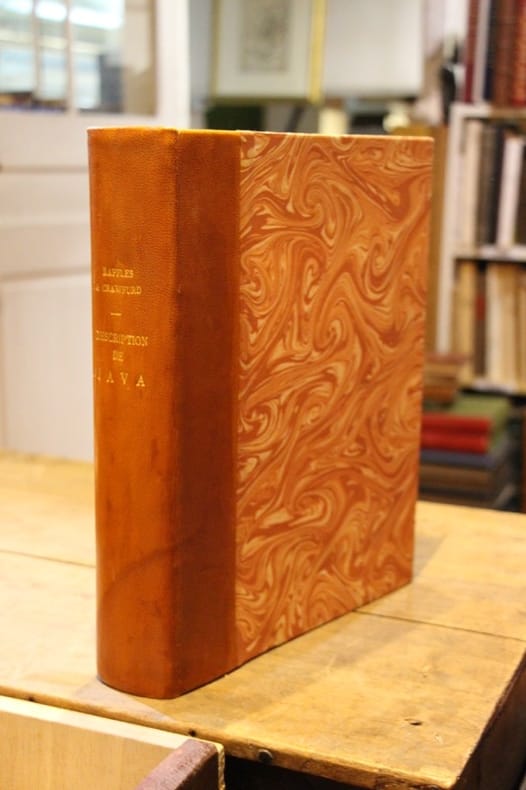
182412525Bruxelles, H. Tarlier & Jobard 1824 In-4, demi-basane moderne, couvertures restaurées conservées, XIX- 364 pp. 48 planches hors-texte : deux cartes dépliantes rehaussées en couleurs carte de l'Archipel Indien 35X43 et carte minéralogique de l'île de Java 13X40, 22 planches lithographiées dont 10 en couleurs vues, costumes, et 24 planches gravées sur cuivre. Rares rousseurs éparses, petit travail de ver in-fine sans atteinte au texte. Brunissure d’humidité au dos en pied, infime atteinte en garde et première couverture.
185089124S.n. | s.l. s. d. (ca 1850) | 30.5 x 40.5 cm | Relié
183089263Veuve Devilly | Metz s. d. (ca 1830) | 13.5 x 22 cm | Broché
1848229448Paris 1848. First editions. Engraved fashion plates 677 of which are hand-colored. Many entitled "Modes de Paris". 16 vols. 4to. Bound in marbled boards with paper spine labels. First editions. Engraved fashion plates 677 of which are hand-colored. Many entitled "Modes de Paris". 16 vols. 4to. Periodical issued bi-weekly then weekly. Volumes for 1832-1836 have 24 issues 1837 has 26 and 1838-1848 have 52 issues each. unknown books
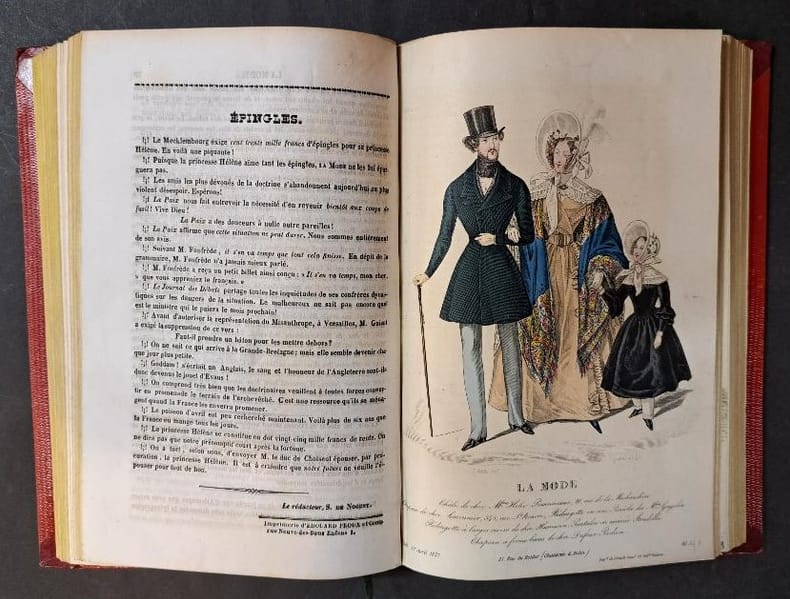
184151794La Mode 1841 Vingt tomes en 10 volumes. In-8 23,5 x 15 cm. Reliures demi-basane cerise à petits coins, dos à nerfs, larges fleurons à froid, filets et dentelles dorés. Tomes trimestriels, ch. entre 300 & 400 pp. Texte sur 2 colonnes. 254 planches en couleurs légendées descriptifs et adresse, certaines repliées. Rares rousseurs. Infimes usures et frottements. Bel exemplaire dans une reliure très décorative.
183028BBMeissen, Goedsche, (1830-1839). 25,5 : 17,5 cm. Mit 4 kolorierten lithographierten Titeln und 244 kolorierten lithographierten Tafeln. Leinenbände der Zeit mit Rückenvergoldung. 3Teile in 4 Bänden.
18176051Von den in dem Hochfürstlichen Schlosse zu Hechingen befindlichen Originalien copirt. Mit gest. Titel mit kolor. Vignette von Joh. Mittensteiner, gest. Widmungsblatt u. 25 kolor. gest. Tafeln. (Gmünd, Mai 1817). 4to. (24,4 x 19,3 cm). 3 Bl. Widmung u. Vorrede, 25 Textblätter. Marmorierter Pappband d. Zt. mit goldgeprägtem roten Rückenschild (Orig.-Umschlag mit Titel bzw. Illustration umgeben von kolor. Bordüre eingebunden).
18256025Volkstrachten. (Titel auf Vorderdeckel). 60 nummerierte lithogr. Tafeln. Wien, Lithogr. und zu haben bey Jos. Trentsensky, [um 1822/1825]. Gr.-4to. (31,8 x 21,7 cm). Späterer Halbleinwandband mit montiertem Titelschild.
18043442ABLondon, Printed for W. Miller by W. Bulmer, 1804. E.A. 4° XXVIII, 50 altkolorierte Bildtafeln mit Begleittexten. Dekorativer Lederbd. mit Vergoldung u. dreiseit. Goldschnitt, sehr guter Zust.
188842BBParis, Didot, 1888. With ca. 420 plates partly iin color chromolithogrqaph, and partly in camaieu. Contemporary half calf. Tafelbände 2-5
1811KOST0189VitrWien, Joseph Eder 1800 (Teil 1) und Joseph Schalbacher 1804, 1807, 1811. 8°. (7 Bde.). Mit 4 [v. 6] gest. Titelbl. m. Vignette u. zus. 247 [v. 423] handcolorierten Kupferstich-Tafeln (Gedr. Tit. (Tl.1), 3 Bll., 220 S.; gest. Titel (Tl.1), 35 num. Tafeln (1-35), gest. Tit. (Tl.2), 35 num. Taf. (36-70); Gedr. Tit. (Tl.3), Ss.(V)-XVI, 507(1); Gest. Tit. (Tl.3), 130 num. Taf. (71-127; 92 m. 4 Tafeln); X S. (einschl. gedr. Tit. zu Tl.4), 1 Bl., 292 S.; Gest. Tit. (zu Tl.4), 47 num. Taf. (1-47); IV [recte VI] S. (einschl. gedr. Tit. zu Tl. 5), 184 S.). Einzelne Nebentitel fehlen. Schwarze Halblederbde. der Zeit m. Titel, Bandnummer u. dez. Verz. in Goldpräg., Einbände etw. berieben, Ecken bestoßen, tlw. gebräunt, vereinzelt fingerfleckig. Lipperheide Ac17,18; Brunet V,72; Colas 2782. Umfangreiche Folge aus der großartigen Kostümkunde. Das Werk erschien im Zeitraum von über 40 Jahren, und taucht fast immer nur in einzelnen Abteilungen auf. Insgesamt erschienen zwischen 1796 und 1837 zwei Abteilungen in zehn Teilen mit je einem Text- und Tafelteil in Oktav und Qu.-Folio. Unsere Sammlung ohne die erste Abteilung (Völker des Alterthums), die 1837 erschienenen Anmerkungen und Ergänzungen, ohne Tl.2 der II. Abt., den Tafelband zu Tl. 4 sowie ohne die Tafelbände im Quer-Quartformat (zusammen 84 Tafeln). - Die II. Abt. enth. die Kostüme des Mittelalters, Tl. 1 die der Gothen, Sueven, Vandalen? der Hunnen, Angelsachsen und Dänen; Tl. 2 die der Franken vom fünften Jhdt. bis in das zwölfte und die der Normänner; Tl. 3 die Geschichte des Ritterwesens im Mittelalter; Tl.4 die der geisltichen Orden u. Tl. 5 - die Trachten der Franzosen, Italiener, Niederländer, Schweizer, Burgunder und Deutschen. - Die Tafeln in leuchtendem Kolorit der Zeit.
1900415140Paris, (ca. 1900). Fol. Tafeln lose in Mappen m. Schließbändern u. goldgepr. Deckeltitel. Mappen teilw. beschäd. (1 m. losen Deckeln). Einige Taf. leicht lichtrandig. Lediglich 1 Mappe m. dazugehör. Tafelverzeichnis. Ohne Texte.
187454872Boston: C.F. Hovey & Co. 1874. Folio. 13.5 x 11 in. 36 pp. 1 59 1 leaves. first 36 pp. incorporating title Memorandum pages several ALS letters and invoices on letterhead 8 pp. on graph paper w/ samples incorporated into the text 2 additional leaves of tissue thin manuscript copies from blotter 925 original fabric samples pinned-in glued-in and laid in sized from .5 x .5 in. up to 6 x 13 in. including a myriad of colours tartans plaids flannels silk blends cottons poplin cottons woolens etc. Original plum-coloured factory sample book purchased by Hovey from stationer P.L. Morin Paris who specialized in producing blank scrapbooks for factory sample cards printing & stationery registers w/ label mounted on front pastedown worn rubbing spine perished hinges loosed somewhat shaken still a remarkable unsophisticated exemplar preserved in folding case. This exceptional Victorian fabric sample order book assembled by a buyer for C.F Hovey & Co.’s fall fashion season furnishes an invaluable time capsule of colours textures and preferences in the 1870s. This era in women’s fashion driven by Parisian and other European design houses demanded extraordinary amounts of fabrics with an emphasis on the back of the skirt long trains and fabric draped up into bustles with an abundance of flounces and ruching. More significantly there was a tremendous growth in patterned poplin fabrics bright cotton & silk fabric blends as well as brilliant jewel colours. This order book with hundreds of different samples also offers a fantastic peek into the Victorian obsession with tartans and plaids driven by the mystique and example of Queen Victoria the ever-growing popularity with the historical romances of Sir Walter Scott celebrating the Highlanders and the poetry of Robert Burns. Tartan and plaid patterns were used in gowns dresses shawls veils hats purses and many fashion houses would often choose a particular clan pattern to celebrate and promote in their sales literature. Men’s suits coats and jackets were buttoned high on the chest the woolens became lighter weight and more durable as well of better quality and fashion designers for Hovey & Co. also incorporated rough finish woolens twills and tweeds into their clothing offered for sale. Many of the fabrics were also sold in Hovey & Co. fabric department in assorted lengths as well as ends for uses by Victorian women in home craft projects. Johnson focused on buying in the major wholesale textile dealers and markets of Europe during the 1870s including Stavert Tigomala & Co. one of the largest textile commission houses in Bradford UK; Firth Booth & Co. who specialized in bright cotton poplin plaids tartans wool blends and moire; Chamberlin Donner & Co. of Manchester one of the largest wholesale merchant houses shippers & traders in the British Empire; A. Van Bergen & Co. in Paris France whose beautifully patterned cotton and silk blends and woolens were enhanced by the award-winning dyes of Blanche at Puteaux; Les Fils de Th. Le Grand with wool blends twills and rough finish woolens. The sizes of the orders were remarkable and show the strength of Hovey’s customer base with one pair of invoices showing orders from Firth Booth & Co. totaling £ 7785 or over £ 855000 in present day value. However as evidenced by letter from Charles Kretschmann in Berlin who notes that Johnson in his June 24 1874 visit was “not pleased with the Berlin style of garments for this season and ordered only a very small lotâ€C.F. Hovey & Co. was founded by Charles Fox Hovey in 1833 as a dry goods merchant and with in a few years became a large department store located on Summer St. Through the years up to his death in 1859 he brought on many partners and was an ardent abolitionist and supporter of women’s rights establishing the Hovey Fund. After his death in 1859 Thomas Mack and Augustus De Puyster took over the running of the company and expansion through the Civil War. Johnson 1839-1927 was a Harvard grad clerk for Hovey & Co. and Civil War Veteran who rose from 1st Lieutenant in Co. H. Massachusetts 44th Infantry to Full Adjutant before mustering out right before Gettysburg. Hovey & Co. survived the massive fire of 1872 by employees soaking all the woolen blankets on the sales counters in water and placing over the roof and windows to protect the building from the flowing cinders expanded into store fronts on Chauncy and Avon Streets and was the first retailer to adopt the policy of requiring monthly payments on credit accounts. See: The History of the House of Hovey 1919; Charles Boston Looking Back at C.F. Hovey’s of Boston Shopping Days in Retro Boston May 6 2011; History of Fashion 1840-1900 Victoria and Albert Museum 2016. C.F. Hovey & Co., hardcover
183362953[Leipzig, Industrie-Comptoir / Baumgärtner etc.], (1833-1856). Small queer-folio (22 x 28,5) cm. Nice later light brown half calf from ca. 1900 with five raised bands and gilt lines to spine (Carl Petersens Enke). Slight wear to extremities. 100 engraved plates, in contemporary colouring. A bit of even browning and occasional offsetting. A few plates with more browning. Some plates with tiny holes in blank margin, from original stiching (having been vertically bound with text-leaves). Occasional light creasing. One plate with a tear (no loss). A few plates signed A. Brückner, most plates numbered and dated, and some plates having ""Extra-Kupfer"" or ""Les Modes Parisiennes Réunis"" (the last five) underneath.
183362953Leipzig Industrie-Comptoir / Baumgärtner etc. 1833-1856. Small queer-folio 22 x 285 cm. Nice later light brown half calf from ca. 1900 with five raised bands and gilt lines to spine Carl Petersens Enke. Slight wear to extremities. 100 engraved plates in contemporary colouring. A bit of even browning and occasional offsetting. A few plates with more browning. Some plates with tiny holes in blank margin from original stiching having been vertically bound with text-leaves. Occasional light creasing. One plate with a tear no loss. A few plates signed A. Brückner most plates numbered and dated and some plates having "Extra-Kupfer" or "Les Modes Parisiennes Réunis" the last five underneath. <br/><br/><em>A lovely collection of 100 beautiful contemporarily coloured engraved fashion-plates from between 1833 and 1856 importing the highest Parisian fashion of the time to Germany. This beautiful collection magnificently documents the clothing fashion and development of two decades primarily for women but also for children and men. Also in the mid-19th-century Paris was seen as the quintessence of elegance and style. The Allgemeine Moden-Zeitung kept the German-speaking public up to date with the latest fashions from Paris. The magazine “Les modes parisiennes reunites†did the same; that too was produced for the German public despite its French title. As well as outfits for appearing in high society eg. at the theatre the fashion plates collected here show clothes and notably also accessories for almost all other parts of life - paying and receiving social calls going for walks attending different events musical siorées going out with the children etc. “As part of her evening wardrobe every fashionable lady simply had to have elegant dresses in brightly coloured silks and satins with frills and lace bows and flounces tight bodices natural waistlines and exposed shoulders which gave the female figure an hour-glass silhouette. The first thing that strikes one about these ladies’ fashions are the stiff voluminous underskirts. Horsehair crinolines invented in 1850 supported wide sweeping skirts which could measure up to two or two-and-a-half metres in diameter and made the upper body look even slimmer.†Deutsches Historisches Museum. "From the 1820s onwards and particularly under the ostentatious Second Empire 1852–1870 the classicising taste of the Napoleonic era changed completely. Instead fashion now drew inspiration from the elegance of the Rococo period so much so that the period became known as the “second Rococoâ€. The waistline returned to its natural level but was awkwardly styled – at least from a health point of view: agonisingly tight corsets emphasised the so-called “wasp waistâ€. Ostensibly guided by aesthetics on closer inspection this fashion trend also had social consequences: with styles that afforded women so little freedom of movement fashion focused on the ostentatious requirements of ladies from the upper echelons of society who didn’t have to work. Practicality was not its concern. This ostentatious and – certainly from the perspective of the 21st century – inconvenient fashion style appealed not only to the fine ladies of high society but also to women from the middle classes and the petty bourgeoisie. The expansion of the textile industry and the rise of the chemical industry made the production of dyes fabrics lace and embroidery and the processing of raw materials and textiles imported from the colonies both quicker and cheaper.†DHM </em> hardcover
185781BBParis, Aubert, 1857 - 1869 -. Mit hunderten von kolorierten Modekupfern, Illustrationen und gefalteten Schnittmusterbogen. Halbleinenbaände der Zeit 3 Bände.
1877245531877 4 Estampe signée en bas à gauche dans la cuvette, titrée, Paris, Liénrard-L'Art, 1877, 23 x 32,5 cm. à vue, feuille 32,5 x 50 cm. (format de la feuille).
187586456Paris, Magasin des Demoiselles 1875 29 volumes. Petit in-4 26 x 17,5 cm. Reliures éditeur demi-chagrin rouge, dos à nerfs encadrés de filets et de petits fers dorés. Environ 400 pp. par volume. Plus de 400 planches hors-texte, près de 350 en couleurs, la plupart de présentations de mode avec 2 à 3 personnages, des notices pour la réalisation d'ouvrages brodés, figures dans le texte. Table à chaque volume. Reliures légèrement frottées, rousseurs marginales, intérieur frais. Très bon ensemble d’une relative rareté.
1877245541877 4 Estampe signée en bas à gauche dans la cuvette, titrée, Paris, Liénrard-L'Art, 1877, 23 x 32,5 cm. à vue, 30,5 x 40.8 cm. (format de la feuille).
186012827(Ohne Ort, Simbach ?), 1860. Deutsche Handschrift auf Papier. 1 Bl. (Text) und 17 Bll. mit montierten Gouachen. Gr.-4°. HLdr. der Zeit (bestoßen und beschabt).