FASHIONBiblio.com
19 007 résultats
133200France: 18th century. Puffs Powders Patches Bibles Billet-doux A beautifully crafted vanity kit bound to mimic a French Book of Hours. Its elaborately gilt-tooled red morocco casing disguises an ingenious interior of fashionable accoutrements bodkin brush looking glass and miniature essentials writing tools all key elements of the ritualized toilette. Books of Hours - personal prayer books kept by laypersons for private devotion - were frequently the remit of women whether gifted to commissioned by or made for them. The books' content encouraged quiet introspection while their lavish illumination decoration and bindings became an external expression of wealth and status. This palm-sized "Heures Royal" as the spine label reads encourages reflection of a more literal kind. Instead of religious meditations its contents include a set of six vanity tools a removable mirror an ivory writing tablet and a retractable pencil all carefully positioned within a compartmentalized silk- and ribbon-lined interior. "A wealthy woman never left home without her travelling case or nécessaire which held her perfumes and toiletries" Martin p. 18. French vanity boxes ranged from the larger nécessaire de voyage and nécessaire de toilette to "nécessaires de poche which housed one or two important bottles and brushes for emergency application deep in the many pockets of their voluminous gowns" Martin. Even tinier were "much smaller vanity cases called etuis intended to fit into a pocket. another must-have item. These were also used as containers for other items such as sewing kits and writing tools" Stewart. Most of the finest manufacturers and retailers of nécessaires were located near to the Palais Royal in Paris. Cases were available in a wide variety of costly materials and designs often incorporated precious stones. Book-form examples like this are much more unusual. Alexander Pope satirized the toilette in The Rape of the Lock 1712 mocking the frivolous combination of "Puffs Powders Patches Bibles Billet-doux" - a clash of religious and cosmetic devotion neatly encapsulated in this etui case. This item has been registered with the UK government's ivory declaration service. Book-form box sextodecimo 112 x 72 mm. Original red morocco green spine label lettered "Heures Royal" raised bands compartments covers and inner dentelles heavily gilt-tooled with floriate scrollwork and star motifs edges gilt 2 metal catches. Interior lined with green moiré silk and trimmed with yellow ribbon. Interior sections include recesses one holding 12 blank paper slips tied with pink ribbon a hinged panel supporting an ivory aide-memoire leaf on recto and a pull-out mirror on verso and compartments for 6 miniature engraved vanity tools: 2 retractable styluses likely formerly holding a pencil or tooth pick pair of scissors bodkin with ear spoon at end scraper and brush. Externally bright and well preserved small chip at upper outer corner of front cover tiny pinholes at edges near catches; internally sound lining a little frayed implements tarnished mirror desilvered and corroded. A remarkable survival. Morag Martin Selling Beauty: Cosmetics Commerce and French Society 2009; Susan Stewart Common and Uncommon Scents: A Social History of Perfume 2022. hardcover
18906155SLND [Paris, circa 1890]. 1890 1 vol in-folio ( 315 x 240 mm ) de 91 ff de 1 à 4 dessins originaux par page exécutés au crayon, à l'aquarelle et à la gouaches, signés "Renée Henry" et montés sur onglets. Demi-basane bordeaux, dos lisse orné de filets titré à l'or "Gravures de mode", plats recouverts de papier marbré. (Usures et défauts d'usage).
195562463New York NY Kansas City MO & Carmel Santa Barbara & San Francisco CA: Marian Ross Mizelle Madrigal 1955-1974. Four Vols. and original Store Sign for Carmel CA boutique. Folio. 2 - 12 x 15.25 in. & 2 - 13 x 19 in. 48; 48; 48; 48 pp unpaginated. all w/ mylar sleeves archival black paper insert backings with 151 original designs in gouache watercolour chalk and pen & ink 38 in pen & ink or pencil sized from 7 x 11 in. up to 10 x 15 in. and nearly all signed by Marian Ross three feature original fabric sample swatches affixed to them including one w/ pencil MS “Winner†and mimeographed description affixed to verso several of them are translucent pochoir stapled to backing paper many are on thick stiff studio board while others on assorted textured paper stock. In addition there are three newspaper and magazine clippings 1966 & 2013 a photostat copy of early Ross Mizelle “Mod†fashion designs and original black & white silver gelatin photo of young Marian Ross modeling a wedding dress. All are preserved in flexible vinyl portfolios printed labels on spines some minor scuffing & shelfwear to portfolios occasional very minor closed tears or edgewear to the designs a few w/ minor holes from removed staples still an exemplary archive of designs together with the original Madrigal signboard sized 16 x 27 in. from their Carmel CA store. This sensational archive of original fashion designs for Kansas City MO based department store suppliers by Marian Ross Mizelle before her move to California in the 1970’s to establish the Madrigal boutique with her husband Elliot A. Mizelle 1916-2007. These vividly reveal the Mid-20th-Century fashion trends following World War II. Many of the designs in this collection reflect the transition from the late 1950’s elegance and emphasis on Dior’s “New Look†highlighting femininity and opulent use of fabrics towards the more youthful designs emerging out of Swinging London which were a slimming down beginning to raise hemlines with short skirts bolero tops and increasing influence of Pierre Cardin Andre Courreges and Givenchy. The Mid-20th-Century saw a tremendous upsurge in marketing slimmer lines tighter fitting bodices and fashions emerging from such cultural events as Audry Hepburn in her iconic 1961 “Breakfast at Tiffany’s†film which heavily influenced a generation of young women.Young Marian Ross b. 1936 after completing her Fashion Academy certificate in 1955 free-lanced and worked in the New York fashion industry before landing with the influential and hot-selling Gay Gibson label with Gernes Garment Co. in 1961. The Gernes Garment Co. had been originally founded in 1928 by Sara Desaix Gernes 1896-1978 and her husband Alexander Gernes 1882-1947 to market her groundbreaking fashion designs targeting everyday fashion for young women juniors and teens. Her designs proved very popular as she initiated and fashioned sizing and dresses and clothing for teenagers through young college-age women and her designs proved very successful and were marketed through Chicago’s Marshall Field’s department store. By 1961 the Gernes Garment Co. moved their design and pattern making department to New York to capture young fashion designers such as Marian Ross as well as be closer to the influential couturier houses in New York & Paris. The Gay Gibson label was marketed in Mademoiselle Seventeen Glamour and Vogue magazines with Twiggy often modeling Gay Gibson dresses in the 1960’s. Marian’s designs were inventive playful and emphasizing movement as well as comfort. Many of the fashion patterns depict her models in flats ballet flats or even shoeless while dressed in elegant evening or formal dress. Also depicted are designs such as billowing harem pants modified and sleek upscale poodle skirts and Tartan patterned capes pockets dresses and accessories. Others encompass swimwear ski wear as well as the emphasized and often enforced domesticity of the late 1950’s to 1960’s with stylish plaid house-dresses in the kitchen and bar as well as frequent use of lace. The Gay Gibson label maintained a showroom at 1407 Broadway on the 39th Floor in New York ad held over 24 showings from 1961-1969 including Junior Dresses Summer Collections Spring Junior Collections as well as Holiday and Resort collections. By the early 1970’s the label was having financial difficulties and the popularity began to drop with the company run by Desaix Gernes her mother and husband Paul before folding a few years after Sara Desaix Gernes’ death. Marian and Elliot Mizelle established Madrigal Inc. name chosen because of the seductive chic of Manhattan’s Le Madrigal restaurant and grew into a legendary luxury boutique at one point operating store fronts in Santa Barbara downtown San Francisco and Carmel CA. In her 2015 interview for “Women in Business†with the Carmel Pine Cone Marian stated she “wanted to be an actress but it didn’t work out that way. I used to sketch a lot so I studied design instead. Everything I touched while was designing worked. I got a lot of jobs and was featured on a lot of Seventeen magazine covers.†This cataloguer could find not similar extant archive of original designs for the 1960’s period of the Gay Gibson label or for Marian Ross Mizelle; See: Interview with Desaix Gernes Garment Industry Oral History Collection The Kansas City Public Library Jan. 14 2005 SC229 Series 2 2024; Gay Gibson Vintage Fashion Guild 2025; Donnelly Garment Company vs. International Ladies Garment Workers Union et al Photographs Clothing Demonstration The Pendergast Years Kansas City in the Jazz Age & Great Depression 2025. Marian Ross Mizelle, Madrigal, hardcover
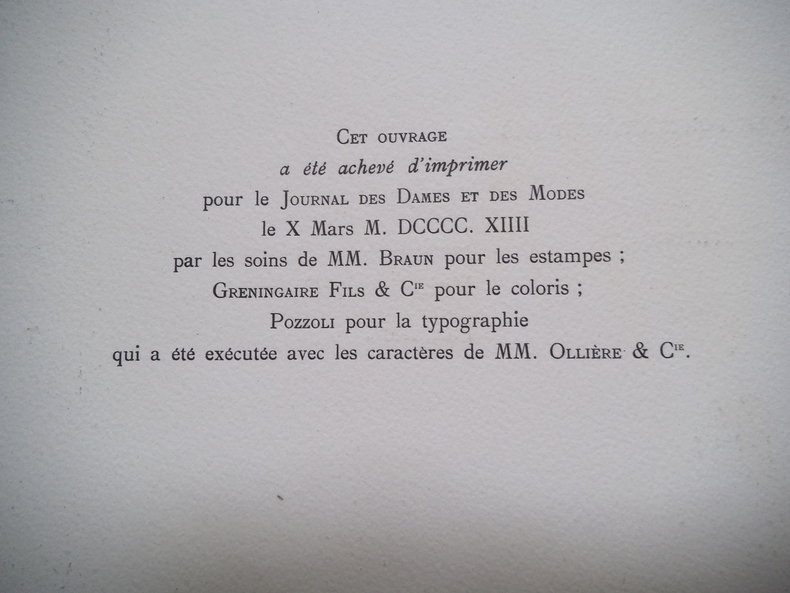
13765BRUNELLESCHI Les masques et les personnages de la Comédie Italienne. Expliqués par GERARD D’ HOUVILLE et interprêtés par BRUNELLESCHI en douze estampes coloriées. A Paris aux bureaux du journal DES DAMES ET DES MODES éditeur 1914. Edition numérotée :Un des Exemplaire sur vélin d'Arches, numéroté à la plume à la plume. Faux titre en rouge, au verso justification du tirage, titre 5 pages, dont 4 d’introduction par GERARD D’ HOUVILLE « celles dont le portait n’est pas là » et Suite de douze estampes superbement coloriées au pochoir d’après BRUNELLESCHI gravées par REIDEL. 1) Arlequin 2) le docteur Balanzone 3) Brighella 4) Coralline 5) Florindo 6) Giacometta 7) Mezzetin et colombine 8) Pantalon 9) Rosauro10) Scaramouche 11) Tartaglia 12) Trivellino. Chemise avec titre imprimé- portefeuille cartonné à rabats, l’ensemble dans un étui cartonné pièce de titre imprimée en long contrecollée. Fermoirs à rubans absents. 510x380mm fermé- 105x380 ouvert. Quelques traces d’usures à l’étui. Cet ouvrage a été chevé d’imprimer pour le Journal des Dames et des Modes le 10 mars 1914, par les soins de MM. BRAUN pour les estampes GRENIN Gaine Fils & Cie pour les coloris POZZOLI pour la typographies qui a été exécutée avec les caractères M OLDIER & Cie. Chef d’œuvre emblématique de BRUNELLESCHI.
in folio obl. (mm.263x352), 12, leg. m. pelle coeva con angoli, carta. dec. ai piatti e fregi al d. Titolo al piatto ant. Splendido album contenente 12 tavv. numerate inc. in litogr. da C. Motte e colorate a mano, siglate J.J., opera del pittore, ritrattista e miniaturista francese (1767-1855) allievo del pittore neoclassico Jacques Louis David. Raffigurano scene di gusto popolare, importanti anche per la storia del costume e della moda dell'epoca. Mancanza di un paio di cm alle cuffie e una cerniera allentata, ma bell'esempl. fresco e marginoso. Raro. [MM25-474]
Cm. 39, con 24 tavole litografiche. Leg. orig. in mezza pelle e cartonato a stampa riportante i dati tipografici in una elegante cornice calligrafica. Esemplare fresco, marginoso ed in eccellente stato di conservazione. Ex libris nobiliare inciso. Splendida e rara opera che illustra i classici costumi e le scene popolari di Napoli. Non citata dalle bibliografie da noi consultate.
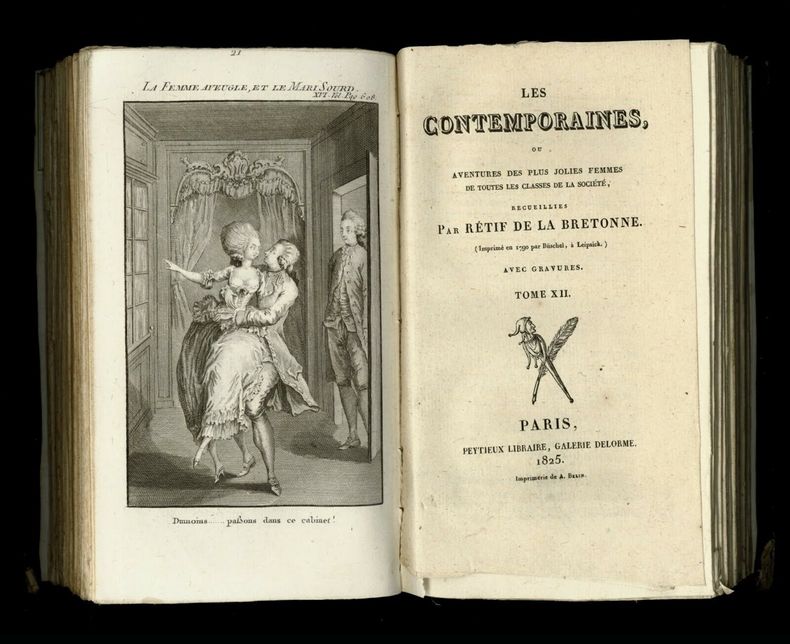
1825AMO-3553Paris, Peytieux libraire, Galerie Delorme, 1825 [i.e. 1781-1792] 38 tomes reliés en 19 volumes in-12. Reliure de l'époque plein cartonnage papier bleu nuit à la bradel. Pièce de titre de cuir rouge : "LES CONTEMPORAINES". Filets horizontaux dorés aux dos. Numéro de volumes au dos (double numéro " 23-24" etc. Exemplaire relié sur brochure, non rogné, tranches ébarbées. De nombreux cahiers restés encore non coupés. Le tirage des gravures présentes dans les 38 tomes sont la plupart d'un tirage assez médiocre assez pâle. Ex libris malheureusement gratté présent dans tous les volumes. Description de l'exemplaire : LES // CONTEMPORAINES, // OU // AVENTURES DES PLUS JOLIES FEMMES // DE TOUTES LES CLASSES DE LA SOCIÉTÉ. // recueillies // Par RÉTIF DE LA BRETONNE. // (Imprimé en 1790 par Büschel, à Leipsick.) // AVEC GRAVURES. // TOME I. (à XXXVIII) // PARIS, // PEYTIEUX LIBRAIRE, GALERIE DELORME. // 1825. // Imprimerie de A. Belin. Description sur l'exemplaire (*) ------------------------------- VOLUME 1. TOME 1-2. 1 feuillet de titre (Peytieux, 1825) tome I. I. Vol. paginé (3) à 290. + 1 feuillet de titre (Peytieux, 1825) tome II. II. Vol. paginé (291) à 552. VOLUME 2. TOME 3-4. 1 feuillet de titre (Peytieux, 1825) tome III. III. Vol. paginé (3) à 292. + 1 feuillet de titre (Peytieux, 1825) tome IV. IV. Vol. paginé (295) à 600. VOLUME 3. TOME 5-6. 1 feuillet de titre (Peytieux, 1825) tome V. V. Vol. paginé (3) à 343. + 1 feuillet de titre (Peytieux, 1825) tome VI. VI. Vol. paginé (347) à 672. VOLUME 4. TOME 7-8. 1 feuillet de titre (Peytieux, 1825) tome VII. VII. Vol. paginé (3) à 264. + 1 feuillet de titre (Peytieux, 1825) tome VIII. VIII. Vol. paginé (291) à 655-(5). [Il manque à cette remise en vente les parties IX, X, XI et XII] (**). Le libraire Peytieux n'a pu en disposer (volumes alors épuisés). VOLUME 5. TOME 9-10. 1 feuillet de titre (Peytieux, 1825) tome IX. XIII. Vol. paginé (3) à 370-(14). + 1 feuillet de titre (Peytieux, 1825) tome X. XIV. Vol. paginé (387) à 672. VOLUME 6. TOME 11-12. 1 feuillet de titre (Peytieux, 1825) tome XI. XV. Vol. paginé (3) à 364-(12). + 1 feuillet de titre (Peytieux, 1825) tome XII. XVI. Vol. paginé (371) à 734-(22). VOLUME 7. TOME 13-14. 1 feuillet de titre (Peytieux, 1825) tome XIII. XVII. Vol. paginé (3) à 318-(42). + 1 feuillet de titre (Peytieux, 1825) tome XIV. I & XVIII. Vol. paginé (3) à 326-(54). VOLUME 8. TOME 15-16. 1 feuillet de titre (Peytieux, 1825) tome XV. II. & XIX. Vol. paginé (9) à 208-(112). + 1 feuillet de titre (Peytieux, 1825) tome XVI. III. & XX. Vol. paginé (291) à 579-(21). VOLUME 9. TOME 17-18. 1 feuillet de titre (Peytieux, 1825) tome XVII. IV. & XXI. Vol. paginé (3) à 346-(14). + 1 feuillet de titre (Peytieux, 1825) tome XVIII. V. & XXII. Vol. paginé (355) à 666-(26). VOLUME 10. TOME 19-20. 1 feuillet de titre (Peytieux, 1825) tome XIX. VI. & XXIII. Vol. paginé (3) à 264-(24) puis paginé 265 à 280. + 1 feuillet de titre (Peytieux, 1825) tome XX. VII. & XXIV. Vol. paginé (283) à 541-(11). VOLUME 11. TOME 21-22. 1 feuillet de titre (Peytieux, 1825) tome XXI. VIII. & XXV. Vol. paginé (3) à 278-(10) + 1 feuillet de titre (Peytieux, 1825) tome XXII. IX. & XXVI. Vol. paginé (291) à 648. VOLUME 12. TOME 23-24. 1 feuillet de titre (Peytieux, 1825) tome XXIII. X. & XXVII. Vol. paginé (3) à 280-(8) puis paginé de 281 à 352 + 1 feuillet de titre (Peytieux, 1825) tome XXIV. XI. & XXVIII. Vol. paginé (355) à 661-(3). VOLUME 13. TOME 25-26. 1 feuillet de titre (Peytieux, 1825) tome XXV. XII. & XXIX. Vol. paginé (3) à 367-(3) + 1 feuillet de titre (Peytieux, 1825) tome XXVI. XIII. & XXX. Vol. paginé (363) à 604-(66). VOLUME 14. TOME 27-28. 1 feuillet de titre (Peytieux, 1825) tome XXVII. I. & XXXI. Vol. paginé (3) à 266 et paginé ([3]) à [16]-(8) + 1 feuillet de titre (Peytieux, 1825) tome XXVIII. II. & XXXII. Vol. paginé (291) à 600. VOLUME 15. TOME 29-30. 1 feuillet de titre (Peytieux, 1825) tome XXIX. III. & XXXIII. Vol. paginé (3) à 292-(28) + 1 feuillet de titre (Peytieux, 1825) tome XXX. IV. & XXXIV. Vol. paginé (323) à 598-(2). VOLUME 16. TOME 31-32. 1 feuillet de titre (Peytieux, 1825) tome XXXI. V. & XXXV. Vol. paginé (3) à 334-(2) + 1 feuillet de titre (Peytieux, 1825) tome XXXII. VI. & XXXVI. Vol. paginé (309) à 548-(14). VOLUME 17. TOME 33-34. 1 feuillet de titre (Peytieux, 1825) tome XXXIII. VII. & XXXVII. Vol. paginé (3) à 310-(2) + 1 feuillet de titre (Peytieux, 1825) tome XXXIV. VIII. & XXXVIII. Vol. paginé (315) à 600. VOLUME 18. TOME 35-36. 1 feuillet de titre (Peytieux, 1825) tome XXXV. IX. & XXXIX. Vol. paginé (3) à 368 + 1 feuillet de titre (Peytieux, 1825) tome XXXVI. X. & XL. Vol. paginé (371) à 702-(2). VOLUME 19. TOME 37-38. 1 feuillet de titre (Peytieux, 1825) tome XXXVII. XI. & XLI. Vol. paginé (3) à 282-(22) + 1 feuillet de titre (Peytieux, 1825) tome XXXVIII. XII. & XLII. Vol. paginé (307) à 568-(22). ---------------------------------- (**) les parties IX, X, XI et XII qui manquent ici contiennent les nouvelles 53 à 80. ---------------------------------- Répartition des gravures présentes dans l'exemplaire. VOLUME 1 : Il a perdu la mémoire + Les Associés VOLUME 2 : La mort d'amour + L'ancienne inclination VOLUME 3 : Le Mari-Dieu + La Belle-Laide VOLUME 4 : Le Mari-père + La Vertu inutile VOLUME 5 : Le Mariage enfantin + La Fille volée (sic) VOLUME 6 : La fille à la mode + La Femme aveugle et le mari sourd VOLUME 7 : Hélène + La jolie Vielleuse VOLUME 8 : La Mercière + Les Rôtisseuses VOLUME 9 : L'Agremeniste + La Confiseuse VOLUME 10 : Les onze marchandes + La Tonnelière VOLUME 11 : Les Épouses par quartier + Femmes qui rendent heureux (leur mari) VOLUME 12 : La Petite Coureuse + La Femme de chambre VOLUME 13 : Les Journalières + La Vigneronne VOLUME 14 : La Marquise et la Comtesse + Les Femmes de garnison VOLUME 15 : La Mère grosse pour sa fille + Les Soeurs-Maîtresses VOLUME 16 : L'Intendante + La Procureuse VOLUME 17 : La Bourgeoise + La Garde Malade VOLUME 18 : figure avant la lettre (acteurs) + figure avant la lettre (deux femmes) VOLUME 19 : figure avant la lettre (chanteuses) + figure avant la lettre (danseurs) Soit 38 gravures en tout pour les 38 volumes (1 gravure en frontispice de chaque tome).
17903599Wien, Artaria, um 1790). 12 typographische Zwischentitel und 138 altkolorierte Kupfertafeln (es fehlt das Titelblatt). Kl.-8°. Marmoriertes Kalbsldr. der Zeit mit Rückenschild und Rückenvergoldung (restauriert).
19175076DBParis, 1917. Elefant-Folio: 80 x 47 cm. 83 Seiten mit meist ganzseitigen farbigen Stoffmustern mit japanischem Design. Leere Seiten am Ende des Bandes. Leinenband. + Wichtig: Für unsere Kunden in der EU erfolgt der Versand alle 14 Tage verzollt ab Deutschland / Postbank-Konto in Deutschland vorhanden +
18352200376<p><i>Including a double-sided hand coloured lithograph mannequin 14.5cm high; together with 5 outdoor slipover costumes and matching hats and one indoor costume; a stand 9.5 x 13.5 cm in the form of a carpet with a hand coloured lithograph design on a red ground; </i><i>contained in the original decorated box 14 x 10 x 2.5 cm the lid with a scene of a dressmakers salon with five ladies and the milliners showing her wares; enclosed within a decorative shaped and gilt embossed paper border; The underside of the box with the label of 'Delaville Sucr. de Terzuolo-Despilly. Papetier du Roi. Rue de la Chaussée d'Antin No. 15.'</i></p><p>An early dressing game based on contemporary costumes and a visit to the milliners shop.</p><p>The quality of this paper doll indicates it was made for the most expensive end of the market confirmed by the label of Delaville who from 1822 had been 'Papetier du Roi'. Delanville had been active from 1804 and got his royal warrant in 1822 he traded from the address Rue de la Chaussée d'Antin during the late 1820s through to at least 1833 but no longer appears in the Parisian <i>l'Almanach du Commerce</i> of 1837.</p><p>The lid shows the scene of a well appointed milliners shop with six women conversing or examining merchandise the two central figures show a seated lady being shown a pink dress by her milliner. The mannequin is of a young lady in her under garments including laced bodice over a light cotton petticoat and wearing a neckless of emeralds rubies and gold.</p><p>All clothing items show the front and back of the young woman including: 1 a silk dress with large puffed out sleeves and embroidered with flowers and shaped tongue ornaments; 2 a green gingham check dress and embroidered shirt with puffed sleeves and a ruff neck holding a parasol; 3 an ochre dress with green open-work lace and fringe banded collar waist and dress band; 4 a white evening dress with grape and vine decorated collar and matching dress with flowers wheat sheaves and roses a green belt with a key on a ribbon and holding a fan in her gloved hand; 5 A light overall decorated dress with leafy fronds and shell decoration wearing tow bracelets and clasping a book; 6 a turquoise evening dress with a white boa around the shoulders and long white gloves. The five interchangeable hats decorated with feathers ribbons and flowers.</p> Delanville
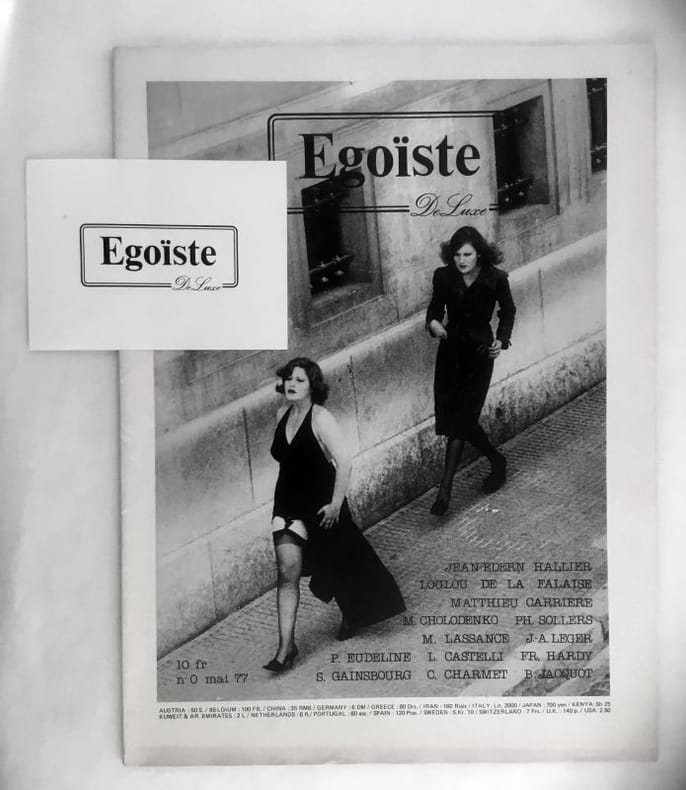
19771025331977 Dirigé par Gérard Julien Salvy, puis Nicole Wisniak, Philippe Morillon étant directeur artistique de la plupart des numéros.En novembre 1977 paraît le premier numéro du journal « Egoïste » sous l'impulsion de Nicole WisniakNotons également son exceptionnelle longévité de 44 ans, avec un tirage qui atteignit 35000 exemplaires.Très bel état général, quelques rares défauts aux premiers numéros.
17697234ABFirenze, Cambiagi, Luigi Bastianelli e Comp./Allegrini, Pisoni e Comp./Domenico Marzi e Comp., 1769-1776. 27,5 cm. Schönes Frontispiz in chiaroscuro nach Pantorno, 298 feine Kupferstichtafeln, 3 Monogrammtafeln und zahlr. Vignetten. Original-Pergament (Hardcover) m. ggpr. Rückentitel., Fadenheftung, rot-schwarzer Sprenkelschnitt. 12 Bände + 2 Supplementbände = 14 Bände komplett. [10 Warenabbildungen] Sehr schöne uniforme gepflegte Reihe. Im Vorsatz zwei ill. Ex-Libris:.1. zeitgen. m. Wappen" Stemma Nob. Della Fam. Patriciae Pisanae Del Testa Del Tignoso" und 1 um 1900: VW (Vernon W?). Auf dem Titel sig.: Del C. Ales. del Testo.
192091841920 1 Mine de plomb sur calque contrecollé sur papier, monogrammé en bas à droite, (ca 1920), encadrée.
1913D7495Paris 1913-1918. Hardcover. Very Good. Morocco backed original cloth; oblong 380 x 305 mm; contains over 100 drawings of dresses hats jackets and more done primarily in pen and ink and colored in pencil or gouache; and highlighted by 5 mounted photographs of a woman modeling different gowns. From the Parisian fashion house Detrois et Cie. Women's garments shown from the front and back and professionally presented -- drawings are polished and nicely detailed and colored. Scuffing along spine and edges of boards; binding a bit shaken. <br/><br/> hardcover
1913D7495Paris 1913-1918. Hardcover. Very Good. Morocco backed original cloth; oblong 380 x 305 mm; contains over 100 drawings of dresses hats jackets and more done primarily in pen and ink and colored in pencil or gouache; and highlighted by 5 mounted photographs of a woman modeling different gowns. From the Parisian fashion house Detrois et Cie. Women's garments shown from the front and back and professionally presented -- drawings are polished and nicely detailed and colored. Scuffing along spine and edges of boards; binding a bit shaken. <br/><br/> hardcover books
1985333396New York: alp 1985. hardcover. near fine/very good. Color and b/w illustrations. 312 pages. 4to pictorial cloth d.w. slightly de-laminating. New York: Alpine Fine Arts 1985. A near fine copy in a very good dust wrapper.<br/> <br/> alp unknown
1945168961945 Aquarelle en couleurs, encre de Chine, signée en bas à droite, 1945, 34 x 25 cm, encadrée.
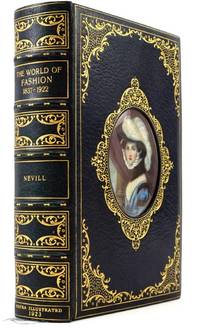
1923ST20131London: Methuen & Co 1923. 218 x 138 mm. 8 1/2 x 5 1/2". vii 1 280 pp. <br/> ELEGANT DARK BLUE MOROCCO GILT BY BAYNTUN stamp-signed on front turn-in covers with gilt fillet frame stippled volute cornerpieces UPPER COVER WITH LOVELY MINIATURE PORTRAIT of a fashionable lady the painting under glass and surrounded by a gilt-tooled frame raised bands spine compartments with volute frame gilt lettering gilt-framed turn-ins ecru moiré silk endleaves all edges gilt. WITH 21 PLATES OF FASHIONABLE PEOPLE five of these called for one color and 16 EXTRA-ILLUSTRATED seven of these in color one double-page and nine in black & white all with tissue guards. Spine gently sunned to navy blue just a hint of rubbing to joints but still quite a fine copy--clean and fresh internally and with almost no signs of use inside or out.<br/> <br/> This handsomely illustrated look at the London social scene during the Victorian and Edwardian eras and after the Great War comes in a suitably chic binding by the last Victorian bindery still in family hands. Author Ralph Nevill 1865-1933 was a denizen of the world he writes about being the son of one of the leading hostesses of the day Lady Dorothy Walpole Nevill 1826-1913; DNB notes that "family tradition" held that Ralph's father was her close friend Benjamin Disraeli Lord Beaconsfield. Nevill has a wide array of insider anecdotes to share about country house life the pleasures of London society and prominent politicians and journalists. He makes it clear that the Victorian era was preferable to the 20th century and nothing is more drab that the post-war world. The illustrations feature portraits of prominent men landscapes of stately homes and scenes from the balls operas and royal occasions that made up the London Season. The very pretty binding is in the Cosway style made popular by bookseller Henry Sotheran and the Riviere bindery characterized by a miniature painting set under glass on the covers or doublures. Our binding was done by the venerable English firm founded in Bath by George Bayntun in 1894. Among the great English workshops of the Edwardian "golden age" of lavish bindings Bayntun has the distinction of being the only one located outside London's West End to be sought after by bibliophiles. Bayntun was a worthy rival to the likes of Sangorski & Sutcliffe and Riviere & Son the latter being subsumed by Bayntun in 1939. Bayntun of Bath continues to create fine hand bindings for bibliophiles. Unusually the miniature painting in our binding is signed by the artist but we were unable to decipher the signature and the Bayntun bindery did not have any information about the painter's identity. Methuen & Co unknown
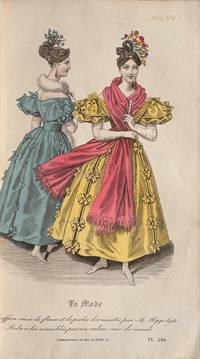
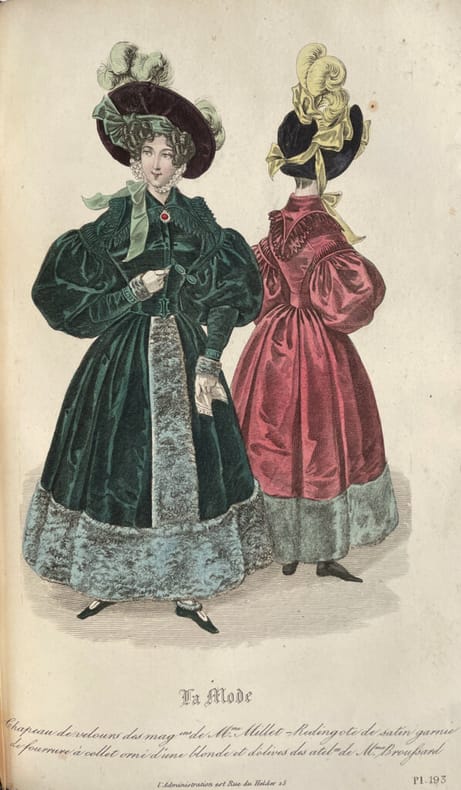
TBF32Paris Janvier-Juillet 1832.<br /><br />4 volumes large 8vo 217 x 130 mm gathering <u>76 plates in total</u>: I/ 320 pp. 21 plates in color: 20 plates numbered from 201 to 220 and 1 not announced wrappers bound in; II/ 344 pages 20 plates numbered from 182 to 200 plate 260 last leaves on yellow paper upper wrapper bound in; III/ 320 pp. 17 plates numbered 221 to 237 wrappers bound in; IV/ 332 pp. quire 11 is missing hence there is a gap within the numbering from p. 253 to 276 17 plates numbered 242 to 256 without plates 238 and 254 tear touching the text p. 23 wrappers bound in.<br />A few waterstains. Brown sheepskin blind-stamped border on the covers flat spines with green morocco lettering pieces yellow edges speckled with blue. <i>Contemporary binding.</i><br /><br /><b>Fourth year of this important magazine founded by Emile de Girardin who is proud to represent the Parisian spirit and fashionable life.</b><br /><br />We find there Doctor Véron whose presence soon attracts Alphonse Karr Alexandre Dumas Eugène Sue Georges Sand as well as Balzac.<br /><br />In 1830 passing under the control of the legitimists with Viscount Walsh La Mode will stand against the July Monarchy.<br /><br /><b>The superb illustration is composed of 76 plates in color.</b><br /><br /><b>Beautiful copy preserved in its contemporary homogeneous bindings.</b><br /><br /><br /><br /><b><u>Français</u></b><br /><br />Paris Janvier-Juillet 1832.<br /><br />4 volumes grand in-8 regroupant <u>76 planches au total</u> : I/ 320 pp. 21 planches en couleur : 20 planches numérotées de 201 à 220 et 1 non annoncée couvertures conservées ; II/ 344 pages 20 planches numérotées 182 à 200 planche 260 derniers feuillets sur papier jaune couverture supérieure conservée ; III/ 320 pp. 17 planches numérotées 221 à 237 couvertures conservées ; IV/ 332 pp. manque le cahier 11 d'où un saut dans la numérotation de la p. 253 à 276 17 planches numérotées 242 à 256 planches 238 et 254 manquantes déchirure atteignant le texte p. 23 couvertures conservées.<br />Qq. mouillures. Basane brune dentelle à froid sur les plats dos lisses avec pièces de titre et de tomaison en maroquin vert tranches jaunes mouchetées de bleu. <i>Reliure de l'époque. </i><br /><br />217 x 130 mm. <br /><br /><b>Quatrième année de cette importante revue fondée par Emile de Girardin qui se flatte de représenter l'esprit et la vie parisienne de bon ton. </b><br /><br />On y retrouve le docteur Véron dont la présence attire bientôt Alphonse Karr Alexandre Dumas Eugène sue Georges Sand ainsi que Balzac.<br /><br />En 1830 passant sous le contrôle des légitimistes avec le vicomte Walsh La Mode se dressera contre la monarchie de Juillet.<br /><br /><b>L'illustration superbe se compose de 76 planches en couleurs.</b><br /><br /><b>Bel exemplaire conservé dans ses reliures uniformes de l'époque.</b><br /> hardcover
LCS-186403Bel exemplaire conservé dans ses reliures uniformes de l’époque. Paris, Janvier-Juillet 1832. 4 volumes grand in-8 regroupant 76 planches au total: I/ 320 pp., 21 planches en couleur: 20 planches numérotées de 201 à 220 et 1 non annoncée, couvertures conservées ; II/ 344 pages,20 planches numérotées 182 à 200 + planche 260, derniers feuillets sur papier jaune, couverture supérieure conservée; III/ 320 pp., 17 planches numérotées 221 à 237, couvertures conservées; IV/ 332 pp., manque le cahier 11 d’où un saut dans la numérotation de la p. 253 à 276, 17 planches numérotées 242 à 256, planches 238 et 254 manquantes, déchirure atteignant le texte p. 23, couvertures conservées. Qq. mouillures. Basane brune, dentelle à froid sur les plats, dos lisses avec pièces de titre et de tomaison en maroquin vert, tranches jaunes mouchetées de bleu. Reliure de l’époque. 217 x 130 mm.
172164835Nürnberg, Christoph Weigel, 1703 (recte um 1721). Fol. Mit 101 Kupfertafeln von Caspar Luyken. 2 nn. Bll., Späterer blindgepr. Lwd.-Bd. m. etw. Rückenverg. u. goldgepr. Deckeltitel.
Manifesto litografico originale, 3 fogli ancora da unire, perfetti. Edito Devambez, Paris,1929 . Misure h 330 x L 200 cm. Condizioni eccellenti A++++++. Cappiello/Rennert, 269.
188264892Paris, A. Quantin, 1882. 4°. Mit chromolithogr. farb. Titel u. Schlußvignette in Schwarz u. Gold (hier in jeweils drei Druckzuständen) sowie zahlr. tlw. gest. Illustrationen u. Buchschmuck in versch. Farben von Paul Avril. 4 Bll., 143 (1) S., Olivgrüner genarbter Ldr.-Bd. d. Zt. m. goldgepr. Rückentitel u. dem eingeb. illustr. Orig.-Seidenumschlag (Vorder- u. Rückendeckel sowie Rücken), marmor. Vorsätze.
188014997ABca. 1880. 33 : 22 cm. 8 coloured paintings on stiff paper, mounted under passepartout.
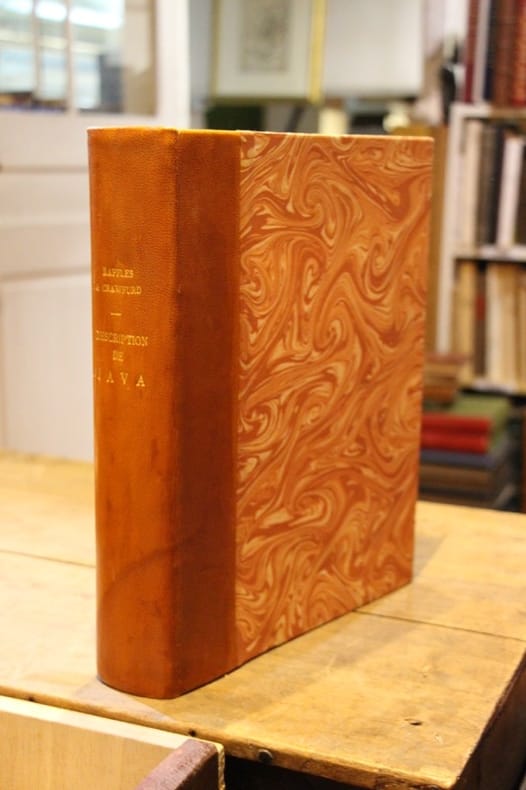
182412525Bruxelles, H. Tarlier & Jobard 1824 In-4, demi-basane moderne, couvertures restaurées conservées, XIX- 364 pp. 48 planches hors-texte : deux cartes dépliantes rehaussées en couleurs carte de l'Archipel Indien 35X43 et carte minéralogique de l'île de Java 13X40, 22 planches lithographiées dont 10 en couleurs vues, costumes, et 24 planches gravées sur cuivre. Rares rousseurs éparses, petit travail de ver in-fine sans atteinte au texte. Brunissure d’humidité au dos en pied, infime atteinte en garde et première couverture.