[Fashion]Biblio.com
1 546 résultats
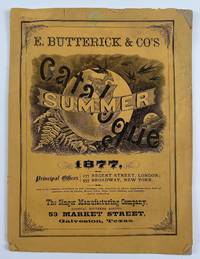
18772152New York 1877. Good. 311pp. Folio. Original orange pictorial wrappers. Light wear and soiling some minor loss to wrappers. Text toned slight biopredation to final leaf. A lovely catalogue of patterns for clothing of all types issued by E. Butterick & Co. The catalogue opens with styles for ladies' coats and dresses moving on to wraps and jackets then skirts and tops followed by essentials such as bloomers and corsets and aprons and chemises. There is a section of clothing for "Misses and Girls" as well as doll patterns children's clothing and "Boys and Gentlemen." Menswear includes everything from smoking jackets and caps to overalls and kneebreeches. The rear cover advertises Singer Sewing Machines which received numerous awards at the Centennial Exhibition in Philadelphia the previous year. The front cover notes agents for Singer machines in Galveston Texas pinpointing the distribution area for the present catalogue. An excellent source for fashions of the period. unknown
185635856Paris: Goubaud et Cie 1856. First Edition. Hardcover. 380pp. Contemporary marbled boards. With twelve hand-coloured wood engravings depicting various styles of clothing and numerous b&w in-text illustrations including embroidery styles. Articles on home economics travels beaux-arts history the Louvre and the Tuileries Palace and much more. Front board is detached with title page and two leaves internally mostly clean with some foxing and toning. Text in French. ; Large Octavo. Goubaud et Cie hardcover
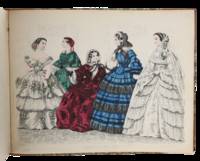
183362953Leipzig Industrie-Comptoir / Baumgärtner etc. 1833-1856. Small queer-folio 22 x 285 cm. Nice later light brown half calf from ca. 1900 with five raised bands and gilt lines to spine Carl Petersens Enke. Slight wear to extremities. 100 engraved plates in contemporary colouring. A bit of even browning and occasional offsetting. A few plates with more browning. Some plates with tiny holes in blank margin from original stiching having been vertically bound with text-leaves. Occasional light creasing. One plate with a tear no loss. A few plates signed A. Brückner most plates numbered and dated and some plates having "Extra-Kupfer" or "Les Modes Parisiennes Réunis" the last five underneath. <br/><br/><em>A lovely collection of 100 beautiful contemporarily coloured engraved fashion-plates from between 1833 and 1856 importing the highest Parisian fashion of the time to Germany. This beautiful collection magnificently documents the clothing fashion and development of two decades primarily for women but also for children and men. Also in the mid-19th-century Paris was seen as the quintessence of elegance and style. The Allgemeine Moden-Zeitung kept the German-speaking public up to date with the latest fashions from Paris. The magazine “Les modes parisiennes reunites†did the same; that too was produced for the German public despite its French title. As well as outfits for appearing in high society eg. at the theatre the fashion plates collected here show clothes and notably also accessories for almost all other parts of life - paying and receiving social calls going for walks attending different events musical siorées going out with the children etc. “As part of her evening wardrobe every fashionable lady simply had to have elegant dresses in brightly coloured silks and satins with frills and lace bows and flounces tight bodices natural waistlines and exposed shoulders which gave the female figure an hour-glass silhouette. The first thing that strikes one about these ladies’ fashions are the stiff voluminous underskirts. Horsehair crinolines invented in 1850 supported wide sweeping skirts which could measure up to two or two-and-a-half metres in diameter and made the upper body look even slimmer.†Deutsches Historisches Museum. "From the 1820s onwards and particularly under the ostentatious Second Empire 1852–1870 the classicising taste of the Napoleonic era changed completely. Instead fashion now drew inspiration from the elegance of the Rococo period so much so that the period became known as the “second Rococoâ€. The waistline returned to its natural level but was awkwardly styled – at least from a health point of view: agonisingly tight corsets emphasised the so-called “wasp waistâ€. Ostensibly guided by aesthetics on closer inspection this fashion trend also had social consequences: with styles that afforded women so little freedom of movement fashion focused on the ostentatious requirements of ladies from the upper echelons of society who didn’t have to work. Practicality was not its concern. This ostentatious and – certainly from the perspective of the 21st century – inconvenient fashion style appealed not only to the fine ladies of high society but also to women from the middle classes and the petty bourgeoisie. The expansion of the textile industry and the rise of the chemical industry made the production of dyes fabrics lace and embroidery and the processing of raw materials and textiles imported from the colonies both quicker and cheaper.†DHM </em> hardcover
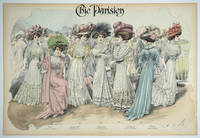
189023483Paris: Eberle 1890. Very good condition. Double spread women's fashion lithograph with early hand color showing an array of seven fashionable gowns. The lithograph depicts a row of ladies at a public event each with her gown and elegant hat depicted in great detail including one showing the intricate ties on the back of the gown. Chic Parisien a competitor to the "Gazette du Bon Ton" was a monthly fashion magazine when dressing well really meant something. 24 1/4 x 16 1/2" Eberle unknown
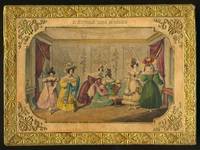
18352200376<p><i>Including a double-sided hand coloured lithograph mannequin 14.5cm high; together with 5 outdoor slipover costumes and matching hats and one indoor costume; a stand 9.5 x 13.5 cm in the form of a carpet with a hand coloured lithograph design on a red ground; </i><i>contained in the original decorated box 14 x 10 x 2.5 cm the lid with a scene of a dressmakers salon with five ladies and the milliners showing her wares; enclosed within a decorative shaped and gilt embossed paper border; The underside of the box with the label of 'Delaville Sucr. de Terzuolo-Despilly. Papetier du Roi. Rue de la Chaussée d'Antin No. 15.'</i></p><p>An early dressing game based on contemporary costumes and a visit to the milliners shop.</p><p>The quality of this paper doll indicates it was made for the most expensive end of the market confirmed by the label of Delaville who from 1822 had been 'Papetier du Roi'. Delanville had been active from 1804 and got his royal warrant in 1822 he traded from the address Rue de la Chaussée d'Antin during the late 1820s through to at least 1833 but no longer appears in the Parisian <i>l'Almanach du Commerce</i> of 1837.</p><p>The lid shows the scene of a well appointed milliners shop with six women conversing or examining merchandise the two central figures show a seated lady being shown a pink dress by her milliner. The mannequin is of a young lady in her under garments including laced bodice over a light cotton petticoat and wearing a neckless of emeralds rubies and gold.</p><p>All clothing items show the front and back of the young woman including: 1 a silk dress with large puffed out sleeves and embroidered with flowers and shaped tongue ornaments; 2 a green gingham check dress and embroidered shirt with puffed sleeves and a ruff neck holding a parasol; 3 an ochre dress with green open-work lace and fringe banded collar waist and dress band; 4 a white evening dress with grape and vine decorated collar and matching dress with flowers wheat sheaves and roses a green belt with a key on a ribbon and holding a fan in her gloved hand; 5 A light overall decorated dress with leafy fronds and shell decoration wearing tow bracelets and clasping a book; 6 a turquoise evening dress with a white boa around the shoulders and long white gloves. The five interchangeable hats decorated with feathers ribbons and flowers.</p> Delanville
188054558Amsterdam: A. Jager ca. 1880. 12mo. 3.5 x 5.25 in. 12 hand-coloured albumen carte de visite images sized 2.25 x 3.5 in. mounted on thick 3 x 5 in. cards text in lower fore-edge of board bound in leporello accordion-style format linen hinges renewed. Original publisher’s decorated red cloth over beveled boards elaborate gilt decorated front cover and lettering minor rubbing edgewear minor bumping to corners still VG exemplar w/ most images retaining strong contrast and colour bookseller’s label of Joh. G. Stemler Cz. Algemeene Goekhandel Amsterdam on rear pastedown. Early printing of this charming photographic souvenir with hand-coloured albumen CDV photos illustrating the styles of folk costumes in different regions of the Netherlands. The villages and regions include Marken North Holland a fisherwoman carrying basket on her head from Scheveningen a fishing port a middle class orphan girl from Amsterdam a young girl wearing elaborate hat from Krommenie North Holland northeast of Haarlem. Jager 1825-1905 published many different series of these souvenir fashion photos as well as images of scenes in and around Amsterdam often as stereoviews some working with Dutch photographer Pieter Oosterhis. See: Maartje van den Heuvel The Rise of Dutch Landscape Photography. How a Vision of Painting Entered Photography Depth of Field Vol. 6 No. 1 July 2015. A. Jager, hardcover
188755685New Haven CT & Pittsburgh PA: L. Candee & Co. H. Childs & Co. 1887. 8vo. 28 pp. Decorated title page lithographed illustrations throughout. Embossed & decorated softcovers front cover decorated & illustrated in gilt & burgundy w/ peacock feather above lettering and nicely executed lithograph on back cover of young saleswoman standing next to a rack of rubber boots & shoes for sale minor toning shelfwear very slight tidemark at upper fore-edge front cover still a VG copy. First edition of this nicely printed Victorian catalogue for rubber boots and shoes. The nicely executed lithographs promote the Hip Boots hip waders thigh high sporting boots double thick Pebble Leg Boots and Fairy Boots reminiscent of cowboy boots as well as the rubber Duck or Canvas Boot for hunting. Also included are many different styles and varieties of rubber shoes for women and children including No Heel Imitation Sandals Gossamer Imitation Sandals Buskins with cotton flannel lining Opera Dew Drop Feather Weight and many others. The company also produced tennis rubber soled shoes croquet shoes as well as heavy duty Stalwart Lumbermen’s Shoe intended to fit over logger’s Wool Boots or German Socks. Leverett Candee 1795-1863 obtained early patent rights from Goodyear for manufacturing rubber shoes as early as 1844 and by 1852 had organized the large Candee Rubber Co. factory with the Hotchkiss Brothers in New Haven and Timothy Lester. No copies located in Worldcat; See: Davis The New England States Vol. I pp. 344-346 1897; Joseph Kane Famous First Facts 1950. L. Candee & Co., [H. Childs & Co.], paperback
188546789Auburn NY: L. Marshall ca. 1885. Tall 8vo. One colour chromolithograph card 6.75 x 11.75 in. very slight toning to fore-edges very slight bumping to couple corners still a VG bright copy. First edition thus of this advertising card for L. Marshall who were a very successful and popular Victorian clothing and furnishing store in Auburn New York. They were particularly well known for their beautiful colour advertising cards sent out as promotions and were at their height of popularity at the end of the 19th century. L. Marshall, hardcover
189554146New York: Standard Fashion Company June 1895. 4to. 96 pp. 1 large folding colour chromolithograph frontisp. sized 21.5 x 10.75 in. 1 colour chromolithograph plate over 150 woodcut text illustrations & engravings. Gold-coloured printed softcovers brick-red lettering minor dustsoiling light wear to creases of folding frontisp. still VG copy. First edition of this scarce and beautifully printed fashion magazine which was published under this title only from 1894 through 1896 when it was forced to change the name to The Standard Designer after losing a lawsuit brought by the Butterick Publishing Co. against Frank Koewing d. 1933 their former western sales manager for Butterick. Founded in 1887 the Standard Fashion Co. would eventually become a serious rival to the Butterick Pattern Co. appropriating the “Delineator†for his magazine poaching employees and eventually building the company to issuing over 100000 cut patterns a week. While often facing bankruptcy and litigious to a fault the company was acquired as a subsidiary in 1900 by Butterick and the combined companies would thrive through the ensuing decades. Each of the Standard Delineator magazine issues featured a large chromolithograph frontispiece of the latest fashions as well as a smaller one of millinery designs. Worldcat locates primarily microfilm copies however individual issues are held by Notre Dame and Davidson College; See; A Man of the Hour Frank Koewing The Bookseller and Newsman Vol. 13 1896 pp. 4-5; Carol Ann Dickson Patterns for Garments: A History of the Paper Garment Pattern Industry in America 1979. Standard Fashion Company, paperback
188848840Paris: Grande Maison de Blanc ca. 1888. 12mo. 42 pp unpaginated. Colour chromolithograph illustrated title 18 colour chromolith plates. Dark green silk gilt lettering on front cover very minor soiling edgewear front cover rear inner hinge starting still a VG bright copy stapled textblock as issued. First edition of this delightfully produced and illustrated history of gloves through the ages. These include descriptions of mesh gloves used by the Egyptians metal gauntlets used by Roman gladiators gloves to keep warm by monks during the Middle Ages leather gloves to protect the hands and arms of the falconer fencing gloves beautiful silk & lace gloves for noblewomen at the courts of Louis XV and Louis XVI and riding gloves for women during the Second Empire of Napoleon III and finally the Belle Epoque. Grande Maison de Blanc was a renowned firm in Paris during the Belle Epoque who were especially proud of selling French-manufactured gloves linens cravats and other household goods at a discount compared to many other stores at the time. They were pioneers in not only producing their own products in house by maintaining factories in Tarare Lille Fives and other areas around France but pushing other suppliers to offer steep wholesale discounts. Worldcat locates 2 copies NYU Princeton. Grande Maison de Blanc, hardcover
187454872Boston: C.F. Hovey & Co. 1874. Folio. 13.5 x 11 in. 36 pp. 1 59 1 leaves. first 36 pp. incorporating title Memorandum pages several ALS letters and invoices on letterhead 8 pp. on graph paper w/ samples incorporated into the text 2 additional leaves of tissue thin manuscript copies from blotter 925 original fabric samples pinned-in glued-in and laid in sized from .5 x .5 in. up to 6 x 13 in. including a myriad of colours tartans plaids flannels silk blends cottons poplin cottons woolens etc. Original plum-coloured factory sample book purchased by Hovey from stationer P.L. Morin Paris who specialized in producing blank scrapbooks for factory sample cards printing & stationery registers w/ label mounted on front pastedown worn rubbing spine perished hinges loosed somewhat shaken still a remarkable unsophisticated exemplar preserved in folding case. This exceptional Victorian fabric sample order book assembled by a buyer for C.F Hovey & Co.’s fall fashion season furnishes an invaluable time capsule of colours textures and preferences in the 1870s. This era in women’s fashion driven by Parisian and other European design houses demanded extraordinary amounts of fabrics with an emphasis on the back of the skirt long trains and fabric draped up into bustles with an abundance of flounces and ruching. More significantly there was a tremendous growth in patterned poplin fabrics bright cotton & silk fabric blends as well as brilliant jewel colours. This order book with hundreds of different samples also offers a fantastic peek into the Victorian obsession with tartans and plaids driven by the mystique and example of Queen Victoria the ever-growing popularity with the historical romances of Sir Walter Scott celebrating the Highlanders and the poetry of Robert Burns. Tartan and plaid patterns were used in gowns dresses shawls veils hats purses and many fashion houses would often choose a particular clan pattern to celebrate and promote in their sales literature. Men’s suits coats and jackets were buttoned high on the chest the woolens became lighter weight and more durable as well of better quality and fashion designers for Hovey & Co. also incorporated rough finish woolens twills and tweeds into their clothing offered for sale. Many of the fabrics were also sold in Hovey & Co. fabric department in assorted lengths as well as ends for uses by Victorian women in home craft projects. Johnson focused on buying in the major wholesale textile dealers and markets of Europe during the 1870s including Stavert Tigomala & Co. one of the largest textile commission houses in Bradford UK; Firth Booth & Co. who specialized in bright cotton poplin plaids tartans wool blends and moire; Chamberlin Donner & Co. of Manchester one of the largest wholesale merchant houses shippers & traders in the British Empire; A. Van Bergen & Co. in Paris France whose beautifully patterned cotton and silk blends and woolens were enhanced by the award-winning dyes of Blanche at Puteaux; Les Fils de Th. Le Grand with wool blends twills and rough finish woolens. The sizes of the orders were remarkable and show the strength of Hovey’s customer base with one pair of invoices showing orders from Firth Booth & Co. totaling £ 7785 or over £ 855000 in present day value. However as evidenced by letter from Charles Kretschmann in Berlin who notes that Johnson in his June 24 1874 visit was “not pleased with the Berlin style of garments for this season and ordered only a very small lotâ€C.F. Hovey & Co. was founded by Charles Fox Hovey in 1833 as a dry goods merchant and with in a few years became a large department store located on Summer St. Through the years up to his death in 1859 he brought on many partners and was an ardent abolitionist and supporter of women’s rights establishing the Hovey Fund. After his death in 1859 Thomas Mack and Augustus De Puyster took over the running of the company and expansion through the Civil War. Johnson 1839-1927 was a Harvard grad clerk for Hovey & Co. and Civil War Veteran who rose from 1st Lieutenant in Co. H. Massachusetts 44th Infantry to Full Adjutant before mustering out right before Gettysburg. Hovey & Co. survived the massive fire of 1872 by employees soaking all the woolen blankets on the sales counters in water and placing over the roof and windows to protect the building from the flowing cinders expanded into store fronts on Chauncy and Avon Streets and was the first retailer to adopt the policy of requiring monthly payments on credit accounts. See: The History of the House of Hovey 1919; Charles Boston Looking Back at C.F. Hovey’s of Boston Shopping Days in Retro Boston May 6 2011; History of Fashion 1840-1900 Victoria and Albert Museum 2016. C.F. Hovey & Co., hardcover
190048322Troy NY: Cluett Peabody & Co. Makers ca. 1900. Painted tin sign w/ black lettering 19 x 14 in. mounted in original quarter-sawn oak frame 24 x 18 in. with the advertising logo painted in black lettering minor scuffing to lettering very minor rust spotting and blue-tinted patina to sign still a VG- example. A wonderful advertising display for Monarch Shirts which originally came out of a Carlton Oregon general store which at the end of the 19th and beginning of the 20th century also sold men’s clothing accessories and shoes. George Bywater Cluett 1838-1912 and Frederick Forrest Peabody 1858-1927 were pioneers in the shirt & replaceable collar industry in Troy NY who created the iconic Arrow brand detachable Collars and shirts. They formed their company from Cluett & Sons to Cluett Peabody & Co. in 1899 and rapidly grew their business by providing women with an easier way to clean their husbands’ stained shirt collars without having to wash the entire shirt. In addition the collars wore out a much faster rate than the rest of the shirts so these replaceable collars would extend the life of the garments. Monarch shirts were famed for their durability and patented their Patent Bound Bosom Shirt which became known to consumers across the country as the Monarch Shirt. In 1905 the company launched the iconic campaign for Arrow Shirts with the famed illustrations by Joseph Leyendecker which ran for over 25 years. Various Cluett divisions maintained offices and showrooms in New York through 2002 and then in 2004 the Arrow Shirt brand was acquired by Phillips-Van Heusen Corp. Cluett, Peabody & Co., Makers, hardcover
190046147Paris: B. Henry 60 Rue de Turbigo ca. 1900. 8vo. 16 pp. Over 75 text illusts. 1 photo illust. of B. Henry. Self-printed wrappers illust. on front cover some minor dustsoiling wear slight creasing still VG- copy stapled as issued. First edition of this fascinating and very scarce catalogue of the elaborate hair-pieces and wigs for the fashions of mostly women and some men at the end of the 19th century. The pieces include full wigs hair extensions hair braided into the styles to be pinned to existing hair decorative pieces for special occasions and more. In addition there is a very good section on how to accurately measure yourself for your hair-piece. No copies located in Worldcat. B. Henry, 60, Rue de Turbigo, unknown
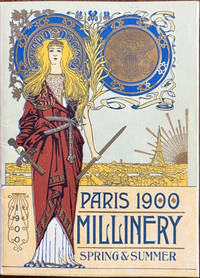
190060928Porland OR: Lipman Wolfe & Co. 1900. 16mo. 32 pp unpaginated. w/ photo illustrations throughout. Colour-illustrated softcovers view of the goddess Minerva holding broken sword city of Paris stretching into the background and medals which originally honored Czar Nicholas for the disarmament conference of 1898 now changed to the United States Seal w/ original mailing envelope post-marked 1¢ Franklin stamp NF/NF copy from the library of Caroline Augusta Gray Kamm 1840-1932 noted socialite and philanthropist in Portland built home for poor women & girls with the YWCA and was daughter of PNW pioneer William H. Gray 1810-1889 who traveled to the Lapwai Mission in Lewiston ID in 1836 where he was the Nez Perce secular agent and subsequently later married Jacob Kamm 1823-1912 pioneering Oregon industrialist and entrepreneur. First edition of this beautiful belle epoque 19th-Century fashion catalogue issued by the historic Lipman Wolfe & Co. department store in Portland OR featuring elaborate large-rimmed hats with extensive trimmings featuring fashions created by such women designers as Madam Michniwicz-Tuvee Esther Meyer Camille Roger perhaps best remembered later for her Art Deco Suffrage hats the Guillard sisters and others. The famed Lipman Wolfe & Co. department store was founded in 1880 by Adolphe Wolfe who teamed up with his uncle Solomon Lipman and at the time still maintained their original Dekum Building at 3rd Street and were the first to introduce customer elevators to their many floors. No copies in Worldcat. Lipman, Wolfe & Co., paperback
188746439London: Edward Harrison January 1887. Elephant folio. 17.25 x 25.25 ins. Hand-coloured engraving architectural details in the backgrounds originally folded into four sheets some chipping & edgewear to plate creases some minor repairs to verso small tears to lower fore-edge affecting a few letters a G- copy w/ the colour and images still very bright and crisp. First edition of this very scarce and beautiful fashion Supplement leaf which was laid-in with this Victorian monthly which was comprised of articles on fashion embroidery sewing craft work family reading sheet music and more. The fashions in the top row include day wear and more casual clothing for the well-dressed Victorian girl as well as winter jackets muffs and hats. The second row is devoted to evening gowns and formal wear reflecting the revived return to the bustle the fashionable tight corset which was intended to create a long torso and force an S-shape as well as high collars and chokers reflecting the influence of Alexandra Princess of Wales who hid a scar with these methods. The bottom row encompasses dress coats and evening coats which were long have elaborate hats fur trims and yards of rich fabrics. Each monthly issue would include descriptions of the illustrations and prices for cut-out fashion patterns which could be purchased from the Young Ladies’ Journal. Typically since these were published on fragile paper and often thrown away they have become quite scarce. Edward Harrison], hardcover
18906155SLND [Paris, circa 1890]. 1890 1 vol in-folio ( 315 x 240 mm ) de 91 ff de 1 à 4 dessins originaux par page exécutés au crayon, à l'aquarelle et à la gouaches, signés "Renée Henry" et montés sur onglets. Demi-basane bordeaux, dos lisse orné de filets titré à l'or "Gravures de mode", plats recouverts de papier marbré. (Usures et défauts d'usage).
189520782Paris, Boussod, Valadon & Cie, 1895 1 volume In-folio (32,6 x 42,2cm) Broché sous couverture au 1er plat entièrement illustré couleurs. Paginé de [XVII] à XX puis de [81] à 100; nombreuses illustrations in texte en noir et en couleurs, 2 planches couleurs hors texte.
189045813Rathenow, Max Babenzien, o. J. (um 1890). Kolor. Orig.-Holzstich (Blattgröße ca. 25 x 17 cm).
189045814Rathenow, Max Babenzien, o. J. (um 1890). Kolor. Orig.-Holzstich (Blattgröße ca. 25 x 17 cm).
189045818Rathenow, Max Babenzien, o. J. (um 1890). Kolor. Orig.-Holzstich (Blattgröße ca. 25 x 17 cm).
189045817Rathenow, Max Babenzien, o. J. (um 1890). Kolor. Orig.-Holzstich (Blattgröße ca. 25 x 17 cm).
189052638Rathenow, Max Babenzien, o. J. (um 1890). Kolor. Orig.-Holzstich (Blattgröße ca. 25 x 17 cm).
189045895Rathenow, Max Babenzien, o. J. (um 1890). Kolor. Orig.-Holzstich (Blattgröße ca. 25 x 17 cm).
189045897Rathenow, Max Babenzien, o. J. (um 1890). Kolor. Orig.-Holzstich (Blattgröße ca. 25 x 17 cm).
189045898Rathenow, Max Babenzien, o. J. (um 1890). Kolor. Orig.-Holzstich (Blattgröße ca. 25 x 17 cm).