Bodenstedt, FriedrichAntiquariat.de

1 550 résultats
1882135403Leipzig, F.A. Brockhaus. 1882. 284 S. 19,5*13,5 cm. OLeinenband mit Goldschnitt.
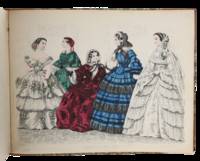
183362953Leipzig Industrie-Comptoir / Baumgärtner etc. 1833-1856. Small queer-folio 22 x 285 cm. Nice later light brown half calf from ca. 1900 with five raised bands and gilt lines to spine Carl Petersens Enke. Slight wear to extremities. 100 engraved plates in contemporary colouring. A bit of even browning and occasional offsetting. A few plates with more browning. Some plates with tiny holes in blank margin from original stiching having been vertically bound with text-leaves. Occasional light creasing. One plate with a tear no loss. A few plates signed A. Brückner most plates numbered and dated and some plates having "Extra-Kupfer" or "Les Modes Parisiennes Réunis" the last five underneath. <br/><br/><em>A lovely collection of 100 beautiful contemporarily coloured engraved fashion-plates from between 1833 and 1856 importing the highest Parisian fashion of the time to Germany. This beautiful collection magnificently documents the clothing fashion and development of two decades primarily for women but also for children and men. Also in the mid-19th-century Paris was seen as the quintessence of elegance and style. The Allgemeine Moden-Zeitung kept the German-speaking public up to date with the latest fashions from Paris. The magazine “Les modes parisiennes reunites†did the same; that too was produced for the German public despite its French title. As well as outfits for appearing in high society eg. at the theatre the fashion plates collected here show clothes and notably also accessories for almost all other parts of life - paying and receiving social calls going for walks attending different events musical siorées going out with the children etc. “As part of her evening wardrobe every fashionable lady simply had to have elegant dresses in brightly coloured silks and satins with frills and lace bows and flounces tight bodices natural waistlines and exposed shoulders which gave the female figure an hour-glass silhouette. The first thing that strikes one about these ladies’ fashions are the stiff voluminous underskirts. Horsehair crinolines invented in 1850 supported wide sweeping skirts which could measure up to two or two-and-a-half metres in diameter and made the upper body look even slimmer.†Deutsches Historisches Museum. "From the 1820s onwards and particularly under the ostentatious Second Empire 1852–1870 the classicising taste of the Napoleonic era changed completely. Instead fashion now drew inspiration from the elegance of the Rococo period so much so that the period became known as the “second Rococoâ€. The waistline returned to its natural level but was awkwardly styled – at least from a health point of view: agonisingly tight corsets emphasised the so-called “wasp waistâ€. Ostensibly guided by aesthetics on closer inspection this fashion trend also had social consequences: with styles that afforded women so little freedom of movement fashion focused on the ostentatious requirements of ladies from the upper echelons of society who didn’t have to work. Practicality was not its concern. This ostentatious and – certainly from the perspective of the 21st century – inconvenient fashion style appealed not only to the fine ladies of high society but also to women from the middle classes and the petty bourgeoisie. The expansion of the textile industry and the rise of the chemical industry made the production of dyes fabrics lace and embroidery and the processing of raw materials and textiles imported from the colonies both quicker and cheaper.†DHM </em> hardcover
189743265München, Braun & Schneider, ca. 1897. Fol. Mit 12 doppelblattgroßen Bilderbögen (davon 3 kindlich koloriert). Farbiger Or.-Pp.; fleckig, Rücken lose u. mit Beschädigungen, Kanten beschabt.
187924682London Griffith and Farran 1879 1 London, Griffith and Farran, 1879, in-8, percaline verte éditeur illustrée en noir et or de deux Basques, tranches dorées, 276 pages.
184526267ABRostock, Verlag der J. G. Tiedemann'schen Hof-Steindruckerei, um 1845. Ca. 10 x 13 cm. Unter Passepartout. Kräftiges Altkolorit. Papier leicht gebräunt, Ränder etwas stärker.
184526266ABRostock, Verlag der J. G. Tiedemann'schen Hof-Steindruckerei, um 1845. Ca. 10 x 13 cm. Unter Passepartout. Kräftiges Altkolorit. Papier leicht gebräunt, Ränder etwas stärker.
184526268ABRostock, Verlag der J. G. Tiedemann'schen Hof-Steindruckerei, um 1845. Ca. 10 x 11 cm. Unter Passepartout. Kräftiges Altkolorit. Papier leicht gebräunt, mit Schriftspiegel-Spuren.
1880439430BBBerlin, 1880-1882. gr. 4°, ca. 120 S. ,reich ill. m. vielen Holzschnitten. Privatbd. brosch. altersgem. gebräunt, m. einigen Bleistift- und Farbstrichen
1883WIRT1301Essek, Selbstvlg. der Handels- u. Gewerbe-Kammer (1883), (Druck: Julius Pfeiffer, Essek-Oberstadt). Gr.-8°. XVI, 275(1) S. Mit 32 tlw. mehrf. gef. Tabellen auf Taf. Dekorativer Halblederband der Zeit auf 5 falschen Bünden m. Titel u. kl. Fileten in Goldpräg. auf Rü. sowie umseit. Farbschnitt. Rücken aufgehellt, Kanten abgerieben, Exlibris auf flieg. Vorsatz, Tafeln an den Rändern tlw. angeschmutzt u. m. Läsuren, einz. Ss. fleckig. In 4 Kapiteln: I. Production von vegetabilischen u. thierischen Artikeln, sowie der Handel mit denselben / II. Handel mit fremden Erzeugnissen / III. Das Gewerbewesen / IV. Verkehrswesen.
1831028639ohne Angabe / Sans Mention De L'éditeur, ohne Angabe 1831. Sehr gut
18256025Volkstrachten. (Titel auf Vorderdeckel). 60 nummerierte lithogr. Tafeln. Wien, Lithogr. und zu haben bey Jos. Trentsensky, [um 1822/1825]. Gr.-4to. (31,8 x 21,7 cm). Späterer Halbleinwandband mit montiertem Titelschild.
184081412Hamburg, [ca. 1840]. Bildgröße: 18,5 x 11,5 cm. Unter Passepartout (29 x 21 cm).
187628030Berlin, Franz Lipperheide, 1876/1877. 4°. 39 S., 12 Tafeln, 43 S., 12 Tafeln. Broschuren. - Die Tafeln zeigen: Burgundische Fürsten, Kroatische Bauern, Bauern aus Klein-Bremen bei Minden, Montenegriner, Oberösterreichische Bauern, Bauern aus Bortfeld, Bauern aus Valle, etc. Einbände repariert, schmutzfleckig und bestoßen. Tafeln mehrheitlich fleckig, bestoßen und verso beschrieben, einige Tafeln rissig.
18767014AB(Berlin, Lipperheide, 1876). 28 : 20 cm. 40 (statt 42) kolorierte Holzstich-Tafeln. Halbleinenband der Zeit.
1890103815BBSchweiz, um 1890. 4° (30 x 19 x 13 cm.). Mit ca. 100 Bordüren, zusammen in 14 flache Kästen mit rotem Siegelwachs montiert. Buchkassette aus Holz mit lederbezogenen Deckeln mit Deckelmonogramm "F. Gbr. M." [11 Warenabbildungen]
183864016[Hamburg, 1838]. Bildgröße ca. 16 x 25 cm; Blattgröße ca. 20,5 x 28, 5 cm. (= Kleidertracht u. Gewohnheit in Hamburg). Feinkartonpassepartout.
184766573Meissen, Goedsche & Steinmetz, (1847). Bild ca. 15,5 x 11,5 cm, Blatt ca. 22,5 x 15 cm. 1 Blatt, verso weiß.
187653717Berlin, Lipperheide, (1876). Darstellung ca. 18 x 14 cm, Blatt ca. 27 x 17,5 cm. 1 Blatt, verso weiß.
190077161Couverture souple. Catalogue. 18 pages. 24 x 31 cm. Légèrement défraîchi.
1885RO80093805CHEZ L'AUTEUR. 1885. In-12. En feuillets. Bon état, Livré sans Couverture, Dos satisfaisant, Intérieur frais. Fascicules de 16 pages, illustré de quelques gravures de mode, en noir et blanc, dans le texte.. . . . Classification Dewey : 391-Mode
187743352Couverture souple. Broché. 174 figures. En général 2 figures par page. Légèrement défraîchi. Manque à la couverture.
187843353Couverture souple. Broché. 245 figures. De 1 à 5 figures par page. Légèrement défraîchi. Manque à la couverture.
187743354Couverture souple. Broché. 114 figures. Légèrement défraîchi. Manque à la couverture.
188755685New Haven CT & Pittsburgh PA: L. Candee & Co. H. Childs & Co. 1887. 8vo. 28 pp. Decorated title page lithographed illustrations throughout. Embossed & decorated softcovers front cover decorated & illustrated in gilt & burgundy w/ peacock feather above lettering and nicely executed lithograph on back cover of young saleswoman standing next to a rack of rubber boots & shoes for sale minor toning shelfwear very slight tidemark at upper fore-edge front cover still a VG copy. First edition of this nicely printed Victorian catalogue for rubber boots and shoes. The nicely executed lithographs promote the Hip Boots hip waders thigh high sporting boots double thick Pebble Leg Boots and Fairy Boots reminiscent of cowboy boots as well as the rubber Duck or Canvas Boot for hunting. Also included are many different styles and varieties of rubber shoes for women and children including No Heel Imitation Sandals Gossamer Imitation Sandals Buskins with cotton flannel lining Opera Dew Drop Feather Weight and many others. The company also produced tennis rubber soled shoes croquet shoes as well as heavy duty Stalwart Lumbermen’s Shoe intended to fit over logger’s Wool Boots or German Socks. Leverett Candee 1795-1863 obtained early patent rights from Goodyear for manufacturing rubber shoes as early as 1844 and by 1852 had organized the large Candee Rubber Co. factory with the Hotchkiss Brothers in New Haven and Timothy Lester. No copies located in Worldcat; See: Davis The New England States Vol. I pp. 344-346 1897; Joseph Kane Famous First Facts 1950. L. Candee & Co., [H. Childs & Co.], paperback
180881236[Hamburg], 1808]. Platte 26,5 x 17,5 cm. Darstellung mit Trockenstempel 28 cm. (= Sammlung verschiedener spanischer National-Trachten und Uniformen der Division des Marquis de la Romana 1807 und 1808 in Hamburg in Garnison, 3). Unter Passepartout.