Moda cataloghi rivisteBiblio.com
740 résultats
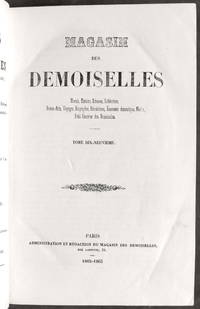
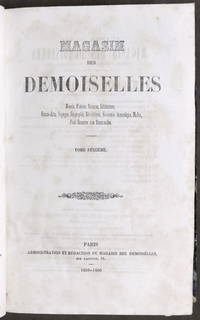
89614Magasin des Demoiselles - Tome Seizieme - 1859 / 1860 - Pag. 380 con illustrazioni nel testo e tavole f.t. - Copertina rigida - Testo in francese. - Condizioni generali molto buone. unknown
89584Magasin des Demoiselles - Tome Dix-Neuvieme - 1862 / 1863 - Pag. 460 con illustrazioni nel testo e tavole f.t. - Copertina rigida - Testo in francese. - Condizioni buone. Mancanza a pag. 459/460 con parziale lesione del testo indice. unknown
003881London: Ward Lock & Co Original Price 8/6 net Yellow cloth in a Yellow based Dustwrapper on the back cover of which is advertised top to bottom " Arithmetic can be fun " " Safety can be Fun" " Manners can be Fun " And " Grammar can be Fun " A NEAR FINE Book in a VERY GOOD not price clipped or torn dustwrapper with a couple of minor marks on it . A truly LOVELY copy . E-mail for further details. 48pp. Signed "with Love from Clare's Grannie Christmas . This Edition is NOT Dated est 1955. Yellow Cloth. Near Fine/Very Good Not Price Clipped. Illus. by Red and Black Illustrations. 4to - over 9¾" - 12". Hard Back. Ward Lock & Co Hardcover
187831932Madrid: Oficinas de La Moda Elegante Ilustrada MDCCCLXXVIII 1878.- 372 p. 2 h.: Profusión de ilustraciones intercaladas en el texto; 8º 19 cm; Media Piel nueva de fina ejecución conserva cubiertas. Las cubiertas originales que conserva están algo fatigadas y con alguna falta. Por lo demás excelente estado. MODAS ALTA COSTURA BELLEZA Y COSMÉTICA Libro en español Oficinas de La Moda Elegante Ilustrada hardcover
21925From Brockwood Park Bramdean Hampshire and Ojai California. Between 1978 and 2008. A total of twenty-eight items of correspondence comprising: nineteen Autograph Letters Signed two on the backs of cards two Typed Letters Signed and seven Autograph Cards Signed. In good condition. All signed 'Mary' and the large part addressed to 'Christopher' with a few to 'Kit' and one to 'Dear Phyl i.e. Fry's wife Phyllis dear Christopher'. The correspondence indicates a deep affection and long-standing intimacy. In 1987 she transcribes entries from her diary of 1958 regarding dinners in Rome between the Frys and Zimbalists while Fry was working on the script of the film 'Ben Hur' which Sam Zimbalist produced commenting: 'it is startling to find how these pale ink lines evoke us then – almost 20 sic years ago'. Later in the letter she states: 'I wish I could have seen the tv broadcast of The Lady and hope you have a video recording of it. It is like wanting to again hear the English language rising and thundering like winter surf and pure as a Bach prelude. Since Christopher Fry this does not happen these days.' In 1997 she writes: 'So many things hovered in my head all night some of them reaching back to Italian summer days when you and Phyl and Sam and I were together. An unbroken line began then for me of feeling whenever I was with Phyl and you that all was well with the world. That has continued ever since – something wondrously enduring.' And in 2000 she tells him that hearing his news 'is a sort of centre of gravity'. Topics include: her pleasure in his messages and calls texts he has sent her 'What you have said about death and love touches so many things I feel profoundly and the eloquence is no less than the truth.' her admiration for his work 'Language is such a root of human understanding. Other writers seem to be stuttering alongside the eloquence of your plays. Your language unfolds in breadth in splendour a music of the mind. It is as if you are creating language of a different order new and yet with its original and intrinsic meaning freed.' her travels her health in 1988: 'I seem to be hobbling about with little grace but ground-covering success' the taking of vitamins a centenarian's death. In 1999 she comments on a list of 'Krishnamurti books' she is sending him concluding by noting that 'Krishnamurti's Notebook' is 'one that is not personal for a time a daily recording of consciousness. In it he notes the curious physical pain he called “the processâ€. It had begun with extreme severity in 1922 after a spiritual experience that altered his life and continued to manifest from time to time with differing intensity. He did not consider it as physical illness but as having to do with perceptive ability. He never took anything to mitigate or affect it and seldom spoke of it.' From Brockwood Park, Bramdean, Hampshire, and Ojai, California. Between 1978 and 2008. unknown
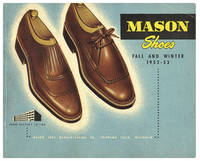
195241618Chippewa Falls WI: Mason Shoe Manufacturing Co 1952. First Edition. Very good . An illustrated wholesale catalog of leather mens and ladies footwear and outerwear from the Mason Shoe Manufacturing Company of Chippewa Falls WI. Generously illustrated in color throughout with detailed product descriptions and model numbers that correspond to the original price list in front. Of note is a four page spread of men's leather coats including "The Racer" a classic motorcycle-culture jacket with multiple zippers straps and buttons. Wraps. Oblong 4to. Color illustrated wraps. Mild handling wear. Faint creasing to wraps. Overall sound clean. 112pp. Mason Shoe Manufacturing Co unknown
195346794New York: McGregor Doniger ca. 1953. Elephant folio. 19 x 28 in colour poster expertly mounted on linen backing with 1.5 in. border around the entire poster NF copy. A wonderfully rendered advertisement which was intended for men’s sportswear and jackets sold by the McGregor-Doniger company as part of their Color of the Hebrides campaign in 1953. The image shows the model dressed in the Hebrides Mustard-coloured corduroy suit with blue & gray tartan vest & lining against the backdrop of Lewis Island with the bold McGregor company name in tartan colours at the lower fore-edge. The McGregor company was founded in 1921 by David D. Doniger a hat-maker and tailor from Scotland who left the family clothing business to establish himself in the United States. He focused on sportswear clothing that was both comfortable but also with fabrics colours and styles which were chosen to compliment one another. The McGregor line became the epitome of Preppy fashion during the 1940s and are perhaps best remembered for the red Anti-Freeze jacket worn by James Dean in the 1955 Rebel without a cause. McGregor Doniger, hardcover
195346793New York: McGregor Doniger ca. 1953. Elephant folio. 19 x 28 in colour poster expertly mounted on linen backing with 1.5 in. border around the entire poster NF copy. A wonderfully rendered advertisement which was intended for men’s sportswear and jackets sold by the McGregor-Doniger company as part of their Color of the Hebrides campaign in 1953. The image shows the model dressed in the coat against the backdrop of the Isle of Skye with the bold McGregor company name in tartan colours at the lower fore-edge. The McGregor company was founded in 1921 by David D. Doniger a hat-maker and tailor from Scotland who left the family clothing business to establish himself in the United States. He focused on sportswear clothing that was both comfortable but also with fabrics colours and styles which were chosen to compliment one another. The McGregor line became the epitome of Preppy fashion during the 1940s and are perhaps best remembered for the red Anti-Freeze jacket worn by James Dean in the 1955 Rebel without a cause. McGregor Doniger, hardcover
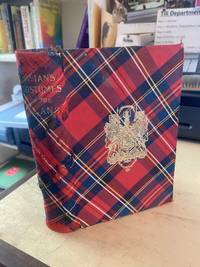
189960273David Bryce and Son Glasgow 1899. Later Edition. Hardcover. Good Condition. Illustrator: R. R. McIan. Size: 12mo 6 3/4 - 7 3/4". 343 pp. Internally clean. Binding firm spine worn. All edges gilt in good condition. Covers slightly worn. Corners bumped. Illustrator: R. R. McIan. Quantity Available: 1. Shipped Weight: Under 1 kilogram. Category: Genealogy & Local History; Scotland; Fashion Fabrics & Style. Pictures of this item not already displayed here available upon request. Inventory No: 60273. . David Bryce and Son hardcover
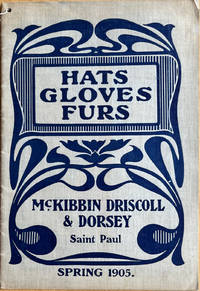
190562191St. Paul MN: McKibbin Driscoll & Dorsey Broadway and Fifth Streets St. Paul Printing Co. 1905. Tall 8vo. 27 1 pp. With text illustrations photo illustrations throughout. Gray decorated softcovers Arts & Crafts cover art & lettering in blue factory & warehouse & offices depicted on back cover small hole punch at upper left corner w/ gray silk braid as issued minor chipping to couple corners minor age-toning to fore-edges still a VG- copy. First edition of this surprisingly scarce Progressive-Era catalogue for the storied company founded originally in 1888 by McKibbin 1856-1941. This catalogue offers McKibbin Stiff Hats bowlers soft-brimmed Western hats such as the Columbia Dakota Manitoba & Railroad along with several Fedora hats. Advertised as well is an interesting novelty called the “Pin Wheel Hat†which were marketed in a round box rolled up and sold by the dozen for $ 4.50. Ladies and young women’s hats are included gloves sheep-lined coats and more. McKibbin was an orphaned self-made business man who managed to attend Princeton and Western University before moving to St. Paul where he eventually launched the business in 1888 which he sold in 1926 to T.W. Stevenson Manufacturing. No copies in Worldcat; See: David Pierce Joseph McKibbin Sept. 27 2014 & Men of Minnesota 1902 p. 372. McKibbin, Driscoll & Dorsey, Broadway and Fifth Streets, [St. Paul Printing Co.], paperback
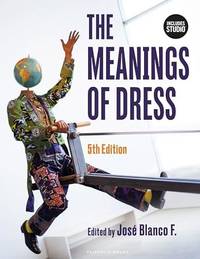
ria9781501391422_inpPaperback / softback. New. New Book; Fast Shipping from UK; Not signed; Not First Edition; Providing insight into a broad and expanding range of topics The Meanings of Dress 5th Edition examines social behavioral and cultural aspects in fashion and dress based on current research and practices. This revised edition respon paperback
1874023291Edinburgh: Neill and Company 1874. Illustrated with five plates two headpieces and a tailpiece pp 16 some foxing throughout otherwise reasonably clean internally marbled endpapers original half morocco and marbled boards slightly rubbed. The title page and facing page are a little marked due to the insertion of a small original photograph till present. RARE. A paper read before the Antiquarian Society of Scotland in March 1873; privately printed a large paper copy with additional illustrations number 6 of only fifty copies. First British paperback edition. Half-Leather. Very Good. Neill and Company Hardcover
19882110502150312133Mainichishinbunsha 1988. Soft Cover. Fine. Volume: 1 Mainichishinbunsha paperback
187454872Boston: C.F. Hovey & Co. 1874. Folio. 13.5 x 11 in. 36 pp. 1 59 1 leaves. first 36 pp. incorporating title Memorandum pages several ALS letters and invoices on letterhead 8 pp. on graph paper w/ samples incorporated into the text 2 additional leaves of tissue thin manuscript copies from blotter 925 original fabric samples pinned-in glued-in and laid in sized from .5 x .5 in. up to 6 x 13 in. including a myriad of colours tartans plaids flannels silk blends cottons poplin cottons woolens etc. Original plum-coloured factory sample book purchased by Hovey from stationer P.L. Morin Paris who specialized in producing blank scrapbooks for factory sample cards printing & stationery registers w/ label mounted on front pastedown worn rubbing spine perished hinges loosed somewhat shaken still a remarkable unsophisticated exemplar preserved in folding case. This exceptional Victorian fabric sample order book assembled by a buyer for C.F Hovey & Co.’s fall fashion season furnishes an invaluable time capsule of colours textures and preferences in the 1870s. This era in women’s fashion driven by Parisian and other European design houses demanded extraordinary amounts of fabrics with an emphasis on the back of the skirt long trains and fabric draped up into bustles with an abundance of flounces and ruching. More significantly there was a tremendous growth in patterned poplin fabrics bright cotton & silk fabric blends as well as brilliant jewel colours. This order book with hundreds of different samples also offers a fantastic peek into the Victorian obsession with tartans and plaids driven by the mystique and example of Queen Victoria the ever-growing popularity with the historical romances of Sir Walter Scott celebrating the Highlanders and the poetry of Robert Burns. Tartan and plaid patterns were used in gowns dresses shawls veils hats purses and many fashion houses would often choose a particular clan pattern to celebrate and promote in their sales literature. Men’s suits coats and jackets were buttoned high on the chest the woolens became lighter weight and more durable as well of better quality and fashion designers for Hovey & Co. also incorporated rough finish woolens twills and tweeds into their clothing offered for sale. Many of the fabrics were also sold in Hovey & Co. fabric department in assorted lengths as well as ends for uses by Victorian women in home craft projects. Johnson focused on buying in the major wholesale textile dealers and markets of Europe during the 1870s including Stavert Tigomala & Co. one of the largest textile commission houses in Bradford UK; Firth Booth & Co. who specialized in bright cotton poplin plaids tartans wool blends and moire; Chamberlin Donner & Co. of Manchester one of the largest wholesale merchant houses shippers & traders in the British Empire; A. Van Bergen & Co. in Paris France whose beautifully patterned cotton and silk blends and woolens were enhanced by the award-winning dyes of Blanche at Puteaux; Les Fils de Th. Le Grand with wool blends twills and rough finish woolens. The sizes of the orders were remarkable and show the strength of Hovey’s customer base with one pair of invoices showing orders from Firth Booth & Co. totaling £ 7785 or over £ 855000 in present day value. However as evidenced by letter from Charles Kretschmann in Berlin who notes that Johnson in his June 24 1874 visit was “not pleased with the Berlin style of garments for this season and ordered only a very small lotâ€C.F. Hovey & Co. was founded by Charles Fox Hovey in 1833 as a dry goods merchant and with in a few years became a large department store located on Summer St. Through the years up to his death in 1859 he brought on many partners and was an ardent abolitionist and supporter of women’s rights establishing the Hovey Fund. After his death in 1859 Thomas Mack and Augustus De Puyster took over the running of the company and expansion through the Civil War. Johnson 1839-1927 was a Harvard grad clerk for Hovey & Co. and Civil War Veteran who rose from 1st Lieutenant in Co. H. Massachusetts 44th Infantry to Full Adjutant before mustering out right before Gettysburg. Hovey & Co. survived the massive fire of 1872 by employees soaking all the woolen blankets on the sales counters in water and placing over the roof and windows to protect the building from the flowing cinders expanded into store fronts on Chauncy and Avon Streets and was the first retailer to adopt the policy of requiring monthly payments on credit accounts. See: The History of the House of Hovey 1919; Charles Boston Looking Back at C.F. Hovey’s of Boston Shopping Days in Retro Boston May 6 2011; History of Fashion 1840-1900 Victoria and Albert Museum 2016. C.F. Hovey & Co., hardcover
196961745Portland & Pendleton OR: Pendleton Woolen Mills Feb. 1969. 4to. 9 x 11.25 in. 176 pp sections all separately paginated. on tinted paper illustrations throughout tan coloured printed section dividers thumb tabs at fore-edges. Colour-illustrated softcover post-binder screw at gutter margin 3-ring hole punched as issued minor creasing edgewear minor edgewear to thumb-tabs still a VG copy. First edition thus of this exceedingly scarce wholesaler jobber price list illustrating and presenting Pendleton Woolen Mills Mid-20th-Century fashions for men’s Shirts Light Jackets Robes Accessories Slacks Jackets Outerwear Outdoor Wear Boyswear Sweaters and Knit Shirts. In the 1960’s Pendleton was well-known for their Sir Pendleton shirt line-up of flannels for men including the Board Shirt used at the time by California surfers over a layer of petroleum jelly as an improvised wetsuit in the early days of the surf scene. The Pendletones rock band actually adopted their name in honor of the surf uniform of Pendleton shirts worn over t-shirts with khakis and later changed their name to the Beach Boys featuring Brian Dennis & Carl Wilson Mike Love and Al Jardine. The Worsted Yarns used in Pendleton men’s fashions at the time were tightly twisted and gave them a resilient luster. The company has even recently revived in 2024 the classic Board Shirt first seen in the plaids of the late 1960’s. No copies in Worldcat; See: Iconic Styles Pendleton Woven Issue No. 7 2024. Pendleton Woolen Mills, paperback
19672111902153101481KK Sportswear 1967. Soft Cover. Fine. Volume: 1 KK Sportswear paperback
19662111902153101831KK Sportswear 1966. Soft Cover. Fine. Volume: 1 KK Sportswear paperback
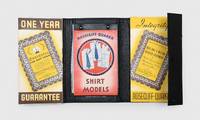
1938162513New York: Rosecliff-Quaker Corp. 1938. First in the field with the newest styles An ephemeral window onto menswear retailing in FDR's America offering the dream of personalized tailoring at an affordable cost. The Rosecliff-Quaker Corporation boasted that it employed 10000 people coast to coast used only unionized labour and guaranteed its shirts for a year. Octavo 214 x 120 mm. Original leatherette wallet binder unfolding to 214 x 460 mm two folding printed card advertising panels with mounted fabric samples 20 tie and 27 hosiery 50 shirt fabric samples each 170 x 120 mm in post-binder with four interleaved printed advertisements central panel lettered in silver. Occasional old pencil annotations. Binder sturdy and still fresh all samples present occasional offsetting and soiling to card panels majority of shirt samples with original paper information slips crudely removed with resulting paper residue. A very good example. hardcover
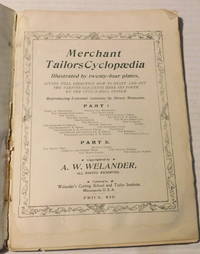
1900100530<p>Minneapolis: Welander's Cutting School and Tailor Institute circa 1900. 1900. Fair. - Small quarto 10-5/8 inches high by 7-3/4 inches wide. Softcover bound in light tan wraps titled within an illustration on the front cover and with an advertisement & price list on the rear cover. The covers are quite stained and the corner of the front cover & the spine are chipped. 51 & 1 pages illustrated with a portrait frontispiece and 23 full page patterns. There is damp staining along the edges of several pages and a tiny perforation through the first 4 leaves. The frontispiece is detached but present with chipping and heavy damp staining to the front edge. There is additional staining to a few pages. Good.</p><p>RARE and not surprisingly so as the price printed on the title page is 10 dollars.</p><p>"During my travels and observations abroad and in this country where I met the best professionals in the trade I had an opportunity to find out that a work on unusual garments such as could not be committed to memory and which were utterly impossible to produce at all by many cutters on account of its lapse of time between such garments were made. From my early recollections as a merchant tailor I had experience of the same kind but could find no work published that met this demand.I decided to compile a work that should cover the scientific production of unusual garments worn by men and in 1898 decided to publish such a work at a later date." - from the "Author's Preface".</p> Minneapolis: Welander's Cutting School and Tailor Institute, circa [1900]. paperback
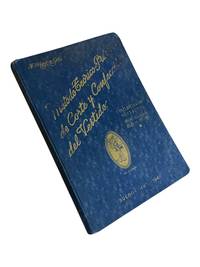
19408804Buenos Aires: Lopez and Co 1940. Fifth edtition. 4to 5 333 v 1pp. Text in Spanish with index at rear illustrations diagrams cut-out patterns throughout one folding. Publisher's shell patterned blue cloth stamped in gilt. First 40 or so pages lightly damp stained around edges and with rippling. Spine gilt worn away corners bumped still a very good sound and complete copy. <br /> <br /> Very uncommon technical treatise on dress making by F. Marti de Gili who is described on the title page as the Founder and Director of the Barcelona Women's Technical Institute and contributor to European and American fashion magazines. The book is copiously illustrated with over 1300 drawings and patterns all new and original. <br /> <br /> OCLC listings seem to indicate this book was published under various titles and likely heavily revised each time to keep up with the fashion between 1935 and 1962. There are perhaps 10-12 holdings in total for the various titles and we find no holdings for this 1940 edition. Lopez and Co unknown
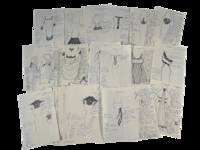
1950218271950. Unknown designer fashion illustration archive circa 1950s-1960s documenting women's garment design and construction practices in the mid-twentieth century. The material operates in Cultural/Representational Mode illustrating the aesthetics technical processes and stylistic evolution of women's fashion during the postwar and early modernist period and offering insight into how clothing design was conceptualized drafted and annotated at the working level. The archive reflects shifting silhouettes and decorative approaches associated with mid-century fashion including structured postwar forms and emerging streamlined influences.<br /> Archive comprises over 100 original fashion illustrations each executed in ink on sheets measuring approximately 6.5 x 9 inches. The drawings depict a range of garments including cocktail dresses coats suits blouses and eveningwear with attention to silhouette drapery and surface embellishment. Many sheets include handwritten annotations in cursive along margins and versos detailing construction elements such as measurements fabric choices and stylistic variations. Examples include labeled designs such as "cocktail dress" "coat" and "suit" with notes specifying features like "turtle neck - bare cut out - colors - gold" and "square low neckline with studded pearls. colors - purple - gold." The annotations suggest iterative design thinking with references to materials color palettes and structural adjustments indicating use as a working portfolio rather than presentation-only sketches.<br /> This archive provides detailed evidence of mid-century fashion design practices at the level of individual garment planning bridging artistic representation and technical instruction. The combination of visual sketches and written notes demonstrates how designers translated aesthetic concepts into wearable forms contributing to the study of dressmaking textile use and women's fashion history during a period of stylistic transition. The volume and consistency of the material suggest sustained use potentially within a professional or training context. Light wear and minor handling marks; overall very good condition. A substantial working archive illustrating mid-twentieth-century women's fashion design and construction methods. unknown
192758104New York: B. Altman & Co. Fifth Avenue July-August 1927. Tall 8vo. 7 x 11 in. 46 pp. Illustrated throughout. Colour-illustrated sofcovers stylish Art Deco cover art of flapper woman in stylish hat with cocktail on ocean liner beach fashions on back cover minor dustsoiling shelfwear minor bumping at couple corners still VG copy. First edition of this nicely printed and quintessential Flapper Era in-house fashion magazine and catalogue for B. Altman. Filled with novelties accessories and designs targeting the young flapper along with encouraging the Negligee for every mood marketing summer vacation items such as cameras photo albums even a portable sun dial. Worldcat locates 3 incomplete and broken run holdings of the Altman Magazine Mint Museum U of RI UVA. B. Altman & Co., Fifth Avenue, unknown
ria9789464366297_inpHardcover. New. New Book; Fast Shipping from UK; Not signed; Not First Edition; In MIRROR MIRROR – Fashion & the Psyche MoMu – Fashion Museum Antwerp and Dr. Guislain Museum examine how fashion psychology self-image and identity are connected. The personal experience of the body is the main theme of this une hardcover
44788795-nnew. unknown
44788795like new. unknown