232 résultats
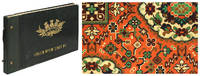
1947173559Zurich: Amstutz Herdig & Co 1947. 2nd Edition. Hardcover. VG-. Oversized brown cloth boards with gilt stamped lettering with two ivory clasps. 12 pages. Eight facsimile reproductions in color. "The orignials of these pictures are painted on paper and silk in the water-colour technique customary only in China. They form part of The Lin Shih-Lu Collection at Foochow and are reproduced with the permission of their owner all except No. 8 appearing for the first time. The Chinse title was written by Professor Lin Chun: 'From the Shih-Lu Collection.' The red stamp on the third page is the stamp of the Lin family of Foochow: 'The Descendants of The Yin House.' This book was awarded a prize at the 1944 Swiss Book Exhibitino for the Artistic Excellence of its Production." Amstutz, Herdig & Co hardcover books
1930108256Oblong 4to. Paris: A. Roques & Fils circa 1930s. Oblong 4to. 2 78 leaves of color linoleum samples with a price list. Bolted quarter green cloth with snakeskin pattern green paper boards stamped in gilt rope handle at the backstrip. Edges of both boards are slightly rubbed mostly at the corners internally bright; very good. § A beautifully bound trade catalogue with 78 bright linoleum samples. A dizzying compilation of French floor coverings of the period varying from art deco to mosaic patterns and many meant to imitate tapestries. A. Roques & Fils hardcover books
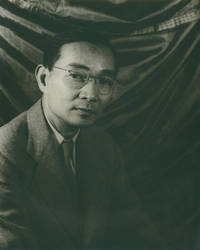
1939219052New York 1939. Bust portrait of the author. Gelatin silver print. 1 vols. 35.3 x 27.7 cm. approximately 13-7/8 x 11 inches. Fine. Docketed on verso in ink giving the name of the sitter the date of the session and the reference to negative and print "X - 9 - 17". Bust portrait of the author. Gelatin silver print. 1 vols. 35.3 x 27.7 cm. approximately 13-7/8 x 11 inches. unknown books
1937140941118New York: John Day in association with Reynal & Hitchcock 1937. Signed Limited First Edition. Near Fine. First edition first printing; limited issue. Copy number 9 of a limited 500 signed by Lin Yutang. Specially bound in publisher's original buckram cloth stamped in red over red leather spine decorated in gilt with gilt-lettered title label; top edges gilt and with red ribbon marker; in publisher's original red paper-covered card slipcase with bronze paper title label on front panel printed in red black and white. Near Fine with some darkening and light edge wear to leather spine in a Near Fine slipcase with light rubbing and wear and light darkening. One of the influential Chinese author inventor philosopher and linguist's best-selling work. John Day in association with Reynal & Hitchcock unknown books
1845583371845. Bogota 1845. First edition. Bogota 1845. First edition. The "Celebrated" First Digest of the Laws of Colombia Colombia. Pombo Lino de 1797-1862 Editor. Recopilacion de Leyes de la Nueva Granada Formada I Publicada en Cumplimiento de la Lei de 4 de Mayo de 1843 I por Comision del Poder Ejecutivo por Lino de Pombo Miembro del Senado. Contiene Toda la Lejislacion Nacional Vijente Hasta el Ano de 1844 Inclusive. Bogota: Imprenta de Zoilo Salazar Por Valentin Martinez Febrero 1845. iv xxvi 541 pp. Text in parallel columns. Folio 12" x 8". Contemporary calf gilt fillets to boards lettering piece and gilt ornaments to spine ribbon markers marbled endpapers. Some rubbing with wear to spine ends and corners. Large woodcut arms of Colombia to title page internally fresh. $1850. This is the first digest of Colombia's laws since the nation became independent in 1821. It also includes the texts of treaties with England the United States France and the Netherlands with parallel translations. "By virtue of the laws of May 4 1843 and June 12 1844 the Congress of New Grenada Colombia specified the statutes then in force and ordered their compilation a task which was entrusted to senator Lino de Pomba. This celebrated collection popularly known as the Recopilacion Granadina contained the extant legislation from 1821 to 1844 inclusive arranged under appropriate headings and was a work of high merit for its time": Backus and Eder A Guide to the Laws of Colombia 125. unknown books
6797Many full-page woodcut illus. Nine columns per page; 20 characters per column. 21; 32 folding leaves. Two vols. incl. addendum. 8vo orig. wrappers remains of block-printed title labels on upper covers. Osaka: Bun'eido 19th century or earlier. This book presents several mysteries. The title-page states "Seppu shoshi Bun'eido shi" "Osaka publisher Bun'eido published this book". In spite of this the book has all the qualities of a Chinese publication: the text paper and wrappers are clearly Chinese. There is no colophon. It would seem that this book was printed in China for the Japanese market. The history of the literati scholar in China dates back to the Tang and Song dynasties A.D. 618-907 and 960-1279 respectively when the court implemented meritocratic civil exams for the selection of bureaucratic officials. The tests assessed the candidates' knowledge and ability in a wide range of subjects including Confucian thought law agriculture and the arts especially calligraphy painting and music. An entire class of intellectual and artistically trained scholars was thus created many of whom built studios filled with beautiful calligraphy and painting tools furniture musical instruments implements for preparing and consuming tea and wine and antiques. The two authors Lin active 13th century and Luo active 1254 compiled this collection of instruments and objects necessary for the studios of the fashionable literati connoisseurs well-versed in all the arts. The text originally appeared as part of the great Shou fu a large anthology of philosophical works commentaries on poetry and essays on culture. The verso of each folding leaf has a full-page woodcut of an instrument used in calligraphy and painting: a brush with cap cake of ink paper in rolls an inkwell a vessel to hold water shells and minerals to be admired a knife rulers scissors a seal a tray to hold instruments a container to hold red ink for corrections screens a light source a box to carry brushes brooms stone weights needles used in binding a board game an ornate antique sword a mirror bow and arrows utensils to prepare pigments arm rests and a number that we cannot determine. On the respective following recto page is a description of each object. The addendum in the second volume was written by Yuanqing Gu 1487-1565 a bibliophile from today's Changzhu in Jiangsu province. He had a large collection of books and was the editor of a treatise on tea by Chunnian Qian active ca. 1530-35. In this section of the book the format changes and has images on the verso with explanatory text on the facing pages. There are illustrations of screens porcelains ornate fly swatters a flute a cane a jade bell an inkwell etc. Nice set of an extremely rare book; we find another set at Kyushu University only. The wrappers of each volume are wormed with careful repairs. The first and final few leaves of Vol. I have some mostly marginal worming. Vol. II has some unimportant worming. unknown books
92110001Edo 1750 Suharaya Mohei. Large folding map 170 x 200 cm. old mended worming rebackedpastel colors Japanese reprint of a map printed in Henan in 1679 folds down to be 21.5 x 25.5 cm. woodblock printed hand color. V E R Y R A R E ! . . AN EXCEPTIONALLY RARE WALL-SIZE MAP OF CHINA . . EXECTED BY A SHAOLIN ZEN MASTER The Shaolin Xi Monastery/Temple is a Chán Zen Buddhist temple at Song Shan near Zheng Zhou City Henan Province in Dengfeng China. It was led by Venerable abbot Shi Yongxìn. founded in the 5th century the monastery has been famous for centuries its association with Chinese martial arts and particularly with Shaolin Kung Fu. It is also a Mahayana Buddhist monastery perhaps best known to the Western world. . The Shaolin Monastery and its famed Pagoda Forest were inscribed as a UNESCO World Heritage Site in 2010 as part of the Historic Monuments of Dengfeng. Extracted from Wikipedia. . A RARE EDITION: Reprinted and published in Japan by Katsuragawa Hosan in 1750 reproduced from the Chinese original of Kangxi 27 1679. The original Chinese edition has been exceptionally obscure and impossible to come by for over the last two-hundred years and is believed now to be lost to posterity. . PRINTING TECHNIQUE AND THE PAPER: The work is woodblock printed by hand on hand-made Washi paper then hand-colored in delicate pastels. . CHINESE VIEW OF ANCIENT CHINA: This grand scale work covers a very large space and is quite handsome suitable for framing and display. The map shows a full view of all of China from the Great Wall in the North Shanghai the East coast down to the oceans in the South and Hainan Island and the coasts along he Eastern shores. This is a spectacular work showing each province in pastel colors with outlines large numbers of place names rivers & the major waterways mountains named and located. By and large inspired to show all of the known lands considered a part of China delineating the country and its exterior boundaries. . Japan and other islands are not shown but boxes with notes in Chinese as to their existence and location are well documented. The lower portion has text discussing the population of the various provinces and other notes. Areas beyond the traditional lines of China i.e.: North of the Great Wall and to . RARITY OF THE MAP AND ITS MAKERS: This grand-scale and truly spectacular work is virtually never found on the market. The Shaolin Monastery monks were the original founders of the celebrated and now famous Kung-fu martial art school located in Henan province. The priests were legendary and the most feared for their martial art prowess. They were also covert with their powerful political force in China. . SHAOLIN SI TEMPLE/MONASTERY LEGENDARY CUSTOMS: Priests who passed the highest level of Kung-fu martial art were invited to participate in a recognition ceremony. They were allowed to self-brand themselves by picking up a red-hot iron brazier that had long temple dragon decorations on the sides. The branding was accomplished by clamping the brazier between their forearms until the dragon image was branded on them. These brazier dragons are identical to the long dragon found at the top of this historic map. Another ancient practices used was the Jieba. It is an ancient ceremony where nine marks are burned onto the head with sticks of incense. In 2007 the Chinese government partially lifted the 300-year ban of the Jieba allowing the the mentally and physically prepared to participate in the ancient tradition. Incense or moxa was used on top of the shaved head and burned in a ceremony of dedication to the Shaolin Si temple/monastery by the most skilled of martial artists. WHY THE DRAGON SYMBOL WAS USED BY SHAOLIN MONKS: The top of the map show the dragon as a symbol of the Shaolin Si. In China the dragon is the first of twelve zodiac animals and is the most powerful of all and represents the ultimate and greatest of all powers known. It is also the one and only legendary animal in the zodiac the rest are actual animals. Because this map was conceived of carved and printed at the Shaolin Xi monastery or temple by these very priests they put the most powerful symbol at the top a dragon. The symbolic meaning indicated that China was superior to all other nations. It was also a private pun by the Shaolin priests indicating for all to see and know that the Shaolin temple and its priests were above all others. Additionally it reminded and indicated that the Shaolin priest were the most powerful martial artists and covert political force in all China. . RARITY: The original Chinese edition has been exceptionally obscure and impossible to come by for over the last two-hundred years and is believed now to be lost to posterity. Shaolin Si temple/monastery imprints are very R A R E ! Few references or examples exist of their woodblock printed works. This edition was a copy of the original re-carved by the Japanese and reissued. Not only is this map of great interest to Chan Zen Buddhists Shaolin Kung-fu collectors martial artists and historians but to students of Chinese cartography collectors and museums. . CONDITION: The map has been professionally re-backed in its distant past due to the large amount of old worming. It is now solid and stable. Because of the rarity of this work a complete map found in any condition would be now considered exceptionally R A R E ! Please review images posted to our website to observe the restored condition. . THE COVERS: The map has been rebound in non-original paper covers perhaps about 100 years ago. It is contained in a brown cloth Chuan Chitsu folding slipcase with ivory clasps cloth a bit faded one edge a bit worn else clean & solid. . THE SCANS: While we have made efforts to take good digital photographs and scans of our copy due to the exceptionally large size of the map these photos are not of the highest quality. We therefore are additionally using copies of this map from the Oda reference book illustrations as samples of what the map is like. Please note the following digital images are from Oda: cover.jpg illus08.jpg & illus12.jpg the balance are from our digital camera. . Any client who purchases this map may be interested in the Japanese text found in Oda. Upon request we are happy to provide a copy of his entry. . BIBLIOGRAPHY: G. Beans: A LIST OF JAPANESE MAPS OF THE TOKUGAWA ERA Supplement A on p.14 as #1750.1 with confirmation date of 1750. Beans gives this the title: "THE BEST COLLECTION OF ANCIENT AND MODERN WORKS CONCERNING THE HISTORICAL EVENTS THROUGHOUT THE DYNASTIES BY THE MONASTERY OF SHAO-LIN." T. Oda: THE WORLD IN JAPANESE MAPS UNTIL THE MID-19TH CENTURY p.52-53 item #24 for 2 excellent color examples. Oda shows the Japanese title: REKIDAI JISEKI ZU: HISTORICAL MAP OF CHINA reproduced from the Chinese original of 1679 by Katsuragawa Hosan 1750. Beautifully reproduced here in full color. Meir Shahar: The Xiaolin Monastery: History Religion and the Chinese Martial Arts. Wikipedia: http://en.wikipedia.org/wiki/Shaolin_Monastery Color scans of this and most items are posted to our web site. . hardcover books