2 624 résultats
002966L.A.S., [Paris], 24 juin 1835, 1p in-8 (19 lignes). Elle écrit à Edouard Robert, directeur du Théâtre Italien, à propos des chaussures de la Comtesse Alfred et de la Comtesse Arthur. Il y a eu, lors de l'envoi des paquets, un mélange qui fait que les souliers de la comtesse Alfred doivent être dans le paquet de la comtesse Arthur, cela a été confirmé par la couturière Mademoiselle Victorine. Il s'agit de « 2 paires de souliers demi-bottes avec de la frange et à gros liège ». Nous n'avons pas trouvé pour quelle pièce étaient ces souliers mais une note indique « pièce quatre-vingt-huitième acte premier ». Les demoiselles Melnotte étaient de célèbres chausseuses de Paris et mademoiselle Victorine une célèbre couturière. Des premières, on dira encore en 1851 : « Quelle élégante de nos jours ne tient pas à être chaussée par Meyer, Dufossé, Melnotte, ... ». Intéressant document.
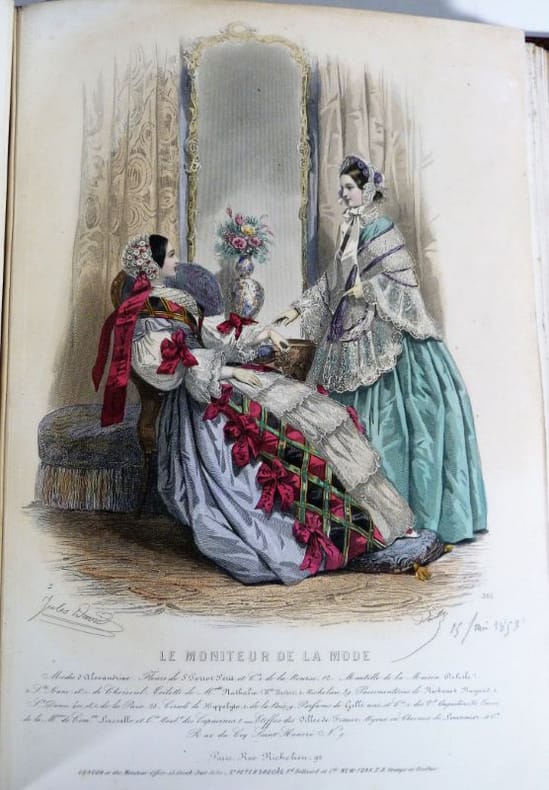
18522368[Paris], sans éditeur, 1852-1853. In-4 - 20,5 x 29,5 cm. Reliure de l’époque en demi-chagrin maroquiné rouge, dos à 5 nerfs orné du titre, des dates et de fleurons dorés, plats de papier marbré. (1 f.), 1 f. « 1852 » (titre manuscrit) ; (4 ff. bl.) ; 2 ff. ; 64 gravures ; 1 f. « 1853 » (titre manuscrit) ; (4 ff. bl.) ; 2 ff. ; 78 gravures. Ce fort volume au titre sobre est un très intéressant album de gravures de modes en couleurs, qu’un amateur (ou une amatrice !) a minutieusement rassemblées à partir de diverses publications du XIXe siècle. Le recueil contient précisément 142 illustrations, toutes montées sur onglets, quelques-unes dépliantes. Le titre de la revue ou la date de parution ne figurant pas sur certaines planches, ils ont parfois été indiqués au crayon. Après chaque titre manuscrit, « 1852 » et « 1853 », suivi, 2 ff. imprimés, « Les Modes Parisiennes illustrées, Journal de la bonne compagnie », Trente et unième année, Paris, Chez le Successeur d’Aubert et Cie, correspondant aux chemises de livraison des « 8 août 1874 - N°1606 » (biffé et remplacé à la plume par « 1852 – 463 à 514 ») et « 15 août 1874 – N°1607 » (année barrée et remplacée à la plume par « 1853 – 515 à 567 »). L’ensemble témoigne de l’importance accordée à la qualité de l’illustration par la presse de mode du XIXe siècle : qu’il s’agisse du papier, des techniques employées (début de la gravure sur acier et mise en couleurs), ou des artistes dessinateurs, graveurs et imprimeurs signataires des planches (tels que Jules David, dessinateur exclusif du Moniteur de la Mode durant cinquante ans ou François Claudius Comte-Calix, qui œuvre notamment pour Les Modes parisiennes et Le Petit Courrier des Dames, l’image participe pleinement aux stratégies éditoriales des revues, dans un contexte de plus en plus international et concurrentiel, tandis qu’elle sert les ambitions publicitaires des maisons de couture. En outre, cette exceptionnelle réunion de modèles de vêtements (féminins et masculins) permet de cerner les principales tendances de la mode du début du Second Empire. Le goût toujours marqué pour le XVIIIe siècle à la Pompadour se modernise grâce à de multiples innovations induites par les progrès techniques et l’industrialisation (augmentation du volume des jupes, apparition de la crinoline, des « cages » en fanons de baleines puis en métal et textile, invention de la jaquette) et à l’adaptation des tenues aux besoins nouveaux de la société bourgeoise, plus mobile, mondaine et élégante : c’est l’âge d’or des robes à transformation, dont le corsage peut être modifié au gré des nécessités du jour ou du soir, qui se parent de volants et garnitures (style tapissier), de teintes vives, ne négligent pas les effets de matières et s’agrémentent d’accessoires (bottines, ombrelles, bonnets…) indispensables pour définir le chic de l’ époque. Enfin, la mise en scène soignée des toilettes présentées et l'usage de nombreux attributs (enfants, animaux, objets) laissent augurer des développements ultérieurs de la publicité dans ce domaine. Les gravures sont issues des revues suivantes : - Le Bon Ton. Journal de Modes = 12 - Le Bon Ton. Modes pour Longchamps = 1 - Les Modes parisiennes = 27 - Le Moniteur de la Mode = 28 - Le Follet = 1 - Modes de Paris (cursives). Petit Courrier des Dames = 26 - La Mode = 5 - Journal des Tailleurs = 7 - Le Lion. Journal des nouveautés et des modes d’hommes = 3 - Journal des Demoiselles = 2 - La Sylphide. Journal de modes = 11 - Le Petit Messager. Journal des Dames et des Modes = 6 - Le Petit Messager. Modes de Longchamps = 1 - Le Progrès (planches dépliantes) = 3 - El Correo de Ultramar = 2 - La chronique de France = 1 - Modes de Paris (cursives). Journal des Tailleurs = 1 - L’Elégant. Journal des Tailleurs = 1 - Sans titre = 1 - La Presse littéraire. Modes de Longchamps = 1 - Musée des Dames et des Demoiselles = 1 - Le Coupeur. Echo de l’Elégant et du Lion (pl. dépl.) = 1 Nombre total de planches = 142
234928[Paris], Lithographie de Engelmann, s.d. (1834) in-8, 44 planches lithographiées regroupant 130 figures de costumes masculins, broché sous couverture de papier fantaisie du XXe siècle. Des mouillures claires infra-paginales à la fin de l'opuscule.
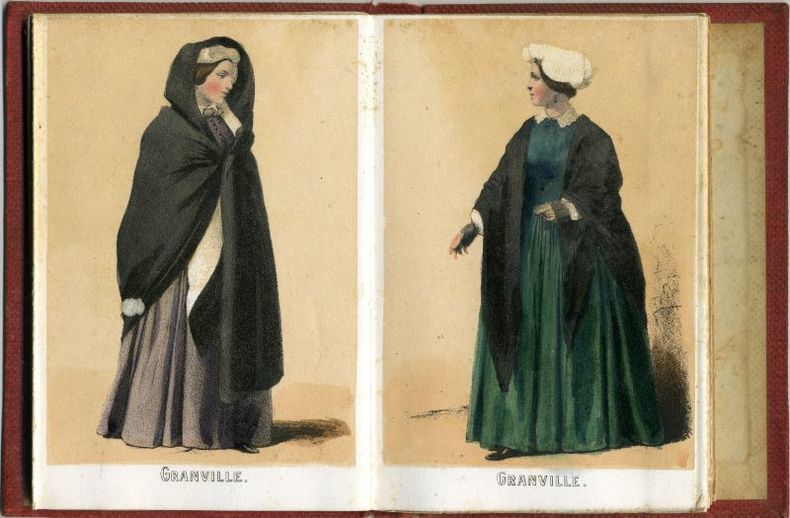
18605755SINNETT 1860 1 Paris, Sinnett éditeur, (1860), in-12, toile rouge éditeur, couverture titrée et encadrée d'un filet doré, 25 planches lithographiées en couleurs réhaussées à la poupée.
200918458Edinburgh and London, W. & A.K. Johnston LDT, 1951 ; in 16, cartonnage de l'éditeur. Thirty-sixth edition - history of each clan and full list or septs.
201805978Strasbourg, Elsassischendruckerei vorm G. FIschbach, 1902 ; grand in-4, cartonnage de l'éditeur. Très bon état reliure un peu frotté - très gros volume - rare - demi-cuir à coin.
1985LFA00e82Un catalogue d'exposition de 64 pages, format 210 x 295 mm, illustré, broché couverture couleurs, publié en 1985, bon état
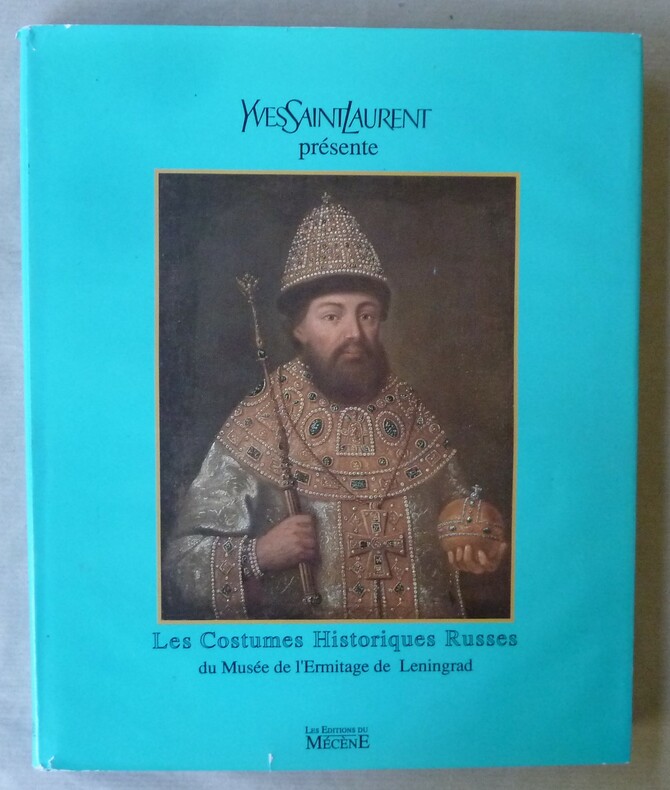
198979381989 Paris, Editions du Mécène, 1989. Un volume de format in 4° de 146 pp.; sur beau papier glacé. Nombreuses reproductions en noir ou en couleurs; souvent en pleine page. Reliure cartonnée de l'éditeur en carton glacé vert; Jaquette illustrée de même.
1880214399Paris.: Firmin Didot et Cie. Circa1880s. Five tinted lithographs on a single sheet highlighted with hand colour and gum arabic 30.1 x 20.7 cms; 36.6 x 25.1 cms sheet margins slightly toned preserved in a modern window mount in very good condition. Attractive costume plates of Thailand South and East Asia. . Firmin Didot et Cie. unknown
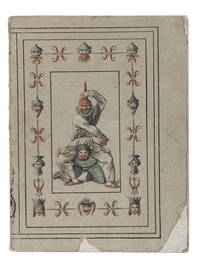
1804E5UG7Z4OCT3NLeipzig 1804. 16mo in 8s 14 x 10.5 cm. Friedrich August Leo Original publisher's paperboards printed from an engraved plate and hand-coloured each board with a costume scene in a decorated frame with caricature faces also with faces and decorations on the spine green paste-downs. With 2 stiff coated leaves at the end apparently intended for writing with a stylus. With 12 numbered engraved plates by Friedrich Wilhelm Nettling all coloured by a contemporary hand each showing several figures in carnival costumes. 31 1 blank pp. Very rare first and only published part of a series of hand-coloured carnival costume plates each of the 12 with a letterpress description in German and French. Only plates 9 and 10 bear the name of the German draughtsman and engraver Friedrich Wilhelm Nettling best known for his portrait of Bach but all may have been engraved by him. The mostly comical or farcical plates illustrate a fairy with her entourage a Chinese man Don Quixote and Sancho Panza a group of beast people and many other extraordinary figures. Two figures in one plate wear funnels as hats like the Tin Man in The Wizard of Oz. Besides the 12 plates in the booklet itself the engravings on the boards show two male figures gymnasts one in a clown-like costume on the front and a dancing woman with a tambourine on the back.With some minor stains and the front of the binding slightly damaged in the lower margin and lower right corner spine cracked. Good copy.l Baumgärtel Die Almanache Kalender und Taschenbücher 1750-1860 der Landesbibliothek Coburg p. 32; Köhring 111; WorldCat 633348944 465355875 3 copies; not in Colas; Hiler; Lanckoronska & Rümann; Lipperheide; for Nettling: Thieme & Becker XXV p. 400. ABE CAT Costumes & Uniforms hardcover
1820D6906N.p. but Germany possibly Liechtenstein c. 1820. Hardcover. Very Good. 4to 245 x 165mm. A compilation of 73 brightly colored watercolors many with manuscript captions in German some are dated for the costume all clipped and mounted into book and illustrating the costumes and attributions of court officials knights Templar Tartar costume St. George on horseback German orders of nobility also for Spain France Holland Italian Turkish Egypt and Babylon and other various orders as in Order of the Garter in England and France and religious dress of ordained and lay members of various orders including German Italian Spanish and Cistercian Carmelite Carthusian Capuchin and Franciscan monks. Also Jesuit pilgrims and sisters of the Benedictine Sylvestrine and Cistercian among other lesser-known orders and historical figures such as Leopold III of Austria and Louis III of Tremoilles. Early 19th-century half calf over imitation silk cloth-covered boards and decorative endpapers spine with label COSTUME; some light foxing most severe at beginning otherwise the colors remaining extraordinarily fresh and bright. Armorial bookplate from the Princely house of Liechtenstein on front pastedown. <br/><br/>Unique compilation of 73 expertly executed hand-colored watercolors of various religious knightly and official orders with a bookplate of the royal arms of Liechtenstein. Each figure is executed with extraordinary talent and is superbly hand-colored in a range of washes; many of these costumes have changed very little and have a history stretching back to medieval times. In the twentieth century an interest in costume and fashion books was spurred on by the dawning Victorian age in England in the 1830s which then spread to the continent. Each picture in this unique set is an individual work of art full of expression and with strikingly attractive faces and gestures. The expert attention given to each work of art strongly suggests this book was a maquette for a larger print-run of a souvenir book of costumes. Captions are in German and early provenance points to possible creation in the principality of Liechtenstein. One can think of the principalitys official motto For God Prince and Fatherland and see how all these official garments best represent a history of European court and important religious connections for an established royal line such as Liechtenstein. Perhaps this book was once in the royal home of the Johann I Joseph Prince of Liechtenstein who had fourteen children and it may have belonged to his son Prince Friedrich Adalbert 1807-1885 who later became the 1018th Knight of the Order of the Golden Fleece in Austria. With interesting connections to the royal house of Liechtenstein and 73 examples of hand-colored historic costumes this truly is a unique survival. hardcover
1823D18682Rome: Luigi Nicoletti 1823. Hardcover. Very Good. 4to 10 1/4 x 81/4 ins.; 265 x 205 mm. Sixty hand-colored plates of military and religious costumes; some light marginal staining to a few plates. Contemporary gilt vellum; upper joint cracked but still holding. Sold as a collection of plates. The hand coloring of the plates especially nice in this copy. Provenance: Robert S Pirie bookplate. <br/><br/> Luigi Nicoletti hardcover
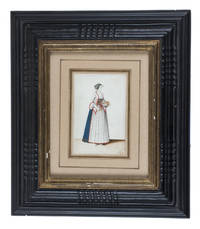
17209AHF2VYD4ZB1Augsburg 1720. Each mounted in a later passe-partout with a gold border in an ebonized wooden frame with a gilt lip glazed 23.5 x 20.5 cm. Four drawings in brown ink watercolour and coloured gouaches on vellum highlighted with gold each 5.9 x 9.0 cm. A matching set of four lovely and delicate watercolour drawings each depicting a young lady in a fancy German costume drawn and painted on vellum by the Augsburg artist Catharina Sperling Heckel 1699-1741. She learned painting and drawing from her father the Augsburg goldsmith Michael Heckel engraving from Johann Ulrich Kraus and married the engraver Hieronymus Sperling 1695-1777 in 1725. It is not clear whether she made these drawings shortly before or shortly after her marriage. She is best known for her ca. 1728 miniature portrait of Charles Edward Stuart Bonnie Prince Charlie the young pretender to the English throne. She never recovered from the birth of her first child in 1741 dying within a few weeks. Each drawing shows a young German lady wearing a long gown and a cap or bonnet but one also carries a hat. The four drawings differ in the style of the gowns and other elements.In very good condition. With a few small chips in the paint of the frame. Lovely watercolour costume drawings of four young German ladies perhaps from a court wedding in the free Imperial city of Augsburg.l Cf. Thieme & Becker XVI pp. 208-209. ABE CAT Costumes & Uniforms hardcover
70448The Netherlands not published ca. 1920. Five original water-colours of 23.5 x 17.5 cm mounted on sheets of 29.0 x 23.5 cm; including three double-sized oblong width 45 cm. In later blind wrapper. = A nice suite of watercolours showing Dutch Amsterdam citizens in their Sunday's suits and dresses. The source of these drawings is unknown. Slight age-toning a few spots but generally in a goood condition. A unique item. unknown
239939[Paris], Imprimerie de Lacrampe, s.d. in-12, 11 pp., dérelié.
181576S.l., s.d. (v. 1860) in-12, 25 vignettes lithographiées, colorisées et gommées, sur un grand dépliant en accordéon, demi-toile chagrinée cerise, dos lisse muet, encadrements à froid sur les plats, guirlande dorée et titre poussé en lettres dorées au centre du plat supérieur, tranches mouchetées (reliure de l'éditeur). Rousseurs.
168816037A Paris, chez Daniel Horthemels, 1688. In-12 de [16]-251-[15] pages, demi-basane beige, dos lisse orné de filets et fleurons dorés, pièce de titre bordeaux. Trace d'ex-libris.
231557(Moitié du XVIIIème siècle) 27 x 17 cm (cuvette) - 27.5 x 17.5 cm (feuille) , Attachée sur feuille en partie gauche. infime déchirure sur le pli de la cuvette.
192414092Paris HACHETTE 1924 1 P., Hachette, 1941, in-8, br., couverture illustrée en noir et blanc, 64 pp.
12713Paris, Société des Editions de "l'Officiel de la Couleur", 1952. 1 volume in folio (26 * 36 cm) sous couverture illustrée, 54 pp., très bon état.
1867768Mame 1867 1 in-folio Paris, imprimerie Mame, 1867, in-folio, en feuilles, sous couverture de papier rose, titre imprimé en noir, 27 pp.
219474Paris, 1773 in-4, un feuillet.
219477Paris, 1776 in-4, un feuillet. Qqs déchirures dans les marges.
219496Paris, 1813 in-8, un feuillet. Petit manque angulaire.
217994Paris, 1778 in-4, un feuillet.