JACQUARD (Albert).-Livre Rare Book
Jacquard (Albert).MareMagnum
Cinq Milliards d'hommes dans un vaisseau.
Un fin volume broché au format poche de 190 pp.; couverture illustrée. Bel état. Voir photo.

Sciardet Daniel · Allemagne8,00 €
400 résultats
1986810081986 Paris, Le Seuil, 1986, in 8° broché, 215 pages ; couvetrure illustrée.
Un fin volume broché au format poche de 190 pp.; couverture illustrée. Bel état. Voir photo.
2007331302007 Paris, Stock, 2007, 13x21, 144pp., couverture souple, très bon état, nouveauté rentrée 2007,
1994833391994 Paris, Ecriture, 1994, in 8° broché, 219 pages ; couverture illustrée.
9052Paris, Seuil, 1982. Coll. "Science ouverte". In-8 broché, couv. ill., 220 p. Fig. in-t. Bon état.
198666400Editions du Seuil , Science Ouverte Malicorne sur Sarthe, 72, Pays de la Loire, France 1986 Book condition, Etat : Bon broché, sous couverture illustrée In-8 1 vol. - 215 pages
199481344Paris, 1994, in-4, 287pp, Reliure éditeur jaquette illustrée, Très bel exemplaire abondamment illustré! 287pp
197034180Paris, 1970, in-8, 392pp, reliure éditeur, Très bel exemplaire! 392pp
11107Plon 28 juillet 1986, in-8 broché, 308pp - très bon état
68975Flammarion 1993, album relié toile avec sa jaquette, 288pp; illustré - très bon état
8363Calmann-Levy 1998, broché avec son bandeau, 190pp; très bon état
CXC72SD
1839461741839. <p>Jacquard Joseph Marie 1752-1834. Portrait in silk of Joseph-Marie Jacquard after an original oil portrait by Claude Bonnefond manufactured by Didier Petit et Cie; woven by Michel-Marie Carquillat 1803-1884 in Lyon France 1839. The image including caption and Carquillat's name taking credit for the weaving is 55 x 34 cm.; the full piece of silk including blank margins is 85 x 66 cm. The visible portion of the image in the frame is 72 x 54.5 cm. and the frame measures 104 x 84 cm. Minor wear from folding barely visible in the image but with the image in clear unfaded and fresh condition. The weaving was professionally treated by a textile conservator whose conservator's report and images of before and after are available. Minor flaws visible in the large outer margins of the silk not affecting the image. In a large and attractive archival frame.</p> <p> This famous image of which only a very few examples are known was woven by machine using 24000 Jacquard cards each of which had over 1000 hole positions. The process of mis en carte or converting the image details to punched cards for the Jacquard mechanism for this exceptionally large and detailed image would have taken several workers many months as the woven image convincingly portrays superfine elements such as a translucent curtain over glass window panes. Once all the "programming" was completed the process of weaving the image with its 24000 punched cards would have taken more than eight hours assuming that the weaver was working at the usual Jacquard loom speed of about forty-eight picks per minute or about 2800 per hour. More than once this woven image was mistaken for an engraved image. The image was produced only to order most likely in a small number of examples. Recorded examples are those at the Metropolitan Museum of Art the Science Museum London The Art Institute of Chicago and the Computer History Museum Mountain View California Musée de Tissus Lyons.</p> <p> The image is the subject of the book by James Essinger entitled Jacquard's Web: How a Hand Loom Led to the Birth of the Information Age 2004. To Charles Babbage the incredible sophistication of the information processing involved in the mis en carte—what we call programming—of this exceptionally elaborate and beautiful image confirmed the potential of using punched cards for the inputting programming and outputting and storage of information in his design and conception of the first general-purpose programmable computer--the Analytical Engine. The highly aesthetic result also confirmed to Babbage that machines were capable of amazingly complex and subtle processes—processes which might eventually emulate the subtlety of the human mind.</p> <p> "In June 1836 Babbage opted for punched cards to control the machine the Analytical Engine. The principle was openly borrowed from the Jacquard loom which used a string of punched cards to automatically control the pattern of a weave. In the loom rods were linked to wire hooks each of which could lift one of the longitudinal threads strung between the frame. The rods were gathered in a rectangular bundle and the cards were pressed one at a time against the rod ends. If a hole coincided with a rod the rod passed through the card and no action was taken. If no hole was present then the card pressed back the rod to activate a hook which lifted the associated thread allowing the shuttle which carried the cross-thread to pass underneath. The cards were strung together with wire ribbon or tape hinges and fan-folded into large stacks to form long sequences. The looms were often massive and the loom operator sat inside the frame sequencing through the cards one at a time by means of a foot pedal or hand lever. The arrangement of holes on the cards determined the pattern of the weave.</p> <p> "As well as patterned textiles for ordinary use the technique was used to produce elaborate and complex images as exhibition pieces. One well-known piece was a shaded portrait of Jacquard seated at table with a small model of his loom. The portrait was woven in fine silk by a firm in Lyon using a Jacquard punched-card loom. The image took 24000 cards to produce and each card had over 1000 hole positions. Babbage was much taken with the portrait which is so fine that it is difficult to tell with the naked eye that it is woven rather than engraved. He hung his own copy of the prized portrait in his drawing room and used it to explain his use of the punched cards in his Engine.</p> <p> The delicate shading crafted shadows and fine resolution of the Jacquard portrait challenged existing notions that machines were incapable of subtlety. Gradations of shading were surely a matter of artistic taste rather than the province of machinery and the portrait blurred the clear lines between industrial production and the arts. Just as the completed section of the Difference Engine played its role in reconciling science and religion through Babbage's theory of miracles the portrait played its part in inviting acceptance for the products of industry in a culture in which aesthetics was regarded as the rightful domain of manual craft and art" Swade The Cogwheel Brain. Charles Babbage and the Quest to Build the First Computer 2000 107-8.</p> . unknown books
1978S7521San Francisco:: Freeman Cooper 1978. 1978. 8vo. 192 pp. Figs. tables index. Two-toned cloth. Fine. FIRST EDITION. Detailed survey of the genetics of human populations that mentions: genetic composition kinship evolution migration mutation genetic markers & synthesis. ISBN: 877354219 Freeman, Cooper, (1978). hardcover books
1978S8022San Francisco:: Freeman Cooper 1978. 1978. First English edition. 8vo. 192 pp. Figs. index. Orange & blue cloth. FINE. Freeman, Cooper, (1978). hardcover books
1984S8023New York:: Columbia University Press 1984. 1984. First English edition. 8vo. ix 187 pp. Figs. index. Yellow cloth dust jacket; jacket with short tear repaired neatly with tape else fine. Columbia University Press, 1984. hardcover books
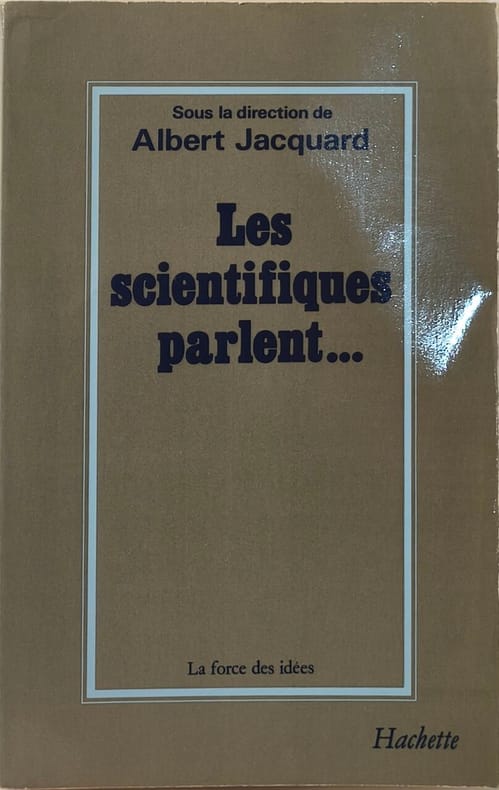
19873595Hachette Littérature 1987 322 pages in8. 1987. Broché. 322 pages. Ouvrage collectif dirigé par Albert Jacquard rassemblant les contributions de scientifiques pour interroger le rôle de la science dans la société et son rapport au pouvoir politique. Le livre adopte une perspective humaniste et critique visant à favoriser une évolution des consciences
1989100048949Seuil 1989 88 pages in12. 1989. Broché. 88 pages.
198455866NY:: Columbia University Press. Very Good in Very Good dust jacket. 1984. Hardcover. 0231054823 . Translated from the French by Margaret M. Moriarty. First American edition. Foxing on edges else very good in a very good fading along the spine dust jacket. . Columbia University Press, hardcover books
198415522NY: Columbia University Press. Near Fine in Near Fine dust jacket. 1984. Hardcover. 0231054823 . Translated from the French by Margaret M. Moriarty. First American edition. Previous owner's name blacked out on front free endpaper else near fine in a fine dust jacket. . Columbia University Press hardcover books
BZG1RT
LN7348Seuil Livre en excellent état : très légère usure de la pointe des coins et du supérieur dos.
A8288Seuil Broché, parfait état
1999100064583Editions Complexe 1999 11x18x1cm. 1999. Broché.