National Learning CorporationBiblio.com

12 649 résultats
083731092X.Gplastic_comb. Good. Access codes and supplements are not guaranteed with used items. May be an ex-library book. unknown
1731857047.Gpaperback. Good. Access codes and supplements are not guaranteed with used items. May be an ex-library book. paperback
0837332222.Gplastic_comb. Good. Access codes and supplements are not guaranteed with used items. May be an ex-library book. unknown
0837331145.Gspiral_bound. Good. Access codes and supplements are not guaranteed with used items. May be an ex-library book. unknown
SONG083731092XNational 2014-12-01. None. plastic_comb. Used: Good. 8.50x0.60x11.00. Buy with confidence. Excellent Customer Service & Return policy. National unknown
201192126Azur Corporation. New. 2011. Hardcover. 4903233618 . FREE UPGRADE to Courier/Priority Shipping Upon Request - IN STOCK AND IMMEDIATELY AVAILABLE FOR SHIPMENT - Flawless copy brand new pristine never opened -- -- with a bonus offer-- . Azur Corporation hardcover
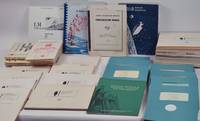
196929710various: various 1969. various. Very Good. Our consignor's father was an aeronautical engineer working for Boeing and assigned to work with NASA on the Apollo program. He did a significant favor for a member of the astronauts office while living in Houston. They asked him what they might do in return. He requested "a full set of Apollo astronaut training manuals" the result of which you see here - 34 items in total. They have remained in the family since. A list of the manuals follows. Many are by the sub-contractors responsible for building the particular systems involved. A remarkable archive. In addition to a letter of provenance from the consignor the archive includes a 1968 Nassau Telephone book showing the previous owner as well as a goodly number of astronauts.<br /> <br /> GRUMMAN MANUALS: The following manuals all state "For training purposes only: In support of LM-5 & Subsequent Subsystem Briefings." and are part of "Contract NAS 9-1100 Exhibit E: Paragraph 3.7.4 Type III Document." They are all three hole punched and held together with dual post "prestong" brand adjustable metal straps with robin blue colored Grumman binder paper with cut-outs for the titles. The metal straps are rusted to varying degrees the paper still bright and clean.<br /> 1 LSG 770-154-6 - LM-5 & Sub. June 1969. "Abort Guidance Section Study Guide Lunar Module LM-5 & Subsequent." Light green paper. No copies OCLC.<br /> 2 LSG 770-430-40 LM-5 & Sub. April 1969. "Instrumentation Subsystem Study Guide Lunar Module LM-5 & Subsequent." Yellow paper. No copies OCLC.<br /> 3 LSG 770-154-7 - LM-5 & Sub. April 1969. "Control Electronics Section Study Guide Lunar Module LM-5 & Subsequent" Light green paper. No copies OCLC.<br /> 4 LSG 770-154-5 - LM-5. April 1969. "Radar Section Study Guide Lunar Module LM-5" Blue paper. No copies OCLC.<br /> 5 LSG-770-154-9-LM-5 & Sub. May 1969. "Propulsion & RCS Subsystem Study Guide Lunar Module LM-5 & Subsequent" Dark green paper. No copies OCLC.<br /> 6 LSG 770-154-4-LM-5 & Sub. May 1969. "Electrical Power Subsystem Study Guide Lunar Module LM-5 & Subsequent" Yellow paper. No copies OCLC.<br /> 7 LSG-770-154-3-LM-5 & Sub. May 1969. "Environmental Control Subsystem Study Guide Lunar Module LM-5 & Subsequent" Tan/orange paper. No copies OCLC.<br /> 8 LSG 770-154-10-LM-5. May 1969. "Lunar Module Structures Handout LM-5" Light grey ash paper. No copies OCLC.<br /> Wikipedia note on the LM-5: "Lunar Module Eagle LM-5 is the spacecraft that served as the crewed lunar lander of Apollo 11 which was the first mission to land humans on the Moon. It was named after the bald eagle which was featured prominently on the mission insignia. It flew from Earth to lunar orbit on the command module Columbia and then was flown to the Moon on July 20 1969 by astronaut Neil Armstrong with navigational assistance from Buzz Aldrin. Eagle's landing created Tranquility Base named by Armstrong and Aldrin and first announced upon the module's touchdown. The name of the craft gave rise to the phrase "The Eagle has landed" the words Armstrong said upon Eagle's touchdown."<br /> <br /> The Grumman manuals below have different wrapper colors but the same metal strap binding.<br /> 9 LSG 770-430. Nov 1967. "Orientation Study Guide Lunar Module" White printed wrappers have ink stamp of "Mutter H.P." White paper internally. No copies OCLC.<br /> 10 LSG 770-430-48 -LM-3. "August 1967. Propulsion and RCS Study Guide Lunar Module LM-3" White printed wrappers. Green paper internally. Inked "Oscar Bernard" on top wrapper. No copies OCLC.<br /> 11 LMA790-1. LMA790-01001C. October 15 1965. Superceeds LMA790-1 dated March 15 1965. "Lunar Excursion Module Familiarization Manual" Exhibit E Paragraph 10.2 NAS 9-1100. Type II Document. Inked in red "Crew Systems" at head of top wrapper with small piece of top wrapper excised. two copies this title OCLC<br /> 12 "Lunar Module Subsystem Assembly and Installations". 52 pages. Printed green wrappers. What appears to be a commercial advertising item rather than a training manual. No copies OCLC.<br /> <br /> GENERAL MOTORS CORPORATION manuals<br /> 1 "Apollo CM Primary Guidance Navigation and Control System Student Study Guide". CSM Digital Autopilots. DAP 2100. June 2 1969. Perfect bound with light blue paper. 3 copies this title OCLC<br /> 2 "Apollo Lunar Module Primary Guidance Navigation and Control System Student Study Guide." LM PGNCS Level III System Mechanization Course SM31000. Dates January 27 1967 Oct 1 1967 and finally Jan 30 1969. Bound with blue plastic comb binding. Blue paper. No copies OCLC.<br /> <br /> NASA MANUALS:<br /> 1 FLIGHT CONTROL DIVISION manual NASA. FC027. 3/15/68. "Lunar Module Systems Handbook Vehicle LM-3" MSC8305-68. 5 hole punched. Not bound. No copies OCLC.<br /> 2 MSC Internal Note MSC-CF-E-68-12. "Photo Equipment for Manned Space Flight Handbook" June 20. 1968. 5 hole punched. Stapled. "Oscar Bernard x-5821" inked on top wrapper and a few inked notes on the bottom wrapper. No copies OCLC.<br /> <br /> NORTH AMERICAN ROCKWELL CORPORATION SPACE DIVISION MANUALS. All note "For Training purposes only". All 11 x 8 1/2 inches.<br /> 1 CSM Logistics Training : Guidance and Control System - Block II May 15 1969. Prefect bound white and blue paper No copies OCLC.<br /> 2 CSM Logistics Training: Sequential Systems EDS SECS LES ELS Course No A-318 Handout No. 1. June 15 1969. Perfect bound light yellow paper. No copies OCLC.<br /> 3 Apollo CSM Logistics Training. Apollo Operations Handbook Subsections 2.2 and 2.3. Guidance and Control. May 1 1969. Perfect Bound blue paper. No copies OCLC.<br /> 4 Apollo CSM Logistics Training. Apollo Operations Handbook Subsection 2.8 Telecommunications. May 1 1969. Perfect bound dark brown paper. No copies OCLC.<br /> 5 Apollo CSM Logistics Training. Apollo Operations Handbook Subsection 2.6 Electrical Power System May 1 1969. Perfect bound yellow paper. No copies OCLC.<br /> 6 Apollo CSM Logistics Training. Apollo Operations Handbook Subsection 2.9 Sequential Systems May 1 1969. Perfect bound tan paper. No copies OCLC.<br /> 7 Apollo Training. Apollo Operations Handbook CSM Preliminary Subsection 2.9 Sequential Systems June 26 1968 Perfect bound light yellow paper some folding on "fax" paper. Ink stamp "Mutter H.P." on top wrapper and spine.<br /> 8 Apollo Training. Structures and Mechanical Subsystems Course Number A-5125. June 13 1969. Perfect bound grey paper. No copies OCLC.<br /> 9 Apollo Training. Block II CSM Propulsion Subsystem. Dec 12 1968. Perfect bound pale green paper. No copies OCLC.<br /> 10 Apollo Training. Electrical Power Subsystem Block II CSM. Nov 1 1968. Perfect bound oblong yellow paper. No copies OCLC.<br /> 11 Apollo Training. CSM/LM Docking and Crew Transfer Block II handout. Apr 15 1968. Perfect bound oblong pale brown paper. Stamp "Mutter H. P." on top wrapper and spine. No copies OCLC.<br /> 12 Apollo Training. Environmental Control System Block II. Apr 1 1969. Perfect bound oblong orange sherbert paper. No copies OCLC.<br /> 13 Apollo Training. Crew Equipment Course A512 C. Jan 1 1969. Perfect bound pink paper. No copies OCLC.<br /> 14 Apollo Training. Crew Equipment Course A512C. June 26 1968. Perfect bound pink paper. No copies OCLC.<br /> #7-14 above show "Apollo Logistics Training" logo on the top wrapper with little or no mention of Rockwell in the document although we believe it is clearly their output given the names physical addresses to use for questions about the documents and production details of the various manuals.<br /> Wikipedia note on the CSM: "The Apollo command and service module CSM was one of two principal components of the United States Apollo spacecraft used for the Apollo program which landed astronauts on the Moon between 1969 and 1972. The CSM functioned as a mother ship which carried a crew of three astronauts and the second Apollo spacecraft the Apollo Lunar Module to lunar orbit and brought the astronauts back to Earth."<br /> <br /> <br /> NORTH AMERICAN AVIATION Inc. SPACE AND INFORMATION SYSTEMS DIVISION manuals<br /> 1 SID 64-1613A GFE Command and Service Module - Manned Space Flight Network Signal Performance and Interface Specificaiton Block II. NAS 9-150 Revised Nov 22 1966. Copy made on "fax" style paper three hole punched with two aluminum screw posts holding the pages together. Another stamp unclear if on the original or here stamped notes Recorded Jul 18 1967 by the Saturn V Data management at the Boeing C. Technical Data Central. Note on orginal document notes 60 8 1/2 x 11 and 20 11 x 17 foldouts presumably. No copies OCLC.<br /> 2 SID 64-1389 GFE NASA Furnished Crew Equipment Performance and Interface Specification Block II. NAS 9-150. Revised Feb 22 1965 Copy made on "fax" style paper three hole punched with two aluminum screw posts holding the pages together. Another stamp unclear if on the original or here stamped notes Recorded Aug 2 1967 by the Saturn V Data management at the Boeing C. Technical Data Central. Note on orginal document notes 164 pages. No copies OCLC.<br /> 3 SID 64-1388. GFE Scientific Equipment Performance and Interface Specification Block II - CM. NAS9-150. Revised Feb 22 1965. Note on original document indiates 51 pages. Stamped upper left rusted one page loose in rear. No copies OCLC.<br /> 4 SID 64-1866. GFE Command and Service Module - Manned Space Flight Network Signal Performance and Interface Specification - Block 1. NAS9-150. January 5 1965. Exhibit I Paragraph 4.1. "Fax" style paper three hole punched with two aluminum screw posts for binding. No copies OCLC.<br /> NOTE: GFE stands for Government Furnished Equipment - where the government would provide equipment to the contractor to assist in their work<br /> <br /> NOTE: The # in the lists above are included solely for convenience of reference. Identifying numbers on the documents if any follow that number.<br /> <br /> Provided with a letter of provenance and the Sept 1968 Nassau Bay TX Telephone Co directory with the consignor's father listed in it as well as a fair number of well known astronauts. various. A remarkable archive of training manuals only a few of which appear in OCLC and only one of which we've seen in the last 20 years. various unknown
0837336813.Gspiral_bound. Good. Access codes and supplements are not guaranteed with used items. May be an ex-library book. unknown
0837352436.Gspiral_bound. Good. Access codes and supplements are not guaranteed with used items. May be an ex-library book. unknown
0837334292.Gspiral_bound. Good. Access codes and supplements are not guaranteed with used items. May be an ex-library book. unknown
0837300185.Gspiral_bound. Good. Access codes and supplements are not guaranteed with used items. May be an ex-library book. unknown
0837300185New. Brand new and still unused unknown
20031-0634073508Ricordi - Bmg Ricordi 2003. Paperback. New. multilingual edition. 227 pages. 12.00x9.00x0.75 inches. Ricordi - Bmg Ricordi paperback
20111-1458402673G Schirmer Inc 2011. Audio CD. New. paperback/cd edition. 8 pages. 10.63x0.47x0.39 inches. G Schirmer Inc unknown
20111-1458402649G Schirmer Inc 2011. Audio CD. New. paperback/cd edition. 8 pages. 10.75x8.25x0.25 inches. G Schirmer Inc unknown
20111-1458402665G Schirmer Inc 2011. Audio CD. New. paperback/cd edition. 8 pages. 10.55x8.11x0.31 inches. G Schirmer Inc unknown
2004SONG0634079093Ricordi 2004-04-01. Pap/Com. paperback. Used: Good. 8.00x0.19x10.75. Buy with confidence. Excellent Customer Service & Return policy. Ricordi paperback
0634079093.Gpaperback. Good. Access codes and supplements are not guaranteed with used items. May be an ex-library book. paperback
190916077Louhans, Imp. Vve Louis Romand, 1909, in 8 ; demi-basane à coins noisette, dos à nerfs, titre doré, couverture conservée (reliure moderne) ; XXXIV, 343 pp., 12 planches d'armoiries nobles, 4 planches d'armoiries de corporations et 1 planche d'armoiries de curés, médecins, bourgeois, etc., nombreuses illustrations.
12335Paris, Librairie Gaston Saffroy, 1965-1976 ; 7 tomes grand in-8, brochés ; tome 1 : XXI, (1), 176 pp. ; tome 2 : (4), 201, (1) pp. ; tome 3 : (4), 202 pp. ; tome 4 : (4), 202 pp. ; tome 5 : (4), 202, (2) pp. ; tome 6 : (4), 198, (2) pp. ; tome 7 (Premier supplément. Sources utilisées et Bibliographie) : (4), VII, 203, (1) pp., couverture imprimée en rouge et noir, texte sur deux colones.
195989623San Diego CA : United States Air Force 1959. Revision B. Single sheet printed on one side. Good. This very large training chart has been folded multiple times. The format is approximately 42 inches by 10 feet. It has many illustrations and captions. The title of the primary graphic on this training chart is View of Launcher Mechanism in Firing Position. There are a number of component diagrams with captions. There is in red a notation of Butler Field and a number in red. Convair Division of General Dynamics Corporation USAF F-106A Delta Dart related. Training Section - Interceptor Armament System Missile Bay & Missile Launcher Detail Marked CONFIDENTIAL; Chart No. 15 4 of 4 3/30/59. Convair Division 1959. Revision B. This very large chart printed on a .flexible backing material has been folded but presents no hard creasing significant crease/fold wear or. discoloration or tearing. The chart has of a number of captioned illustrations pertaining to the armament system of the USAF F-106A Delta Dart nuclear capable jet interceptor. There is a notation in red of “Butler Field†perhaps this was what is now Butler-Municipal in Georgia. This chart came from the Estate of Convair engineer who worked on the Armament Control aspects of the F-106A in the late '50s and ' 60s. Illustrations include the overall location of the armament system within the F-106A a cutaway view of the interceptor showing the mounting of the MB-1 rocket and GAR missiles weapons load this is the primary graphic of the chart and is labeled “View of Launcher Mechanism in Firing Position†and a number of close-ups of system details. The F-106 Delta Dart was an all-weather interceptor aircraft designed and produced by the American aircraft manufacturer Convair. The interceptor had no provisions for guns or bombs instead carrying the MB-1 Special Weapon and AIM-4 Falcon air-to-air missiles within an internal weapons bay which presented a clean exterior beneficial to supersonic flight. On 26 December 1956 the prototype performed its maiden flight. After flight testing demonstrated lesser performance gains than anticipated the USAF ultimately only ordered 350 of the planned 1000 F-106s. Becoming operational in June 1959 the F-106 was the primary all-weather interceptor aircraft of the USAF through much of the Cold War era. The F-106 was gradually withdrawn from USAF service during the 1980s as the arrival of newer air superiority fighters particularly the McDonnell Douglas F-15 Eagle had made the role of dedicated interceptors obsolete. The all-missile armament housed internally in a ventral weapons bay consisted of a single Douglas MB-1 AIR-2A or 2B Genie unguided rocket equipped with a 1.5 kt W25 nuclear warhead plus four Hughes GAR-3 Falcon radar-homing or GAR-4 infrared-homing air-to-air missiles. The MB-1 was an unguided timer-detonated rocket relying on its 1.5 kt nuclear warhead to ensure a kill. Launch weight was 822 pounds and maximum velocity was Mach 3.3. Snap-out fins gave the missile stability during flight. Range was about 8 miles flight time to target was about 12 seconds and the effective blast radius was about 1000 feet. The Genie rocket was ejected from the weapons bay by gas pressure generated when 5 impulse cartridges fired on the special weapons rack kicking the rocket down and away from the aircraft. Good. Single sheet printed on one side. United States Air Force unknown
195989624San Diego CA : United States Air Force 1959. Revision B. Single sheet printed on one side. Good. RARE SURVIVING COPY. This large training chart has been folded multiple times. The format is approximately 42 inches by 10 feet. It has illustrations and captions. The title of the primary graphic on this training chart is View of Launcher Mechanism in Firing Position. There are a number of component diagrams with captions. There is in red a notation of Butler Field and a number in red. Convair USAF F-106A Delta Dart related. Training Section - Interceptor Armament System Missile Bay & Missile Launcher Detail Marked CONFIDENTIAL; Chart No. 15 3 of 4 3/30/59. Convair Division 1959. Revision B. This very large chart printed on a strong flexible backing material has been folded multiple times but presents no hard creasing significant crease/fold wear or tearing or discoloration. The chart consists of a number of illustrations with captions pertaining to the armament system of the USAF F-106A Delta Dart nuclear capable jet interceptor. The primary graphics of the chart pertain to the Trunnion and the Uplock Mechanism with a number of close-ups of system details. There is a notation in red of “Butler Field†perhaps this was what is now Butler-Municipal in Georgia and a number in red. This chart came from the Estate of Convair engineer who worked on the Armament Control aspects of the F-106A in the late '50s and ' 60s. The F-106 Delta Dart was an all-weather interceptor aircraft designed and produced by the American aircraft manufacturer Convair. The interceptor had no provisions for guns or bombs instead carrying the MB-1 Special Weapon and AIM-4 Falcon air-to-air missiles within an internal weapons bay which presented a clean exterior beneficial to supersonic flight. On 26 December 1956 the prototype performed its maiden flight. After flight testing demonstrated lesser performance gains than anticipated the USAF ultimately only ordered 350 of the planned 1000 F-106s. Becoming operational in June 1959 the F-106 was the primary all-weather interceptor aircraft of the USAF through much of the Cold War era. The F-106 was gradually withdrawn from USAF service during the 1980s as the arrival of newer air superiority fighters particularly the McDonnell Douglas F-15 Eagle had made the role of dedicated interceptors obsolete. The all-missile armament housed internally in a ventral weapons bay consisted of a single Douglas MB-1 AIR-2A or 2B Genie unguided rocket equipped with a 1.5 kt W25 nuclear warhead plus four Hughes GAR-3 Falcon radar-homing or GAR-4 infrared-homing air-to-air missiles. The MB-1 was an unguided timer-detonated rocket relying on its 1.5 kt nuclear warhead to ensure a kill. Launch weight was 822 pounds and maximum velocity was Mach 3.3. Snap-out fins gave the missile stability during flight. Range was about 8 miles flight time to target was about 12 seconds and the effective blast radius was about 1000 feet. The Genie rocket was ejected from the weapons bay by gas pressure generated when 5 impulse cartridges fired on the special weapons rack kicking the rocket down and away from the aircraft. Good. Single sheet printed on one side. United States Air Force unknown
0837324815.Gspiral_bound. Good. Access codes and supplements are not guaranteed with used items. May be an ex-library book. unknown
1248696220.Gpaperback. Good. Access codes and supplements are not guaranteed with used items. May be an ex-library book. paperback
0266917747.Ghardcover. Good. Access codes and supplements are not guaranteed with used items. May be an ex-library book. hardcover