George BarbierBiblio.com
1 499 résultats
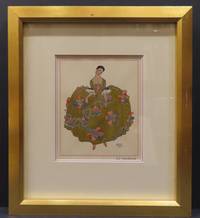
19196626<p>Original pochoir by Barbier of a woman in a floral motif gold dress from Panorama Dramatique. Printed with black gold blue light blue red pink and orange colors. Pink trim surrounds image. Dated in print 1918. Wooden frame with gilt front. Frame: 14.75 x 16.75 inches; Window: 7 x 8.25 inches.</p> Lucien Vogel
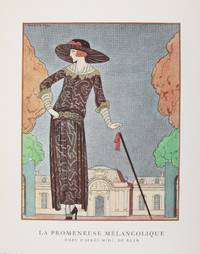
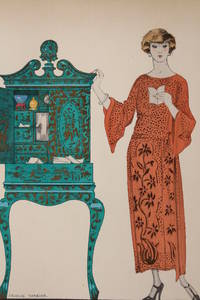
192284789Paris: Lucien Vogel éditeur 1922. Fine. Lucien Vogel éditeur Paris 1922 18 x 24 cm une feuille Original color print finely heightened with gold printed on laid paper signed in the top left of the plate. La Gazette du bon ton one of the most beautiful and influential fashion magazines of the twentieth century celebrating the talent of French creators and artists in the full bloom of Art Deco. The famous fashion magazine founded in 1912 by Lucien Vogel La Gazette du bon ton was published until 1925 with an interruption during the War from 1915 to 1920 due to the mobilization of its editor-in-chief. It consists of 69 issues printed in only 2000 copies and is illustrated notably with 573 color plates and 148 sketches representing models by great couturiers. From their publication these luxurious publications ""address bibliophiles and worldly aesthetes"" Françoise Tétart-Vittu ""La Gazette du bon ton"" in Dictionnaire de la mode 2016. Printed on fine laid paper they use a typeface specially created for the magazine by Georges Peignot the Cochin character adopted in 1946 by Christian Dior. The prints are created using the metallic stencil technique enhanced with colors and some highlighted with gold or palladium. The adventure begins in 1912 when Lucien Vogel a man of society and fashion - he had already participated in the magazine Femina - decides to found with his wife Cosette de Brunhoff sister of Jean the father of Babar the Gazette du bon ton whose subtitle was then ""Art modes et frivolités"". Georges Charensol reports the words of the editor-in-chief: ""In 1910 he observes there existed no fashion journal that was truly artistic and representative of the spirit of its time. I was therefore thinking of creating a luxury magazine with truly modern artists . I was certain of success because for fashion no country can rival France."" ""Un grand éditeur d'art. Lucien Vogel"" in Les Nouvelles littéraires no.133 May 1925. The magazine's success is immediate not only in France but also in the United States and South America. Originally Vogel therefore assembled a group of seven artists: André-Édouard Marty and Pierre Brissaud followed by Georges Lepape and Dammicourt; and finally his friends from the École des beaux-arts who were George Barbier Bernard Boutet de Monvel or Charles Martin. Other talents quickly joined the team: Guy Arnoux Léon Bakst Benito Boutet de Monvel Umberto Brunelleschi Chas Laborde Jean-Gabriel Domergue Raoul Dufy Édouard Halouze Alexandre Iacovleff Jean Émile Laboureur Charles Loupot Charles Martin Maggie Salcedo. These artists unknown for the most part when Lucien Vogel called upon them would subsequently become emblematic and sought-after artistic figures. These same illustrators created the drawings for the Gazette's advertisements. The plates highlight and sublimate the dresses of seven creators of the period: Lanvin Doeuillet Paquin Poiret Worth Vionnet and Doucet. The couturiers provided exclusive models for each issue. Nevertheless some of the illustrations feature no real model but only the illustrator's idea of the fashion of the day. La Gazette du bon ton is a decisive stage in fashion history. Combining aesthetic excellence and plastic unity it brought together for the first time the great talents from the worlds of arts letters and fashion and imposed through this alchemy a completely new image of woman slender independent and audacious also carried by the new generation of couturiers Coco Chanel Jean Patou Marcel Rochas. Taken over in 1920 by Condé Montrose Nast the Gazette du bon ton would largely inspire the new composition and aesthetic choices of the ""dying little journal"" that Nast had bought a few years earlier: Vogue magazine. Lucien Vogel éditeur unknown
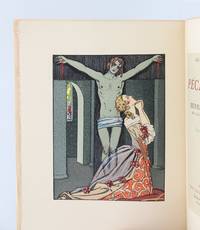
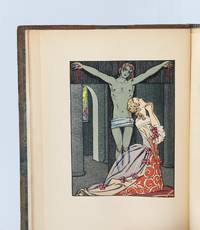
192485648Paris: Editions Mornay 1924. Fine. Editions Mornay Paris 1924 15 x 20.50 cm broché Edition decorated with original color illustrations by George Barbier one of 921 numbered copies on Rives. A fine copy. Editions Mornay unknown
192485423Paris: Editions Mornay 1924. Fine. Editions Mornay Paris 1924 15 x 20.50 cm relié Edition illustrated with original color illustrations by George Barbier one of 53 numbered copies on japon impérial. Half almond-green morocco binding with corners faded spine with three raised bands gilt date at foot boards marginally faded marbled paper boards endpapers and pastedowns original wrappers and spine preserved contemporary binding signed F. Hauttecoeur. Handsome copy. Editions Mornay hardcover
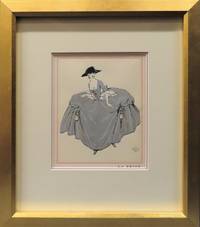
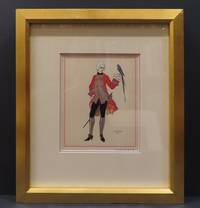
19196620<p>Original pochoir print by Barbier of a woman in a silver dress and hat. Printed with silver red pink blue silver black and grey colors from Panorama Dramatique. Casanova Décors et Costumes. Pink trim surrounds image. Dated in print 1918. Wooden frame with gilt front. Frame: 14.75 x 16.75 inches; Window: 7 x 8.25 inches.</p> Lucien Vogel
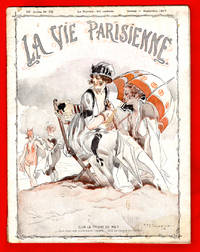
1917001464Paris: La Vie Parisienne 1917. First Edition . Illustrated Wraps. Very Good. 13.75" x 10.5. Rene Vincent; Henry Gerbault; Georges Barbier; Georges Leonnec; others uncredited. Paris: La Vie Parisienne 1917. The September 1 1917 Issue 55e annee No 35. Illustrations by Rene Vincent; Henry Gerbault; Georges Barbier; Georges Leonnec; others uncredited. Text in French. Illustrated wraps folio 13.75" x 10.5" 19 pp. 770 through 789 for the volume plus covers. Slender but large: folio size. See scans. Some cover soiling wrinkling wear and very small scale chips; contents sharp bright about Very Good overall; nice condition for this thin-but-large fragile weekly. This particular issue also has a chip in the middle of the front cover see scan. Glossy covers; first and last few internal pages are on newsprint else all glossy. Rather spectacular full-page color illustrations in every issue in fact by the coterie of guys who knew how to do what you see here. In the case of this issue Rene Vincent; Henry Gerbault; Georges Barbier and Georges Leonnec are credited for the big stuff but some of the other very credit-worthy art is uncredited. See scans. Cute humor from the same mood as mutoscope cards or perhaps a bit only a bit more refined yields the cover art caption: "Sur Le Front De Mer / Son Mari est surement reparti.elle se baigne en maillot" approximately two women remarking that the risque-for-that-era bathiing suit of another young lady indicates her husband must be out of town; rear cover caption is World War I humor that escapes me but the image does not which see. Gentle titillation. Even the occasional partial nudity is rather tasteful and soft though humorously flirtatious. All of the full page efforts are eminently frame-able and at this time of a sensibility midway-evolved between nouveau and deco as is much of the uncredited b&w illustration. An original - and of course first and only edition - of the 9/1/1917 issue of this memorable and long-lived French weekly offering of very soft very artful light erotica. The captioned illustrations by the eminent "dessins" luminaries named above and others in their clan are what really "make" this issue as was generally the case through the era but cartoons serial fiction and around-town pieces nicely compliment those. Gorgeous oversized large color illustrations are what you collect these for. l-LNG1 <br/> <br/> La Vie Parisienne paperback
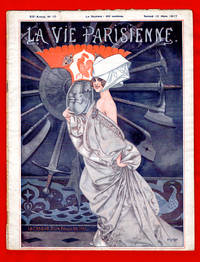
1917001463Paris: La Vie Parisienne 1917. First Edition . Illustrated Wraps. Very Good. 13.75" x 10.5. Cheri Herouard; Armand Vallee; Fabien Fabiano; George Barbier; Georges Leonnec; other uncredited. Paris: La Vie Parisienne 1917. The March 10 1917 Issue 55e annee No 10. Illustrations by Cheri Herouard; Armand Vallee; Fabien Fabiano; Georges Barbier; Georges Leonnec; others uncredited. Text in French. Illustrated wraps folio 13.75" x 10.5" 19 pp. 215 through 233 for the volume plus covers. Slender but large: folio size. See scans. Some cover soiling wrinkling wear and very small scale chips; contents sharp bright about Very Good overall; nice condition for this thin-but-large fragile weekly. Glossy covers; first and last few internal pages are on newsprint else all glossy. Rather spectacular full-page color illustrations in every issue in fact by the coterie of guys who knew how to do what you see here. In the case of this issue Cheri Herouard; Armand Vallee; Fabien Fabiano; George Barbier and Georges Leonnec are credited for the big stuff but some of the other very credit-worthy art is uncredited. See scans. Cute humor from the same mood as mutoscope cards or perhaps a bit only a bit more refined yields the cover art caption: "Le Casque d'Un Poilu de 1417" the helmet of a soldier of 1417 for an artful depiction of a medieval young Lady who has conquered with her wiles; rear cover caption is "Mars venteux et Avril pluvieux Font le May gay et gracieux" below a brave young lass whose skirts are being elevated a bit out in foul weather - always a favorite. Gentle titillation. Even the occasional partial nudity is rather tasteful and soft though humorously flirtatious. All of the full page efforts are eminently frame-able and at this time of a sensibility midway-evolved between nouveau and deco as is much of the uncredited b&w illustration. An original - and of course first and only edition - of the 3/10/1917 issue of this memorable and long-lived French weekly offering of very soft very artful light erotica. The captioned illustrations by the eminent "dessins" luminaries named above and others in their clan are what really "make" this issue as was generally the case through the era but cartoons serial fiction and around-town pieces nicely compliment those. Gorgeous oversized large color illustrations are what you collect these for. l-LNG1 <br/> <br/> La Vie Parisienne paperback
192284386Paris: Lucien Vogel 1922. Fine. Lucien Vogel Paris s. d. 1922 12.50 x 25 cm broché First hors commerce edition printed for the author's friends in 60 copies numbered on hollande and justified in pencil by George Barbier. Work illustrated with wood engravings by Fernand Siméon. Handsome and rare copy despite clear foxing at the foot of the leaves. Lucien Vogel unknown
1921007075Paris: Éditions de la Guirlande. Printer: L'Imprimerie Studium 1921. First Edition Thus. Stiff Wraps. Very Good. 4to. 29 by 20 cm. Unpaginated 136 pp. 8 color pochoir plates by Barbier with many smaller color illustrations interspersed in the text. Unnumbered copy to match the 225 on Verge d'Arches from a total edition of 300. Condition: light soiling to the wraps. A few tears and one dangling piece of the spine with minor loss of the paper on the spine. Light age toning to the leaves within. Éditions de la Guirlande. Printer: L'Imprimerie Studium unknown
1964100194Roma : Edizioni Paoline 1964. 185x120mm. 1188 831Êpagine legatura del editore. Jaquette rodo•d. TrÂs bel exemplaire. 1601 Edizioni Paoline unknown
19196628<p>Original pochoir by Barbier of a man playing a violin in formal attire from Panorama Dramatique. Printed with black gold red grey white and purple colors. Pink trim surrounds image. Wooden frame with gilt front. Frame: 14.75 x 16.75 inches; Window: 7 x 8.25 inches.</p> Lucien Vogel
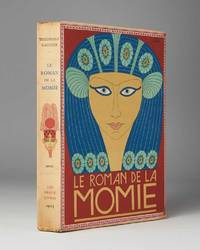
192921238021929. Paris: A & G Mornay. 1929. 8vo. Original pictorial paper wrappers with fold-over flaps with glassine dust jacket; pp. 6 323 1 untrimmed with colour illustrations by Barbier wood-engraved by Emile Gasperini including frontispiece title page chapter headings tail pieces and illustrations in the text; light shelf wear to spine ends corners a little bumped spine and top edge of rear wrapper gently toned else a near-fine bright copy; printed publisher's note loosely inserted.8vo. Original pictorial wrappers by Gasperini after Barbier with fold-over flaps with glassine dust-jacket partially untrimmed; pp. vi 325 2 colophon blank; over 30 wood-engraved illustrations by Gasperini after Barbier including frontispiece title-page head- and tailpieces initials and in-text illustrations; spine lightly bumped at head and foot slight wear to corners spine and head of rear wrapper lightly toned; else a near-fine bright copy; printed bifolium quire 21 and printed publisher's note on green paper loosely inserted see below.Uncommon first edition of Gautier's novel - set partly in the nineteenth century and partly in ancient Egypt - to be illustrated by Georges Barbier no. 289 of 834 copies printed on Rives paper from a total edition of 1091.Le Roman de la momie follows a young English aristocrat and a German Egyptologist on an expedition to the Valley of the Kings where they uncover a sarcophagus containing the perfectly preserved mummy of Tahoser the beautiful daughter of a high priest. The narrative then unfolds her past life and lovers. This edition is beautifully illustrated by Georges Barbier 1882-1932 celebrated designer of stage costumes and one of the most renowned French Art Deco illustrators and was one of the last illustrative projects executed before his death. Theophile Gautier 1811-1872 was a prolific and influential author whose work became a touchstone for later literary movements including Parnassianism Symbolism Decadence and Modernism and was much admired by the likes of Charles Baudelaire T. S. Eliot and Marcel Proust. First serialised in Le Moniteur universel in 1857 and published in book form the following year by Hachette Le Roman de la momie remains one of the most successful literary products of nineteenth-century Egyptomania.Loosely inserted is a printed notice from the publishers apologising for the colophon's erroneous statement that this is the forty-seventh volume in their Beaux Livres series it was the forty-eighth along with a printed bifolium in which the error has been corrected. 'Four of the five titles which Barbier undertook between 1924 and 1931 for Mornay's series Les Beaux Livres are tales by Henri de Regnier also with 18th century settings . More attractive is Gautier's Le roman de la momie of 1929 thanks in large part to the harmonious engravings printed in color by which Gasperini rendered the artist's designs. Barbier seems to have welcomed the opportunity offered by Gautier's Egyptian setting to rival the middle eastern subjects which preoccupied Schmied at this time' Ray p. 43.Outside continental Europe OCLC finds eight copies of which six in North America Fisher Morgan RIT Royal Ontario Museum SMU University Club Library one in Japan Waseda and only one in the UK NLA.See Ray The Art Deco Book in France II 2005; this edition not in Cartier cf. vol. III p. 179. unknown
192254957Paris: Lucien Vogel éditeur 1922. Fine. Lucien Vogel éditeur Paris 1922 18 x 24 cm une feuille Original color print heightened with gold printed on vergé paper signed in the plate. An original print used to illustrate the Gazette du bon ton one of the most attractive and influential 20th century fashion magazines featuring the talents of French artists and other contributors from the burgeoning Art Deco movement. A celebrated fashion magazine established in 1912 by Lucien Vogel La Gazette du bon ton appeared until 1925 with a hiatus from 1915 to 1920 due to the war the editor-in-chief having been called up for service. It consisted of 69 issues printed in only 2000 copies each and notably illustrated with 573 color plates and 148 sketches of the models of the great designers. Right from the start this sumptuous publication was aimed at bibliophiles and fashionable society Françoise Tétart-Vittu La Gazette du bon ton in Dictionnaire de la mode 2016 and was printed on fine vergé paper using a type cut specially for the magazine by Georges Peignot known as Cochin later used in 1946 by Christian Dior. The prints were made using stencils heightened in colors some highlighted in gold or palladium. The story began in 1912 when Lucien Vogel a man of the world involved in fashion he had already been part of the fashion magazine Femina decided with his wife Cosette de Brunhoff the sister of Jean creator of Babar to set up the Gazette du bon ton subtitled at the time: Art fashion frivolities. Georges Charensol noted the reasoning of the editor-in-chief: In 1910 he observed there was no really artistic fashion magazine nothing representative of the spirit of the time. My dream was therefore to make a luxury magazine with truly modern artists I was assured of success because when it comes to fashion no country on earth can compete with France. Un grand éditeur dart. Lucien Vogel in Les Nouvelles littéraires no. 133 May 1925. The magazine was immediately successful not only in France but also in the United States and Latin America. At first Vogel put together a team of seven artists: André-Édouard Marty and Pierre Brissaud followed by Georges Lepape and Dammicourt as well as eventually his friends from school and the School of Fine Arts like George Barbier Bernard Boutet de Monvel and Charles Martin. Other talented people soon came flocking to join the team: Guy Arnoux Léon Bakst Benito Boutet de Monvel Umberto Brunelleschi Chas Laborde Jean-Gabriel Domergue Raoul Dufy Édouard Halouze Alexandre Iacovleff Jean Émile Laboureur Charles Loupot Chalres Martin Maggie Salcedo. These artist mostly unknown when Lucien Vogel sought them out later became emblematic and sought-after artistic figures. It was also they who worked on the advertising drawings for the Gazette. The plates put the spotlight on and celebrate dresses by seven designers of the age: Lanvin Doeuillet Paquin Poiret Worth Vionnet and Doucet. The designers provided exclusive models for each issue. Nonetheless some of the illustrations are not based on real models but simply on the illustrators conception of the fashion of the day. The Gazette du bon ton was an important step in the history of fashion. Combining aesthetic demands with the physical whole it brought together for the first time the great talents of the artistic literary and fashion worlds; and imposed through this alchemy a completely new image of women: slender independent and daring which was shared by the new generation of designers including Coco Chanel Jean Patou Marcel Rochas and so on Taken over in 1920 by Condé Montrose Nast the Gazette du bon ton was an important influence on the new layout and aesthetics of that little dying paper that Nast had bought a few years earlier: Vogue. Lucien Vogel éditeur unknown
190700-PS7K-0FI4Printed for the Museum. Fair. 1907. Unknown Binding. Dark grey paper covers edge worn small tears frayed top and bottom spine. Paper toned.; Common Clays; 32 pages . Printed for the Museum unknown
1907000506New York: : Doubleday Page and Company 1907. 1st Ed Cloth gilded spine with hard blue paper cover boards with gilt title. UncleAndy. Hard Cover. Very Good. : Doubleday, Page, and Company Hardcover
1908154740London: Hodder & Stoughton 1908. hardcover. very good. Illustrated in black & white. Thin 8vo beige cloth-backed boards lettered in gilt. London: Hodder & Stoughton 1908. Very good.<br/> <br/> Art Primer Pennsylvania Museum and School.<br/> <br/> Hodder & Stoughton unknown
1907PAG47Printed for the Museum of Art Philadelphia: 1907. 1907 32 p. Frontis numerous photo illustrations. 8vo. Original printed wraps. Very good copy. Very scarce & important. GER-ENG PAMPH BX2 BAG 3. Language: eng. Soft cover. Very Good. Printed for the Museum (of Art), Philadelphia: 1907. paperback
1902mon0000093628London : MacMillan 1902-01-01. Hardcover. Good. in x in x in. 1892 edition on burgundy leather cloth macmillan lovely edition with crest to frontis London : MacMillan hardcover
1902153103London : MacMillan 1902. Fourth reprinted edition with additions. Hardback. Near fine copy in the original gilt-blocked cloth. Slightest suggestion only of dust-dulling to the spine bands and panel edges. Remains particularly well-preserved overall; tight bright clean and strong. ; 221 pages; Physical desc. : xii 221 p. ; 18 cm. Subject: Sermons Biographical --England --Ecclesiastical history. London : MacMillan hardcover
1999Q-0924886420Gems 1999. Paperback. New. In shrink wrap. Looks like an interesting title! Gems paperback
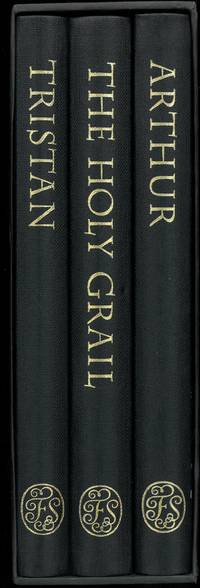
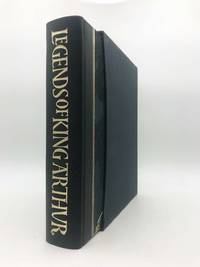
200072395London 2000. 8vo. Originalbind i kassett. 726 s. Fortløpende paginering. Illustrert i svart/hvitt. Folio Society Engelsk. unknown
2000mon0000078744The Folio Society 2000T. hardcover. Like New. 2.2843 cent in x 22.3350 cent in x 14.9746 cent in. The Folio Society hardcover
200022018<p>London: The Folio Society 2000. First Thus 1st Printing. Hardcover. Near Fine. Pisarev Roman. Handsome Folio edition of these classic tales. First Thus The Folio Society London 2000; 726 2 blank pages; quarter-bound leather illustrated cloth boards gold titling to spine dark green topstain a fine copy; in near-fine plain green cardboard slipcase. With 16 full-page illustrations by Roman Pisarev. Edited & with introduction by Richard Barber. <br /><br /></p> The Folio Society hardcover