Manesse, (Denis-Joseph)Antiquariat.de

76 résultats
1787106329BBParis, Guillot, 1787. 8°. 196 S. Moderner Hprgt. mit goldgepr. Rückenschild. [4 Warenabbildungen]
228288Paris, Guillot, 1787 in-12, viij pp., pp. 9-16, 196 pp., basane fauve marbrée, dos lisse cloisonné et fleuronné, pièce de titre bouteille, hachuré doré sur les coupes, tranches rouges (reliure de l'époque). Trois coins abîmés.
8785Editions Bornemann 1975
6235Paris, Anciennes Maisons Le Bailly et O. Bornemann, S. Bornemann sucesseur, Editeur, 1929, nouvelle édition complétée et mise au courant des procédés actuels par E. N. SANTINI , broché, 14x22,5 cm, 64 pages, illustrations en noir et blanc.
In 12°; X, 76 pp. e una c. di tav. in antiporta. Legatura editoriale in tutta tela con titolo entro cornice in oro e a secco al piatto anteriore, dove è anche presente l'immagine di un'airone. Qualche leggera scoloritura. Un leggero alone bruno nel margine alto del volume, non fastidioso. Rarissima edizione di questo già di per se raro trattato di tassidermia nel quale l'autore descrive diverse tecniche di imbalsamazione di quadrupedi, uccelli, pesci, insetti oltre ad un numero di altri oggetti di storia naturale. Fra gli altri si parla di pipistrelli, ricci, lepri, nutrie, farfalle, conchiglie, vermi ecc. ecc. Very rare.
197811059Paris Fédération nationale de la Fourrure 1978 Un volume in-8 reliure plein skyvertex caramel, dos muet, titre doré sur le plat supérieur, 190 pages. Petites tâches sur le plat supérieur, bon état.
72205London John Cooper & Sons 1928. Taxidermy gilt-bordered bow-fronted case 45 x 25 x13 cm in naturalistic setting. = With label 'Perch caught in the Ouse by John Catchpole August 28th 1928 1lb 7oz'. Taxidermy items with such detailed information are quite uncommon. The style of this case strongly reminds of those made by the London firm of J. Cooper and Sons which was active from the mid-19th century until the 1950's. However the Ouse is a river in Yorkshire which may indicate that perhaps a northern taxidermist produced this excellent example of a mounted fish in its natural surroundings. The perch Perca fluviatilis Linnaeus German: Barsch; French: perche; Dutch: baars is an angler's favourite throughout Europe. Some slight wear to the wood panelling slight abrasion of the gilt border otherwise in very good condition. Note: we do not ship this item outside the EU. unknown
72204Great Britain John Cooper and Sons ca. 1900. Taxidermy bow-fronted cased 41 x 39 x 20 cm in naturalistic winter setting. Case with three glass panels bow front and two side panels and hanger. = An excellent Victorian taxidermy case - if not a small diorama - of a female common kestrel Falco tinnunculus Linnaeus. German: Turmfalke; French: faucon crécerelles; Dutch: torenvalk catching a siskin Spinus spinus Linnaeus German: Erlenzeisig; French: tarin des aulnes; Dutch: sijs. Two fine wonderfully preserved taxidermy cased specimens. This falcon is one of the most successful birds-of-prey in the temperate regions of the Old World occurring in a wide variety of landscapes. It preys on mice and other small animals. "The kestrel was once used to drive and keep away pigeons" Wikipedia. The siskin is a common European bird more often seen during winter times. The case differs from most such cases because oif its more detailed and naturalistic setting. Case paint cover chipped here and there especially at edges otherwise very good. Note: we do not ship this item outside the EU. unknown
19822121283Leipzig: Zentralantiquariat der Deutschen Demokratischen Republik 1982. VIIII, 218, (6), 12 Seiten. Mit 6 Bildtafeln im Anhang. 8° (21 x 13,5 cm). Orig.-Pappband mit goldgeprägtem Titel auf Deckel- und Rückenschild. [Hardcover / fest gebunden].
19822121284Leipzig: Zentralantiquariat der Deutschen Demokratischen Republik 1982. VIIII, 218, (6), 12 Seiten. Mit 6 Bildtafeln im Anhang. 8° (21 x 13,5 cm). Orig.-Pappband mit goldgeprägtem Titel auf Deckel- und Rückenschild. [Hardcover / fest gebunden].
228289Paris, Terry, Audin, 1826 in-12, [2] ff. n. ch., 186 pp., avec 4 planches dépliantes hors texte, demi-basane blonde, dos lisse orné de filets dorés, pièce de titre, coins en vélin, tranches jaunes (reliure de l'époque). Dos frotté.
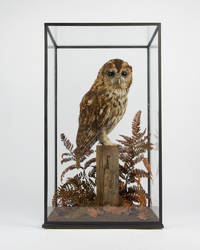
123829. Taxidermied tawny owl; late 20th century; mounted in a naturalistic setting on a fence post with ferns moss and dead leaves housed in a rectangular glass case measuring 32 x 24 x 55 cm.<br /> An attractive taxidermied tawny owl mounted in a glass case with a naturalistic setting of ferns.<br /><br />Tawny owls are one of the most common owl species in the UK and live in a wide range of habitats including urban and suburban gardens and parks. 'They are responsible for the most commonly heard owl sound the classic nocturnal "twit twoo" call which most people are familiar with' The Barn Owl Trust.<br /> unknown
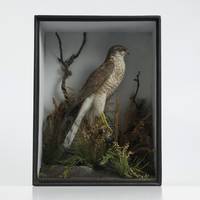
72202Norwich T. E. Gunn pre-1923. Taxidermy cased 40 x 30 x 15 cm in naturalistic setting. Black wooden case with glass front; interior painted light blue. Printed label on rear board. = A fine wonderfully preserved taxidermy cased specimen of the Eurasian sparrowhawk Accipiter nisus Linnaeus German: Sperber; French: épervier. This little bird is one of Europe's most ferocious birds-of-prey even hunting in city gardens. Its typical lifespan is four years but the oldest-known lived for more than 20 years. Currently the sparrowhawk is recovering from a population crash that occurred during the 1950-1980's due to pesticides. This specimen however is much older probably dating from the late 19th or early 20th century predating 1923. The case differs from most such cases because of its more detailed and naturalistic setting. This is the work of the renowned British taxidermist Thomas Edward Gunn 1844-1923 of Norwich. With a label of his firm mounted on the rear board. The label provides a great deal of information on the scope of his business including the sale of many different natural history objects such as eggs insects preserved reptiles fish etc. etc. "Thomas Gunn . was born at Norwich in Norfolk. . Gun was apprenticed to John Sayer a Norwich taxidermist taking over the business on Sayer's death. A master craftsman Gunn won medals and honours for his skill in the art of taxidermy. He ran the business until 1923 bearing his name. His son Frederick retired from his father's business in 1941. The firm closed its doors in 1950" from the website taxidermy4cash dotcom. Case with some wear the label partly soiled and worn the interior clean and fresh. A beautiful example of taxidermy as a skill and an art. Note: we do not ship this item outside the EU. unknown
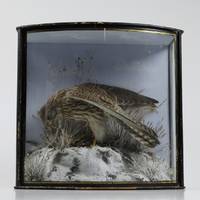
124086. Taxidermied snipe; late 20th century; mounted in a naturalistic setting in a glass case with tufts of grass the case measuring 14.5 x 24 x 33 cm.<br /> A charming and particularly well-presented taxidermied snipe.<br /><br />Snipe compromise a group of twenty-six species of wading birds that use their long bills to forage for invertebrates in mud and sand. Their alertness and cryptic plumage make them difficult to hunt hence the origin of the term 'sniper'.<br /> unknown
pp. xiii, 313 + Plus numerous photographs. Map endpapers. Penciled underlings. 8vo. Original full black cloth binding, gold lettered. First Edition. Akeley and his wife ransacked Africa for specimens of wild life which he had mounted in life-like tableaux for the American Museum of Natural History in New York. **PRICE JUST REDUCED! AFRICA/1
70-[2] pages, portrait Demi-basane cerise 1840, 1840, in-8, 70-[2] pages, portrait, Demi-basane cerise, Troisième édition. La seconde, parue aussi en 1840, ne comptait que 45 pages. Un portrait de Gannal en lithographie. Jean Nicolas Gannal (1791-1852) fut l'un des pionniers de la thanatopraxie. Cet ancien pharmacien de la Grande Armée élabora son procédé d'après la méthode du médecin palermitain Giuseppe Tranchina (1797-1837) : il s'agissait de pratiquer une petite incision à la partie latérale du cou pour introduire par l'artère carotide, à l'aide d'une pompe, la liqueur conservatrice, puis d'envelopper le corps de bandes imbibées de liqueurs aromatiques. En deux heures, l'opération était terminée, et le corps renfermé dans un cercueil de plomb. Il n'y avait plus de mutilations, ni de soustraction d'organes. La promptitude, la décence et le prix peu élevé du mode opératoire de Gannal contribuèrent à en propager l'emploi. Dès 1840, la cession de son brevet fut faite pour un grand nombre de départements. En plein Romantisme, tout un chacun avait désormais la possibilité de présenter le corps du cher défunt avant sa mise en terre. Gannal lui-même embauma Samuel Hahnemann en 1843, sur la demande son épouse. Parmi les anatomistes, le procédé fut également un succès : il rencontra notamment la faveur de Bourgery, qui l'utilisa pour son fameux traité d'anatomie, et d'Auzoux, qui l'employa pour mettre sous les yeux de ses ouvriers les préparations qu'ils devaient reproduire. Avec la présente publication, l'auteur élargit son propos à toute la taxidermie puisqu'il développe aussi un art de mégir, de parcheminer, d'empailler et de monter les peaux. Dos passé, coiffe supérieur arasée, étiquette en tête. Fortes rousseurs. Nicolas Delestre, Petite histoire de l'embaumement en Europe au XIXe siècle. Paris, le Murmure, 2017
70-[2] pages, portrait Broché, couverture originale imprimée 1840, 1840, in-8, 70-[2] pages, portrait, Broché, couverture originale imprimée, Troisième édition. La seconde, parue aussi en 1840, ne comptait que 45 pages. Un portrait de Gannal en lithographie. Jean Nicolas Gannal (1791-1852) fut l'un des pionniers de la thanatopraxie. Ce fut lui qui embauma Hahnemann en 1843, sur la demande son épouse. Son procédé consistait en une petite incision à la partie latérale du cou pour introduire par l'artère carotide, à l'aide d'une pompe, la liqueur conservatrice ; puis, à l'extérieur, des bandes arrosées avec des liqueurs aromatiques. En deux heures, l'opération était terminée, et le corps renfermé dans un cercueil de plomb. Il n'y avait plus de mutilations, ni de soustraction d'organes. La promptitude, la décence et le prix peu élevé du mode opératoire de Gannal contribuèrent à en propager l'emploi. Dès 1840, la cession de son brevet fut faite pour un grand nombre de départements. Parmi les adeptes de ce procédé, on compte Bourgery, qui l'utilisa pour sa fameuse "Traité d'anatomie"; et Auzoux, qui l'employa pour mettre sous les yeux de ses ouvriers les préparations qu'ils devaient reproduire. Avec la présente publication, l'auteur élargit son propos à toute la taxidermie puisqu'il développe aussi un art de mégir, de parcheminer, d'empailler et de monter les peaux. Ex-libris manuscrit sur la page de faux-titre. Exemplaire tel que paru. Couverture usée, petit manque angulaire. Quelques rousseurs
191260725London: Rowland Ward 1912. Price list. Four different examples of this publication from Rowland Ward two with the title above one from 1904 with the caption title "Stuffed Animals: Museum Specimens All Mounted in Standing Positions" and one from 1912 with the caption title "Price List of Mounted Specimens for Museums". 4to. The lists vary from three to ten pages rectos only two include a full page illustration of a stuffed elephant one torn three include a Rowland Ward decorated cover sheet. Animals from Africa predominate but there are also specimens from India Asia Europe North and South America and Australia; prices seem to top out at $500 for an African elephant typically an entry would include common name of the animal its genus and species its sex country of origin and price. Apparently none of these lists are located on OCLC. Folded for mailing one with a receipt stamp two with ink docketing. Very good lot of scarce Rowland Ward ephemera. Brad-bound in an upper corner. #7966. <br/><br/> Rowland Ward unknown books
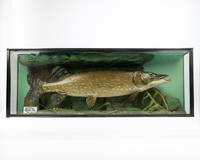
123830. Taxidermied pike; 1983; mounted in a naturalistic diorama depicting a stream bed with flowing plants housed in a rectangular case measuring 93 x 15 x 33.5 cm.<br /> A large and handsome taxidermied pike mounted in a diorama depicting a stream bed with flowing plants. With a plaque stating that the fish was caught by Austin Haines at Mill Pool on August 28th 1983 and weighed 7lbs 12 ozs.<br /> unknown
1859NP335391859 Paris, Roret, 1859 : In-18 Carré, Broché. nouvelle édition, 498 pp., 5 planches hors-texte dépliantes, contenant l'art d'empailler les animaux, de conserver les végétaux et les minéraux, de préparer les pièces d'anatomie normale et pathologique : suivi d'un traité des embaumements Bon état, Couv. défraîchie, Dos abîmé, Quelques rousseurs.
1921NP335431921 Paris, Mulo, (1921) : In-18 Carré, Broché. 1° partie : s.d., nouvelle édition corrigée, augmentée et entièrement refondue, viii, 342 pp., 32 figures in-texte, dos recollé, nom et date en page de titre, collection des encyclopédie-Roret, contenant : les classifications d'histoire naturelle: la recherche et l'emballage des objets d'histoire naturelle, ainsi que les meilleurs procédés pour la conservation des collections : 2° partie : 1921,nouvelle édition entièrement refondue et complétée par Maigne, xi, 420 pp., 77 figures in-texte, nom et date en page de titre, collection des encyclopédie-Roret, contenant : l'art d'empailler et de conserver les animaux vertébrés et invertébrés: de préparer les végétaux et les minéraux: de faire les préparations anatomiques: de conserver les cadavres temporairement ou définitivement Parfait état, Couv. convenable, Dos satisfaisant, Intérieur frais.
4145broché - 12x18,5 - 420pp - 1910 - Société française d'Editions littéraires et techniques, Paris.Encyclopédie RORET.Nouvelle édition entièrement refondue et complétée. ouvrage orné de 77 figures.
64031Librairie Encyclopédique De Roret Paris 1845 In-16 ( 140 X 90 mm ) de 463 pages, demi-basane vert-bronze, dos lisse orné de filets et palettes dorés ( Reliure de l'époque ). 5 planches dépliantes hors-texte comportant 127 vignettes. tache claire sur une planche, bon exemplaire.