105 résultats
1900CJW1901Boston: J. B. Millet Company 1900. No. 306 OF 500 COPIES. 256 x 181 mm. 10 x 7 1/8". Two volumes. <br/> Very attractive contemporary olive green morocco covers with gilt border incorporating an elaborate cornerpiece design of a butterfly; raised bands expertly rebacked preserving original backstrips spines gilt in compartments with lacy frames enclosing a large central butterfly gilt turn-ins marbled endpapers leather hinges all edges gilt. With more than 400 photographic illustrations and 62 ACTUAL ENTOMOLOGICAL TRANSFERS FROM LIFE all but one of the latter with original tissue guards. Bennett p. 33; McGrath p. 177; Nissen ZBI 1079; Reese "Nineteenth Century American Color Plate Books" 107. Spines faintly sunned two leaves with minor thumbing one corner crease otherwise AN EXTREMELY FINE SET the very appealing bindings quite lustrous and entirely sound and the text and plates clean fresh and bright with virtually no signs of use.<br/> <br/> This is a collection of butterfly and moth illustrations printed by direct transfer from the insects the creation of a leading innovator in the display of lepidoteral specimens. Sherman Foote Denton 1854-1937 came from a family of amateur naturalists who managed to turn their favorite pastime into a global business. Denton patented a butterfly mount that captured a specimen on a white plaster tablet where it could be pressed under glass avoiding the mess smell and eventual degradation of butterflies and moths mounted on paper using pins. The present publication presents a collection of specimens in a far more portable form that still preserves the color and detail of the insects' wings. The author collected by his own count more than 50000 specimens to produce the color plates for this limited edition. He explained his process: "The colored plates or Nature Prints used in the work are direct transfers from the insects themselves; that is to say the scales of the wings of the insects are transferred to the paper while the bodies are printed from engraving and afterward colored by hand." Since each specimen could be used only once it was necessary to obtain 500 perfect specimens of each species pictured. The effort and expense prevented larger runs of such publications and Reese observes that "new methods of printing color often too difficult to be practical were sometimes undertaken by enthusiasts.". J. B. Millet Company unknown
18672091202133201488Day and son 1867. Soft Cover. Fine. Volume: 1 Day and son paperback
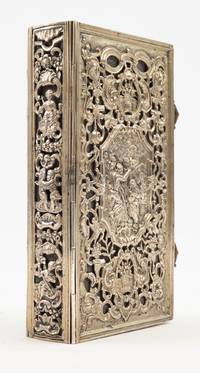
1885ST20549cOxford: Printed at the University Press for Peacock Mansfield and Britton London ca. 1885. 146 x 80 mm. 5 3/4 x 3 1/8". 536 pp. <br/> IN A LOVELY 18TH CENTURY SILVER BINDING over contemporary brown morocco DONE IN THE FRENCH RÉGENCE STYLE combining piercing with repoussé ornamentation the covers with central cartouche depicting a scene from the life of Christ in repoussé that on the front cover showing the Baptism of Christ with two hallmarks at the upper left an "A" and a rooster that on the lower cover showing the Ascension this surrounded by a pierced frame of rocaille drawer handles vases of flowers swans a leafy fronds spine pierced with rocaille and flowers separating three allegorical putti ornaments representing Faith Hope and Charity two openwork rocaille clasps. Endpapers rather worn at fore edge isolated very faint foxing otherwise A FINE COPY the text clean and fresh and THE SILVER BINDING SPARKLING AND UNMARRED.<br/> <br/> This glittering binding is a lovely example of 18th century silverwork in nearly flawless condition. While we have been unable to identify the maker the binding is probably French. A silver binding on a 1686 copy of a Rotterdam "Speculum Poenitentiae" catalogued by Antiquariat Roo is identical to ours in size and design except for the content in the large central frames and is identified by them as French. They find a master's mark of "T. G" beneath the front scene not present on our binding. In any case the delicate symmetrical ornamentation featured on our binding is typical of French Régence decorative arts with scrolls studded with naturalistic embellishments that reward close inspection. Many charming details are hidden within the sea of volutes such as the swans stealing treats from overflowing baskets of fruit. The central scenes from the life of Christ come to life through meticulous execution as our silversmith has taken great care with the details: water trickles from John the Baptist's outstretched arm and voluminous curls of cloud frame Christ's Ascension. The later Book of Common Prayer the binding now contains is a testament to the binding's enduring appeal as a precious devotional object. Printed at the University Press for Peacock, Mansfield, and Britton, London unknown
1817ST19508aLondon: Henry Colburn 1817. FIRST EDITION. 322 x 274 mm. 12 3/4 x 10 3/4". One volume extended to two. <br/> SUMPTUOUS CRIMSON STRAIGHT-GRAIN MOROCCO GILT BY MORRELL stamp-signed on front turn-ins covers with wide frame decorated with Neoclassical ornaments raised bands spine compartments framed by volutes and flowers gilt lettering gilt-framed turn-ins scarlet watered silk endleaves leather hinges top edges gilt. WITH 30 HAND-COLORED PLATES as called for including a double-page view of the Battle of Waterloo a folding battle plan for Ligny and a folding map of the route from Brussels to Paris the last two expertly repaired and backed in linen and EXTRA-ILLUSTRATED WITH 66 PLATES eight of these hand-colored most portraits of military leaders. With "Portraits of General Officers" used as the frontispiece as in Abbey in place of the seldom-seen plate "Waterloo in Memory of Shaw of the Life Guards" that appears in some copies but is not on the list of plates. With an ALS dated Dublin Castle 1st Oct 1819 signed by Lord Whitworth. Front flyleaves with engraved armorial bookplate of Frederick S. Peck. Abbey "Life" 372; Tooley 336; Cohn "Cruikshank" 556. ◆Joints edges and corners with visible but not serious wear one plate with neatly repaired marginal tear just touching edge of image occasional mild foxing additional trivial imperfections otherwise fine--clean and fresh internally with richly colored plates in a lustrous binding bright with gilt.<br/> <br/> This is a very attractively illustrated celebration of Wellington's victorious campaign against Napoleon offered here in a special copy enhanced by additional plates many depicting principal actors in the conflict and a stately Neoclassical binding. Famed illustrator George Cruikshank drew the frontispiece depicting the seven general officers for the British side along with the ebullient illustrated title depicting victory the double-page plate of the fateful Battle of Waterloo and the ignominious "Flight of Bonaparte." The plates contributed by James Rouse mostly depict the countryside and villages in the area where fighting was taking place. Journalist and novelist William Mudford 1782-1848 wrote the text with assistance from primary sources among these the Duke of Wellington himself to whom the work is dedicated. Mudford was the editor of the "Courier" an evening journal with a conservative stance on politics. His prose is described as "vigorous" by the "Dictionary of Literary Biography" which also notes his flair for creating atmosphere. These gifts were brought to bear on the present account rendering this historic campaign in vivid terms. The manuscript letter inserted into the second volume was written by Lord Charles Whitworth 1752-1825 Lord Lieutenant of Ireland at the time of writing. He had been the British Ambassador to France when Napoleon was first consul and had gained much respect for the determination and dignity with which he had handled the mercurial Bonaparte's tirades against his country. Here he recommends to an unknown recipient the person who had conducted financial affairs for him in France. The present bindings are the work of the London bindery of W. T. Morrell established about 1861 as successor to the firm begun by Francis Bedford who in turn had taken over the famous bindery of Charles Lewis. Prideaux in her "Modern Bookbindings" says that Morrell at that time had a very large business that supplied "all the booksellers with bindings designed by his men" which were "remarkable for their variety and merit." The scion of an old and prosperous New England family former owner Frederick Stanhope Peck 1868-1947 was an avid collector of books and manuscripts amassing a collection of more than 8000 titles. When his library went to auction in 1944 it was noted for its fine bindings and excellent condition. Henry Colburn unknown
1840ST19460Paris: L. Curmer 1840-42. First Editions. 264 x 178 mm. 10 3/8 x 7". Nine volumes. <br/> Very pleasing contemporary red cloth backed in red morocco by Weidle stamp-signed in gilt on tail of spines raised bands compartments with gilt lettering or large gilt decorative tool head compartment on each spine with sometimes blurred handwritten ink shelf number. WITH 415 FULL-PAGE PLATES HAND-COLORED AND ENHANCED WITH GUM ARABIC one in black & white including eight frontispieces all of the plates with original tissue guards one double-page map and numerous vignettes and head- and tailpieces in black & white after Bellangé Charlet Daubigny Daumier Gavarni Grandville Vernet Johannot etc. Front pastedowns with bookplate of Count Grigori Alexandrovitch Stroganov. A hint of rubbing to extremities occasional trivial scuff or small stain to boards but A FINE SET THE PLATES CLEAN AND BRIGHT WITH RICH COLORING the contents fresh and clean and the essentially unworn bindings quite attractive on the shelf.<br/> <br/> Characterized by Carteret as the "most important publication of the Curmer editions" this series is one of the major works of the Romantic era presenting as it does a panorama of all classes of French society. An adept bookseller and publisher specializing in illustrated books Henri-Léon Curmer 1801-70 attracted some of the best artisans of the day and was known for the high quality of his output. For the present work he recruited some of the most famous writers of the period--Balzac one of the main contributors Gautier Nerval Borel Janin Monnier and Sand--to delineate the various professionals tradesmen and social "types" populating 19th century France. Their text is accompanied by more than 800 images--all but one of them beautifully hand colored--by Gavarni Eugène Lami Grandville Tony Johannot Daumier Henry Monnier Meissonier and others; there are also numerous wood-engraved vignettes in the text. The profiles of the various "types" of citizens are accompanied by portraits depicting them in their usual surroundings and featuring the physical characteristics assigned by the popular pseudo-scientific physiognomic theory to that trade gender or social class. As Carteret notes "The plates are of the highest interest for the history of costumes the fashion and the clothes of all the social classes of French society at the Romantic period; all the artists from the time took part in this huge publication." Of the nine volumes five depict Parisians three cover the provinces and the last "Le Prisme" looks at everything from "Tourists in Italy" to "A University Education" and "A Woman with No Taste." This final volume was issued exclusively to subscribers; Carteret calls it an "indispensable complement" to the series and notes that it "became very rare." The present set is comprised of first issue volumes which "can be recognized thanks to the whiteness of the pages and the delicacy of the coloring which was enhanced with gum Arabic; the second issue is on tinted paper and the coloring is less meticulous." Carteret This copy belonged to Count Grigori Alexandrovitch Stroganov who was born in September 1770 in St Petersburg and died in January 1857 in the same city. A Russian aristocrat and count of the Empire from 1826 Stroganov was also a diplomat and private adviser patron of the arts and one of the most cultivated men of his time. L. Curmer unknown