7 715 résultats
7142, Tongeren, Provinciaal Gallo-Romeins Museum, 1976., originele geillustreerde uitgeversomslag in kleur, 48 p., ill., merkt., bibliogr. catalogus
612 pages. Index. Profusely illustrated with archival black and white photos. Local history of the town of Tomahawk, Alberta, located west of Edmonton. Includes considerable genealogical information. Gilt decoration and lettering upon front board and backstrip. Maroon cloth-covered boards. Average wear. Binding intact. An excellent reference. Book
2022mon0003856279Chronicle Books 2022T. hardcover. Good. . Chronicle Books hardcover
186818543Toledo 1868. 3 1 blank pp. Folded 10.5" x 8.5" sheet. A couple of margin fox spots and light wear Good or Very Good. "Having established a Factory in this city for the manufacture of Silver Plated Ware we desire to call your attention to our goods. All our Spoon Ware is marked 'Toledo Mf'g Co. A 1' and is plated on the best quality of Nickel Silver." The Company presents its list of forks spoons and replating services with prices. "The Railway and Lake Transportation facilities of this city place us at your door. Your orders can be filled in but a few hours from the time they are sent." Not in Winterthur Romaine. unknown books
186818543Toledo 1868. 3 1 blank pp. Folded 10.5" x 8.5" sheet. A couple of margin fox spots and light wear Good or Very Good. "Having established a Factory in this city for the manufacture of Silver Plated Ware we desire to call your attention to our goods. All our Spoon Ware is marked 'Toledo Mf'g Co. A 1' and is plated on the best quality of Nickel Silver." The Company presents its list of forks spoons and replating services with prices. "The Railway and Lake Transportation facilities of this city place us at your door. Your orders can be filled in but a few hours from the time they are sent." Not in Winterthur Romaine. unknown
2005Q-1567184243Llewellyn Publications 2005-06-08. Paperback. New. In shrink wrap. Looks like an interesting title! Llewellyn Publications paperback
087542791XNew. New. Satisfaction Guaranteed or your money back. unknown
2002Q-087542791XLlewellyn Publications 2002-09-08. Paperback. New. In shrink wrap. Looks like an interesting title! Llewellyn Publications paperback
61004579Llewellyn Publications pp. 360 Index. Papeback. New. Llewellyn Publications unknown
1971283862Gertz Brothers 1971-72. Pamphlet . Good. Vol IX 134 Vol. X No 14 Vol XI No 1 4 Vol XII No2 3 4 XIII No 1 each about 15 pages appearing at holiday times fillled with brief sermons thoughts to stimulate apparently Gertz Brothers specialized in synagogue bulletins and sent these out to Reform Rabbis not on worldcat Gertz Brothers unknown
2002Q-1567187218Llewellyn Publications 2002-09-08. Paperback. New. In shrink wrap. Looks like an interesting title! Llewellyn Publications paperback
1994SONG15690122371994-08-28. paperback. Used: Good. 5.50x0.75x8.50. Buy with confidence. Excellent Customer Service & Return policy. paperback
192625921Doubleday Page & Company 1926 HARDBACK NODUSTJACKET 1926 Stated First Edition. Hardcover. Book Condition: GOOD/GOOD- CONDITION AS-IS NOJACKET Green cloth hardcover with orange decorations and lettering light dampstain on cover and page edges rear free end page removed cracking rear hinge else contents tight nicely illustrated!. Interior nice tight clean with some blank margin stains & light wrinkle & creases some pgs LIGHT FOX Wear & few pencil marks Cvr light rub wear tiny chips Tears Edges slight Lean Bk 6 X 7 3/4 in. 158 Pgs .Art Deco illustrations by C. E. Millard who also illustrated Classic California Fairy Tales. First Edition. Hard Cover. Doubleday, Page & Company hardcover
Gebonden, Hardcover met prachtige illustraties. 216 pagina's ISBN 9789082538205. Het gebruik om iemand mild te stemmen met een goede gave is van alle tijden. Wat de een profijt brengt, kan de ander tot voordeel strekken. Stadsbesturen realiseerden zich dat ook. Van de late middeleeuwen tot in de 18de eeuw lieten zij tinnen kannen maken, die, gevuld met wijn, werden aangeboden aan invloedrijke bezoekers. Over deze tinnen stadskannen verhaalt dit smaakvolle boek. Het vertelt uitgebreid hoe stadskannen werden gemaakt en wanneer, hoe en door wie ze werden gebruikt. Uiteraard wordt ook stilgestaan bij de inhoud van het tinnen schenkgerei: de zogenoemde presentwijnen. Alle 81 bewaard gebleven stadskannen in de Noordelijke en Zuidelijke Nederlanden passeren de revue -overzichtelijk ingedeeld per stad. De achttien stadskannen van Maastricht, de twaalf van Oudenaarde, de afwijkende exemplaren uit Enkhuizen, de gestolen stadskannen van Woerden: ze zijn stuk voor stuk geportretteerd in woord en beeld. Verder aandacht voor stadskannen van buiten de Lage Landen, vervalsingen, tinnegietersmerken, stijlen en dateringen, en het verschil tussen stadskannen en ?gewone? schenkkannen. Tal van historische illustraties en Duitse, Franse en Engelse samenvattingen maken deze uitgave compleet.
softcover, 320 bladzijden Gewicht : 970 gr. text in NL - FR. rijkelijk geillustreerd met foto's van merktekens. broche, Nombre de pages: 320 Poids: 970 gr. texte dans NL - FR. richement illustre avec des photographies de marques. Nieuw naslagwerk met 4.725 merken , Het tweetalig boek (Nederlands-Frans) bevat 82 Belgische steden, niet inbegrepen Luxemburg en Sint-Winnoksbergen. Het bevat de ijkmerken van de - Ancien Regime-17de-18de eeuw en het decimaal stelsel tot 1946. Nouveau livre de reference avec 4725 marques, le livre bilingue (neerlandais-francais) contient 82 villes belges, non compris le Luxembourg et Saint-Winnoksbergen. Il comprend des marques de verification de l'Ancien Regime, 17eme-18eme siecle et le systeme decimal jusqu'en 1946
44156Leuven, Dangis, 2014 softcover, 320 bladzijden Gewicht : 970 gr. text in NL - FR. rijkelijk geillustreerd met foto's van merktekens. broche, Nombre de pages: 320 Poids: 970 gr. texte dans NL - FR. richement illustre avec des photographies de marques.
1996Q-0374277850Farrar Straus & Giroux 1996-10-01. Hardcover. New. In shrink wrap. Looks like an interesting title! Farrar Straus & Giroux hardcover
445 pagina's met 307 afbeeldingen in kleur met merken. Harde omslag met stofhoes. ISBN 9789081017022. Jubileumboek TIN - ÉTAIN - PEWTER - ZINN 25 jaar Nederlandse TinVereniging Tin van de leden
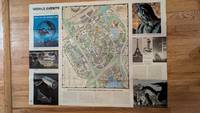
196421751Silver Burdett With Time and Life. 1964. Poster. Very Good. World Events. A News Publication of Silver Burdett in Association with Time and Life. Volume II Issue 30: April 13 1964. The poster depicts a large birdview's view of the exhibition map in the center surrounded by the major attractions of the exhibition: Unisphere Futurama Space Pietà Dinosaurs. The poster also recalls previous World Fairs: Paris 1889 Tour Eiffel 1876 Philadelphia US Centennial Fair and the 1939 New York World's Fair. . Silver Burdett With Time and Life unknown
197816184New York: Dodd Mead & Company 1978. 1st. Hardcover. Very Good/Very Good. 10.2x7.6x0.9in. light foxing to edges of text block small bookstore label at bottom of front pastedown dust jacket with tiny tear at bottom of front panel and tiny tear at top of back panel. Dust jacket in clear protector. <br>Illustrated with drawings from original sketchbooks of designs more than three hundred black and white photographs and four color plates. <br>296pp 2.57lb 10.2x7.6x0.9in Dodd, Mead & Company hardcover
12325Silver City. Very Good. Binder. Newspaper with the usual tanning chipping at some edges. Vintage photo with some spotting most apparent with two on bottom edge. ; Orange three ring binder containing: Silver City 2 pages with 6 photocopy newspaper clippings; 8 black paper backed poly sleeves with 32 photocopy news clippings. Dates of the 14 total 1899-1905 most 1883; subjects include cattle rustling Indian wars shootings etc. Newspapers: 5 copies of the Silver City Press 1960; 1 copy of the Silver City Enterprise 1978. BEN LILLY: One 6" x 4" vintage silver print standing portrait with B. Lilly written in pencil on back c. 1920- One envelope containing five 8.5 x 10" glossy photographs of Lilly. The envelope has written on top edge: Ben Lilly . All but one photo are reproductions of Lilly photos seen elsewhere. One is of a man Lilly with several hounds but younger and without the beard. The photos are numbered I-VI so III is missing. Collected by Bob Stepp a prominent bookseller businessman in Silver City mentioned in one of the newspapers as filling a vacancy on the Pioneer Foundation board. ; 8vo 8" - 9" tall; "Benjamin Vernon Lilly or Ben Lilly 1856 1936 nicknamed Ol' Lilly was a notorious big game hunter houndsman and mountain man of the late American Old West. He remains famous for hunting down large numbers of grizzly cougars and black bears. A mix between a transcendentalist spirit and an ardent Christian he is described as an unfathomable Southern wild character. He was a stern practitioner of simple living and outdoor freedom roamed and hunted from Louisiana to Arizona and from Idaho to as far south as Chihuahua and Durango Mexico and was a subject of American folktales. He died at eighty on December 17 1936 on a ranch in Pleasanton near Silver City New Mexico. " Wikipedia . unknown
2002Q-1551094010Nimbus Publishing 2002-01-04. Paperback. New. In shrink wrap. Looks like an interesting title! Nimbus Publishing paperback
7024Japan: 1816 or after. A fine complete and uncommonly well-illustrated set of scrolls concerning the famous gold silver and copper mine on Sado Island illustrating all the steps from mining to refining to minting along with the administrative and commercial activities associated with the mines. We have had several sets of "Sado Island Scrolls" and this is by far the finest in terms of the quality of the illustration completeness and richness of detail. The skilled artist of these scrolls has provided an enormous amount of valuable factual content by labeling each depicted person's role in the production of gold silver and copper. For a really excellent account of the history of mining on Sado Island and the scrolls produced there see Hamish Todd "The British Library's Sado Mining Scrolls" in The British Library Journal Vol. 24 No. 1 Spring 1998 pp. 130-43. Our description is largely based on this wonderful and beautifully researched article. Gold silver and copper mining on Sado Island just off the coast of Niigata Prefecture had its beginnings in ancient times. With the discovery in 1601 of the rich Aikawa gold and silver mine Sado experienced an economic boom. The Edo shogunate assembled miners and slave laborers mostly the homeless from throughout Japan and sent them to Sado to exploit the Aikawa mine and three other principal mines. It soon became the largest gold and silver mine in Japan attracting a population of 200000 and to a very large degree financed the Edo shogunate for several hundred years. A series of unique mining smelting and minting technologies developed at Sado were disseminated to other mines within Japan. Today the Sado complex of mines is on the "Tentative List" of Unesco World Heritage Sites. The Aikawa mine was one of the few mines at the time to be based on kodobori mine-digging. A series of pre-modern mine management systems and mining-related technologies ranging from mining to smelting were developed at Sado including methods for extracting gold from silver such as the Chinese haifuki cupellation method brought in from the Iwami Ginzan Silver Mine Shimane Prefecture; the yakikin method; as well as manufacturing-based operational formats such as the yoseseriba. It is particularly important to remember that the entire series of processes from mining and smelting to ultimately the production of gold coinage were carried out at this single mine and its environs. The finely drawn scrolls depict every process of extraction refining and minting. Each scroll has a title on a label on the outside: "Sado kozan saikutsu jikkei" "Actual View of Sado Mining". As we unroll the scroll we find another title "Sashu kingin saisei zenzu" "Sado Gold & Silver Extracted & Processed Illustrated" and a grand index of the pictorial contents of the three scrolls. The first scroll begins with a map showing the Aikawa mountain and the numerous entrances to the mining complex with names and locations of refining buildings. This is followed by wonderful paintings of the main entrance to the mine and the surrounding buildings; miners entering and working in the shafts; the ladders made from logs into which steps have been cut; lamps made of iron dishes to hold oil and attached to long iron handles; buckets and pulleys to remove water; baskets to carry ore; government officials the mine operator and surveyors discussing the best location for a new tunnel; carpenters constructing support beams; etc. Each person has a label so we know his exact title and function. The remainder of the scroll takes place outside of the mine: blacksmiths making tools; women removing waste material from the ore and placing the ore in sieves to be washed under the watchful eye of government supervisors; the administrative center for the mine where the ore is graded for sale to the smelters with a bookkeeper recording all the transactions; a back office where managers senior administrators of the mine and accountants are meeting; a room where the ore is examined once again; the ore sewn into sacks and carried out to be loaded onto oxen to be transported to the smelting works; a storage area with big locks; another government office where mine workers turned in their ID cards at the beginning of their shifts; the building known as Kanaba where the ore was pulverized to win the precious metals; a horsetail sieve to separate the ore into various constituents; grinding of the ore using ishiusu grindstones; the process of nekonagashi which used cotton cloth in wooden troughs to extract the very smallest particles using the gravimetric principle etc. The second scroll depicts the smelters called fukidaiku with men operating the bellows all watched by a guard. The gold/silver/lead alloy was then taken to an area called the Haifukidoko where the alloy was subjected to roasting in a cupel. The following scene shows the government office where the gold sujimengane and silver yamabukigin samples are examined. Now we shift to the scenes showing the processing of copper. We see the pulverizing and winning of the copper using methods similar to those for gold and silver with the addition of extensive smelting scenes employing large smelting furnaces nibukidoko mabukidoko and nanbandoko. There are a number of processing scenes including daifukisho which are not present in the BL set of scrolls. From the copper works we move to the coast of Sado where we see the extraction of alluvial gold and silver from the sand of the beaches by means of a technique called sluicing or nekonagashi. An Archimedes screw is used to draw water up to form a flow that could be used for sluicing. The material is then taken to a building called the Hamanagashi no seriba for further processing. The third scroll is devoted to minting in the Kobandokoro where small coins called koban were produced. Using the cementation process called shioyaki the partly refined gold is further refined. Above is a criss-cross construction of wooden planks known as a senryodana designed to trap any gold dust mixed with smoke from the smelting. The workers are wearing only loin cloths to prevent theft. The powdered gold is then mixed with salt and shaped into cones. Then the cones are burned slowly for seven or eight hours. Further processing steps are shown finally resulting in balls of gold called yosegane suitable for minting. Next the silver by-product is shown being processed and refined in a series of scenes. The following series of scenes show the gold being formed into metal strips called nobegane which were then polished by salt before being sent to the office run by the Goto family the Goto Yakusho. We see Sanemon Goto 2nd d. 1845 in his office. He succeeded to running the Goto Yakusho in 1816 and this is the basis for dating these scrolls. In this office the strips were tested for purity before being cut into small sections. In fine condition. There is minor marginal worming in the beginning of the second and third scrolls. hardcover books
002887n.p. New York: n.p. The Bibliographical Society of America n.d. 1953. Soft cover. Very Good. Octavo. No pagination. Printed paper wrappers. Offprint from the 'Papers of the Bibliographical Society of America' Volume Forty-seven Fourth Quarter 1953. Most likely Wroth's copy. This item came from a large collection of bibliographical items belonging to Lawrence Wroth along with items from A.N.L. Munby and Thomas Streeter's collections. <br/> <br/> n.p. [New York]: n.p. [The Bibliographical Society of America], n.d. [1953]. paperback
1930D0346London, s.e., s.d. (vers 1930) ; 164 x 239 mm, 10 pp. + 2 pl. hors-texte, couverture et cahier agrafés. Tiré à part, en langue anglaise. British Journal of Dermatology and Syphilis (Reprinted from) Vol. XLIX, July 1937. Bon état.