Salt, HenryBiblio.com
145 résultats
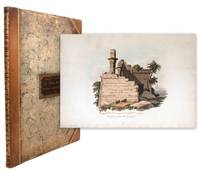
1822323375London: William Miller 1822. First edition later issue. Hand-colored aquatint dedication/title and 24 hand colored aquatint plates by D. Havell J. Hill and J. Bluck supervised by Robert Havell after Henry Salt on thick Whatman paper watermarked 1822. Interleaved throughout with blanks. Without the separately-issued octavo text as usual. Elephant folio. Contemporary half calf and marbled paper boards large morocco label on the upper cover spine gilt. Foxing to a few plates. First edition later issue. Hand-colored aquatint dedication/title and 24 hand colored aquatint plates by D. Havell J. Hill and J. Bluck supervised by Robert Havell after Henry Salt on thick Whatman paper watermarked 1822. Interleaved throughout with blanks. Without the separately-issued octavo text as usual. Elephant folio. A very fine set of views after drawings by Henry Salt. Salt left London in 1802 for an eastern tour with Lord Valentia visiting Indian and Ceylon and taking part in the first British mission to Abyssinia. At Calcutta they were entertained by the Governor-General Marquis Wellesley the dedicatee and travelled to Benares Lucknow Ceylon and Madras. From Mangalore Salt explored the Red Sea. After returning to Bombay and Poona he travelled again to the Red Sea and made an extensive journey inland to the Abyssinian Highlands.<br /> <br /> Salt's original drawings remained in Valentia's possession and after Salt's death the plates too became his property. Like Fraser's Himala Salt's Twenty-Four Views was published in the same size and style as Daniell's Oriental Scenery and is seen very much as a continuation of that great work. The plates include fine views of Chowringhee; the fort of Jaunpur; 2 aquatints of Lucknow including the mosque in the Great Imambara; the great Temple at Tanjore; Poona; the Chaitya Cave; 2 aquatints of Cairo; Cape Town etc.<br /> <br /> The present example is the reissue by Thomas M'Lean printed on Whatman paper watermarked 1822 but otherwise printed from the same plates as the 1809 edition. Abbey Travel 515; Tooley 440; Prideaux Aquatint Engraving pp.234-237 William Miller unknown
181421982London: F. C. and J. Rivington 1814. First edition and with the errata leaf. 37 maps charts views etc. including two vignettes and a very large multi-folding hand-coloured map of Abyssinia. Large 4to contemporary diced russia gilt decorated with double fillet lines and roll tooled borders on the covers raised bands with gilt decorations to the compartments of the spine gilt edged boards and turnovers marbled endleaves all edges marbled. xii 506 lxxv index pp. Rare in contemporary binding unrestored the hinges are cracking and could be refurbished quite well cords generally sound a few unobtrusive ex libris markings quite small in nature at the prelims plates and charts and maps in nice condition the text crisp and clean and sound. Salt was sent by the British government to Abyssinia to present gifts to the king report on the state of the country and cultivate relations with the tribes along the Red Sea coast. F. C. and J. Rivington hardcover
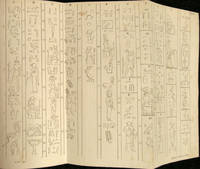
182586465London: A.J. Valpy 1825. Fine. A.J. Valpy London 1825 15.20 x 24 cm 1 volume relié First edition with seven folding plates engraved by Hallmandel after G. Schärf. Beige full calf binding spine with five raised bands framed in gilt gilt lettered morocco title label lengthwise stamped arms of the Society of Writers to the Signet in the center of the boards. Restored spine and corners brittle spine ends spalls and stains to boards. A very rare and important publication by the British Consul General in Egypt in 1815 Henry Salt 1780-1827involved in the excavation of several historical sites and the collection of numerous antiquities. The most remarkable of these is the colossal bust of Ramses II found at Thebes and housed in the British Museum which is said to have inspired Percy Shelley's ""Ozymandias"". Salt carefully reproduces and explains various inscriptions bearing the cartouches of Egyptian gods and pharaohs. He made valuable contributions to the understanding of hieroglyphics following Thomas Young's work on the Rosetta Stone and Jean-François Champollion's groundbreaking discoveries presented in 1822. Historiography even proved that he successfully translated some Egyptian names independently of Champollion's work. Provenance: bindings with the arms of the Society of Writers to the Signet Scottish sollicitors association founded in the late 16th century. Library shelf label glued to the flyleaf. A.J. Valpy hardcover
180941444London: William Miller 1809. Hand-coloured aquatint engraving by D. Havell after Henry Salt on wove paper watermark 'J Whatman'. A view of Lucknow showing the famous Asafi Mosque.<br/> <br/> Henry Salt artist traveller diplomat and collector of antiquities was born at Lichfield Staffordshire England on 14 June 1780. He was determined to become a portrait-painter and upon leaving school was taught drawing by Glover the watercolour-painter of Lichfield. In 1797 he went to London to study with Joseph Farington R.A. and then with John Hoppner R.A. in 1800. The turning point in his career was 3 June 1802 when Salt left London for an Eastern tour with George viscount Valentia afterwards Lord Mountnorris whom he accompanied as secretary and draughtsman. He visited India Sri Lanka and Abyssinia returning to England on 26 Oct. 1806. He made many drawings some of which served to illustrate Lord Valentia's Voyages and Travels to India published in 1809. The present image is from a work titled Twenty-four Views in St. Helena the Cape India Ceylon the Red Sea Abyssinia and Egypt published by William Miller with hand-coloured aquatints by D. Havell and J. Bluck from Salt's own drawings. The originals of all these drawings were retained by Lord Valentia who also retained the ownership of the copper plates after Salt's death. The format and style of presentation of the plates is similar to Thomas and William Daniell's great work Oriental Scenery 1795-1808 and displays great artistry by both Salt and his engravers. The Asafi Mosque is part of the larger Bara Imambara complex which was commissioned by Nawab Asaf-ud-Daula the fourth Nawab of Awadh in 1784 and was completed in 1791. The Asafi Mosque follows the Mughal architectural style characterized by grand arches domes and intricate designs. The mosque is a prominent example of the cultural and artistic heritage of the region during the Nawabi era.<br/> <br/> Abbey Travel II 515 no.3. William Miller unknown
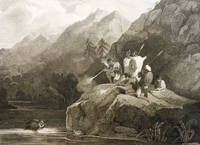
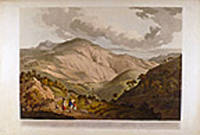
18099205London: William Miller 1809. Hand-coloured aquatint engraving by J. Bluck after Henry Salt on wove paper. A lyrical South African view from the 'Roode Zand' Red Sand Pass inland from the Cape of Good Hope.<br/> <br/> Henry Salt artist traveller diplomat and collector of antiquities was born at Lichfield Staffordshire England 14 June 1780. He was destined to be a portrait-painter and on leaving school was taught drawing by Glover the watercolour-painter of Lichfield. In 1797 he went to London and became a pupil of Joseph Farington R.A. and in 1800 of John Hoppner R.A. The turning point in his career was 3 June 1802 when Salt left London for an eastern tour with George viscount Valentia afterwards Lord Mountnorris whom he accompanied as secretary and draughtsman. He visited the Cape India Sri Lanka and in 1805 Abyssinia returning to England on 26 Oct. 1806. He made many drawings some of which served to illustrate Lord Valentia's Voyages and Travels to India published in 1809. The present image is from a work titled Twenty-four Views in St. Helena the Cape India Ceylon the Red Sea Abyssinia and Egypt published by William Miller with hand-coloured aquatints by D. Havell and J. Bluck from Salt's own drawings. The originals of all these drawings were retained by Lord Valentia who also retained the ownership of the copper plates after Salt's death. The format and style of presentation of the plates is similar to Thomas and William Daniell's great work Oriental Scenery 1795-1808 and displays great artistry by both Salt and his engravers.<br/> <br/> Abbey Travel II 515 no.3. William Miller unknown
180941443London: William Miller 1809. Hand-coloured aquatint engraving by D. Havell after Henry Salt on wove paper watermark 'J Whatman'. An excellent view of Tamil Nadu including one of the great irrigation tanks: a true masterpiece of early technology.<br/> <br/> Henry Salt artist traveller diplomat and collector of antiquities was born at Lichfield Staffordshire England on 14 June 1780. He was determined to become a portrait-painter and upon leaving school was taught drawing by Glover the watercolour-painter of Lichfield. In 1797 he went to London to study with Joseph Farington R.A. and then with John Hoppner R.A. in 1800. The turning point in his career was 3 June 1802 when Salt left London for an Eastern tour with George viscount Valentia afterwards Lord Mountnorris whom he accompanied as secretary and draughtsman. He visited India Sri Lanka and Abyssinia returning to England on 26 Oct. 1806. He made many drawings some of which served to illustrate Lord Valentia's Voyages and Travels to India published in 1809. The present image is fromTwenty-four Views in St. Helena the Cape India Ceylon the Red Sea Abyssinia and Egypt published by William Miller with hand-coloured aquatints by D. Havell and J. Bluck from Salt's own drawings. The originals of all these drawings were retained by Lord Valentia who also retained the ownership of the copper plates after Salt's death. The format and style of presentation of the plates is similar to Thomas and William Daniell's great work Oriental Scenery 1795-1808 and the artistry displayed by both Salt and his engravers is in many cases more than a match for the Daniell's images. Salt visited Sri Lanka only a few years after the British had wretes power from the Dutch who had been the dominant western presence on the island from the middle of the 17th century until 1795.<br/> <br/> Abbey Travel II 515 no.13. William Miller unknown
180934489London: William Miller 1809. Hand-colored aquatint by Daniel Havell. Sheet: 21 1/4 x 29 inches. Mild bubbling in places. This view of Cairo from a hilltop near the Citadel shows Old Cairo with its walls domed buildings and minarets. Across the Nile in the hazy distance are the pyramids of Giza. Heny Salt later returned to Cairo as consul-general for the British. Henry Salt artist traveller diplomat and collector of antiquities was born at Lichfield Staffordshire England 14 June 1780. He was destined to be a portrait-painter and on leaving school was taught drawing by Glover the watercolour-painter of Lichfield. In 1797 he went to London and became a pupil of Joseph Farington R.A. and in 1800 of John Hoppner R.A. The turning point in his career was 3 June 1802 when Salt left London for an eastern tour with George viscount Valentia afterwards Lord Mountnorris whom he accompanied as secretary and draughtsman. He visited the Cape India Sri Lanka and in 1805 Abyssinia returning to England on 26 Oct. 1806. He made many drawings some of which served to illustrate Lord Valentia's Voyages and Travels to India published in 1809. The present image is from a work titled Twenty-four Views in St. Helena the Cape India Ceylon the Red Sea Abyssinia and Egypt published by William Miller with hand-coloured aquatints by D. Havell and J. Bluck from Salt's own drawings. The originals of all these drawings were retained by Lord Valentia who also retained the ownership of the copper plates after Salt's death. The format and style of presentation of the plates is similar to Thomas and William Daniell's great work Oriental Scenery 1795-1808 and displays great artistry by both Salt and his engravers.<br/> <br/> Abbey 515. William Miller unknown
180934488London: William Miller 1809. Hand-colored aquatint by R. Havell. Sheet size: 21 1/2 x 29 3/4 inches. In this large panoramic view Salt demonstrates the appropriateness of the sobriquet "City of a Thousand Minarets". In the foreground is the great Sultan Hussan Mosque one of the largest mosques in Cairo. As we look through the streets towards the distant Nile we see many neighborhood mosques and holy places. Henry Salt artist traveller diplomat and collector of antiquities was born at Lichfield Staffordshire England 14 June 1780. He was destined to be a portrait-painter and on leaving school was taught drawing by Glover the watercolour-painter of Lichfield. In 1797 he went to London and became a pupil of Joseph Farington R.A. and in 1800 of John Hoppner R.A. The turning point in his career was 3 June 1802 when Salt left London for an eastern tour with George viscount Valentia afterwards Lord Mountnorris whom he accompanied as secretary and draughtsman. He visited the Cape India Sri Lanka and in 1805 Abyssinia returning to England on 26 Oct. 1806. He made many drawings some of which served to illustrate Lord Valentia's Voyages and Travels to India published in 1809. The present image is from a work titled Twenty-four Views in St. Helena the Cape India Ceylon the Red Sea Abyssinia and Egypt published by William Miller with hand-coloured aquatints by D. Havell and J. Bluck from Salt's own drawings. The originals of all these drawings were retained by Lord Valentia who also retained the ownership of the copper plates after Salt's death. The format and style of presentation of the plates is similar to Thomas and William Daniell's great work Oriental Scenery 1795-1808 and displays great artistry by both Salt and his engravers. William Miller unknown
1814314823London: F.C. and J. Rivington 1814. First edition. With 28 engraved plates on 27 leaves 7 engraved maps and charts on 6 sheets including 4 folding and 1 hand-colored and 2 vignettes. xi 5 506 lxxv pp. 4to. Contemporary brown russia neatly rebacked. Fine copy. First edition. With 28 engraved plates on 27 leaves 7 engraved maps and charts on 6 sheets including 4 folding and 1 hand-colored and 2 vignettes. xi 5 506 lxxv pp. 4to. A fine copy of this important work by Salt on his two years journey to Abyssinia. "On 2 March 1809 Salt sailed on a mission from the British government to Abyssinia to carry presents to the king and report on the state of the country. Owing to factious unrest he was prevented from going to the king at Gondar and was obliged to deliver the presents instead to the ras of Tigré. While in Abyssinia he made many observations on the geography the customs of the people and the flora and fauna. He brought back many specimens including a previously unknown dik-dik . In 1812 he was elected one of the very few honorary members of the African Association in acknowledgement of information he had procured in its interest. In 1814 he published A Voyage to Abyssinia which was received with some acclaim" ODNB. Salt was subsequently appointed consul-general in Egypt and played an important role in fostering Egyptology financing the excavations of Belzonia Caviglia and d'Athanasi. Blackmer 1479; Czech African p. 141; Fumagalli 139; Gay 2683 F.C. and J. Rivington unknown
182729696Paris: Bobee et Hingray 1827. Rare the first French edition one of only 300 copies printed. With 5 folding lithographic plates lacking folding frontis. 8vo in a handsome French binding of quarter black morocco over marbled boards the spine with blind tooled compartments between gilt ruled raised bands one compartment finely gilt lettered additional gilt decorations at both tips. 4 ix 70 pp. A fine and handsome copy of this rare work as is always the case there is some light foxing and general toning due to the paper stock used. The binding is in very fine condition. THE RARE FIRST FRENCH EDITION OF SALT'S Essay on Dr. Young's and Champollion's System of deciphering the Hieroglyphics of ancient Egypt. Salt was appointed British Consul General of Egypt in 1816. Once set up in Cairo he began to work on his mission of securing antiquities and artifacts for the British Museum. Salt was able to foster beneficial relations between the British government and Pasha Mohammed Ali negotiating deals concerning trade and territorial rights. He also sponsored the excavations of Thebes and Abu Simbel personally carrying out significant archaeological research at the pyramids of Giza and the Sphinx. He earned praise from Jean-François Champollion for his ability to decipher hieroglyphs. Bobee et Hingray hardcover
181227080London: William Miller 1812. Hand-coloured aquatint engraving by D. Havell after Henry Salt on wove paper watermark 'J Whatman 1812'. View of the British colonial island St. Helena prior to its becoming Napoleon's last residence<br/> <br/> Henry Salt artist traveller diplomat and collector of antiquities was born at Lichfield Staffordshire England 14 June 1780. He was destined to be a portrait-painter and on leaving school was taught drawing by Glover the watercolour-painter of Lichfield. In 1797 he went to London and became a pupil of Joseph Farington R.A. and in 1800 of John Hoppner R.A. The turning point in his career was 3 June 1802 when Salt left London for an eastern tour with George viscount Valentia afterwards Lord Mountnorris whom he accompanied as secretary and draughtsman. He visited India Ceylon and in 1805 Abyssinia returning to England on 26 Oct. 1806. He made many drawings some of which served to illustrate Lord Valentia's Voyages and Travels to India published in 1809. The present image is from a work titled Twenty-four Views in St. Helena the Cape India Ceylon the Red Sea Abyssinia and Egypt published by William Miller with hand-coloured aquatints by D. Havell and J. Bluck from Salt's own drawings. The originals of all these drawings were retained by Lord Valentia who also retained the ownership of the copper plates after Salt's death. The format and style of presentation of the plates is similar to Thomas and William Daniell's great work Oriental Scenery 1795-1808 and the artistry displayed by both Salt and his engravers is in many cases more than a match for the Daniell's images.<br/> <br/> Abbey Travel II 515 no.5. William Miller unknown
180917298London: William Miller 1809. Hand-coloured aquatint engraving by D. Havell after Henry Salt on wove paper watermark 'J Whatman'. View of the British colonial island St. Helena prior to its becoming Napoleon's last residence<br/> <br/> Henry Salt artist traveller diplomat and collector of antiquities was born at Lichfield Staffordshire England 14 June 1780. He was destined to be a portrait-painter and on leaving school was taught drawing by Glover the watercolour-painter of Lichfield. In 1797 he went to London and became a pupil of Joseph Farington R.A. and in 1800 of John Hoppner R.A. The turning point in his career was 3 June 1802 when Salt left London for an eastern tour with George viscount Valentia afterwards Lord Mountnorris whom he accompanied as secretary and draughtsman. He visited India Ceylon and in 1805 Abyssinia returning to England on 26 Oct. 1806. He made many drawings some of which served to illustrate Lord Valentia's Voyages and Travels to India published in 1809. The present image is from a work titled Twenty-four Views in St. Helena the Cape India Ceylon the Red Sea Abyssinia and Egypt published by William Miller with hand-coloured aquatints by D. Havell and J. Bluck from Salt's own drawings. The originals of all these drawings were retained by Lord Valentia who also retained the ownership of the copper plates after Salt's death. The format and style of presentation of the plates is similar to Thomas and William Daniell's great work Oriental Scenery 1795-1808 and the artistry displayed by both Salt and his engravers is in many cases more than a match for the Daniell's images.<br/> <br/> Abbey Travel II 515 no.5. William Miller unknown
1814010594London: Rivington 1814. First Edition; E.O. Un volume in 4to 25x33 cm di XI-4-506-LXXV pagine. In barbe quindi a larghi margini. 7 carte geografiche di cui 5 ripiegate 1 colorata a mano; 27 pagine ft di incisioni con 28 tavole; 2 vignette incise. Completa quindi di tutte le carte e le incisioni. Bella legatura in mezza pelle moderna con dorso ornato e tassello di titolo. Sontuoso esemplare di questa prima edizione del più famoso libro illustrato di viaggi nel Corno d'Africa dell'Ottocento. Extra postage cost is required for international shipping. Please email us for the new shipping cost. Rivington unknown
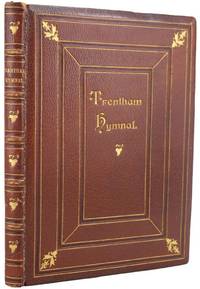
1894096437N: privately printed 1894. Compiled and arranged by T. Johnson Salt organist and choirmaster S. Mary and All Saints Trentham. Pp. 64last blank printed music; handsomely bound by Bagguley in full brown morocco over bevelled boards the spine lettered and decorated in gilt boards panelled in gilt & blind with gilt corner decorations the upper board lettered in gilt and with a small central fleuron gilt edges corners of boards lightly worn joints rubbed tiny snag at head of spine; a.e.g.; brown moire silk endpapers with elaborate finely tooled gilt doublures; bookplate on verso of upper free endpaper the outer leaves a trifle foxed and soiled; privately printed Newcastle-under-Lyme n.d.1894. Printed privately for the Duchess of Sutherland for use only in the Church of S. Mary and All Saints Trentham. Trentham was the seat of the Dukes of Sutherland. This copy inscribed and signed by the Duchess to the Reverend Thurston Rivington dated November 5 1896 on blank preliminary leaf. Millicent 4th Duchess of Sutherland 1867-1955 was sometimes nicknamed 'Meddlesome Millie'. She was a well known social reformer involved in several local causes the most notable being her campaign to eliminate the use of poisonous lead in the glazing process in the pottery industry. During the First World War she established a Red Cross Hospital The Millicent Sutherland Ambulance in Belgium and France. G. T. Bagguley is today best known for his 'Sutherland tooling process' by which colour tooling was executed on vellum which he mainly used on books bound for the Duchess of Sutherland. privately printed unknown
181688779Paris: Magimel 1816. Fine. Magimel Paris 1816 13.5 x 21.3 cm et 317 x 233 pour l'atlas Broché Rare first edition of the French translation established by P.-F. Henry. Gay 2683.Some occasional light foxing.The work also includes an oblong quarto atlas in which map no. 6 has been bound upside down containing 33 engraved plates and maps 1 to 32 plus 1bis based on the author's original drawings.The illustrations comprise 8 maps or plans and 25 plates depicting a variety of subjects: views portraits inscriptions buildings hunting scenes animals etc.As is frequently the case our copy lacks the out-of-text plate in volume 2 showing ancient inscriptions.In 1809 Henry Salt was sent on a diplomatic mission to Abyssinia to establish trade relations with England. During this his second journey to the region he traveled along the eastern coast of Africa visited Portuguese colonies and collected extensive data on the hydrography of the coastal areas. In addition to the travel narrative the work includes several vocabularies of African tribes ranging from Mozambique to Egypt: Makua Monjour Somali Hurrur Galla Darfur Amharic Tigrinya etc.; it also contains notes on Abyssinian birdlife and rare plants.A handsome copy preserved in its original publishers wrappers with plain covers and title labels pasted at the heads of the spines minor marginal flaws to the plain covers without significance. Magimel unknown
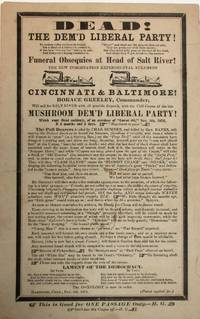
187238915Hartford 1872. Broadside 6" x 9-1/2" text surrounded by mourning border. A few spots Very Good. Illustrations of two steamers. At the bottom: "This is Good for ONE PASSAGE Only. - H.G." Dated at Hartford November 5 1872.<br /> <br /> "Salt River" is 19th century American slang: a losing candidate for office was taking a trip "up Salt River." Tickets for passage "up Salt River" were frequently printed to mock supporters of losing candidates. <br /> This humorous scarce broadside taunts Horace Greeley and other defectors from the Republican Party for their support of Greeley in 1872. "On the overwhelming defeat of the Liberal Republican Party and its candidate Horace Greeley in the presidential election of 1872. Greeley had been nominated at a Liberal Republican convention at Cincinnati in May and at the Democratic National Convention at Baltimore in July 1872" AAS description.<br /> Pall bearers include Charles Sumner and General Banks prominent Republican supporters of Greeley.<br /> OCLC 191231113 2- AAS Middlebury 47090036 1- CT Hist. Soc. as of August 2025. unknown
1891322358London: Sampson Low Marston and Co 1891. First edition no. 7 of 50 copies on Large Paper. xliv 64pp. 1 vols. 4to. Quarter publisher's green morocco and boards. With the bookplate of Leon Gruel famous French binder and Randeria bookplate. Light traces of rubbing. Very good plus. First edition no. 7 of 50 copies on Large Paper. xliv 64pp. 1 vols. 4to. S-K 1103; Mejer 1205 Sampson Low, Marston and Co unknown