[Beda the Venerable] (Pseudo-Bede)Biblio.com
49 résultats
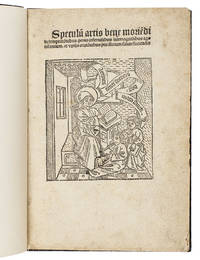
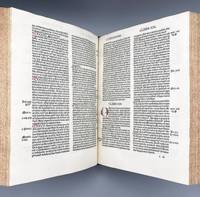
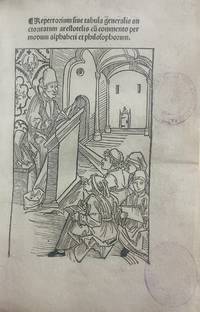
14913742Nürnberg Nuremberg: Peter Wagner 1491. First edition. Spine rubbed with minor wear to corners. Bound in a later half-leather binding spine with gilt fillets; buckram-covered boards. Bookplate of Joseph Prill presumably the German theologian and scholar 1852-1935 on the inner front board. Spine rubbed with minor wear to corners. First and last leaves reinforced probably at the time the present binding was made. 19th-century shelf marks and pencil annotations on the pastedown; old collection stamp on the title page and the date "1490" added in pencil. Occasional early marginal annotations throughout. Some light browning mostly marginal. Complete and internally sound overall a very good copy. Title page with full page woodcut illustration. Title page with full page woodcut illustration. First edition. Spine rubbed with minor wear to corners. Bound in a later half-leather binding spine with gilt fillets; buckram-covered boards. 4to. a-m8 n10 = 106 unnumbered leaves. <p><br /> One of only three incunable editions transmitted under the name of Bede combining a late medieval scholastic core with a humanist Ciceronian addendum.<br /> <p><p><br /> The Repertorium auctoritatum Aristotelis traditionally attributed to Bede the Venerable is an alphabetically arranged florilegium of philosophical auctoritates. It consists of brief excerpts drawn primarily from Aristotle each accompanied by a short explanatory or paraphrastic comment. Conceived as a practical tool for reference and instruction it was well suited to late medieval scholastic teaching and preaching. The attribution to Bede is made explicit on the opening page which states "a reverendissimo et venerabili Beda presbitero edita" a formulation that contributed to the work's long-standing acceptance under his authorship. <br /> <p><p><br /> The title page is illustrated with a full-page woodcut depicting a scholastic lecture scene showing a master reading at a lectern before a group of students visually underscoring the book's pedagogical function. The main scholastic compilation is followed by the appended Auctoritates Ciceronis introduced separately and preceded by a dedicatory epistle to Sebald Schreyer by Peter Danhauser and the volume concludes with a short Latin poem functioning as a conventional closing piece.<br /> <p><p><br /> The Aristotelian material is presented without distinction between authentic and spurious works a feature characteristic of medieval Aristotelian transmission. Aristotle is treated as a unified authority without philological discrimination. Alongside him the compilation draws extensively on other philosophical auctoritates notably Boethius Avicenna Averroes and Porphyry with Seneca also cited particularly in moral contexts. In later manuscript and printed traditions Senecan material becomes increasingly prominent.<br /> <p><p><br /> The present Nuremberg edition printed by Peter Wagner was prepared under the direction of Peter Danhauser of Nuremberg an editor and organizer of learned texts active in the 1490s and connected with the humanist and scholarly circles of Nuremberg and Vienna including Hartmann Schedel Conrad Celtis and Sebald Schreyer see Worstbrock. In this edition Danhauser appended the humanist Auctoritates Ciceronis to the scholastic Repertorium. This Ciceronian section is introduced by the standard preface praising Cicero as studii humanitatis maximus cultor taken verbatim from Albrecht von Eyb's Margarita poetica and is preceded by a dedicatory epistle addressed to Sebald Schreyer church administrator of St. Sebald and a prominent Nuremberg patron. In the dedication Danhauser presents the Ciceronian excerpts as a moral and pedagogical aid for students and young readers and frames the addition as a humanist offering connected to Schreyer's cultural and bibliophilic activity. The Repertorium was later reissued without the Ciceronian appendix and continued to circulate independently into the sixteenth century.<br /> <p><p><br /> Bede the Venerable ca. 673-735 an Anglo-Saxon monk of Wearmouth-Jarrow was among the most influential scholars of the early Middle Ages best known for the Historia ecclesiastica gentis Anglorum and numerous biblical and chronological works. Modern scholarship has demonstrated that the attribution of the Repertorium to Bede is untenable: its reliance on Aristotelian texts Arabic commentators such as Avicenna and Averroes and later scholastic authorities places its composition firmly in the late Middle Ages. The work is therefore regarded as Pseudo-Bede.<br /> <p><p><br /> This book is one of only three known incunable editions transmitted under the name of Bede the Venerable. According to the Incunabula Short Title Catalogue ISTC these comprise the Historia ecclesiastica gentis Anglorum and two editions of the Repertorium: the present first edition which includes the appended Auctoritates Ciceronis and the later Cologne edition issued by Quentell in 1495. Although the Repertorium is now recognized as a pseudo-Bedan work it nonetheless belongs to this strictly delimited incunable corpus and occupies a defined position within the earliest printed tradition of works attributed to Bede offering a clear example of late medieval scholastic compilation with a limited humanist overlay.<br /> <p><p><br /> Scarce. ISTC records 45 surviving copies of which only four are held in the United Kingdom Glasgow University Library; British Library; Wellcome Collection imperfect; Bodleian Library Oxford and three in the United States Southern Methodist University Bridwell Library; University of Rochester Rush Rhees Library; Library of Congress. With the exception of the present copy no other example appears to have been offered for sale according to Rare Book Hub RBH.<br /> <p><p><br /> References: ISTC ib00294000; Goff B-294; HC 2733 = H 1926; GW 3757; Klebs 164.1; Grabmann M. 2022. Methoden und Hilfsmittel des Aristotelesstudiums im Mittelalter Der Text des Neusatzes folgt der Ausgabe »Sitzungsberichte der Bayerischen Akademie der Wissenschaften« Philosophisch-historische Abteilung Jahrgang 1939 Heft 5 Verlag der Bayerischen Akademie der Wissenschaften München 1939. Boer Verlag; Worstbrock F. J. 2015. Deutscher Humanismus 1480-1520 Verfasserlexikon. Walter de Gruyter De Gruyter<br /> <p>. [Peter Wagner] unknown
1495ABC_47543Cologne: Heinrich Quentell 1495. Recent marbled paper over boards by the Geneva bookbinder Jean-Luc Honegger b. 1953 who set up his atelier ca. 1978 signed with his honegger stamp in blue ink at the foot of the back paste-down sewn on 3 recessed supports the marbled paper in an antique spot pattern see Wolfe 162-163 with black spots on unusually fine-grained grey Stormont spots and with veins in red turquoise orange dark blue and white black morocco spine label with the title in gold roman capitals reading up the spine. Small Chancery 4to 20.5 x 14.5 cm. With a large woodcut 10.0 x 8.8 cm on the title page: depicting a teacher Pope Gregory the Great ca. 600 CE declared a saint in 1295 with a dove on his shoulder his attribute seated behind a lectern with an open book instructing two of his pupils seated before him each with a book in his hands with above them a scroll inscribed Accipies tanti doctoris dogmata sancti. Set in a single column with 36 lines to the page in a rotunda gothic type Quentell type 7 here 79G though in the Typenrepertorium 80G with a larger textura gothic for the first line of the title Quentell type 10 155G though the only capital in that line is the 8 mm lombardic initial S Quentell initials e described as 6/7 mm but noting that they are used with type 10. With spaces left for manuscript initials 1 6-line and many 3-line a few - mostly on b1v and b2r - with manuscript guide letters in black ink. Most pages with a few words underscored in black ink. Quentells second quarto edition of the well-known manual on the art of dying in the original Latin matching his ca. 1493 quarto edition almost line for line and using the same woodcut quite different from any used with this text before that date. Quentells quarto editions contain the original long version of the text known as Speculum artis bene moriendi often attributed to Matthaeus de Cracovia or Albertus Magnus editions in Italian are often attributed to Dominicus de Capranica Cardinal of Fermo. The Ars moriendi was one of the earliest incunabula printed and consists of two related Latin texts written around 1415 and 1450 offering guidance on how to have a good death according to Christian beliefs of the late Middle Ages. The texts were written in response to the Black Death and social upheavals of the 15th century with the earliest versions likely composed in southern Germany. The highly popular Ars moriendi was translated into many West European languages and was the first in a tradition of guides to death and dying. The first edition in the original Latin appeared ca. 1474 but was preceded by a German edition in 1473 and perhaps by an edition in Italian described as ca. 1471/75. Quentell published the Latin text together with other works in a folio edition described as ca. 1484/89 but he published four quarto editions of the Ars moriendi alone described as ca. 1493 the present ca. 1495 ca. 1498 and another probably after 1500. He published no Ars moriendi editions in vernacular languages. His first three quarto editions have the same collation but the present edition matches the ca. 1493 edition almost line for line and uses the same woodcut while the ca. 1498 edition differs considerably and uses a different woodcut.Heinrich Quentell one of the greatest early Cologne printer-publishers issued many theological and philosophical texts for university use but also liturgical texts working both alone and with Johann Helman who may have also jointly employed contract printers and dispatched servants to sell books. Quentell was one of the first printers to consistently provide his books with title-pages with approximately 91% of his over 380 publications including one.Quentell used the present Magister cum discipulis-woodcut in several other editions including the Heymericus de Campo Promptuarium argumentorum 1492 GW 12406 and Jacobus van Gruitrode Speculum aureum animae peccatricis 1493 GW M10728. Wynkyn de Worde used a copy in his Parabolarum Alani cum commento 1508 STC 254.3 and other printers copied it as well.All Quentells Ars moriendi editions are undated and the present one used his types 7 and 10 and initials e which all apeared in his books in the period 1488 to 1500. The present edition is probably dated ca. 1495 in the literature because it appears to fall between the two quarto editions thought to date from ca. 1493 and ca. 1498.The bookbinder Jean-Luc Honegger still active today is best known for his bindings for the Bibliothèque Nationale de France in Paris and the Bodmer Foundation near Geneva. With the bookplate of the Bibliotheca Philosophia Hermetica Joost Ritman in Amsterdam and probably bound for them. Slightly browned water stains at the foot of a few leaves not approaching the text some smudges in the margins and on the blank final page. The binding slightly worn at the extremities and with a few unobtrusive scratches on the back board. Otherwise in very good condition and only slightly trimmed about 5 mm at the head and probably no more at the fore-edge and foot giving generous margins about 2 3 and 4 cm at the head fore-edge and foot respectively and some leaves with tranchefiles at the foot.l Bibliothèque Nationale Catalogue des incunables A598; BMC I p. 294; Bod-Inc A449; Bohonos Szandorowska Incunabula quae in bibliothecis Poloniae asservantur 562; BSB-Ink A766; Buffévent VIII 45; Goff A1098; Günther Wiegendrucke der Leipziger Sammlungen 781; GW 02610; HC 14911; ISTC ia01098000; Madsen Kongelige Biblioteks inkunabler 352; Ohly-Sack 274; ÖNB-Ink A483; Pell 1339; Polain 972; Proctor 1425; Sack Freiburg 306; Sallander Uppsala 2046; Schramm VIII 484; Schreiber Manuel de lamateur de la gravure sur bois et sur métal au XVe siècle 3671; Thienen Incunabula in Dutch libraries 425; UBL-Ink A354; USTC 739947; Voulliéme Die Buhdrucker Kölns 305; Voulliéme Inkunabeln der Königlichen Bibliothek 1011; Voulliéme Trier 697. Heinrich Quentell, hardcover
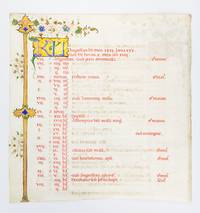
1441ST19882Italy Ferrara 1441-48. 205 x 200 mm. 8 x 7 7/8". 35 lines in a very fine rounded gothic hand. <br/> Text in dark brown and red capitals touched with yellow two four-line "KL" initials in blue pink and green on burnished gold ground with leafy marginal extensions the initials on the recto crowned with an exuberant spray of green blue and gold acanthus hairline tendrils pink flowers and gilt bezants and leaves the verso initials with a long bar border on outer margin painted pink on gilt ground with pink green and blue motifs at middle and top the border traced with black the top of the border accompanied by a spray of hairline tendrils colorful flowers gold bezants and leaves. ◆Lower margin of the verso trimmed away with loss of the end of bar border though not the text some of the other margins trimmed close crowding but not affecting the decoration some fading to brown ink less faded on recto legible on both sides in any case negligible dampstain in upper margin short closed tear just entering gold bar at top left of verso; not without imperfections but still an exquisite and very desirable leaf with richly colored and gilt embellishment.<br/> <br/> This item presents a very special perhaps singular opportunity to own the only known calendar leaf from the renowned Llangattock Breviary to emerge since the manuscript was taken apart in the 20th century. Executed with great skill and delicacy in sensitive Italianate colors highlighted by spring green and pink our leaf is unsurprisingly from a manuscript intended for a powerful aristocrat. It comes from the celebrated Breviary illuminated for the chapel of the Marquises of Este rulers of Ferrara and Mantua a manuscript commissioned by Leonello d'Este duke of Ferrara from 1441-50. According to the d'Este family records this manuscript seems to be the Breviary done for Leonello by Giorgio d'Alemagna Bartolomeo de Beninc Guglielmo Giraldi and Matteo de' Pasti see Toniolo "La Miniatura a Ferrara dal Tempo di Cosm Tura all'eredit di Ercole de' Roberti" 1998 pp. 19-20 and 76-77. Leaves from this manuscript show subtle variations in the style of the illuminations a result of work performed individually by a team of artists doing variations on a theme. At one time in a Spanish library the manuscript was brought to Britain during the Peninsular War and came to be owned by the Rolls family later Lords Llangattock of Monmouth in Wales from whom it takes its name. By the time the work reached Britain most of the miniatures had already been cut out. The Breviary sold at Christie's on 8 December 1958 lot #190 after which it was acquired and subsequently dismembered by Goodspeed's of Boston. The attribution of this leaf to the Llangattock Breviary is based its script ruling and style of decoration as well as physical attributes such as width of the leaf and the appearance of the vellum which all correlate to other known leaves from this manuscript. Furthermore according to the 1958 auction description of the complete manuscript the entire calendar section had its lower margins trimmed away as here. The present leaf appeared in a 1979 catalogue of bookseller Kenneth Rendell and it remains the only known calendar leaf from this manuscript that has ever been advertised. unknown
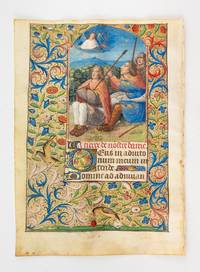
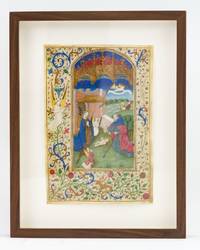
1500ST20810PParis ca. 1500. 165 x 117 mm. 6 1/2 x 4 5/8". Single column 18 lines in a gothic book hand. <br/> Rubrics in red line fillers in blue and pink with gold bezant five one-line initials in burnished gold on pink and blue ground one two-line initial in blue on gold ground with a flower in the center one three-line initial in blue filled with ivy on gold ground recto with panel border of colorful flowers vase and acanthus verso with A LARGE ARCH-TOPPED MINIATURE OF THE ANNUNCIATION TO THE SHEPHERDS surrounded by A FULL BORDER of acanthus flowers and two birds all on a painted gold ground. Slight soiling to vellum but a very well-preserved leaf in fine condition.<br/> <br/> From what was surely a costly Book of Hours this leaf features a charming and skillfully painted miniature of the Annunciation to the Shepherds attributable to the workshop of Jean Pichore fl. ca. 1502-20 a major figure among illuminators of the period and one of the most sought-after artists in France at the turn of the 16th century. Depicting the traditional subject associated with the hour of Terce our miniature portrays as usual an angel appearing to shepherds tending their flock bringing news of the birth of Christ. Although the biblical narrative suggests that the shepherds were startled by the angel's appearance the three figures in this miniature appear remarkably unmoved--in fact only one of them seems to take any notice at all. The first shepherd sits on the ground looking straight ahead; the second holds his hands in prayer but looks little more than well prayerful at the angel in the sky; and a third figure maintains a slightly aloof expression taking no particular interest in the unfolding miraculous event. What may seem to be indifference can be explained easily enough by the artist's successful portrayal of nighttime cold! All three shepherds are thickly dressed one with his arms pressed tightly against his chest another with a hood partly covering his face and the sheep are tightly huddled together into one woolly white cluster. Another manifestation of the artist's success here is seen in the particularly well done molding of the faces with subtle shading attractively rendered features and clear individuation. Moreover although the shepherds seem essentially unmoved their garments are dusted with a glistening gold radiance from above a further subtle touch revealing a high level of achievement on the part of the painter. Finally the borders are one last source of delight with a small bird shown in mid-flight and a second one investigating a single strawberry that seems to have been placed there just for him. All of these indications of sophistication suggest that the original manuscript must have been commissioned by a patron able to pay a premium for the work of a highly skilled atelier. unknown
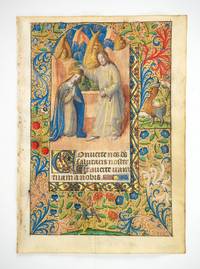
1500ST20810RParis ca. 1500. 163 x 115 mm. 6 1/2 x 4 1/2". Single column 18 lines in a gothic book hand. <br/> Rubrics in red line fillers in blue and pink with gold bezant six one-line initials in burnished gold on pink and blue ground two two-line initials in blue on gold ground with a flower in the center one three-line initial in blue filled with ivy on gold ground verso with panel border of colorful flowers and acanthus recto with A LARGE ARCH-TOPPED MINIATURE OF THE CORONATION OF THE VIRGIN with an "L" shaped frame of burnished gold and painted flowers and A FULL BORDER of acanthus flowers a man playing a bagpipe and a hybrid creature wearing a hat all on a painted gold ground. Very minor wrinkling to vellum but the leaf IN LOVELY CONDITION with the gold everywhere gleaming brightly.<br/> <br/> From a luxuriously appointed Book of Hours this leaf features a handsome miniature of the Coronation of the Virgin attributed to the workshop of Jean Pichore fl. ca. 1502-20 a major figure among illuminators of the period and one of the most sought-after artists in France at the turn of the 16th century. Executed with imagination and delicacy the miniature features the traditional subject associated with the hour of Compline showing the Virgin being crowned Queen of Heaven following her Death and Assumption. The composition here is quite intimate with the Virgin kneeling before her son as she accepts with humility the crown he lays upon her head. Christ is depicted barefoot and slightly bowed toward his mother in a gentle display of respect. The artist creates a wonderful backdrop for this scene composed entirely of seraphim painted gold blue light pink and green closely packed together. Two of the seraphim hold up light pink draperies behind the central figures as if to shield this tender moment from prying eyes. The borders here are a source of delight featuring a figure wearing a jester-like cap and playing the bagpipe as well as a creature with the body of a bird and the face of a human donning a rather fashionable bycocket cap. The illumination here is of high quality features a liberal use of gold and contains unique marginal details suggesting that the original manuscript must have been a costly commission for a wealthy patron. unknown
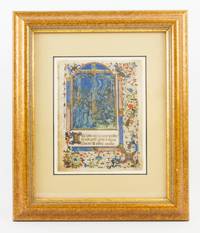
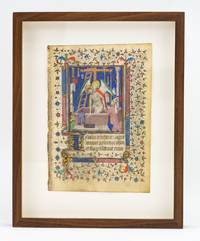
1440ST19540aMetz ca. 1440. Leaf: 162 x 124 mm. 6 3/8 x 4 7/8". Frame: 308 x 258 mm. 12 1/8 x 10 1/8". Single column three lines of text under the miniature obverse with 18 ruled lines five of which contain text in a gothic book hand. <br/> Attractively matted and framed. Recto with one three-line initial in gold on pink and blue ground WITH A LARGE MINIATURE OF THE CRUCIFIXION WASHED IN BLUE Christ on a painted gold cross flanked by two thieves on painted gold crosses surrounded by throngs of people including the Virgin St. John Mary Magdalene and numerous soldiers all in an arched gold frame inside a three-sided painted and gilt baguette and a FULL BORDER of colorful vine sprays and flowers inhabited by a peacock. See: "The Jeanne Miles Blacburn Collection of Manuscript Illuminations" nos. 29-38; Avril & Reynaud pp. 182 & 190. Minor soiling/browning right at inner edge away from border and image otherwise IN VERY FINE CONDITION THE MINIATURE REMARKABLY WELL PRESERVED WITHOUT ANY LOSS OF PAINT.<br/> <br/> This stunning miniature with its memorable nocturnal scene comes from a very fine Book of Hours probably executed by Henri d'Orquevaulz or d'Orquevaulx or a member of his workshop. D'Oquevaulz was active during the second quarter of the 15th century in Metz the cultural and commercial capital of Lorraine during the period and the center of a growing book trade. According to the catalogue of the Jeanne Miles Blackburn Collection in the Cleveland Museum of Art which owns 10 leaves from the original manuscript the parent Book of Hours can be localized based on the Lorraine dialect found in the French text on some of the leaves including the present example and because the calendar singled out two bishop-saints of Metz Clement and Arnoul. Although little is known about d'Orquevaulz his dated signature in the colophon of a Livy manuscript that he illuminated for an alderman of Metz indicates that he was active in that city in 1440. Artistic affinities with northern European styles make it possible that d'Orquevaulz had emigrated from the Netherlands or Germany to Lorraine; another possibility one that Avril and Renaud suggest is that the master himself was from Metz but that he had German associates perhaps from the Rhineland area. According to these two scholars the painter's use of large flat areas of colors is more typical of the Rhineland the Netherlands or Bohemia than of France; in any case they praise his "exquisite color harmonies." The artist has outdone himself in the present miniature rising to the height of pathos and making it one of the most extraordinary leaves we have ever offered for sale. In contrast to the bright colors used in Books of Hours even to depict the most serious scenes the present leaf presents a remarkable visual nocturne with the figures and buildings painted in the same shades of blue as the sky suggesting that heaven itself is darkening at the death of Christ. Mary Magdalen kneels at the foot of the cross while St. John supports the devastated Virgin as a soldier pierces the Savior's side with a lance. The miniature is crowded with figures we see well-defined faces of no fewer than 18 persons and two horses but the artist has not lost his dramatic focus as Christ on his cross of brushed gold dominates the scene. In choosing to make this a darkened composition the artist has risked obscuring detail but his skill has been equal to his concept here as he has used a diluted blue paint that allows for a very successful delineation in various shades almost like grisaille this technique not incidentally has prevented the cracking and erosion so commonly seen with the normal thick applications of typical cobalt blue. The result of the decision to show the world in eclipse at Christ's death is to heighten and universalize the drama here to such an extent that the scene leaves a powerful and lasting impression. The text on this leaf is entirely in French in rhyming verse. Roughly it translates as: "Jesus on the cross did hang / And took upon himself our sins / Gave to humankind redemption / Rendered up his soul to God. / The sunshine lost its glowing light / The earth did tremble and did crack / Grieving for the bitter death / Suffered by the son of God." Although the original Book of Hours was dismembered some time in the 20th century extant leaves suggest that its visual program was much bigger than usual and probably the result of an important commission by a wealthy patron--something likely to be painted by one of the chief artists in the workshop. Illuminated manuscripts from Metz--let alone examples of this quality--are uncommonly seen on the market. unknown
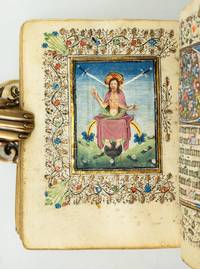
1450ST20835Flanders ca. 1450. 109 x 81 mm. 4 1/4 x 3 1/8". Single column 14 lines in a gothic book hand. 161 leaves. COMPLETE. Contents: Calendar f. 1r; Mass of the Holy Spirit f. 14r; Mass of the Holy Cross f. 23r; Requiem Mass f. 30r; Prayer on the Seven Last Words of Christ by the Venerable Bede f. 36v; Passion according to John f. 40v; blank f. 53; Hours of the Holy Cross f. 55r; Mass of the Virgin Mary f. 60r; Gospel Lessons f. 66v; Hours of the Virgin f. 73r; Penitential Psalms f. 126r; Litany f. 138r; Office of the Dead f. 144r. <br/> PLEASING NEAR-CONTEMPORARY BLIND-ROLLED CALF apparently with some old skilled restoration to joints spine and corners covers with rolled vine border surrounding a panel of three columns bearing a roll with parts of the inscription "AVE MARIA GRACIA PLENA" each word separated by one of four small motifs a flower a human profile the lamb of god and a sitting animal--perhaps a lion raised bands compartments with part of the same inscription roll. Lacking the original ties. Housed in a very attractive custom-made brown calf folding case with blind-stamped lettering on the spine interior lined in suede the whole within a calf-lipped suede-lined matching slipcase. Rubrics in red numerous one-line initials in blue with red penwork or gold with dark blue penwork many two-line initials in burnished gold on pink and blue ground with white embellishments several larger "I" initials between four and 11 lines in burnished gold on pink and blue ground with white embellishments 12 six- to seven-line initials some painted pink or blue with white embellishments and filled with flowers and tendrils on a gold ground or the initial in burnished gold on pink and blue ground with white embellishments EIGHT LARGE MINIATURES each inside a thin gold frame and with a three-quarter border of gilt leaves hairline vines and floral spays each facing page with a similar three-quarter border the subjects of the miniatures being: the Holy Spirit in the form of a dove f. 13v; St. Helena and the True Cross f. 22v; Raising of Lazarus f. 29v; Crucifixion f. 54v; Virgin and Child Enthroned f. 59v; Annunciation f. 72v; Last Judgment f. 125v; Funeral Mass f. 143v. Prickings visible in fore margins. See: Defoer et. al "The Golden Age of Dutch Manuscript Illumination" pp. 75-86. Just minor wear to the solid very pleasing early binding. A little chipping almost always mild to four of the miniatures with square frames the fifth the Annunciation somewhat rubbed and faded the three domed miniatures perfectly intact vellum with minor soiling and thumbing in places especially in lower corners of leaves in second half other trivial imperfections but overall a very well-preserved manuscript with no major issues.<br/> <br/> This enchanting little prayer book features eight attractive miniatures large gleaming burnished gold initials and a pleasing period binding--all in an excellent state of preservation. The miniature program here can be attributed to the so-called Masters of Otto van Moerdrecht the name given to a variety of Dutch artists active in the 1430s and '40s all working in a similar mode rather than to a specific master or workshop. According to Defoer et al. the work of these miniaturists "exhibit varied compositional formulas and bright highly contrasting colors . . . . The small somewhat doll-like figures appear rather wooden but their expressive gestures give the scenes a varied and vivid character." Two artistic hands are responsible for the present miniatures. The artist behind the first three miniatures all set within domed gilt frames the Holy Spirit St. Helena and Raising of Lazarus shows particular skill with a very smooth application of color figures with long eloquent hands and faces with subtle white highlighting. A second artist was responsible for the remaining five miniatures set within square golden frames Crucifixion Virgin and Child Enthroned Annunciation Last Judgment and Funeral Mass. Though this hand is less polished and the miniatures slightly smaller in size the scenes are all quite charming and attractively colored with vivid splashes of bright orange bubblegum pink sky blue and pale green. It is worth noting that the miniatures differ not only because of the artists' degree of success but also because of their condition: whereas the five are generally well preserved the other three are in a virtually perfect state. In addition to the central text of the Hours of the Virgin this manuscript contains several Masses each of which is preceded by a miniature. Perhaps the most interesting of these is the Mass of the Holy Cross which is paired with a miniature of St. Helena mother of Constantine the Great. According to Christian tradition Helena found the wooden cross used in the Crucifixion while she was travelling in Jerusalem in the fourth century. Constantine built the Basilica of the Holy Sepulchre in its honor and installed the relic there to be venerated. Britannica says that the adoration of the True Cross led to wide-spread sale of its fragments sought after as objects of devotion. It is unusual to find St. Helena depicted in a Book of Hours and this image is especially appealing with Helena in a beautiful red robe crown and halo embracing a large wooden cross in the center of the composition. The background is reminiscent of the work of the Gold Scrolls group with small swirls of liquid gold swimming in a scarlet sky the same scrolling motif graces the Holy Dove miniature. There is no indication of former ownership in this manuscript although the Calendar presents a few unusual saints that confirm a Flanders connection. These include St. Amandus in red known as the "Apostle of Flanders" on 2 February; St. Guido known as the "Poor Man of Anderlecht" on 9 September; St. Bavo in red patron saint of Ghent where a Cathedral is named in his honor on 10 October; and St. Eligius patron saint of goldsmiths and metalworkers on 1 December. The binding here is very close to contemporary and probably dates to the late 15th century. Neither the floral roll nor the "Ave Maria" roll seems to appear in EBDB. Similar rolls include r001954 r000623 and r000670 but ours is the only one with four different and charming tools one of each used between every "Ave" and "Maria." For a manuscript only slightly bigger than the palm of one’s hand this Book of Hours has a great deal to offer. In addition to its early binding and lovely illumination by an influential group of artists great care has been put into its preservation so that it resolutely endures for our pleasure and for owners in the centuries to come. unknown
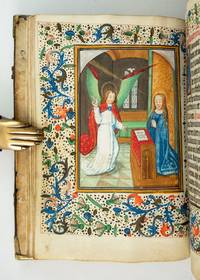
1470CLe2501Low Countries probably Bruges ca. 1470-80. 186 x 135 mm. 7 3/8 x 5 1/4". Single column 20 lines in a gothic book hand. i blank 108 i blank leaves bound too tightly for a close collation but APPARENTLY COMPLETE. Contents: Calendar f. 1r; Gospel Lessons f. 7r; Hours of the Holy Cross f. 11r; Hours of the Holy Spirit f. 15r; Mass of the Virgin 18r; "Obsecro te" f. 21r; "O Intemerata" f. 23r; Suffrages f. 24r; Hours of the Virgin f. 33r; Office of the Virgin as said throughout Advent f. 71r; Penitential Psalms f. 76r; Litany and petitions f. 81v; Office of the Dead f. 87r. <br/> HANDSOME RENAISSANCE ENTRELAC BINDING upper joint and parts of spine very skillfully repaired covers with a gilt floral border surrounding a central panel of gilt strapwork design with traces of original polychrome painting raised bands spine gilt in compartments original bosses and catchplates clasps renewed all edges gilt. Rubrics in red numerous one-line initials in blue with red penwork or gold with dark purple penwork many two-line initials in burnished gold on pink and blue ground with white highlights most of these with floral sprays extending into the margins 22 SMALL MINIATURES measuring approximately 45 x 37 mm. each with panel borders of colorful acanthus and flowers at the top and bottom of the page connected by a strand of gilt bezants and 14 FULL-PAGE MINIATURES each surrounded by a full border of acanthus flowers and bezants the facing pages also with full borders and a large six-line initial painted pink or blue filled with swirling vines and flowers on gilt and painted ground. Subjects of the large miniatures being: Crucifixion f. 10v; Pentecost f. 14v; Virgin and Child f. 17v; Annunciation f. 32v; Visitation f. 42v; Nativity f. 49v; Annunciation to the Shepherds f. 52v; Adoration of the Magi f. 55v; Presentation in the Temple f. 58v; Massacre of the Innocents f. 61v; Flight into Egypt f. 66v; Coronation of the Virgin f. 70v; David in Prayer f. 75v; Raising of Lazarus f. 86v. Front pastedown with a 16th century inscription see below; rear pastedown with a 17th century ownership inscription in ink signed François le Paige. Lower joint a bit rubbed margins with a little soiling and occasional wrinkle fore-edge border rule just grazed by binder in a few places the other borders quite ample miniatures with tiny chips light fading or rubbing in a couple places etc. but IN EXCELLENT CONDITION the attractive period binding very well preserved with boards showing virtually no signs of wear the vellum generally clean and bright and the miniatures fresh and richly colored.<br/> <br/> This is an extensively illustrated Book of Hours preserved in an especially attractive early binding with richly colored miniatures attributed to the Master of Philip of Cleves' "Book of the Hunt." Active in the Low Countries from approximately 1470-90 this artist was patronized by some of the area's wealthiest elite and is known to have collaborated with another important illuminator called the Bruges Master of 1482. Some trademarks of our painter include faces with subtle blue shading; high arched eyebrows; thin golden halos; and women with very straight shoulder-length hair highlighted with strands of gold. Outdoor scenes often contain narrative elements in the distance such as the figures of a young David and Goliath in the miniature of King David at Prayer or pagan idols dropping from a column in the Flight into Egypt recalling a popular apocryphal tale of pagan relics miraculously falling to pieces as the Holy Family passes by. Some miniatures of note in addition to these two are the Raising of Lazarus for the Office of the Dead--a popular alternative to funeral images particularly among Flemish illuminators--and the Massacre of the Innocents for the hour of Vespers a particularly violent episode in which King Herod commands his soldiers to slaughter the male infants of Bethlehem. Like other miniatures in this work the action in these scenes is spread out between the fore middle and background creating a multi-layered narrative that invites the eye to explore and meditate. The artist's color palette in this manuscript is quite memorable and includes a bright mustard yellow pale green and cherry blossom pink. The Coronation of the Virgin makes particularly strong use of color with a sunset-like gradient giving way to billowy blue clouds. The Annunciation miniature also demonstrates the Master's facility with color; here the Angel Gabriel's red and green wings are fully extended while the Virgin is radiant against a golden yellow wall covering. In addition to the large compositions we are treated to 22 smaller miniatures depicting the Evangelists and saints each of which is charming in its more confined presentation. Although the saints found in the Suffrages are quite typical for a Book of Hours the Calendar is another story. Despite being rather sparsely filled out the calendar here includes several feast days some of them unusual enough to provide additional insight into the manuscript's localization and use. For example there is St. Landoaldi 19 March a missionary to Northern France and Belgium and St. Winnoc 6 November the son of a Breton king with a former abbey in the far north of France. The calendar is idiosyncratic in other ways as well with saints' names that are repeated and others that are either extremely obscure or whose dates seem to be wrong. Whatever the case additional research into the calendar would undoubtedly prove revealing. We are fortunate to have some early provenance information written into this Book of Hours. The inscription on the front pastedown reads: "This last day of September 1590 we name erased but Claude le Paige lieutenant of the guards of his highness of Bar le Duc on the one hand and Alix de la Taxe on the other hand have married in front of the holy Catholic church at the place of Mirecourt." Below this inscription are notes indicating the ages of the bride and groom 17 and 36 respectively as well as the dates of their deaths: he died on 9 May 1610 and she on 14 September 1622. Located in the strategically important Meuse region in northeastern France the Duchy of Bar-le-Duc unified with Lorraine in 1480 and became extremely wealthy during the 16th century. Although we do not know for whom the manuscript was originally made it seems quite possible that it was commissioned for a forebear of the named Bar-le-Duc spouses and was perhaps passed down through later generations of the family. The signature on the pastedown indicates that François le Paige son of Claude and Alix inherited the book from his parents. This manuscript was lavishly and tastefully bound early in the 16th century and has survived in excellent condition to the present day. This binding would originally have been painted but even without its original colors it is still quite attractive perhaps even splendid. In excellent condition inside and out the manuscript is a fortunate survival and a testament to generations of careful stewardship. unknown
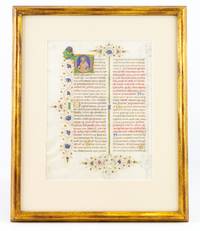
1441ST19880Italy Ferrara 1441-48. Visible leaf: 245 x 187 mm. 9 5/8 x 7 3/8"; Frame: 380 x 315 mm. 15 x 12 1/4". Double column 30 lines in a very fine rounded gothic hand a few lines of text in the same hand but smaller. <br/> Mounted and in a simple but pleasing gold frame. Visible side with rubrics in red one-line initials in burnished gold or painted blue one two-line initial in burnished gold on a pale pink ground with white tracery a lovely illuminated bar between the columns with a central plant knot AND SPROUTING IN UPPER AND LOWER MARGINS CLUSTERS OF FLOWERS AND LEAVES IN VARIOUS COLORS AS WELL AS GOLD BEZANTS outer margin with swirling penwork studded with gilt bezants running the length of the column each penwork swirl enclosing a painted and gilt flower with ONE FIVE-LINE HISTORIATED INITIAL DEPICTING ST. PAUL HOLDING A SWORD AND BOOK the initial painted pink with green leaves and a blue and green acanthus extension on a gilt ground. ◆Not examined outside of frame but in very fine condition: vellum slightly wavy text in the bottom margin just a bit faded but by all appearances A VERY CLEAN BRIGHT LEAF SPARKLING WITH GILT.<br/> <br/> Executed with great skill and delicacy and in sensitive Italianate colors highlighted especially by spring green and pink the present leaf is from a manuscript intended for a powerful aristocrat. It comes from the celebrated Breviary illuminated for the chapel of the Marquises of Este rulers of Ferrara and Mantua a manuscript commissioned by Leonello d'Este duke of Ferrara from 1441-50. Because the d'Este family kept excellent records we have confidence that this manuscript was done for Leonello by Giorgio d'Alemagna Bartolomeo de Benincà Guglielmo Giraldi and Matteo de' Pasti see Toniolo "La Miniatura a Ferrara dal Tempo di Cosmè Tura all'eredità di Ercole de' Roberti" 1998 pp. 19-20 and 76-77. The leaves show subtle variations in the style of the illuminations a result of work done by a team of artists doing variations on a theme. At one time in a Spanish library the manuscript was brought to Britain during the Peninsular War and came to be owned by the Rolls family later Lords Llangattock of Monmouth in Wales from whom it takes its name. By the time the work reached Britain most of the miniatures had already been cut out. The Breviary sold at Christie's on 8 December 1958 lot #190 to Goodspeed's of Boston who broke it up. The intact first quire of 10 leaves was purchased by Philip Hofer and given to Harvard cf. Wieck "Late Medieval and Renaissance Illuminated Manuscripts" p. 130 and fig. 74 and individual leaves appeared in 1967 in the catalogues of Folio Fine Art "the quality of the leaves is extremely high" Maggs Brothers "of a very high quality" and Alan Thomas "of exquisite quality". The present example is especially desirable for the portrait of St. Paul who is depicted holding a sword and book and whose carefully molded features reflect the growing interest in realistic portraiture in Renaissance Italy. unknown
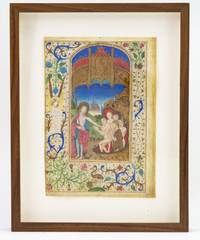
1470ST17764Delft ca. 1470. Leaf: 175 x 122 mm. 6 7/8 x 4 3/4"; Frame: 250 x 195 mm. 9 3/4 x 7 3/4". No text on recto or verso. <br/> In an attractive wooden frame. A FINELY PAINTED MINIATURE OF THE HARROWING OF HELL within an arch-topped compartment the mouth of hell depicted on the left with a fiery red interior and five people emerging from it the figure of Christ on the left holding a cross on a long staff and half-clothed in a pink and blue robe the background with a castle in the distance ALL OF THIS BENEATH A VERY DETAILED ARCHITECTURAL CANOPY suspended in the sky AND THE WHOLE WITHIN A FULL BORDER of acanthus leaves and other foliage and flowers in reds blues greens yellows and brushed gold along with very many small burnished gold ivy leaves and buds on hairline stems a small stork in the bottom border and a large delicately shaded angel in the left border. ◆Left margin trimmed very close to decoration just escaping loss and the other three margins ample mild darkening right at fore and tail edge but not reaching into borders otherwise IN FINE CONDITION the colors rich and true and the burnished gold still shimmering.<br/> <br/> This extraordinary miniature notable for its uncommon subject matter memorable imagery and fine workmanship was produced by a talented artist belonging to the stylistic group known as the Masters of the Delft Half-Length Figures. The subject here is infrequently depicted in Books of Hours: the Harrowing of Hell appears as a full-page miniature in only three of the 119 prayer books described by Roger Wieck in his "Time Sanctified" and three others contain a Harrowing depiction inside an initial. Christian theological tradition tells us that after his crucifixion Christ went to liberate souls from Limbo--a location inhabited by those barred from entry into Heaven because they died before the Redemption. In our scene Christ wrapped in a regal cloak and carrying a long staff his hands and feet still bleeding from the wounds he received on the Cross reaches into an absolutely wonderful Hellmouth to extricate Adam and Eve and other naked souls while the recently deceased and original saint John the Baptist still clad in an animal skin garment waits patiently for his turn to emerge. The great maw of Hell as depicted here has bulging eyes a distended snout thickly matted hair and a bad complexion; his gaping mouth punctuated by sharp gray teeth glows red hot and one can tell from the creature's expression that he is loath to comply with this rescue of souls. In addition to its compelling subject matter there is a high level of artistic achievement here including delicately molded figures impressively detailed architectural elements and a lovely color palette. The elegance and quiet sophistication observed in this miniature distinguishes the artist responsible for this work as a particularly talented member of his circle. Active from about 1450-80 the Masters of the Delft Half-Length Figures were named by James Marrow after the angels and other figures whose upper bodies are typically found emerging from a cloud within the borders. Although the present leaf uncharacteristically contains a full-length angel in the border it shares other stylistic similarities such as the elaborate architectural canopy hovering over the main composition; and it particularly resembles the work of the artist of Keble College MS 77 an illuminator described in "The Golden Age of Dutch Manuscript Illumination" as "one of the more articulate of the group" whose "figures are more fully modelled and his palette . . . deeper and brighter" than that of his contemporaries. Because the subject of the present miniature goes beyond the standard image program seen in routine productions and because of the high level of artistic accomplishment seen here this leaf was almost certainly part of an elaborate Book of Hours produced in response to an important commission. unknown
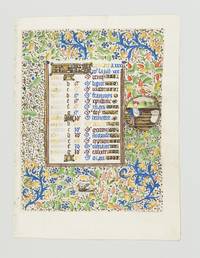
1460ST12835Paris ca. 1460. 195 x 143 mm. 7 3/4 x 5 1/2". Single column 16 lines in a gothic book hand. <br/> Minor feast days in red and blue major feasts in gold numerous gold and painted line fillers the five "A" initials and the "KL" highly decorative and painted pink and blue against a gold background gold and pink bar surrounding the text on three sides BOTH SIDES OF THE LEAF WITH EXTRAVAGANTLY DECORATIVE BOTANICAL FULL BORDERS with two small birds hidden within and INCORPORATING TWO MEDALLION MINIATURES DEPICTING THE LABOR OF THE MONTH SOWING AND THE SIGN OF THE ZODIAC SCORPIO FOR OCTOBER. ◆IN VERY FINE FRESH CONDITION with gold and paint extraordinarily bright.<br/> <br/> The extraordinarily lavish and animated full borders coupled here with extensive use of brushed and burnished gold--for major feast days for decorative border elements and even for the hundreds of seeds being sown!--suggests that this calendar folio comes from a Book of Hours that was commissioned for a person or persons of high rank since it would have been very costly. The leaf comes from a manuscript that included numerous roundels depicting the lives of St. Catherine and the more obscure St. Alexius and it is possible that the Book of Hours belonged to a husband and wife for whom these saints served as patrons. The style of the delicately painted figures especially in the roundels indicates an artist who was familiar with the early output of the Coëtivy Master who according to Avril and Renaud can be identified with Colin d'Amiens who made a great name for himself in Paris not as was previously thought with Henri de Vulcop who made a great name for himself in the Loire region. The master takes his name from the Book of Hours now in the Austrian national library that he painted for Olivier de Coëtivy and his wife Marie de Valois one of some 30 works that have been identified as his. Although there is considerable Flemish influence that can be seen in his work he has links for example with Simon Marmion Colin d'Amiens was active in Paris during the third quarter of the 15th century and with Barthélmy van Eyck and Jean Fouquet was among the three great artists of this period patronized by the French court--Avril and Renaud says flatly that our master was "the most important artist practising in Paris in the third quarter of the century from about 1450 to 1485." For more on the Coëtivy Master see Avril and Reynaud pp. 58-69. unknown
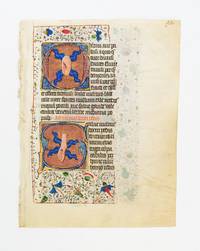
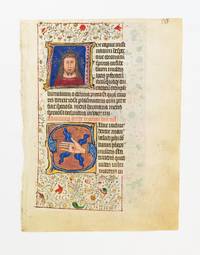
1465ST17243bBruges ca. 1465. 193 x 145 mm. 7 5/8 x 5 3/4". Single column 21 lines in a gothic book hand. <br/> Rubrics in red one two-line initial in gold filled with blue on pink ground WITH THREE LARGE HISTORIATED INITIALS: ONE FEATURING AN OVAL-SHAPED PIECE OF FLESH WITH A GASH IN THE CENTER AND TWO WITH CHRIST'S DISEMBODIED FOOT SHOWING THE PUNCTURE WOUND FROM THE CRUCIFIXION each initial in pink or blue with white tracery filled with dark pink and thin gilt lines and dots four wavy blue rays radiating from behind each appendage all within a thin gilt frame both sides with a three-quarter border consisting of hairline vines gold bezants and a few colorful flowers. ◆Vellum a shade less than bright faint marginal rumpling trivial paint transfer on one initial BUT IN FINE CONDITION the initials richly painted and extremely well preserved.<br/> <br/> From a manuscript probably produced in Bruges for the English market this leaf contains arresting initials that direct the viewer's attention to the wounds endured by Christ during the Passion. According to Roger Wieck Passion Cycle images enjoyed a particular vogue in 15th century Dutch Flemish and English Books of Hours including those that were exported to England. In the present example the strikingly unusual imagery includes the wounds of the left and right foot as well as the spear injury to Christ's side depicted as an oval piece of flesh with a laceration across the center. A sister leaf to the present item features three additional initials showing a portrait of Christ wearing the Crown of Thorns his gaze fixed directly at the viewer and in separate initials his left and right hands appear disembodied and displaying the stigmata. The parent manuscript containing the present leaf sold at Christie's on 15 November 2006 lot 16 the description for which gives us additional information about the book's contents and provenance: it was made for the Use of Sarum included a calendar with the English saint Thomas Becket and Popes Gregory and Silvester with their names crossed out indicating that it was in England through at least the time of the Reformation and contained an early ownership inscription of a woman named Bridget Lowe with a Middle English inscription on the pastedown. Christie's also attributed the parent manuscript to the workshop of William Vrelant with miniatures possibly by his chief assistant the Master of the "Vraie Cronique Descoce." They note that this work is "of higher quality than many of the works that satisfied the English demand for Netherlandish illumination" and that it "demonstrates why Vrelant appealed to the great bibliophiles of the Burgundian Netherlands." Vrelant was the leading purveyor of books of private devotion in Bruges during the third quarter of the 15th century and his prominent position among Flemish illuminators of the time is indicated by the considerable number of manuscripts illustrated in his manner by other miniaturists both in Bruges and in nearby cities in Flanders. Similar examples to the present leaf can be found in intact Books of Hours at the Philadelphia Free Library MS Widener 3 and the Huntington HM 1086--both of which were produced in Flanders or the Netherlands around the same time as the present work. The present leaf surpasses both of these examples in terms of excellence of the artistic hand and attention to detail. unknown
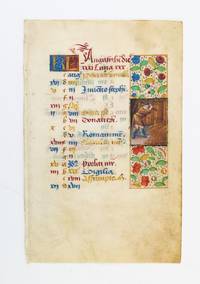
1470ST17245-09Northern France probably Rouen ca. 1470. 180 x 117 mm. 7 x 4 5/8". Single column 18 lines text in a bâtarde hand. <br/> Text in red blue and gold two-line "KL" in shell gold on blue and red ground both sides with panel border composed of flowers and ink dots WITH TWO SMALL MINIATURES each centered in the middle of the panel borders featuring the labor of the month Threshing and the zodiac sign a young woman for Virgo. Vellum a bit soiled and slight wrinkling in margins small area of rubbing at bottom of the Virgo miniature but in excellent condition overall the fine details in the miniatures well preserved.<br/> <br/> Situated among the flowers of the panel borders here are two small but charming miniatures depicting the labor of the month "Threshing" and the zodiac sign for August. According to Roger Wieck far fewer than half the Books of Hours of the period contain illustrated calendars "even in manuscripts with otherwise lavish cycles of miniatures"; when they do appear they are invariably charming as is the case here. In the threshing scene a young layman brings down his grain flail two hinged pieces of wood the longer one called a helve and the other a beater joined by a thong in an effort to separate the grain while neatly gathered bushels of straw appear just behind him. On the verso we see a representation of Virgo as a young woman holding appropriately two long stalks of grain in her hands. The rich palette used in these miniatures allows the delicate gold highlighting on the harvested crop and garments to shine through adding a fine sense of detail to each image. unknown
1465ST17243aBruges ca. 1465. 193 x 145 mm. 7 5/8 x 5 3/4". Single column 21 lines in a gothic book hand. <br/> Rubrics in red WITH THREE LARGE HISTORIATED INITIALS: ONE WITH A PORTRAIT OF CHRIST WEARING THE CROWN OF THORNS AND TWO WITH DISEMBODIED HANDS SHOWING THE STIGMATA each initial in pink or blue with white tracery filled with dark pink or blue with thin gilt lines and dots hands with wavy blue rays radiating from behind the appendage all within a thin gilt frame both sides with a three-quarter border consisting of hairline vines gold bezants and a few colorful flowers. ◆Margins with a little light soiling BUT IN FINE CONDITION THE PAINT OF THE INITIALS ESPECIALLY RICH AND WELL PRESERVED.<br/> <br/> From a manuscript probably produced in Bruges for the English market this leaf contains arresting initials that direct the viewer's attention to the wounds endured by Christ during the Passion. According to Roger Wieck Passion Cycle images enjoyed a particular vogue in 15th century Dutch Flemish and English Books of Hours including those that were exported to England. In the present example the strikingly unusual imagery includes a portrait of Christ wearing the Crown of Thorns his gaze fixed directly at the viewer and in separate initials his left and right hands appear disembodied and displaying the stigmata. A sister leaf to the present item features three additional initials showing the wounds of the left and right foot as well as the spear injury to Christ's side depicted as an oval piece of flesh with a laceration across the center. The parent manuscript containing the present leaf sold at Christie's on 15 November 2006 lot 16 the description for which gives us additional information about the book's contents and provenance: it was made for the Use of Sarum included a calendar with the English saint Thomas Becket and Popes Gregory and Silvester with their names crossed out indicating that it was in England through at least the time of the Reformation and contained an early ownership inscription of a woman named Bridget Lowe with a Middle English inscription on the pastedown. Christie's also attributed the parent manuscript to the workshop of William Vrelant with miniatures possibly by his chief assistant the Master of the "Vraie Cronique Descoce." They note that this work is "of higher quality than many of the works that satisfied the English demand for Netherlandish illumination" and that it "demonstrates why Vrelant appealed to the great bibliophiles of the Burgundian Netherlands." Vrelant was the leading purveyor of books of private devotion in Bruges during the third quarter of the 15th century and his prominent position among Flemish illuminators of the time is indicated by the considerable number of manuscripts illustrated in his manner by other miniaturists both in Bruges and in nearby cities in Flanders. Similar examples to the present leaf can be found in intact Books of Hours at the Philadelphia Free Library MS Widener 3 and the Huntington HM 1086--both of which were produced in Flanders or the Netherlands around the same time as the present work--but the present leaf surpasses both of these examples in terms of excellence of the artistic hand and level of detail depicted. unknown
1460ST12839Paris ca. 1460. 153 x 110 mm. 6 x 4 3/8". Single column 14 lines of text in a fine gothic book hand. <br/> One-line initial in burnished gold on a pink and blue ground with white tracery a two-line initial and a three-line initial in pink with white tracery on a ground of burnished gold the center filled with twining blue vines bearing pink and scarlet flowers verso with a rinceau panel border featuring twining hairline stems bearing burnished gold ivy leaves and fruit blue and gold acanthus leaves and flowers recto WITH AN ARCH-TOPPED MINIATURE OF THE HOLY TRINITY SURROUNDED BY THE HEAVENLY HOST this and the accompanying text enclosed by a pink blue and burnished gold bar border on one side and a brushed gold bar border with pink lotus flowers on two sides the whole surrounded by A FULL RINCEAU BORDER DENSE WITH ACANTHUS LEAVES FOLIAGE FRUIT FLOWERS AND TINY GOLD BERRIES on hairline stems. ◆A little paint flaked from the book held by the Trinity a couple of small spots in the margin otherwise in fine condition--clean and smooth with comfortable margins and bright gold.<br/> <br/> The Trinity is shown here seated on a canopied throne with God the Son his hand raised in blessing to the left of the Father. The latter in a towering crown holds a gold orb and the Father and Son together support a large book opened between them. The dove of the Holy Spirit hovers above the book radiating golden beams. The Trinity is flanked on both sides by cherubim and seraphim in rich red and soft yellow. It is the rendering of this angelic ambiance that elevates the level of aesthetic achievement here: both red and yellow celestial beings are given a ghostly appearance as if appearing out of a filmy yellow or a densely red fog. The artistic qualities as a whole suggest that this leaf comes from a manuscript commissioned by a person of significant means. unknown
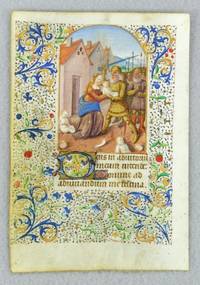
1450ST11774-85Paris ca. 1450. 159 x 108 mm. 6 1/4 x 4 1/4". Single column four lines of text on the verso 15 on the recto in a very pleasing gothic book hand. <br/> Attractively matted. Recto with a line filler in colors and gold verso with a one-line initial in burnished gold on a maroon and blue background with white tracery and a three-line "D" in blue and white enclosing a spray of violets in the same colors the capital on a burnished gold ground the same side WITH A FULL SWIRLING BORDER of acanthus leaves flowers and berries and many burnished gold ivy leaves ENCLOSING A BLOODY ILLUMINATED MINIATURE OF THE MASSACRE OF THE INNOCENTS measuring approximately 78 x 54 mm. Fore and lower margins on the side with the miniature a bit rubbed and with a faint patina reflecting frequent use also minor fading and loss of paint and gold in the same place otherwise in fine condition THE MINIATURE itself REMARKABLY WELL PRESERVED WITHOUT ANY EROSION OF PIGMENT.<br/> <br/> This leaf comes from a Book of Hours decorated by extremely skilled members of what must have been a first-class workshop. The Massacre of the Innocents cannot help but be a moving subject and the composition here as well as the painter's considerable ability add to the emotional impact in the present miniature. The center of the scene is dominated by the gold-armored gray-bearded soldier whose sword is raised over the head of a woman clinging to her son. The blood-spattered foreground is littered with the dismembered bodies of infants looking like so many broken dolls. On the left we see a row of modest cottages providing considerable depth as they recede toward distant hills. On the right stands a crowd of grim-faced soldiers all as elderly as their commander and seemingly following orders that are unwelcomed; it is perhaps the acute sadness in their faces that makes this scene especially memorable. The clear sky green fields and serene blue mountains in the distance contrast markedly with the horrific events unfolding. unknown
1415ST17763Paris ca. 1415-20. Leaf: 160 x 110 mm. 6 1/4 x 3/8"; Frame: 232 x 185 mm. 9 1/8 x 7 1/4". Recto with three lines single column in a gothic book hand verso not inspected due to frame. <br/> Mounted in a wooden frame. Recto with a three-line initial in blue on gold ground embellished with ivy leaves A HALF-PAGE MINIATURE DEPICTING THE MASS OF ST. GREGORY the recently crucified Christ depicted emerging from a tomb supported by an angel and surrounded by the Arma Christi St. Gregory kneeling at the corner of the image the text and miniature framed by thick bar borders of pink blue and gold on three sides all SURROUNDED BY A FULL BORDER of hairline vines gilt ivy leaves and bezants and a few colorful flowers and acanthus. A little faint smudging in top and bottom borders very small scarcely noticeable area of blue background retouched not affecting the figures but A BEAUTIFUL LEAF the colors bright and the detail in the miniature very well preserved.<br/> <br/> Featuring carefully realized detail intriguing iconography and artistry that shows a very high degree of skill this is an important and early example of the work of the Master of the Harvard Hannibal. The subject of the present work is a well-known story about the sixth century Pope Gregory ca. 540-604 commonly known as St. Gregory the Great. According to legend Gregory was saying Mass when one of his deacons expressed a doubt in the doctrine of Transubstantiation whereby the communion bread actually becomes the body of Christ. Gregory prayed to God for a verifying sign whereupon Christ appeared in the guise of the Man of Sorrows clad in a loincloth and displaying the bloody wounds he incurred during the Crucifixion. Most Medieval miniatures depict Gregory kneeling before an altar as he says Mass accompanied by one or more deacons or assistants who bear witness to the miraculous event. In a notable departure from this norm the present miniature depicts the saint alone at the edge of the picture plane; in place of the chalice host and altar that would normally occupy the center of the scene is a considerable open tomb from which a larger-than-life-size Christ emerges. With blood still rushing from his wounds he places one hand on the edge of the tomb to steady himself while an angel supports him from behind. Christ's expression conveys both physical and mental pain as he struggles to support his own bodyweight; the angel who assists him spreads his wings protectively around the body of Christ while looking down at Gregory with a sorrowful expression knitted into his brow. The fine detail work seen in the figures' faces the angel's wings and the careful delineation of each slender finger is also carried over into more than a dozen objects crammed into the spaces in and around the tomb the rope is especially remarkable in the representation of its detail. Known as the "Arma Christi" or "Instruments of the Passion" these objects are meant to symbolize Christ's suffering. Seen here are: the cross nails and hammer that were used to crucify Christ the ladder used in the Deposition the disembodied hand symbolizing the one which slapped Christ's face the dice used by soldiers to see who would claim his seamless robe a lantern used by the soldiers who arrested Christ the 30 pieces of silver from Judas' betrayal a purple robe used in the mockery of Christ and other items that appear as part of the Passion narrative. It is also interesting to note that although a St. Gregory miniature usually appears at the beginning of the Hours of the Cross the Penitential Psalms or before the Seven Prayers of St. Gregory here rather unusually it opens a reading from John chapter 19 beginning "In illo tempore adprehendit Pilatus Iesum et flagellavit" describing the events of the Passion. This miniature can be attributed to an artist known as the Master of the Harvard Hannibal so-named for a splendid miniature painting of the "Coronation of Hannibal" prefacing a Livy in the Harvard College Library. Active from about 1415-30 in Paris and later possibly Rouen it is believed that our illuminator was a pupil of the Boucicaut Master with whom he is thought to have collaborated on several manuscripts both secular and religious. The present miniature would probably have been executed early in his career and while it certainly shows the influence of his teacher it also reveals certain stylistic tendencies that would become staples of the Master of the Harvard Hannibal's more mature work such as his preference for rich colors heavy molding of the faces and interest in decorative details. With its clever composition meticulous detail work and emotive figures that engage the viewer the present miniature is not only a beautiful work of art it also documents the precocious talent of an emerging master early in his professional career. unknown
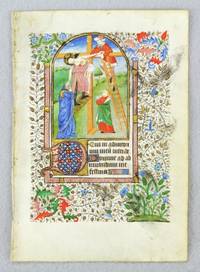
1420ST12005fFrance probably Paris ca. 1420. 210 x 146 mm. 8 1/4 x 5 3/4". Single column recto with five lines of text verso with 16 lines all in a very pleasing very regular gothic book hand. <br/> Attractively matted. Rubrics in red verso with a one-line and two two-line initials as well as a line filler in colors and burnished gold recto with a one-line initial and a line filler in the same style and with a quite large five-line "D" in pink and white with enclosed floral diapering all on a burnished gold ground the same side WITH A LOVELY FULL BORDER of swirling hairline stems bearing numerous leaves and berries of burnished gold and with sprays of acanthus leaves and flowers in multiple colors spilling from the corners this ENCLOSING A POIGNANT ARCH-TOPPED MINIATURE OF THE REMOVAL OF CHRIST FROM THE CROSS measuring approximately 85 x 60 mm. the miniature within a thin gold frame and enclosed in turn on three sides by bars in colors and gold the scene showing two men on ladders unfastening Christ's lifeless body from the cross while Joseph of Arimathea waits below clutching cloth to be used for a burial shroud as the Madonna at the lower left of the picture reaches up to clasp her son's bloody arm. With a small cross stitched in white thread in each upper corner. ◆A little soiling right along hinge edge a few smudges in the border a couple of tiny flakes of paint missing from the cross and the sky otherwise fine the vellum clean and fresh the colors rich and the gold lustrous.<br/> <br/> This is an especially sorrowful scene depicted with power grace and sensitivity by an artist demonstrating very considerable skill in composition and execution. The scene is well designed with the cross providing a device for focus at the center of the miniature. Nicodemus identified by his expensive attire is atop a ladder behind the cross lowering Christ's limp body onto the shoulder of another man probably a servant whose ladder is set against the front. Despite the fact that the corpse is more bones than flesh the artist has made it seem a heavy burden draped over the shoulder of the man as he walks backward down his ladder. Fully stretched out Christ's left arm is held for balance by Nicodemus at the top right while the other arm hangs down toward the Virgin. While we can only see her back her image evokes great pathos as she reaches up with both hands to grasp the mangled arm of her son his blood running from his hand onto hers. Joseph of Arimathea whose position anchors the right side of the picture looks on with concern tightly holding linen to shroud the body. St. John and Mary Magdalen conventional participants in the Deposition are not present in this miniature. While it is possible and even likely that the same artist produced this scene and the miniature of Christ Carrying the Cross this one is better as the faces are more deftly painted and the folds in the various garments are more clearly defined. unknown
1470ST17765Delft ca. 1470. Leaf: 172 x 115 mm. 6 3/4 x 4 1/2". Frame: 242 x 190 mm. 9 1/2 x 7 1/2". <br/> In an attractive wooden frame. A FINELY PAINTED MINIATURE OF THE NATIVITY within an arch-topped compartment the parents of the Christ Child kneeling before him as he lies on the ground outside the stable Joseph uncharacteristically supporting himself with a cane in his left hand and holding a long burning candle in his right two diminutive angels in attendance the head of an ass sticking out of the stable window in the background to the left AND IN THE RIGHT BACKGROUND A CHARMING DEPICTION OF THE ANNUNCIATION TO THE SHEPHERDS ALL OF THIS BENEATH A VERY DETAILED ARCHITECTURAL CANOPY suspended in the sky AND THE WHOLE WITHIN A FULL BORDER of acanthus leaves and other foliage and flowers in reds blues greens yellows and brushed gold along with very many small burnished gold ivy leaves and buds on hairline stems a small stag in the bottom border and a large delicately shaded angel who mirrors the Virgin's pose in the left border verso blank. ◆A hint of soiling to edges of vellum but IN VERY FINE CONDITION without any paint erosion with the colors rich and true and with the burnished gold still shimmering.<br/> <br/> Notable for its attractive color scheme fine craftsmanship and unusual composition this vibrant leaf was produced by a talented artist belonging to the stylistic group known as the Masters of the Delft Half-Length Figures. The lack of text and blank back of this leaf clearly suggest that it was produced as a singleton intended for insertion in a Book of Hours and its subject matter indicates that it would have faced the opening for the third hour of the day Prime. The present depiction of the Nativity is out of the ordinary in that it is combined with another scene the Annunciation to the Shepherds a subject that usually begins Terce in the Hours of the Virgin. It is a testament to the artist's ingenuity and compositional skills that he has managed to incorporate these two scenes so seamlessly; in fact rather than pulling focus from the main subject celebrating the birth of Christ this secondary scene adds additional interest to the picture and amplifies the storyline. Though the Annunciation to the Shepherds takes place at a distance from the Nativity we immediately grasp their connection and can see how arrival of humanity's savior was felt far beyond the manger. It is also interesting to note how much the artist has emphasized the figure of Joseph. Not only does he take up as much space as the Virgin but the candle and cane he holds frame the Christ child and communicate a strong suggestion of a protective parent the Virgin is doing her part by praying hard but she is more passive. In addition to its engaging subject matter there is a high level of artistic achievement here including delicately molded figures impressively detailed architectural elements and a lovely color palette. The elegant hand seen in this miniature manifests a quiet sophistication that distinguishes this artist as a particularly talented member of his circle. Active from about 1450-80 the Masters of the Delft Half-Length Figures were named by James Marrow after the angels and other figures whose upper bodies are typically found emerging from a cloud within the borders. Although the present leaf uncharacteristically contains a full-length angel in the border it shares other stylistic similarities such as the elaborate architectural canopy hovering over the main composition; and it particularly resembles the work of the artist of Keble College MS 77 an illuminator described in "The Golden Age of Dutch Manuscript Illumination" as "one of the more articulate of the group" whose "figures are more fully modelled and his palette . . . deeper and brighter" than that of his contemporaries. Because of the complexity of the subject matter and the high level of artistic accomplishment seen here this leaf was probably part of an elaborate Book of Hours produced in response to an important commission. unknown
1419ZB705446Brooklyn New York: 1914-1933. Volume 1 1914-1915 through Volume 20 LACKING vol. 2#1 and 11#4 else all complete volumes mostly bound library book plates and markings a few leaves have minor and neat repairs but overall very good interiors. - If you are reading this this item is actually physically in our stock and ready for shipment once ordered. We are not bookjackers. Buyer is responsible for any additional duties taxes or fees required by recipient's country. Photos available upon request. Brooklyn, New York: unknown
1401mon0003702925Luther Burbank Press 1914-01-01. Hardcover. Very Good. . 12-volume set complete with over 100 color photographs 1915 printing. Covers uniformly bound and show minor wear and rubbing bumped edges. Pages tanned and clean. Luther Burbank Press hardcover
149511825Paris: Ulrich Gering and Berthold Rembolt 1495. Late 17th- or early 18th-century mottled calf worn hinges cracked slightly wormed crown repaired spine and label gilt edges sprinkled red. <p> The Moralia brings Christian mysticism asceticism dogma and allegory to bear on the story of Job's suffering. Pope Gregory deeply engages Scripture in his massive commentary which bridged the ancient and medieval worlds and remained a preeminent guide to moral theology through the Enlightenment.<br /> For this edition THE PRINTERS ADDED TWO NEW INDICES FOR YOUNG SCHOLARS and busy clerics. The first index provides access to all Bible verses referenced or quoted in the text - some fifteen hundred entries. THE SECOND INDEX TREATS THE NATURAL WORLD in three hundred entries - animals metals herbs stars human body parts precious gems rivers etc. Two copies in U.S. libraries. In good condition a few pale scattered stains and minor worming loss of six sorts on the title verso a handful of contemporary annotations manuscript title inscription Ex biblioteca Sanctae Crucis Viridariensis 1669.<br /> ¶Seow Job 1-21: Interpretation and Commentary 193; Manitius Geschichte der lateinischen Literatur des Mittelalters I: 971; ISTC ig00431000; Goff G-431.</p> Ulrich Gering and Berthold Rembolt unknown
1403ND170305422Sony 2014-03-25. audioCD. Very Good. 5x5x1. Sony unknown
141916817JLos Angeles June 14 1960. Original 139 page mimeographed script printed on yellow paper for the John Wayne starring film set in Africa capturing wild animals for zoos of the world. Bound in full brown leather with Hatari! stamped on the spine and cover. This was screenwriter Frank Waldman’s personal copy with his name stamped in gold in the lower right hand corner on the front cover. Additionally bound in are 46 pages of individual biographies of the characters. Two of the sections are co-written with Leigh Brackett. Director Howard Hawks commissioned the Waldman Brothers to write the script and then brought on Leigh Brackett. Eventually Hawks had Brackett rewrite the whole script. However story elements and various scenes were invented by the Waldmans and are present here in this first version of the film. Fine condition. hardcover
1403179115022300620th Century Fox 2014-03-25. DVD. Good. DVD plays perfectly & the case looks good. 20th Century Fox unknown