122 150 résultats
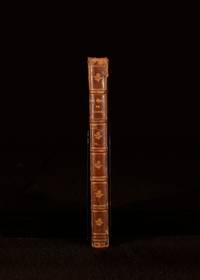
174257800London: Printed for J. Osborn and C. Davis in Pater-noster Row; and J. Hodges at the Looking-Glass over-against St. Magnus Church London Bridge MDCCXLII 1742. Second Edition. Hardcover. Very Good. This is an ex-library copy with a blind stamp on the corner of the title page. 16mo 6 7/8" tall engraved frontispiece vi and leaf removed 359 pages; fore-edges reddened 5 banded spine gilt spine titles and piping full calf with cover edges tooled. This is a good copy overall interior very good with significant shelf wear and rubbing to the spine and chipping to the top and bottom edges fore-corner tips through to boards cover edges worn binding solid paper light to moderately yellowed minor foxing primarily to front-matter but scattered throughout with apparent damp-staining at the margins of the endpapers which is not visible in the interior. This is: "The Second Edition carefully revised and greatly enlarged in every chapter by the Author; who has now first added an appendix containing many curious pieces in both prose and verse relating to the character of the Lord-Protector. London: Printed for J. Osborn and C. Davis, in Pater-noster Row; and J. Hodges, at the Looking-Glass, over-against St. Magnus Ch hardcover
17966On his letterhead with autograph address Green Gates 55 Corton Road Lowestoft Suffolk . 16 September 1948. 1p. 8vo. In fair condition aged and creased. The letterhead in orange and blue boasts that Franklin is 'The World's Worst Wizard' and is headed 'Too Tuubes sic The original cod prestidigitateur with a new act which is packed with crazy comedy and clean fun'. He asks him to send 'Stevenson Toy Theatre Book' and asks if he has 'any books on Marionette & string Puppets'. On his letterhead, with autograph address Green Gates, 55 Corton Road, Lowestoft [ Suffolk ]. 16 September 1948. unknown
14908Book: London Printer not stated. Circa 1911. Letter: on letterhead of 15 St James's Square Pall Mall SW London; 9 February 1912. For more about O'Neill son of the Victorian artist George Bernard O'Neill see his obituary in The Times 15 June 1946. LETTER: 4pp. 12mo. Bifolium. In good condition on lightly-aged paper. Begins: 'My dear Hay Will you honour the humble author by accepting the enclosed copy of "Clerical Verses"' Regarding the poems he writes: 'You will at any rate be amused at the Vanity which threw them into type and bound them in cloth.' The book is he continues 'strictly limited to Clericals in its circulation' but he is making an exception in the case of 'an old Clerical such as you for you have always encouraged my Muse'. He has 'only printed "proper" verses but you'll find one improper one on a loose sheet'. He concludes: 'All the verses are strictly founded on facts.' BOOK: 31pp. 8vo with the 'loose leaf' mentioned in the letter to Hay tipped in at the end carrying a poem titled 'A Moment' with explanatory text. In blue cloth binding with title in gilt on front cover. In fair condition on aged and worn paper shaken in worn binding. The poems are humorous and many are preceded by explanatory texts the first for example to a poem titled '76 pro 27' reading: 'The following verses were sent to me when Leeds Branch Manager by Mr. Besant in return for an acceptance letter rating a man of 27 up to age 76. The life in question now a distinguished member of the Colonial Civil Service would be "office age 91" to-day 1911 if he had been fool enough to complete.' Laid down on the front pastedown is a reproduction of a cartoon. The volume is excessively scarce with no copy traced on either COPAC or OCLC WorldCat. The volume contains 29 inserts including two Autograph Letters Signed from A. D. Besant son of Annie Besant General Manager of the Clerical Medical and General to 'Raynes'. Both are on the letterhead of 9 Hampstead Hill Gardens NW3 and they date from 28 February and 2 March 1953. In the first Besant mentions among other matters 'O'Neill's verses': 'I have various odd ones stored away somewhere and if I can dig them out I will send you copies.' In the second he states that he is sending 'the poem by O'Neill on which I could not put my hand when I wrote to you last week. He dashed it off impromptu'. The poem referred to appears to be present among the other 28 inserts in O'Neill's autograph and titled 'Impromptu' and beginning 'When the Bobby's on his beat'. The other inserts include four more leaves carrying manuscript compositions one of them a holograph 'Copy' of a twenty-line poem 1p. 8vo by O'Neill dated at the end 'H. D. O'N. 24.12.12.' The poem is untitled and begins: 'This is the Saga of Digby The Saga of Digby and Christmas Tells how he carried the parcels Numerous brown-paper parcels Tied up with string by a lady .'. Also present are a manuscript prose text headed 'The late George Gould Churchward and 21 cuttings of poems extracted from the Post Magazine and Insurance Monitor from 1927 and 1928 and one from 1931. Nineteen of the poems are by O'Neill and the other two are addressed to him one from 'L. H.' and the other from 'I. B.' Book: [London?] Printer not stated. [Circa 1911.] Letter: on letterhead of 15 St James's Square, Pall Mall, SW [London]; 9 Febru hardcover
20844London: Ford & West Imp. 54 Hatton Garden. 1852. 6pp. small 4to. Stitched into brown wraps with lithographed title on cover in pastiche of Gothic design including monogrammed initials 'IS' in shield with the letters picked out in red. In fair condition aged and worn. An extremely scarce item no copies found on OCLC WorldCat or COPAC whose text and illustrations cast light on the practices at the Royal Academy in the mid-Victorian period. Scumble is a glaze painting technique. The piece is a poem in four-line stanzas written in Wardour Street English beginning: 'Now lyth and listen Students all I come before ye here To tell the Mischance that befell A yonge Probationere Merrye it was in Londonne streetes The daye was faire to see When sallied forth an Artiste-youth To the Royal Academie.' The drophead title on the first page has the letters in the name 'Arthur Scumble' also picked out in red. Each page carries a highly-stylised illustration the last five in text the first in the margin and depicting a herald holding a flag on a pole and blowing into a horn. The other five illustrations show: the artist handing in his drawing; drawing a skeleton; drawing his 'Figure after the Antique'; running away with hat and glasses flying; and his body being searched after his suicide by two policemen. Running synopses in margins the first reading: 'Of a yonge Artiste hight Arthur Scumble & how he takes a Drawynge to ye Academie to obtain entrance therein as a Probationere.' There follow: 'He urgeth on ye Portere ye. necessitie of a speedie Decisionne by ye. Council.' 'He commenceth Worke at ye Academie' 'But lykes it lyttle' 'He fyndeth ye Skeleton tough' 'Commenceth hys Figure after the Antique. The Cause of much swearynge' 'and wyshynge the Curator and Keeper to be in a warmer place than wold be consistent with ease and comforte' 'He groaneth in spirit' 'He completeth hys figure' 'The Council decides on ye Drawynges wyth its usual Judgmente' 'Ye Decisionne of ye Councill is adverse – rejectynge ye Drawynges' 'Ye Rage of Scumble thereat' 'and' 'Astonishmente of ye. Portere' 'In dysorder of mind & Bodye he fleeth from ye Academye' 'He commyteth Suicide' 'Ye. Ende'. See IMage. London: Ford & West, Imp. 54, Hatton Garden. 1852. paperback
228384 March 1847 and 31 January 1848. Both from the Theatre Royal Dublin. Both letters 2pp 12mo. In good condition lightly aged. Cole's handwriting is difficult. The recipient is not named. The first letter 34 lines long concerns a bill which Cole has drawn on the recipient of the letter. It is coming due and he is uncertain whether it is for £90 or £100. He asks him to withhold payment for a while as 'Lent is always a dead time with me'. He is 'going to try the experiment of Mr Butter for 6 nights' and has 'good hopes of the result'. The second letter begins: 'My dear Sir I have made most liberal offers to Farren Mrs. Nesbitt & Mr. Glen as Mr Lee will tell you & with the exception of the old lady none of the parties appear to have the least consideration or wish to accommodate or help a manager who pays them so liberally as you do - It is not I am sorry to say an uncommon case.' The latter part of the letter is not easily read but concludes: 'I sincerely hope the Keans & the Wife's Secret are showing you full houses.' 4 March 1847 and 31 January 1848. Both from the Theatre Royal, Dublin. unknown
2452414 March 1949; 60 Christchurch Road Streatham Hill SW2 London. From the Macqueen-Pope papers see his entry in the Oxford DNB. 2pp 8vo. In good condition lightly aged and worn and folded three times for postage. She asks him to send ‘3 or 4 more copies’ of his ‘nice write up in the “Sunday Chronicle†March 13th.’ as she would like to send ‘a copy to Australia Canada & America as there is some talk about my going to America in the near future’. She has ‘tried all over Streatham and Brixton and it seems impossible to get a copy anywhere’ and will be happy to pay the cost. She would ‘also like to ask you if you could put me in touch with anyone who could write up my memoirs for me’. 14 March 1949; 60 Christchurch Road, Streatham Hill, SW2 [London]. unknown
1789660 Killick Street Caledonian Road King's Cross N1. 8 July 1946. On his letterhead with photograph. 1p. 4to. On shiny art paper. In fair condition lightly aged and worn with one dogeared corner. On letterhead which covers half of the page with photograph of the pair and text in red and black 'Presenting Comdey Cartoons and "Fashions from Rags" Dress Designing Extraordinary! Two or Three Entirely Different Comdey Spots if required introducing Monologues Conjuring Numbers etc. Evening Dress when required. Special Clowning and Conjuring Act for the Children. Road Show Production Panto Variety or C.P.' The letter offers for sale 'a lot of old John Dick's "Penny" Plays'. With autograph postscript. 60 Killick Street, Caledonian Road, King's Cross, N1. 8 July 1946. On his letterhead, with photograph. unknown
26489Between April and June 1907 Daily Chronicle; National Vigilance Association; London Council for the Promotion of Public Morality; London Female Preventive and Reformatory Institution. A marvellous slice of unexplored Edwardian social history raising questions of morality censorship art and pornography from the papers of William J. Taylor Secretary of the London Female Preventive and Reformatory Institution. The 'Living Statuary' controversy arose over 'the propriety of the living statuary exhibitions in music-halls' Daily Chronicle 30 April 1907 and in particular the performances of the Australian artiste Pansy Montague b. 1885 known as 'La Milo' who posed as a living statue covered in alabaster whitening with a few strategically placed pieces of white material. The scandal was not restricted to London: a parade in Coventry in 1907 in which 'La Milo' took part as Lady Godiva caused an outrage. The present collection gives a full picture of the range of opinion with Taylor invoking John Ruskin and a large number individuals quoted in the newspaper reports some of the quotaions lengthy from individuals ranging from leading clerics and Mrs Bramwell Booth to Millicent Fawcett Hall Caine Sir Lawrence Alma-Tadema and Max Beerbohm the last of whom comments with characteristic wit: 'It is no more improper for human beings to represent statues than for statues to represent human beings. But the practice strikes me as rather absurd.' The result of the controversy was inconclusive and the practice of 'living statuary' continued for decades in the 'tableaux vivants' at Soho's Windmill Theatre. The collection is in good condition with light signs of age and wear apart from the three loose newspaper cuttings which are in poor condition. ONE: Duplicated copy of letter on 'LIVING STATUARY' by William J. Taylor as secretary of the LFPRI 200 Euston Road NW 4 May 1907 'To the Editor of the Daily Chronicle'. 2pp 8vo. With a few minor manuscript corrections. 'Having for nearly 49 years laboured to rescue the victims of ungoverned passion' he is in the present case 'surprised that not more references have been made to that prince of art critics John Ruskin. His words are surely worth of recall.' A long quotation from 'the “Eagle's Nest†Lecture 8' follows on how 'The study of the nude is injurious beyond the limits of honor and decency in daily life'. Taylor feels that 'the words of Ruskin should be written in letters of fire and burned into the consciences of men and women everywhere. The only safe path to the maintenance of virtue is not to go in any direction calculated to excite our baser nature but in striving to keep as far away as it is possible.' TWO: Two typewritten circulars and two manuscript cards from the National Vigilance Association And International Bureau for the Suppression of the White Slave Trade London. All four items on the NVA's letterhead and the first three signed by both the NVA secretary Willliam Alexander Coote 1842-1918 and the secretary of the London Council for the Promotion of Public Morality E. Fox Butlin. First circular 15 May 1907 2pp discussing the fact that 'the Music Halls have for some time been giving an entertainment described as “Living Statuary†in which men and women appear apparently in a state of nudity' and the 'strong protests' that have been made 'in London and the Provinces'. The NVA and LCPPM are joining a deputation to the London County Council which is to be headed by the Bishop of London and they request a delegate so that 'the deputation shall be thoroughly representative of the efforts being put forth in London to help young men and women to a more excellent way of life'. First card postmarked 16 May 1907 and addressed to the secretary of the London Female Preventive and Reformatory Institution written in manuscript and giving the date of the deputation. Second circular 29 May 1907 1p giving details of the time and place of the delegation. Second card postmarked 3 July 1907 unsigned and in manuscript a reminder of the date for the deputation. THREE: File of newspaper cuttings from the Daily Chronicle. In brown paper folder with the following on the cover: 'Row III Hole I Correspondence Daily Chronicle April – May 1907 Living Statuary'. A series of fourteen cuttings of long articles in small print from between 30 April and 6 June 1907 each headed 'LIVING STATUARY' laid down on one side each of twelve ruled 8vo leaves. The date of each article is given in manuscript. Subtitles: 'Exhibitions Withdrawn in Manchester. Managers' Decision' 'Attitude of the London County Council. La Milo's Reply. Protest by Mr. Thornycroft the sculptor' 'Is it degrading What famous painters think. Sir L. Alma-Tadema's view.' 'Influential Deputation to the L.C.C. No answer given.' 'Leading public men on the controversy. Artists' views. Influential appeal to the L.C.C.' includes quotations from figures including Conrad Dressler Hayden Coffin Charles Hawtrey and Evan Spicer 'Further protests from notable men. Bishop's opinion. Effect of campaign on the managers.' quotations from figures including the Bishop of Ripon W. R. Colton G. R. Sims Mrs. Bramwell Booth 'Birmingham exhibitions withdrawn. Father Vaughan. Trenchant attack on the performers.' many quotations including ones from Hall Caine Walter Crane Max Beerbohm 'It is no more improper for human beings to represent statues than for statues to represent human beings. But the practice strikes me as rather absurd.' Bishop of Manchester; 'â€La Milo†Makes an Appeal to the L.C.C. Artists' Deputation.' 'Rev. Silvester Horne's Visit to Music Hall. His impressions.' 'Nottingham Police as Censors of the Exhibitions. Mr. Straus is pleased.' 'Licensing Committee to view La Milo. Dr. Emil Reich. “Revolting untruth of the accusations.â€' 'Exhibitions Withdrawn in Glasgow. The London Crusade.' several quotations 'Bishop of London to Lead Deputation to L.C.C. Action in Wigan.' including long quotations from 'Mr. John Davidson' 'Dr. Horton' and 'Mrs. Fawcett'. FOUR: A further four cuttings the first three loose and in poor condition with detached sections chipping and loss to text. The first from the Tribune 26 June 1907: 'Living Statues Banned. County Council's Decision. Indignant Artists.' The second an editorial from the Evening News and Evening Mail same date: 'The Death of Living Statuary.' The third without source or date: 'Living Statuary. Important Deputation to the L.C.C. Action Probable.'The fourth laid down on paper an unrelated short report on 'Art and American Morals' from the Evening News 4 June 1907. Between April and June 1907 [Daily Chronicle; National Vigilance Association; London Council for the Promotion of Public Moralit unknown
22267Berlin; 4 September 1820. The letter announces the transfer to Berlin of 'Monsieur de Wagner' London Chargé d'Affaires of the the Kingdom of Württemberg resident at 42 Alpha Place Regent's Park. The recipient Sir John Coxe Hippisley whom George III had described as a 'busy man' and 'grand intriguer' had retired from public life two years previously but was clearly still involved in diplomatic affairs. 2pp 4to. Bifolium. Forty-one lines of neatly-written text addressed to 'Sir J C Hippisley Bart. Lower Grosvenor Street.' On aged and worn paper with short closed tears at edges of folds. On paper with two prominent circular watermarks one a regal eagle with motto 'Gott bewahre sein Reich' the other a portrait of 'Friedrich Wilhelm III Koenig von Preussen'. Wagner begins with 'the most humble and anxious apology' for his late letter which he hopes to excuse by explaining the 'circumstances': 'Soon after my arrival in Stuttgart I had the honor to see the King and to deliver your letters and parcels; I delivered also those to the Queen Dowager Augusta of Brusnwick wife of Frederick I who had died in 1816 in her own hands as well as to Baron Maucler who probably has written to you since'. Wagner delayed writing to Hippisley as Maucler had 'promised me a letter for you'. Wagner was 'received very graciously and promoted to the rank of Councillor of Legation'. A bout of ill health was cured by a two-month tour of Switzerland. 'The King and Queen as you will have heard were in Italy and derived benefit from the baths tho' as yet without the desired effect for the prospect of the throne' i.e. no pregnancy. On Wagner's return to Stuttgart 'the situation as Chargé d'Affaires at Berlin was offered to me under favorable conditions' which he accepted. The previous holder Count Mandelsloh is to be Wagner's 'second successor in London' and will 'present you this himself and I beg to recommend him to you most particularly for you will find him worthy in every respect of the kind reception and confidence with which I have been honored by you myself'. He will write to Hippisley 'more at length on another opportunity when I shall have more leasure sic'. In the meantime he presents his respects 'to Lady and to Miss Hippisley as well as to Mr. Hippisley'. He ends with an expression of the 'due sense of gratitude for the kindness you have conferred on me'. Berlin; 4 September 1820. unknown
21253United Kingdom Foreign Office Whitehall London. Circa 1953. The Mau Mau uprising began in 1952 and the atrocities committed by the rebels were matched by those of the British whose Attorney General in Kenya Eric Griffith-Jones wrote to Governor Baring in 1957 that the colony's detention camps for Mau Mau suspects were 'distressingly reminiscent of conditions in Nazi Germany or Communist Russia'. He advised that suspects be beaten mainly on their upper bodies and that those administering violence should 'remain collected balanced and dispassionate' also commenting: 'If we are going to sin we must sin quietly.' Among the victims of British brutality was Hussein Onyango Obama grandfather of President Barack Obama. From a batch of Foreign Office documents including material from the Information Research Department for whose activities financed from the budget of the Special Intelligence Service otherwise MI6 see The Times 17 August 1995; and also Michael Cullis's obituary of Sir John Peck in the Independent 20 January 1995. Duplicated typescript. Headed: 'a The political and economic effect of MAU MAU in KENYA.' 8pp foolscap 8vo. Paginated 'a 1' to 'a 7' including interpolated passage on 'a 2A'. Complete with catchwords to all but the last page. Divided into five sections headed: 'What is Mau Mau' 'Action against Mau Mau terrorism' 'Sir Philip Mitchell's dispatch on East African economic problems' with subsections on 'Population Problems' 'Labour problems and Wages' 'Social Welfare' 'Royal Commission for East Africa' 'Development plans for Kenya'. The first section begins: 'Before considering in detail what the secret society called Mau Mau is and what are its aims; it will be as well to examine traditional background of the tribe of Africans involved – the Kikuyu.' The section includes an 'account of the barbaric rites practised at Mau Mau initiation ceremonies' from 'the Nairobi Correspondent of The Times' 9 October 1952. The section on 'Mau Mau terrorism' begins with a description of the police response to 'the murder of Chief Waruhiu' and discusses the activities of Jomo Kenyatta. The points of Sir Evelyn Baring's 'programme for the economic and social development of Kenya' 28 October 1952 are enumerated in the last section followed by a description of Governor Baring's'defence plans'. No other copy traced. [United Kingdom Foreign Office, Whitehall, London. Circa 1953.] unknown
531520 September 1893; 4 Bentinck Terrace Regent's Park London N.W. One page 12mo. Very good on lightly aged paper. Giving details of a proposed lecture. He was to have been in Salford Manchester but the dates have been changed. Can only offer two dates. '<> the two years' <> has been a huge success & a most interesting journey by which we have all benefited. I remember the Bolton audience with great pleasure. Kindly name the subject you choose. My fee: ten guineas as before.' Accompanied by magazine cutting of photographic portrait captioned 'M. PAUL BLOUET "MAX O'RELL" NEW EDITOR OF THE PARIS "FIGARO." 20 September 1893; 4 Bentinck Terrace, Regent's Park, London N.W. unknown
1919369642London: Printed by Waterlow Brothers & Layton Limited 1919. First Limited Edition. Hardcover. Poor copy in title-blocked cloth. Spine bands worn. Panel edges dulled and rubbed as with age. Hinges starting front free end paper loose but present. Text remains clear without blemish. Provenance: Albert Cutt's copy with his regimental registration card and associated ephemera loosely inserted. Limited edition of only 1600 pages this being number 256. Physical description: 6 118 pages: maps some fold. ports. plates some col.; 32 cm. Subjects: Great Britain Army Machine Gun Corps Battalion 33rd.World War 1914-1918; Personal narratives English. Military history. London: Printed by Waterlow Brothers & Layton, Limited hardcover
20201London: Printed by Order of "The National Union" of Conservative and Constitutional Associations 9 Victoria Chambers Westminster S.W. 1868. 15pp. 8vo. Stitched and unbound. In good condition lightly aged with central vertical fold. In small print. In the conclusion of the speech - 'greeted with repeated rounds of applause' - he states that he 'cannot be a party to severing that Church and State under which it is the glory and the privilege of the state to uphold the light of the Reformation in the midst of Ireland'. Scarce: only two copies on OCLC WorldCat at the British Library and Illinois and no copy at the National Library of Ireland. According to Cranbrooke's entry in the ODNB he began 'as a reformer but adopting Conservative colours from 1835 mainly from anxiety at challenges to the position of the established church in Ireland and England. He was of evangelical tendencies and was friendly with William Wilberforce.' London: Printed by Order of "The National Union" of Conservative and Constitutional Associations, 9 Victoria Chambers, Westminst unknown
16794Without place or date but after the demise of the 'New Witness' in 1923 and before G. K. Chesterton's death in 1936. 3pp. 4to. In fair condition on aged worn and browned paper. Ada Chesterton worked with her brother-in-law while assistant editor of the 'New Witness'. Her admiration for his talents was fully reciprocated G. K. Chesterton describing his sister-in-law as 'brilliant'. It begins: 'Very much has been written and said of G. K. C. the poet the pamphleteer the genius of paradox who holds the attention of his listeners by his dazzling sleight of words. I am going to write of him from a different angle - G. K. C. the journalist as he is known and gauged in Fleet Street. There is held generally speaking a most mistaken view of that same Fleet Street which is for the most part regarded as the mere receptacle for the Capitalist press: the place where mis-statements by the million are issued from a rapidly revolving hoe and distributed broadcast.' She proceeds to describe 'another side of Fleet Street' 'an informal tribunal where men are tried for offences never mentioned in the public press' a place where arrogance is 'a sin'. It is here that there is 'no greater idol' than Chesterton 'a supreme journalist' who 'can write anywhere and anywhen on anything'. She recounts an anecdote regarding an incident involving a 'distinguished literary critic' and Chesterton 'during the life of the New Witness'. She concludes by stating that having 'worked with him in difficult and troublous circumstances' she feels that Chesterton proves 'his title to genius more in his capacity for turning the commonplace of existence into the pure gold of fine thought'. It is unknown whether the piece was published. Without place or date, but after the demise of the 'New Witness' in 1923, and before G. K. Chesterton's death in 1936. unknown
17728London: The Modern Press 13 Paternoster Row E.C. and W. L. Rosenberg 261 East Tenth Street New York City. 1886. 16pp. 12mo. Disbound without covers. In fair condition on lightly-aged paper. Signed in type at the end 'H. H. C.' At foot of reverse of title: 'The Writer will be glad to hear from anyone who agrees with his conclusions.' Scarce. London: The Modern Press, 13, Paternoster Row, E.C. and W. L. Rosenberg, 261, East Tenth Street, New York City. 1886. unknown
1848008777London: Charles Gilpin 1848. Original blind-stamped binding of brown cloth some wear/rubbing stains to rear cover corners pushed/worn dust and browning to rough-trimmed edges spotting to endpapers and title page internally predominantly very good. First Edition. Hardcover. Good. Charles Gilpin Hardcover
13980Printed prospectus dated Edinburgh 14 July 1847. Circular letter from Committee Rooms Cranston's Temperance Coffee House High St Edinburgh; 1 August 1844. Accounts at 12 August 1844. Surprisingly little appears to have been written about the public baths at 12 Nicolson Square Edinburgh; with no references to it on the Scottish Archives Network. There is however an informative reference to the subject in Francis H. Groome's 'Ordnance Gazetteer of Scotland' 1884: 'Good public baths of various kinds and various extent for the upper and the middle classes are in several parts both of the city and its environs. Public baths for the working classes were long a desideratum though earnestly desired by many of the working classes themselves. A proposal to establish them by subscription was at length spiritedly begun in 1844 but somewhat flaggingly carried out. The chief suite of them was fitted up in a tenement purchased for the purpose in Nicolson Square. They cost upwards of £1000 beyond the amount of the subscriptions paid in or obtainable; passed under the immediate management of persons who became bound for the extra sum; and were so well constructed and so much appreciated that nothing but the debt upon them prevented the immediate extending and cheapening of baths for working men.' ITEM ONE. Printed prospectus headed 'PUBLIC BATHS FOR THE WORKING CLASSES.' Signed in type by 'D. McLAREN' and 'WM. JOHNSTON'. Dated 'Edinburgh 14th July 1847.' 1p. 4to. Begins: 'SIR AT a Meeting of the Association for the establishment of BATHS FOR THE WORKING CLASSES held in the Council Chambers on the 6th. inst. - the Right Hon. Lord Dunfermline in the Chair - a Report was laid before the Meeting giving a statement of the whole proceedings of the Association together with a detailed account of the total receipts and expenditure. It appeared from these documents that the PUBLIC BATHS ARE NOW COMPLETED and ready for being opened in Nicolson square one of the most central situations in town for those who are expected to use them. There are Fourteen Baths on the Lowest Floor and Back Area for which the charge of Fourpence is proposed to be made including Hot Baths; Five on the Street Floor fitted up in a superior manner for which Sixpence will be charged; and Five on the Upper Floor having accommodation equal to any in town for which a Shilling will be charged. From this class it is expected a profit will be derived so as with the others to make the whole Establishment self-supporting if opened free from the incumbrance of debt. last eight words in italics With reference to the Expenditure and Receipts it appeared that the whole outlay in reference to and including the original purchase-money of the property had been £2585 8s. 5d. of which £1645 0s. 10d. have been paid thus leaving a deficiency of £940 7s. 7d.' An appeal for subscriptions is made and the name of members who have 'agreed to double their subscriptions' is given including Bishop Gillis. Eight parties receiving subscriptions are named from 'MESSRS WILLIAM BLACKWOOD & SONS 45 George Street' to 'MR THOMAS IRELAND 4 Hunter Square General Collector to the Baths Fund.' It is stressed that the matter is 'peculiarly important at the present period when the promotion of habits of personal cleanliness may be instrumental in preventing the spreading of contagious disease which prevails to such a great extent in this City.' Similar items concerning meeting at the Hopetoun Rooms and Music Hall are listed on COPAC but this item is not to be found either on COPAC or WorldCat. ITEM TWO: Secretarial Letter signed by Charles Gardner Secretary of 'the Committee appointed for establishing working Men's Baths in Edinburgh' to the Directors of the Bank of Scotland. Committee Rooms Cranston's Temperance Coffee House High Street Edinburgh. 1 August 1844. 3pp. 4to. Bifolium. In fair condition on aged and worn paper with a closed tear repaired with archival tape. Giving 'a brief statement of our present case' beginning: 'By subscriptions among the working men themselves we have now collected somewhat more than a thousand pounds. The Sum of two thousand is required for the proper construction of the Baths and a large portion of this Sum we expect to obtain in the course of a few months by collections now going on among the operatives and further Subscriptions from among the middle and upper classes. It has occurred to several gentlemen who take an interest in the proposed Baths that we might allowably make an Appeal to the Banks and other great establishments in Edinburgh trusting that they might be disposed to regard the object as one justifying an exercise in their liberality.' The 'establishment of Baths is an idea originating amongst the working men themselves and which they have much at heart and promises to add much to their health and comfort'. It will also assist 'the moral improvement of the humbler classes of society' and it is 'also very clear that when the health of the humbler inhabitants of a large City is improved the benefit is reflected upon the superior classes both in preserving their own health and in reducing the burdens to which they are subject from all causes which promote indigence. This view of course bears in an especial manner upon the Banks and Public offices'. The working classes 'are in a manner compelled to ask aid from their more amply endowed brethren trusting that the kindly charities which exist among the different classes of Society in <> will hear them out in the attempt'. THREE: Manuscript titled 'State of the Funds belonging to the Association for the erection of Baths for the Working classes as at 12th August 1844.' 3pp. 4to. Bifolium. Good on aged paper with similar closed tear to that of Item Two and repaired in the same way. Lists '1. Higher Class Subscriptions' including £100 from 'His Royal Highness Prince Albert'. This is followed by '2. Middle Class Subscriptions' and '3. Trades' followed by 'Note -. Many of the Trades have subscribed considerable sums particularly the Cabinet Makers & who contributed to 36 the average subscription of the operatives is a days wage for each man'. Followed by 'Remarks' of 33 lines. 'The use of the Bath they conceive is pregnant with the most beneficial results to this class by cleaning the skin and imparting a new tone the nerves are invigorated a desire for improvement springs up and the nurseries of disease in which so many operatives reside are by a natural consequence wholesome and healthful abodes . filthy habits aer the parents of crime . The working man would submit that they are not proceeding too far when they say that it is in the interest of the public establishments to patronize a Scheme which carries such important benefits to all classes of the community'. Printed prospectus dated Edinburgh, 14 July 1847. Circular letter from Committee Rooms, Cranston's Temperance Coffee House, High unknown
82611 May 1859. 12mo 4 pp. Bifolium. Watermarked 'TOWGOOD'S SUPER FINE 1859'. Eighty-seven lines of text. Text clear and complete on aged and grubby paper. With little hope of influencing the editor of Punch the author feels compelled to 'write and tell you what I and many others think about your Publication and the malignant spite you display towards individuals who happen to incur your wrath'. This 'malignity' he feels 'must be derived from that murderous old ruffian from whom your publication takes its name and which alone prevents it being an influential publication. Men laugh at the jokes in it and admire the skill of Mr. Leech and his assistants but II have yet to find the Man whose opinions were ever changed by anything he saw in "Punch".' He gives two examples of 'many instances of individuals who have been persecuted' by the magazine: the actor Charles Kean and 'Mr Williams of Lambeth'. What had Kean 'done to incur the wrath of "Punch" Simply offended one of its staff'. As for Williams he had stated 'in a Speech to the Electors of Lambeth . that he had been offered a Title which he rejected - now that was nothing but the truth for you know very well that a Baronetcy really was offered to Mr Williams and rejected'. The author accuses 'Punch' of being 'ready enough to make yourself a mere tool of corruption . trying to do that by ridicule which those in power could not do by flattery'. Quotes 'the advice given this day by the "Weekly Dispatch" to the "Saturday Review" before concluding 'You need not make any funny remarks about any grammatical errors that may appear in this letter. If there are any I admit them for I do not profess to be a Scholar'. 1 May 1859. unknown
21822Newcastle Co. Down. 'Published by the Mourne Press for the author.' Slug on last page: 'BANBRIDGE CHRONICLE PRESS'. 12pp landscape folio. Sewn with red thread. The words 'The Big Grey Man' on cover and title-page in red ink rest of pamphlet in black ink. In fair condition lightly aged and worn. A 48-line poem in eight six-line stanzas spread over three rectos signed at end 'Richard Rowley.' Inscribed on title-page: 'Mrs. Brown. With best wishes for Christmas from Mr. & Mrs. R. V. Williams. 1942.' Six bucolic illustrations reproduced from woodcuts by Annesley including one on cover. Colophon on recto of last leaf with printers' slug on otherwise-blank reverse. First stanza reads: 'Above the Cairns of Goward The dark-draped mountains loom And in the depths of Goward Is dug the Heroes' tomb; There in the Place of Echoes They wait wait in the gloom.' Scarce: only two copies on COPAC at Trinity College Dublin and the National Library of Scotland. [Newcastle, Co. Down.] 'Published by the Mourne Press for the author.' [Slug on last page: 'BANBRIDGE CHRONICLE PRESS'.] unknown
2438429 October 1907. On ‘Khartoum’ Sudan letterhead. The entry for Slatin in the Oxford DNB gives a good outline of the life of this adventurer. The present item forms half of a 4to leaf torn down the middle vertically no doubt in order to provide an autograph. In good condition lightly aged. Written lengthwise on the reverse in a large bold hand is the valediction: ‘Hoping that you are fit & well / Yours ever / R Slatin’. The text on the recto reads: ‘. Jackson / . again - and / .y Home a little .cians dates - although .d written word . the gift comes . & thank you for . this time the Katran . be a success’. 29 October 1907. On ‘Khartoum’ [Sudan] letterhead. unknown
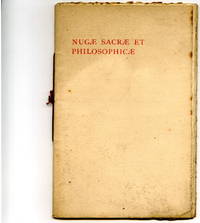
8930Oxford: B. H. Blackwell Broad Street 1905. 12mo 27 pp. Pamphlet stitched with red ribbon. In original wraps with title printed in red on front cover. Title-page in red and black. Lord Rosebery's unobtrusive ownership blindstamp in top right-hand corner of title. Good tight copy in grubby and lightly-spotted covers. Containing three jeu d'esprit: two poems 'Ruth' and 'Esther' and a spoof 'model essay' 'to assist candidates' to the Green Philosophical Prize titled 'The Reciprocal Relations of Morals and Metaphysics'. A very short preface reads 'It is we think matter of regret that so few of our University prizes are open to Senior Members of the University. The Sacred Poem and the GREEN Philosophical Prize are we believe the only exceptions. The following Poems and Essay were humble attempts to secure these prizes; but owing possibly to some failure on the part of the Judges to appreciate their eminent merit failed in doing so. We venture to submit them to the judgment of a discerning Public.' Scarce: no copy at the British Library and the only copy on COPAC at Oxford. The only copies on WorldCat at Yale and the Claremont Colleges. Image attached. Oxford: B. H. Blackwell, Broad Street, 1905. paperback
85841937. One copy headed in manuscript: 'From T. B. SIMPSON 11/6/49.'. Each of the two typescripts is on one side of a piece of A4 paper. One is signed in type at end 'T. B.S.' and the other which appears to be mimeographed carries what is presumably Simpson's signature at head in the manuscript note: 'From T. B. SIMPSON 11/6/49.' Text of each clear and complete on creased and aged paper. Apart from the typed signature to the one copy and the fact that one copy has square brackets and the other curved the two texts are identical. The poem consists of six four-line stanzas with the first reading: 'Between the Palace and the Hill Behold the ranks of archers stand! They are not standing straight or still And yet the spectacle is grand.' The fifth stanza consists of some 'fragments of dialogue': '"Have you got heather-beetle still" "This year the plovers' eggs were late." "What do you think of Herbert's Bill" "My God! I've dropped my dental plate." In the last stanza 'the Monarch' is said to know 'That he is guarded by those bows Which few can hold and fewer draw.' 1937. [One copy headed in manuscript: 'From T. B. SIMPSON | 11/6/49.'] unknown
1887LTH15-B-17London: John Parry and Co. 1887. Leather. Very Good. 8" by 5". Not Stated. A very scarce novel by "The Bar Harbour Nine" in very attractive leather binding. With very scarce photographic plates throughout the work deals with town of Bar Harbour Maine previously known as Eden and sets its story there. In calf binding with gilt detailing. Externally sound there is wear and rubbing to extremities as well as markings to boards and cracking to joints with some wear to the joints and backstrip. Internally the pages are firmly bound and are bright and clean throughout. Very Good John Parry and Co. hardcover
7974'IPOH 11th MAY 1933.' 'Printed at the Kuang Ming Press Ipoh. Malaya'. Printed in blue on one side of a piece of white paper roughly 60 x 40 cm. Good: lightly-aged and creased. The text is enclosed within an ornate decorative border and is headed 'Charles Ingle Robinson Esqr. B. Sc. Lond. Associate R. S. M. M. I. C. E. M. I. M. M. Senior Inspector of Mines F. M. S.' This is followed by nineteen lines expressing 'deep regret and genuine sorrow' at his 'departure for Europe on retirement'. 'You earliest appointment in Malaya was one in this State of Perak and we hardly realise that twenty-one years have elapsed since you first came amongst us in 1912 so rapidly and imperceptibly has Father Time stolen a march on us all.' Among Robinson's qualities is the 'thoroughly unbiassed and unprejudiced' manner in which he as dealt with 'the many nationalities and races which inhabit this Peninsula'. At the foot of the document the names of sixty-eight employees are arranged in four columns under the headings 'PERAK.' 'SELANGOR.' 'NEGRI SEMBILAN.' and 'PAHANG.' The first name is 'LEONG SIN NAM M.C.H.M.S.C.J.P.' and the last 'CHAN SANG.' 'IPOH 11th MAY, 1933.' ['Printed at the Kuang Ming Press, Ipoh. [Malaya]'] unknown
74021810. 'Cox and Son Printers Gt. Queen Str.' London. Printed on one side of a piece of thin laid paper dimensions 320 x 195 mm. Laid down on a piece of brown paper and discoloured by the glue employed. Text clear and entire but with chipping and slight loss to extremities. Twenty-one line notice beginning 'LONDON the 16th May 1810. The COURT of DIRECTORS of the United Company of Merchants of ENGLAND Trading to the EAST INDIES do hereby declare that they will put up to Sale at their present MARCH SALE besides those Goods already declared the undermentioned viz. COMPANY'S Rice - - - Bags 1700 PRIVATE-TRADE AND PRIVILEGE Benjamin Camphire Castor Oil Galls Ginger Gum Lack Lake. Rice Safflower Saffron Sal Ammoniac Spice Sticklac Redwood &c.' The sale also includes 'PRIVATE TRADE AND PRIVILEGE Cornelians Tortoiseshell China-Ware Rattans Ebony &c.' See Image. 1810. 'Cox and Son, Printers, Gt. Queen Str.' [London] unknown