122 150 résultats
1961328022Cambridge: Museum of Fine Arts 1961. hardcover. near fine/very good. Profusely illustrated with some plates in color. 232 pages. Small 4to white cloth edgeworn d.w. Boston: Museum of Fine Arts 1961. A fine copy in a very good dust wrapper.<br/> <br/> Exhibition held at the Museum of Fine Arts May 4-July 16 1961. Includes the work of Baskin Arp Matisse Maillol Leger etc.<br/> <br/> Museum of Fine Arts unknown
1939185133Cummington MA: Association of Friends of the Cummington School 1939. First edition. Softcover. Printed in an edition of only 300 copies. Features two poems by William Bronk and single poems by Samuel French Morse Harry Duncan and Jane Ward. A very good copy in stapled wrappers with some minor wear and a small edge tear to the right edge of the front panel. Association of Friends of the Cummington School unknown

0951103504.Gpaperback. Good. Access codes and supplements are not guaranteed with used items. May be an ex-library book. paperback
1813051137London: James Cawthorn 1813 1813. Hardcover. Very Good. Folio - over 12 - 15" tall. Original color engraving with its frame. Oblong folio. 28 x 41 cm. Description in English. Originally folded. It's in frame. It's from the book named 'A Journey through Albania and other Provinces of Turkey in Europe and Asia to Constantinople during the years 1809 and 1810' by John Cam Hobhouse printed in 1813 London. Attractive one of 17 color plates in the book. Scarce. <br/> <br/> [James Cawthorn], [1813] hardcover
1915017821Long Beach California: Authority of the Legislative Body. "Adopted by the City of Long Beach October 1914: Adopted by the State Legislature January 1915" A rare copy of the 1st publicaton of this 1914 charter of the city. Still in exceptional condition. Contains the reports of all the departments and some little known and forgotten history. 55 pages plus index. Size: Thin 8vo - over 7¾" - 9¾" Tall . VG or Near Fine. Pamphlet. Graves & Hersey Y.M.C.A. Court. 1915. Authority of the Legislative Body unknown
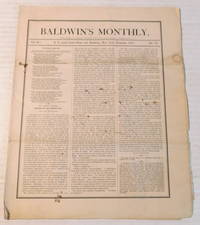
1874100032<p>New York: Baldwin the Clothier 1874. 1874. Good. - Quarto 12 inches high by 9-5/8 inches high. Softcover self-wraps with the banner title above three columns of text. 8 unopened uncut pages each with 3 columns of text printed on both sides of a folded 19 inch high by 24 inch wide sheet of newsprint with 2 woodcut illustrations including one illustrating Madge Elliot's poem "How They Helped Santa Claus". There is a tear along one of the vertical folds a few small stains to the cover page including ink stains and a couple of tiny tears to the front edges of the pages. Good.</p><p>A clever advertising periodical for Baldwin the Clothier a men's clothing store which includes a few articles and columns on the clothing trade interspersed with poems playful and witty stories and anecdotes. Among the fashion or clothing contents are found short articles such as "Very Naughty Boys" about a young man with a too short overcoat a line about "Thousands of Business Suits" "The Fat Men's Association" a line about "Imported Fabric" "English Pattern Ulsters" a column listing prices of various suits etc.</p><p>Evidently in honor of William Cullen Bryant's 80th birthday November 8 1874 his poem "Thanotopsis" is published in this issue.</p><p>RARE.</p> New York: (Baldwin the Clothier), 1874. paperback
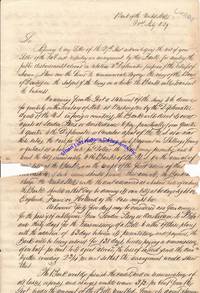
5457SECOND BANK OF THE UNITED STATES. The Bank of the United States was the federal governments short-lived initial attempt as a central bank. The First Bank was active from 1791-1811 and the Second Bank operated from 1816-1836. Both versions which acted as the governments fiscal agent were highly controversial between those politicians in favor of central power and those against it. Neither had its initial 20-year Congressional charter renewed.Archive. 8 pieces. 1829. A set of eight documents related to the Second Bank of the United States. There are six letters and two financial documents. All are handwritten contemporary copies of the originals. The letters are between U.S. Secretary of the Treasury Samuel D. Ingham 1779-1860 President of the Bank of the United States Nicholas Biddle 1786-1844 and Acting President of the Bank of the United States Thomas Cadwallader. All concern negotiations for the Bank of the United States to handle the federal governments overseas disbursements. This correspondence pre-dates the Bank War - President Andrew Jacksons disapproval of the Second Bank of the United States that led him to veto attempts to renew its charter in 1836. However the seeds of discord between the bank and the federal government can perhaps be read between the lines of this negotiation. The documents are in fair condition with toning and losses or tears to the central fold of every page sometimes repaired crudely with tape on the verso. Some words of text have been lost due to the damage the extend of which varies from document to document:Letter. 1pg. July 24 1829. Treasury Department. Contemporary copy of a letter written by Ingham to Biddle requesting the Bank of the United States to handle overseas disbursements for the U.S. government. It is the desire of the Department to enter into arrangements by which all the public disbursements abroad may be made thro the Bank of the U.S. My present object however is to effect this only in relation to those for diplomatic purposes and for the relief of Seamen.Document. 1pg. N.d. 1829. N.p. Contemporary copy of a handwritten financial document entitled Bills of Exchange remitted to Europe for & on acct of the U States Department of State for 1825. 1826. 1827. 1828.Document. 1pg. N.d. 1829 N.p. Contemporary copy of a handwritten financial document entitled Estimate of the Sums which may be drawn during the year 1829 for Foreign intercourse. It is likely that this and the abovementioned document are copies of statements originally sent with Inghams July 24 1829 letter. Letter. 1pg. July 27 1829. Bank of the United States. Contemporary copy of a letter written by Cadwallader to Ingham. As Acting President of the bank Cadwallader informs Ingham that he will put Inghams request before the banks board.Letter. 4pgs. July 31 1829. Bank of the United States. Contemporary copy of a letter written by Cadwallader to Ingham concerning the bank boards decision about Inghams request. On receiving from the Gov.t a statement of the Sums to be drawn for quarterly on the Secretary of State at Washington by the Diplomatic agents of the U.S. in foreign countries the Bank will direct its own agents at London Paris or Amsterdam to pay punctually from quarter to quarter to the Diplomatic or Consular agent of the U.S. at or near those cities the cash for his bills making such payment in Shillings francs or guilders at whatever rate per Dollar the Gov.t may prescribe and to remit the bills immediately to the Bank of the U.S. on the arrival . Some of the text is illegible due to damage.Letter. 1pg. August 7 1829. Treasury Department. Contemporary copy of a letter from Ingham to Cadwallader. The Treasury Department does not accept the Banks terms. The terms on which you propose to provide for the public disbursements abroad cannot be accepted. It appears to me that any advance of money which the bank may make abroad it has always an equivalent in the possession of an equal amount of the public money for the same time at home and that when the commission paid to its agent abroad and the difference of exchange are allowed to the bank it is fully indemnified leaving nothing to be added but an allowance for its own trouble in transacting the business. It is evident from the explanations which accompany your proposal that the peculiar considerations arising from the pecuniary relations in which the bank stands towards the Government have not entered into your estimate of the subject.Letter. 3pgs. August 14 1829. Bank of the United States. Contemporary copy of a letter from Cadwallader to Ingham. The bank responds to the Inghams complaints. perfectly aware of the advantages which the Bank derives from the deposits of public money we are nevertheless of opinion that a full equivalent for those advantages is to be found in the bonus of a million & a half of dolls paid to the US for its charter in its obligation to hold those monies at the order of the Gov.t to give the necessary facilities for transferring them without charge from place to place within the US and in its assumption of the arduous and expensive duties & responsibilities of the Loan office & pension agencies by which the Bank has unavoidably incurred very heavy losses.Letter. 1pg. November 28 1829. Bank of the United States. Contemporary copy of a letter from Biddle to Ingham. Biddle opens negotiations once again. In consequence of the personal explanations of the Treasy Dept during my recent visit to Washington in regard to the disbursements for diplomatic purposes in foreign countries the subject has been resumed by the Bank with the strong desire always entertained to carry into effect the financial views of the Department and to render the Bank instrumental to the safe and economical distribution of the public funds.Letter. 1pg. November 6 1830. Treasury Department. Contemporary copy of a letter from Ingham to Biddle. Ingham finalizes details relating the arrangement the Treasury Department and Bank of the United States have come to. hardcover
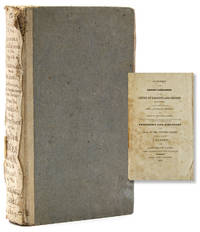
1823319699Baltimore: Thomas Murphy 1823. First edition. 28 xix 280 118pp. Folding tables. Uncut. 8vo. Publisher's paper-backed blue boards early manuscript titling on the spine. Title page torn without loss foxing. First edition. 28 xix 280 118pp. Folding tables. Uncut. 8vo. The establishment of the Second Bank of the United States in 1816 prompted immediate distrust of the institution with opponents charging it as constitutionally illegitimate and a direct threat to Jeffersonian agrarianism. With more local banks than any other state Maryland faced an unprecedented demand on specie from out-of-state banks and thus passed a bill calling for a tax on bank notes not issued by banks chartered within the state. The only such bank was the Baltimore branch of the Bank of the U.S. The cashier of the Baltimore Bank of the U.S. refused to pay the tax and the ensuing lawsuit would eventually make its way to the Supreme Court leading to the monumental decision in McCulloh v Maryland which held that the State could not tax a branch of the United States Bank and affirmed federal powers not delineated within the Constitution.<br /> <br /> Anti-banking prosecutors in Maryland however did not take the defeat in the Supreme Court lightly. Instead they indicted McCulloh and the President of the Baltimore bank of the U.S. James A. Buchanan 1768-1840; not to be confused with the U.S. President on conspiracy charges relating to 3 million dollars in loans that Buchanan and McColloh had extended to themselves and friends without proper collateral and without informing the directors of the parent Bank of the U.S.<br /> <br /> This scarce work comprises the reports indictments and evidence presented on the banking conspiracy cases brought against Buchanan and McCulloh published by the Directors of the Bank of the U.S. as part of their attempt to recuperate losses and address public .<br /> <br /> Scarce with only a single example in the auction records in the last quarter century. Sabin 23396; Shaw and Shoemaker 12485 Thomas Murphy unknown
286823New York: Frederick A Stokes Homemade Striped Cloth Bookcover Stitched Closed So Covers Must Be Excellent. Title Page Is Taped Twice A Few Other Neat Tape Repairs. Slight Soiling. Short Tear Pg 63 Bottom. Cracked But Holding Good. Scarce Copy Well Cared For. 24mo - over 5 - 5¾" tall. Owner's Name. First American Edition. Hardcover. Very Good/Very Good. Frederick A Stokes hardcover
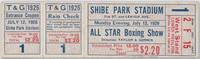
1926606165Philadelphia: Shibe Park Stadium / Globe Ticket Company 1926. Unbound. Near Fine. Complete unused ticket measuring 7"x 2". Light soiling most notably on the verso a few gentle bumps near fine overall. An unused ticket to a boxing match held at Shibe Park Stadium in Philadelphia July 12 1926 between Benny "Little Fish" Bass and Honey Boy Finnegan. 25000 fans were in attendance to watch the 10-round draw purportedly the largest showing in Shibe Park history. The ticket is for the West Stand Lower Pavilion Row 2 Sec. F Seat 15. Shibe Park Stadium / Globe Ticket Company unknown
1909stela585New York: 1909. 1909. 12mo. pp. 154 8. Profusely illus. in b/w. wrs. spine worn & chipped covers detached but present edges sunned with some chips. Exhibition catalogue. Soft cover. Good. New York: 1909. Paperback
1984stela482Saint Louis: The Saint Louis Art Museum in association with Prestel-Verlag Munich 1984. 1984. 4to. pp. 482. profusely illus. in colour & b/w. bio. biblio. index. wrs. couple nicks to lower spine crease line to lower right front corner and rear left edge. First American Edition. Exhibition catalogue. 1st Edition. Soft cover. Very Good. Saint Louis: The Saint Louis Art Museum in association with Prestel-Verlag Munich, [1984]. Paperback
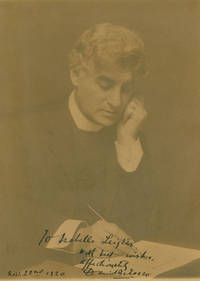
192038054New York: The Misses Selby 1920. Gelatin silver print half-length view showing Belasco seated at his desk writing. 8-1/2 x 6-3/4 inches. Slightly toned. Gelatin silver print half-length view showing Belasco seated at his desk writing. 8-1/2 x 6-3/4 inches. Inscribed "To Isabelle Leighton with best wishes affectionately David Belasco. Nov. 22nd 1920. "<br /> <br /> Signed in pencil below image "The Misses Selby N.Y." and with their label "The Misses Seby 628 Fifth Avenue." on the back. The Misses Selby unknown
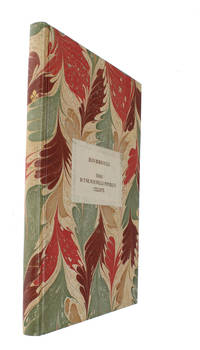
173542459Paris Imprimerie Royale 1735. 4to. Fine recent marbled boards. Printed titlelabel on frontcover. 6144 pp. and 1 double-page folded engraved plate. Johann B's paper: pp. 1- 91. - Daniel B's papers: pp. 93- 122 and pp. 123-144. A few marginal brownspots. <br/><br/><em>First edition of these prize winning papers by father Jean and son Daniel. - Both papers deals with the cause of the inclination of the planetary orbits relative to the solar equator. - In Daniel's paper he put foreward the hypothesis of the existence of an atmosphere resempling air and rotating around the solar axis resulting in an increasing inclination of the planetary orbits toward the equator of the sun. Daniel was the first importent Newtonian outside Great Britain. The problems faced here by Daniel are treated in Newtonian manner.The publication of these papers by father and son resulted in a controversy between the two forcing Daniel to leave his fathers house. - Poggendorff I:161. </em> hardcover
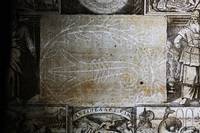
162718927Frankfurt: Matthaeus Merian 1627. First edition. Hardcover. Very good. Matthaeus Merian. Oblong folio leaves: 20.6 by 31.2 cm; plates: 10 to 11.5 by 14.5 to 15.5 cm. Engraved titlepage borders without letterpress; 231 of 233 engraved plates printed on the rectos with no printed text depicting biblical scenes from the Old and New Testaments lacks Gen. XIX: Lot and his daughters after the destruction of Sodom and Gomorrah; Exod. VIII & IX: The plague of frogs. Recent marbled calf lightly rubbed at extremities bordered in blind; gilt-tooled spine with raised bands gilt lettering pieces. Occasional light stains and smudges especially at the outermost leaves and almost entirely restricted to the blank margins; old mostly marginal repairs and reinforcement of tears to about 30 leaves Matt. IV plate with loss of about 10 words of manuscript text. Protected by wide margins the plates are clean fresh and bright with relatively few minor blemishes. Housed and protected in a custom luxurious modern leather clamshell box.<br /> <br /> Rare suite of biblical illustrations printed before letter perhaps as proofs comprising 231 of 233 engraved plates from the Icones Biblicae of Matthaeus Merian the elder 1593-1650. The engravings are printed on large paper and lack any printed text. They are preceded by a leaf of the engraved title borders to the first part in which the central cartouche which would have contained a letterpress title and imprint is here blank. Neat manuscript annotations appear throughout: atop each engraving is a brief title along with a notation of the biblical book and chapters; beneath each engraving are six-lines of rhyming verse in German; at the top corners are leaf numbers in Arabic numerals. All are penned in black ink in the same old cursive German hand. The engraved title leaf is not included in the manuscript foliation. The first three leaf numbers and several others among the first 23 leaves are obscured by wear or later marginal repairs. The foliation ends at leaf 233 and is discontinuous where one would expect to find numbers 15 and 38 corresponding to the missing plates noted above. As noted by Wütrich only four of the 233 plates are signed by Merian all in the New Testament series. Each of these signed plates appears in our suite: Matthaei I. - page 7; Johannis VIII. - page 65; Matthaei XXVII. - page 101; Apocalyps. IX. - page 145 header titles and page numbers from the first edition.<br /> <br /> The first editions were published at Frankfurt in four parts between 1625 and 1627. The Pentateuch series was published in 1625. The second part illustrating the Old Testament books from Joshua to Kings appeared in 1626. These first two series were published under the name of Merian's father-in-law the printer and bookseller Johann Theodor de Bry 1561-1623 whose heirs retained title to the business. The third part illustrates the remainder of the Old Testament and Apocrypha; the fourth the New Testament. These last two parts were published in 1627 under the engravers's own name. Verses in Latin German and French accompany each plate in the three Old Testament series the French verses being omitted in the 1627 New Testament series.<br /> <br /> While the eminent Swiss draughtsman and engraver Matthaeus Merian is best known for his topographical depictions of the German speaking lands which appeared in the Theatrum Europaeum his novel selection of biblical stories and innovative stylistic approach revealed in the present series of plates proved highly influential ushering in a new age of copperplate engraving in Bible illustration. Merian broke with the century-long tradition of woodcuts which had accompanied countless editions of Luther's German Bible. Even as he drew on the Bible illustrations of Jost Amman Hans Holbein Virgil Solis and Tobias Stimmer Merian greatly expanded the traditional iconographic and compositional repertoire. The Old Testament alone contains 23 prints depicting stories that had never before been the subject of an engraver. While earlier New Testament woodcuts focused on the Book of Revelation Merian now provided a rich series of plates to illustrate the Gospels and Acts of the Apostles as well.<br /> <br /> Merian had an obvious preference for crowd scenes and battles along with some of the novelistic features of the Old Testament such as Jacob's lentil dish Solomon and Shulamit in the Song of Songs or the apocryphal story of the Dragon in Babylon. Merian sometimes provides local color from his home town of Basel as in his depiction of Solomon's Temple Consecration in which despite the baroque redesign the Basel Cathedral with the old choir is easily recognizable. The costumes and gestures of Merian's biblical characters display a baroque fantasy of the ancient Near East as reflected in the theater of his day; in depicting cities and buildings however Merian generally prefers to follow contemporary models. In individual cases such as Bathsheba's Bath he succumbed to the temptation as an engraver and artist to show off his skills in a magnificent fashionable palace and garden complex. All-in-all Merian's engravings initiated a development in Bible illustration "that led further and further away from the didactic Reformation purpose of Bible pictures to purely artistic-representational purposes and finally ended in the well-known pathos of the German Romantic Nazarenes" Schmidt.<br /> <br /> In the first few decades after their appearance these Bible plates were widely copied throughout Europe especially in the Netherlands and France Poortman. The first folio Bible to use Merian's copper plates to illustrate the text was published by the heirs of Lazarus Zetzner at Strasbourg in 1630. Subsequent editions of the "Merian Bible" were published at Frankfurt where Merian had taken over his father-in-law Johann de Bry's business. For over a century as Merian's heirs continued to publish new editions this would become "the most widespread German illustrated Bible in southern Germany Basel and Alsace primarily in wealthy households" Schmidt. After the demise of the Merian publishing house in 1727 the bookseller Philip Heinrich Hütter acquired the copper plates which he used to illustrate a Catholic Bible edition published at Frankfurt in 1740 Poortman.<br /> <br /> A very notable instance of transposing Merian's biblical engravings into another context occurs in the famous and oft-reprinted Amsterdam Haggadah the ritual for the Jewish Passover meal first published in 1695. The engravings were made by Abraham ben Jacob a former Protestant preacher who converted to Judaism. Introducing skills he had earlier acquired when working outside the Jewish community Abraham ben Jacob "widened the scope of Jewish book illustration" Rosenau and introduced new elements into the traditional iconography of the Haggadah. "He chose many of the same incidental scenes as had appeared in the Venice Haggadot 1599-1604 but he drew them afresh basing his work on the biblical pictures in the Icones Biblicae by Matthew Merian" EJ. Among them was the image of the Temple of Solomon in Jerusalem. As Merian used a wide variety of prototypes Rosenau suggests that the two free-standing columns Jachin and Boaz depicted at the front porch of the Temple in Merian's engraving and Abraham ben Jacob's adaptation may have ultimately been derived from the woodcuts which accompany Estienne's Bible Paris 1540 based upon the scholarship of Franciscus Vatablus.<br /> <br /> In Das druckgraphische Werk von Matthaeus Merian d. Ae. 1993 L. H. Wüthrich describes a "Spezialausgabe ohne Drucktext" complete with 233 biblical engravings located in Darmstadt at the Hessische Landesbibliothek 31/643. This "separate edition without text or a series of proofs" which he describes has three notable features: 1 an undated first edition title page of the second part Pars II of the Old Testament which has been "corrected. by crossing out or shaving" to read "Pars I"; 2 the first edition title page of the New Testament series dated 1627; 3 an engraving of the The Fall of Man probably after Johann Theodor de Bry which later appears in Gottfried's Chronicle part 1 1629/1630 but which differs from that found in most copies of the first edition Wütrich 1a. The copies containing this plate after de Bry Wütrich 1aa. were likely printed in 1626. Further research perhaps locates only one other suite of Merian plates without text at the Herzog August Bibliothek Wolfenbüttel catalogued under two call numbers: the Old Testament series dated 1626-1627 comprising 157 leaves including an engraved title A: 30.1 Geom. 2 "Ausg. ohne Text von Ps. 1 und 2." = VD17 23:289608V and the New Testament series dated 1627 comprising 78 leaves including an engraved title A: 30.1 Geom. 3 "Ausg. ohne Text" = VD17 23:655618H. The catalogue entry for the Old Testament series references Wütrich's "Spezialausgabe ohne Drucktext." Surprisingly the key images provided for this entry illustrate the same three notable features of the "Spezialiausgabe" which Wütrich located at Darmstadt !. Our suite of plates is provided with a single blank engraved title leaf the one used for the first series of the Old Testament plates which lacks any letterpress. The third plate which depicts the Fall of Man is here in Merian's style and is the image more commonly found in the first printings Wütrich 1a.<br /> <br /> In the first edition of the Icones Biblicae the title page notes "Mit Versen und Reymen in dreien Sprachen geziert und erkläret Durch Johann Ludwig Gottfried" decorated and described with verses and rhymes in three languages by Johann Ludwig Gottfried. In the first three parts of Icones Biblicae Gottfried's German verses are in four lines with a rhyme scheme of ABBA. In the fourth part the New Testament the German verses are modified to six lines with a rhyme scheme of AABCCB. The manuscript verses in German which accompany each of the 231 plates in our suite differ from both of these formats being composed in six lines of iambic hexameter with a rhyme scheme of ABABCC. To give a sense of how these versions differ the four lines of the German printed verses which accompany the first plate The Creation may be compared with the following transcript of the written verses which describe this scene in our set.<br /> <br /> in the first edition of Merian's Bilderbibel<br /> <br /> Im Anfang Gott Erschuff den Himmel und die Erden<br /> Die Wasser und das Meer das Liecht der Sternenschein<br /> Die Vögel Fisch Gewürm alle Thier groß und klein<br /> Warauß sein Gütigkeit und Kraft erkant mag werden.<br /> <br /> the hand of anonymous versifier<br /> <br /> Im Anfang schuff der Herr den Himmel und die Erden<br /> Das Licht die Sonn den Mond die Sternen und das Meer<br /> Gras Bäume Laub und Kraut und was genannt mag werden<br /> Von Thieren Vögel Fisch in ihrem grosen Heer<br /> Nur durch ein einig Wort: Ich kan hieraus erkennen<br /> O Gott! dein ew'ge Krafft und dich den Schöpffer nennen.<br /> <br /> Watermark: flambeau surrounded by garland<br /> <br /> Provenance: laid-in typed description on a half-sheet bearing the early twentieth-century letterhead of Harry A. Levinson Rare Books: "There appears to be no record of another such copy of proofs before letter." References: L. H. Wüthrich Das druckgraphische Werk von Mattaeus Merian d. Ae. Basel: Bärenreiter 1993 vol. 3 p.16: "Spezialausgabe ohne Drucktext;" Enc. Jud. 2nd ed. 8:215; W. C. Poortman Bijbel en Prent 's-Gravenhage 1986 2:56-59; H. Rosenau Vision of the Temple London: Oresko 1979 pp. 135; 146f. Ph. Schmidt Die Illustration der Lutherbibel Birsfelden/Basel 1977 pp. 304-329; VD17 23:289608V and 23:655618H. [Matthaeus Merian] hardcover
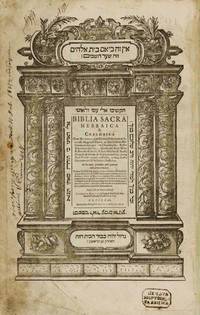
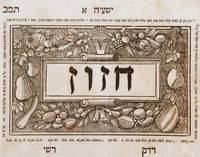
161948847Basel: Ludwig König 1619. First editions. Hardcover. Good. Seven parts in two volumes folio biblical texts and commentary in four parts continuously foliated; two supplemental sections each with separate foliation; Tiberias 1620 with separate pagination here bound after the second part - Vol. 1: 6 title and prelims 1-228 1 sect. title 234-441 1 blankff.; 6 sect. title and prelims 2 blank 114 2 blankpp. Vol. 2: 442-946; 8 Targum Yerushalmi; last leaf unfoliated; 67 Masora 1 blankff. Largely arranged in two columns of biblical texts in square font surrounded by commentaries in rabbinic Rashi font; text reads from right to left. This copy with collective Latin title surrounded by biblical quotations in Hebrew set within elaborate woodcut architectural borders. Hebrew sectional titles set within the same woodcut borders for the second and fourth parts with a plain letterpress half-title for the Five Megillot. The third sectional title for the Latter Prophets is lacking as are the Ashkenazi Haftarot readings not found in all copies. Apart from these lacks the Rabbinic Bible collates complete despite numerous errors in foliation throughout as per the detailed notes in Prijs Die Basler hebräischen Drucke. Opening word of each biblical book set in large one-third to one-half page cartouche vignettes with elaborate woodcut borders and surrounding letterpress Hebrew text. Main Latin title dated 1619 with the editor's Latin preface to the reader appearing at the verso. Jewish date chronogram for the second section Former Prophets dated 5378 1618/1619. Early twentieth-century black cloth boards worn at extremities gilt-lettered spine. Title moderately soiled re-inforced at gutter; neat old repairs to corners and fore-edge of title and next three leaves; old Russian stamp at bottom margin title manuscript entry in Russian along fore-edge dated 1837; intermittent mild to moderate marginal dampstains largely confined to corners and embrowning throughout both volumes somewhat more heavily in the first especially throughout Tiberias; top right corner of the opening leaf in vol. 2 repaired with loss of about 12 words surrounding title cartouche recto and some text in 9 lines of the commentary at the verso. Overall a good set with a notable chain of provenance. <br /> <br /> Sixth Rabbinic Bible in Hebrew: Mikra'ot Gedolot edited by Johann Buxtorf I 1565-1629 professor of Hebrew at the University of Basel and the foremost Christian Hebraist of his era with the assistance of the Jewish scholars Abraham Braunschweig who served as the principal corrector and Mordechai Gumplin of Posen. This was "a truly audacious undertaking for his time" Burnett From Christian Hebraism to Jewish Studies as no Christian scholar had yet attempted to edit the entire biblical corpus including the Aramaic versions Targumim and masoretic notes. Based mainly on the third Rabbinic Bible published by Daniel Bomberg at Venice in 1546-1548 the editor has carefully incorporated elements from two other Venetian editions. At the verso of the Latin title Buxtorf provides a detailed bibliographical excursus on the earlier Venetian editions and offers a tribute to Bomberg's industry by reprinting the colophon of the second Venetian Rabbinic Bible 1524-1525 at the conclusion of the masoretic appendix with text by the Hebrew grammarian and lexicographer Elijah Levita 1468 or 1469-1549 and a new introduction by Abraham Braunschweig. The design of the sectional titles and separate book title vignettes closely model those of the Venetian editions. "Buxtorf did not plan simply to reprint one of the existing Venice editions but rather to assemble the best features of them all into one work" and "to provide theologians with what he considered the most important tools for interpreting the Old Testament" Burnett. Buxtorf served in an official capacity as Basel's Hebrew censor charged with the oversight of all Jewish printing in the city and insuring that "no 'blasphemies' or slurs against Christians or Christianity appear in any book printed in Basel" Burnett. He carefully edited the Jewish commentaries in the Rabbinic Bible in accordance with this mandate "and removed many words and phrases which had escaped the attention of earlier censors" Burnett. <br /> <br /> The Rabbinic Bible contains the vocalized Masoretic text of the Hebrew Scriptures with accents and a vocalized Targum an Aramaic paraphrase of the biblical text: Onkelos for the Pentateuch; Jonathan b. Uzziel for the Prophets; and Targum Hagiographa for the Writings. The Hebrew and Aramaic versions are printed in square characters and presented in facing columns at the center of each page. The Jerusalem Targum of the Pentateuch appears as an appendix. In addition to the Aramaic paraphrases the Rabbinic Bible includes a massive scholarly apparatus of biblical commentaries by Rashi Ibn Ezra Baal ha-Turim Jacob b. Asher R. David Kimchi Radak R. Levi b. Gershon Ralbag Saadia Gaon and R. Isaiah along with the Masora a corpus of critical notes on the external form of the Biblical text compiled by Jewish scholars from late antiquity through the medieval era. As frequently occurs a copy of Buxtorf's work on the textual history of the Hebrew Bible Tiberias the 1620 first edition is bound-in. This work was made possible by the publication in 1538 of Elijah Levita's Masoret ha-Masoret a commentary on the Masora which Buxtorf translated into Latin for his own private use in 1593. "Buxtorf was concerned with the integrity of the consonantal text and the origin and integrity of the vowel points and accents of the Hebrew Bible from the very beginning of his scholarly career" and while he had earlier published a long excursus on the age of the vowel points and accents in his 1609 Thesaurus Grammaticus "Tiberias is Buxtorf's fullest and most impressive work on the history of the biblical text" Burnett. Intended as a reference work for Christian students and scholars interested in studying the Masora Buxtorf was also keen to refute the view advanced by Levita that the Hebrew vowel points were early medieval innovations. Our folio version of Tiberias was intended to accompany the Rabbinic Bible and has the same architectural borders at the title. König also published a quarto edition in the same year but only the folio version includes a critical commentary on the Masora in which Buxtorf proposes various corrections to the Masoretic notes. <br /> <br /> As noted at the title Buxtorf's faithful study and tireless labor studio fido et labore indefesso yielded notably long-lasting results: "The Basel rabbinical Bible became a standard tool for research among Christian scholars and would remain so. until the end of the nineteenth century" Burnett. A vast array of early modern scholars including Protestants like Johannes Drusius and John Selden as well as Roman Catholics like Robert Bellarmine and Andreas Masius owned a copy or two of the Rabbinic Bible. "Johannes Buxtorf's thoroughly censored "Christian" version of the Rabbinic Bible Basel 1618-19 only made it easier for Hebraists to own copies of their own" Burnett Christian Hebraism in the Reformation Era p.163.<br /> <br /> A note on the date of publication: "The actual printing began between the mid-August and mid-September of 1618. According to the colophon production ended on the 24 of Ab 5379 = August 4 1619 but since this date also appeared on the colophon of the Bomberg Biblia rabbinica edition of 1524-25 reprinted unchanged in the 1546-48 and 1568 editions it is suspect. Prijs suggested that the probable completion date was sometime during Ab of 5379 between July 12 and August 10 of 1619" Burnett. <br /> <br /> Provenance: from the library of acclaimed theologian and biblical scholar Brevard Childs with his entry at the free endpaper in the second volume. The earlier bookplate of judge Samuel Heller with his motto in Hebrew: Mi-kol melamdai hiskalti from all my teachers I have learned appears at the front paste-down. An old blue ink-stamp in Hebrew characters makes occasional appearances the text: Bet ha-Midrash ha-Gadol Minsk The Great Synagogue of Minsk. A Russian entry dated 1837 appears at the fore-margin of the main title along with an old ink stamp in Russian at the bottom margin the last word of which reads "Rabbina" References: Biblia Sacra: Burnett 7. Cowley 87. Darlow & Moule 5120 bound with the 1665 second edition of Tiberias cf. 5093. Davidson Otsar ha-shirah vol.1 p.406 no.8954. Prijs 219. Steinschneider 423 423b. VD17 23:675325G. S. Burnett Christian Hebraism in the Reformation Era Leiden: Brill 2012 p.163. Tiberias: Burnett 111. Prijs 222a. For detailed analyses of both works see: S. Burnett From Christian Hebraism to Jewish Studies Leiden: Brill 1996 pp.169-239 chaps. 6 & 7.<br /> <br /> Full Latin title: Biblia Sacra Hebraica & Chaldaica cum Masora quae critica Hebraeorum sacra est Magna & Parva ac selectissimis Hebraeorum interpretum commentariis Rabbi Salomonis Jarchi R. Abrahami Aben Esrae R. Davidis Kimchi R. Levi Gerson R. Saadie Gaon R. Jeschajae & Notis ex authore quem Baal Turim vocant collectis quibus textus grammaticè & historicè illustratur. In his nunc primum post quatuor editiones Venetas textus Chaldaicus qui Targum dicitur à deformitate punctationis & pravitate vocum innumeratum vindicatus; loca in Masora transposita deficientia pugnantia numeris depravata subsidio diversorum exemplarium & Concordantiarum Hebraicarum quantum fieri potuit reposita restituta & conciliata sunt ut in praefatione amplius declarabitur. Studio fido & labore indefesso Johannis BuxtofI linguae sanctae in Academia Basileensi Professoris Ord. Basileae: Sumptibus & typis Ludovici König 1619.<br /> <br /> Collation vol. 1 Rabbinic Bible: ital.a6 a-z8 A-E8 F4 G-Z8 Aa-Hh8 Ii9 Ii10 blank; 1 blank :3 1 blank A-N4 O5.<br /> <br /> Collation vol. 2 Rabbinic Bible: Kk-Rr8 Kk1 lacks Ss6 Tt10 Vv-Zz8 AA-PP8 QQ-TT6 VV9 VV10 blank XX-ZZ8 Aaa-Nnn8 Ooo3 Ooo4 blank PppTtt8 Vuu3 Vuu4 blank Xxx-Zzz8 AAaa-EEee8 8 A-G8 H6 I5 I6 blank. Ludwig König hardcover
161952679Basel: Ludwig König 1619. First edition in part. Hardcover. Good. Eight parts in three volumes folio biblical texts and commentary in four parts continuously foliated; three supplemental sections each with separate foliation; Tiberias 1655 with separate pagination here bound after the Haftarot - Vol. 1: 6 title and prelims 1-228 1 sect. title 234-441 1 blank ff. Vol. 2: 1 sect. title 442-705 3 blank 707 sect. title-837 1 blank ff. Vol. 3: 839 half-title-881 1 blank 883-946; 8 Targum Yerushalmi; last leaf unfoliated; 67 Masorah 1 blank; 1 title 2-36 Haftarot ff.; 8 title and prelims 108pp. Despite the gap in foliation between the first and second parts and numerous errors in foliation throughout the Rabbinic Bible collates complete with all blanks noted in Prijs Die Basler hebräischen Drucke and the Haftarot bound at the end. Largely arranged in two columns of biblical texts in square font surrounded by commentaries in rabbinic Rashi font; biblical texts read from right to left. This copy with collective Hebrew title surrounded by biblical quotations in Hebrew set within elaborate woodcut architectural borders; brief preface in Hebrew by Abraham Braunschweig at the verso. Hebrew sectional titles set within the same woodcut borders for the three other biblical sections and the Haftarot with a plain letterpress half-title for the Five Megillot. Opening word of each biblical book set in large one-third to one-half page cartouche vignettes with elaborate woodcut borders and surrounding letterpress Hebrew text. Main title Jewish date chronogram = 5378 1618-1619. Near-contemporary half calf over speckled boards worn and rubbed; spines with raised bands gilt morocco lettering pieces and old paper labels heavily faded. About two-thirds of the text embrowned ranging from minimal to moderately heavy; worm tracing in a 1- by 2-inch section at leaves 541-553 affecting text. A good complete set notably containing the Ashkenazi Haftarot readings not found in all copies.<br /> <br /> Sixth Rabbinic Bible in Hebrew: Mikra'ot Gedolot edited by Johann Buxtorf I 1565-1629 professor of Hebrew at the University of Basel and the foremost Christian Hebraist of his era with the assistance of the Jewish scholars Abraham Braunschweig who served as the principal corrector and Mordechai Gumplin of Posen. This was "a truly audacious undertaking for his time" Burnett as no Christian scholar had yet attempted to edit the entire biblical corpus including the Aramaic versions Targumim and masoretic notes. Based mainly on the third Rabbinic Bible published by Daniel Bomberg at Venice in 1546-1548 the editor has carefully incorporated elements from two other Venetian editions. At the verso of the Latin title Buxtorf provides a detailed bibliographical excursus on the earlier Venetian editions and offers a tribute to Bomberg's industry by reprinting the colophon of the second Venetian Rabbinic Bible 1524-1525 at the conclusion of the masoretic appendix with text by the Hebrew grammarian and lexicographer Elijah Levita 1468 or 1469-1549 and a new introduction by Abraham Braunschweig. The design of the sectional titles and separate book title vignettes closely model those of the Venetian editions. "Buxtorf did not plan simply to reprint one of the existing Venice editions but rather to assemble the best features of them all into one work" and "to provide theologians with what he considered the most important tools for interpreting the Old Testament" Burnett. Buxtorf served in an official capacity as Basel's Hebrew censor charged with the oversight of all Jewish printing in the city and insuring that "no 'blasphemies' or slurs against Christians or Christianity appear in any book printed in Basel" Burnett. He carefully edited the Jewish commentaries in the Rabbinic Bible in accordance with this mandate "and removed many words and phrases which had escaped the attention of earlier censors" Burnett. <br /> <br /> The Rabbinic Bible contains the vocalized Masoretic text of the Hebrew Scriptures with accents and a vocalized Targum an Aramaic paraphrase of the biblical text: Onkelos for the Pentateuch; Jonathan b. Uzziel for the Prophets; and Targum Hagiographa for the Writings. The Hebrew and Aramaic versions are printed in square characters and presented in facing columns at the center of each page. The Jerusalem Targum of the Pentateuch appears as an appendix. In addition to the Aramaic paraphrases the Rabbinic Bible includes a massive scholarly apparatus of biblical commentaries by Rashi Ibn Ezra Baal ha-Turim Jacob b. Asher R. David Kimchi Radak R. Levi b. Gershon Ralbag Saadia Gaon and R. Isaiah along with the Masora a corpus of critical notes on the external form of the Biblical text compiled by Jewish scholars from late antiquity through the medieval era. As frequently occurs a copy of Buxtorf's work on the textual history of the Hebrew Bible Tiberias the 1655 revised edition is bound-in. This work was made possible by the publication in 1538 of Elijah Levita's Masoret ha-Masoret a commentary on the Masora which Buxtorf translated into Latin for his own private use in 1593. While "Buxtorf was concerned with the integrity of the consonantal text and the origin and integrity of the vowel points and accents of the Hebrew Bible from the very beginning of his scholarly career." While he had earlier published a long excursus on the age of the vowel points and accents in his 1609 Thesaurus Grammaticus "Tiberias is Buxtorf's fullest and most impressive work on the history of the biblical text" Burnett. Intended as a reference work for Christian students and scholars interested in studying the Masora Buxtorf was also keen to refute the view advanced by Levita that the Hebrew vowel points were early medieval innovations. Our folio version of Tiberias was intended to accompany the Rabbinic Bible and has the same architectural borders at the title. König also published a quarto edition in the same year but only the folio version includes a critical commentary on the Masora in which Buxtorf proposes various corrections to the Masoretic notes. <br /> <br /> As noted at the title Buxtorf's faithful study and tireless labor studio fido et labore indefesso yielded notably long-lasting results: "The Basel rabbinical Bible became a standard tool for research among Christian scholars and would remain so. until the end of the nineteenth century" Burnett. A vast array of early modern scholars including Protestants like Johannes Drusius and John Selden as well as Roman Catholics like Robert Bellarmine and Andreas Masius owned a copy or two of the Rabbinic Bible. "Johannes Buxtorf's thoroughly censored "Christian" version of the Rabbinic Bible Basel 1618-19 only made it easier for Hebraists to own copies of their own" Burnett Christian Hebraism in the Reformation Era p.163.<br /> <br /> A note on the date of publication: "The actual printing began between the mid-August and mid-September of 1618. According to the colophon production ended on the 24 of Ab 379 = August 4 1619 but since this date also appeared on the colophon of the Bomberg Biblia rabbinica edition of 1524-25 reprinted unchanged in the 1546-48 and 1568 editions it is suspect. Prijs suggested that the probable completion date was sometime during Ab of 379 between July 12 and August 10 of 1619" Burnett. References: Biblia Sacra: Burnett 7. Cowley 87. Darlow & Moule 5120 like our copy bound with the 1665 second edition of Tiberias cf. 5093. Davidson Otsar ha-shirah vol.1 p.406 no.8954. Prijs 219. Steinschneider 423 423b. VD17 23:675325G. S. Burnett Christian Hebraism in the Reformation Era Leiden: Brill 2012 p.163. Tiberias: Burnett 114. Prijs 272a. For detailed analyses of both works see: S. Burnett From Christian Hebraism to Jewish Studies Leiden: Brill 1996 pp.169-239 chaps. 6 & 7. Ludwig König hardcover
082883U.s. Department of health education and Welfare. First Edition. Hardcover. Very Good. 4 substantial vols. Published 1965-1984 Numbers 1 through 20. Postage at cost. U.s. Department of health, education and Welfare hardcover
1980411966California 1980. Unbound. Near Fine. A collection of eight fabric sticker backstage passes or patches featuring new wave bands performing in San Francisco circa 1980s. The passes vary in size from 3½†x 3¼†to 5†x 3â€. Light soiling from the back of the stickers peeling with some fraying near fine. <br /> <br /> All items are near fine with light soiling and edgewear. The bands include several popular new wave artists such as Billy Idol The Cars Tears for Fears Sting Power Stations The Police and U2. The passes were previously owned by a back stage employee for concerts in the California area. The passes are for popular venues in San Francisco such as the Cow Palace and Bill Graham presents at the Fillmore. Many of the passes are brightly colored with printed pictures and band logos showing the typographic designs of the time. unknown
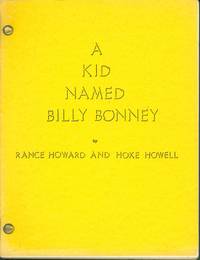
1970264982Howard & Howell 1970. Trade Paperback. 112 pages. 11 x 8.5 inch sheets printed on recto only. Rance Howard and Hoke Howell were both American actors. The screenplay treats the early days of Billy the Kid. Unfilmed. Very good in yellow wrappers paperback 2 prong-bound on left side.<br> Howard & Howell paperback
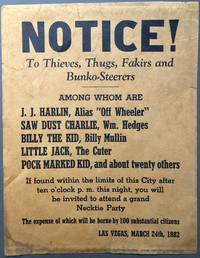
1882H15997Las Vegas 1882. Good. 11 x 8.5 in tanning wove paper good with some short repaired tears bottom edge with some staining and darkening. Possibly from 1882 but probably not however it does give off the vibe of having been printed at least a hundred years ago and is substantially different in typography from the modern reproductions being offered online. This is definitely OLD. unknown
1903ST20279Paris: Librarie A. Roquette 1903. No. 92 OF 150 COPIES on Japon and another 10 copies on vellum paper. 251 x 160 mm. 9 7/8 x 6 1/4". 2 p.l. 67 1 pp. 2 leaves followed by additional suite of etchings. <br/> HANDSOME TAN CRUSHED MOROCCO GILT BY THE CLUB BINDERY stamp-signed and dated 1905 on front turn-in covers framed by gilt strapwork and multiple fillets raised bands spine compartments with similar gilt tooling gilt lettering densely gilt turn-ins marbled endpapers top edge gilt. In a modern slightly ill-fitting suede-lined gray linen clamshell box backed with blue morocco. Illustrated throughout with elegant borders and scenes surrounding the text colored with pochoir. With an additional suite of illustrations printed in black before letters. Front pastedown with morocco ex-libris of Robert Hoe and with bookplate of the Robin Collection. Spine uniformly a bit darkened text margins with a hint of browning because of paper quality but still a very pleasing copy with virtually no signs of use.<br/> <br/> Bound by one of America's greatest binderies and once owned by the renowned collector Robert Hoe this is a charming adaptation of a Medieval legend illustrated with delicate pochoir images by a popular French Art Nouveau artist. Originating in the 13th century the story here concerns a pious sacristan whose faith is tested when she falls in love with a young noble. The pages are adorned with attractive borders inspired by nature along with images from the story all colored in soft hues that evoke an angelic ethereal quality that fits perfectly with the themes of the legend. Our artist Henri Caruchet 1873-1943 was a sought-after illustrator in the bibliophilic world producing work for authors such as Octave Uzanne Theophile Gautier and Anatole France. The present work also contains a suite of uncolored illustrations printed before letters allowing the viewer to appreciate how much the pochoir coloring does to enliven Caruchet's designs. Our binding is a product of the esteemed Club Bindery founded by Grolier Club members and other wealthy collectors to provide close to home fine quality binding work rivalling what was available abroad. The workshop provided bindings that tended to be traditional in style--though frequently with elaborate decoration--and that lived up to its patrons' expectations in terms of excellence. The first members of the staff of the Club Bindery were the Englishmen R. W. Smith and Frank Mansell. They were subsequently joined by a number of French binders chief among them being Léon Maillard who had worked previously for Cuzin Gruel and Marius Michel. The Club Bindery was in operation until 1909 with Robert Hoe 1839-1911 being its most influential manager and client. Hoe was also the founding member and first president of the Grolier Club and according to Beverly Chew his library was "the finest America has ever contained." He acquired illuminated manuscripts early printing he owned a Gutenberg Bible on paper and one on vellum fine bindings French and English literature and Americana; when his library was sold in 1911-12 it fetched nearly $2 million a record that held until the Streeter sale more than 50 years later. Librarie A. Roquette unknown
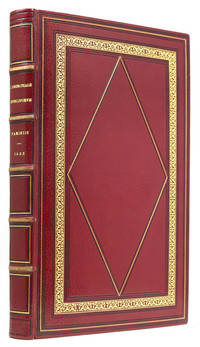
1633306616Paris: Societatis Typographic Librorum Officii Ecclesiastici . 1633. Engraved title numerous small and large engraved vignettes head-and tail-pieces one full-page engraving; text printed in black running headlines and chapter headings in red numerous large decorated initial capitals. 1 vols. Folio. Full red crushed morocco covers decorated with single black and gilt fillets including a central diamond in black and gilt with a gilt-rolled frame spine in six compartments with raised bands gilt lettered in two others with simple frame of black and gilt fillets wide gilt turn-ins with large gilt cornerpieces a.e.g. gilt-stamped on the turn-in of the inside front cover "French Binders Garden City NY" and on that of the rear cover "H. Hardy Relieur 1934 G. Pilon Doreur." Very slight rubbing to extremities still near fine with some toning to text. In a quarter morocco slipcase with chemise. Engraved title numerous small and large engraved vignettes head-and tail-pieces one full-page engraving; text printed in black running headlines and chapter headings in red numerous large decorated initial capitals. 1 vols. Folio. Beautifully bound in full red morocco by The French Binders successors to The Club Bindery and signed on the rear turn in by two of the firm's most distinguished binders Henry Hardy and Gaston Pilon. <br /> The French Binders traces its lineage back to The Club Bindery founded in 1895 by members of the Grolier Club to provide exceptionally fine bindings for American collectors. The Club Bindery moved to Cleveland where it was successively renamed the Rowfant Bindery 1909-1913 the Booklover's Shop 1914-1917 and finally The French Binders 1918-1920s as in-house bindery to Doubelday in Garden City New York. Henry Hardy worked for all incarnations of the bindery starting with The Club Bindery; his brother-in-law Gaston Pilon worked with Chambolle-Duru in Paris and came over to America to join the Rowfant Bindery. Both Hardy and Pilon were named Officers of the French Academy in 1933 the highest recognition given by the French government to naturalized Americans see Martin Antonetti's essay in Bound to Be the Best: The Club Bindery. Provenance: Estelle Doheny red morocco booklabel; Carl C. Kalbfleisch brown morocco booklabel Societatis Typographic Librorum Officii Ecclesiastici .. unknown
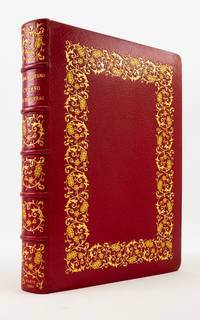
1899ST20804Paris: Armand Magnier 1899. No. 42 OF 500 COPIES this ONE OF 20 ON JAPON WITH ENGRAVINGS IN THREE STATES. 300 x 207 mm. 12 x 8". 4 p.l. <br/> ELEGANT SCARLET CRUSHED MOROCCO GILT AND INLAID BY THE CLUB BINDERY and LEON MAILLARD Finisher both names stamp-signed in gilt on front turn-ins covers framed by curling gilt vines bearing citron morocco blossoms a total of 104 inlays on each cover raised bands spine panels with gilt vine circlets blooming with a total of 20 inlaid citron morocco flowers gilt lettering turns-ins elaborately gilt marbled endpapers top edge gilt other edges untrimmed. Original paper wrappers bound in the pictorial front cover present in three additional states black & white B&W before letters and color. In slightly worn matching morocco-backed jacket. With 54 wood engravings by Romagnol after François Thévenot cover and portrait Adrien Moreau Act I Charles Léandre Act II Albert Laurens Act III François Flameng Act IV and Albert Besnard Act V including five full-page plates all in three states one before letters the full-page plates also in a color state separately furnished to subscribers by the publisher per a notice bound in at the end of the text. Front pastedown with morocco bookplate of Robert Hoe. Lower corners a bit bumped tail edge of lower board with shallow one-inch dent occasional paper flaws or discoloration to edges of leaves but an excellent copy the interior clean and fresh and the binding lustrous.<br/> <br/> This is a luxurious illustrated edition of Rostand's classic work offered in a sumptuous binding done by the Club Bindery for its co-founder and manager Robert Hoe. Rostand's influential and enduringly popular 1897 verse play in five acts--sometimes referred to colloquially as the "Romance of the Nose"--is loosely based upon the real-life story of the French author and duelist Cyrano de Bergerac 1619-55 who was famous for having a prodigious proboscis. A theatrical triumph from its opening night the play focuses on the eloquent Cyrano's unrequited love for the comely Roxanne whom he must court as secret proxy for a friend of handsome visage but wooden tongue. Rostand 1868-1918 wrote a number of successful plays often like "Cyrano" based on figures from French history. The present beautiful large-format copy was originally owned by Robert Hoe a founder of the Grolier Club and one of the world's great book collectors. After Grolier was established in 1884 it soon became apparent that the country's few established hand binders were overtaxed in providing repairs and rebinding for the club members' rapidly accumulating acquisitions. As a consequence in 1895 Grolier members along with Edwin Holden and other wealthy collectors established the Club Bindery in order to attract European craftsmen to provide close to home fine quality binding work rivalling what was available abroad. The Club Bindery was in operation until 1909 with Hoe being its manager and most important client. It provided bindings that tended to be traditional in style--though frequently with elaborate decoration--and that lived up to its patrons' expectations in terms of excellence. The first members of the staff of the Club Bindery were the Englishmen R. W. Smith and Frank Mansell. They were subsequently joined by a number of French binders chief among them being Leon Maillard who had worked previously for Cuzin Gruel and Marius-Michel and whose precise and intricate finishing is impressively demonstrated on our binding here. It is said by Beverly Chew that Hoe 1839-1911 had a collection that was "the finest America has ever contained." He acquired illuminated manuscripts early printing he owned a Gutenberg Bible on paper and one on vellum fine bindings French and English literature and Americana and when his library was sold in 1911-12 it fetched nearly $2 million a record that held until the Streeter sale more than 50 years later. The present volume represents the fine level of aesthetic achievement typical of the bindery and it is especially impressive because of its significant dimensions. Armand Magnier unknown
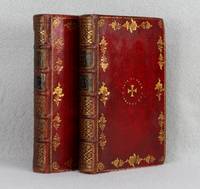
1779ST12581London: Sold by Dodsley 1779. 165 x 102 mm. 6 1/2 x 4". Complete with usual jump in pagination in volume II. Two volumes. <br/> Pleasant contemporary crimson morocco BOUND FOR JONAS HANWAY BY HIS SECOND BINDER covers gilt with twining border enclosing a frame of roses with sunburst cornerpieces upper cover with Greek cross at center encircled by the motto "O save us from ourselves" lower cover with winged hourglass and the motto "Revere the appointment of Nature"; raised bands spine compartments gilt in a checkerboard pattern punctuated by daisies one olive and one black morocco label gilt turn-ins marbled endpapers all edges gilt. Engraved title pages with emblem depicting Death hovering over socializing persons with a lutist in the background. A Large Paper Copy. Verso of front free endpapers with armorial bookplate from which the name has been excised. ◆Spines a bit darkened with muted gilt leather on covers varying in color from fading or soiling but the bindings entirely solid and with only trivial wear to the joints. Leaves with a hint of offsetting and isolated soiling faint dampstain to lower fore edge of one gathering otherwise extremely pleasing internally the text clean fresh and bright and with vast margins.<br/> <br/> These bindings were specially crafted for Jonas Hanway 1712-86 an eccentric philanthropist and prolific pamphleteer who designed custom bindings for edifying works usually his own which he often presented to libraries friends and even the king; our binding was in fact probably intended for presentation though the recipient is unknown. In his "English Bindings in the Library of J. R. Abbey" G. D. Hobson has done a census of 26 Hanway bindings but the present one is not listed there. Hobson states that Hanway has been unjustly overlooked whereas another 18th century eccentric "who took an interest in the art of decorating bookcovers Thomas Hollis has appeared in every account of English binding" after J. A. Arnett's "The Books of the Ancients" appeared in 1837. "The bindings executed for Hanway are of better material" says Hobson "and the tools which decorate them are more amusing than those of his contemporary; perhaps they have been neglected because they are comparatively rare." Hanway employed two different binders to translate his ideas into leather and the present volumes represent the work of his second binder who entered his employ in 1765. This binder has not been identified by name but his work is known as here by the appearance of a small number of tools used in various combinations. For example our winged hourglass rose ornaments twining roll sunburst and checkerboard design on the spine also appear on Hobson's "Abbey" #91 and on item #155 in Maggs Catalogue 1212. An enthusiastic and effective philanthropist concerned with child welfare Hanway founded schools to teach boys farming trades and seamanship. He also wrote some 150 books and pamphlets and perhaps his reputation as an eccentric derived from his being the first male in London to use an umbrella. Nixon notes in "Oldaker Collection" that he was "a highly estimable character but one of the greatest bores of his day." An advocate of such practices as the consumption of whole wheat bread and abstinence from tea drinking he inveighs in the present work against "nocturnal diversions" and the keeping of late hours. Midnight should be the signal to end dancing music and other amusements if one wishes to preserve one's health and virtue. Thankfully the author's bindings remain more interesting than the written works he produced. Sold by Dodsley unknown