323 résultats
16981227588Leiden, Fr. Haaring, 1698. 14 Bl., 576 (recte 574) S., 13 Bl., 1 doppelblatt-gr. Kupfertafel. Pgtbd d. Zeit (hinterer Deckel u. Vorsatz wasserfleckig, Buchblock teilw. etwas gebräunt u. leicht feuchtwellig, Paginierung springt nach S. 544).
166111654Basileae: Johan. Jacobum Deckerum 1661 Ludovici Regis 1640 1661. Third revised 1661 Second edition 1640. Hardcover. 12 Mo. Original full vellum with handwritten lettering on spine. 1 Synagoga Judaica: Third revised edition. 34 779 38 pp. Title-page in red and black lettering. Fascinating work on Jewish rituals and traditions. Latin translation of this originally in German published work. Johannes Buxtorf the Elder was a celebrated Hebraist born in Westphalia member of a family of Orientalists; professor of Hebrew for thirty-nine years at Basel and known by the title "Master of the Rabbis". He was succeeded by his son who also became a renowned professor. 2De Abbreviaturis Hebraicis: 14 472 8pp. Second edition of a Latin reference work of abbreviations in Hebrew from the Talmud. First published in 1613. Includes at end a bibliography of Rabbinical literature. Title-page with woodcut vignette. Closed tear of 1.5' on top of front joint. Minor soiling to binding. Previous owner's signature and ex-library sticker on free front endpaper. Hinges starting. Interior in very good condition. Johannes Buxtorf the Elder was a 17th century Hebraist who served as professor of Hebrew for thirty-nine years at Basel and known by the title "Master of the Rabbis." He was one of the most important Christian Hebraists of his day and was largely responsible for transforming Hebrew studies from an amateur hobby into an established academic discipline in the early seventeenth century. He was succeeded by his son Johannes Buxtorf the Younger who also became a renowned professor. Johan. Jacobum Deckerum (1661) Ludovici Regis (1640) hardcover
169141859Leipzig Grosse & Gleditsch 1691. 4to. Contemp. full vellum. Faint handwritten title on spine. a small stamp on titlepage. In: "Acta Eruditorum Anno MDCLXXXXI". 85906 pp. and 13 of 15 folded engraved plates. The 2 first plates lacks but they do not belong to the papers listed.Leibniz' papers: pp.277-281 a. 1 plate pp. 435-439. Johann Bernoulli: pp. 274-276 a. 1 plate. Huygens: pp. 281-282. - Jacob Bernoulli: pp. 282-290 a. 1 plate. <br/><br/><em>All papers first apperance. All 5 of extreme importence in the development of the Calculus. Leibniz' 2 papers on the catenary curve paper 1-2 offered here was written at the instigation of Jacques Bernoulli. Following the example of Blaise Pascal who had initiated in 1658 a contest for the construction of the cycloid Leibniz also provoked the geometers of his time by challenging them to submit at the fixed date of mid-1691 their geometric method for the construction of the catenary curve. Leibniz later provided the answer followed by Johann Bernoulli and Huygens.'These two papers are a historical account of the origin of the study of this transcendental curve and at the same time the first physical-geometric construction showing the species-relationship between the catenary and the logarithmic curves as two companion curves; one arithmetic the other geometric. All of the differentials of the catenary curve are arithmetic means of corresponding differentials of the logarithmic curve; and all of the differentials of the logarithmic curve are geometric means of the catenary.'"The Catenary is the form of a hanging fully flexible rope or chain the name comes from "catena" which means 'chain' suspended on two points. The interest in this curve originated with Galileo who thought that is was a parabola. Young Christiaan Huygens proved in 1646 that this cannot be the case. What the actual form was remained an open question till 1691 when Leibniz Johann Bernoulli and the then much older Huygens sent solutions to the problem to the "Acta" Jakob Bernoulli 1690 Johann Bernoulli 1691 Huygens 1691 and Leibniz 1691 - these 4 1691-papers offered here - in which the previous year Jakob Bernoulli had challenged mathematicians to solve it. As published the solutions did not reveal the methods but through later publications of manuscripts these methods have been known. Huygens applied with great paper 4 virtuosity the by then classical methods of 17th century infinitesimal mathematics and he needed all his ingenuity to reach a satisfactory solution. Leibniz the papers 1-2 and Bernoulli paper 3 applying the new Calculus found the solutions in a much direct way. In fact the catenary was a test-case between the old and the new style in the study of curves and only because the champion of the old style was a giant like Huygens the test-case can formally be considered as ending in a draw." Grattan-Guiness in "From the Calculus to Set Theory 1630-1910.".The paper by JACOB BERNOULLI no. 5 offered here is a milestone papers as it marks the invention of the "SYSTEM OF POLAR COORDINATES" with points located by reference to a fixed point and a line through that point. Although newton had earlier also devised such a coordinate system in 1671 his work was not known so that the credit for the discovery generally goes to Bernoulli. Parkinson Breakthroughs 1691.Further papers contained in this volume of Acta Eruditorum:DENYS PAPIN: Mecanicorum de Viribus Motricibus sententia asserta a D. Papino adversius C.G.G. L. Leibniz objectiones. pp. 6-13. The plate lacks. - and Dion. Papini Observationes quaedam circa materias ad Hydraulicam spectantes. Pp. 208-213 a. 1 plate. This importent paper is part of the LEIBNIZ-PAPIN-CONTROVERSY.JACOB BERNOULLI: Specimen Calculi Differentialis in dimensione Parabolæ helicoidis ubi de flexuris curvarum in genere carundem evolutionibus. Pp. 13-22. The plate lacks. - and J.B. Demonstratio Centri Oscillationis ex Natura Vectis reperta occassione eorum quæ super hac materia in Historia Literaria Roterodamensi recensentur articulo.Pp.317-321.LEIBNIZ: O.V.E. Additio ad Schediasma de Medii Resistentia publicatum in Actis mensis Febr. 1889. Pp. 177-178. and O.V.E. Quadratura Arithmetica Communis Sectionum Conicarum quæ centrum babent.Pp. 178-182 a. 1 plate.TSCHIRNHAUS: Singularia Effecta Vitri Caustici bipedalis quod omnia magno sumtu hactenus constructa specula ustoria virtute superat per D.T. Pp. 517-520 </em> hardcover
169141859Leipzig, Grosse & Gleditsch, 1691. 4to. Contemp. full vellum. Faint handwritten title on spine. a small stamp on titlepage. In: ""Acta Eruditorum Anno MDCLXXXXI"". (8),590,(6) pp. and 13 (of 15) folded engraved plates. The 2 first plates lacks, but they do not belong to the papers listed.Leibniz' papers: pp.277-281 a. 1 plate, pp. 435-439. Johann Bernoulli: pp. 274-276 a. 1 plate. Huygens: pp. 281-282. - Jacob Bernoulli: pp. 282-290 a. 1 plate.
169441704Leipzig Grosse & Gleditsch 1694. 4to. Contemp. full vellum. Faint handwritten title on spine. a small stamp on titlepage. In: "Acta Eruditorum Anno MDCXCIV". 2518 pp. and 11 folded engraved plates. As usual with various browning to leaves and plates. The entire volume offered. Leibniz's papers: pp. 311-316 pp. 364-375. - Johann Bernoulli's papers: pp. 200-206 pp. 394-99 pp. 435-437 pp. 437-441. - Huygen's papers: pp. 338 pp. 339-41. - Jakob Bernoulli's papers: pp. 262-276 pp. 276-280 pp. 336-338 pp. 391-400. Some mispaginations. <br/><br/><em>All papers first appearance dealing with and clarifying the problems and the new applications of Leibniz' inventions of the differential- and integral calculus.In the papers Leibniz shows how to reduce linear first order ordinary differential equations to quadratures. I the other paper he gives a general method of finding the envelope of a family of curves which helped to spread the theory of plane curves.In the groundbreaking paper offered here Jakob Bernoulli introduces THE LEMNISCATE a symmetric self-intersecting curve resembling a figure eight and defined by the condition that the product of the distance of anay point on the curve from two fixed points is d/22 where d is the distance between the fixed points."Jacob Bernoulli was fascinated by curves and the calculus and one curve bears his name - the "lemniscate of Bernoulli" given by the polar equation r2=a cos 2"0". The curve was described in the Acta Eruditorum of 1694 as resembling a figure eight or a knotted ribbon lemniscus. However the curve that most caught his fancy was the logarithmic spiral.he swowed that it had several strioking properties not noted before.it is easy to appreciate the feeling that led Bernoulli to request that the "spira mirabils" be engraved on his tombstone together with the inscription "Eadem mutata resurgo" Though changed I arise again the same." Boyer in his History of Mathematics. </em> hardcover
169441704Leipzig, Grosse & Gleditsch, 1694. 4to. Contemp. full vellum. Faint handwritten title on spine. a small stamp on titlepage. In: ""Acta Eruditorum Anno MDCXCIV"". (2),518 pp.. and 11 folded engraved plates. As usual with various browning to leaves and plates. The entire volume offered. Leibniz's papers: pp. 311-316, pp. 364-375. - Johann Bernoulli's papers: pp. 200-206, pp. 394-99, pp. 435-437, pp. 437-441. - Huygen's papers: pp. 338, pp. 339-41. - Jakob Bernoulli's papers: pp. 262-276, pp. 276-280, pp. 336-338, pp. 391-400. Some mispaginations.
16442501100017xbvk1. Amsterdam, Elevier, 1648 [*) roman Apostrophus (actually a mirrored 'C')]. / 2. Leiden, Hack, 1644. 1. 1 blank sheet; (8 p.: Titlesheet in red and black, Dedication to Cardinal Mazarin, Names-Index), 384 pages. / 2. (2 p.: Engraved Titlesheet by William Marshall), 235 pages, (3 of 4) pages Chapter-Index (last Index-leaf is missing). - 20th century full vellum binding with spanisch corners (appearing as of the period) with modern grey handmade endpapers, head and foot-edges originally red; 12mo.(ca. 13,5 x 8 x 4,5 cm).
1631BTETM0002700Germany: Johann Krebs Cologne Koln 1631. Hardcover. Good/No Jacket. Super octavo 8vo 7 × 11 in 178 × 279 mm . Please email for Photographs or further information. Good - Present: engraved title 128 plates single-sided; versos blank. One plate is duplicated the Sacrifice of Isaac scene appears twice. Accordingly one subject from the standard 128-plate suite is absenta not-uncommon issue in surviving plate suites where plates may have been gathered or replaced at some point in the books history. The missing subject can be identified definitively by matching the plates to a reference suite such as VD17. Later patterned-paper boards with printed/handwritten label; rubbing and edgewear with bumps/scuffs consistent with age and handling. Internally generally clean and well-contrasted for the period with scattered toning/foxing and occasional light handling marks. Margins with minor wear. Prior-owner pencil numbering and a bibliographic note on the front pastedown/blank. Collation: pp. 129 Please see Photos as part of condition report. 1631 Köln: Johann von Kreps Oblong ICONES BIBLICAE PRAECIPUAS SACRAE SCRIPTURAE Historias eleganter et graphicae repraesentantes = Biblische Figuren; darinnen die furnembsten Historien in Heiliger Gottliger Schrifft begriffen Biblical Icons Elegantly and Graphically Representing the Main Stories of the Holy Scriptures By after Matthäus Merian the Elder Author Bio: Matthäus Merian der Ältere or "Matthew" "the Elder" or "Sr."; 22 September 1593 19 June 1650 was a Swiss-born engraver who worked in Frankfurt Germany for most of his career where he also ran a publishing house. He was a member of the patrician Basel Merian family. Synopsis: Cologne Köln / Johann Krebs issue 1631 first Kreps issue. A compact image-led Bible in copper: 128 finely etched scenes spanning the principal narratives of Scripture issued here as an oblong picture-book with an engraved title. A Cologne imprint closely related to the widely-collected Icones Biblicae suites associated with the Merian tradition the series also appears in later expanded and reordered states. A striking early 17th-century suite of biblical imagerysmall dramatic stage-sets of sacred history rendered with the lively line and atmospheric hatching typical of German Baroque book-illustration. The plates function as a visual concordance: creation and patriarchal scenes prophetic and royal narratives the life of Christ and emblematic moments of judgement and revelation each designed to be read quickly as a devotional prompt or teaching aid. This kind of compact iconographic core set is notably desirable to collectors because it sits at the intersection of: print-history a portable coherent suite of copperplates devotional culture pictures meant to be read without text collector appeal the plates also circulate independently in museum and printroom collections. Format: Hardcover Super octavo 8vo 7 × 11 in 178 × 279 mm Note: Binding/size selection follows standard bibliographic conventions and is approximate; exact measurements may vary. Language: German/Latin Published By: Johann Krebs Cologne Koln Germany Condition Report: Dust Jacket: No Jacket Dust Jacket Condition: No Jacket Good - Present: engraved title 128 plates single-sided; versos blank. One plate is duplicated the Sacrifice of Isaac scene appears twice. Accordingly one subject from the standard 128-plate suite is absenta not-uncommon issue in surviving plate suites where plates may have been gathered or replaced at some point in the books history. The missing subject can be identified definitively by matching the plates to a reference suite such as VD17. Later patterned-paper boards with printed/handwritten label; rubbing and edgewear with bumps/scuffs consistent with age and handling. Internally generally clean and well-contrasted for the period with scattered toning/foxing and occasional light handling marks. Margins with minor wear. Prior-owner pencil numbering and a bibliographic note on the front pastedown/blank. Collation: pp. 129 Please see Photos as part of condition report. SKU: BTETM0002700 Shipping Info: Approximate Package Dimensions H: 12.5 L: 30 W: 25 Units: cm W: 2Kg Tracked Shipping Insurance Coverage as per Customer Request Johann Krebs, Cologne (Koln) hardcover
167100JT29France. Good. 1671. Manuscript. Referred to as "Folio 36" this ancient document details all the names owing seigniorial dues owed to the Baronnie of Digione in 1671. It is stamped in Dijon and both have a notation requiring copies to Antoine also known as "Canault au Choumoy".; 8vo - over 7¾" - 9¾" tall; KEYWORDS: HISTORY OF FRANCE SEIGNIORIAL DIJON HANDWRITTEN MANUSCRIPT DOCUMENT LETTER AUTOGRAPH WRITER HAND WRITTEN DOCUMENTS SIGNED LETTERS MANUSCRIPTS HISTORICAL HOLOGRAPH WRITERS AUTOGRAPHS PERSONAL PERSONAL HISTORY DIARIES JOURNALS LOGS MEMOIR MEMORIAL DIARY JOURNAL LOG; Signed by Autograph . unknown
16810001028EDINBURGH SCOTLAND. Very Good. 1681. Unbound. On offer is an excellent skin charter being a land grant from Charles II to well-noted jurist James Dalrymple 1st Viscount of Stair Scotland with mentions the Dukes of Rothes and Lauderdale who were also prominent Scotsmen. Dalrymple was famed not only for his legal judgments but also he was a prominent character in Scotland's history having been involved in the negotiations between Charles and the Scottish Parliament. This grant was given at Edinburgh on the 10th of December 1680 absent of seals. There is another note on the back of the parchment to say that the charter was written at Edinburgh on the second of March 1681 suggesting the deal was struck in December but that the charter was not actually drawn up until the next March. Historically the Charters falls squarely between the Restoration period and when he was prominent until his sympathy with the Covenanters at the time of the Scottish Test Act caused him to lose 1681 his appointment as judge. The note giving March as the date for the writing of the charter appears to be in the same hand as the charter itself. Dalyrymple was a fascinating Scotsman who found himself on one side or the other of the Scottish-English political scene but was well considered. Sir Walter Scott observe that the Viscount of Stair was fortunate in his descendants. "The family of Dalrymple produced within two centuries as many men of talent civil and military of literary political and professional eminence as any house in Scotland." Folded to a small 12mo. Save for some general soiling this ancient document is VG.; Latin; Elephant Folio - over 15" - 23" tall; ENGLAND GREAT BRITAIN CHARLES II HANDWRITTEN MANUSCRIPT DOCUMENT LETTER AUTOGRAPH WRITER HAND WRITTEN DOCUMENTS SIGNED LETTERS MANUSCRIPTS HISTORICAL HOLOGRAPH WRITERS AUTOGRAPHS PERSONAL PERSONAL HISTORY DIARIES JOURNALS LOGS MEMOIR MEMORIAL antiquité contrat vélin document manuscrit papier Antike Brief Pergament Dokument Manuskript Papier oggetto d'antiquariato atto velina documento manoscritto carta antigüedad hecho vitela documento Manuscrito . unknown
1666ALDR0371London, Printed for J. Starkey 1666. Kl.4°. 96 S. [Frontispiz fehlt]. - Angebunden: STUBBE, Henry. The Miraculous Conformist: Or An account of severall Marvailous Cures, performed by the stroaking oft the Hands of Mr Valentini Greatarick (sic!); With A Physicall Discourse thereupon, In a Letter to...Robert Boyle Esq;...By Henry Stubbe, Physician at Stratford upon Avon (etc.) - Oxford, Printed by H. (Henry) Hall Printer to the University, for Ric. (Richard) Davis 1666. Kl.4°. 2 unbedr. Bl., Titelbl., 2 nn. Bll., 44 (= 40) S. (Ss. 35 bis 38 überspr.) - Angebunden: LLOYD, David. Wonders No Miracles; Or, Mr. Valentine Greatrates (sic!) Gift of Healing Examindet, Upon occasion of a Sad Effect of his Stroaking, (etc.) - London, Printed for Sam. (Samuel Speed) 1666. Titelbl., 46 S. Lederband d. Zeit, Einbandrücken restauriert, Reste des früheren Rückenbezugs mit (abgeriebener) Goldprägung und des von alter Hand beschriebenen Rückenschildchens aufgeklebt, Einbanddeckel mit Zierrahmen in Goldprägung, mit dreiseitiger, grossteils abgeriebener Stehkantenverzierung, Buchschnitt rotgefärbt, Vorsatz erneuert. Wenig gebräunt, nur schwach stockfleckig. Mit ausführlichen bibliographischen und biographischen Anmerkungen von alten Händen auf den unbedruckten Blättern (This Book is very Curious & very Scarce), eine Anmerkung betreffend die falsche Seitenzählung am zweiten und eine Autorenangabe (by David Bryde) am dritten Titelblatt. NUC 216,238. 574,340 u. 336,191 - Sammelband mit drei selbständig erschienenen Schriften in Erstausgaben (bzw. im Jahr der Erstausgabe erschienen) von bzw. über den zu seiner Zeit berühmten und umstrittenen - auch noch später immer wieder in Publikationen erwähnten - Wunderheiler - Valentine Greatrakes (1628-1682). Der aus Irland stammende 'Geistheiler', wirkte in Irland und England und hatte neben Erfolgen auch Misserfolge zu verzeichnen. Der Sammelband enthält eine Schrift des Naturwissenschaftlers und anerkannten Altphilologen H. Stubbe (auch Stubbes; 1632-1676), die Greatrakes Heilungen durch Handauflegen ins Bereich des Wunderbaren und Mysteriösen verweisen, sowie eine Schrift, die heute dem Biographen David Lloyd (1635-1692) - nicht David Bryce, wie auf dem Titelblatt vermerkt - zugeschrieben wird, in welcher er gegen Greatrakes Stellung nimmt. Als Reaktion darauf verfasste Greatrakes den vorliegenden 'Brief Account' in Form eines Briefes an den bekannten Naturforscher Robert Boyle. Der aus Irland stammende Boyle (1627-1692) gilt als Mitbegründer der modernen Naturwissenschaften. Diese drei zeitgenössischen, noch zu Greatrakes Lebzeiten erschienenen, Schriften sind überaus selten. - Das fehlende Frontispiz liegt in Kopie bei. - Differenzbesteuert
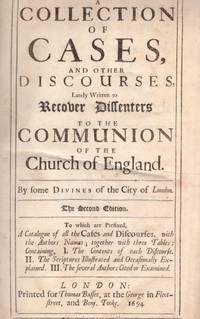
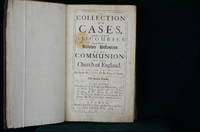
169435368London: Printed for Thomas Basset at the George in Fleet-street and Benj. Tooke 1694. The Second Edition. Hardcover. Fair. Folio. 15 16 pages xxxvi 17-512 pages. Marbled paper covered boards with leather corners. Binding is in poor condition. No spine. Both covers are cleanly detached. Text is lightly damp stained in front. Occasional light foxing to the contents. An ink or other brown stain at the top edge of pages 340-470. Ex-institutional copy with partially removed label on the front paste down and a blind perforated stamp on the title page - "Philadelphia Divinity School. Printed for Thomas Basset, at the George in Fleet-street, and Benj. Tooke hardcover
16948438Printed for Thomas Basset at the George in Fleet-street and Benj. Tooke. 1694. Hardcover. folio 32 cms 12.5 ins x 20 cms 7.8 ins xxx1-16xvii-xxvi17-220221-507vpp there is some irregular pagination in gathering "Ii" however the text is complete and in correct order the catchwords corresponding throughout the entire work; contemporary calf rebacked with blind tooling corners carefully restored binding very firm; some marginal worming a few water stains last few leaves dusty at top a couple of marginal tears not affecting text however the text is overall very clean book overall very good. Notes: Makeup: front free endpaper followed by 3 unsigned leaves title page dedication page "Catalogue of all Cases" then Signatures: a-c4 B-E2 f-h4 G-Z4 A2-Zz4 Aa2-Xxx4 followed by 2 leaves "A table of Texts of Scripture" and "Table of Those Authors Who are Cited in this Book" and a final free endpaper. Provenance: "The Hope Trust" Edinburgh. English Dissenters: Protestant Christians who disagreed in opinion belief and other matters and separated from the Church of England in the 17th and 18th centuries. Many emigrated to the "New World" especially to British colonies the Thirteen Colonies on the Atlantic coast of North America and also to Canada. It is considered by many that English dissenters played a key role in the spiritual development of the United States. This spirit of independence initially born of the determination to achieve independence in conduct of religious observance gave rise eventually to the American Revolutionary War of 1775 and subsequent independence in 1776. Wing 5116 Printed for Thomas Basset, at the George in Fleet-street, and Benj. Tooke. hardcover
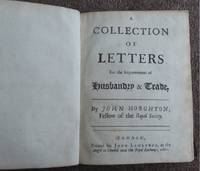
168152963<p>London printed for JOHN LAWRENCE at the Angel in Cornhill near the Royal Exchange 1681. VOLUME 1 ONLY The first trade & agriculture periodical in England 1681 complete with all 15 parts VOLUME 2 which is missing had six parts no more published. Although the title page is dated 1681 each issue has a separate imprint the last number 15 is dated 1683. Small 4to approximately 190 x 140 mm 7½ x 5½ inches pages: title page 1-184 bound in contemporary sheep rebacked with paler leather 2 black leather gilt lettered labels and gilt pattern dots to spine 2 bookplates of previous owners. Binding rubbed and lightly scuffed corners slightly worn 1 with small repair occasional pale age-browning strip of browning to edges of pastedowns and endpapers "Winchilsea" in old ink to top of first page free endpapers slightly chipped at edges otherwise a very good copy. Part 12 has a chapter by JOHN EVELYN pages 127-136: An Account of bread from the Learned John Evelyn Esquire; Entituled Panificium or the several manners of making Bread in France. Where by universal consent the best Bread in the World is eaten: Benit O Brioche Household-Bread Mountrau D'Esprit D'Citroville D'Cousin. Pages 35- 38 mention the Plantations in America. Part 14 pages 163-167 "An Experiment of the Ingenious Mr. John Worlidge for improving and Fyning of Syder" fining of cider; No.15 consists of lists of imports exports and ship movements in and out of London from Feb. 1683-March 1684; Other chapters History of Malting and the Method of making Malt; Improving Land by Marle; Some Account of the Plague 1665; The Manner and Advantage of Planting Liquorice; A Catalogue of the Books in the Library of the Royal Society relating to Agriculture; articles on trade agriculture the poor Ireland and all kinds of grain etc. See: Geoffrey Keynes John Evelyn A Bibliography of his Writings pages 261-62 No. 127; Mary Aslin Catalogue of the Printed Books on Agriculture 1471-1840 page 64; Forum Auctions lot 373 11th July 2018; Fussell 1523-1730 pages 81-82; Donald McDonald Agricultural Writers 1200-1800 pages 122-124; Catalogue of the Goldsmiths Library of Economic Literature Volume 1 page 140; The Kress Library of Business and Economics page 86 No. 1538; ESTC P2335. MORE IMAGES ATTACHED TO THIS LISTING ALL ZOOMABLE FURTHER IMAGES ON REQUEST. POSTAGE AT COST AND ALL PARCELS SENT FULLY TRACKED AND FULLY INSURED.</p> London, printed for JOHN LAWRENCE, at the Angel in Cornhill near the Royal Exchange, 1681. hardcover
16841397186London 1684. Fourth Impression. Hardcover. Quarto 14 65 68-182 193-374 173-178 379-406 12 pages. In Good minus condition. Bound in full brown leather with blind tooling to boards. Paneled spine with faded label and loss of leather along the head/tail loss of endbands and cracking along the joints. Pieces of leather torn away from the boards significant chipping and bumping to corners resulting in exposed boards. Front board is detached from spine and rear board is partially detached from spine. Textblock has light plus age toning stains impacting text on page 238-239 and soiling scattered throughout. Text in English and Latin. Shelved in Room A. 1397186. Special Collections. hardcover
1698GD013104BC10S3London: Ri. Chiswell 1698. London: Ri. Chiswell at the Rose and Crown in St. Paul's Church-Yard 1698 second edition corrected 8vo. 652 pages. Book bound in original brown blind stamped boards spine rebacked with 4 raised bands and black leather title author and date labels on spine. Small bookplate on verso of front board. Book overall very good condition. Second Edition Corrected. Hard Cover. Very Good/No Dust Jacket. 8vo - over 7¾" - 9¾" tall. London: Ri. Chiswell Hardcover
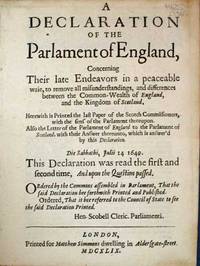
164929369London: Printed for Matthew Simmons dwelling in Aldersgate-street 1649. 1st edition issue with 'Parlament' Wing E-1498 noting "Part of E1505". Disbound with leather remnants to spine. Age toning to text block edges. A VG copy. 2 12 - 28 = 18 pp. P. 13 misnumbered as p. 12. Printed glosses to pp 19-20. Headpieces. Decorative initial capital letters. 4to: 2 C-D3 -D4 a blank. 6-7/8" x 5-1/8" <br/><br/> Printed for Matthew Simmons dwelling in Aldersgate-street hardcover books
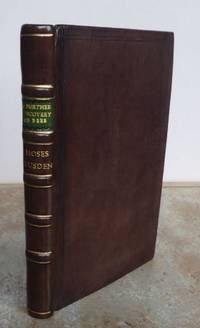
167952434<p>London printed for the author and are to be sold at his house next the sign of the Kings Arms in the Bowling-Alley near the Abby in Westminster: and by Henry Million bookseller at the Bible in the Old-Bayley 1679. TITLE CONTINUED: Also proper directions to all such as keep bees as well to prevent their robbing in straw-hives as their killing in the colonies. By Moses Rusden an apothecary; bee-master to the Kings most excellent Majesty. Published by His Majesties especial command and approved by the Royal Society at Gresham Coll. FIRST EDITION 1679. Small 8vo approximately 170 x 95 mm 6½ x 4 inches engraved frontispiece by Henry Million 3 folding plates pages: 24 1-144 last page blank rebound in full modern calf gilt lettered green label author's gilt name and gilt rules to spine between raised bands new brown endpapers. Neat vertical repair to inner margin on blank side of frontispiece with pale browning to foot title page and frontispiece lightly dusty old ink name to top of title page 2 outer margins neatly replaced 1 outer margin slightly trimmed varying pale brown staining some with tide mark to lower part of pages 81-100 all text legible see attached images 1 corner neatly repaired pale age-browning to margins a few margins lightly soiled not affecting text old ink stain to first pastedown and small ink splash to last free endpaper 2 leaves lightly dusty. A good copy with some minor repairs and staining. Moses Rusden was appointed Beemaster to the King at the instigation of John Evelyn who had a copy of this title in his library. Rusden firmly believed that a hive was led by a King and not a Queen. In 1679 Rusden improved Geddie's hive and put a frame in it for the bees to fasten their combs upon. See: British Bee Books A Bibliography 1500-1976 page 61 No. 55; Walker Catalogue of Bee Books page 61; Geoffrey Keynes John Evelyn A Study in Bibliophily page 300 No. 83; ESTC R11920. MORE IMAGES ATTACHED TO THIS LISTING ALL ZOOMABLE FURTHER IMAGES ON REQUEST. POSTAGE AT COST.</p> London, printed for the author, and are to be sold at his house next the sign of the Kings Arms in the Bowling-Alley, near the hardcover
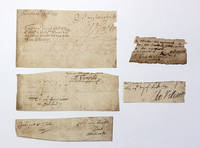
1650031291UK 1650. First Edition . Paper. Very Good. 48mo - over 3" - 4" tall. A group of 5 Ink Signatures of Royalist soldiers who fought in the 1st Civil War. They include 2nd Viscount Molyneux of Maryborough George Monck 1st Duke of Albemarle Sir William Compton General William Legg; Edward Villiers and Guilford Slingsby. Dated between 1640/1680. All removed from various paper documents and comprising signatures of: Richard 2nd Viscount Molyneux of Maryborough c. 1617-1654 'R. Molyneux' signed at the foot of a small piece with text in another hand being a list of supplies and countersigned by Corporal Griffith Standen; George Monck 1st Duke of Albemarle 1608-1670 'Albemarle' on an irregularly trimmed piece dated 4 February 1660; Sir William Compton 1625-1663 'W. Compton' written at the foot of a possible autograph sentiment sent to General William Legg; Edward Villiers 1620-1689 'Edw. Villiers' on a small piece dated 29 April 1680; Guilford Slingsby 1610-1643 'Gylf. Slyngsby' on an irregularly cut piece with autograph sentiment 'your loving friend' Richard Molyneux 2nd Viscount Molyneux of Maryborough about 1617-1654 was a Royalist officer in the English Civil War. Molyneux was present at the siege of Manchester in September 1642 and on 20 April 1643 was defeated by Captain Ashton at Whalley. After the surprise capture of Wakefield on 21 May 1643 the Earl of Derby being then with Queen Henrietta Maria at York Molyneux was ordered to conduct the Lancashire forces thither. He was defeated on 20 August 1644 by Major-general Sir John Meldrum at the battle of Ormskirk and narrowly escaped capture by hiding in a field of corn. He was at Oxford on 24 June 1646 when the city surrendered to the Parliament. George Monck 1st Duke of Albemarle 1608 -1670 was an English military officer and politician who fought on both sides during the Wars of the Three Kingdoms. A prominent military figure under the Commonwealth his support was crucial to the 1660 Stuart Restoration of Charles II. Sir William Compton 1625 - 1663 was an English royalist army officer. He earned the name of the "godly cavalier" in 1648 from Oliver Cromwell for his conduct at the siege of Colchester. William Legge 1608 - 1670 was an English army officer and politician who was a close associate of Prince Rupert of the Rhine. On the outbreak of the First English Civil War Legge joined the king's army and was taken prisoner in a skirmish at Southam Warwickshire on 23 August 1642. Committed by the House of Commons to the Gatehouse Prison he escaped about 4 October 1642 and rejoined King Charles at Oxford. Henceforth he closely attached himself to Prince Rupert and was wounded and again taken prisoner while under his command at the siege of Lichfield in April 1643. At the Battle of Chalgrove Field on 18 June 1643 he was temporarily taken prisoner on the field. After the first Battle of Newbury 20 September 1643 the king presented him with an ornate hanger and wanted to knight him. On 19 May 1644 Prince Rupert appointed him temporary Governor of Chester. Guilford Slingsby 1610-1643 was a member of the Yorkshire gentry who was confidential secretary to Thomas Wentworth 1st Earl of Strafford and present during the trial which ended in his execution in April 1641. Slingsby sat in the Parliament of Ireland as Member of Parliament for Carysfort from 1634 to 1635 and during Strafford's period as Lord Deputy of Ireland was appointed to several administrative posts. When the First English Civil War began in August 1642 he raised a regiment for the Royalist army in Northern England; he was badly wounded in a skirmish near Guisborough on 16 January 1643 and died three days later. Some occasional spotting age toning and paper sizes 11 x 18.5 cm and smaller. Ref19239 <br/> <br/> unknown
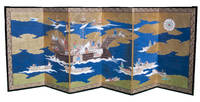
1700ABC_49540Japan 1700. 104 x 272 cm each illustrated panel: ca. 90.5 x 44.5 cm. Ink watercolours gold paint and gold leaf on paper. The image is surrounded by a frame of silk brocade a narrow frame in burgundy and gold and a wider frame in yellow gold and black with a clear floral pattern; together the frame is 5 cm wide the whole is mounted on six roiro black lacquered wood panels with gilt metal fittings on the outer corners of the outer panels. The panels are backed with decorative paper. A remarkable example of a Nanban byobu literal translation: Southern Barbarian screen a type of Japanese folding screen byobu depicting the arrival of Europeans especially the Portuguese in Japan during the late 16th- and early 17th centuries. It shows the vast expanse of the Portuguese seaborne empire. From their possessions along the coast of the Indian subcontinent and their lease of Macau individual Portuguese reached Japan in 1542 and were followed by traders and missionaries the most famous being Francis Xavier. Nanban art provides a unique glimpse into a period of significant cultural exchange and the Japanese perspective on the arrival of the Portuguese in their islands. While inspired by the arrival of and trade with the Portuguese in Japan before the enforcement of the isolationist foreign policy commonly known as Sakoku by the Japanese Tokugawa shogunate from 1633/1639 onwards it remained a popular subject to depict on these folding screens and in other artworks during the Edo period and beyond. The image on the present folding screen shows a large four-masted ship probably approaching the port of Nagasaki. Crew members both Portuguese and people from Portuguese possessions in the Indian subcontinent are seen furling the sails and performing remarkable acrobatic feats in the ship's rigging. The artist emphasises the balloon-like bagginess of their bombacha trousers typically associated with the Portuguese and other Europeans but focuses also on distinctive details such as heavy gold necklaces facial hair hats capes frilly white handkerchiefs and ruffled collars. The foreigners are depicted as being exotic but not scary or very "other" they are depicted as being different while still simply being human. The decoration and colours of the flags flown at the top of each mast are reminiscent of Christian symbols the Cross of Christ and Portugal's colours green and red. Cargo and passengers are offloaded into small boats that pull alongside the ship the top right corner shows a 12-point wind rose including a depiction of the globe. The whole scene is enschrouded in gold clouds.After the Sengoku period a period of practically consecutive and almost continuous civil wars and social upheavals in the 15th- and 16th centuries Japan entered a more peaceful and prosperous period. Folding screens such as the present example were used to divide larger homes and generally show of the growing wealth and prosperity of the warrior and merchant classes. The screens are finely executed in detail and using vibrant colours and copious amounts of gold paint and/or gold leaf. Thematically the painting here continues a tradition of now-lost screens of Chinese trade ships that were in vogue during the 15th- and 16th centuries at the peak of the Sino-Japanese tribute missions that brought entourages numbering in the thousands from the Ming court. The precise subject of these paintings had since shifted from Chinese trade ships to Chinese- or more general Southeast Asian-style ships carrying European including men from the European possessions in Africa and Asia crews. The scene illustrates the dynamic convergence of Eastern and Western cultures through trade around 1600. Portuguese traders first arrived in Japan in 1543 and by 1570 they had established the Bay of Nagasaki as a strategic hub for their commercial operations which were largely unregulated. They generated significant profits by exchanging Chinese silk for Japanese silver although some European goods were also part of the trade. The Portuguese carracks massive three-decked vessels weighing up to 1600 tons captivated local observers with their impressive scale unfamiliar crews and exotic cargo.Alongside these traders Jesuit missionaries sought to spread Christianity finding particular success in Kyushu where many local daimyo converted. However a Christian-led rebellion in 1638 alarmed the Tokugawa authorities raising fears of European colonial interference. As a result the Portuguese were expelled in 1639. When a Portuguese delegation attempted to restore diplomatic relations the following year all sixty members were executed. In 1640 the shogunate instituted a policy of national seclusion restricting foreign contact to limited trade with Chinese merchants a small number of Dutch traders and occasional Korean envoys. By 1650 Christianity was outlawed and any missionary work was punishable by death. The present screen is a slightly later example and the focus of the scene lies mostly on trade and the ship's crew itself and not directly on any Christian identity of the foreigners arriving on Japanese shores.This screen belongs to approximately ninety surviving Nanban screens ranking second only to capital city scenes in popularity among Japanese patrons. The earliest examples date to the 1590s and their continued production throughout the Edo period demonstrates the lasting impact of the Portuguese encounter on Japanese culture.Some minor flaking of the gold paint/gold leaf barely any soiling the decorative paper back of the work shows some traces of wear and use. The image remains clear and the colours vibrant. Overall in very good condition. This exceptional screen offers collectors an important historical document that captures both Portuguese maritime exploration and the Jesuit mission to Japan-a unique period of cultural exchange between East and West. unknown
1679Ant61051679. Holles Denzel Modern blue quarter leather. Engraved frontispiece. Wing H2461a hardcover
1690500033258London: Randolph Taylor 1690. First Edition. . Paperback. Good. disbound pamphlet. A half title Title page Dedication & 24pp <br/> <br/> Randolph Taylor paperback
16702080502106917709Not Available 1670. Soft Cover. Fine. The book is in fine condition. Not Available paperback
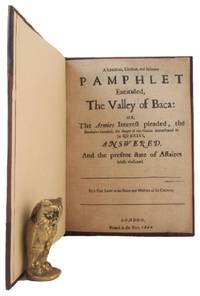
1660169785London: no publisher 1660. And the present State of Affaires briefly Vindicated. By a True Lover to the Peace and Wellfare of his Country. Pp. 16 decorative headpiece; small f'cap 4to; bound in twentieth century half calf spine lettered in gilt brown cloth boards faintly marked; bookplate of David Levine Sydney on upper pastedown small chip to top edge pp. 5/6 the letterpress sometimes slightly crooked a little faint soiling; London 1660. Wing S815; ESTC R203483. The text is a reply to an untraced work by a 'Querist' who presumably was not in favour of the Restoration. He is described on the final page as 'no friend to God his King or Country in regard that he in a clandestine way. hath published such a wicked Paper tending to beget and foment Fears and Jealousies in His Majestie's subjects by Reflecting upon Public Actions to put all in a flame and disturbance out of which the Nations through the goodness of God lately have been delivered'. The Thomason copy of this pamphlet is annotated 'July 25' which is two months after Charles II landed at Dover from the Netherlands. no publisher unknown
1697PP2215Th. Parkhurst 1697. No ownership marks. Very scarce: one copy on Copac. Small square 8vo 13.5 x 18cm attractively rebound in recent blue limp cloth gilt title to front cover. Paper lightly browned. Dedicated to Sir Henry Ashurst merchant Member of Parliament and influential presbyterian. ~Robust packaging. Paperback. Paperback. Very Good. iv 28pp. Th. Parkhurst Paperback