81 résultats
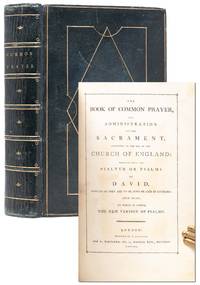
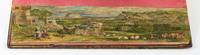
1788ST19954London: Printed for the Author and sold by Edwards in Pall Mall; Also by Edwards's in Halifax 1788. FIRST EDITION quarto issue with the etchings printed directly above the text. 257 x 205 mm. 10 1/8 x 8 1/8". iv 27 1 pp. 25 leaves; 11 1 pp. 25 leaves. Two parts bound in one volume. <br/> HANDSOME ORIGINAL ESTRUSCAN CALF BY EDWARDS OF HALIFAX covers with central panel of tree calf enclosed by a gilt Greek key border and a frame of stenciled dark brown palmettes on light tan calf this surrounded by graceful gilt ivy roll on dun-colored calf all within a gilt pentaglyph-and-metoped border smooth spine divided into panels by strips of inlaid black morocco tooled with gilt Greek key roll panels with inlaid central oval medal featuring an Etruscan vase calligraphic gilt flourishes at corners black morocco label bright pink endpapers all edges gilt expertly rebacked preserving original spine. WITH A FINE BRIGHTLY COLORED FORE-EDGE PAINTING OF THE CRAIGMILLAR CASTLE RUINS WITH EDINBURGH IN THE DISTANCE. WITH 50 ENGRAVED VIGNETTES 60 x 85 mm. of the ruins of Scottish castles and abbeys. A Large Paper Copy. Front pastedown with engraved armorial bookplate of Christopher Turnor Stoke Rochford Library. Lowndes 370; ESTC T153718 but with a variant title page. Front cover with a couple small areas of lost patina from insect activity rear cover just slightly marked upper corners a bit bumped faint freckled foxing in the margins more noticeable on the first two leaves slight offsetting of engravings on facing blank versos. A few condition issues but still a very attractive book the lovely binding retaining virtually all of its antique appeal and the contents with nothing approaching a significant problem.<br/> <br/> This is an excellent atypically large example of an Edwards of Halifax binding enhanced with a most appealing early fore-edge painting depicting one of the castles pictured in this attractive quarto edition. Scottish surgeon and antiquary Adam de Cardonnel 1746/7 - 1820 wrote and illustrated the present work "to preserve from oblivion the ancient remains of Caledonian splendour." Originally intended as a supplement to the popular "Pennant's Tour" of Scotland it appeared in four parts the first two in 1788 in a few different forms including an octavo edition and the second two published in 1793. The fore-edge painting features Craigmillar castle a Medieval fortress located a few miles from Edinburgh whose most famous guest was Mary Queen of Scots. One of her stays resulted in the so-called "Craigmillar bond" which set in motion plans to dispatch Mary's husband Henry Stuart. By the late 18th century the castle had fallen into disrepair and it appears in the present painting as an idyllic ruin with sheep and cows grazing in the fore-ground and the city with Edinburgh Castle rising in the distance. The Edwards of Halifax bindery was founded by William Edwards 1723-1808 and continued by several of his brothers half-brothers and sons by far the most important of the sons being Thomas who lived from 1762-1834. This famous firm produced a number of important innovations in binding design the most significant being the idea of concealing a painting under the gilt of the fore edge. This hidden treasure could be revealed once the edge was fanned out as a special surprise element of the volumes the Edwards firm bound--typically in Etruscan calf as here or in their patented transparent vellum. Although bindings produced by the Edwards workshop are almost never signed the present item is surely Edwards' work as indicated by the characteristic binding style and by the fact that our volume was actually sold by the Edwards firm. As usual there is no clear way to assign a precise date to the painting; while it is not done in the soft grays that can be firmly associated with the earliest Edwards examples it clearly is a painting done before 1850. While fore-edge paintings likely produced at the Edwards bindery and especially produced by their imitators appear in the marketplace with some regularity most offered are octavo or duodecimo in size. Of the fore-edge paintings attributed to Edwards of Halifax that have appeared in RBH over the past 65 years fewer than one in 10 were on quarto volumes. This copy was previously owned by the MP Christopher Turnor 1809-86 a member of the House of Commons and owner of more than 20000 acres in Linconshire where he built the grand Stoke Rochford Hall. Printed for the Author, and sold by Edwards, in Pall Mall; Also by Edwards's, in Halifax unknown
17922110502150906716Not Available 1792. Soft Cover. Fine. Number of books: 1 width Not Available paperback
17926999London: Printed by T. Davidson for L. Wayland 1792. First thus. Near Fine. Handsomely bound in contemporary full dark blue straight-grained morocco. Small quarto 250 x 155 mm. collating complete with thirteen fine engraved plates including frontispiece. Geometric gilt design to boards gilt spine with five raised bands and turn-ins with gilt floral roll. With a very fine double fore-edge painting by Martin Frost. The painting which fans open to 4 in. 100 mm. captures two views: the first is of the Cantebury and Salisbury Cathedrals and the second of Westminster Abbey and Chester Cathedral. A Near Fine copy clean and bright throughout with just a bit of edgewear and some foxing to versos of plates. In a custom silk-lined dark blue linen clamshell case with gilt-lettered leather spine label.<br /> <br /> Martin Frost is a master craftsman who was awarded the MBE in the New Years Honours list in 2019 for his work to preserve the art of fore-edge painting. This lovely colorful double-view example demonstrates the height of his skill as an artist presented here on an attractively printed and elegantly bound volume. Near Fine. Printed by T. Davidson for L. Wayland unknown
179471006hLondon: T. Cadell Junior and W. Davies 1794. Book. Fine. Hardcover. 12mo - over 6¾ - 7¾" tall. Contemporary full gilt crimson straight-grain morocco with gilt edges and marbled endpapers. With a hidden fore-edge painting of a marine scene of the Cromer seashore. Mild scuffing and toning to covers. Contemporary and early owners' names to front fly-leaf. Otherwise clean tight and unmarked. Very neat -- a sound and handsome copy. With custom crimson quarter-morocco slip-case and chemise. T. Cadell, Junior, and W. Davies Hardcover
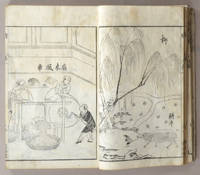
1735911581735. ZUE TOKAI åœ–æœƒå®—å½ SOU-I 7 vols in one. Edo Suharaya Shimbei Kyouho 20 1735. Oohon 27.0 x 17.5 cm. Originally published as a series of artists's guides in a set in China in 1607 it was redone in Japan in 1702 then reprinted as here in 1735. Like the HASSHU GAFU å…«ç¨®ç”»èœ it had a large influence in Japan particularly on Nanga style artists. Everything human animal and vegetable is rendered in beautiful sumi-e woodblock prints. There are extracts from classic Chinese texts on painting technique going back centuries. A vade mecum for the Edo artist interested in the techniques and theory of Chinese painting. The seven volumes of the original are here rebound into a single volume with the original worn cover and title label. This gappon volume is complete and has been cleaned internally to neutralize staining. There are some pages that remain stained but the book is still a remarkable work which is quite scarce. Most copies referenced online are incomplete or microfilmed. See Mitchell 566 for his information on the original Chinese edition. It should be noted that the copy he saw of the Genroku 1702 edition was incomplete. Not a common set. Mitchell misreads ZUE as ZUKAI in the title. unknown
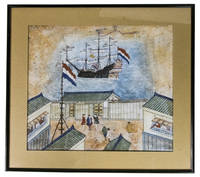
1800ABC_48559Japan 1800. In a passepartout and framed. Drawing size ca. 34 x 39.5 cm; frame size ca. 46 x 51 cm. Oil painting on leather. Late 18th-century painting on leather depicting everyday life on the island of Deshima in Japan created by an anonymous artist who seems to be of Japanese origin possibly originating from the Nagasaki school of painting: the faces of most human figures show remarkable Japanese features despite their reddish-brown hair and Dutch clothing.Judging by a woodcut map of Deshima published in 1780 by Toshimaya Bunjiemon the south-eastern part of the island is shown in the present illustration. On the left the warehouse masters residence next to a tall flagpole with the Dutch flag at top; in the centre the important watergate through which cargo was brought in via ship with four Dutch merchants one seen from behind and two Javanese servants in front of the gate; on the right the warehouse "De Lelie" The Lily. In the background lying in the bay of Nagasaki a Dutch three-master has been depicted with fourteen hoisted Dutch flags and several sailors on deck and in the rigging. This ship closely resembles a transom return ship in Dutch: "spiegelretourschip" which was used by the Dutch East India Company VOC during its whole existence.Based on the depicted style of clothing of the Dutch merchants we assume that this painting could have been made during the second half of the 18th century.The artificial island of Deshima was a small fan-shaped island used as trading post initially by the Portuguese until 1639 and subsequently by the Dutch from 1641 until 1858. During the Tokugawa Shogunate the military government of Japan in the Edo period of 1603-1868 foreigners were not allowed to enter the Japanese territory and the island of Deshima was the only place where initially only the Portuguese and later only the Dutch were admitted.With some flaking of the paint off the leather slightly affecting the image but mainly affecting the upper outer corners. Otherwise in good condition.l H. Paul Nederlanders in Japan 1600-1854. De VOC op Desjima pp. 106-107. unknown