1 239 résultats
1867670281 brochure in-8, E. Dentu, Paris, 1867, 48 pp. avec 2 planches hors texte (portrait et eau-forte de Maneet d'après Olympia)
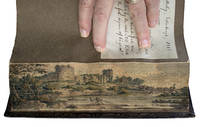
1813FF2499Edinburgh:: John Ballantyne 1813. 1813. 4to. x 330 cxvi pp. Original olive green straight-grain morocco gilt-extra with alternating pattern of ovals and feathers raised bands all edges gilt BOUND BY TAYLOR & HESSEY London with their gilt-stamp on the outer fore-edges of the upper and lower cover as is common with their stamps. Near fine. ". . . BOUND UNDER THE DIRECTION OF SIR WALTER SCOTT HIMSELF": Manuscript note found within this copy: "Sir Walter Scott's Rokeby Edinburgh 1813. Original edition green morocco. This precious volume was bound under the direction of Sir Walter Scott himself transmitted to the binder by John Ballantyne the publisher; the edge when bent discloses a wonderful view of Rokeby corrected in pencil: Barnard Castle painted by the celebrated Patrick Nasmyth 1787-1831 when in the full rigor of his great artistic talent." – THIS MUST BE THE TAYLOR & HESSEY PAINTER his work is profoundly similar to this artist especially when considering his expert use of creating depth in a painting plus his preponderance of thick dense trees that are painted with remarkable detail unlike other fore-edge painters. This is an extremely rare example of the actual artist's name being mentioned. This is a choice example of a Taylor & Hessey binding with their exquisitely painted fore-edge painting the binding being signed in the usual way from this bindery. Of all the Taylor & Hessey specimens I have examined this is the first to mention the artist's name. The added association with this being a quarto volume not the more typical and cheaper octavo and that Sir Walter Scott's name is associated with the design of the binding suggesting also the fore-edge painting this is something quite unique. John Ballantyne, 1813. hardcover
181910-G1819. Öl, auf festem braunem Papier, verso signiert und datiert ?M. Wentzel ad. natur. Wien 1819.?. 25:34,6 cm. Das in einem delikaten Kolorit und einer fein ausgewogenen Lichtführung gestaltete Stilleben entstand während Wentzels Aufenthalt in Wien, der durch die Datierung auf der Rückseite des Bildes sicher für 1819 angenommen werden darf.
18542092902144201618Not Available 1854. Soft Cover. Fine. The book is in fine condition. Not Available paperback
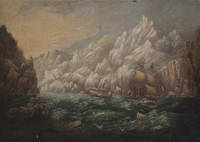
1850C79DXBHARQJQEngland 1850. Later mounted on another canvas and stretched over a wooden frame with a handwritten note about the painting pasted on the back. Oil painting on canvas 65.5 x 91 cm showing 2 ships in a rough sea amid dangerous rocks and ice. A mid-19th-century oil painting depicting two ships 3-masted barks in a rough sea amid dangerous rocky and icy cliffs mountains and outcroppings. Pasted to the back is an old slip of paper with a note the parts of the text in parentheses are lost but have been filled in based on an earlier transcription: "The sailing ships 'Erebus' and 'Terror' passing through the Davis Straight in 1846 the 6 later "corrected" to 7. It was on this expedition that Sir John Franklin discovered the North West Passage and in which he lost his life". In fact Franklin sailed these two ships through Davis Strait in 1845 passed on through Lancaster Sound in search of a Northwest Passage and spent the winter on Beechey Island. In 1846 he and his expedition made their way through using the modern names Peel Sound and Franklin Strait into McClintock Channel where they got caught in the ice near King William Island. Most of the crew died there including Franklin in 1847. A few made it on foot to the mainland but were unable to reach any outpost. The last died in 1848. Since no one who saw the ships in these waters survived the anonymous artist who made the present painting appears to have turned to an 1847 painting of the same ships by John Wilson Carmichael in London though he did not copy it. Carmichael had earlier made a drawing of an expedition in search of the Northwest Passage by William Edward Parry who made three expeditions in the years 1819 to 1825 each with two ships but in 1847 he used parts of his existing Arctic scene as models for the composition of a new painting showing an Antarctic scene of James Clark Ross's voyage with the ships Erebus and Terror in 1842: "'Erebus' and 'Terror' in the Antarctic". Carmichael's drawing and painting survive at the National Maritime Museum in Greenwich. The central ship in the present painting follows that in Carmichael's painting quite closely and the second ship more distantly. The rocks and ice are similar in general appearance and arrangement but quite different in detail.With some restorations along the edges of the painting and a small scuffmark near the foot toward the left but generally in good condition.l Cf. Howgego 1800-1850 P9 R27 & F21. ABE CAT Alaska Canada & Greenland unknown
18292110502150906596Yamamoto-ya-ban 1829. Soft Cover. Fine. Number of books: 3 Yamamoto-ya-ban paperback
1885143011885. Iran Art Qajar School Lovers in Embrace gouache painting on paper nineteenth century represents the courtly aesthetic erotic refinement and dynastic visual language that defined Persian painting under Qajar rule. The composition situates a princely male figure and his adorned companion in intimate embrace reinforcing themes of aristocratic leisure romanticized sovereignty and elite identity in Qajar Iran. The work supports research in Persian court painting gender representation in Islamic art Qajar costume and regalia and nineteenth century Iranian material culture.<br /> <br /> Persian Qajar gouache on paper with gold illuminated border. Depicts a young prince wearing blue and gold coat and karakul headgear embracing female companion adorned with tiara and pearls. Floral and animal illuminated margins including deer and monkeys. Image size 18.5 x 11 inches.<br /> <br /> The prince's distinctive headgear confirms Qajar rather than Zand period attribution aligning the work with the heightened stylization and opulent textile rendering characteristic of nineteenth century Tehran ateliers. Comparable compositions appear in Qajar painting traditions associated with artists such as Mohammad Sadiq whose courtly embrace scenes similarly emphasize costume detail glassware and staged intimacy as markers of refinement. The illuminated border populated by floral and animal motifs situates the lovers within a cosmological and decorative framework typical of Qajar manuscript aesthetics adapted to single-sheet painting. Minor browning to margins and discreet restoration to verso margins not affecting image. Very good. A refined example of Qajar visual culture centered on dynastic elegance and performative intimacy. unknown
184202-G1842. Öl auf Leinwand, links unten signiert und datiert ?F.C. Kiaerskou 1842.?, verso bezeichnet ?i Noerheden af Inspruck F C Kiaerskou 1842.?. 34,5:49 cm. Mit Vergolderrahmen. Mit zwei kleinen Retuschen, sonst gut erhalten.
18242110502150903366Not Available 1824. Soft Cover. Fine. Number of books: 3 Not Available paperback
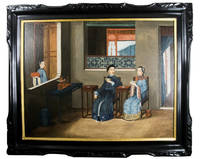
1820ABC_45805China 1820. 47 x 61 cm. picture; 61 x 74.5 cm. frame. Oil painting on canvas in a black lacquered Chinese export frame. An elegant interior scene from a Chinese Mandarins home in the early nineteenth century: a Manchu Mandarin and his consort taking tea in a domestic setting. He wears non-official semi-formal winter attire including rank badge sitting beside ahis beautiful Chinese lady surrounded by fine furniture and fittings. The whole scene reflects his good taste and social standing.Whilst tea had been the driving force of the China Trade since the early eighteenth century giving rise to export paintings illustrating its cultivation and production process the style and subject of the early export paintings was firmly rooted in traditional Chinese art and culture as in this delightful painting.l Cf. Choi Kee Il Tea and design in Chinese export painting in: The Magazine Antiques vol. 154 no. 4 October 1998. unknown
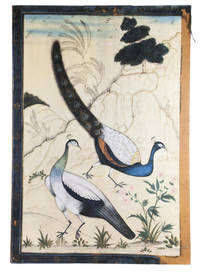
1900ABC_485731900. Ca. 107 x 74 cm. The silk canvas is mounted on a fibreboard panel of the same size. Painting on silk. Beautiful large and vibrantly coloured silk painting of a pair of peafowls painted after a watercolour attributed to the Mughal court painter Ustad Mansur master Mansur ca. 1590-1624. The intriguing work depicts a pair of peafowls in a rocky landscape. The peacock is captured in a natural pose running with a prey in its beak which draws the peahen's attention. The scene was most likely drawn from life. The peafowls themselves are painted in a Mughal fashion while the stylised background and floral border are reminiscent of Persian art. Unlike Mansur's watercolour which was painted on paper the present painted is painted on silk. It is also three times the size of Mansur's work.Mansur worked during what is considered the great age of Mughal art ca. 1580-1650 and was one of the favourite painters of Emperor Nuruddin Salim Jahangir r. 1605-1627. He received the rare title "Nadir-al-'Asr" unrivalled of his age from the emperor himself as he excelled in depicting plants and animals. Jahangir was particularly interested in nature and prided himself in being the first to direct artists to record it. And in this no one surpassed Mansur. He was known to paint birds and other animals unknown to the local population and is one of the very few artists to have painted a living dodo. His peafowl watercolour is one of the best known and most popular miniatures of the Mughal school.With holes and tears in the blue floral border and the peacock's tail the border is detached on the right side but still present a few small water stains on the left side and a trail of snail slime around the peacock's tail. Otherwise in good condition with colours that are still very vibrant.l Cf. MET SL.17.2011.36.1; Welch S. Imperial Mughal painting p. 91. unknown
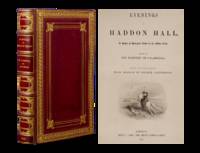
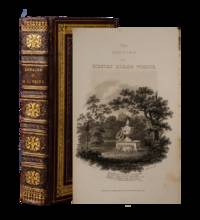
18486282London: Henry G. Bohn 1848. First edition. Octavo 8 5/8 x 5 5/8 inches; 219 x 143 mm. viii 1-453 1 blank pp. Engraved frontispiece engraved vignette title-page and twenty-four fine engraved plated by George Cattermole. Bound ca. 1910 by Rivière & Son in full maroon straight-grain morocco covers elaborately bordered in gilt and blind spine with five raised bands elaborately tooled in gilt and blind and lettered in gilt in compartments. Gilt-ruled board edges gilt decorated turn-ins pink endpapers all edges gilt. A very fine example with the remains of the bookplate of Frederick S. Peck and an old bookseller's descriptions on front paste-down. Housed in a felt-lined burgundy cloth clamshell case spine with leather label lettered in gilt. Fore-edge painting by Miss C.B. Currie depicting Haddon Hall. Together with a letter of authenticity from Jeff Weber and the original receipted invoice to Randall Moscovitz dated September 5 2012.<br /> <br /> Featuring a delicate fore-edge painting by Miss C.B. Currie "showing the dignity and grandeur of Haddon Hall. flanked by towering trees and beautiful greensward. Horses are being led to their stable by a groom and a mounted horseman can be seen in the middle distance talking to two young ladies" Weber. The artist Miss C.B. Currie Caroline Billin Curry 1849-1940 was one of the most beloved book painters of the 20th century who spent the majority of her career working for Henry Sotheran Booksellers in London. "She became famous for her miniature paintings applied to two art forms. First on ivory mounted on Rivière bindings and named by her employer as "Cosway" bindings. Later she expanded her work into the art of painting on the fanned edge of a book -- called a fore-edge painting. Most of these paintings were signed and numbered by the artist. Whereas fore-edge painting history is replete with unknown artists Currie is a notable exception. In the book world the name Miss C.B. Currie is widely recognized yet her personal life and real name remained guarded and unknown until now. It turns out her name was in fact partly a pseudonym. Though her work is highly prized there is no known published biography. Her correct full name was recently discovered to be Caroline Billin Curry. During her entire artistic career Curry used the slightly altered version of her name "Currie". Her true full name is not to be found in any published record of her work from Sotheran's" Weber.<br /> <br /> Although unsigned expert Jeff Weber firmly attributes the painting on this book to Miss C.B. Currie based on style and binding. He explains ". though unsigned and as such this is the only known book without a Currie signature but bears all the signs of having been painted by her. It is on the Rivière binding it lacks the usual "colophon" leaf seen with nearly all other Currie paintings. Currie painted both fore-edge paintings and Cosway miniatures on ivory both in bindings commissioned and bound for Sotheran's by Rivière and Son. There are Currie paintings on ivory that are datable to pre-1910 and yet they are not signed. Peck was an active book buyer during this same period his home and library was built in 1905 raising the likelihood that he bought a Currie fore-edge prior to her signing them" Weber. <br /> <br /> Provenance: Frederick S. Peck - Parke-Bernet Galleries November 14-15 1944 lot 114; G.J. Guthrie Nicholson Parke-Bernet Galleries November 8-9 1948 lot 231; Jeff Weber Rare Books - sold to Randall Moscovitz September 5th 2012. Frederick S. Peck 1868-1947 born in Providence Rhode Island became a Legislator and lived in Barrington R.I. His papers are located at the Rhode Island Historical Society. <br /> <br /> Weber Annotated Dictionary of Fore-Edge Painting 306. Henry G. Bohn unknown
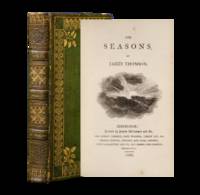
18096288Edinburgh: James Ballantyne 1809. Twelvemo 6 3/8 x 3 3/4 inches; 163 x 95 mm. iv i-xxii 2 contents verso blank 1-262 pp. Including engraved vignette title. Bound ca. 1809 in the style of or possibly by Taylor & Hessey. Full green straight-grain morocco covers elaborately bordered in gilt with gilt floral pieces. Spine with three wide raised bands decoratively tooled in gilt in compartments and lettered in gilt on the raised bands. Gilt decorated board-edges gilt ruled turn-ins marbled endpapers all edges gilt. Original booksellers printed ticket "Sold at/Barratt's Library./Bond Street Bath." on front paste-down. With a very fine contemporary fore-edge painting of 'Westminster Abbey from the River Thames' possibly by the Taylor & Hessey artist.<br /> <br /> Scottish poet James Thomson's The Seasons is a four-part pastoral poem inspired by Milton's narrative blank verse consisting of Winter 1726 Summer 1727 Spring 1728 and Autumn 1730. This edition brings all four together with a brief biography of the author. The poem would inspire painters and musicians including Gainsborough and Bach and would be translated into French and German; it was also at the center of in two legal disputes over publication copyrights.<br /> <br /> The firm Taylor and Hessey was at its height between 1808-1823 working in both publishing and fine bindings. Their work is usually identifiable from their use of colored Morocco and gilt-stamp name on the foredge of their book boards. Taylor & Hessey also employed a foredge painter whose identity remains lost but whose work predominantly features buildings and landscapes. Of the twenty-four books in American libraries studied by Weber only one exception can be found in the "copy of Mrs. Tighe's Psyche London 1811 on the fore-edge of which 'the Marlborough Gem' is painted" Weber. <br /> <br /> Provenance: Weber. 1001 Fore-Edge Paintings. Maine 1949. P. 151; Sold by Maggs of London to Mrs. Estelle Doheny June 7th 1949 her acquisition number " 6297" in ink on verso of rear blank leaf; Catalogue of the Books and Manuscripts in the Estelle Doheny Collection part III Los Angeles 1955. James Ballantyne unknown
18572110502150907243Sakana Ei-ban 1857. Soft Cover. Fine. Number of books: 1 Sakana Ei-ban paperback
18032110502150909027Noshiro Ryuko Engraving 1803. Soft Cover. Fine. Number of books: 1 Noshiro Ryuko Engraving paperback
18402110502150903194Not Available 1840. Soft Cover. Fine. Number of books: 1 Not Available paperback
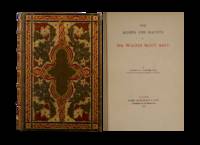
18976290Glasgow: James Maclehose 1897. Limited edition. Fine. Limited to 550 copies printed on Japanese vellum paper a Fine copy. Octavo 8 3/4 x 5 7/8 inches; 222 x 149 mm. i-xiv 2 map verso blank 1-216 pp. Twenty-four fine photogravure plates and seventy-two engravings in the text. Removed bookplate from front flyleaf. Bound ca. 1905 by Alfred De Sauty stamped in gilt on front turn-in. Contemporary full green levant morocco front cover elaborately decorated in gilt pointille and inlaid with Celtic strapwork and floral patterns in red brown and dark blue morocco's. Rear cover decoratively ruled in gilt with a central strapwork of red brown and dark blue morocco's. Spine with five raised bands elaborately decorated in gilt pointille and inlaid red morocco flowers. Gilt ruled board edges and turn-ins red morocco doublures and endleaves the doublures decorated with flowers in gilt all edges gilt. Spine very slightly faded front joint expertly and almost invisibly repaired. Housed in a felt-lined red cloth clamshell case spine with leather label lettered in gilt. <br /> <br /> A Superb Alfred De Sauty Arts & Crafts Binding with a fine triptych Fore-Edge Painting depicting three scenes from the text: "The Entrance to Milton Lockhart" page 142; "Norham Castle page 24; "Lasswade Cottage" page 33 and with fine gilt pointille work typical of the great Rivière bindings of 1905-1920. "The binding is signed on the leather front doublure. Even though the fore-edges are not signed no other person but the binder would have added paintings on the fore-edge of a special binding" Weber. <br /> <br /> The work of bookbinder Alfred de Sauty 1870-1949 is appreciated for its delicate tooling. Although little is known about his life he worked in both London 1898 to 1923 and Chicago 1923 to 1935. "For instance scholars are unsure whether when in London de Sauty worked independently for the firm of Riviere & Sons or both. While in London he may also have been a designer for the Hampstead Bindery and a teacher at the Central School of Arts and Crafts" Harvard as works he bound during this period are signed "de S" or "De Sauty.". De Sauty's career in Chicago working for the hand bindery of R. R. Donnelley & Sons is better documented; bindings made here use the name R. R. Donnelly. "He signed his work at the foot of the front doublure if present and at the center of the bottom turn-in of the front upper board if not" Harvard.<br /> <br /> Provenance: Ziern-Hanon Galleries Missouri 2009; Weber. Annotated Dictionary De Sauty 2. 2010. Fine. James Maclehose unknown
18222110502150901548Hanmoto fumei 1822. Soft Cover. Fine. Number of books: 3 Hanmoto fumei paperback
1830ABC_50486France 1830. 8vo ca. 19 x 14 cm. Half beige sheepskin and red leather-patterened paper sides. With 30 illustrations including 4 folding leaves with 3 illustrations each. 1 56 10 blank 2 pp. An early 19th-century French manuscript is an illustrated treatise detailing a wide range of painting techniques particularly those inspired by Chinese and Japanese practices applied to materials different materials including wood silk paper and lacquer. Likely composed in the 1830s-1840s by an anonymous but skilled artist it stands out for its practical depth and crisply coloured illustrations. Its portable fomat and carefully organised content including over a hundred indexed techniques suggest it was both a working companion and a repository of specialised artistic knowledge. Altogether it emerges as a testament to cross-cultural artistic exchange with 30 finely preserved colour plates.The spine and boards are somewhat stained and rubbed mainly around the edges and corners of the boards the inner front joint is slightly weakened. Each of the folding plates has a minor tear at the lower fold crease. The work is somewhat browned and slightly foxed throughout. Otherwise in good condition. hardcover
1830ABC_50486France 1830. Half beige sheepskin and red leather-patterened paper sides. 8vo ca. 19 x 14 cm. With 30 illustrations including 4 folding leaves with 3 illustrations each. An early 19th-century French manuscript is an illustrated treatise detailing a wide range of painting techniques particularly those inspired by Chinese and Japanese practices applied to materials different materials including wood silk paper and lacquer. Likely composed in the 1830s-1840s by an anonymous but skilled artist it stands out for its practical depth and crisply coloured illustrations. Its portable fomat and carefully organised content including over a hundred indexed techniques suggest it was both a working companion and a repository of specialised artistic knowledge. Altogether it emerges as a testament to cross-cultural artistic exchange with 30 finely preserved colour plates.The spine and boards are somewhat stained and rubbed mainly around the edges and corners of the boards the inner front joint is slightly weakened. Each of the folding plates has a minor tear at the lower fold crease. The work is somewhat browned and slightly foxed throughout. Otherwise in good condition. hardcover
18166287London: Longman Hurst Rees Orme and Brown 1816. Seventh edition. Two volumes bound in one. Octavo 8 3/8 x 5 1/4 inches; 214 x 133 mm. i-viii 1-376; i-viii 1-316 pp. Volume one with an engraved portrait frontispiece and additional vignette title; Volume two with an engraved view of the islet which he had often forded when the river was not knee-deep. Some offsetting from plates to title-pages. With a fine fore-edge painting ca. 1935 by Lyman Young depicting a typical English county fox-hunting scene with hounds and riders. The fore-edge is signed by Lyman Young on the final free-endpaper. Full contemporary maroon straight-grain morocco covers decoratively bordered in gilt spine with four shallow raised bands decoratively tooled and lettered in gilt gilt decorated turn-ins red paper endleaves. Minor repairs to the outer joints near the crown. Housed in a later red cloth slipcase. <br /> <br /> Lyman Young 1893-1984 was an American cartoonist trained at the Chicago Art Institute and based on California famous for his comic strip "Tim Tyler's Luck." According to Weber "Young knew Col. Don L. Wells who commissioned him to make fore-edge paintings possibly during the mid-1930s in Los Angeles CA. Young apparently did not supply title-labels but he did sign the books typically on the rear free endleaf facing the fore-edge. In 1940 he demonstrated painting on a fore-edge as part of the "Art in Action" project at the Golden Gate International Exposition Palace of Fine Arts." Annotated Dictionary of Fore-Edge Painting. There are eight examples of Lyman Young's Fore-Edge Painting in Weber's Annotated Dictionary including the present which is pictured in color and described thusly ". the artist offered a scene of fox hunting with the hounds and riders. Young wrote his name as per his usual style on the back inside leaf along the recto's edge using red colored paint: his name in capital letters." Annotated Dictionary of Fore-Edge Painting. A rare example of Lyman Young's work. Longman, Hurst, Rees, Orme, and Brown unknown
18642092902138300780Gun Takara Do 1864. Soft Cover. Fine. Size: 18cm Number of books: 4 Gun Takara Do paperback
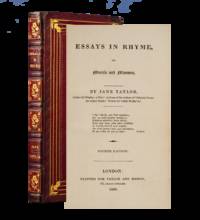
18206281London: Taylor and Hessey 1820. Fourth edition. A superb example. Twelvemo 6 3/8 x 3 7/8 inches; 162 x 98 mm. 2 blank iv 1-174 2 blank pp. Inscribed by the author on the first blank: "Wiggiston from J. Taylor." Bound ca. 1820 by Taylor and Hessey Booksellers London in full maroon straight-grain morocco. Covers decoratively paneled in gilt and blind spine with five raised bands decoratively tooled in gilt and blind and lettered in gilt in compartments decorative gilt board edges and turn-ins lilac endpapers all edges gilt. With a fine contemporary fore-edge painting by Taylor & Hessey depicting a view of Welbeck Abbey in Nottinghamshire. <br /> <br /> English novelist and poet Jane Taylor 1783-1824 perhaps better known for her collaborative authorship with her sister Ann was the voice behind "Twinkle Twinkle Little Star." Taylor's verses have been here delightfully bound by Taylor and Hessey. The Firm was at its height between 1808-1823 working in both publishing and fine bindings. Their work is usually identifiable from their use of colored Morocco and gilt-stamp name on the foredge of their book boards. Taylor & Hessey also employed a foredge painter whose identity remains lost but whose work predominantly features buildings and landscapes. Of the twenty-four books in American libraries studied by Weber only one exception can be found in the "copy of Mrs. Tighe's Psyche London 1811 on the fore-edge of which 'the Marlborough Gem' is painted" Weber. Here the fore-edge painting depicts the old Premonstratensian Welbeck Abbey in the Dukeries in North Nottinghamshire. The ancient monastery founded by Thomas de Cuckney in 1140 appears in the famous Domesday Book. Taylor and Hessey unknown
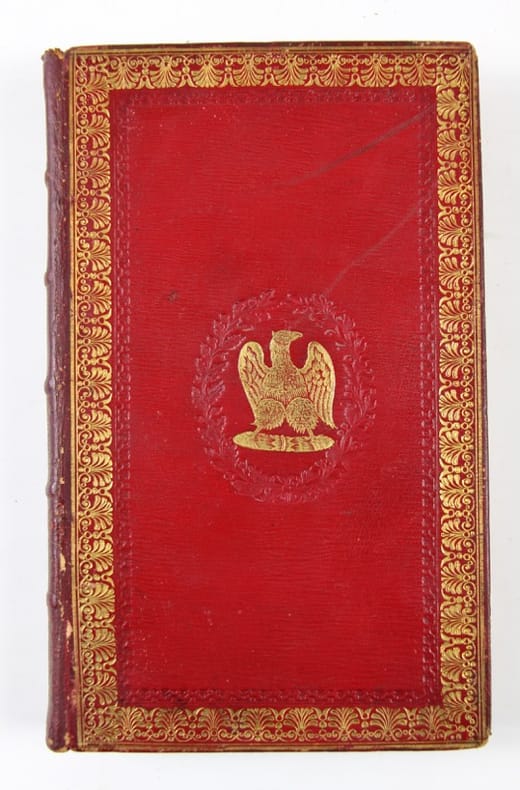
1815129304Bossange et Masson, 1815 19 volumes in-8, maroquin rouge a long grain, bordure doree et a froid, armes imperiales dorees au centre, dos orne des mêmes armes repetees, tranches dorées Reliure de l'époque. Nombreuses planches gravees hors-texte. Exemplaire relié en maroquin rouge à l’aigle impériale dorée ayant appartenu à Louis-Napoléon Bonaparte, alors President de la Republique, comme le signale une note manuscrite dans le premier volume : Cet ouvrage appartint à Louis Napoléon Bonaparte à present Président de la Republique francaise – C.S 1852 actuellement Empereur des français portant le nom de Napoléon III. Charles Paul Landon 1760-1826 collaborait à l'influent Journal des arts, des sciences et de la littérature. Il était également copropriétaire de la Gazette de France, où étaient publiés les comptes rendus détaillés des Salons annuels de Paris.
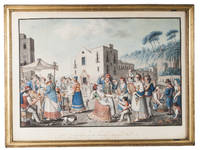
1817ABC_48010Southern Italy 1817. Gilded frame ca. 56 x 76 cm. Watercolour on paper ca 51 x 71 cm dated in the lower left corner. Beautiful vibrant watercolour painting of Southern Italian costumes. The work has been attributed to Luigi del Giudice active 1777-1816 as the style and subject matter are identical to his other work. The painting depicts the colourful traditional Italian dress worn at a local festival and shows the various activities the participants engage in including a traditional dance with castanets likely the Tarantella the sale of prints of the Madonna and child and eating local delicacies. The inscription below the painting mentions Sicily but the work probably depicts the Piedigrotta festival in Naples.Del Giudice was an Italian artist who was a student of painter Giacomo Cestaro 1718- ca. 1779 in Naples. He specalised in watercolours of costumes and festivals. The present work is part of a series of 5 paintings with similar scenes which can be found in multiple museums in Naples. Del Giudice's work is a good example of the Romantic movement popular in Europe at the time.The paper has small scratch marks in the top border and small dust particles in all borders without affecting the painted image. A few small parts of the frame have chipped off on the inner and outer edge and tape on the back. Otherwise in very good condition.l Thieme/Becker 14 p. 204. ABE CAT Art History ABE CAT Costumes & Uniforms unknown