51 890 résultats
- Boussod, Valadon & Cie, Paris s.d (1889), in-plano (41x59cm), en feuilles sous portefeuille de l'éditeur. - 15 lithographies d'après Degas [15 lithographs after Degas] Boussod, Valadon & Cie | Paris [1889] | folio (41 x 59 cm) | loose leaves under the publisher's portfolio First and only edition published of this remarkable set of 15 original lithographs from the post-impressionist painter George William Thornley, only 100 copies printed. Publisher's portfolio bound in boards very skilfully restored. 14 of the 15 lithographs are printed in colour (black, blue, green, mauve and different browns) on broadside China paper laid on pale blue thick paper, one is directly printed on thick paper. All except the last, bear the stamp of Thornley's signature with the words "Chez Mrs Boussod & Valadon - 19 Bd Montmartre" and "Imp. Becquet frères à Paris". "In 1888, George William Thornley was commissioned to produce a series of lithographs based on the works of Degas. These lithographs go well beyond the reproduction quality of the renowned publisher. They also demonstrate the high level of collaboration between Degas and Thornley. Thornley first selected the works to publish, made the necessary changes in the preparatory drawings and even interrupted the printing at times so that improvements could be made. "The importance of Thornley's engravings in Degas' work is particularly highlighted by the book dedicated to Degas by JS Boggs and published by the Metropolitan Museum of New York; a publication in which we find several of the engravings presented in the collection." (Chantal and Guy Heytens) We have only identified two copies in libraries: one in the Bibliothèque nationale de France and the other in the Institut national d'histoire de l'art. [FRENCH VERSION FOLLOWS] Édition originale et seule parue de cette remarquable suite de 15 lithographies originales du peintre post-impressionniste Georges William Thornley, imprimée à seulement 100 exemplaires. Portfolio cartonné de l'éditeur très habilement restauré. Quatorze des quinze lithographies sont imprimées en couleurs (noir, bleu, vert, mauve et différents bruns) sur papier de Chine volant appliqué sur papier fort bleu pâle, une seule est directement imprimée sur le papier fort. Toutes à l'exception de la dernière, portent le cachet de la signature de Thornley avec les mentions «?Chez Mrs Boussod & Valadon - 19 Bd Montmartre?» et «?Imp. Becquet frères à Paris?». «?En 1888, Georges William Thornley se vit passer commande d'une série de lithographies d'après les uvres de Degas. Ces lithographies vont bien au-delà de la qualité de reproduction de l'illustre éditeur. Elles démontrent aussi le haut degré de collaboration entre Degas et Thornley. Ce dernier sélectionna tout d'abord les uvres à éditer, effectua les changements nécessaires dans les dessins préparatoires et interrompit même parfois l'impression afin que des améliorations puissent être encore apportées. L'importance des gravures de Thornley dans l'uvre de Degas est tout particulièrement mise en lumière par l'ouvrage consacré à Degas par J.-S. Boggs et édité par le Metropolitan Museum de New York ; publication dans laquelle nous retrouvons plusieurs des gravures présentées dans la collection.?» (Chantal et Guy Heytens) Nous n'avons recensé que deux exemplaires en bibliothèque?: un à la BNF et un à l'INHA.
LCS-14866Superbe peinture chinoise en rouleau horizontal représentant le cortège d’un mariage luxueux. Chine, dynastie Qing, seconde moitié du XIXe siècle. S.l.n.d. [Chine, dynastie Qing, seconde moitié du XIXe siècle].Rouleau horizontal peint sur soie et papier traditionnel chinois. Encre de Chine et lavis coloriés. Baguette d’enroulement en bois sombre ornée d’une bande de soie bleue. L’axe central du rouleau a un diamètre de 2 cm environ. Couverture décorée de soie multicolore. Dimensions du rouleau : environ 3,85 m de longueur x 0,36 m de largeur.
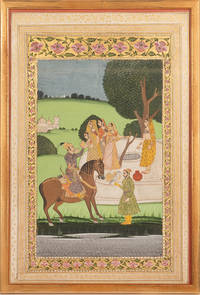
119661Mughal India possibly Murshidabad mid- to late-18th century. . Single miniature painting on card opaque pigments with gold depicting a scene with a Prince on horseback accepting a drink from a gold vessel from a village maiden miniature 282 x 179 mm full album page 394 x 255 mm; painting framed within multiple gilt rulings innermost frame painted with delicate pink and white flowers on a spiralling green vine set against a richly gilt background some very minor surface soiling overall in exceptionally bright and attractive condition framed and glazed.<br /> Scenes painted around imagined amorous encounters between the 'prince and village girl' were popular among artists during the late Mughal period in centres such as Delhi Lucknow and Murshidabad. The concept of 'love at first sight' was similarly echoed in the tradition of the courtly poets of the pan-European middle ages and can be seen echoed through their visual arts.<br /><br />The inspiration behind the theme in this painting was likely rooted in Persian literary sources the Nayrang'i Eshq The Charm of Love by Mughal Sufi poet Ghanimat Kunjahi d. 1695 AD being one such example. Written during a period of considerable Muslim-Hindu cultural interaction the poem was later absorbed into Sanskrit works and grew further in popularity. One notable section of the poem stanza 40.7 describes how in pursuit of a stag Shahid comes upon a village where he is struck by the sight of village girls at a well and is particularly struck by the beauty of Wafa the daughter of the village headsman see C. Shackle Persian Poetry and Q dir Sufism in Later Mughal India: Ghan mat Kunj h and his Mathnaw -yi Nayrang-i 'ishq in The Heritage of Sufism: Volume 3 Late Classical Persianate Sufism Boston 1999. <br /><br />In this painting a beautiful maiden leans across to offer the handsome stranger a drink from the well. Neither appears abashed and their eyes fix upon each other as if a spell has been cast. Of note is the way their hands come together around the vessel of water though they do not touch. The mono green background gives a prominence to this encounter watched by the other village girls. There are subtle details that give context to the scene the stranger's courtly attire and jewelled ruby dagger. His companion's falcon hints at their noble status. By contrast the village girl's sari is tied in the style of a working women as she draws water from the well. For notable examples see Indian Painting 16001870 Oliver Forge & Brendon Lynch New York 2012 and Painting 91 in Domains of Wonder B.N Goswamy & C. Smith 2006.<br /> Mughal India, possibly Murshidabad, mid- to late-18th century. unknown
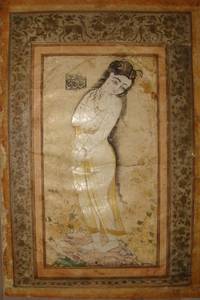
000588Painting. Very Good. No Binding. Signed by Illustrators. 8vo - over 7¾ - 9¾" tall. Central panel: 17.5x6.5 cm. Leaf: 24.5x16.5 cm. illustrated with animal and floral motifs. The portrait is tiny signed at the mid-right: "Raqm kamineh R.". Ink drawing with gouache embellished with gold on paper.
2110502150907600Hanmoto fumei N.A. Soft Cover. Fine. Volume: 1 Hanmoto fumei paperback
14301Iran Persian Qajar Lovers gouache painting on paper with gold illuminated border design. The image portrays a young Qajar prince in an elaborate blue and gold coat with an orange and gold karakul cap embracing his lover. The prince holds a glass in one hand while embracing his lover with the other. She with a tiara on her head pearls on her neck and a see-through blouse is wearing a Qajar coat with typical Persian paisley design. The lovers are seated in an embrace at a small table with crystal decanters next to them. This work composition is somewhat similar to the depiction of lovers embrace attributed to Mohammad Sadiq 1770-80 Layla Diba Royal Persian Paintings NY 1998 number 27 pg 156-7. The headgear of the prince confirms this to be from the Qajar epoch rather than the Zand period. Wide margins with floral and animal illumination including deer and monkeys. The illumination work is of a very high and intricate quality. Image size 18.5" x 11." Some browning to the margins minor expert repair not affecting image on verso in margin to fortify them. Overall in very good condition. An exquisite image with more sensibility than most other Qajar paintings. unknown books
1867670281 brochure in-8, E. Dentu, Paris, 1867, 48 pp. avec 2 planches hors texte (portrait et eau-forte de Maneet d'après Olympia)
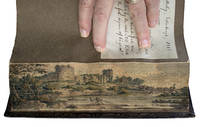
1813FF2499Edinburgh:: John Ballantyne 1813. 1813. 4to. x 330 cxvi pp. Original olive green straight-grain morocco gilt-extra with alternating pattern of ovals and feathers raised bands all edges gilt BOUND BY TAYLOR & HESSEY London with their gilt-stamp on the outer fore-edges of the upper and lower cover as is common with their stamps. Near fine. ". . . BOUND UNDER THE DIRECTION OF SIR WALTER SCOTT HIMSELF": Manuscript note found within this copy: "Sir Walter Scott's Rokeby Edinburgh 1813. Original edition green morocco. This precious volume was bound under the direction of Sir Walter Scott himself transmitted to the binder by John Ballantyne the publisher; the edge when bent discloses a wonderful view of Rokeby corrected in pencil: Barnard Castle painted by the celebrated Patrick Nasmyth 1787-1831 when in the full rigor of his great artistic talent." – THIS MUST BE THE TAYLOR & HESSEY PAINTER his work is profoundly similar to this artist especially when considering his expert use of creating depth in a painting plus his preponderance of thick dense trees that are painted with remarkable detail unlike other fore-edge painters. This is an extremely rare example of the actual artist's name being mentioned. This is a choice example of a Taylor & Hessey binding with their exquisitely painted fore-edge painting the binding being signed in the usual way from this bindery. Of all the Taylor & Hessey specimens I have examined this is the first to mention the artist's name. The added association with this being a quarto volume not the more typical and cheaper octavo and that Sir Walter Scott's name is associated with the design of the binding suggesting also the fore-edge painting this is something quite unique. John Ballantyne, 1813. hardcover
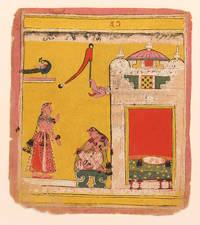
112940India Malwa circa 1630 AD. . Single leaf ink and gouache painting on paper image double-ruled and framed within red borders total leaf 200 x 175 mm; lightly faded with some chipping of paint with slight loss of pigmentation outer edges a little worn contemporary ink inscription to reverse in Sanskrit tipper-into card mount.<br /> Keshav Das d. 1601 was a renowned Indian court poet best known for the Rasikapriya which is considered a pioneering work of Hindu literature dealing with the classification of idealised types of male and female lovers nayakas and nayikas and their emotions and interactions. The work was compiled around the 1590s probably in Bundelkhand to the east of Malwa and the present painting is from a near-contemporary series of illustrations depicting scenes from the poems. Three leaves from the same series are housed in the Ashmolean Museum's collections these all dated c. 1630 also described as Malwa accession nos. EA2012.200 EA2012.202 EA2012.201.<br /> India, Malwa, circa 1630 AD. unknown
653830 fine color paintings & 24 black ink drawings of various parts of the bamboo. 50 leaves. 4to 275 x 206 mm. modern bright silk brocade wrappers stitched as issued. Probably Japan: late Edo.<br/> <br/> A beautiful album of finely rendered drawings of bamboo accompanied by explanatory text. There has been a long tradition in both China since the eighth century and Japan of illustrating bamboo with much thought given to composition and the painting of the stems knots branches and leaves. A number of treatises were written on the subject.<br/> <br/> This handsomely painted manuscript contains many illustrations all finely painted or brush-drawn of bamboo. Following the title there are two leaves which are somewhat soiled illustrating the yin and yang of the three variations of bamboo painting. They include how to place the brush on the drawing surface and how to maneuver the brush and lift it at just the right moment the calligraphy techniques are named. These are followed two fine calligraphic illustrations using black ink of bamboo branches again the calligraphy methods are named followed by a leaf of instructions.<br/> <br/> Next there are 18 pages of illustrations of leaves with each illustration becoming increasingly more complex.<br/> <br/> Then the manuscript text turns to the botanical aspects of bamboo: where it grows the genera and uses appearance how to propagate etc. Both Chinese and Japanese names are given with references to the classic botanical guide Ben cao gang mu Compendium of Materia Medica. Next we have 28 fine full-page illustrations of many genera of bamboo some pages contain multiple images each preceded by text describing the examples depicted. They are very vividly colored and finely painted using many techniques including the application of mica. Among the elaborate and richly colored illustrations are cross-sections roots sprouts leaves and fruits. Some of the examples are very exotic.<br/> <br/> Now we come upon two full-page color illustrations of tools for cutting and trimming bamboo and for the extraction and preparation of medicines with two pages of explanatory text.<br/> <br/> Finally we have a section with six artistic renderings of bamboo in art and literature. They include various iconic Chinese scenes including variations of literati in bamboo groves and the Seven Sages of the Bamboo Grove. Each painting is preceded by a leaf of text with a description and historical background of the scene.<br/> <br/> In fine condition. A contemporary reader has made some neat annotations in red ink. Final leaf has the artist’s pen name written “Seigetsu an.†Several minor and marginal wormholes. Preserved in a chitsu. unknown
653830 fine color paintings & 24 black ink drawings of various parts of the bamboo. 50 leaves. 4to 275 x 206 mm. modern bright silk brocade wrappers stitched as issued. Probably Japan: late Edo. A beautiful album of finely rendered drawings of bamboo accompanied by explanatory text. There has been a long tradition in both China since the eighth century and Japan of illustrating bamboo with much thought given to composition and the painting of the stems knots branches and leaves. A number of treatises were written on the subject. This handsomely painted manuscript contains many illustrations all finely painted or brush-drawn of bamboo. Following the title there are two leaves which are somewhat soiled illustrating the yin and yang of the three variations of bamboo painting. They include how to place the brush on the drawing surface and how to maneuver the brush and lift it at just the right moment the calligraphy techniques are named. These are followed two fine calligraphic illustrations using black ink of bamboo branches again the calligraphy methods are named followed by a leaf of instructions. Next there are 18 pages of illustrations of leaves with each illustration becoming increasingly more complex. Then the manuscript text turns to the botanical aspects of bamboo: where it grows the genera and uses appearance how to propagate etc. Both Chinese and Japanese names are given with references to the classic botanical guide Ben cao gang mu Compendium of Materia Medica. Next we have 28 fine full-page illustrations of many genera of bamboo some pages contain multiple images each preceded by text describing the examples depicted. They are very vividly colored and finely painted using many techniques including the application of mica. Among the elaborate and richly colored illustrations are cross-sections roots sprouts leaves and fruits. Some of the examples are very exotic. Now we come upon two full-page color illustrations of tools for cutting and trimming bamboo and for the extraction and preparation of medicines with two pages of explanatory text. Finally we have a section with six artistic renderings of bamboo in art and literature. They include various iconic Chinese scenes including variations of literati in bamboo groves and the Seven Sages of the Bamboo Grove. Each painting is preceded by a leaf of text with a description and historical background of the scene. In fine condition. A contemporary reader has made some neat annotations in red ink. Final leaf has the artist's pen name written "Seigetsu an." Several minor and marginal wormholes. Preserved in a chitsu. unknown books
- Paris 1930-1952, formats divers ; cahier 18,1x22,3cm , 11 photographies et un cahier de 45 ff.. - Exceptional set of archives from the Rudier foundry: a manuscript register of castings (45 leaves and 8 loose leaves) and a set of 11 original silver print photographs. Housed in a box covered with a decorative paper. Register bound in a cloth, first cover detached; consolidated with a re-used cover from an insurance company sheet. Numerous tears on the covers, tears on a few pages not affecting the text, a few pages loose. Extremely rare documents, to our knowledge unique set of archives to have survived the destruction of the molds and records of the Rudier foundry in 1952. The only other archives known to date only concern castings commissioned by the Rodin Museum. Precious visual and manuscript archives of a place where both Rodin's and Giacometti's Walking Man were first cast into bronze. This exceptional notebook records the genesis of Cubist works of art, as well as timeless creations of Rodin and wonderful pieces of Art Deco sculpture. Probably kept by a worker of the Rudier foundry between 1930 and 1952, this register of mostly bronze casts records an important part of 20th-century art history - the only surviving chronicles of the foundry where some of the most famous sculptures in modern art were made and are now exhibited in major museums and private collections. The notebook records the casts of Giacometti masterpieces: L'Homme au doigt (1947), Grande Figure (1949), La Place (1950), Buste d'Homme (1950), La Roue de la fortune (1950) tracing back to his very first sculpture ever cast by Rudier (Femme couchée qui rêve, 1931). And casts of major Rodin sculptures, whom Rudier was the official founder: The Thinker, Monument to Balzac are recorded numerous times on the register and appear on two unpublished photographs taken at the foundry. Includes a lot of entries for castings of Rodin's Kiss, sculptures from The Gates of Hell, The Burghers of Calais and The Age of Bronze. Also contains numerous entries for artworks by Bourdelle, Maillol, Zadkine, Renoir, Pompon, Jean Joachim, Paul Manship, Edgar Brandt, as well as Chana Orloff, Germaine Richier, Marie-Louise Simard, Céline Emilian, Claire Colinet ou Malvina Hoffmann, and many more. 11 unpublished photographs (described at the end), only one was featured in L'Art et les artistes, 1936. These rare photographs show works by Rodin, his pupil Jules Desbois, and masterpieces of Art Deco sculpture by Antoine Bourdelle (Vierge à l'Offrande) and Joseph Bernard (Femme à l'enfant). In other photographs, foundry workers proudly pose next to major Parisian monuments, including a Wederkinch monument near the Eiffel Tower, a deer from the Versailles gardens restored at the foundry, the statue of Albert I (place de la Concorde), or a monumental angel from the Sacré-Coeur Church in Gentilly. This collection offers a unique view inside a major place of artistic creation. The foundry thrived under the direction of Eugène Rudier, who became Rodin's appointed founder and was an undisputed master of the delicate art of sand casting (Laurence Betrand-Dorléac, The Art of Defeat (1940-1944)). He maintained a long and fruitful collaboration with world-renowned artists. Rudier gave Antoine Bourdelle shelter in his property, where he died in 1929. In 1947, Giacometti commissioned him to cast his very first Walking Man and visited him to admire his many Rodin sculptures: "One autumn day in 1950, Giacometti found himself in the park of the foundryman Eugène Rudier at Le Vésinet, and could not resist gazing at Eustache de Saint Pierre, one of the valiant Burghers of Calais [...] This irruption of the "Grison" sculptor into one of Rodin's most emblematic works demonstrates once again his admiration for this great genius." The notebook (48 leaves) was certainly written by one of the foundry workers who worked for several decades in the Rudier atelier, providing precious information on the castings
- Pitois-Levrault et Cie, Paris 1839, volume de texte : 13x21cm / atlas : 24x28,5cm, 2 volumes reliés. - De la loi du contraste simultané des couleurs, et de l'assortiment des objets colorés, considéré d'après cette loi Pitois-Levrault et Cie | Paris 1839 | text: 13 x 21 cm / plate volume: 24 x 28.5 cm | contemporary calf The first edition, complete with the two folding tables in the text volume. The second volume has 40 plates, making up a hundred or so illustrations, partly coloured and all signed by Chevreul. These show examples of colour contrasts through lithographed colour spots on light or dark backgrounds. At the end of this volume, there is also a text by Condorcet printed on 9 different-coloured leaves. Contemporary half light-brown calf, spine with fillets in gilt and blind, gilt dentelle at head and foot, marbled paper pastedowns and endpapers. Plate volume in half-cloth Bradel binding. An internationally renowned chemist, member of the Royal Society and director of the Natural History Museum, Michel-Eugène Chevreul was inspired by his lectures at the Gobelins tapestry workshops to write this foundational work on colour theory. This work, of key scientific importance, also had a significant impact on the applied arts (textiles, glass, and so on) and painting. Chevreul's chromatic circles inspired the Impressionists (especially Seurat) and later also the Neo-Impressionists like Sonia and Robert Delaunay. Paul Signac acknowledged his debt in his famous essay D'Eugène Delacroix au Néo-impressionnisme (1899): "During a visit we made to Chevreul at the Gobelins in 1884, which was our initiation into the science of colours, the learned sage told us that around 1850, Delacroix, whom he didn't know, wrote to him expressing the desire to debate with him the scientific theory of colours and ask him about several things that were still troubling him. Unfortunately, Delacroix's permanent sore throat prevented him from going out on the appointed day, and they never met. Perhaps, otherwise, the sage would have enlightened Delacroix even further." Rare complete copy of this work, which played a fundamental role in the evolution of modern painting. [FRENCH VERSION FOLLOWS] Édition originale. Exemplaire bien complet des deux tableaux dépliants du volume de texte et des 40 planches de l'atlas présentant une centaine de figures partiellement coloriées et toutes signées par Chevreul. Elles montrent des exemples de contrastes de couleurs à partir de points colorés lithographiés sur fonds clairs ou sombres. À la fin de ce même volume se trouve un texte de Condorcet imprimé sur 9 feuillets de couleurs différentes. Reliure de l'époque en demi veau lavallière, dos lisse orné de filets dorés et à froid, dentelle dorée en tête et en queue, gardes et contreplats de papier caillouté, reliure de l'époque. Atlas en demi percaline à la bradel. Chimiste de réputation internationale, membre de la Royal Society et directeur du Museum d'histoire naturelle, Michel-Eugène Chevreul s'inspira de ses conférences sur les tapisseries à la manufacture des Gobelins pour réaliser cet ouvrage fondateur de la théorie des couleurs. Ce travail, d'une importance scientifique capitale, eut également une influence considérable sur les arts appliqués (tissus, vitraux...) et la peinture. Les cercles chromatiques de Chevreul inspirèrent les impressionnistes (notamment Seurat) et plus tard les néo-impressionnistes comme Sonia et Robert Delaunay. Paul Signac reconnut sa dette dans son fameux essai, D'Eugène Delacroix au Néo-impressionnisme (1899)?: «?Lors d'une visite que nous fîmes à Chevreul, aux Gobelins, en 1884, et qui fut notre initiation à la science de la couleur, l'illustre savant nous raconta que, vers 1850, Delacroix, qu'il ne connaissait pas, lui avait, par lettre, manifesté le désir de causer avec lui de la théorie scientifique des couleurs et de l'interroger sur quelques points qui le tourmentaient encore. Malheureusement le perpétuel mal de gorge dont s
EN-130o.J. Öl auf Leinwand, um 1920, auf Keilrahmen, unsigniert. 50:40 cm.- Randdoubliert, mit restaurierter Fehlstelle im Bereich der Kopfbedeckung. Auf dem Keilrahmen bezeichnet ?Model Frau Tillmann? und ?Portrait Ruth?. Provenienz: Privatsammlung, Köln. Literatur: Ausstellungskatalog: August Sander und die Kunstszene der 20er Jahre im Rheinland, Köln, Josef-Haubrich-Kunsthalle und Kunsthalle zu Kiel, 2000, Kat. Nr. 283, Abb. 91, S. 85. - Abelen porträtierte Frau Tillmann mit ihrem von einer Lederkappe verdecktem Kurzhaarschnitt und Felljacke möglicherweise als Pilotin eines offenen Automobils, unbedingt aber als emanzipierte Frau der Weimarer Republik.
181910-G1819. Öl, auf festem braunem Papier, verso signiert und datiert ?M. Wentzel ad. natur. Wien 1819.?. 25:34,6 cm. Das in einem delikaten Kolorit und einer fein ausgewogenen Lichtführung gestaltete Stilleben entstand während Wentzels Aufenthalt in Wien, der durch die Datierung auf der Rückseite des Bildes sicher für 1819 angenommen werden darf.
24-Go.J. Öl, auf Karton, um 1830, verso mit schwarzer Feder beschriftet ?Venus Tempel zu Rom? sowie darunter mit Kreide von fremder Hand fälschlich bezeichnet ?Franz Ludwig Catel?. 24,1:19,2 cm. Die Authentizität des Gemäldes wurde von Gerd Bartoschek, Potsdam bestätigt (siehe: Villa Grisebach, Berlin, Auktion 27.11.2013, Kat.-Nr. 124). Es handelt sich um eine Variante des ehemals in Schloß Charlottenburg in Berlin befindlichen Gemäldes ?Ruinen des Tempels der Venus und Roma in Rom? (Öl auf Leinwand, 35:29 cm). Vergleichsliteratur: Zerstört, entführt, verschollen. Die Verluste der preußischen Schlösser im Zweiten Weltkrieg. Gemälde I. Bearbeitet von G. Bartoschek u. Chr. M. Vogtherr. Potsdam, Stiftung Preußischer Schlösser und Gärten Berlin-Brandenburg, 2004, S. 101.
18542092902144201618Not Available 1854. Soft Cover. Fine. The book is in fine condition. Not Available paperback
190601-G1906. Öl auf Leinwand, links unten signiert und datiert ?Eug. Bandell 1906?, verso auf dem Keilrahmen von der Künstlerin nochmals signiert und datiert sowie betitelt. 84,5:64 cm. Literatur: S. Sumera, Eugenie Bandell (1858-1918), Eine Frankfurter Malerin - das Spätwerk. Magisterarbeit, Univ. Frankfurt am Main, 1996, Nr. 99; Ausst. Katalog: Frankfurter Malerei seit der Jahrhundertwende. Galerie und Kunstantiquariat Joseph Fach, Frankfurt am Main, 1988, Nr. 6 mit Farbabb. auf dem Titel; Ausst. Katalog: Frauen an der Staffelei - Ein vernachlässigtes Kapitel der Frankfurter Kunstgeschichte. Frankfurter Sparkasse von 1822, Frankfurt am Main 1994.
27-Go.J. Öl, auf Papier, auf Hartfaserplatte aufgezogen, verso mit Zuschreibung an August Lucas sowie älterer Besitzvermerk. 22:18 cm. Diese vor der Natur gemalte Ölstudie dürfte im September/Oktober 1832 während der Reise in den Süden entstanden sein. Bäume, immer wieder Bäume nehmen im malerischen und zeichnerischen Werk von August Lucas einen wichtigen Platz ein. ?Seit 1822 zeichnete und skizzierte er Bäume, besonders Eichen und Buchen. Er beobachtete ihren hohen Wuchs mit Borke, Wurzeln und Knorpeln im Detail.? (Zit. aus: Barbara Bott, Gemälde hessischer Maler des 19. Jahrhunderts. Darmstadt, Hess. Landesmuseum, 2003, S. 194).
ABE-4369645028Peter Kettle An original painting on a gesso panel in a hardwood frame. This tranquil image is based upon the poem by T. S. Eliot 'Little Gidding' which forms the climax of his extraordinary Four Quartets sequence. A regular exhibitor at London's Royal Academy Kettle's work has been sought out by many writers and book collectors because of his regular use of literary themes. Language: eng Language: eng 0.0 Language: eng 0.0 Language: eng 0.0 Language: eng. Hardcover. New. Peter Kettle hardcover
195419802The book published in Cambridge: At the University Press for Members of the Limited Editions Club 1954. Together two items. AN ORIGINAL WATERCOLOUR PAINTING SIGNED by Dulac and reprinted as one of the illustrations for the publication of COMUS. With a copy of the book itself first edition thus from the L.E.C. in a printing of 1500 numbered copies. The painting is of a woman standing in field of flowers within the curve of a dragon’s tale. Behind her is a large tree laden with fruit and with additional floral and arboreal decorations in the background. The book contains the printed version of this work along with 5 other colourplates from original watercolours by Dulac. This was the last book to be illustrated by Dulac. With frame16.5†13.5†the painting is now handsomely matted and presented in silver-leafed wooden frame. The book is in the publisher’s original parchment backed marbled boards the spine lettered in gilt and housed in the original black slipcase lettered in gilt. 58 16. The original painting in beautiful condition very handsomely framed and presented the book is a fine and bright copy the slipcase only with very minor wear. A RARE AND BEAUTIFUL ORIGINAL PAINTING BY EDMUND DULAC. Dulac is considered one of the most original and prolific book illustrator’s of the first two decades of the 20th century. His name is often linked with Arthur Rackham as they both produced illustrations for lavish gift books for children and adults which were of the highest quality and commercial success. Dulac born a Frenchman settled in England to build his artistic career. He quickly caught the eye of J.M Dent publishers and produced illustrations for an illustrated edition of Jane Eyre in 1905. But it was when he was discovered by Leicester Galleries that his career actually took off. They had been seeking another talented artist of the stature and appeal of Arthur Rackham for children’s gift book illustrations. At that time children’s books were purchased by the wealthy as symbols of good taste and there was a huge market to be captured by a new imaginative artist. Dulac was the perfect choice.<br> Dulac offered a new sensibility to book illustration by his intense use of color his Eastern atmosphere his brightly jeweled patterns and mystical themes. His work met with instant success and approbation. From 1907 with the publication of his magnificent Arabian Nights until 1914 with the issue of Sinbad the Sailor he published an annual collection of outstanding watercolors for gift books for children. These books included: The Tempest in 1908 the Rubaiyat of Omar Khayyam in 1909 Sleeping Beauty in 1910 Stories from Hans Anderson in 1911 Bells and other Poems Edgar Allan Poe in 1912 and Princess Badoura in 1913. During the war years when an understandable shift in publishing took place he produced Princess Mary’s Gift Book King Albert’s Books Edmund Dulac’s Picture Book for the French Red Cross and in 1916 Edmund Dulac’s Fairy Book. All of his books were highly praised and he became one of the most sought after illustrators in the world.<br> Dulac as a young artist had been deeply inspired by William Morris Walter Crane and Aubrey Beardsley. He had a spiritual temperament which developed throughout his life and was intensified by his exposure to Eastern mysticism. Much of his art was inspired by Persian miniatures in its use of bright radiant colors detailed patterns and asymmetrical compositions. He aimed to take his art out of the realm of representation and into a more subjective mystical “eternal†plane. He produced some of the most enduring works of beauty and transcendence during his artistic career and continues to be appreciated and collected to this day.<br> Dulac's illustrations conjure the mysterious atmosphere of the oriental text and transport the reader to a lyrical world of grace and beauty. “The Arabian Nights gave Dulac an opportunity to indulge in his nocturnes; the the softness of the gleam of moonlight on stone or on shadowy figures and his use of ultramarine indigo and Prussian blue mingled with purples and violets brought to the illustrations the calm and mystery of Eastern nights.â€-Colin White<br> Dulac's illustrations evoked the oriental atmosphere in a new and beautiful way and he treated each picture with a seriousness that brought him great praise showing that he like any fine easel painter could accomplish great art even for use in the book arts. The book sealed his reputation and set him permanently on the long course of success he would enjoy throughout his career. The original painting offered here represents a rare opportunity to own one of the painter’s most accomplished pieces. At the University Press for Members of the Limited Editions Club hardcover
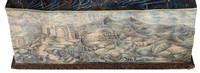
1481FF2519Cologne:: Johann Guldenschaff 1481. 1481. First edition. Small folio. 311 of 314 leaves; CCXII and CXV supplied in early manuscript lacking a1 blank. Gothic type rubrications in red or blue leaves 90-132 with paragraph marks initial strokes and underlining in red; first four leaves with repairs to fore-edge margin some dampstains. BOUND in full 19th century polished calf over wooden boards and decorated in blind five raised bands gilt spine lettering decorative blind roll to edges inner dentelles stamped in blind marbled endpapers; moderate edgewear joints starting rear joint partially split rubbed and worn with some losses small sticker to upper board. Housed in modern custom brown cloth clamshell case spine lettered in gilt minor edgewear. Very good. EXTREMELY RARE: A FORE-EDGE PAINTING ON AN INCUNABLE. Fore-edge painting by John T. Beer depicting "Monastic Ruins at Mount Sinai" signed & dated 1895 in the lower left corner. NOTE see below: 'yellow' circle marking the location of Beer's signature on the painting. Beer inscribed the title of the fore-edge scene on his bookplate and also on a rear endsheet. This is one of four books from the fifteenth century that Beer painted a fore-edge painting on. FIRST PERSON TO SIGN HIS FORE-EDGE PAINTINGS & ALSO PAINTED ON BOOKS FROM HIS PERSONAL LIBRARY. PROVENANCE: John T. Beer bookplate – Sotheby Wilkinson & Hodge 12 November 1903 Beer Library sale lot 311 "Gotscaldius Fra. – William Ridler bookseller – Wican Free Public Library bookplate – Bonhams London Sale 20412 lot 158 October 2 2012 – Reiss & Sohn April 23 2013 – Bloomsbury 12 June 2013 lot 69 – Jeff Weber Rare Books – Randall J. Moskovitz MD – Heritage Auction 9 June 2021 lot 45002 – Jeff Weber Rare Books. REFERENCES: BMC I 225; Goff H-294; Hain 8766; Weber Jeff The Fore-edge Paintings of John T. Beer 2005 no. 116; Weber Jeff Annotated Dictionary of Fore-edge Painting Artists & Binders pp. 54-59. From the Estate of Randall J. Moskovitz MD Memphis Tennessee. Johann Guldenschaff, 1481. hardcover
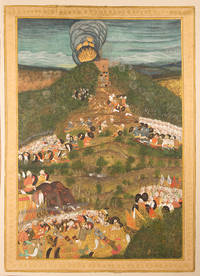
114054Post Mughal India probably late 19th century. . Single large illuminated miniature on paper ink and gouache on paper depicting the view of the Siege of Khandahar in modern-day Afghanistan total leaf 760 x 545 mm miniature 690 x 470 mm; miniature double-ruled in gilt framed decorated with spiraling florettes a few light surface smudges leaf a little cockled mounted to thick card.<br /> A very large and impressive view of the Siege of Khandahar the Mughal-Safavid war of 1649-1653 as presented in the Padshahnameh of Shah Jahan. <br /><br />The Padshahnameh is illustrated chronicle of the reign of Shah Jahan the fifth Mughal emperor commissioned during his reign as a propagandist celebration of his kingdom and dynasty. The text is a detailed chronological narrative of each day of the emperor's reign describing his daily activities court ceremonies as well as the significant events in Emperor Shah-Jahan's life such as the durbars lavish processions and glorious victories on the battlefield.<br /> Post Mughal India, probably late 19th century. unknown
Nittve, Lars, Olle GranatIn Pristine Condition. unknown
ABE-4454427681Eugene Ionesco wrote Rhinoceros a play considered to be a masterpiece of the Theatre of the Absurd in which the inhabitants of a small provincial French town turn into rhinos. The only human who does not succumb to this is the central character and the play is often read as a response to the upsurge of totalitarianism. The play explores themes of conformity culture philosophy and morality. Peter Kettle painted this large image - 18"x35" - in response to the plays themes. He imagined a sculptor intending to create a monumental image of a rhinoceros beetle. The exquisite beetle is perched on a copy of the book and seemingly looking at the crude carving with contempt. Thus the viewer is taken a further step towards absurdity. Language: eng Language: eng 0.0 Language: eng 0.0 Language: eng 0.0 Language: eng. Signed by Author. No Binding. New. unknown