Dulac, Painting; [and] Milton JohnBiblio.com

998 résultats
195419802The book published in Cambridge: At the University Press for Members of the Limited Editions Club 1954. Together two items. AN ORIGINAL WATERCOLOUR PAINTING SIGNED by Dulac and reprinted as one of the illustrations for the publication of COMUS. With a copy of the book itself first edition thus from the L.E.C. in a printing of 1500 numbered copies. The painting is of a woman standing in field of flowers within the curve of a dragon’s tale. Behind her is a large tree laden with fruit and with additional floral and arboreal decorations in the background. The book contains the printed version of this work along with 5 other colourplates from original watercolours by Dulac. This was the last book to be illustrated by Dulac. With frame16.5†13.5†the painting is now handsomely matted and presented in silver-leafed wooden frame. The book is in the publisher’s original parchment backed marbled boards the spine lettered in gilt and housed in the original black slipcase lettered in gilt. 58 16. The original painting in beautiful condition very handsomely framed and presented the book is a fine and bright copy the slipcase only with very minor wear. A RARE AND BEAUTIFUL ORIGINAL PAINTING BY EDMUND DULAC. Dulac is considered one of the most original and prolific book illustrator’s of the first two decades of the 20th century. His name is often linked with Arthur Rackham as they both produced illustrations for lavish gift books for children and adults which were of the highest quality and commercial success. Dulac born a Frenchman settled in England to build his artistic career. He quickly caught the eye of J.M Dent publishers and produced illustrations for an illustrated edition of Jane Eyre in 1905. But it was when he was discovered by Leicester Galleries that his career actually took off. They had been seeking another talented artist of the stature and appeal of Arthur Rackham for children’s gift book illustrations. At that time children’s books were purchased by the wealthy as symbols of good taste and there was a huge market to be captured by a new imaginative artist. Dulac was the perfect choice.<br> Dulac offered a new sensibility to book illustration by his intense use of color his Eastern atmosphere his brightly jeweled patterns and mystical themes. His work met with instant success and approbation. From 1907 with the publication of his magnificent Arabian Nights until 1914 with the issue of Sinbad the Sailor he published an annual collection of outstanding watercolors for gift books for children. These books included: The Tempest in 1908 the Rubaiyat of Omar Khayyam in 1909 Sleeping Beauty in 1910 Stories from Hans Anderson in 1911 Bells and other Poems Edgar Allan Poe in 1912 and Princess Badoura in 1913. During the war years when an understandable shift in publishing took place he produced Princess Mary’s Gift Book King Albert’s Books Edmund Dulac’s Picture Book for the French Red Cross and in 1916 Edmund Dulac’s Fairy Book. All of his books were highly praised and he became one of the most sought after illustrators in the world.<br> Dulac as a young artist had been deeply inspired by William Morris Walter Crane and Aubrey Beardsley. He had a spiritual temperament which developed throughout his life and was intensified by his exposure to Eastern mysticism. Much of his art was inspired by Persian miniatures in its use of bright radiant colors detailed patterns and asymmetrical compositions. He aimed to take his art out of the realm of representation and into a more subjective mystical “eternal†plane. He produced some of the most enduring works of beauty and transcendence during his artistic career and continues to be appreciated and collected to this day.<br> Dulac's illustrations conjure the mysterious atmosphere of the oriental text and transport the reader to a lyrical world of grace and beauty. “The Arabian Nights gave Dulac an opportunity to indulge in his nocturnes; the the softness of the gleam of moonlight on stone or on shadowy figures and his use of ultramarine indigo and Prussian blue mingled with purples and violets brought to the illustrations the calm and mystery of Eastern nights.â€-Colin White<br> Dulac's illustrations evoked the oriental atmosphere in a new and beautiful way and he treated each picture with a seriousness that brought him great praise showing that he like any fine easel painter could accomplish great art even for use in the book arts. The book sealed his reputation and set him permanently on the long course of success he would enjoy throughout his career. The original painting offered here represents a rare opportunity to own one of the painter’s most accomplished pieces. At the University Press for Members of the Limited Editions Club hardcover
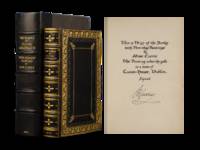
19026285London: Macmillan and Co 1902. The Globe edition. Octavo 7 1/8 x 4 3/4 inches; 180 x 121 mm. ii Miss Currie signed limitation verso blank i-v vi-lx ii 1-695 1 pp. Inserted photogravure portrait frontispiece of "Mr. Quick as Tony Lumpkin". Laid-in is the original catalog description and receipt from Zeitlin & Ver Brugge Los Angeles dated March 5th 1986. Bound ca. 1931 by Rivière & Son for Henry Sotheran. Full dark blue straight-grain morocco covers elaborately tooled in gilt and blind spine with five raised bands decoratively tooled in gilt and blind and lettered in gilt in compartments. Gilt -ruled board edges gilt decorated turn-ins gray endpapers all edges gilt. With the bookplate of Brooklyn Public Library Ramsay fund on front paste-down. Housed in a fleece-lined quarter black morocco clamshell case spine with five raised bands lettered in gilt in compartments. With a very fine fore-edge painting by Miss C.B. Currie of Lucan House Dublin. Inserted limitation leaf at front "This is No. 157 of the Books/with Fore-edge Paintings/by/Miss Currie/The Painting under the gold/is a view of/Lucan-House Dublin./Signed/ C.B. Currie". A very fine example.<br /> <br /> Goldsmith was an Irish novelist playwright and poet whose facility among different genres brought him fame and friendship with many great eighteenth-century British authors. Kept busy by writing quickly and voluminously for Grub Street the center of London's disreputable part of the literary world Goldsmith nevertheless also found time to hone novels such as The Vicar of Wakefield poems such as The Deserted Village and plays such as She Stoops to Conquer. Contemporaries celebrated Goldsmith's ability to craft deceptively complex characters most notably in the case of Charles Primrose the vicar from The Vicar of Wakefield. Goldsmith counted Samuel Johnson among his closest friends and Johnson wrote the epitaph that appears on Goldsmith's memorial in Westminster Abbey's famous Poets' Corner: "To the memory of Oliver Goldsmith poet philosopher and historian by whom scarcely any style of writing was left untouched and no one touched unadorned whether to move to laughter or tears; a powerful yet lenient master of the affections in genius sublime vivid and versatile in expression noble brilliant and delicate is cherished in this monument by the love of his companions the fidelity of his friends and the admiration of his readers." <br /> <br /> "The miniature painter "Miss C.B. Currie" b. December 12 1849; d. April 2 1940 was one of the most prominent fore-edge artists in the twentieth century. A master of the art of miniature painting she excelled as a copyist working for Henry Sotheran Booksellers London. She became famous for her miniature paintings applied to two art forms. First on ivory mounted on Rivière bindings and named by her employer as "Cosway" bindings. Later she expanded her work into the art of painting on the fanned edge of a book -- called a fore-edge painting. Most of these paintings were signed and numbered by the artist. Whereas fore-edge painting history is replete with unknown artists Currie is a notable exception. Even today many fore-edge artists remain anonymous. In the book world the name Miss C.B. Currie is widely recognized yet her personal life and real name remained guarded and unknown until now. It turns out her name was in fact partly a pseudonym. Though her work is highly prized there is no known published biography. Her correct full name was recently discovered to be Caroline Billin Curry. During her entire artistic career Curry used the slightly altered version of her name "Currie". Her true full name is not to be found in any published record of her work from Sotheran's. Her private affairs remain mostly unknown to us and sadly no portrait photograph is known. The earliest year Currie fore-edge paintings appear in Sotheran catalogues is a 1913 supplemental leaf and after that not until 1924 see Currie 20. Since nineteen fore-edge paintings were made prior to 1924 and none of these appear in the Sotheran catalogues available to me from 1910-1923 it is unclear as to when the fore-edge painting effort really began. She may have made a few fore-edge paintings from ca. 1911 to 1914 and then discontinued until after the war. The number 172 was reached by 1933 and it seems unlikely that many more were done after that date." Weber 273. <br /> <br /> Provenance: Bloomsbury Book Auctions London Feb. 6th1986 lot 153 purchased by E. Joseph London; Sold to Zeilin Ver Brugge 1986; Sold to Randall Moscovitz 1986.<br /> <br /> Weber. Annotated Dictionary of Fore-Edge Painting. Catalogue Raisonné No. 157 p. 343 with color photograph. Macmillan and Co unknown
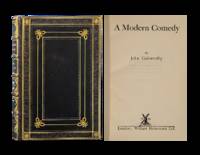
19296286London: William Heinemann Ltd 1929. First edition. Octavo 7 1/8 x 4 5/8 inches; 180 x 117 mm. ii Miss Currie signed limitation verso blank i-xxvii i blank 1-1088 pp. Inserted folded "Forsyte Family Tree" small neat repair to one fold. Inserted limitation leaf at front "This is No. 160 of the Books/with Fore-edge Paintings/by/Miss Currie/The Painting under the gold/is a view of/Mapledurham./Signed/ C.B. Currie". Bound ca. 1930 by Rivière & Son for Henry Sotheran. Full dark blue straight-grain morocco covers elaborately tooled in gilt and blind spine with five raised bands decoratively tooled in gilt and blind and lettered in gilt in compartments. Gilt-ruled board edges gilt decorated turn-ins gray endpapers all edges gilt. A very fine example housed in a custom made felt-lined black cloth clamshell case with black leather label on spine lettered in gilt. With a very fine fore-edge painting by Miss C.B. Currie of Mapledurham Oxfordshire from The Forsyte Saga.<br /> <br /> John Galsworthy's The Forsyte Saga is a multi-novel & short story series following the tumultuous lives of a wealthy English family as they navigate relationships and changing times in the late-19th and early 20th centuries. A Modern Comedy is the sequel to the series consisting of three aditional novels and two interludes.<br /> <br /> The artist Miss C.B. Currie Caroline Billin Curry 1849-1940 was one of the most beloved book painters of the 20th century who spent the majority of her career working for Henry Sotheran Booksellers in London. "She became famous for her miniature paintings applied to two art forms. First on ivory mounted on Rivière bindings and named by her employer as "Cosway" bindings. Later she expanded her work into the art of painting on the fanned edge of a book -- called a fore-edge painting. Most of these paintings were signed and numbered by the artist. Whereas fore-edge painting history is replete with unknown artists Currie is a notable exception. In the book world the name Miss C.B. Currie is widely recognized yet her personal life and real name remained guarded and unknown until now. It turns out her name was in fact partly a pseudonym. Though her work is highly prized there is no known published biography. Her correct full name was recently discovered to be Caroline Billin Curry. During her entire artistic career Curry used the slightly altered version of her name "Currie". Her true full name is not to be found in any published record of her work from Sotheran's" Weber.<br /> <br /> Provenance: Sotheran's catalogue 819 supplement item 1690 illustrated; Christie's London 29th October 1969 lot 19 purchased by E. Joseph London; Brauun Rasmussen 6th December 2005; New England Book Auction 18th April 2006 purchased by Jeff Weber; Sold to Randall Moscovitz 2007.<br /> <br /> Weber. Annotated Dictionary of Fore-Edge Painting. Catalogue Raisonné No. 160 p. 344 with photograph. William Heinemann Ltd unknown
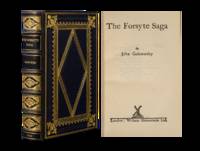
19336283London: William Heinemann Ltd 1933. Later printing. Octavo 7 1/8 x 4 5/8 inches; 180 x 117 mm. ii Miss Currie signed limitation verso blank i-xvi 1-1104 pp. Including folded "Forsyte Family Tree". Inserted limitation leaf at front "This is No. 172 of the Books/with Fore-edge Paintings/by/Miss Currie/The Painting under the gold/is a view from/Richmond Hill./Signed/ C.B. Currie". Bound ca. 1933 by Rivière & Son for Henry Sotheran. Full dark blue straight-grain morocco covers elaborately bordered in gilt and blind enclosing a diamond-shaped gilt lozenge spine with five raised bands decoratively tooled in gilt and blind and lettered in gilt in compartments. Gilt -ruled board edges gilt decorated turn-ins gray endpapers all edges gilt. A very fine example. Housed in a custom made felt-lined black cloth clamshell case with black leather label on spine lettered in gilt. With a very fine fore-edge painting by Miss C.B. Currie of Richmond Hill from The Forsyte Saga.<br /> <br /> John Galsworthy's The Forsyte Saga is a multi-novel & short story series following the tumultuous lives of a wealthy English family as they navigate relationships and changing times in the late-19th and early 20th centuries. Here the fore-edge painting features a building central to many of the character's lives. <br /> <br /> The artist Miss C.B. Currie Caroline Billin Curry 1849-1940 was one of the most beloved book painters of the 20th century who spent the majority of her carrier working for Henry Sotheran Booksellers in London. "She became famous for her miniature paintings applied to two art forms. First on ivory mounted on Rivière bindings and named by her employer as "Cosway" bindings. Later she expanded her work into the art of painting on the fanned edge of a book -- called a fore-edge painting. Most of these paintings were signed and numbered by the artist. Whereas fore-edge painting history is replete with unknown artists Currie is a notable exception. In the book world the name Miss C.B. Currie is widely recognized yet her personal life and real name remained guarded and unknown until now. It turns out her name was in fact partly a pseudonym. Though her work is highly prized there is no known published biography. Her correct full name was recently discovered to be Caroline Billin Curry. During her entire artistic career Curry used the slightly altered version of her name "Currie". Her true full name is not to be found in any published record of her work from Sotheran's" Weber.<br /> <br /> Provenance: Sotheran's catalogue 819 supplement item 1688 or 1689; Chas. J. Sawyer Ltd. Catalogue 154 item 127 1929 -- said to have passed to an Akron Ohio institution -- unknown Ohio bookseller -- Mosher Books 2008; Sold to Randall Moscovitz 2008.<br /> <br /> Weber. Annotated Dictionary of Fore-Edge Painting.Catalogue Raisonné no. 172. William Heinemann Ltd unknown
19292091202133201489Otsuka Kogeisha 1929. Soft Cover. Fine. Number of books: 2 books in total Otsuka Kogeisha paperback
1927911101927. PAINTING ALBUM. Nikuhitsu Manga KAIKOKU ROKUJUNENSHI ZU-E. Done by the Chuo Bijutsu Kyokai in Tokyo in 1927 as a 43 x 31 cm portfolio of 52 original watercolor drawings counting the table of contents and cover title label on satiric and comical themes done to commemorate the 60th anniversary of the opening of Japan in the mid-19th century. The title represents quite a liberal interpretation of chronology since the opening of Japan was in 1854 but it is probably refers to the Meiji Restoration as the beginning of "opening" and also refers to Baron Okuma's somber and influential 50 year history of modern Japan with its almost identical title done in 1909. There was more than one set of these drawings assembled. It seems to have been issued as a limited hand-drawn edition. One of several such major painted works in a manga style There is a hand-written table of contents/colophon with the captions of the drawings and their artists listed by Nakamura Fusetsu 1866-1943 the important Haiga artist. Two dozen or so of the most prominent cartoonists satirists and artists are represented. One of the two watercolors by the great cartoonist Okamoto Ippei 1886-1948 is a caricature of his friend Natsume Soseki the famous author of "I Am A Cat" captured with his pet tabby beside him inextricably linked in Ippei's imagination and ours. The "father of modern manga" Kitazawa Rakuten 1876-1955 has two as do the important printmakers Maekawa Sempan 1888-1960 and Mizushima Nihofu 1884-1958. The list of talented and significant contributors goes on as does the subject matter: political satire China vs. Japan East vs. West tradition vs. modernity technology vs. craft from abstract Sumo wrestlers to a surreal embodied eye a congeries of images overwhelms our eyes in turn. A wonderful visual epitome of the free spirit of democracy if not anarchy in the 1920s before the dark days to come. In very good condition the watercolors are skillful and powerful. There is quite a bit of contemporary supplementary material included from the time. unknown
19072110502150903206Matsuki Heikichi-ban 1907. Soft Cover. Fine. Number of books: 1 Matsuki Heikichi-ban paperback
19262092902141000803Darumaya Bookstore 1926. Soft Cover. Fine. Number of pages: 1 quires Size: 30x44cm Darumaya Bookstore paperback
19062110502150902985Matsuki Heikichi-ban 1906. Soft Cover. Fine. Number of books: 1 Matsuki Heikichi-ban paperback
19072110502150903323Matsuki Heikichi-ban 1907. Soft Cover. Fine. Number of books: 1 Matsuki Heikichi-ban paperback
19062110502150903322Matsuki Heikichi-ban 1906. Soft Cover. Fine. Number of books: 1 Matsuki Heikichi-ban paperback
19512090202120402735The New Japanese Society of Literature Hiroshima Branch Our Poetry Club 1951. Soft Cover. Fine. Number of books: 1 The New Japanese Society of Literature Hiroshima Branch Our Poetry Club paperback
196428236Maine: Skowhegan School of Painting & Sculpture. As New. 1964. Paperback. FREE UPGRADE to Courier/Priority Shipping Upon Request - IN STOCK AND IMMEDIATELY AVAILABLE FOR SHIPMENT - AS NEW THE TEXT BLOCK IS PRISTINE CLEAN UNMARKED AND IN EXCELLENT CONDITION - - -- with a bonus offer-- . Skowhegan School of Painting & Sculpture paperback
19422091502135500936Toyo tosho 1942. Soft Cover. Fine. Number of pages: 213p Portrait 1 folded map 15 separate appendix pages Size: 16x 22cm Toyo tosho paperback
19062110502150903226Matsuki Heikichi-ban 1906. Soft Cover. Fine. Number of books: 1 Matsuki Heikichi-ban paperback
19062110502150903009Matsuki Heikichi-ban 1906. Soft Cover. Fine. Number of books: 1 Matsuki Heikichi-ban paperback
19182092902138300980Darumaya Bookstore 1918. Soft Cover. Fine. Number of pages: 2 quires Size: 25cm Darumaya Bookstore paperback
19622092902138301650Ohara Soichiro 1962. Soft Cover. Fine. Number of pages: 1 book Size: 37cm Ohara Soichiro paperback
19282092902141000858Kaizo-sha 1928. Soft Cover. Fine. The book is in fine condition. Kaizo-sha paperback
19212110502150908241Yamamoto Painting Hall 1921. Soft Cover. Fine. Number of books: 1 Yamamoto Painting Hall paperback
19042110502150906461Fukuda Hatsujiro Edition 1904. Soft Cover. Fine. Number of books: 6 discs Fukuda Hatsujiro Edition paperback
19012092902138300191Yamada unsodo 1901. Soft Cover. Fine. Size: 37X25 Yamada unsodo paperback
19032111902158904508Kyoto Art Association 1903. Soft Cover. Fine. Volume: 1 Kyoto Art Association paperback
19062110502150903384Matsuki Heikichi-ban 1906. Soft Cover. Fine. Number of books: 1 Matsuki Heikichi-ban paperback
19042110502150908508Cho Koku-gawa 1904. Soft Cover. Fine. Number of books: 3 discs Cho Koku-gawa paperback