[INDIAN MINIATURE PAINTING].Biblio.com
2 085 résultats
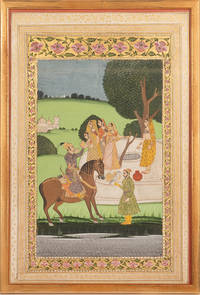
119661Mughal India possibly Murshidabad mid- to late-18th century. . Single miniature painting on card opaque pigments with gold depicting a scene with a Prince on horseback accepting a drink from a gold vessel from a village maiden miniature 282 x 179 mm full album page 394 x 255 mm; painting framed within multiple gilt rulings innermost frame painted with delicate pink and white flowers on a spiralling green vine set against a richly gilt background some very minor surface soiling overall in exceptionally bright and attractive condition framed and glazed.<br /> Scenes painted around imagined amorous encounters between the 'prince and village girl' were popular among artists during the late Mughal period in centres such as Delhi Lucknow and Murshidabad. The concept of 'love at first sight' was similarly echoed in the tradition of the courtly poets of the pan-European middle ages and can be seen echoed through their visual arts.<br /><br />The inspiration behind the theme in this painting was likely rooted in Persian literary sources the Nayrang'i Eshq The Charm of Love by Mughal Sufi poet Ghanimat Kunjahi d. 1695 AD being one such example. Written during a period of considerable Muslim-Hindu cultural interaction the poem was later absorbed into Sanskrit works and grew further in popularity. One notable section of the poem stanza 40.7 describes how in pursuit of a stag Shahid comes upon a village where he is struck by the sight of village girls at a well and is particularly struck by the beauty of Wafa the daughter of the village headsman see C. Shackle Persian Poetry and Q dir Sufism in Later Mughal India: Ghan mat Kunj h and his Mathnaw -yi Nayrang-i 'ishq in The Heritage of Sufism: Volume 3 Late Classical Persianate Sufism Boston 1999. <br /><br />In this painting a beautiful maiden leans across to offer the handsome stranger a drink from the well. Neither appears abashed and their eyes fix upon each other as if a spell has been cast. Of note is the way their hands come together around the vessel of water though they do not touch. The mono green background gives a prominence to this encounter watched by the other village girls. There are subtle details that give context to the scene the stranger's courtly attire and jewelled ruby dagger. His companion's falcon hints at their noble status. By contrast the village girl's sari is tied in the style of a working women as she draws water from the well. For notable examples see Indian Painting 16001870 Oliver Forge & Brendon Lynch New York 2012 and Painting 91 in Domains of Wonder B.N Goswamy & C. Smith 2006.<br /> Mughal India, possibly Murshidabad, mid- to late-18th century. unknown
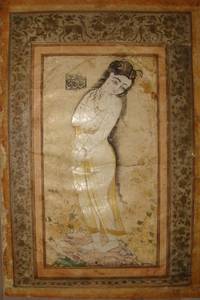
000588Painting. Very Good. No Binding. Signed by Illustrators. 8vo - over 7¾ - 9¾" tall. Central panel: 17.5x6.5 cm. Leaf: 24.5x16.5 cm. illustrated with animal and floral motifs. The portrait is tiny signed at the mid-right: "Raqm kamineh R.". Ink drawing with gouache embellished with gold on paper.
2110502150907600Hanmoto fumei N.A. Soft Cover. Fine. Volume: 1 Hanmoto fumei paperback
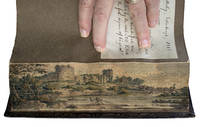
1813FF2499Edinburgh:: John Ballantyne 1813. 1813. 4to. x 330 cxvi pp. Original olive green straight-grain morocco gilt-extra with alternating pattern of ovals and feathers raised bands all edges gilt BOUND BY TAYLOR & HESSEY London with their gilt-stamp on the outer fore-edges of the upper and lower cover as is common with their stamps. Near fine. ". . . BOUND UNDER THE DIRECTION OF SIR WALTER SCOTT HIMSELF": Manuscript note found within this copy: "Sir Walter Scott's Rokeby Edinburgh 1813. Original edition green morocco. This precious volume was bound under the direction of Sir Walter Scott himself transmitted to the binder by John Ballantyne the publisher; the edge when bent discloses a wonderful view of Rokeby corrected in pencil: Barnard Castle painted by the celebrated Patrick Nasmyth 1787-1831 when in the full rigor of his great artistic talent." – THIS MUST BE THE TAYLOR & HESSEY PAINTER his work is profoundly similar to this artist especially when considering his expert use of creating depth in a painting plus his preponderance of thick dense trees that are painted with remarkable detail unlike other fore-edge painters. This is an extremely rare example of the actual artist's name being mentioned. This is a choice example of a Taylor & Hessey binding with their exquisitely painted fore-edge painting the binding being signed in the usual way from this bindery. Of all the Taylor & Hessey specimens I have examined this is the first to mention the artist's name. The added association with this being a quarto volume not the more typical and cheaper octavo and that Sir Walter Scott's name is associated with the design of the binding suggesting also the fore-edge painting this is something quite unique. John Ballantyne, 1813. hardcover
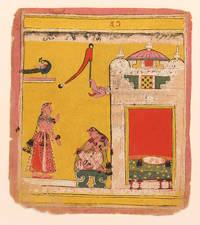
112940India Malwa circa 1630 AD. . Single leaf ink and gouache painting on paper image double-ruled and framed within red borders total leaf 200 x 175 mm; lightly faded with some chipping of paint with slight loss of pigmentation outer edges a little worn contemporary ink inscription to reverse in Sanskrit tipper-into card mount.<br /> Keshav Das d. 1601 was a renowned Indian court poet best known for the Rasikapriya which is considered a pioneering work of Hindu literature dealing with the classification of idealised types of male and female lovers nayakas and nayikas and their emotions and interactions. The work was compiled around the 1590s probably in Bundelkhand to the east of Malwa and the present painting is from a near-contemporary series of illustrations depicting scenes from the poems. Three leaves from the same series are housed in the Ashmolean Museum's collections these all dated c. 1630 also described as Malwa accession nos. EA2012.200 EA2012.202 EA2012.201.<br /> India, Malwa, circa 1630 AD. unknown
653830 fine color paintings & 24 black ink drawings of various parts of the bamboo. 50 leaves. 4to 275 x 206 mm. modern bright silk brocade wrappers stitched as issued. Probably Japan: late Edo.<br/> <br/> A beautiful album of finely rendered drawings of bamboo accompanied by explanatory text. There has been a long tradition in both China since the eighth century and Japan of illustrating bamboo with much thought given to composition and the painting of the stems knots branches and leaves. A number of treatises were written on the subject.<br/> <br/> This handsomely painted manuscript contains many illustrations all finely painted or brush-drawn of bamboo. Following the title there are two leaves which are somewhat soiled illustrating the yin and yang of the three variations of bamboo painting. They include how to place the brush on the drawing surface and how to maneuver the brush and lift it at just the right moment the calligraphy techniques are named. These are followed two fine calligraphic illustrations using black ink of bamboo branches again the calligraphy methods are named followed by a leaf of instructions.<br/> <br/> Next there are 18 pages of illustrations of leaves with each illustration becoming increasingly more complex.<br/> <br/> Then the manuscript text turns to the botanical aspects of bamboo: where it grows the genera and uses appearance how to propagate etc. Both Chinese and Japanese names are given with references to the classic botanical guide Ben cao gang mu Compendium of Materia Medica. Next we have 28 fine full-page illustrations of many genera of bamboo some pages contain multiple images each preceded by text describing the examples depicted. They are very vividly colored and finely painted using many techniques including the application of mica. Among the elaborate and richly colored illustrations are cross-sections roots sprouts leaves and fruits. Some of the examples are very exotic.<br/> <br/> Now we come upon two full-page color illustrations of tools for cutting and trimming bamboo and for the extraction and preparation of medicines with two pages of explanatory text.<br/> <br/> Finally we have a section with six artistic renderings of bamboo in art and literature. They include various iconic Chinese scenes including variations of literati in bamboo groves and the Seven Sages of the Bamboo Grove. Each painting is preceded by a leaf of text with a description and historical background of the scene.<br/> <br/> In fine condition. A contemporary reader has made some neat annotations in red ink. Final leaf has the artist’s pen name written “Seigetsu an.†Several minor and marginal wormholes. Preserved in a chitsu. unknown
18542092902144201618Not Available 1854. Soft Cover. Fine. The book is in fine condition. Not Available paperback
ABE-4369645028Peter Kettle An original painting on a gesso panel in a hardwood frame. This tranquil image is based upon the poem by T. S. Eliot 'Little Gidding' which forms the climax of his extraordinary Four Quartets sequence. A regular exhibitor at London's Royal Academy Kettle's work has been sought out by many writers and book collectors because of his regular use of literary themes. Language: eng Language: eng 0.0 Language: eng 0.0 Language: eng 0.0 Language: eng. Hardcover. New. Peter Kettle hardcover
195419802The book published in Cambridge: At the University Press for Members of the Limited Editions Club 1954. Together two items. AN ORIGINAL WATERCOLOUR PAINTING SIGNED by Dulac and reprinted as one of the illustrations for the publication of COMUS. With a copy of the book itself first edition thus from the L.E.C. in a printing of 1500 numbered copies. The painting is of a woman standing in field of flowers within the curve of a dragon’s tale. Behind her is a large tree laden with fruit and with additional floral and arboreal decorations in the background. The book contains the printed version of this work along with 5 other colourplates from original watercolours by Dulac. This was the last book to be illustrated by Dulac. With frame16.5†13.5†the painting is now handsomely matted and presented in silver-leafed wooden frame. The book is in the publisher’s original parchment backed marbled boards the spine lettered in gilt and housed in the original black slipcase lettered in gilt. 58 16. The original painting in beautiful condition very handsomely framed and presented the book is a fine and bright copy the slipcase only with very minor wear. A RARE AND BEAUTIFUL ORIGINAL PAINTING BY EDMUND DULAC. Dulac is considered one of the most original and prolific book illustrator’s of the first two decades of the 20th century. His name is often linked with Arthur Rackham as they both produced illustrations for lavish gift books for children and adults which were of the highest quality and commercial success. Dulac born a Frenchman settled in England to build his artistic career. He quickly caught the eye of J.M Dent publishers and produced illustrations for an illustrated edition of Jane Eyre in 1905. But it was when he was discovered by Leicester Galleries that his career actually took off. They had been seeking another talented artist of the stature and appeal of Arthur Rackham for children’s gift book illustrations. At that time children’s books were purchased by the wealthy as symbols of good taste and there was a huge market to be captured by a new imaginative artist. Dulac was the perfect choice.<br> Dulac offered a new sensibility to book illustration by his intense use of color his Eastern atmosphere his brightly jeweled patterns and mystical themes. His work met with instant success and approbation. From 1907 with the publication of his magnificent Arabian Nights until 1914 with the issue of Sinbad the Sailor he published an annual collection of outstanding watercolors for gift books for children. These books included: The Tempest in 1908 the Rubaiyat of Omar Khayyam in 1909 Sleeping Beauty in 1910 Stories from Hans Anderson in 1911 Bells and other Poems Edgar Allan Poe in 1912 and Princess Badoura in 1913. During the war years when an understandable shift in publishing took place he produced Princess Mary’s Gift Book King Albert’s Books Edmund Dulac’s Picture Book for the French Red Cross and in 1916 Edmund Dulac’s Fairy Book. All of his books were highly praised and he became one of the most sought after illustrators in the world.<br> Dulac as a young artist had been deeply inspired by William Morris Walter Crane and Aubrey Beardsley. He had a spiritual temperament which developed throughout his life and was intensified by his exposure to Eastern mysticism. Much of his art was inspired by Persian miniatures in its use of bright radiant colors detailed patterns and asymmetrical compositions. He aimed to take his art out of the realm of representation and into a more subjective mystical “eternal†plane. He produced some of the most enduring works of beauty and transcendence during his artistic career and continues to be appreciated and collected to this day.<br> Dulac's illustrations conjure the mysterious atmosphere of the oriental text and transport the reader to a lyrical world of grace and beauty. “The Arabian Nights gave Dulac an opportunity to indulge in his nocturnes; the the softness of the gleam of moonlight on stone or on shadowy figures and his use of ultramarine indigo and Prussian blue mingled with purples and violets brought to the illustrations the calm and mystery of Eastern nights.â€-Colin White<br> Dulac's illustrations evoked the oriental atmosphere in a new and beautiful way and he treated each picture with a seriousness that brought him great praise showing that he like any fine easel painter could accomplish great art even for use in the book arts. The book sealed his reputation and set him permanently on the long course of success he would enjoy throughout his career. The original painting offered here represents a rare opportunity to own one of the painter’s most accomplished pieces. At the University Press for Members of the Limited Editions Club hardcover
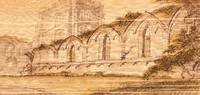
1481FF2519Cologne:: Johann Guldenschaff 1481. 1481. First edition. Small folio. 311 of 314 leaves; CCXII and CXV supplied in early manuscript lacking a1 blank. Gothic type rubrications in red or blue leaves 90-132 with paragraph marks initial strokes and underlining in red; first four leaves with repairs to fore-edge margin some dampstains. BOUND in full 19th century polished calf over wooden boards and decorated in blind five raised bands gilt spine lettering decorative blind roll to edges inner dentelles stamped in blind marbled endpapers; moderate edgewear joints starting rear joint partially split rubbed and worn with some losses small sticker to upper board. Housed in modern custom brown cloth clamshell case spine lettered in gilt minor edgewear. Very good. EXTREMELY RARE: A FORE-EDGE PAINTING ON AN INCUNABLE. Fore-edge painting by John T. Beer depicting "Monastic Ruins at Mount Sinai" signed & dated 1895 in the lower left corner. NOTE see below: 'yellow' circle marking the location of Beer's signature on the painting. Beer inscribed the title of the fore-edge scene on his bookplate and also on a rear endsheet. This is one of four books from the fifteenth century that Beer painted a fore-edge painting on. FIRST PERSON TO SIGN HIS FORE-EDGE PAINTINGS & ALSO PAINTED ON BOOKS FROM HIS PERSONAL LIBRARY. PROVENANCE: John T. Beer bookplate – Sotheby Wilkinson & Hodge 12 November 1903 Beer Library sale lot 311 "Gotscaldius Fra. – William Ridler bookseller – Wican Free Public Library bookplate – Bonhams London Sale 20412 lot 158 October 2 2012 – Reiss & Sohn April 23 2013 – Bloomsbury 12 June 2013 lot 69 – Jeff Weber Rare Books – Randall J. Moskovitz MD – Heritage Auction 9 June 2021 lot 45002 – Jeff Weber Rare Books. REFERENCES: BMC I 225; Goff H-294; Hain 8766; Weber Jeff The Fore-edge Paintings of John T. Beer 2005 no. 116; Weber Jeff Annotated Dictionary of Fore-edge Painting Artists & Binders pp. 54-59. From the Estate of Randall J. Moskovitz MD Memphis Tennessee. Johann Guldenschaff, 1481. hardcover
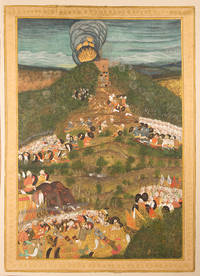
114054Post Mughal India probably late 19th century. . Single large illuminated miniature on paper ink and gouache on paper depicting the view of the Siege of Khandahar in modern-day Afghanistan total leaf 760 x 545 mm miniature 690 x 470 mm; miniature double-ruled in gilt framed decorated with spiraling florettes a few light surface smudges leaf a little cockled mounted to thick card.<br /> A very large and impressive view of the Siege of Khandahar the Mughal-Safavid war of 1649-1653 as presented in the Padshahnameh of Shah Jahan. <br /><br />The Padshahnameh is illustrated chronicle of the reign of Shah Jahan the fifth Mughal emperor commissioned during his reign as a propagandist celebration of his kingdom and dynasty. The text is a detailed chronological narrative of each day of the emperor's reign describing his daily activities court ceremonies as well as the significant events in Emperor Shah-Jahan's life such as the durbars lavish processions and glorious victories on the battlefield.<br /> Post Mughal India, probably late 19th century. unknown
Nittve, Lars, Olle GranatIn Pristine Condition. unknown
ABE-4454427681Eugene Ionesco wrote Rhinoceros a play considered to be a masterpiece of the Theatre of the Absurd in which the inhabitants of a small provincial French town turn into rhinos. The only human who does not succumb to this is the central character and the play is often read as a response to the upsurge of totalitarianism. The play explores themes of conformity culture philosophy and morality. Peter Kettle painted this large image - 18"x35" - in response to the plays themes. He imagined a sculptor intending to create a monumental image of a rhinoceros beetle. The exquisite beetle is perched on a copy of the book and seemingly looking at the crude carving with contempt. Thus the viewer is taken a further step towards absurdity. Language: eng Language: eng 0.0 Language: eng 0.0 Language: eng 0.0 Language: eng. Signed by Author. No Binding. New. unknown
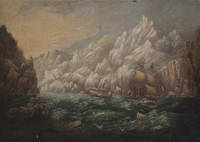
1850C79DXBHARQJQEngland 1850. Later mounted on another canvas and stretched over a wooden frame with a handwritten note about the painting pasted on the back. Oil painting on canvas 65.5 x 91 cm showing 2 ships in a rough sea amid dangerous rocks and ice. A mid-19th-century oil painting depicting two ships 3-masted barks in a rough sea amid dangerous rocky and icy cliffs mountains and outcroppings. Pasted to the back is an old slip of paper with a note the parts of the text in parentheses are lost but have been filled in based on an earlier transcription: "The sailing ships 'Erebus' and 'Terror' passing through the Davis Straight in 1846 the 6 later "corrected" to 7. It was on this expedition that Sir John Franklin discovered the North West Passage and in which he lost his life". In fact Franklin sailed these two ships through Davis Strait in 1845 passed on through Lancaster Sound in search of a Northwest Passage and spent the winter on Beechey Island. In 1846 he and his expedition made their way through using the modern names Peel Sound and Franklin Strait into McClintock Channel where they got caught in the ice near King William Island. Most of the crew died there including Franklin in 1847. A few made it on foot to the mainland but were unable to reach any outpost. The last died in 1848. Since no one who saw the ships in these waters survived the anonymous artist who made the present painting appears to have turned to an 1847 painting of the same ships by John Wilson Carmichael in London though he did not copy it. Carmichael had earlier made a drawing of an expedition in search of the Northwest Passage by William Edward Parry who made three expeditions in the years 1819 to 1825 each with two ships but in 1847 he used parts of his existing Arctic scene as models for the composition of a new painting showing an Antarctic scene of James Clark Ross's voyage with the ships Erebus and Terror in 1842: "'Erebus' and 'Terror' in the Antarctic". Carmichael's drawing and painting survive at the National Maritime Museum in Greenwich. The central ship in the present painting follows that in Carmichael's painting quite closely and the second ship more distantly. The rocks and ice are similar in general appearance and arrangement but quite different in detail.With some restorations along the edges of the painting and a small scuffmark near the foot toward the left but generally in good condition.l Cf. Howgego 1800-1850 P9 R27 & F21. ABE CAT Alaska Canada & Greenland unknown
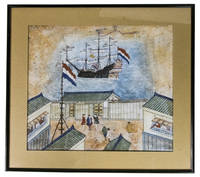
1800ABC_48559Japan 1800. In a passepartout and framed. Drawing size ca. 34 x 39.5 cm; frame size ca. 46 x 51 cm. Oil painting on leather. Late 18th-century painting on leather depicting everyday life on the island of Deshima in Japan created by an anonymous artist who seems to be of Japanese origin possibly originating from the Nagasaki school of painting: the faces of most human figures show remarkable Japanese features despite their reddish-brown hair and Dutch clothing.Judging by a woodcut map of Deshima published in 1780 by Toshimaya Bunjiemon the south-eastern part of the island is shown in the present illustration. On the left the warehouse masters residence next to a tall flagpole with the Dutch flag at top; in the centre the important watergate through which cargo was brought in via ship with four Dutch merchants one seen from behind and two Javanese servants in front of the gate; on the right the warehouse "De Lelie" The Lily. In the background lying in the bay of Nagasaki a Dutch three-master has been depicted with fourteen hoisted Dutch flags and several sailors on deck and in the rigging. This ship closely resembles a transom return ship in Dutch: "spiegelretourschip" which was used by the Dutch East India Company VOC during its whole existence.Based on the depicted style of clothing of the Dutch merchants we assume that this painting could have been made during the second half of the 18th century.The artificial island of Deshima was a small fan-shaped island used as trading post initially by the Portuguese until 1639 and subsequently by the Dutch from 1641 until 1858. During the Tokugawa Shogunate the military government of Japan in the Edo period of 1603-1868 foreigners were not allowed to enter the Japanese territory and the island of Deshima was the only place where initially only the Portuguese and later only the Dutch were admitted.With some flaking of the paint off the leather slightly affecting the image but mainly affecting the upper outer corners. Otherwise in good condition.l H. Paul Nederlanders in Japan 1600-1854. De VOC op Desjima pp. 106-107. unknown
18292110502150906596Yamamoto-ya-ban 1829. Soft Cover. Fine. Number of books: 3 Yamamoto-ya-ban paperback
1885143011885. Iran Art Qajar School Lovers in Embrace gouache painting on paper nineteenth century represents the courtly aesthetic erotic refinement and dynastic visual language that defined Persian painting under Qajar rule. The composition situates a princely male figure and his adorned companion in intimate embrace reinforcing themes of aristocratic leisure romanticized sovereignty and elite identity in Qajar Iran. The work supports research in Persian court painting gender representation in Islamic art Qajar costume and regalia and nineteenth century Iranian material culture.<br /> <br /> Persian Qajar gouache on paper with gold illuminated border. Depicts a young prince wearing blue and gold coat and karakul headgear embracing female companion adorned with tiara and pearls. Floral and animal illuminated margins including deer and monkeys. Image size 18.5 x 11 inches.<br /> <br /> The prince's distinctive headgear confirms Qajar rather than Zand period attribution aligning the work with the heightened stylization and opulent textile rendering characteristic of nineteenth century Tehran ateliers. Comparable compositions appear in Qajar painting traditions associated with artists such as Mohammad Sadiq whose courtly embrace scenes similarly emphasize costume detail glassware and staged intimacy as markers of refinement. The illuminated border populated by floral and animal motifs situates the lovers within a cosmological and decorative framework typical of Qajar manuscript aesthetics adapted to single-sheet painting. Minor browning to margins and discreet restoration to verso margins not affecting image. Very good. A refined example of Qajar visual culture centered on dynastic elegance and performative intimacy. unknown
18242110502150903366Not Available 1824. Soft Cover. Fine. Number of books: 3 Not Available paperback
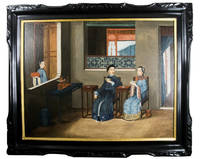
1820ABC_45805China 1820. 47 x 61 cm. picture; 61 x 74.5 cm. frame. Oil painting on canvas in a black lacquered Chinese export frame. An elegant interior scene from a Chinese Mandarins home in the early nineteenth century: a Manchu Mandarin and his consort taking tea in a domestic setting. He wears non-official semi-formal winter attire including rank badge sitting beside ahis beautiful Chinese lady surrounded by fine furniture and fittings. The whole scene reflects his good taste and social standing.Whilst tea had been the driving force of the China Trade since the early eighteenth century giving rise to export paintings illustrating its cultivation and production process the style and subject of the early export paintings was firmly rooted in traditional Chinese art and culture as in this delightful painting.l Cf. Choi Kee Il Tea and design in Chinese export painting in: The Magazine Antiques vol. 154 no. 4 October 1998. unknown
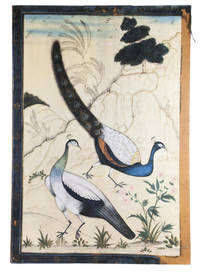
1900ABC_485731900. Ca. 107 x 74 cm. The silk canvas is mounted on a fibreboard panel of the same size. Painting on silk. Beautiful large and vibrantly coloured silk painting of a pair of peafowls painted after a watercolour attributed to the Mughal court painter Ustad Mansur master Mansur ca. 1590-1624. The intriguing work depicts a pair of peafowls in a rocky landscape. The peacock is captured in a natural pose running with a prey in its beak which draws the peahen's attention. The scene was most likely drawn from life. The peafowls themselves are painted in a Mughal fashion while the stylised background and floral border are reminiscent of Persian art. Unlike Mansur's watercolour which was painted on paper the present painted is painted on silk. It is also three times the size of Mansur's work.Mansur worked during what is considered the great age of Mughal art ca. 1580-1650 and was one of the favourite painters of Emperor Nuruddin Salim Jahangir r. 1605-1627. He received the rare title "Nadir-al-'Asr" unrivalled of his age from the emperor himself as he excelled in depicting plants and animals. Jahangir was particularly interested in nature and prided himself in being the first to direct artists to record it. And in this no one surpassed Mansur. He was known to paint birds and other animals unknown to the local population and is one of the very few artists to have painted a living dodo. His peafowl watercolour is one of the best known and most popular miniatures of the Mughal school.With holes and tears in the blue floral border and the peacock's tail the border is detached on the right side but still present a few small water stains on the left side and a trail of snail slime around the peacock's tail. Otherwise in good condition with colours that are still very vibrant.l Cf. MET SL.17.2011.36.1; Welch S. Imperial Mughal painting p. 91. unknown
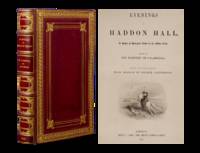
18486282London: Henry G. Bohn 1848. First edition. Octavo 8 5/8 x 5 5/8 inches; 219 x 143 mm. viii 1-453 1 blank pp. Engraved frontispiece engraved vignette title-page and twenty-four fine engraved plated by George Cattermole. Bound ca. 1910 by Rivière & Son in full maroon straight-grain morocco covers elaborately bordered in gilt and blind spine with five raised bands elaborately tooled in gilt and blind and lettered in gilt in compartments. Gilt-ruled board edges gilt decorated turn-ins pink endpapers all edges gilt. A very fine example with the remains of the bookplate of Frederick S. Peck and an old bookseller's descriptions on front paste-down. Housed in a felt-lined burgundy cloth clamshell case spine with leather label lettered in gilt. Fore-edge painting by Miss C.B. Currie depicting Haddon Hall. Together with a letter of authenticity from Jeff Weber and the original receipted invoice to Randall Moscovitz dated September 5 2012.<br /> <br /> Featuring a delicate fore-edge painting by Miss C.B. Currie "showing the dignity and grandeur of Haddon Hall. flanked by towering trees and beautiful greensward. Horses are being led to their stable by a groom and a mounted horseman can be seen in the middle distance talking to two young ladies" Weber. The artist Miss C.B. Currie Caroline Billin Curry 1849-1940 was one of the most beloved book painters of the 20th century who spent the majority of her career working for Henry Sotheran Booksellers in London. "She became famous for her miniature paintings applied to two art forms. First on ivory mounted on Rivière bindings and named by her employer as "Cosway" bindings. Later she expanded her work into the art of painting on the fanned edge of a book -- called a fore-edge painting. Most of these paintings were signed and numbered by the artist. Whereas fore-edge painting history is replete with unknown artists Currie is a notable exception. In the book world the name Miss C.B. Currie is widely recognized yet her personal life and real name remained guarded and unknown until now. It turns out her name was in fact partly a pseudonym. Though her work is highly prized there is no known published biography. Her correct full name was recently discovered to be Caroline Billin Curry. During her entire artistic career Curry used the slightly altered version of her name "Currie". Her true full name is not to be found in any published record of her work from Sotheran's" Weber.<br /> <br /> Although unsigned expert Jeff Weber firmly attributes the painting on this book to Miss C.B. Currie based on style and binding. He explains ". though unsigned and as such this is the only known book without a Currie signature but bears all the signs of having been painted by her. It is on the Rivière binding it lacks the usual "colophon" leaf seen with nearly all other Currie paintings. Currie painted both fore-edge paintings and Cosway miniatures on ivory both in bindings commissioned and bound for Sotheran's by Rivière and Son. There are Currie paintings on ivory that are datable to pre-1910 and yet they are not signed. Peck was an active book buyer during this same period his home and library was built in 1905 raising the likelihood that he bought a Currie fore-edge prior to her signing them" Weber. <br /> <br /> Provenance: Frederick S. Peck - Parke-Bernet Galleries November 14-15 1944 lot 114; G.J. Guthrie Nicholson Parke-Bernet Galleries November 8-9 1948 lot 231; Jeff Weber Rare Books - sold to Randall Moscovitz September 5th 2012. Frederick S. Peck 1868-1947 born in Providence Rhode Island became a Legislator and lived in Barrington R.I. His papers are located at the Rhode Island Historical Society. <br /> <br /> Weber Annotated Dictionary of Fore-Edge Painting 306. Henry G. Bohn unknown
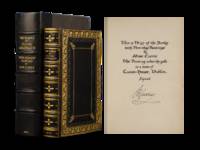
19026285London: Macmillan and Co 1902. The Globe edition. Octavo 7 1/8 x 4 3/4 inches; 180 x 121 mm. ii Miss Currie signed limitation verso blank i-v vi-lx ii 1-695 1 pp. Inserted photogravure portrait frontispiece of "Mr. Quick as Tony Lumpkin". Laid-in is the original catalog description and receipt from Zeitlin & Ver Brugge Los Angeles dated March 5th 1986. Bound ca. 1931 by Rivière & Son for Henry Sotheran. Full dark blue straight-grain morocco covers elaborately tooled in gilt and blind spine with five raised bands decoratively tooled in gilt and blind and lettered in gilt in compartments. Gilt -ruled board edges gilt decorated turn-ins gray endpapers all edges gilt. With the bookplate of Brooklyn Public Library Ramsay fund on front paste-down. Housed in a fleece-lined quarter black morocco clamshell case spine with five raised bands lettered in gilt in compartments. With a very fine fore-edge painting by Miss C.B. Currie of Lucan House Dublin. Inserted limitation leaf at front "This is No. 157 of the Books/with Fore-edge Paintings/by/Miss Currie/The Painting under the gold/is a view of/Lucan-House Dublin./Signed/ C.B. Currie". A very fine example.<br /> <br /> Goldsmith was an Irish novelist playwright and poet whose facility among different genres brought him fame and friendship with many great eighteenth-century British authors. Kept busy by writing quickly and voluminously for Grub Street the center of London's disreputable part of the literary world Goldsmith nevertheless also found time to hone novels such as The Vicar of Wakefield poems such as The Deserted Village and plays such as She Stoops to Conquer. Contemporaries celebrated Goldsmith's ability to craft deceptively complex characters most notably in the case of Charles Primrose the vicar from The Vicar of Wakefield. Goldsmith counted Samuel Johnson among his closest friends and Johnson wrote the epitaph that appears on Goldsmith's memorial in Westminster Abbey's famous Poets' Corner: "To the memory of Oliver Goldsmith poet philosopher and historian by whom scarcely any style of writing was left untouched and no one touched unadorned whether to move to laughter or tears; a powerful yet lenient master of the affections in genius sublime vivid and versatile in expression noble brilliant and delicate is cherished in this monument by the love of his companions the fidelity of his friends and the admiration of his readers." <br /> <br /> "The miniature painter "Miss C.B. Currie" b. December 12 1849; d. April 2 1940 was one of the most prominent fore-edge artists in the twentieth century. A master of the art of miniature painting she excelled as a copyist working for Henry Sotheran Booksellers London. She became famous for her miniature paintings applied to two art forms. First on ivory mounted on Rivière bindings and named by her employer as "Cosway" bindings. Later she expanded her work into the art of painting on the fanned edge of a book -- called a fore-edge painting. Most of these paintings were signed and numbered by the artist. Whereas fore-edge painting history is replete with unknown artists Currie is a notable exception. Even today many fore-edge artists remain anonymous. In the book world the name Miss C.B. Currie is widely recognized yet her personal life and real name remained guarded and unknown until now. It turns out her name was in fact partly a pseudonym. Though her work is highly prized there is no known published biography. Her correct full name was recently discovered to be Caroline Billin Curry. During her entire artistic career Curry used the slightly altered version of her name "Currie". Her true full name is not to be found in any published record of her work from Sotheran's. Her private affairs remain mostly unknown to us and sadly no portrait photograph is known. The earliest year Currie fore-edge paintings appear in Sotheran catalogues is a 1913 supplemental leaf and after that not until 1924 see Currie 20. Since nineteen fore-edge paintings were made prior to 1924 and none of these appear in the Sotheran catalogues available to me from 1910-1923 it is unclear as to when the fore-edge painting effort really began. She may have made a few fore-edge paintings from ca. 1911 to 1914 and then discontinued until after the war. The number 172 was reached by 1933 and it seems unlikely that many more were done after that date." Weber 273. <br /> <br /> Provenance: Bloomsbury Book Auctions London Feb. 6th1986 lot 153 purchased by E. Joseph London; Sold to Zeilin Ver Brugge 1986; Sold to Randall Moscovitz 1986.<br /> <br /> Weber. Annotated Dictionary of Fore-Edge Painting. Catalogue Raisonné No. 157 p. 343 with color photograph. Macmillan and Co unknown
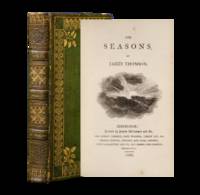
18096288Edinburgh: James Ballantyne 1809. Twelvemo 6 3/8 x 3 3/4 inches; 163 x 95 mm. iv i-xxii 2 contents verso blank 1-262 pp. Including engraved vignette title. Bound ca. 1809 in the style of or possibly by Taylor & Hessey. Full green straight-grain morocco covers elaborately bordered in gilt with gilt floral pieces. Spine with three wide raised bands decoratively tooled in gilt in compartments and lettered in gilt on the raised bands. Gilt decorated board-edges gilt ruled turn-ins marbled endpapers all edges gilt. Original booksellers printed ticket "Sold at/Barratt's Library./Bond Street Bath." on front paste-down. With a very fine contemporary fore-edge painting of 'Westminster Abbey from the River Thames' possibly by the Taylor & Hessey artist.<br /> <br /> Scottish poet James Thomson's The Seasons is a four-part pastoral poem inspired by Milton's narrative blank verse consisting of Winter 1726 Summer 1727 Spring 1728 and Autumn 1730. This edition brings all four together with a brief biography of the author. The poem would inspire painters and musicians including Gainsborough and Bach and would be translated into French and German; it was also at the center of in two legal disputes over publication copyrights.<br /> <br /> The firm Taylor and Hessey was at its height between 1808-1823 working in both publishing and fine bindings. Their work is usually identifiable from their use of colored Morocco and gilt-stamp name on the foredge of their book boards. Taylor & Hessey also employed a foredge painter whose identity remains lost but whose work predominantly features buildings and landscapes. Of the twenty-four books in American libraries studied by Weber only one exception can be found in the "copy of Mrs. Tighe's Psyche London 1811 on the fore-edge of which 'the Marlborough Gem' is painted" Weber. <br /> <br /> Provenance: Weber. 1001 Fore-Edge Paintings. Maine 1949. P. 151; Sold by Maggs of London to Mrs. Estelle Doheny June 7th 1949 her acquisition number " 6297" in ink on verso of rear blank leaf; Catalogue of the Books and Manuscripts in the Estelle Doheny Collection part III Los Angeles 1955. James Ballantyne unknown
06244Paris: Printed by P. Didot Sen. and sold by W. Edwards and Sons Halifax 1791. A Superb Early Edwards of Halifax Vellum Binding with an Edwards Fore-Edge Painting<br /> <br /> FORE-EDGE PAINTING. EDWARDS OF HALIFAX binder and artist. BIBLE IN ENGLISH. The Book of Common Prayer and Administration of the Sacraments and other Rites and Ceremonies of the Church according to the use of the Church of England: Together with the Psalter or Psalms of David. Paris: Printed by P. Didot Sen. and sold by W. Edwards and Sons Halifax 1791.<br /> <br /> Twelvemo 5 5/8 x 3 3/8 inches; 143 x 86 mm. ii title-page verso blank xxii preface & table 408 pp. <br /> <br /> With a fine contemporary fore-edge painting by Edwards of Halifax. The scene is St. Martin's Church Canterbury and shows the single figure of a cemetery worker seated on the ground and behind him a row of grave stones<br /> <br /> Full contemporary vellum covers bordered in dark blue with Greek key pattern enclosing a decorative gilt border. Smooth spine elaborately decorated in gilt with dark blue stained spine labels lettered in gilt. Gilt decorated board edges and turn-ins pink marbled endpapers all edges gilt.<br /> <br /> A wonderful example of an Edwards of Halifax ' Fore-Edge' painting on a book originally bound and sold by Edwards of Halifax.<br /> <br /> Neat ink gift inscription on second front blank "Eliz. Buckle. / April 2 1818."<br /> <br /> Provenance: Elizabeth Buckle; Tony Hattersley. <br /> <br /> Tony Hattersley was a renowned English antiquarian bookseller who retired to a giant granite mansion hidden up the valley behind Whitby Dracula's landing place. His books were sold by Bonham's in two parts. Part 1 11/09/07. Paris: Printed by P. Didot Sen. and sold by W. Edwards and Sons, Halifax, 1791 unknown
18572110502150907243Sakana Ei-ban 1857. Soft Cover. Fine. Number of books: 1 Sakana Ei-ban paperback