8 977 résultats
Bulino, 1605 circa, firmato in lastra, nell’immagine a sinistra sul basamento “C V. Sichem Sculpsit”. In alto a destra “C. Wou”. Dall’opera Historische beschrijvinge ende affbeeldinge der voorneemste hooft ketteren, so vande catholijcke, ende christelijcke kercke[…], pubblicata ad Amsterdam nel 1608 da C. van Sichem. Ottimo esemplare, impresso su carta vergata coeva, in ottimo stato di conservazione. Ritratto di David Joris, o Jan Jorisz o anche Jan Joriszoon, in latino Ioannes Davidus Georgius (Fiandre, 1501 o 1502 – Basilea, 25 agosto 1556), anabattista, noto anche come Jan van Brugge. Dopo il fallimento della rivolta di Münster, alla quale non aveva partecipato, cercò di riunire i vari gruppi anabattisti a cui si era avvicinato dal 1528-30, ma le persecuzioni colpirono duramente il movimento. In rapporti con C. S. Curione e con S. Castellione, J. Rappresenta, dell'anabattismo, la corrente mistica con tendenze apocalittiche; da ciò il carattere profetico e le "visioni" che caratterizzano i suoi scritti, tra questi il Wonderboeck, waein dat van der Werldt den Versloten gheopenbaers (in traduzione: Il libro delle meraviglie in cui viene rivelato il destino del mondo) del 1542, raffigurato nel ritratto. È ritratto a mezzobusto, con un guanto nella mano sinistra; la mano destra, nella quale tiene un garofano, è appoggiata su un libro da lui scritto e il cui titolo, Wonder Boeck, è riportato sul taglio laterale. Secondo Hollstein, la lastra fu pubblicata con testo olandese e tedesco, con bordo ornamentale, nelle edizioni del 1608; senza testo e bordo ornamentale, nell'edizione del 1677. Engraving, 1605 circa, signed at upper left of image “C V. Sichem Sculpsit”. Inscribed, in plate, upper right of image: “C. Wou:” and inscribed on the edge of book “Wonder Boeck.”. Based on a work of Jan Cornelisz Woudanus. From Historische beschrijvinge ende affbeeldinge der voorneemste hooft ketteren, so vande catholijcke, ende christelijcke kercke[…], published in Amsterdam in 1608 by C. van Sichem. Good example, printed on contemporary laid paper, with unidentified watermark, very good condition. Portrait of David Jorisz. On the table a copy of Wonder Boeck, written by him. He lets his hand, in which he holds a carnation, rest on the book; in the other has a glove. Above his head the year 1554 and his age are mentioned. David Joris, (born 1501/02, Ghent or Bruges, Flanders—died August 25, 1556, Basel, Switz.), religious reformer, a controversial and eccentric member of the Anabaptist movement. He founded the Davidists, or Jorists, who viewed Joris as a prophet and whose internal dissension led—three years after his death—to the cremation of his body after his posthumous conviction as an heretic. According to Hollstein, the plate was published with Dutch and German text, in ornamental border, used in edition of 1608; without text and ornamental border in 1677 edition.
Bulino, 1605 circa. Da un disegno di Jan Cornelisz Woudanus. Tratto da Historische beschrijvinge ende affbeeldinge der voorneemste hooft ketteren, so vande catholijcke, ende christelijcke kercke[…], pubblicato ad Amsterdam nel 1608 da C. van Sichem. Ottimo esemplare, impresso su carta vergata coeva, con filigrana non identificata, in ottimo stato di conservazione. Ritratto di Harm (Harmen) Schoemaker (Schoenmaker), un anabattista olandese. Secondo Hollstein, la lastra fu pubblicata con testo olandese e tedesco, con bordo ornamentale, nelle edizioni del 1608; senza testo e bordo ornamentale, si trova nell'edizione del 1677. Engraving, 1605 circa. Based on a work of Jan Cornelisz Woudanus. From Historische beschrijvinge ende affbeeldinge der voorneemste hooft ketteren, so vande catholijcke, ende christelijcke kercke[…], published by C. van Sichem in Amsterdam in 1608. Good example, printed on contemporary laid paper, with unidentified watermark, very good condition. According to Hollstein, the plate was published with Dutch and German text, in ornamental border, used in edition of 1608; without text and ornamental border in 1677 edition. Harm (Harmen) Schoemaker (Schoenmaker), a Dutch Anabaptist, who by his unsound bigoted fanaticism (he called himself the Messiah and even God the Father) caused a tumult at 't Zandt, Dutch province of Groningen, in January 1535. On the farm called "De Arke," owned by Eppe Pietersz, a wealthy farmer, a large crowd gathered, over 300 of whom were baptized in one night by Schoenmaker, assisted by Cornelis int Kershof. Schoenmaker was arrested and put in prison in Groningen, where he soon died insane. He clearly took the Münsterite views and initially considered himself an elect to bear the banner of God from Groningen to Münster; i.e., to be the leader of the revolutionary Anabaptists of the Groningen region to the New Zion, which Jan van Leiden had erected in Münster.
Bulino, 1605 circa, firmato in lastra, nell’immagine in basso a destra: “Christof: van Sichem Sculp: et exc:”. Da un disegno di Jan Cornelisz Woudanus, a sua volta basato su Aldegrever. Dall’opera Historische beschrijvinge ende affbeeldinge der voorneemste hooft ketteren, so vande catholijcke, ende christelijcke kercke […], pubblicato ad Amsterdam nel 1608. Ottimo esemplare, impresso su carta vergata coeva, con filigrana non identificata, in ottimo stato di conservazione. Ritratto di Giovanni di Leida (propr. Jan Buytenwech), Capo degli anabattisti di Münster (Leida 1509-Münster 1536). Secondo Hollstein, l’esemplare fu pubblicato con testo olandese e tedesco, con bordo ornamentale, nelle edizioni del 1608; senza testo e bordo ornamentale, fu pubblicato nell'edizione del 1677. Engraving, 1605 circa, inscribed, in plate, lower right of image: “Christof: van Sichem Sculp: et exc:”. Taken from a work of Jan Cornelisz Woudanus, this one based on Aldegrever’s sketch. From Historische beschrijvinge ende affbeeldinge der voorneemste hooft ketteren, so vande catholijcke, ende christelijcke kercke […], published in Amsterdam in 1608. Good example, printed on contemporary laid paper, with unidentified watermark, very good condition. According to Hollstein, the plate was published with Dutch and German text, in ornamental border, used in edition 1608; without text and ornamental border in edition 1677. Portrait of Jan van Leiden, (1509 – 1536) an Anabaptist leader from Leiden, in the Holy Roman Empire's County of Holland. Half length, directed to the right, wearing an embroidered coat, a big chain with a crucifix around his neck and a cap; holding a sceptre and orb, a book and a rolled-up sheet of paper and leaning on a balustrade; at top left there is a scroll with an orb and a crown in front of two crossed swords.
193317465Paris Imprimerie Art et Commerce 1933 1 in-folio Texte et dessins de Toe. Paris, Imprimerie Art et Commerce, 1933, in-folio, en feuilles, sous couverture grise, titre imprimé en noir.
196643825Graz, Akademische Druck- u. Verlagsanstalt, 1966. Fol. Mit 210 (1 gefalt.) Farbtafeln. VIII, 120 S., 1 Bl., OLwd. über Holzdeckeln m. illustr. OUmschlag.
Maniera nera, 1660-1670 circa, nel margine inferiore: “A van Dÿck P. ANTOINE VAN DYCK, Peintre très-celebre” e “W. Vaillant F.”. Da un autoritratto di Anton van Dyck. Ottimo esemplare, impresso su carta vergata coeva, completo oltre la linea del rame, in ottimo stato di conservazione. Wallerant Vaillant è stato un pittore, disegnatore e incisore olandese, il più famoso di una famiglia di pittori e incisori franco-olandese. Fratello di Jean e fratellastro di Jacques da Maria Warlop, apprese i rudimenti di disegno nella sua città natale. Nel 1637 divenne allievo di Erasmus Quellinus il Vecchio ad Anversa. Abbandonata la scuola di questo maestro, decise di dedicarsi alla pittura ritrattistica, maggiormente lucrativa e più adatta alle sue capacità. Nel 1647 si trasferì a Middelburg, dove divenne membro della locale Corporazione di San Luca. Nel 1652 operò ad Amsterdam e dal 1656 al 1659 a Francoforte sul Meno. In quest'ultima città dipinse parecchi ritratti di personaggi illustri e acquisì una reputazione fuori dal comune. Fu il primo artista ad utilizzare in modo professionale la tecnica del mezzotinto, che apprese quando si trovava a Francoforte sul Meno nel 1658 o forse a Londra al seguito del principe Rupert, ottenendo un grande seguito. Mezzotint, 1660-1670 circa, lettered in lower margin: “A van Dÿck P.” and “W. Vaillant F.”. Good example, printed on contemporary laid paper, trimmed close to platemark, in excellent condition. After a van Dyck’ self -portrait, with his hand on his chest looking to right, half-length. Willem or Guiliam van Nieulandt, sometimes Terranova (1584–1635) was a painter, engraver, poet and playwright from Antwerp. Having spent some time in the studio run by Jacob Savery in Amsterdam, which was followed by a lengthy stay in Rome as an assistant to Paul Bril, the artist returned to his native Antwerp in about 1605. He became a member of the local Guild of St. Luke and was granted the freedom of the city not long afterwards. According to Willem Adriaan te Slaa, this set of Views of Rome is in all probability one of van Nieulandt’s earliest printed works, dating back at 1605. New Hollstein (Dutch & Flemish) 507, copy (Van Dyck)
Bulino, 1621, monogrammato in lastra in basso a destra. Magnifica prova, impressa su carta vergata coeva, con piccoli margini, applicata su antico supporto di collezione, in ottimo stato di conservazione. Ritratto di Jan van de Velde il Vecchio inciso dal figlio. Opera rara. Engraving, 1621, signed with monogram on right plate. Magnificent work, printed on contemporary laid paper, with small margins, laid on antique collector’s paper, in excellent condition. Portrait of Jan van de Velde the Elder in an oval frame; below a crowned swan holding a pencil case in its beak; at lower centre the sitter's arms with three sheep. Lettered on the oval frame: 'T LEEFT AL VAN DE VELDE AETATIS SUAE LIII ANNO 1621'. And signed in bottom right corner: 'JV fe.' Rare. Franken & van der Kellen 40.41; Hollstein 414.II.
1924102502London: Hodder & Stoughton. n.d.1924. 1st ed. quarto original cloth boards decorated in gilt. pp viii 163 18 tipped-in colour plates with captioned tissue guards. N.d. 1924. Prev owner's signature front free endpaper spine lightly bumped otherwise near-fine condition. Kings and Queens: Khafra Pepy I. Amenemhatt III Queen Tetasheri Queen Hatshepsut Thothmes III Akhnaten; Queen Ty; Queen Nefertete; Queen Mutnezemt Sety I Rameses II Rameses III. 1st Edition. Decorated Cloth. Hodder & Stoughton hardcover
1892131205New York / London: MacMillan and Co. 1892. Limited Edition. Leather Bound. Very Good. 8vo 7.75 - 9.75'' tall. Leather Bound. Condition: Very Good. MacMillan and Co. New York / London 1892. Limited Edition. 113 pages. '200 copies of This Edition were printed on handmade paper October 1892'. First Edition. 1st Printing. Leather spine and board tips marbled boards. Nice Firm Clean copy ! Moderate general wear. Size: 8vo 7.75 - 9.75'' tall. Shortly before he died Tennyson told his son Hallam to ""put 'Crossing the Bar' at the end of all editions of my poems"". This book does not have 'Crossing the Bar.' Poetry::Before 1900 6163 6163 MacMillan and Co. hardcover
16692866A Paris, Chez François Mauger, 1669. 2 vol. in-12 de [12]-332 p. + [4]- de 333 à 651 pages. Pleine basane marron, dos à nerfs ornés de fleurons, tomaison, titre et encadrements dorés. Coiffe supérieure vol. 1 manquante, accroc à la coiffe supérieure du vol. 2, dos frottés, mors du 1er plat vol. 1 fendu, galeries de vers au bas des dos.
18951723Paris, Lib. Hachette, 1895-1896. 4 volumes in-8 de LXXXIII-372 / XVI-543 / XXXVI-526 et XXXII-548 pages, demi-percaline bordeaux, dos lisses, étiquettes de titre brunes, un brin frottées, couvertures conservées.
18422781Paris, J.-J. Dubochet et Cie, 1842. 1 vol. in-4 de [4]-LXVI-[2]-472 pages. Demi-basane blonde, dos lisse orné de fers dorés, filets dorés sur les plats. Coiffes et mors frottés, charnière du 1er plat faible.
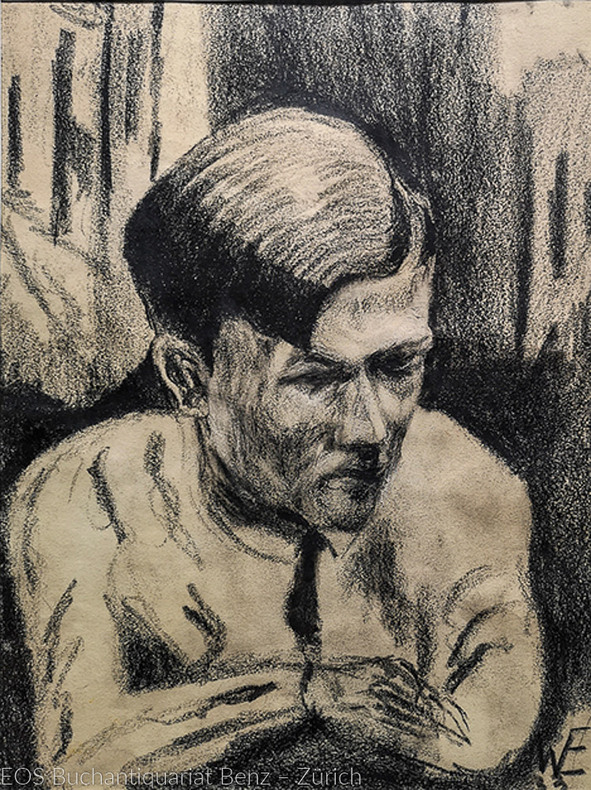
19321027DG1932. Kohle auf weissem Zeichenpapier, montiert, unten rechts monogrammiert und datiert. 65 x 50 cm.
19351029DG1935 Kohle auf weissem Zeichenpapier, unten links monogrammiert und datiert. 39,5 x 29 cm.
1933787DG1933. Kohlezeichnung. 33 x 24 cm.
1890679AGParis, 1890. Kol. Zeitungsblatt. Format: 45 x 29 cm.
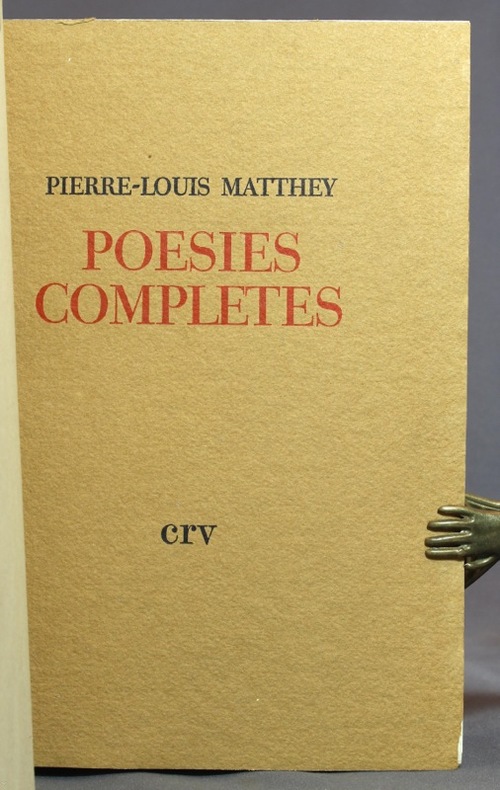
196814834Lausanne, Cahiers de la Renaissance Vaudoise, 1968. In-8 de 294-[2] pages, plein veau blond, dos à 4 nerfs orné d'un décor, de roulettes et du titre doré, pièces de titre rouges, couvertures conservées.
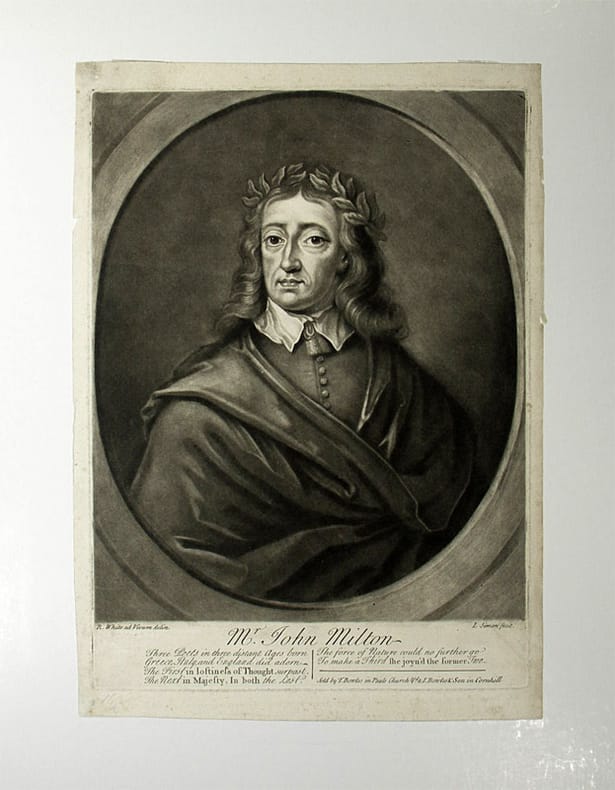
1740162CG(London), T. Bowles, o.J. (um 1740). Kupferdruck in Schabkunst von I. Simon nach Robert White. Bildgrösse: 18 (33 Platte) x 24 cm. Blattgrösse: 36 x 26 cm.
1820688DB2 (Tafel-) Bände. O.O., (um 1820). Kl.-4°. Mit 62 Portrait-Kupfertafeln von Heinrich Pfenninger. Pappbände der Zeit.
1791192CGLondon, John Hall, 1791. Kupferstich von John Hall nach Josua Reynolds. Bild- u. Blattgrösse: 49 x 36 cm.
9988London: Printed for T. Payne Mews Gate; J. Edwards Pall-Mall; W. Otridge and Son Strand; and R. Faulder New Bond Street. 1793. 4to xiv 479 Appendix: 56 Index: lxxx pp. Uncut in original quarter-binding of grey paper boards and green cloth spine with chipped red paper label gilt 'CATALOGUE OF BRITISH PORTRAITS'. Internally sound and tight on aged paper apart from detached half-title and flyleaf. In worn boards with closed tears to hinges. Ownership inscription of 'F. Walker' on flyleaf and armorial bookplate of Captain Neville Rodwell Wilkinson Ulster King of Arms and Principal Herald of All Ireland on front pastedown. Annotated throughout in a contemporary hand making brief additions to entries and giving notes of prices fetched at auction for example 'at Kings 1 - 11. 6 Gs. 2. 8. 0'. and 'W L with the Book of prints 3: 3: 0 - 2: 14: 0 Edward Brother to Edmd Kneeling'. Loosely inserted is a corrected typescript possibly by Wilkinson headed 'PREFACE: Authors to a book on 'the glories of great palaces'' and written in an entertaining style with reference 'the unscientific picture-lover whose quiet waters of contemplation will be stirred by the squalls of controversy'. London: Printed for T. Payne, Mews Gate; J. Edwards, Pall-Mall; W. Otridge and Son, Strand; and R. Faulder, New Bond Street. 179 hardcover
16361486-16[Augsburg, Kilian 1636]. Orig.-Kupferstich. 25 x 16 cm. Geglätteter Mittelfalz. Knapp zu den Rändern beschnitten.
191528732nantes 1915-16 1 Carnet demi toile, format 25,5 x 16,5 cm, 1ère de couverture orné en partie haute d'une carte de visite de l'UNION ARTISTIQUE DE BRETAGNE NANTES, ainsi qu'un tampon de la meme societé imprimé en partie basse, titré au centre de facon manuiscrite à l'encre noir en lettres epaisses : REFERENCES, CARNET DE REPRESENTANT DE L'UNION ARTTISTIQUE DE BRETAGNE VENDANT AUX DIFFERENTES COMMUNES DE BRETAGNE DES PORTRAITS COMMEMORATIFS DES MORTS DES SOLDATS DE LA GRANDE GUERRE, CONTENANT 13 LETTRES DE REMERCIEMENTS (PROVENANT DE VENDEE, MAYENNE, LOIRE-ATLANTIQUE, DEUX-SEVRES) SERVANT DE REFERENCES : DE PARTICULIERS ET MAIRIES AYANT FAIT APPEL A LEUR SERVICES ET EN ONT ETE TRES CONTENTS + 10 PAGES EXTRAITES ET CERTIFIEES CONFORME ET SIGNEES PAR LE DIRECTEUR MR DANIEL, AU LIVRE D'OR DE L'ETABLISSEMENT DANIEL - PHOTOS ET AGRANDISSEMENTS ARTISTIQUES, 105 BD ST DENIS - PARIS (SOIT 35 REMERCIEMENTS TIRES, VENANT DE TOULON, NICE, ORAN, MAYENNE, MANCHE, VENDEE, LOIRE-ATLANTIQUE, ILLE-ET-VILAINE, ) 1915-1916
Format: 365 x 250 mm (bis an den Bildrand beschnitten). *Dargestellt ist Gabriel Bodenehr der Ältere" (geb. 1673 [nicht 1664] in Augsburg; gest. 1765), ein deutscher Verleger, Kartograph und Kupferstecher, der Stadtansichten zahlreicher deutscher Städte schuf. Beruht auf einem Selbstbildnis von 1652, sein gleichnamiger Sohn Gabriel Bodenehr (1705-1792) hat die Platte überarbeitet und verändert. Die Darstellung enthält unten eine Gedenkwidmung mit den Lebensdaten 1673 - 1765 sowie dem Widmungstext: "Nun lieber Ehrengreiß Dein sechszig jähriger Sohn hat Dir dein Bildnis hier in Kupffer eingegraben. Das sollst du jetzt von ihm zum letzten Denkmahl haben". Der Sohn griff dabei auf eine frühere Kupferplatte des Vaters zurück, auf welcher dieses Bildnis des Vaters schon gestochen war. Er hat die Platte verändert oder neu gestochen. So trägt z.B. der Kopf nun eine Haube (zuvor eine größere Pelzmütze). In der Literatur werden die Lebensdaten von Gabriel Bodenehr bis heute sehr unterschiedlich genannt (so wird als Geburtsjahr oft 1664 und als Todesjahr auch 1758 genannt. Anhand des vorliegenden wohl recht seltenen Blattes im Todesjahr lassen sich die Lebensdaten nun eindeutig verifizieren. Graphiken de
Format (Platte): 28 x 20,5 cm. Blatt: 37 x 28 cm. *Karl Ludwig Bernhard Christian Buchhorn (1770-1856 in Berlin) war ein deutscher Maler und Graphiker. Zwischen 1790 und 1793 war Ludwig Buchhorn an der Kunstakademie von Berlin und dort u. a. Schüler bei Joseph Darbes (Bildnismalerei) und vor allem Daniel Berger (Kupferstich). Neben Aquatinta und Lithographien übernahm Buchhorn von seinen Dozenten auch die Technik im Crayon-Stils. 1811 nahm ihn die Akademie als ordentl. Mitglied auf und berief ihn drei Jahre später als Dozent für Zeichnen und Kupferstich. Im Jahr 1814 gründete Buchhorn zusammen mit einigen Kollegen den Berlinischen Künstler-Verein, 1824 Leitung der Akademischen Kupferstecherschule. Beeinflusst durch Franz Krüger und Johann Gottfried Schadow fand Buchhorn bald zu einem eigenen Stil und arbeitete in seinen späten Werken immer mehr „nach der Natur“. Buchhorn wurde mit der Zeit, neben Schadow, zu einem der bedeutenderen Zeichnern in Berlin. - Der dargestellte Gottlieb Hiller (1778-1826) aus Sachsen war ein einfacher Knecht und Tagelöhner. Durch Wielands Lyrik angeregt, begann er Gedichte zu schreiben, die von seinem Förderer und Herausgeber Ludwig Gustav Bäntsch verbreitet wurden. Das aufflackernde Interesse an dem kuriosen "Naturdichter" Hiller verschwand aber ebenso schnell wie es entstanden war. - Schöner kräftiger Abzug mit vollem Rand. Graphiken de