8 974 résultats
7815o.J. Hardcover
Format Plattenrand: 29 x 24 cm. (Blattgröße: 45,5 x 32,5 cm). Gedruckt auf kräftiges Büttenpapier mit Wasserzeichen "Van Gelder Zonen", unten mittig mit kleinem Blindprägestempel "Photographische Gesellschaft Berlin". *Schönes ausdrucksstarkes Porträt. - Die "Photographische Gesellschaft Berlin" war ein Kunstverlag, gegr. 1862 von Emil und Albert Werckmeister. Zunächst wurden klassische Kupferstiche in Photographie veröffentlicht und Reproduktionen direkt nach Ölgemälden. Gegen Ende des 19. Jahrh. leistete die Firma Hervorragendes in der Technik der Photogravüre. Galeriewerke und zahlreiche Einzelbilder wurden per Kataloge an Kunsthandlungen vertrieben. Die Photogravüre (auch Heliogravüre genannt), war ein fotografisches Edeldruckverfahren im Tiefdruck auf gelatinebeschichtete Kupferplatten (ein Vorläufer des späteren Kupfertiefdrucks). Als eine Weiterentwicklung des alten Aquatinta-Verfahrens schon in der ersten Hälfte des 19. Jahrh. begonnen, wurde es mit der Heliogravüre möglich, Fotos und Illustrationen durch ein aufwendiges fotomechanisches Druckverfahren so zu reproduzieren, dass sich echte und sehr differenzierte Halbtöne darstellen und eine ausdrucksstarke plastische Tiefenwirkung des Bildes erzeugen lassen. Mit den technischen Verbesserungen gegen Ende des 19. Jahrh. wurde die Heliogravüre das beherrschende graphische Verfahren insbesondere für anspruchsvolle und künstlerische Photographie und andere Bildvorlagen. - Vollrandiges Blatt in sehr guter Erhaltung. Graphiken de
18600427-22Berlin, J. Hesse [um 1860]. Lithographie. 30, 8 x 23, 8 cm. (Blattgr.). Gut erhalten, oberer rechte Ecke mit Nummer in Tinte. - (aus: A. H. Payne, Pracht-Album für Theater & Musik, Bd. 2, Leipzig/Dresden 1861)
Une seule affiche de dimensions 45 x 64 cm; impression offset sur vélin fort Parfait état. Voir photo. Peu fréquente.
193360942Leipzig : Koehler & Amelang 1933. 280 S. : 2 Taf. ; 8°, Schrift: Fraktur / Altdeutsche Schrift. gebundene Ausgabe, Leinen, Leinenrücken bräunlich, Einband fleckig, sonst Exemplar in gutem Erhaltungszustand
Ritratto di Carlo II d'Austria. Bulino, 1568 circa, firmato in lastra in basso al centro. Magnifica prova, ricca di toni, impressa su carta vergata coeva, rifilata al rame, piccolo restauro all'angolo superiore destro, per il resto in ottimo stato di conservazione. L'opera appartiene alla rara raccolta Ritratti di alcuni prencipi, et huomini illustri o Imagines quorundam principum et illustrium virorum pubblicata a Venezia da Bolognino Zaltieri nel 1568. Carlo II Francesco d'Austria (Vienna, 3 giugno 1540 – Graz, 10 luglio 1590) è stato arciduca d'Austria, membro della dinastia degli Asburgo e ha governato sull'Austria Interiore dal 1564 alla morte. Timbro di collezione di Friedrich August II de Saxe (Lugt 971) all'angolo inferiore destro. Portrait of Charles, Margrave of Burgau, half-length in profile to the left, wearing armour and sash; in lettered oval within a decorative setting wth scrolls, angels and hybrid figures. Engraving, circa 1568, lettered around the oval with title and with production detail "Dmco. Zenoi f. - Cum privilegio". A fine impression, printed on contemporary laid paper, trimmed to the platemark, a small repair at the upper left corners, otherwise very good. From the Ritratti di alcuni prencipi, et huomini illustri also titled Imagines quorundam principum et illustrium virorum published by Bolognino Zaltieri in Venice in 1568. Collector's mark - at the lower right corner - of Friedrich August II de Saxe (Lugt 971). Rare.
Ritratto di Carlo II di Spagna, firmato da Nicolò Billy “il vecchio”. L’opera appartiene ad una rarissima serie di incisioni di personaggi illustri, probabilmente mai pubblicata come raccolta. Non è noto sapere il numero delle incisioni che compongono la raccolta; sicuramente molto più delle 8 tavole - tra l’altro, erroneamente attribuite a Nicolò Billy “il giovane” - nel catalogo dell’Istituto d'Arte "Duccio di Buoninsegna" di Siena, che apparentemente possiede la collezione più grande di questi bellissimi ritratti. Solo uno dei ritratti è tra gli 11 in nostro possesso. Pertanto, il numero delle lastre conosciute sale, quantomeno, a 18. Nicolò o Nicola Billy “il vecchio” fu incisore, calcografo e mercante di stampe, occasionalmente anche disegnatore. Di origine francese, legato a Giacomo (Jacques Belly) e Vincenzo Billy, a lui affini per attività, fu attivo a Roma dalla fine del Seicento alla prima metà del Settecento. Apparentemente il primo della dinastia; poco chiari i repertori tanto sul genere e sugli estremi cronologici della sua attività, quanto sui rapporti che lo legarono ai figli Antonio e Nicola. Quale "intagliatore e mercante di stampe" sottoscrisse "vicino all'Orologgio della Chiesa Nuova", "a San Salvatore di Lavoro" e "vicino a Pasquino". Quale incisore lavorò per i più abili mercanti di stampe romani, da Giovanni Marco Paluzzi a Vincenzo Billy "alla Chiesa Nuova", dal Komarek ai molti membri della calcografia De Rossi "alla Pace": vasta fu la produzione incisoria, talora dai repertori ignorata o talora (tranne le generiche assegnazioni del Gori Gandellini, 1771, che gli dà come collaboratore il figlio Antonio) confusa con quella del figlio Nicola, anche per l'identità di firma. Il carattere più artigianale che artistico, la resa diseguale, l'incisione a tratti spesso rozzi e sbrigativi, può far attribuire al Billy un gruppo di stampe: soggetti religiosi e ritratti in specie. Come editore ristampò molte delle opere di Pietro Testa. Acquaforte e bulino, 1685 circa firmata in lastra in basso. Magnifica prova, ricca di toni, impressa su carta vergata coeva, con margini, in perfetto stato di conservazione. Molto rara. Bibliografia Fabia Borroni, BILLY, Nicola, il Vecchio in “Dizionario Biografico degli Italiani” - Volume 10 (1968); Ch. Le Blanc, Manuel de l'amateur d'estampes, I, Paris 1854, p. 340, con un elenco di 47 pezzi ascrivibili ai due Nicola Billy. Portrait of Charles II of Spain, signed by Nicolò Billy "the elder". The work belongs to a very rare series of engravings of famous people, probably never published as a collection. It is not known how many engravings compose the collection; certainly, far more than the 8 plates -among other things, erroneously attributed to Nicolò Billy "the younger" - in the catalog of the "Duccio di Buoninsegna" Art Institute in Siena, which apparently own the largest collection of these beautiful portraits. Only one of the portraits is among the 11 in our possession. Therefore, the number of known plates rises, at the very least, to 18. Nicolò or Nicola Billy “the elder” was an engraver, publisher and print dealer, occasionally also a draughtsman. Of French origin, related to Giacomo (Jacques Belly) and Vincenzo Billy, who were related to him in activity, he was active in Rome from the late seventeenth Century to the first half of the eighteenth Century. Apparently the first of the dynasty; unclear repertoires as much on the genre and chronological extremes of his activity as on the relations that bound him to his sons Antonio and Nicola. As an "engraver and merchant of prints," he subscribed near the “Orologgio della Chiesa Nuova”, “in San Salvatore di Lavoro” and “vicino a Pasquino”. As an engraver he worked for the most skilled Roman print dealers, from Giovanni Marco Paluzzi to Vincenzo Billy “alla Chiesa Nuova”, from Komarek to many members of the De Rossi Family “alla Pace”: vast was his engraving production, sometimes ignored by the repertories or sometimes (except for the generic assignments of Gori Gandellini, 1771, which gives him as collaborator his son Antonio) confused with that of his son Nicola, also because of the identity of signature. The more artisanal than artistic character, the uneven rendering, the engraving with often crude and hasty strokes, may attribute a group of prints to Billy: religious subjects and portraits in particular. As a publisher he reprinted many of Pietro Testa's works. Etching and engraving, 1685 circa, signed in plate at the bottom. Magnificent proof, rich in tone, impressed on contemporary laid paper, with margins, in perfect condition. Very rare. Bibliografia Fabia Borroni, BILLY, Nicola, il Vecchio in “Dizionario Biografico degli Italiani” - Volume 10 (1968); Ch. Le Blanc, Manuel de l'amateur d'estampes, I, Paris 1854, p. 340, con un elenco di 47 pezzi ascrivibili ai due Nicola Billy.
GF16694Notice biographique et portrait gravé parus dans la Galerie des Contemporains Illustres publié à Paris chez Ducrocq - sd - (vers 1850) - Plaquette in12 brochée de 36 pages + portrait en frontispice (sans couverture, à relier) - trés bon état -
15586Beau portrait. Beau tirage XVIIIè sur vergé. en feuille Très bon 15 x 11 cm
1868102071868 1 Paris, Michel Lévy, 1868, in-8, broché, couverture illustrée et imprimée en noir, 15 planches.
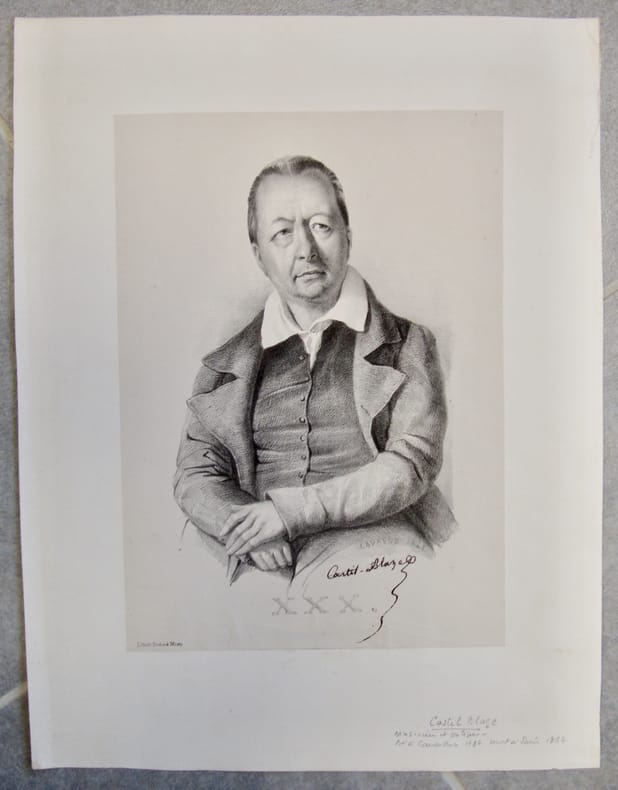
18415252Beau portrait imprimé à Montpellier, du musicographe né à Cavaillon en 1784 et mort à Paris en 1857. Épreuve sur Chine contrecollée. En feuille Très bon Montpellier Boehm 1841 39 x 31
15134, Aetas Aurea, Vol. XVI , Cloth bound with dusjacket, as new !!, 2002. 4to., 542 pp. text, 378 ill. (33 full-page colourplts). ISBN 9070288370.
127723aaf1756, 30x20 cm (Lichtmass), Brustbild en face, mit dem Wappen der Familie THOMANN in einer Wappenkartusche. Gerahmt. - Unter Glass in Schwarzer Holzrahmen. Ca. 45 x 33 cm.
Incisione tratta dalla celebre raccolta Icones principum, virorum, doctorum, pictorum, chalcographorum, di Anton van Dyck, edita per la prima volta ad Anversa verso il 1640. Opera celebre ed importante, vero monumento dell’arte incisoria fiamminga del sec. XVIII, contiene le biografie ed i ritratti degli uomini illustri che Van Dyck aveva conosciuto e con i quali aveva avuto importanti rapporti. L’artista ne eseguì le effigi in numerosi dipinti e disegni che poi decise di pubblicare, affidandone la trasposizione calcografica ai migliori incisori del suo tempo, come Bolswert, Pontius, Vorsterman, de Jode, Hollar, molti dei quali aveva avuto come condiscepoli nell’atelier di Rubens. "Sir Anthony Van Dyck stands out as the solitary great etcher of the school. Portrait etching had scarcely had an existence before his time, and in his work it suddenly appears at the highest point ever reached in the art" (Hind, p. 165). "The plan of this publication took shape after Van Dyck returned from Italy (1626) and before he went to England (1632). He made careful preparatory drawings in chalk and brush for the publication. He directed and revised the work of the engravers, the best of the Rubens circle; he collaborated with his etching needle in some of the plates and himself etched the most beautiful set, mainly portraits of artists. One of the most brilliant in human characterization is the portrait of Peter Brueghel the Younger, son of the great Peasant Brueghel. It is remarkable that the etching appeared in this sketchy form in the book, proving that the master regarded it as finished. All interest is focussed on the wonderful had. The first edition was published in Antwerp in 1635-1636. Yet it was not complete, and the title-page did not appear before the Gillis Hendricx edition of 1645, engraved by Jacob Neels" (Benesch, Artistic and Intellectual Trends, p. 32.) Hofer, Baroque Book Illustrations 132. Acquaforte con ritocchi al bulino, stampata su carta vergata coeva, filigrana del “giullare”, con margini, in ottimo stato di conservazione. Etching and engraving, circa 1645, signed on plate at lower edge. A fine impression, printed on contemporary laid paper, with margins, very good condition. From Icones principum, virorum, doctorum, pictorum, chalcographorum by Anton van Dyck, printed for the first time in Antwerp, 1645. A famous and important work, a real monument of the Flemish engraving art of the XVIII century, containing the biographies and portraits of the famous artists Van Dyck had met and with whom he had worked. Following the success of his portrait paintings and in the tradition of Italian and Flemish portrait series, Van Dyck decided to organise a print publication containing portraits of the most prominent men during his lifetime, divided into three categories: princes, politicians and soldiers (16), statesmen and scholars (12), artists and art connoisseurs (52). The initial idea could have been that Van Dyck would etch the faces (a process possibly learnt from Vorsterman) while others would finish the plates in engraving. Designs were needed for the plates and several drawings and oil sketches (grisailles, sometimes in different versions) have survived. Van Dyck only etched 17 plates himself, while he commissioned others to complete the set, overseen by Lucas Vorsterman I (especially after Van Dyck settled in England in the Spring of 1632). Although this project was started by Van Dyck around 1630, he never saw it completed. The Antwerp publisher Maarten van den Enden may have been involved from the start as eighty early impressions bear Van den Enden's address. They are engraved by Paulus Pontius (30 plates), Lucas Vorsterman I (22), Pieter de Jode II (12), Schelte a Bolswert (7), Robert van Voerst (4), Willem Hondius (2), Willem Jacobsz Delff (1), Cornelis Galle (1), and Nicolaes Lauwers (1). It is known that Van den Enden was in debt to Gillis Hendricx around 1644, the Antwerp publisher who must have obtained Van den Enden's plates which he published in 1645 in the first edition of these plates (containing between 100 and 104 portrait plates). Hendricx continued to publish these plates until his death in 1677 when they were auctioned off by the St Luke guild (keeping the Iconography plates together). It is not clear who bought these plates but they re-appeared around 1720 when they were published by Hendrick and Cornelis Verdussen in Antwerp.
374P., 1930. In 4° broché, couverture rempliée, 132 pp. et 64 planches.
375P., Petit, 1928. In 4° broché, couverture rempliée, 112 pp. et 56 planches, dos défraîchi.
15542Princesse de Navarre, 1558-1604. Beau portrait. Beau tirage XVIIIè sur vergé. en feuille Très bon 15 x 11 cm
15549seconde femme de Pierre Le Grand, morte en 1727. Beau portrait. Beau tirage XVIIIè sur vergé. en feuille Très bon 15 x 11 cm
15562Comtesse d'Olonne. Beau portrait. Beau tirage XVIIIè sur vergé. en feuille Très bon 15 x 11 cm
1902GITg063Auch Imprimerie Léonce Cochanaux 1902. In-8 broché XXXVII 309pp imprimées sur 2 colonnes 1 feuillet non chiffré table. Dos bruni, intérieur frais et bien complet.
Four volumes, complete. THE MONUMENTAL CATALOGUE OF BERALDI'S PRINT COLLECTION, ONE OF THE GREATEST EVER ASSEMBLED. A comprehensive array of 18th and 19th century French prints, with a few 17th century items as well. Volume I: 266 lots, 32 full-page facsimile plates; Volume II: 329 lots, 56 plates; Volume III: 200 lots, 40 plates; Volume IV: 360 lots, 64 plates. Printed on very good paper throughout, with absolutely no discoloration or foxing. 4to. Original wraps. UNCUT. Spines somewhat worn but structurally solid, else FINE AND BRIGHT. A rare set.
[iv],395,[1]pp., title-page and prelims spotted, cont. cloth-backed boards, spine a little frayed, printed paper label to spine, 11,756 items. Caption title, 'Catalogue of prints, part iv. Forming the first part of a catalogue of portraits...' A second part was issued in 1853.
197375741London, Sotheby & Co, 1973. Original-Broschur, kl.4°, 76 Seiten. Day of saile: 21th of June 1973. Mit 69 Abbildungen.
19,[1]pp., 278 lots. 2 Works bound as one, presentation inscription from Bullock to William Upcott, cont. half morocco, marbled boards, rubbed, head of spine torn.
189045298Washington DC: np 1890. 8vo. 16 pp. printed double-column. Original printed pink wrappers margins badly chipped but not the text stitched. First edition. Describes 967 items usually with a simple single line. OCLC locates six copies Buffalo/Erie County Public New York Historical Society George Washington Abraham Lincoln Presidential Center National Archives Western Reserve Historical Society. <br/><br/> np unknown books