TALLEMANT DES REAUXLivre Rare Book
8 974 résultats
24709Albin Michel IV-349+363 pages collection Chroniques indiscrètes et galantes d'autrefois. Paris. in-8. Sans date. Demi-Cuir ornés de motifs dorés aux dos. IV-349+363 pages. Avec appendices et notes par A. Meyrac - Avec de nombreuses gravures en noir - L'ouvrage 'Rois grandes dames et beaux esprits d'autrefois' est une sélection tirée des 'Historiettes' de Tallemant des Réaux présentant des portraits et anecdotes sur les personnalités marquantes de la société parisienne entre la fin du règne d'Henri IV et le début de celui de Louis XIV. L'auteur y mêle observations pertinentes et détails souvent crus ou piquants sur les mœurs de l'époque
Bulino, 1572 circa, tratta da Pictorum Aliquot Celebrium Germaniae Inferioris Effigies. Primo stato. La prima edizione viene pubblicata dalla vedova di Hieronymus Cock ad Anversa nel 1572. Pictorum aliquot celebrium Germaniae inferioris effiges, una serie di 23 ritratti di artisti dei Paesi Bassi, è pubblicato nel 1575 con imprint “In de Vier Winden”, una delle principali stamperie di Amsterdam. Sebbene alcuni abbiano suggerito che la serie è stata concepita dall'umanista Dominicus Lampsonius, che ha composto versi per accompagnare i ritratti, è più probabile che l'autore sia stato Hieronymus Cock, il fondatore della tipografia con sede “In de Vier Winden”. La serie è apparsa in un momento in cui l'interesse per la vita degli artisti stava crescendo e di conseguenza ha attraversato diverse edizioni e interpretazioni di altri editori. Ottime condizioni. Engraving, 1572 circa, from Pictorum Aliquot Celebrium Germaniae Inferioris Effigies. First state. The first edition published by the widow of Hieronymus Cock in Antwerp in 1572. The Pictorum aliquot celebrium Germaniae inferioris effiges, a series of 23 portraits of artists from the Low Countries, published in 1575 by In de Vier Winden, a leading Amsterdam printing house. Although some have suggested that the series was conceived by the humanist Dominicus Lampsonius, who composed verses to accompany the portraits, the author is more likely to have been Hieronymus Cock, the founder of In de Vier Winden. The series appeared at a time when interest in the lives of artists was growing and consequently went through multiple editions and reinventions by other publishers. Very good condition.
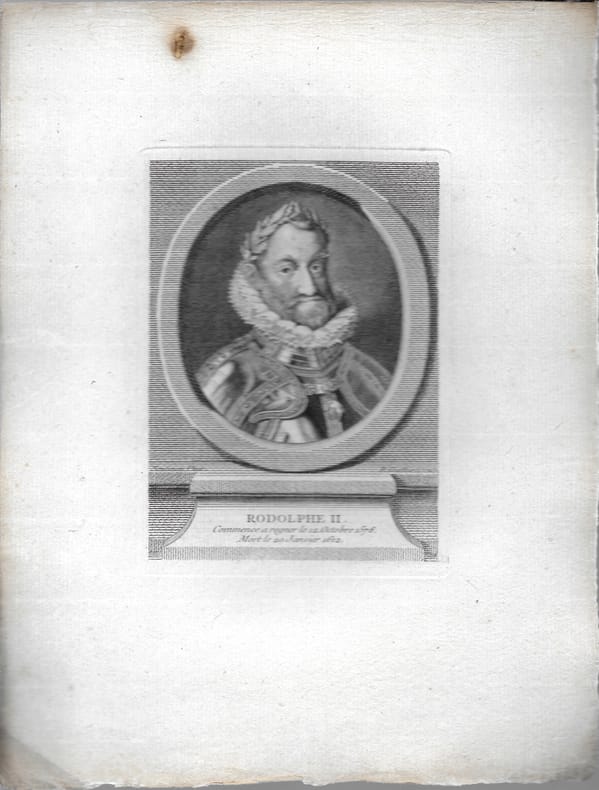
11459Empereur du Saint-Empire En feuille Très bon XVIIIè Feuille 27 x 21 cm
127714aaf1756, 30x20 cm (Lichtmass), Brustbild en face mit Pelzkragen und Kette, mit dem Wappen der Familie Meiss in einer Wappenkartusche. Gerahmt. - Unter Glass in Schwarzer Holzrahmen. Ca. 45 x 33 cm.
127719aaf1756, 30x20 cm (Lichtmass), Brustbild en face mit Pelzkragen, mit dem Wappen der Familie ÄSCHER in einer Wappenkartusche. Gerahmt. - Unter Glass in Schwarzer Holzrahmen. Ca. 45 x 33 cm.
127736aaf1756, 30x20 cm (Lichtmass), Brustbild en face, mit dem Wappen der Familie CHAAM in einer Wappenkartusche. Gerahmt. - Unter Glass in Schwarzer Holzrahmen. Ca. 45 x 33 cm.
19852020655Pasadena CA: Twelvetrees Press 1985. Second Edition. Hardcover. Near Fine/near fine. Folio unpaginated cloth spine and dj bumped with wear. <br/><br/>"Certain Mapplethorpes" a preface by Susan Sontag: "Mapplethorpe wants to photograph everything: that is everything that can be made to pose. . What he looks for which could be called Form is the quiddity or isness of something. Not the truth about something but the strongest version of it." One of 5000 casebound copies. Twelvetrees Press hardcover
Portfolio, 8 parts, 35 plates Hardcover Very good condition, complete as issued
15484Beau portrait. Beau tirage XVIIIè sur vergé. en feuille Très bon 20 x 14 cm (28 x 21,5 cm la feuille)
15520Comte de Leicester. Beau portrait. Beau tirage XVIIIè sur vergé. en feuille Très bon 20 x 14 cm (28 x 21,5 cm la feuille)
36258Bernard Grasset. 1955. Les Cahiers Verts -30-. In-12. Br. couv. rempliée. 251 p. BE.
197312363Galerie nationale du Canada Petit in-4 carré Couverture souple Ottawa 1973
Incisione tratta dalla celebre raccolta Icones principum, virorum, doctorum, pictorum, chalcographorum, di Anton van Dyck, edita per la prima volta ad Anversa verso il 1640. Opera celebre ed importante, vero monumento dell’arte incisoria fiamminga del sec. XVIII, contiene le biografie ed i ritratti degli uomini illustri che Van Dyck aveva conosciuto e con i quali aveva avuto importanti rapporti. L’artista ne eseguì le effigi in numerosi dipinti e disegni che poi decise di pubblicare, affidandone la trasposizione calcografica ai migliori incisori del suo tempo, come Bolswert, Pontius, Vorsterman, de Jode, Hollar, molti dei quali aveva avuto come condiscepoli nell’atelier di Rubens. "Sir Anthony Van Dyck stands out as the solitary great etcher of the school. Portrait etching had scarcely had an existence before his time, and in his work it suddenly appears at the highest point ever reached in the art" (Hind, p. 165). "The plan of this publication took shape after Van Dyck returned from Italy (1626) and before he went to England (1632). He made careful preparatory drawings in chalk and brush for the publication. He directed and revised the work of the engravers, the best of the Rubens circle; he collaborated with his etching needle in some of the plates and himself etched the most beautiful set, mainly portraits of artists. One of the most brilliant in human characterization is the portrait of Peter Brueghel the Younger, son of the great Peasant Brueghel. It is remarkable that the etching appeared in this sketchy form in the book, proving that the master regarded it as finished. All interest is focussed on the wonderful had. The first edition was published in Antwerp in 1635-1636. Yet it was not complete, and the title-page did not appear before the Gillis Hendricx edition of 1645, engraved by Jacob Neels" (Benesch, Artistic and Intellectual Trends, p. 32.) Hofer, Baroque Book Illustrations 132. Acquaforte con ritocchi al bulino, stampata su carta vergata coeva, filigrana del “giullare”, con margini, in ottimo stato di conservazione. Etching and engraving, circa 1645, signed on plate at lower edge. A fine impression, printed on contemporary laid paper, with margins, very good condition. From the Icones principum, virorum, doctorum, pictorum, chalcographorum by Anton van Dyck, printed for the first time in Antwerp, 1645. A famous and important work, a real monument of the Flemish engraving art of the XVIII century, containing the biographies and portraits of the famous artists Van Dyck had met and with whom he had worked. Following the success of his portrait paintings and in the tradition of Italian and Flemish portrait series, Van Dyck decided to organise a print publication containing portraits of the most prominent men during his lifetime, divided into three categories: princes, politicians and soldiers (16), statesmen and scholars (12), artists and art connoisseurs (52). The initial idea could have been that Van Dyck would etch the faces (a process possibly learnt from Vorsterman) while others would finish the plates in engraving. Designs were needed for the plates and several drawings and oil sketches (grisailles, sometimes in different versions) have survived. Van Dyck only etched 17 plates himself, while he commissioned others to complete the set, overseen by Lucas Vorsterman I (especially after Van Dyck settled in England in the Spring of 1632). Although this project was started by Van Dyck around 1630, he never saw it completed. The Antwerp publisher Maarten van den Enden may have been involved from the start as eighty early impressions bear Van den Enden's address. They are engraved by Paulus Pontius (30 plates), Lucas Vorsterman I (22), Pieter de Jode II (12), Schelte a Bolswert (7), Robert van Voerst (4), Willem Hondius (2), Willem Jacobsz Delff (1), Cornelis Galle (1), and Nicolaes Lauwers (1). It is known that Van den Enden was in debt to Gillis Hendricx around 1644, the Antwerp publisher who must have obtained Van den Enden's plates which he published in 1645 in the first edition of these plates (containing between 100 and 104 portrait plates). Hendricx continued to publish these plates until his death in 1677 when they were auctioned off by the St Luke guild (keeping the Iconography plates together). It is not clear who bought these plates but they re-appeared around 1720 when they were published by Hendrick and Cornelis Verdussen in Antwerp. "Sir Anthony Van Dyck stands out as the solitary great etcher of the school. Portrait etching had scarcely had an existence before his time, and in his work it suddenly appears at the highest point ever reached in the art" (Hind, p. 165). "The plan of this publication took shape after Van Dyck returned from Italy (1626) and before he went to England (1632). He made careful preparatory drawings in chalk and brush for the publication. He directed and revised the work of the engravers, the best of the Rubens circle; he collaborated with his etching needle in some of the plates and himself etched the most beautiful set, mainly portraits of artists. One of the most brilliant in human characterization is the portrait of Peter Brueghel the Younger, son of the great Peasant Brueghel. It is remarkable that the etching appeared in this sketchy form in the book, proving that the master regarded it as finished. All interest is focussed on the wonderful had. The first edition was published in Antwerp in 1635-1636. Yet it was not complete, and the title-page did not appear before the Gillis Hendricx edition of 1645, engraved by Jacob Neels" (Benesch, Artistic and Intellectual Trends, p. 32.) Hofer, Baroque Book Illustrations 132.
Bulino, 1611, firmato sotto l'immagine “S. C. M.tis Scultore Aeg. Sadeler ad vivium / delineavit, et DeD: Pragae 1611”. Secondo stato, con l'excudit di Marco Sadeler aggiunto in basso a destra: “Marco Sadeler excudit”. Nella cornice ovale, l'iscrizione latina “Vincentius Muschinger in Gumpendorff Rudol II Imperat et Mathiae II reg Hung et Bohem consiliarius cam Aulicus necnon Maximil Archid Aust a consil”. Bell’esemplare, impresso su carta vergata coeva, applicato su antico support cartaceo con triplice cornice, minime fioriture, nel complesso molto buono lo stato di conservazione. Ritratto di Vincenz Muschinger von Gumpendorff (m. 1628), consigliere degli imperatori Rodolfo II e Mattia che nel 1611, data di questa stampa, era re di Ungheria e Boemia. Un disegno preparatorio per la stampa è conservato a Parigi (EBA, M.576). Engraving, 1611, signed under the image “S. C. M.tis Sculptor Aeg. Sadeler ad vivium/ delineavit, et DeD: Pragae 1611”. Second state, with the excudit by Marco Sadeler added at bottom right “Marco Sadeler excudit”. In the oval frame, the Latin inscription “Vincentius Muschinger in Gumpendorff Rudol II Imperat et Mathiae II reg Hung et Bohem consiliarius cam Aulicus necnon Maximil Archid Aust a consil”. Good example, printed on contemporary laid paper, applied on old paper support with frames, occasional foxing, in very good condition. Portrait of Vincenz Muschinger von Gumpendorff (d. 1628), counsellor to the Emperors Rudolf II and Matthias – in 1611, the date of this print, the latter was King of Hungary and Bohemia. Half length portrait, bearded, with wing collar, brocade doublet, chains and large waist sash. A preparatory drawing for the print is in Paris (EBA, M.576). Hollstein 313.I
Acquaforte e bulino, circa 1625. Magnifica prova, impressa su carta vergata coeva applicata su antico supporto di collezione, con piccoli margini, tracce di colla agli angoli, per il resto in eccellente stato di conservazione. Celebre per i suoi ritratti di tutta l’aristocrazia romana degli inizi del XVII secolo, il Leoni, romano di nascita, deve il suo soprannome alla città natale del padre, anch’egli pittore di ritratti. Etching and engraving, circa 1625. Magnific impression on contemporary paper, laid down on antique paper, with small margins, in good condition. Famous for his portraits of all the Roman aristocracy in the early seventeenth century, Ottavio Leoni, Roman by birth, owes its nickname to the birthplace of his father, also a painter of portraits. Bartsch 11
Acquaforte e bulino, 1625, ante litteram. Magnifica prova del raro primo stato di due, avanti la firma e la data, impressa su carta vergata coeva, rifilata al rame, in eccellente stato di conservazione. Disegnatore, pittore e stampatore, figlio del padovano Ludovico Leoni (1542–1612), un fabbricante di medaglie e di ritratti a rilievo su cera, da cui il soprannome "Padovanino". Celebre per i suoi ritratti di tutta l’aristocrazia romana degli inizi del XVII secolo, il Leoni, romano di nascita, deve il suo soprannome alla città natale del padre, anch’egli pittore di ritratti. Controversa l'identità del volto raffigurato: secondo il Mariette, grande appassionato di disegni ed incisioni del Leoni, si tratterebbe di Mario Nuzzi detto “Mario de’ Fiori”, mentre più ragionevolmente si tratta del suo amico Tommaso Salini, ipotesi confermata dalla leggenda aggiunta nella prova del secondo stato. Ai lati del ritratto principale, un curioso accostamento di due testine incise al bulino, ad avvalorare il fatto che la lastra non gli fu commissionata, ma venne realizzata in tutta libertà. Nel 1603 fu coinvolto nel celebre processo contro il Caravaggio accusato di diffamazione, insieme con altri compari, da Giovanni Baglione: secondo la deposizione proprio di Tommaso Salini Leoni sarebbe stato tra gli autori con Orazio Gentileschi di parte di quei versi infamanti; ma fu discolpato completamente dalla testimonianza del Caravaggio, il quale affermò di conoscere il Leoni solo di vista e di non avergli mai parlato. Pittore, incisore ma innanzitutto straordinario disegnatore di ritratti, immortalò su un numero sterminato di fogli di carta azzurra i volti della Roma del primo Seicento: papi, cardinali, nobiluomini e dame, ma anche scienziati, matematici, artisti e poeti. I suoi ritratti detti "alla macchia" (Baglione, p. 321), cioè tirati a memoria dopo aver visto il modello quasi di sfuggita, conquistarono un pubblico amplissimo per la straordinaria resa realistica, cui contribuì certamente l'artificio della tecnica à trois crayons (matita nera, sanguigna e gesso bianco). Bibliografia Bartsch 7 I/II; Petrucci, Il Caravaggio acquafortista, pp. 35/46. Etching and engraving, 1625, unlettered. A magnificent impression of the rare first state of two, before the letters, printed on contemporary laid paper, trimmed to the platemark, in excellent condition. Famous for his portraits of all the Roman aristocracy in the early 17th century, the Roman-born Leoni owes his nickname to the birthplace of his father, who was also a portrait painter. The identity of the face depicted is controversial: according to Mariette, a great fan of Leoni's drawings and engravings, it is Mario Nuzzi, known as "Mario de' Fiori", while it is more likely to be his friend Tommaso Salini, a hypothesis confirmed by the legend added on the examples of the second state. On either side of the main portrait is a curious juxtaposition of two engraved heads, confirming the fact that the plate was not commissioned. Ottavio Leoni was the son of the Paduan-born Ludovico Leoni (1542–1612), a maker of medals and wax relief portraits. Although Ottavio was active entirely in Rome, where his father had also worked and died, he was often known as ‘il Padovanino’ because of the family origins. In 1603 Ottavio was involved in a libel action against Caravaggio by the painter Giovanni Baglione, whose life provides the best source of information on Leoni’s life. One witness at the trial, Tommaso Salini, claimed he had received verses criticizing Baglione written by Orazio Gentileschi and ‘Ottavio Padovano’. Caravaggio testified that he knew Leoni without having ever spoken to him. The following year Leoni was admitted to the Accademia di S Luca in Rome and in 1614 became its principal. It was at this time, according to Baglione, that he painted two canvases, a Martyrdom of St Martina and an Ascension (both untraced). In 1621 Leoni became a member of the Accademia dei Virtuosi del Pantheon, the body to which he presented in 1628 an oil portrait of Gregory XV. He portrayed the faces of early 17th century Rome on an endless number of sheets of blue paper: popes, cardinals, noblemen and ladies, but also scientists, mathematicians, artists and poets. His portraits known as "alla macchia" (Baglione, p. 321), i.e. drawn from memory after having seen the model almost in passing, won a very wide public for their extraordinary realistic rendering, to which the artifice of the à trois crayons technique (black pencil, sanguine and white chalk) certainly contributed. Bibliografia Bartsch 7 I/II; Petrucci, Il Caravaggio acquafortista, pp. 35/46.
Acquaforte, 1695 circa, sul nastro sotto il ritratto “Silvestro Valerio per la Dio gratia doge di Venetia CIX et C”. Ritratto di Silvestro Valier (1630 – 1700), eletto il 25 febbraio del 1694 CIX doge della Repubblica di Venezia. Nella cornice è riportata l’intera cronologia dei dogi, con l’indicazione del nome, del numero ordinale e del relativo anno di elezione. Esemplare tratto dall’Isolario, tomo II dell’Atlante Veneto del Coronelli. In ottimo stato di conservazione. Etching, 1695 circa, on the banner “Silvestro Valerio per la Dio gratia doge di Venetia CIX et C”. Portrait of Silvestro Valiero or Valier (1630 –1700) the 109th Doge of Venice, reigning from his election on 25 February 1694 until his death six years later. From the Isolario, P. II of Atlante Veneto by Coronelli. Very good condition.
Maniera Nera, 1709, datata in lastra in basso a sinistra. Da un dipinto di David Hoyer. Magnifica prova, impressa su carta vergata coeva, con sottili margini, leggere pieghe di carta, per il resto in ottimo stato di conservazione. Mezzotint, 1709, signed ad dated at lower center. After a painting by David Hoyer. A fine impression,printed with tone on contemporary laid paper, laid down on antique mounting, light folds in the blank area, otherwise very good condition. Rare.
Bulino, 1567, firmato e datato in lastra in basso. Magnifica prova, ricca di toni, impresa su carta vergata coeva, rifilata al rame, minime ossidazioni, per il resto in ottimo stato di conservazione. Applicata su antico supporto. L'opera appartiene alla rara raccolta Ritratti di alcuni prencipi, et huomini illustri o Imagines quorundam principum et illustrium virorum, pubblicata a Venezia da Bolognino Zaltieri nel 1568. Papa Pio V, al secolo Antonio Ghislieri (Bosco Marengo 1504 – Roma 1572), è stato il 225º vescovo di Roma e papa della Chiesa cattolica, sovrano dello Stato Pontificio, oltre agli altri titoli propri del romano pontefice, dal 7 gennaio 1566 alla sua morte. Teologo e inquisitore domenicano, operò per la riforma della Chiesa secondo i dettami del Concilio di Trento. Con san Carlo Borromeo e sant'Ignazio di Loyola è considerato tra i principali artefici e promotori della Controriforma. Durante il suo pontificato furono pubblicati il nuovo Messale romano, il Breviario e il Catechismo, furono intraprese le revisioni della Vulgata e del Corpus Iuris Canonici. Fu beatificato nel 1672 da papa Clemente X e canonizzato il 22 maggio 1712 da papa Clemente XI. Timbro di collezione di Friedrich August II de Saxe (Lugt 971) all'angolo inferiore destro. Plus V Ghislerius Alexandrin Ord Praedicat Pont. Opt Max Aet SUae LXIII Pont Suianni MDLXII (Portrait of Pope Pius V 1567). Inscribed at bottom, "NNF 1567"; Inscribed in cartouche: "Quale sit officium Pictatis id explicat almus Papa Pius quintus, qui Pictate scatet”. Engraving, printed on contemporary laid paper, trimmed to the platemark, laid down on antique mounting, a light watrestain, otherwise very good. From Ritratti di alcuni prencipi, et huomini illustri also titled Imagines quorundam principum et illustrium virorum published by Bolognino Zaltieri in Venice in 1568. Pope from 1566-1572 and one of the foremost leaders of the Catholic Reformation, Pius V, bBorn Antonio Ghislieri in Bosco, Italy, to a poor family, he labored as a shepherd until the age of fourteen and then joined the Dominicans, being ordained in 1528. He was elected Bishop of Sutri in 1556, and served as an inquisitor in Milan and Lombardi, and then as inquisitor general of the Church and a cardinal in 1557. He was elected Pope on January 7, 1566. His six year pontificate saw him constantly at war with two massive enemy forces; the Protestant heretics and the spread of their doctrines in the West, and the Turkish armies who were advancing from the East. He worked hard to unite the Christian armies against the Turks, and perhaps the most famous success of his papacy was the miraculous victory of the Christian fleet in the battle of Lepanto on October 7, 1571. In memory of the triumph, he declared the day the Feast of Our Lady of the Rosary because of her intercession in answering the mass recitation of the Rosary and obtaining the victory. He has also been called ‘the Pope of the Rosary’ for this reason. Pope Pius V died seven months later on May 1, 1572, of a painful disease, uttering "O Lord, increase my sufferings and my patience!" He is enshrined at Santa Maria Maggiore in Rome, and was beatified by Clement X in 1672. He was canonized by Clement XI in 1712. Collector's mark at the lower right corner of Friedrich August II de Saxe (Lugt 971). Rare. Nagler Monogrammisten IV 1798.
Acquaforte, 1714, firmata in basso a destra “Hyeronimus Rossi Inc”, a sinistra “Petrus Nelli pinxit”. In basso al centro, l’indirizzo editoriale e la data “Romae: Dominicus de Rubeis ad templu[m] S. Mariae de Pace cum Privilegio Summi Pont. ann. [...], 1714”. Da un dipinto di Pietro Nelli.Nel margine inferiore, entro un cartiglio ornamentale “CLEMENS UNDECIMUS/ALBANUS URBINAS/ PONTIFEX MAXIMUS/ CREATUS DIE XXIII NOVEMBRIS MDCCC/CORONATUS DIE VIII DECEMBRIS EIUSDEM ANNI”.Magnifico esemplare, impresso su carta vergata coeva, filigrana “dobbio cerchio con giglio”, ampi margini, in ottimo stato di conservazione.Ritratto di papa Clemente XI, al secolo Giovanni Francesco Albani (Urbino, 23 luglio 1649 – Roma, 19 marzo 1721) pontefice dal 1700 alla sua morte.Il pittore carrarese Pietro Nelli (1691-1740) fu il ritrattista ufficiale della corte di Clemente XI Albani. Del dipinto, noto solo attraverso questa stampa di Girolamo Rossi (non è detto infatti che si tratti dell’ovato conservato presso il palazzo Albani di Urbino, come sostenuto in Busiri Vici, 1982); esiste un disegno preparatorio, conservato nel Philadelphia Museum of art. Etching, 1714, lower right “Hyeronimus Rossi Inc”, lower left “Petrus Nelli pinxit”. In lower centre the publisher’s address and the date “Dominicus de Rubeis ad templu[m] S. Mariae de Pace cum Privilegio Summi Pont. ann. [...], 1714”. After a lost painting by Pietro Nelli’s painting. In the cartouche, under the portrait: “CLEMENS UNDECIMUS/ALBANUS URBINAS/ PONTIFEX MAXIMUS/ CREATUS DIE XXIII NOVEMBRIS MDCCC/CORONATUS DIE VIII DECEMBRIS EIUSDEM ANNI”. Excellent example, printed on contemporary laid paper, with “double encircled fleur-de-lys”, very good condition. Portrait of Pope Clemens XI, born Giovanni Francesco Albani (Urbino, 23 luglio 1649 – Roma, 19 marzo 1721). He was Pope from 23 November 1700 to his death in 1721.
Bulino, datato 1590 in lastra, sul foglio appoggiato sotto al teschio, nel margine sotto l’immagine la lunga iscrizione con dedica di J. Sadeler al figlio di Otto Henricus, Wolfang Jacob, su 9 linee: “Vera Effigies Clarissimi Deq[ue] Repub. optime meriti herois D. Ottonis Henrici Comitis a Schwarzenberg, Liberi Baronis ... D. Wolfgango Jacobo Comiti ... filio ac heredi dedicata. Ab Sereniss Bavar: Ducis Guilielmi Scalp: ptore Joāne Sadelero”. Impresso su carta vergata coeva, applicata su antico supporto cartaceo, rifilato ai margini, in ottimo stato di conservazione. Stampa raffigurante Otto Heinrich van Schwartzenberg (1535 – 1590), ritratto seduto, accanto a un tavolo, sul quale appoggia il braccio sinistro; accanto un teschio, appoggiato su un foglio sul quale è riportata l’iscrizione “Mors fiat mihi grata quies /portusque salutis. e la data 1590 in numeri romani un compasso, un cartiglio e un orologio. Engraving, 1590, dated in Roman numbers on the sheet under the skull bearing the inscription: “Mors fiat mihi grata quies, /portusque salutis.” Lettered with production details and dedication (to son of the sitter, Wolfgang Jacob), in nine lines: "Vera Effigies / Clarissimi Deq[ue] Repvb: Optime Meriti Herois D. Ottonis Henrici / Comitis a Schwarzenberg, Liberi Baronis ... / ... D. Wolfgango Jacobo Comiti ... filio ac heredi dedicata. / Ab sereniss. Bavar: Ducis Guilielmi scal: / ptore Joane Sadelero.". Printed on contemporary laid paper, applied on old paper support, trimmed at margins, in very good condition. Portrait of Otto Henry, Count of Schwarzenberg (1535 – 1590), three-quarter length, seated next to a table, wearing a ruff and a fur-lined coat, resting his hand on some paper sheets, table with a compass, a skull and a clock, a curtain beyond. Hollstein 615
Bulino, 1605, iscrizioni in persiano e latino, "Mechti Kvli Beg Ennvg Ogly Illvstris D. In Persia Legatvs Regis Persar: Ad Imp: Roman" e “S.Caes. Mti.s scultore Aegidius Sadeler ad vivum delineauit Cum Privil.S.Cae. Mti.s Anno. Pragae.1605”. Primo stato, avanti l’indirizzo editoriale. Buon esemplare, stampato su carta vergata coeva, applicato su antico supporto di carta da collezione, rifilato ai margini, occasionale foxing, altrimenti in ottime condizioni. Ritratto inciso di Mehdi Quli Beg (d. 1629), ambasciatore di Shah Abbas I presso la corte di Rodolfo II del Sacro Romano Impero. Engraving, 1605, lettered in Persian and Latin, “Mechti Kvli Beg Ennvg Ogly Illvstris D. In Persia Legatvs Regis Persar: Ad Imp: Roman”, (Mehdi Quli Beg, son of Ennug, a famous lord in Persia, ambassador of the King of the Persians to the Roman Emperor), and “S.Caes. Mti.s Sculptor Aegidius Sadeler ad viuum delineauit Cum Privil.S.Cae. Mti.s Anno. Pragae.1605”. First state before publisher's address. Good example, printed on contemporary laid paper, applied on collector’s old paper support, trimmed at margins, occasional foxing, otherwise very good condition. Engraved portrait of Mehdi Quli Beg (d. 1629), ambassador of Shah Abbas I to the court of the Holy Roman Emperor Rudolf II, half-length and slightly turned to left, a bird (probably a falcon) perched on his right hand, in oriental dress and wearing a turban. Zeynal Khan Shamlu, and later, Mehdi Quli Beg, were amongst seven ambassadors sent by Shah 'Abbas to European courts, as part of his attempt to enlist Christian cooperation in confronting the Ottomans with a multi-front threat. The ongoing war in Hungary had led to financial strains, internal revolts and a decline in loyalty of Ottoman troops; to 'Abbas these troubles signalled that the Ottoman adversary had been weakened to the point where his revived Persian army could reclaim the territory lost in the previous war. Zeynal Khan Shamlu departed in mid-1603 and arrived in Prague on 19th July 1604 to much fanfare. He and his party of 30 servants were given an escort of over one thousand men, mounted and on foot. Mehdi Quli Beg arrived later, in December, updating Rudolf on the situation. After endless debate and vacillation, Rudolf elected to begin peace negotiations with the Ottomans. All this meant that the Persian ambassadors were fixtures in Prague until October 1605, and were doubtless regarded as exotic figures (which is obvious from the insistence on using Persian for the prints, which no one in Prague could read and which would have taken some effort to reproduce). Hollstein 275.I
Bulino, da una medaglia incisa dal Doni. L'opera fa parte della serie Discorsi sopra le medaglie de gli Antichi, edita a Venezia nel 1558, una sorta di traduzione a stampa delle medaglie realizzate da Antonio Doni. Bellissima prova, impressa su carta vergata, rifilata al rame, in buono stato di conservazione. Bust portrait of Luigi Domenechi facing right set within an elaborate cartouche. Engraving, after a medal engraved by Doni. Lettered above around portrait cartouche 'J.S.L. Domenichi. Intelletto. Raro', lower left 'Medaglia del Doni' at right 'Enea da Parma Inv f.' The work is part of “Discorsi sopra le medaglie de gli Antichi”, published in Venice in 1558.Excellent work, printed on laid paper, trimmed to platemark, in good condition. Bartsch XV.334.243; Wendy Thompson, 'AFD's Medaglie' in 'Print Quarterly', XXIV 2007, pp.223-7.
Acquaforte e bulino, 1625, firmato e datato in lastra in basso. Magnifica prova, ricca di toni, impressa su carta vergata coeva priva di filigrana, rifilata al rame, in eccellente stato di conservazione. Celebre per i suoi ritratti di tutta l’aristocrazia romana degli inizi del XVII secolo, il Leoni, romano di nascita, deve il suo soprannome alla città natale del padre, anch’egli pittore di ritratti, effigiato in questo lavoro. Etching and engraving, circa 1625. Magnific impression on contemporary paper, with small margins, in good condition. Famous for his portraits of all the Roman aristocracy in the early seventeenth century, Ottavio Leoni, Roman by birth, owes its nickname to the birthplace of his father, also a painter of portraits. Bartsch 28; Petrucci, Il Caravaggio acquafortista, pp. 35/46.