Mantegna, Andrea; Et AlBiblio.com
634 résultats
200979488Silvana Editoriale. New. 2009. Paperback. 8836612997 . FREE UPGRADE to Courier/Priority Shipping Upon Request - IN STOCK AND IMMEDIATELY AVAILABLE FOR SHIPMENT - Flawless copy brand new pristine never opened -- Text in French. 80 pp. 28 x 23 cm. -- with a bonus offer-- . Silvana Editoriale paperback
197656330Electa Editrice. As New. 1976. Hardcover. FREE UPGRADE to Courier/Priority Shipping Upon Request IN STOCK AND IMMEDIATELY AVAILABLE FOR SHIPMENT - AS NEW THE TEXT BLOCK IS PRISTINE CLEAN UNMARKED AND IN EXCELLENT CONDITION - - Text in Italian. 179 page exhibition catalogue / monograph -- with a bonus offer-- . Electa Editrice hardcover
199282379Thames & Hudson Ltd. New. 1992. Hardcover. 0500974004 . FREE UPGRADE to Courier/Priority Shipping Upon Request - IN STOCK AND IMMEDIATELY AVAILABLE FOR SHIPMENT - Flawless copy brand new pristine never opened -- Corresponds to ISBN: 0500974004. Xi 503 pages 330 illus. 100 in color large 4to. -- with a bonus offer-- . Thames & Hudson Ltd hardcover
199286403Academy. New. 1992. Paperback. 0900946393 . FREE UPGRADE to Courier/Priority Shipping Upon Request - IN STOCK AND IMMEDIATELY AVAILABLE FOR SHIPMENT - Flawless copy brand new pristine never opened -- Corresponds to ISBN: 0870996401. Xi 503 pages 330 illus. 100 in color large 4to. -- with a bonus offer-- . Academy paperback
199286402Olivetti / Electa. New. 1992. Paperback. 0900946407 . FREE UPGRADE to Courier/Priority Shipping Upon Request - IN STOCK AND IMMEDIATELY AVAILABLE FOR SHIPMENT - Flawless copy brand new pristine never opened -- Corresponds to ISBN: 0900946407. Xi 503 pages 330 illus. 100 in color large 4to. -- with a bonus offer-- . Olivetti / Electa paperback
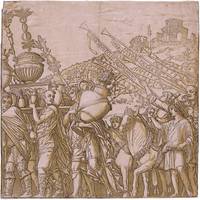
15997751599. Chiaroscuro woodcut in colors printed from four blocks on laid paper in dark brown grey and three shades of ochre 14 1/2 x 14 1/2 inches 370 x 370 mm the full sheet. A very good impression with gaufrage clearly visible on the verso trimmed to the platemark. A central vertical fold is mainly visible on the verso an additional diagonal fold is also visible on the verso. There are several scattered expert repairs to areas of skinning in the lower right quadrant of the sheet on the verso as well as one pea-sized area of expert repair in the center-left sheet on the verso. Repairs are not visible on the recto unless the sheet is viewed through raking light. Laid down to an archival paper matrix.<br /> <br /> Bartsch XII.101.11. Andreani published this suite of prints to reproduce the nine canvases of the Triumphs of Caesar by Andrea Mantegna made for the Gonzaga ducal palace in Mantua between 1484 and 1492 now residing in Hampton Court. The set his last large-scale publication took four years to complete and was the first to depict a painted cycle in its entirety. According to the dedication page Andreani worked after drawings prepared by the Mantuan painter Bernardo Malpizzi. Each of the nine scenes were printed with four blocks; the key block for outlines and separately carved blocks to apply the different shades of color. <br /> - The Chiaroscuro Woodcut in Renaissance Italy edited by Naoko Takahatake p108. unknown
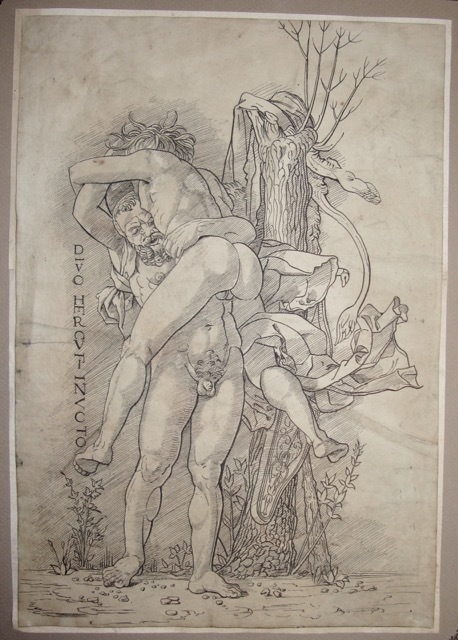
5507Cette estampe est une curiosité : le dessin est très proche de celle de Mantegna "Hercule et Anthée", mais elle est inachevée par rapport à cette dernière. Fait troublant, Bartsch signale que dans la planche de Mantegna le "I" de Invicto semble avoir été inséré entre le V et le C. Or dans notre épreuve, ce I est absent. S'agit-il d'un tout premier état ? En feuille, très bon état, 33 x 23 cm. En feuille Très bon 330 x 230
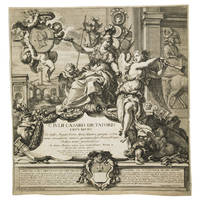
1692ABC_46071Rome 1692. Domenico de Rossi The 10 prints are preserved in a paperboard folder covered with half green cloth and green marbled sides ca. 57 x 47 cm. With an engraved allegorical title-print showing Minerva on a throne pointing towards a medallion with Caesar's profile and 9 engraved prints ca. 43.5 x 41 cm except print 1 ca. 51.5 x 41 cm by Robert van Audenaerde after Andrea Mantegna's paintings showing the triumphal military parade celebrating Caesar's victory in the Gallic Wars. Each is numbered at the lower right and captioned below with an engraved description. 1 9 engraved ll. Complete series of 9 engraved prints by Robert van Audenaerde after Andrea Mantegna's paintings of Caesars triumphs preceded by the title-print commissioned by Cardinal Panciatico with his arms at the foot of the title-print. Mantegna 1430/31-1506 created these paintings between 1484 and 1492 for the Ducal Palace in Mantua commissioned by Duke Federico I Gonzago or more likely his son Francesco II. They show the triumphal military parade celebrating Julius Caesar's victory in the Gallic Wars: a procession of Roman soldiers musicians exotic animals war equipment and captives. These paintings are often acknowledged as Mantegnas greatest masterpiece because they form the most complete pictorial representation of a Roman triumph. His paintings became very popular also for engravers and printmakers and many print series followed including one from his own workshop. The present series by the Ghent engraver Robert van Audenaerde 1663-1743 is one of the most beautiful and gracious renderings of these paintings with beautiful and highly detailed images. Paperboard folder a little worn front hinge cracked so that the front board is nearly detached boards reinforced at some places with transparent tape. Each print with a vertical crease hardly affecting the plates a few with very small marginal tears some plates with an occasional stain or slightly browned or dust-soiled but otherwise in good condition.l Berlin Kat. 4060; Le Blanc Manuel de lamateur destampes Audenaerde 79-88 p. 68; not in Hollstein. hardcover
Bulino misure: 243 x 260 Nei primi mesi del 1475 Mantegna, artista poliedrico, incisore in prima persona e al tempo stesso sperimentatore, decide di far incidere alcuni suoi disegni e affida questo compito al giovane Cavalli, orafo, scultore e incisore mantovano. Cavalli viene invitato a bottega per firmare una sorta di contratto esclusivo e riservato di collaborazione reciproca nel rispetto dell'accordo professionale esclusivo che Mantegna e Cavalli avevano con il Duca di Mantova Marchese Francesco II Gonzaga. Studi recenti riconducono a tale sodalizio nove incisioni a soggetto religioso, mitologico o trionfale. I portatori sono una di queste. L’uso sciolto del chiaroscuro conferisce plasticità e chiarezza alle figure. Questo è infatti il soggetto della serie dei Trionfi che la critica considera meglio riuscito per vigore e ricchezza di contrasti. Il soggetto deriva da un disegno perduto di Mantegna ed è molto simile alla versione definitiva dipinta. Ci sono tuttavia evidenti differenze, in primo luogo nel paesaggio di fondo lasciato bianco nell'incisione, nella posizione della figura che regge l'armatura esattamente al centro nel dipinto e spostata verso destra nell'incisione, infine le armature nel dipinto sembrano in cuoio e di foggia meno credibile rispetto a quelle nell'incisione. Hind conta trentasette impressioni di questo bulino, parte con filigrana italaina , parte con filigrana francese. Il soggetto è la tavola VI del ciclo dipinto tra il 1486 e il 1505 per celebrare Francesco II Gonzaga, il ciclo è purtroppo rimasto incompiuto. Le tele sono oggi a Londra nel Palazzo di Hampton Court. Impressione eccellente omogenea dai neri intensi. Rara da trovarsi in queste condizioni e con questa qualità di stampa visibile anche al verso del foglio. Ottimo stato di conservazione rifilata alla linea di inquadramento su tre lati, mancanza di mm 23 lungo il lato superiore, due piccoli assottigliamenti della carta. Filigrana: piccolo fiore a quattro petali, simile a Briquet 6327. (1503 circa) Un altro esemplare è conservato presso la NGA Bibliografia: Print Quarterly, September 2021, vol XXXVIII n. 3, ill. n 184 a pag 265.