Max Jacob Illustrated by Pablo PicassoBiblio.com
5 436 résultats
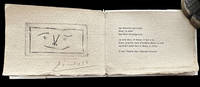
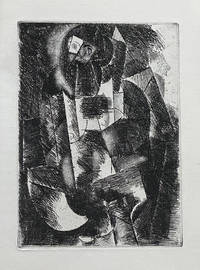
1914N - 2024 - 115<p>Max Jacob. Illustrated with three cubist etchings by Picasso in full page from 1913. Max Jacob three-act play reflect the author mystic quest and his research into the cabala and astrology Picasso completed the illustrations during the winter of 1913/14 making three etchings and dry points one for each act to which he gave the titles: Femme Nue plate 1 Nature Morte au Crâne plate 2 and Femme plate 3. This book is second illustrated book published by Daniel-Henry Kahnweiler created in collaboration with Picasso. Signed by the Picasso and Jacob in the justification page and marked as number "40" of 85 copies on "Holland van Gelder" total edition 106 copies. The book is complete in the original glassine light offsetting is present in the text page near the first illustration. Ref Cramer #3. Very good conditions.</p> Daniel- Henry Kahnweiler, Editeur hardcover
1962138061Vallauris: Unpublished 1962. No edition. One of 68 trial proofs of the first state in beige or ochre on black. Stamped Picasso signature lower right as issued marked "Gravure ineditée" in pencil lower left rubber stamp of Marina Picasso to verso. Printed by Arnéra Vallauris. Linocut in ochre over black on vélin d'Arches watermarked wove paper. Image size: 52.4 x 63.7 cm. Sheet size: 75.1 x 62.1 cm. Framed size: 84.3 x 94.3 cm. Light creasing to upper right corner light skinning to verso from previous hinging otherwise in very good condition. Presented in a handmade gold leaf frame with conservation acrylic glazing. Wofsy L-148; Baer 1327 I. unknown
196048558Alès.: PAB. Pierre. André. Benoit. 1960. Loose as issued in original publisher's printed wrappers with flaps original drypoint engraving on celluloid 'Homme Grec Barbu' by Picasso to front cover original publisher's patterned paper-covered board chemise with title in black to spine and matching slipcase. Folio. 512 x 340 mm. Leaf with title leaf with Picasso's original drypoint engraving on celluloid as frontispiece leaf with Pindar's dedication in Greek two leaves with Pindar's verse in Greek original drypoint engraving recto leaf with translator's credit leaf with Pindar's dedication in French two leaves with Pindar's verse in French translated by Jean Beaufret leaf with original drypoint engraving and final leaf with justification and achevé d'imprimer. A superb example of this superb collaboration between Picasso and PAB.From the edition limited to 50 copies with this one of 44 signed and numbered in pencil on the justification by the publisher and artist; six copies numbered in Roman numerals as well as six hors commerce copies were also issued.Picasso's four original drypoint engravings are titled as follows: 'Homme Grec Barbu' for the front cover; 'Lutteur avec Lance et Bouclier'; 'Athlète de Face'; 'Athlète au Repos'.'Pindar's Eighth Pythian Ode was after Ovid's Metamorphoses 1931 and Aristophanes's Lysistrata 1934 the third and last text from classical antiquity which Picasso illustrated . At the request of P.A. Benoit Picasso executed four drypoints on celluloid for Pindar's text . The Eighth Pythian Ode was presented i.e. sung in 446 BC at Aegina in honour of a certain Aristomenes who had won the wrestling competition at the Pythian Games at Delphi. Pindar celebrates the youth's splendid victory but also mourns the transience of happiness and glory by evoking the sad fate of the defeated.' Patrick Cramer.Cramer 108; Baer 1077 - 1080. PAB. (P[ierre]. A[ndré]. B[enoit].). unknown
51-1019Paris: Ambroise Vollard 1931. 13 original etchings unbound as issued in a sleeve inside the bound book. One of 65 deluxe copies no. 10 on Imperial Japan paper signed by Picasso and Vollard. Only the deluxe copies on Japan paper were signed on the colophon by the artist and publisher. This copy without the second suite on Rives. Housed in a custom clamshell case encased throughout in three leathers by the celebrated binder Alexandr Mosalov. References : Cramer Pablo Picasso les livres illustrés n° 20 ;Bloch: 82-94; Livre no 19. Un des précieux exemplaires sur Japon sans la suite.In-4 228 x 250 mm. En feuilles sous chemise rempliée illustrée. Quelques défauts à la couverture dos et bords inférieurs du premier plat légèrement passés accident à la coiffe supérieure quelques taches coin inférieur du premier feuillet blanc coupé bords des planches de la suite très légèrement maculées sans atteinte aux gravures.13 eaux fortes originales hors texte dont la table des gravures et 67 dessins gravés sur bois de Pablo Picasso. Paris: Ambroise Vollard, 1931. hardcover
Im Jahr 1932 veröffentlichte Cahiers d'Art den ersten Band des Picasso-Katalogs, ein Projekt, das Christian Zervos gemeinsam mit Picasso erarbeitet hat. Die Neuausgabe des Werkverzeichnisses der Gemälde, Aquarelle und Zeichnungen wurde wissenschaftlich von der Picasso Administration auf den neuesten Stand der Forschung gebracht. Die Ausgabe ist in Englisch und Französisch lieferbar. - This new, revised editon includes corrections to the original catalogue prepared together with the Picasso Administration. With over 16000 black- and white illustrations. The new edition is available in French, and in English translation for the first time in its history.
21202Paris, Guy Lévis Mano, 1935 - 1937. Collection Repères publiée entre juillet 1935 et août 1937 à Paris par Guy Lévis Mano. 25 volumes in-4 en feuilles sous couvertures vermillon ou jaune. Série complète en parfaite condition, sous chemise et étui.
2014167067Paris: Cahiers d'Art 2014. Softcover. Revised Edition one of 1200 English language copies. Complete in 33 volumes. As New.<br /> <br /> Preceded in publication by the original French language editions published individually between 1932 and 1978 and the French language 33-volume set published in 1991.<br /> <br /> Catalogue raisonné published by Cahiers d'Art founder Christian Zervos in partnership with Picasso himself. Illustrated with over 16000 black-and-white images of Picasso's work. A monumental production.<br /> <br /> Fine and unread each volume in the original Near Fine glassine dust jacket. Housed in nine off-white linen slipcases as issued by the publisher. Still in publisher's shrinkwrap. <br /> <br /> Oversize set shipping billed at cost. Cahiers d'Art unknown
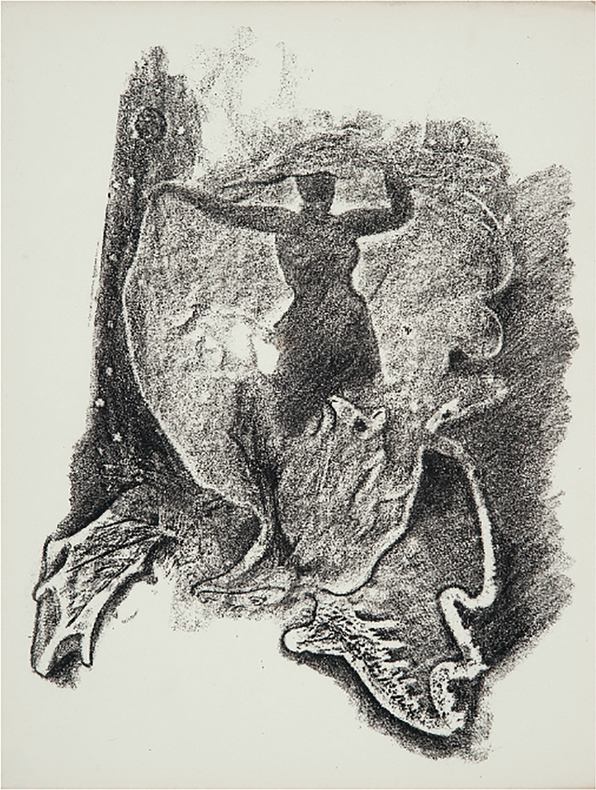
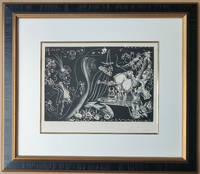
1969902981969. PICASSO Pablo. El Entierro del Conde de Orgaz. Three volumes. 12 XI 1 69 7 pp. Illustrated with one signed engraving and 12 etchings by Picasso and a preface by Rafael Alberti. Folio 370 x 470 mm bound loose as issued in the original wrappers and vellum-covered slipcase. The whole preserved in a cloth folding box. Barcelona: Gustavo Gili and Ediciones de la Cometa 1969. A Spanish production in every sense in this Picasso book Picasso illustrated his own poetry based upon his life and youth in Andalucia. The title bears reference to the painting by El Greco an artist very much admired by Picasso. Picasso began this poem in 1957 during a period of renewed interest in his Spanish heritage. Included in the work is a facsimile of Picasso's original manuscript of the poem written in coloured pencils. To illustrate his autobiographical poetry the artist selected one of his engravings from 1939 and etchings finished between 1966 and 1967. Printed and published by the publishing house Gustavo Gili of Barcelona with a prologue-poem by Rafael Alberti El Entierro del Conde de Orgaz includes a total of thirteen Picasso etchings of circus scenes and allegorical images infused with eroticism all echoing the artist's Spanish homeland and influences therefrom. One of an edition of 263 copies on Romani wove. It is notable that the present publication was the subject of a single exhibition at the Fundacion Picasso "Pablo Ruiz Picasso: El Entierro del Conde de Orgaz" May 2004. Goeppert 146. Bloch 1465-1477. Johnson Artists' Books in the Modern Era 1870-2000 No. 92. hardcover
196948574Barcelona.: Ediciones de la Cometa. 1969. Loose as issued in original publisher's printed wrappers and cloth-lined parchment-covered box. 2 vols. Folio. 470 x 370 mm or the reverse. Frontispiece engraving with burin signed in pencil by Picasso loose in paper portfolio as issued and Picasso's printed text illustrated with a further 12 original etchings by Picasso. Picasso's poetic and pictorial homage to El Greco and Velazquez.From the edition limited to 263 copies with this one of 220 examples with 12 original etchings together with an original etched frontispiece signed in pencil by Picasso.'From 1955 on the frequent visits of fellow Spaniards re-awakened Picasso's memories of Spain. In 1957 he began to write again in Spanish and he painted 'Las Meninas' after Velazquez. From January 6 1957 to August 20 1959 - the date of each text is meticulously noted - he wrote this dramatic poem and gave it the title of El Greco's masterpiece … Ten years later he suggested to Gustavo Gili a publisher in Barcelona that he should publish the piece. To illustrate it he chose 15 prints done between 1966 and 1967 … The prints depict fleshy women watched by a jealous cupid a male who is ferocious and ready for violence circus theatre and family scenes and the painter and his model. To these was added a burin engraving dated June 9 1939 in which a text in Spanish beginning 'Trozo de almíbar' 'bit of sirop' is enclosed by remarques.' Cramer.Cramer 146. Ediciones de la Cometa. hardcover
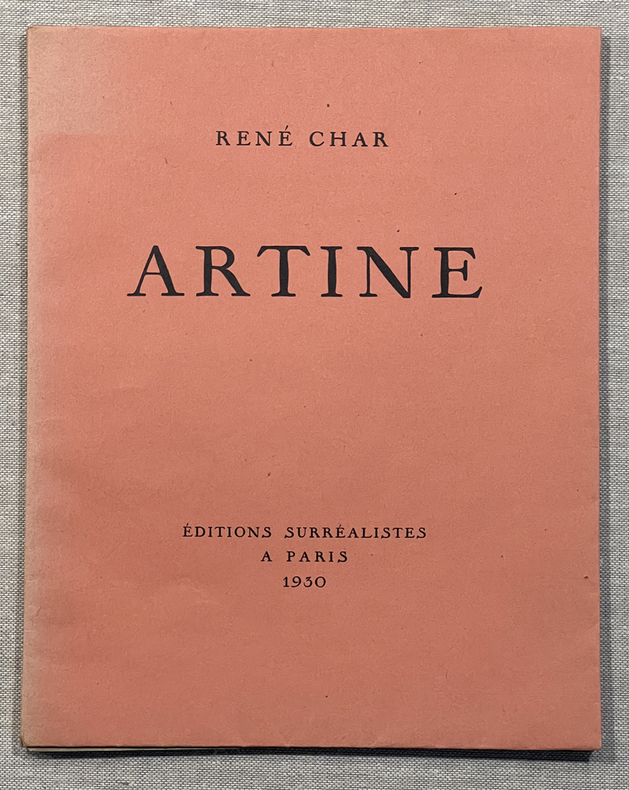
19303884Paris, Éditions Surréalistes, Corti, 1930. Un volume petit-in-4 (235 x 185 mm), broché, couverture de papier rose imprimée. Édition originale tirée à 215 exemplaires. CELUI-CI L'UN DES 15 SUR INGRES VERT, ROSE ET BLEU AVEC UNE EAU-FORTE ORIGINALE DE SALVADOR DALI EN FRONTISPICE (N° 18). Seuls ces exemplaires et les 15 ex. de tête sur japon la contiennent. Le volume est signé au colopon par René Char. Bien complet du "Prière d'insérer" imprimé sur papier couché rouge. Artine est le second ouvrage comportant une gravure de Dali entré dans le groupe surréaliste en 1929. - ENGLISH DESCRIPTION: René CHAR. ARTINE. Paris, Éditions Surréalistes, Corti, 1930. A small quarto volume (235 x 185 mm), paperback, printed pink paper cover. First edition, limited to 215 copies. THIS IS ONE OF 15 COPIES ON GREEN, PINK, AND BLUE INGRES PAPER WITH AN ORIGINAL ETCHING BY SALVADOR DALI AS A FRONTISPIECE (No. 18). Only these copies and the 15 deluxe copies on Japanese paper contain it. The volume is signed in the colophon by René Char. Complete with the "Please Insert" printed on red coated paper. Artine is the second book to include an engraving by Dalí, who joined the Surrealist group in 1929. A perfectly preserved copy. References: Michler-Löpsinger, 3 - Cahiers de l'Herne, 20 - Monod, I-2603 - PAB, René Char, 4. Additional photographs available on request.
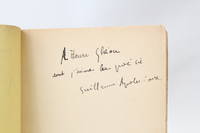
191371213Paris: Mercure de France 1913. Fine. “To Henri Ghéon whose poetry I love Guillaume Apollinaire” Mercure de France Paris 1913 11.50 x 18.50 cm broché First edition one of the first-issue copies press-numbered from a total limitation of just 23 deluxe copies on Holland paper. Illustrated with a frontispiece portrait of Guillaume Apollinaire by Pablo Picasso. Spine sunned with discreet restorations.Our copy is preserved in a red half morocco chemise spine with five raised bands date lettered at the foot paper-covered boards matching paper slipcase edged in red morocco the whole signed by Boichot. Rare signed autograph inscription by Guillaume Apollinaire: « à Henri Ghéon dont j'aime la poésie Guillaume Apollinaire ». Our copy further contains five manuscript corrections in ink by Apollinaire on pages 71 77 92 110 and 189. Also included is an autograph satirical quatrain by Apollinaire composed two years earlier offering a caustic critique of René Fauchois's mediocre play 'Rivoli' devoted to Napoleon. Apollinaire presented this copy to Henri Ghéon literary critic for La Nouvelle Revue Française. The poet took care to correct himself the typographical errors still present in this very first edition corrections likewise found in other presentation and review copies distributed by the author. Upon receiving his copy Ghéon devoted an article to Alcools «Alcools par Guillaume Apollinaire» Nouvelle Revue Française no. LVI 1 July 1913 describing the collection as a «démarche aventureuse». Presentation copies of this work inscribed by Apollinaire are rare and highly sought after. The small autograph satirical quatrain by Apollinaire composed two years earlier offers a caustic critique of René Fauchois's mediocre play 'Rivoli' devoted to Napoleon. Although it makes no claim to the poetic ambition of Alcools the poem nevertheless shares with that celebrated collection several features that illuminate the genesis of Apollinaire's masterpiece. Published under the pseudonym « Montade » in the Mercure de France of April 1911 with five commas the manuscript of the poem is written entirely without punctuation just like the avant-garde poems of Alcools. The very form of this brief poem reveals Apollinaire's curiosity and his constant search for the renewal of poetic expression as evidenced by the introductory note accompanying its publication in the Mercure: « Chantecler a été l'occasion pour les poètes français de reprendre un genre délaissé l'épigramme. . Le Rivoli de M. Fauchois a aussi inspiré des épigrammes. En voici deux qui sont bien tournés. L'une a été insérée dans l'Intransigeant :Après Beethoven Amen ! Après Rivoli au lit !La seconde parce qu'il y a plus de ruelles court les brasseries :Le grand Napoléon au jour de Rivoli Avait fait par ma foi une belle trouvaille Inutile vraiment puisque partout on lit Qu'à l'Odéon Fauchois a perdu la bataille » One also notes the poet's own assessment of his work and his desire for a poetry that wanders freely through the streets and cafés liberated from the constraints of print punctuation and formal rigidity much like the cascading calligraphy of these handwritten verses composed nine years before Calligrammes. Mercure de France hardcover
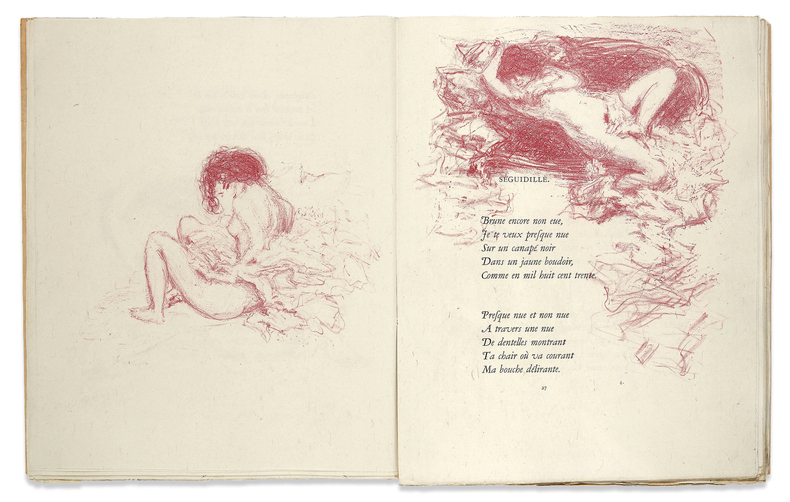
19003912Un volume in-4°, broché, couverture imprimée illustrée d'une vignette de l'artiste . - 109 lithographies originales de Pierre Bonnard (1867-1947). Toutes les lithographies sont tirées en rose sanguine et disposées librement, transcrivant avec sensualité la poésie de Verlaine en forme et en couleurs ; il s’en dégage une profonde harmonie entre le texte et l’illustration. Élégamment imprimé en Garamond, comme le seront plus tard Les Fêtes galantes illustrées par Laprade, l’ouvrage marque le début de la grande aventure éditoriale d’Ambroise Vollard. Édition : 230 exemplaires numérotés sur Chine ou Hollande. - "Ceci n’est pas un traité de géométrie !" Il existe deux états de la couverture de Parallèlement : Vollard dut en effet remplacer la vignette de l'Imprimerie nationale à l’effigie de la République française par un dessin de Bonnard (ainsi notre exemplaire). Ce remaniement était intervenu à la suite d’une interpellation à la Chambre au sujet de la présence de l'effigie de la République sur un livre jugé « licencieux ». Une fois l’ouvrage imprimé, on s’était avisé que Parallèlement n'était pas un traité de géométrie… (Pierre Berès). Exemplaire numéroté sur vélin de Hollande, conservé broché, tel que paru et en excellent état de conservation.
In-folio (300 x 200mm). 320 carte, grande iniziale in rosso di 26 linee, interamente rubricato. Legatura in pelle di scrofa coeva tedesca su assi di legno (Heilbronn), anticamente legato al pluteo, angoli e fermagli in metallo, borchie mancanti.
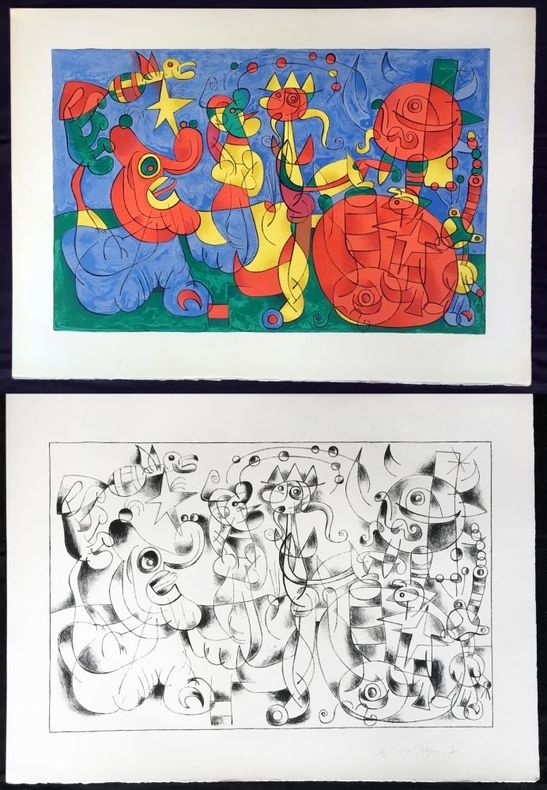
19661567-BParis, Tériade Éditeur, 1966. In-plano (750 x 550 mm) en feuilles. Feuillet de titre, table des planches. LA SUITE COMPLÈTE DES 13 LITHOGRAPHIES ORIGINALES EN COULEURS ET NOIR DE JOAN MIRÓ POUR UBU ROI + LA SUITE COMPLÈTE DES 13 LITHOGRAPHIES EN NOIR retravaillées par l'artiste . (feuilles: 750 x 550 mm environ, sujets: 630 x 410 mm environ), chaque épreuve titrée au crayon au verso de la feuille. Tirage: 75 exemplaires sur grand vélin d'Arches, celle-ci hors-commerce non signée (Mourlot 392-430 ; Cramer 108) Chaque composition en noir a été intensément retravaillée par Miró qui y a ajouté estompes et ombres, épaissi les traits de certains sujets. La vision grotesque et surréaliste de l'artiste, impliqué corps et âme dans ce cycle sur Franco et contre tous les fascismes, y apparait encore avec plus de force et d' évidence. Très rare. Excellent état de conservation.
191371213Mercure de France | Paris 1913 | 11.50 x 18.50 cm | broché
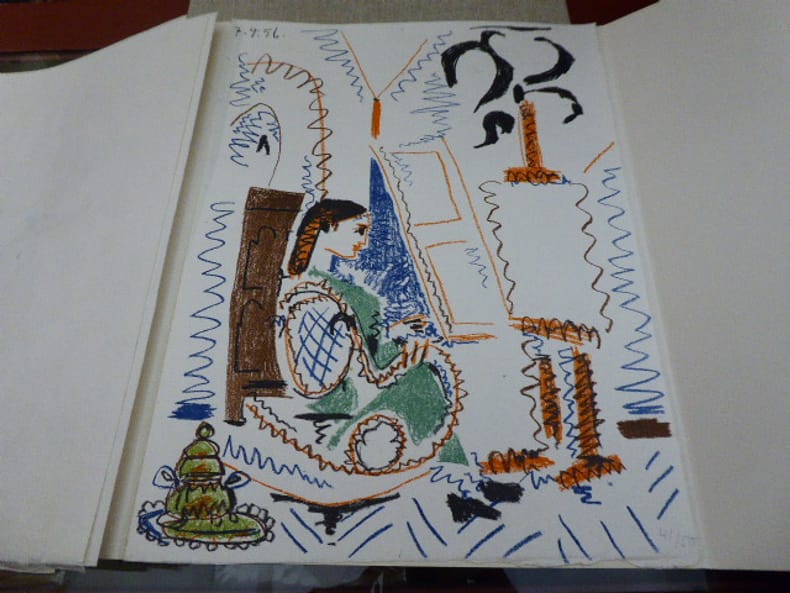
937995Fernand Mourlot Paris 1957 In-folio ( 444 x 334 mm ), en feuilles, sous couverture rempliée illustrée en lithographie couleurs sur les 2 plat, coffret-boite de toile bis imprimé sur le dos. 6 lithographies originales dont 4 en couleurs ( dont couverture ) de Pablo PICASSO et 30 reproductions de dessins, tableaux, collages datant des années 1914 à 1948. EDITION ORIGINALE au tirage limité à 275 exemplaires sur Arches, celui-ci, 1 des 50 exemplaires du tirage de tête sur papier vélin d'Arches ( N°41 ), signé par Pablo PICASSO au crayon rouge et accompagné d'une suite à part de 13 lithographies originales chacune justifiée ( 41/50 ) tirée sur Japon à la forme Hodomura. Très bel exemplaire, en parfait état. Cramer 88. The Artist and the book, 1972, Cat. 240.
1956N - 2023 - 99<p>Rene Crevel first edition of is poem NUIT published in the "Autumn 1924 Winter 1925" issue of Little Review New York magazine illustrated with an original engraving with burin on celluloid by Picasso signed in pencil. Oblong tiny format 65 x 90mm published by PAB Alès May 1956. Limited numbered edition of 30 copies printed on fine Auvergne laid paper by Richard-de-Bas n. 29 signed in pencil by PAB Pierre Andre Benoit Ref: Cramer 74. Very Good lightly tanned.</p> PAB (Pierre Andre Benoit)
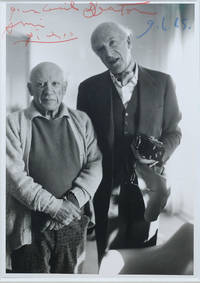
19652784France: np 1965. First edition. Very Good. Cecil Beaton. INSCRIBED BY PICASSO IN RED AND BLUE CRAYON TO THE PHOTOGRAPHER CECIL BEATON: "pour Cecil Beaton. Ami Picasso 9.6.65.". Cecil Beaton British 1904 -1980 photographed virtually every prominent person in public life over the course of his career which spanned more than half a century. Everyone from the Queen to the Rolling Stones sat before his lens. As an arbiter of glamor the opportunity to sit for Beaton represented the pinnacle of success for many but in some cases it was Beaton who pursued the sitter and he had followed Pablo Picasso Spanish 1881 - 1973 long before they first met.<br /> <br /> As one of the foremost artists of the twentieth century Picasso was sought after by many who wanted to rub elbows with success. He became one of those whom Beaton photographed several times over a period of many years first at the rue de la Boetie in Paris in 1933 then at the rue Augustins in 1944 and finally at Mougin in the south of France in 1965. Vickers. In addition to taking photographs Beaton wrote about Picasso in his private diary sketched his portrait and after the 1965 sitting wrote a profile of Picasso for Vogue Magazine.<br /> <br /> Photographs from Picasso's home in the hills above Mougin reveal a close bond between the two men. Here they appear relaxed comfortable with one another and with a gleam in their eyes. By then Picasso was 84 years old and still painting late into the nights. Writing in Vogue Beaton describes Picasso's energy as he gave Beaton a tour of the sprawling studio crowded with paintings some still wet with paint and others from decades before.<br /> <br /> Beaton wrote of Picasso's welcome: "Pablo said 'It has been twenty years since I last saw you!' A golden Picasso threw open his arms. 'After so long we must embrace.'" The two then made much fun about the passage of years and how they had aged. Beaton. A clear sign of affection Picasso inscribed select prints and dedicated them to Beaton. Picasso writes in red and blue crayon on this print: pour Cecil Beaton. Ami Picasso 9.6.65. The print stands as testament to the kinship between the two artists.<br /> <br /> Provenance: With stamp "From the Beaton Studio / Sotheby Parke Bernet" on verso sold Sothebys Parke Bernet 1978. Also with stamped notation "1/1" possibly indicating that this is a unique print. We have not been able to locate any others.<br /> <br /> Silver gelatin print. Signed inscribed and dated by Pablo Picasso "pour Cecil Beaton / Ami / Picasso 9.6.65" in red and blue ink recto. Image: 111â„4 x 73â„4 in. 28.5 x 19.6 cm.; sheet: 111â„2 x 91â„4 in. 29.2 x 23.4 cm. Majestically framed to an overall size of 24 x 19.5 in. Small abrasion evident to the right of Beaton's left ear; otherwise fine.<br /> <br /> References:<br /> <br /> Vickers Hugo ed. Cecil Beaton: Portraits & Profiles. London: Frances Lincoln 2017. P 152.<br /> <br /> Beaton Cecil. "Golden Picasso" Vogue Magazine volume 146 November 15 1965. np unknown
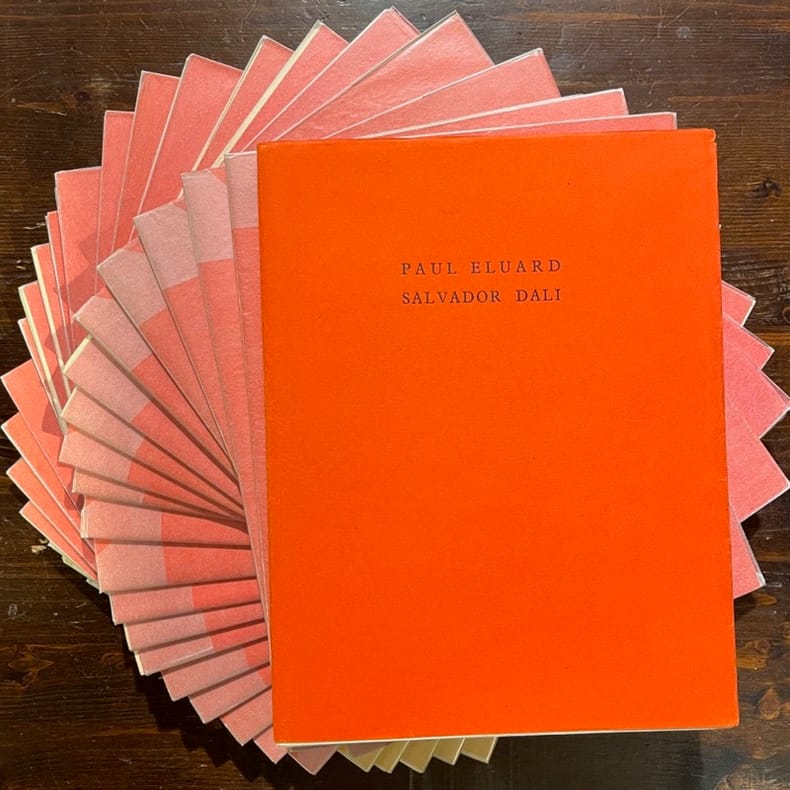
19391435Paris, NRF, Gallimard, 1939. in-4 (260 x 200 mm) broché, toutes marges, 70 pages, couverture imprimée rempliée. ÉDITION ORIGINALE TRÈS RARE de ce recueil contenant : "Trois chevaux aigus. Nous sommes. Nulle rupture. À l'ombre de ma porte. Poème perpétuel. L'or et l'eau froide. Trois poèmes inachevés. Les vainqueurs d'hier périront". Tirage : 5 Japon nacré + 15 vergé d'Arches. Celui-ci l' un des 15 ex. numérotés sur vergé d'Arches (n°12), SIGNÉ PAR PAUL ÉLUARD ET MAX ERNST, ACCOMPAGNÉ DE 4 SUPERBES LITHOGRAPHIES ORIGINALES À PLEINE PAGE TIRÉES EN NOIR SUR VERGÉ DE HOLLANDE DE MAX ERNST (seuls les 20 premiers exemplaires en grand papier contiennent ces lithographies). - Note bibliographique et historique : Max Ernst avait prévu une série de douze lithographies, mais seules quatre d’entre elles furent publiées dans l’édition de luxe à petit nombre. Un an plus tôt, en 1938, désapprouvant ses positions trotskystes, Éluard avait rompu avec Breton : À sa suite Max Ernst quitte le groupe surréaliste outré d’avoir à subir l’exigence de « saboter la poésie de Paul Éluard par tous les moyens » (in Centre Georges Pompidou, Paul Éluard et ses amis peintres, 1982, p.109).
1965127727Paris: Galerie Louis Leiris 1965. Edition of 50. Signed in pencil lower right by Picasso numbered lower left. Etching and aquatint on Richard de Bas paper. Image size: 27.1 x 37.6 cm. Sheet size: 42 x 51 cm. Framed size: 63 x 56 cm. Excellent condition. Presented in a hand-made white gold leaf frame with acrylic glazing. Bloch 1218; Baer 1200 Bb1. unknown
196674882<p>Pablo Picasso<br />Untitled from Le Cocu Magnifique 1966<br />Etching with aquatint<br />Hand signed lower right<br />Numbered 12 / 30<br />mage size: 22.5 × 32.5 cm<br />Frame size: 50.5 x 58 x 2 cm<br />Published by Crommelynck Paris</p><p>Reference Bloch 1249 Baer 1437</p><p>There was also an unsigned and unnumbered edition of 200 with narrow margins</p>
1967126012Paris: Galerie Louis Leiris 1967. Edition of 50. Signed in pencil lower right by Picasso numbered lower left. The plate was originally etched in 1963 of which one image was printed the edition was printed and released in 1967. Aquatint on Vélin de Rives paper. Image size: 31.2 x 41.2 cm. Sheet size: 45.1 x 55.2 cm. Framed size: 57 x 65.7 cm. Excellent condition. Presented in a handmade white gold leaf frame with conservation acrylic glazing. Bloch 1115; Baer 1108 IIIBb. unknown
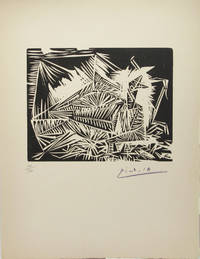
1939172347Paris: Jonquières 1939. Edition of 226. Signed in red pencil crayon lower right by Picasso numbered in pencil lower left. Linocut on Velin d'Arches paper lower edge deckled. Image size: 15.9 x 20.2 cm. Sheet size: 36.7 x 28 cm. Framed size: 48.6 x 43.3 cm. Toning to margins otherwise a bright impression. Presented in a handmade white gold leaf frame with conservation acrylic glazing. Bloch 326; Baer 1028; Cramer 84. unknown
194748620Paris.: Latitud Curenta y Uno. Le Degré Quarante et Un / 41º. 1947 / 1948. . Oblong folio. 396 x 620 mm. Etching grattoir and burin on copper by Picasso printed on a full sheet of parchment pierced at edges for printing and with central fold by Roger Lacourière Paris; sheet size: 396 x 310 mm folded 396 x 620 mm unfolded. A very rare signed proof of the cover for 'Pis'mo: Escrito por Iliazd / Grabado por Picasso' Picasso's 1948 collaboration with Iliazd.Picasso's etching with grattoir and burin is for the vellum cover of the 1948 book 'Pis'mo' also known as 'Escrito por Iliazd / Grabado por Picasso'. The text of the book is a love poem in Russian by Iliazd one of the very few he wrote after leaving Georgia inspired by his meeting with Olga Djordjadze - Picasso too met her later - in Cannes in 1946. Picasso's print includes the title in Russian correctly at the top and incorrectly and effaced beneath as well as at right the figure of a woman seen from behind and turned away from the viewer; Picasso has dated the print '3 mars 47' in the copperplate which is printed in reverse.The present proof is printed on a sheet of vellum as for the published book although slightly whiter and slightly thinner than the published version and while it does have a central fold it is unfolded at the head and foot and is pierced around the outer edge of the sheet with small pinholes as part of the printing process. Signed at lower right by Picasso the sheet is annotated by Iliazd verso above and beneath the visible platemark 'haut' and 'bas' and 'Plier à l'envers'; Iliazd appears too to have drawn a pencil frame it differs from the engraved area to the verso beneath the 'haut' and 'bas'. A different hand has annotated the foot of the blank area adjacent to the printed section: 'Picasso P. Eau-forte pour la couverture du livre d'Iliazd 'ESCRITO' 1er Epreuve d'essai sur parchemin / le livre a été tiré à 66 exemplaires'.Proofs of the cover are very rare and examples signed by Picasso rarer still. Baer suggests that several trials and proofs were taken from Picasso's plate noting the 'bon à tirer' example on 'vélin sans filigrane' Georges Bloch's copy on parchment inscribed 'tirage d'essai' by Iliazd and signed at a later date by Picasso 'environ 7 épreuves sur parchemin avec annotations d'Iliazd sur la préparation du parchemin et le séchage' as well as a final signed example sold by Sotheby's in the 1970s.'In his poem 'Rogelio Lacourière pêcheur de cuivres' published in 'Hommage à Roger Lacourière 1968 Iliazd recalls in poetic terms the genesis of the book's title etching. The story goes that Lacourière had given Picasso a plate which was too large and which had a white mark to indicate where it should later be cut. Picasso - tempted by this extra space and the unexpected freedom it gave him - etched a nude on it. Lacourière therefore refrained from cutting the plate and Iliazd noticed that the asymmetry thus created in the title etching echoed his conception of the folded pages: the 'magnaminous' painter had 'transfigured' the book.' Patrick Cramer.Baer 785Ba; Bloch 462; see Cramer 48. Latitud Curenta y Uno. (Le Degré Quarante et Un / 41º). unknown
193934506Paris: From the Press of Robert Blanchet ca. 1939. No. 161 of a Limited Edition of only 226 copies printed on vélin d'Arches. AN ORIGINAL GRAVURE A LA GOUGE PRINT SIGNED IN CRAYON BY PICASSO. Folio single sheet. A fine copy of the signed engraving. A very important print a signed impression of the original linogravure 'Le Pigeonneau' c. 1939 which is believed to be either Picasso's first or second effort in the technique. From the Press of Robert Blanchet unknown