2 389 résultats
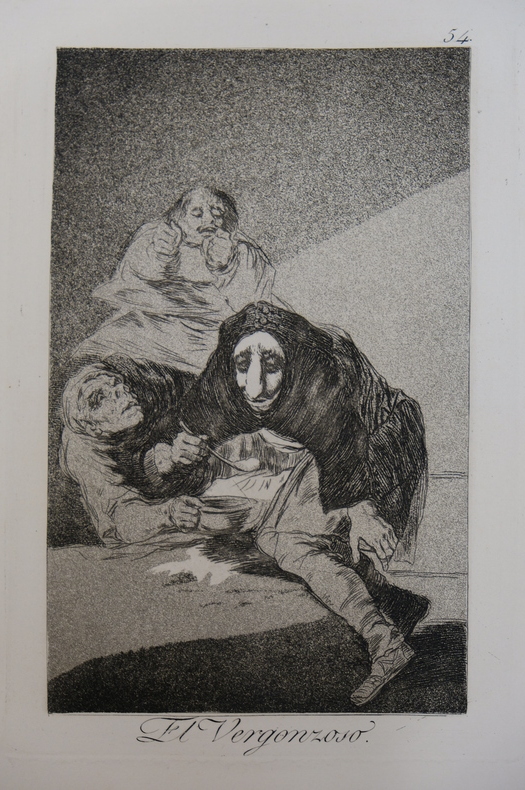
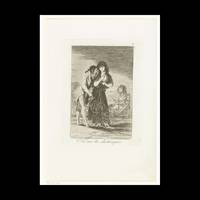
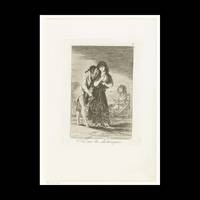
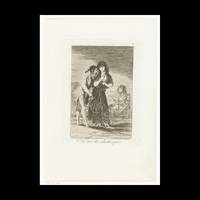
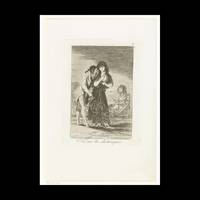
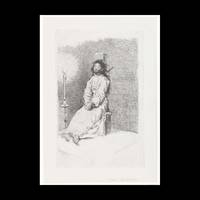
Opera tratta dai Los Caprichos, per la prima volta pubblicati nel 1799.Prova della quarta edizione di dodici, stampata dalla calcografia di Madrid, circa 1870.Acquaforte, acquatinta brunita e puntasecca, in perfetto stato di conservazione.La serie chiamata Los Caprichos, è composta da ottanta incisioni, la cui prima edizione [l’unica a non essere pubblicata postuma] venne alla luce ne 1799. Curata in fase d’edizione dallo stesso artista, la serie fu commercializzata e dopo poco tempo ritirata dal mercato.Infatti, a causa dei numerosi soggetti che ironizzavano sulla società spagnola di fine secolo, il Goya subì una censura. L’interpretazione dei soggetti rappresentati su queste lastre, sempre enigmatiche, è spesso controversa. In questo soggetto Goya affronta il tema del mondo alla rovescia. Nella scena ci sono tre personaggi, il centro dell'attenzione è l'uomo che sta mangiando, e che cerca di evitare tutti gli sguardi, vergognandosi dei tratti osceni del suo viso. L'artista ha chiaramente indicato il suo pensiero disegnando la cintura di un paio di pantaloni sopra la testa del personaggio. I nasi assumono una presenza notevole sul viso, e nel linguaggio popolare "nasi" è un chiaro eufemismo sessuale. Il modo in cui il viso è costruito, in modo che sopracciglia, occhi e naso evochino l'apparato genitale maschile, rafforzerebbe lo stesso senso. Altri commenti insinuano che la figura, nel piano superiore, con i suoi grandi pugni serrati, stia commettendo sodomia con la figura che tiene il vaso da cui mangia l'uomo vergognoso. L'anno 1799 è uno dei momenti chiave nella vita e nel lavoro di Francisco de Goya. Oltre ad essere nominato primo pittore da camera di Goya, a godere di un crescente prestigio come ritrattista e ad inaugurare la cappella di San Antonio de la Florida, che aveva decorato, il 6 febbraio il Diario de Madrid pubblicò un annuncio in cui venivano messe in vendita le ottanta stampe che compongono la serie dei Caprichos. Etching with burnished aquatint and engraving, 1799.From the fourth edition of twelve of the so-called Los Caprichos series, edited by the Madrid Calcografia [circa 1870].A very good impression, with good contrast, printed on contemporary paper, usual wide margins, in very good conditions.The series called Los Caprichos, consists of eighty etchings. This first edition of 1799, the only one not to be published posthumously, is imprinted on soft laid pape.Cured in phase edition by the same artist, the series was marketed and before long withdrawn from the market. In fact, because of the many subjects that mocked the Spanish society of the century, Goya suffered censorship.The interpretation of the subjects represented on these plates, always enigmatic, is often controversial. In this print Goya approaches the theme of the world upside down. In the scene there are three characters, being the focus of attention the man who is eating, and tries to avoid all eyes, ashamed of the obscene features of his face. The artist has clearly indicated his thinking by drawing above the character's head the waistband of a pair of pants. The noses take on a notable presence on the face, and in popular language "noses" is a clear sexual euphemism. The way the face is constructed, so that eyebrows, eyes and nose evoke the male genital apparatus, would reinforce the same sense. Other comments insinuate that the figure, in the upper plane, with his large clenched fists, is committing sodomy with the figure holding the vessel from which the shameful man eats. The year 1799 is one of the key moments in the life and work of Francisco de Goya. In addition to being named first chamber painter, enjoying a growing prestige as a portrait painter and the inauguration of the chapel of San Antonio de la Florida, which he had decorated, on February 6 the announcement of the sale of the eighty prints that form the series of the Caprichos was published in the Diario de Madrid. Here, Goya focuses his social criticism on the bestiality of a deformed man whose head emerges from his breeches. Among the slight variations between the print and the preparatory drawing, the most striking is that, in the former, he wears his trousers, but in the latter, he does not. As a result, the latter came to be known as The satire of man’s lechery. Moreover, this is the only drawing in the series to mix red-ink wash with pen. Valentín Carderera’s handwritten commentaries on the Caprichos, which are in both the Biblioteca Nacional and the Museo del Prado, further clarify this subject. The first reads: Men with large noses also tend to have large arrows [here, “arrow” is a euphemism for penis] and fat gandumbas [testicles]. As they are often sodomites, this one is depicted with his breeches on his head, with his pudenda hanging out as he lies on top of a poor devil and pulls up his skirts. The second commentary completes the information: There are men whose face is the most indecent part of their body, and it would be good if those whose face is that disgraceful and ridiculous would stick it in their breeches. Example fomr the HENRI MARIE PETIET (Saint-Prix, Seine-et-Oise, 1894-1980) collection (Lugt 5031). Harris 89; Delteil 91.
1799est149b2Dimension extérieur 35 x 25,9 cm, cuvette 21,5 x 15 cm. Magnifique eau-forte réalisée par le très célèbre Francisco de Goya en 1799. Elle est en parfait état. Dimensión externa 35, x 25,9 cm, cuenco 21,5 x 15 cm. Hermoso grabado del famosísimo Francisco de Goya en 1799. Está en perfecto estado.
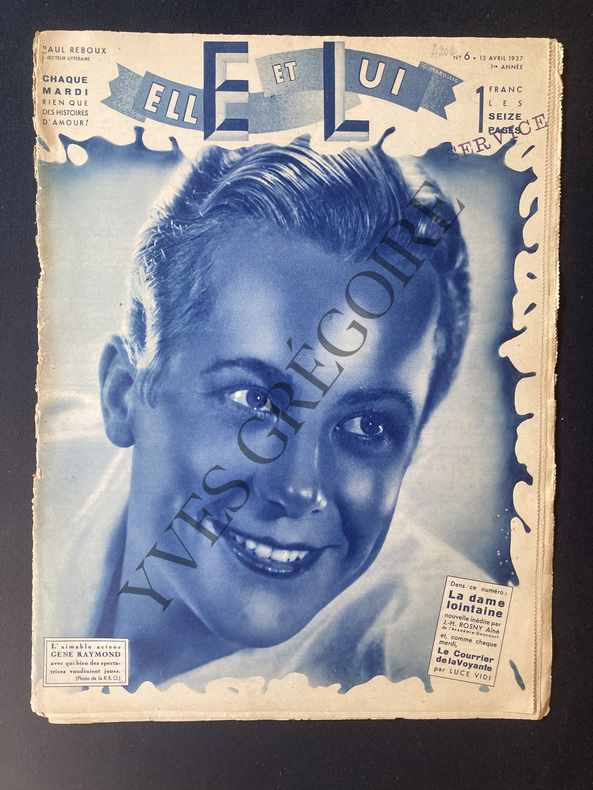
1937ABE-1501104104216 PAGES FORMAT 28 CM X 37,5 CM-GENE RAYMOND EN COUVERTURE, GROS PLAN PHOTO MONOCHROME-P2: SIMONE, POUPEE, PAR JEAN VALMY BAYSSE, PHOTO RAYMOND VOINQUEL-P3: LA JEUNESSE ET L'INTELLIGENCE, PAR PAUL REBOUX, PHOTO ELIZABETH RUSSEL ET LOUIS DA PRON-P4 P5 P6: L'IMPOSSIBLE SOLITUDE A DEUX, PAR A.DIDIER, PHOTO JANE AUBERT, PHOTO MYRNA LOY, PHOTO MONA GOYA-P7: LES YEUX S'OUVRENT, PAR PIERRE THIBAUT, PHOTO ROBERT CUMMINGS ET JANE RHODES-P8 P9: LA DAME LOINTAINE, PAR ROSNY AINE, PHOTO MADGE EVANS ET ROBERT MONTGOMERY, PHOTO LORETTA YOUNG ET ROBERT TAYLOR-P10: LE SKI TEL QU'ON LE PRATIQUE, PAR CHARLES GRYON, PHOTO PATRICIA ELLIS-P11 P12 P13: VERTIGE D'AMOUR, ROMAN INEDIT PAR JEAN DE LA HIRE, PHTO CLARK GABLE ET JOAN CRAWFORD, PHOTO GEORGE MURPHY ET SES GIRLS, PHOTO JEAN GABIN DANS "LES BAS-FONDS"-P14:LE CAPITAINE AUX GUIDES, PAR PIERRE LOUYS-P16: NORMA SHEARER, GROS PLAN MONOCHROME BLEU
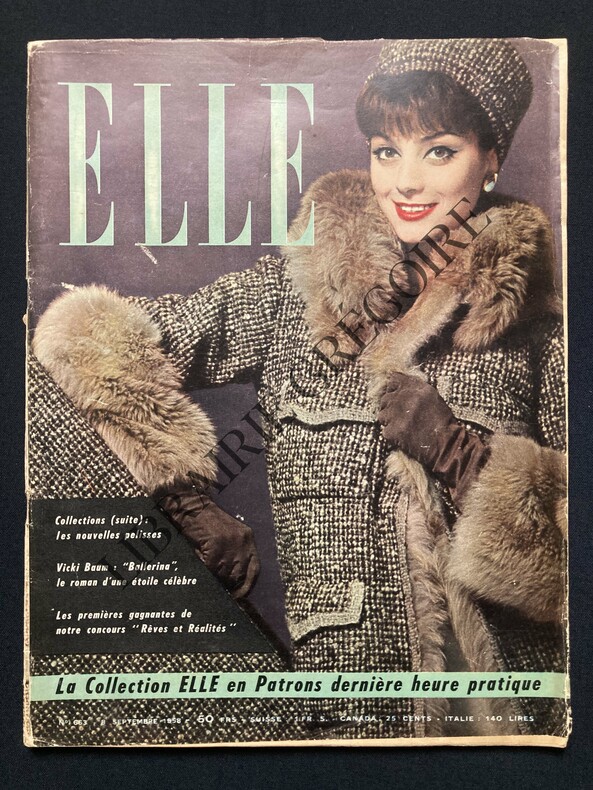
1958ABE-3069513778108 PAGES-EN COUVERTURE MARIE HELENE ARNAUD MANNEQUIN VEDETTE DE CHANEL, PELISSE EN GROS TWEED-POUR SORAYA ET DOMINGUIN: SOUPER ET CORRIDA, 2 PHOTOS-BERNARD BUFFET DECOUVRE SAINT TROPEZ ET VOUS LE PRESENTE EN 3 DESSINS TRES BERNARD BUFFET, 3P, 8 ILLUSTRATIONS-AVA GARDNER ENSORCELLE GOYA, 2P, 10 PHOTOS N&B-GRAND CONCOURS DE ELLE, VOICI LES CINQ PREMIERES GAGNANTES-LE SECRET DE BARBARA HUTTON PAR VOLDEMAR LESTIENNE
1195837Contentum Ltd. Loose sheet. New. High-quality art print based on an original work from the Rijksmuseum. Created in the 19th century 1876. Professionally printed on premium fine-art paper Museum Etching museum quality in size A3. The artwork is printed with a white border museum-style presentation. Contentum Ltd. unknown
1659176Contentum Ltd. Loose sheet. New. High-quality art print based on an original work from the Rijksmuseum. Created in the 19th century 1811. Professionally printed on premium fine-art paper Museum Etching museum quality in size A3. The artwork is printed with a white border museum-style presentation. Contentum Ltd. unknown
1659179Contentum Ltd. Loose sheet. New. High-quality art print based on an original work from the Rijksmuseum. Created in the 19th century 1811. Professionally printed on premium fine-art paper Museum Etching museum quality in size A2. The artwork is printed with a white border museum-style presentation. Contentum Ltd. unknown
1659177Contentum Ltd. Loose sheet. New. High-quality art print based on an original work from the Rijksmuseum. Created in the 19th century 1811. Professionally printed on premium fine-art paper Photo Matt Fibre in size A2. The artwork is printed with a white border museum-style presentation. Contentum Ltd. unknown
1659178Contentum Ltd. Loose sheet. New. High-quality art print based on an original work from the Rijksmuseum. Created in the 19th century 1811. Professionally printed on premium fine-art paper Photo Rag Bright White premium quality in size A2. The artwork is printed with a white border museum-style presentation. Contentum Ltd. unknown
196155997Arts et métiers graphiques impr. Blanchard 1961 In-4 relié. Bon état d’occasion.
76-0144Madrid: Real Academia 1903. Etching aquatint and drypoint on wove paper. 24 x 33 cm sheet. Limited edition to 100. Very Good light specks of foxing in the margins.Ref.: Harris 161; Delteil 160. Madrid: Real Academia, 1903. unknown
An exhibition catalogue for the show Feb 7 - June 8 2003 including the artists Goya Degas Pissarro Seurat Redon Modigliani Mondrian Brancusi, Leger, Klee, Picasso, Chagall, Klimt, Schiele Grosz, Kirchner, Giacometti. 142 pages many color plates. Text is in Spanish
Opera tratta dai "Los Caprichos", per la prima volta pubblicati nel 1799. Prova della quarta edizione di dodici, stampata dalla calcografia di Madrid, circa 1870. Aquaforte, acquatinta brunita e puntasecca, in perfetto stato di conservazione. La serie chiamata Los Caprichos, è composta da ottanta incisioni, la cui prima edizione [l’unica a non essere pubblicata postuma] venne alla luce ne 1799. Curata in fase d’edizione dallo stesso artista, la serie fu commercializzata e dopo poco tempo ritirata dal mercato. Infatti, a causa dei numerosi soggetti che ironizzavano sulla società spagnola di fine secolo, il Goya subì una censura. L’interpretazione dei soggetti rappresentati su queste lastre, sempre enigmatiche, è spesso controversa Etching with burnished aquatint and engraving, 1799. From the fourth edition of twelve of the so-called "Los Caprichos" series, edited by the Madrid Calcografia [circa 1870].A very good impression, with good contrast, printed on contemporary paper, customary margins, in very good conditions. The series called Los Caprichos, consists of eighty etchings. This first edition of 1799, the only one not to be published posthumously, is imprinted on soft laid pape. Cured in phase edition by the same artist, the series was marketed and before long withdrawn from the market. In fact, because of the many subjects that mocked the Spanish society of the century, Goya suffered censorship. The interpretation of the subjects represented on these plates, always enigmatic, is often controversial. Harris 48, Delteil 50
Acquaforte, acquatinta brunita, puntasecca misure: mm 335 x 245 Pittore di corte, autore di celebri ritratti, disegnatore e stampatore spagnolo. Ha anticipato con le sue opere e il suo stile molte delle tendenze artistiche di fine Ottocento ed è considerato il primo vero artista moderno. Egli utilizza l'incisione come mezzo per esprimere e diffondere quei 'sogni dell'immaginazione' che tanto lo affascinano. Nasce cosi la serie chiamata "Los Caprichos" composta da ottanta incisioni, la cui prima edizione venne pubblicata nel 1799. La serie dei Capricci è caratterizzata da scene brutali, grottesche, figure oscene e sgradevoli ma anche animali e maschere tutte immagini di fantasia che servono all'artista per incriminare i vizi e la meschinità dell'uomo. Egli realizza circa 700 dipinti, 900 disegni e 300 stampe attraverso le quali è possibile rivivere la sua attività artistica. Nella tavola 29 il soggetto è un uomo grottesco che sembra leggere nonostante gli occhi socchiusi e due servi; uno intento a sistemare i capelli e l'altro, raffigurato in ginocchio, mentre lo aiuta a calzare le scarpe. Impressione eccellente. Stampata dalla Calcografia della Real Academia tra il 1905 e il 1907 su carta sottile e liscia. Titolata nel margine in basso e numerata "29" in alto a destra. Ottimo stato di conservazione, probabilmente ottava edizione. Bibliografia: Harris 1964 64.II; Delteil 66.
Opera tratta dai "Los Caprichos", per la prima volta pubblicati nel 1799. Prova della quarta edizione di dodici, stampata dalla calcografia di Madrid, circa 1870. Aquaforte, acquatinta brunita e puntasecca, in perfetto stato di conservazione. La serie chiamata Los Caprichos, è composta da ottanta incisioni, la cui prima edizione [l’unica a non essere pubblicata postuma] venne alla luce ne 1799. Curata in fase d’edizione dallo stesso artista, la serie fu commercializzata e dopo poco tempo ritirata dal mercato. Infatti, a causa dei numerosi soggetti che ironizzavano sulla società spagnola di fine secolo, il Goya subì una censura. L’interpretazione dei soggetti rappresentati su queste lastre, sempre enigmatiche, è spesso controversa. Etching with burnished aquatint and engraving, 1799. From the fourth edition of twelve of the so-called "Los Caprichos" series, edited by the Madrid Calcografia [circa 1870].A very good impression, with good contrast, printed on contemporary paper, customary margins, in very good conditions. The series called Los Caprichos, consists of eighty etchings. This first edition of 1799, the only one not to be published posthumously, is imprinted on soft laid pape. Cured in phase edition by the same artist, the series was marketed and before long withdrawn from the market. In fact, because of the many subjects that mocked the Spanish society of the century, Goya suffered censorship. The interpretation of the subjects represented on these plates, always enigmatic, is often controversial. Harris 111
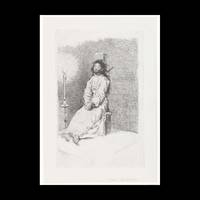
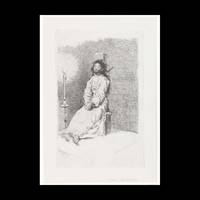
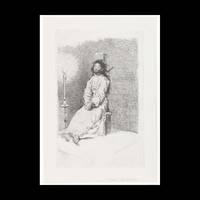
1648334Contentum Ltd. Loose sheet. New. High-quality art print based on an original work from the Rijksmuseum. Created in the 18th century 1797. Professionally printed on premium fine-art paper Museum Etching museum quality in size A3. The artwork is printed with a white border museum-style presentation. Contentum Ltd. unknown
1648335Contentum Ltd. Loose sheet. New. High-quality art print based on an original work from the Rijksmuseum. Created in the 18th century 1797. Professionally printed on premium fine-art paper Photo Matt Fibre in size A2. The artwork is printed with a white border museum-style presentation. Contentum Ltd. unknown
1648336Contentum Ltd. Loose sheet. New. High-quality art print based on an original work from the Rijksmuseum. Created in the 18th century 1797. Professionally printed on premium fine-art paper Photo Rag Bright White premium quality in size A2. The artwork is printed with a white border museum-style presentation. Contentum Ltd. unknown
1648337Contentum Ltd. Loose sheet. New. High-quality art print based on an original work from the Rijksmuseum. Created in the 18th century 1797. Professionally printed on premium fine-art paper Museum Etching museum quality in size A2. The artwork is printed with a white border museum-style presentation. Contentum Ltd. unknown
1938066Contentum Ltd. Loose sheet. New. High-quality art print based on an original work from the Rijksmuseum. Created in the 18th century 1778. Professionally printed on premium fine-art paper Museum Etching museum quality in size A3. The artwork is printed with a white border museum-style presentation. Contentum Ltd. unknown
1938068Contentum Ltd. Loose sheet. New. High-quality art print based on an original work from the Rijksmuseum. Created in the 18th century 1778. Professionally printed on premium fine-art paper Photo Rag Bright White premium quality in size A2. The artwork is printed with a white border museum-style presentation. Contentum Ltd. unknown
1938067Contentum Ltd. Loose sheet. New. High-quality art print based on an original work from the Rijksmuseum. Created in the 18th century 1778. Professionally printed on premium fine-art paper Photo Matt Fibre in size A2. The artwork is printed with a white border museum-style presentation. Contentum Ltd. unknown
1938069Contentum Ltd. Loose sheet. New. High-quality art print based on an original work from the Rijksmuseum. Created in the 18th century 1778. Professionally printed on premium fine-art paper Museum Etching museum quality in size A2. The artwork is printed with a white border museum-style presentation. Contentum Ltd. unknown
16148Paris, Galerie Gaveau, s.d. (1960). 1 vol. in-8° agrafé au dos, couv. ill. 50 pp., (1) p., illustrations dans le texte.[Cat05]
20111-0762763930Falcon Pr Pub Co 2011. Paperback. New. 224 pages. 9.50x6.25x0.75 inches. Falcon Pr Pub Co paperback