423 résultats
18016589London: Published by John Raphael Smith 1801. Mezzotint with roulette coloured by hand. Image size: 17 1/4 x 21 1/2 inches. A touching scene after Morland: 'a master of genre and animal painting an artist worthy to be placed in the same rank as the best of those Dutch masters whom he studied as a boy' DNB<br/> <br/>This print is a wonderful example of the manner in which Morland perfectly conveys the hardships and beauties of country life his depiction of a poor country family battling the hardships of winter shows the bitter side of the pastoral life with grace and sympathy. George Morland was one of the most successful genre painters of his time creating during his industrious career some of England's most cherished paintings. At an early age Morland displayed his artistic genius he learned to paint at three and exhibited his first work at the Royal Academy at the mere age of ten. Morland was a prodigious painter producing more than 4000 paintings during the entirety of his career and sometimes painting two or three works in a day. His beautiful idealistic scenes were a favorite source of inspiration for contemporary engravers and as many as 250 separate engravings were done of his paintings during his lifetime. One such engraver was John Raphael Smith who throughout his career translated many of Morland's paintings to print. Smith was a highly influential figure in the late eighteenth-century British art world he quickly became an impresario of the print-publishing trade producing nearly 400 prints during his lifetime 130 of which were of his own design. This beautiful print refelects both the talents of the engraver and the genius of the artist in its sentiment and execution it demonstrates the best of English genre. Published by John Raphael Smith unknown books
18016589London: Published by John Raphael Smith 1801. Mezzotint with roulette coloured by hand. Image size: 17 1/4 x 21 1/2 inches. A touching scene after Morland: 'a master of genre and animal painting an artist worthy to be placed in the same rank as the best of those Dutch masters whom he studied as a boy' DNB<br/> <br/> This print is a wonderful example of the manner in which Morland perfectly conveys the hardships and beauties of country life his depiction of a poor country family battling the hardships of winter shows the bitter side of the pastoral life with grace and sympathy. George Morland was one of the most successful genre painters of his time creating during his industrious career some of England's most cherished paintings. At an early age Morland displayed his artistic genius he learned to paint at three and exhibited his first work at the Royal Academy at the mere age of ten. Morland was a prodigious painter producing more than 4000 paintings during the entirety of his career and sometimes painting two or three works in a day. His beautiful idealistic scenes were a favorite source of inspiration for contemporary engravers and as many as 250 separate engravings were done of his paintings during his lifetime. One such engraver was John Raphael Smith who throughout his career translated many of Morland's paintings to print. Smith was a highly influential figure in the late eighteenth-century British art world he quickly became an impresario of the print-publishing trade producing nearly 400 prints during his lifetime 130 of which were of his own design. This beautiful print refelects both the talents of the engraver and the genius of the artist in its sentiment and execution it demonstrates the best of English genre. Published by John Raphael Smith unknown
187689659La Habana La Havane Havana: Andres Pego 1876. Fine. Andres Pego La Habana La Havane Havana 1876-1877 17.5 x 25.2 cm 3 volumes reliés New edition embellished at the close of the first volume with a folding plate printed out of text cf. Palau 17346.Cherry half-shagreen bindings spines with four raised false bands decorated with gilt fillets and double gilt panels gilt lettering at the foot of the spines slight rubbing to the headcaps blind-tooled frames on the textured cloth boards pebble-paper endpapers and pastedowns a few bumped corners period bindings. Rear board of the first volume partially soiled.New edition prepared under the supervision of the physician Rafael Ãngel Cowley Valdés-Machado 1837–1908 and Andrés Pego gathering three major sources for Cuban historiography: José MartÃn de Arrate y AcostaÂ’s 1701–1765 Llave del Nuevo Mundo. Antemural de las Indias Occidentales a meticulous portrait of eighteenth-century Cuban society first published only in 1830; Ignacio Urrutia y MontoyaÂ’s 1735–1795 Teatro Histórico JurÃdico PolÃtico Militar de la Isla Fernandina de Cuba of which only the first part had appeared in 1795; and finally Antonio José ValdésÂ’s 1770–1824 Historia General de la Isla de Cuba y en especial de la Habana published in 1811.Provenance: from the library of Ricardo Quintiliano Garcia his name gilt-stamped at the foot of the spines; with his presentation inscription to his brother dated 15 July 1877 on the front flyleaf of the first volume. Andres Pego hardcover
180720249London: Johnson J. Et Al. Poor with no dust jacket. 1807. First Edition. Hardcover. Oversized six volume set. Calfskin titled in gilt marbled textblock edges. 1807 new edition. Poor to fair condition. Ex-library with bookplates and reinforced/taped spines a few library stamps. The first volume is in the poorest condition. Hinges cracked and boards detached on V. 1 and boards nearly detached in other volumes. Scattered foxing. The pages are still reasonably well attached to the spines and the contents are quite legible. The leather board edges are frayed and deteriorating. Scarce. ; Folio 13" - 23" tall . Johnson, J. Et Al hardcover
1869236593Paris: l'auteur rue Royer-Collard 1869. First edition. 200 sepia-toned plates bound out of sequence. 1 vols. Folio. Three quarter green morocco spine richly gilt hinges repaired bookplates discreet embossed library stamp to title page some edges rough plates clean. First edition. 200 sepia-toned plates bound out of sequence. 1 vols. Folio. Lipperheide 337; Colas 1528; Hiler p. 473 l'auteur, rue Royer-Collard unknown books
1869236593Paris: l'auteur rue Royer-Collard 1869. First edition. 200 sepia-toned plates bound out of sequence. 1 vols. Folio. Three quarter green morocco spine richly gilt hinges repaired bookplates discreet embossed library stamp to title page some edges rough plates clean. First edition. 200 sepia-toned plates bound out of sequence. 1 vols. Folio. Lipperheide 337; Colas 1528; Hiler p. 473 l'auteur, rue Royer-Collard unknown
185571896London:: William Charlton Wright 1855 date from folding plates. Fifth edition. publisher's cloth with printed paper label on spine which is so darkened as to be illegible. Two gatherings starting; a few smudges to text; small chips and soiling to the cloth. The folding plates are fine. . 16mo. Hand-colored illustrated title page and two colored folding plates: "The Mystical Wheel of Pythagoras" and "The Tablet of Questions & the Cabalistical Tablet of the Stars.". By the Author of the Prophetic Messenger. With Ten Coloured Designs on Copper on two folding paltes by R. Cruikshank & the Author and a Piece of Music by Blewitt. William Charlton Wright, hardcover
182511300London: Knight and Lacey 1825. Seventh Edition First Edition thus. Half Calf. Very Good. Seventh Edition First Edition thus. Half Calf. Robert Cross Smith 1795-1832 a former carpenter was an English astrologer writing under the pseudonym of "Raphael." He also referred to himself as the Royal Merlin. He married in 1820 and moved to London where he became interested in astrology. Together with G. W. Graham he published a book on geomancy in 1822. Smith began to edit a periodical The Straggling Astrologer in 1824 but failed to receive enough subscribers and the periodical had to be discontinued after a few issues. He collected the issues of the failed periodical in a volume entitled The Astrologer Of The Nineteenth Century in the same year. From 1827 until his death in 1832 he edited an astrological almanac entitled The Prophetic Messenger. Also published by Smith was The Familiar Astrologer and A Manual of Astrology both in 1828. Smith died on 26 February 1832 in London. His almanac continued to be edited as Raphael's Ephemeris and would become a standard work in British and US American astrology. Raphael's Ephemeris popularized the system of Placidian system of astrological houses in the English-speaking world and in modern western astrology in general. Published posthumously. The name Raphael one of the names given to one of the three archangels in the Old Testament was used as Smith's pseudonym. The Astrologer of the Nineteenth Century covers in quite dramatic prose a multitude of occult topics in ten chapters or "circles." Raphael contends that he believes firmly in astrology fairly firmly in geomancy and not much in magic rites charms or incantations. Includes many necromantic workings including a summoning spell for Oberon. He only includes these last to satisfy "those who delight in the terrific and the horribly sublime." The book makes a range of arguments for the veracity of astorlogy the most ingenious being that "the greatest rulers and statesmen and chiefs of the present age" are part of a conspiracy. Formerly owned by Alfred Pearce noted 19th century astrologer. Scarce. Boards rubbed and soiled loose and shaken verso boards chipping and cracking printed paper label rubbed and worn foxing throughout unprofessional repairs otherwise tight and sound contents fine. Half marbled boards with printed paper label on spine worn. Lacking all but one color plates. Former owner label. 8vo. xvi 509pp. Illus. b/w engravings 1 color plate "Awful Appearance of a Spirit.". Knight and Lacey unknown
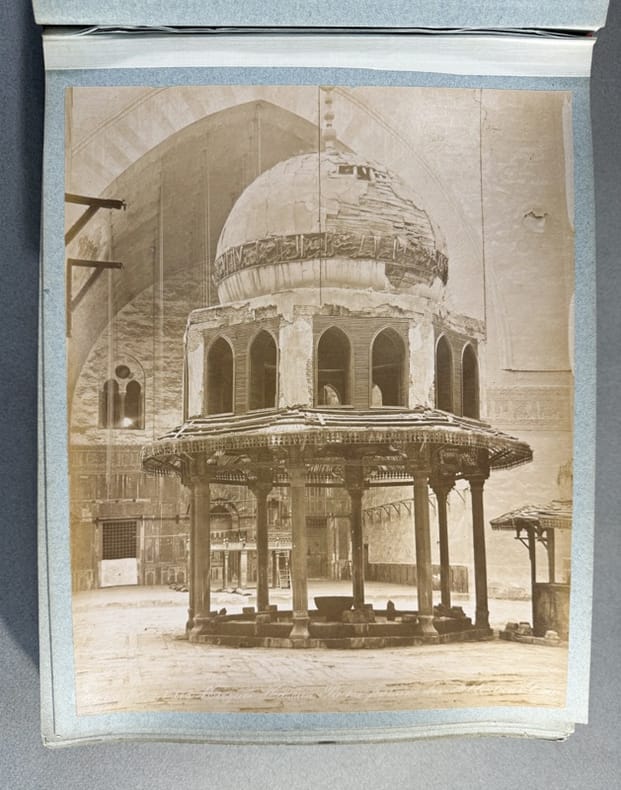
18803132Circa 1870-1880. Album in plano (30,5 x 24,5cm) composé de 52 feuilles cartonnées. Pleine percaline noire d’époque, muette, tranches dorées. Rares rousseurs, quelques photos au contraste faible, une photo avec une légère déchirure en marge, sinon très bon état de conservation. L’album est composé de soixante photos, la plupart de grand format (24 x17 cm).
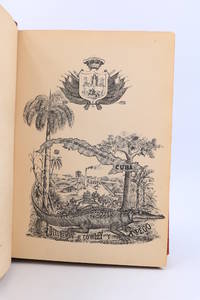
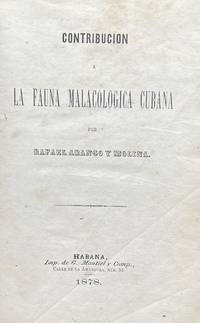
18782328Habana: Imp. de G. Montiel y Comp. Calle de la Amargura num. 36. 1878. In contemporary half leather. Bookseller’s/bookbinder’s vignette on inner front panel: Miguel Alorda / Libreria la Enciclopedia Encuadernaciones Habana. Later presentation inscription on front fly leaf. Binding worn rubbed. Inside firm sporadic foxing otherwise in very good condition. In contemporary half leather. 280 35 1 p. <p><p><br /> First edition of the first catalog of Cuban mollusks.<br /> Contribucion a la Fauna Malacologica Cubana was written by the most notable Cuban malacologist of all time Rafael Arango y Molina 1836–1893. Espinosa 2013 Contribucion Arango’s most important work is an extensive catalog of autochthonous mollusks that collects the classification of this group of families genera and species with their scientific names and also the synonymy the habitat and region of the country where they are located.<br /> <p><br /> During the 17th–18th centuries only a few Cuban species of the mollusk fauna were discovered and all of them were erroneously attributed to Italy and China. It was the 19th-century when more than a hundred new Cuban mollusks were discovered and described also in the present work which is the first catalog of Cuban mollusks. Maceira et al. 2011<br /> <p><p><br /> Literature: Espinosa J.: Las polimitas. Guatemala; La Habana: Ediciones Polymita; Ediciones Boloña. 2013.; Maceira D. et al. 2011. Historia de la malacologia terrestre cubana 1839–2010. Gaia Biodiversidad medioambiente y sociedad 12: pp. 1–48. Imp. de G. Montiel y Comp., Calle de la Amargura, num. 36. unknown
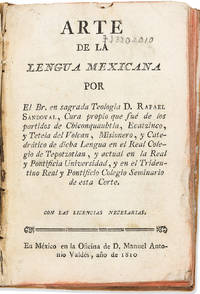
1810A2786<p>16 62 2 pages with as usual two reprints of earlier Nahuatl works: <em>Doctrina breve sacada del catecismo mexicano que dispuso el P. Ignacio de Paredes</em>; and José de la Mota <em>Alabado en mexicano.</em> 4 pages. Both Mexico: reimpresa Mariano Zúñiga de Ontiveros 1809. Octavo 6 1/4" x 4" bound in later stiff vellum edges tinted red. Medina Mexico 10289 and 10278; Medina Mexico 10504; Palau 297166 First edition</p><p>The first new book in Nahuatl to be published since 1770. See León-Portilla <em>Tepuztlahcuilolli impresos en náhuatl</em> page 98. Palau calls for a frontispiece copperplate engraving of the Holy Trinity not noted in Medina and not found in the Oxford or University of Michigan examples online but present following the title page in the John Carter Brown Library example.</p><p><strong>Condition:</strong> Later stiff vellum minor staining; lacking endpapers lacking frontispiece red pencil note on page 54 front end paper detached else about very good.</p> Manuel Antonio Valdés
18566878Mexico City: Jose A. Godoy 1856. First edition. Quarto pp 480 3 errata. A state-by-state guide book for travel throughout Mexico with routes and distances between each city town village ranch etc. The routes described extend into Texas San Antonio and El Paso and New Mexico Albuquerque Bernalillo Santa Fe. Also of note are the routes going from Sonora "al Placer de Oro de la Alta California" i.e. the gold mines of Upper California. This was known as the "Sonora Route" and was traversed by many Mexicans who were among the first to reach the gold fields in 1849 and the early 1850s. It enters the U.S. at the Colorado River and goes through Temecula La Joya then "La Mision vieja se pasa el rio de los Nietos y a la derecha del camino a una legua de distancia esta la mision de San Gabriel opulenta ante su destruccion. Los Angeles: poblacion hoy de los Estados Unidos del Norte." The route then goes through various ranches and follows the "Mission Trail" northward: "La Mision de S. Buenaventura. El rancho de Carpinteria. Sta Barbara presidio: a una milla de distancia esta la mision con una hermosa parroquia y es el obispado. La Mision de Santa Ines. S. Luis Obispo: pasa este camino por un frondoso rio que llaman Arroyo Seco. La Joya: rancho despoblado a la orilla de un rio cubierto de grandes alamedas. La Mision de San Miguel: para llegar a esta se pasa por el rancho que nombran Paso de Robles. La Mision de Soledad. Mision de San Juan. Pueblo de San Jose: pasando por el Ojo del rancho de Cochi. la Laguna y otros mas. Mision de San Jose. Stokton poblacion que esta formando sobre un estero de rio de San Joaquin el cual tiene mucho comercio por los buques procedentes de San Francisco del Alta California. El Rio Estanislao. Un aguage que proporciona pastos que escasean mucho adelante. El Placer de Estanislao Stanislaus." The notes concerning each place are valuable and in some cases very detailed for instance for Baja Caliornia and Tamaulipas with detailed description of the border town of Matamoros on the "Rio Bravo". Sabin 976: Eberstadt 138-033 "An important guide book giving the routes and mileages with sketches of the country throughout Mexico including Coahuila Sonora and New Mexico." Though fairly well-represented on Worldcat the book is quite scarce in the market Eberstadt's copy from 1956 being the only one recorded. Previous owner's name -- "P. Argumoso / 1917" on title page; Mexican book-seller's stamp on ffep. Half calf over marbled boards. Very nice copy. <br/><br/> Jose A. Godoy hardcover books
1856WRCAM41810Mexico City 1856. 4804pp. Several errors in pagination. Small quarto. Contemporary red half sheep and boards spine gilt. Boards and extremities rubbed. Contemporary bookplate on front pastedown. Light toning and minor foxing. Very good. An extremely valuable compilation which gives detailed data including route scenery and other key information about many various parts of Mexico. By piecing together the different itineraries it offers a traveler could basically go anywhere in Mexico and into the U.S. already provided with extremely detailed instructions about the best route and what facilities - such as water grass and shelter - were available every step of the way. A detailed name index listing routes and where they are to be found in the book further enhances the volume's usefulness for travelers be they headed to destinations great or small. Many of the routes described begin in Mexico City; some routes extend into Texas and New Mexico. Among the most interesting are two itineraries concerning California. One describes a journey from La Paz at the far southern end of Baja California to the U.S. border. This is one of the most detailed and expansively described routes in the entire book preserving a wealth of geographic and natural details. Many of the places detailed in this section have either disappeared or been extensively altered. The other journey is along the Sonora Route from Ures to Sonora to the California gold fields. This trip passes through Los Angeles and includes some commentary on the missions in the area. "An important guide book giving the routes and mileage with sketches of the country throughout Mexico" - Eberstadt. PALAU 9290. SABIN 976. EBERSTADT 138:033. BARRETT 34. hardcover books
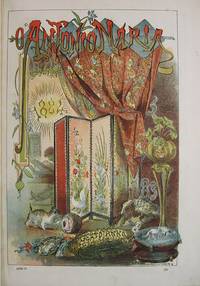
1879LL1<p><strong>Portugal's First Great Political Satirical Magazine a Complete Set</strong></p><p><strong>Includes Portuguese Poetry </strong></p><p>6vols; small folio; 315 issues COMPLETE. Contemporary half leather bindings red brown and green.2 color title pages and two chromolithographic cartoons; three full-page chromolithographic caricatures; black and white lithographs throughout.</p><p>O António Maria was Portugal's first great political satire magazine directed by Portugal's first great political cartoonist Rafael Bordalo Pinheiro 1846-1905.</p><p>The title meant as an exclamation expropriated the first half of the name of the reigning Portuguese Prime Minister António Maria Fontes Pereira.</p><p>Like Puck O António Maria usually devoted its first last and center pages to cartoons. The text pages also were dotted with cartoon art. Among the contributors were the poet Guilherme de Azevedo "João Rialto" Ramalho Ortigão "João Ribaixo" Alfredo Morais Pinto "Pan-Tarantula" João Broa Emílio Pimentel Enrique Casanova António Ramalho Ribeiro Cristino Columbano Bordalo Pinheiro Manuel Gustavo and others. Initially the magazine struck a balance between cartoons and text but as it matured the text took a subservient position to cartoons and comic strips.</p><p>Pinheiro used satire and irony in the pages of his magazine to oppose those in power and denounce the selfishness and corruption of the elites. All of Portugal's leading politicians and heads of first families appeared in caricature at one time or another in the weekly In 1884 the government revised the criminal code which seriously limited freedom of the press. It was in this repressive environment against which journalists generally adopted a passive attitude that led Pinheiro in his final issue to explain: "<em>When in a meeting of journalists' I proposed an 18-day publishing moratorium to protest the shameful situation in which the Portuguese government has placed the Portuguese press it was pointed out that O António Maria as a weekly sheet would not be seriously affected by the resolution. So I take the execution of my proposal one step further: O António Maria closes its doors forever in a sign of mourning</em>."</p><p>#WorldCat: 2 copies in US Libraries.</p>
18272164<p><em><strong>Bolivar improves medical services in Venezuela</strong></em></p><p>Simón Bolívar 1783-1830; José Rafael Revenga 1786-1852.</p><p><strong>Decreto sobre el rèjimen i gobierno del hospital militar.</strong></p><p>Caracas April 23 1827.</p><p>8°. 18 pp.</p><p>Recent paper covers.</p><p>Decree by Bolivar to improve the military hospital at Caracas Venezuela and the medical infrastructure in general. Issued by his Secretary General José Rafael Revenga this lists 19 articles to which the hospital and all other medical establishments should adhere to. The final pages states that this decree was "Given at my headquarters in Caracas on April 23 1827-17°". Medical services had been largely the responsibility of religious organisations. Bolivar aimed to strip monastic orders of their influence and the present decree can be seen as an example of that development.<br />This decree was issued just after settling temporarily the rebellion of Jose Antonio Paez in Venezuela. In 1826 Bolivar travelled to Venezuela to subjugate the resistance instigated by General Paez. This was resolved peacefully when Bolivar confirmed Paez's military authority in Venezuela and Bolivar's subsequent stay to celebrate. This in turn caused De Paula Santader to revolt in Bogota urging Bolivar to leave Venezuela in June. He left Paez in charge of Venezuela with the title of jefe superior. Thus when the present decree was issued in April Bolivar was still in Venezuela. José Rafael Revenga was Secretary of Foreign Affairs of Colombia since 1825 and became private secretary of Bolivar when he travelled to Caracas in 1826 making it likely that this was printed in Caracas. The first book was printed in Caracas in 1810.</p><p><strong>Condition: </strong>slightly spotted more on the last pages. Small hole in final leaf affecting text.</p><p><strong>Reference:</strong> not in Palau; Sabin.</p>
181662954Paris, Ferra jeune 1816 3 volumes, in-12 plein veau jaspé ép., dos lisses richement ornés, p. de titre et de tom. en mar. rouge, tr. marbrées. Bien complet des 24 figures hors-texte en couleurs. Dos du tome 2 refait à l'identique, qqs restaurations, galeries de vers en marge intérieure aux tomes 1 et 2. Infimes rousseurs. Bon exemplaire.
1875018433Mexico: Imprenta de Ignacio Escalante 1875. Book. Good condition. Hardcover. First Edition. 4to - over 9¾ - 12" tall. ii 60 pages of text followed by 12 beautifully hand-colored plates of hummingbirds. The text has sustained water damage but those pages have been professionally washed and stabilized. Signatures page gatherings were reformed and resewn. Rebound with a new leather spine with gilt-lettered leather spine label and linen-covered boards. The tinted lithographed frontisportrait and six pages of text are affected by dark areas of discoloration from the water exposure and many pages have minor rippling as some treated pages were discreetly detached for treatment and re-inserted on an added tab. Minor rippling to the hand-colored plates but the images remain bright and are not noticeably affected. There is minor soiling to the plates. All page edges were trimmed by about a half inch to remove damaged paper and does not affect any text or plates; the size is about 10.5 inches height by about 7.5 inches. Imprenta de Ignacio Escalante Hardcover
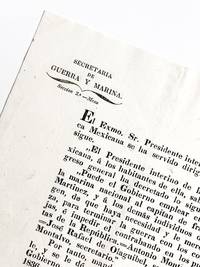
183652758Mexico City: Palacio del Gobierno Nacional 1836. Fine. Official printed government notice of Mexico's continuing efforts to maintain control over Texas immediately after the loss at San Jacinto - here working with privateers to harass Texans at sea. When Mexico finally won its independence from Spain in 1821 its territory included modern-day Texas settled by a mix of Tejano Mexican and Texian Anglo-American populations in addition to indigenous tribes and enslaved African Americans. Tensions between the Tejano and Texian factions increased and finally erupted into full-scale violence in 1835 beginning what is now called the Texas Revolution. Its most famous battle at the Alamo occurred a few months before this broadside was issued. <br /> <br /> The decisive battle of the war San Jacinto occurred on 21 April a Mexican defeat that led to the formation of the Republic of Texas. While the Mexican general Santa Anna negotiated a surrender the Mexican government deposed him for it and refused to recognize an independent Texas. After San Jacinto Mexico avoided pitched battles but continued to take action to undermine and antagonize the new Texas nation. This broadside was one such effort issued just over a week after the defeat at San Jacinto. It announces the formal employment in the navy of private ships to aid in attacking Texans at sea and forming a blockade "para terminar la guerra con los colonos de Tejas é impedir el contrabando en los puertos y costas de la República". Privateers were necessary because the Mexican government did not yet have a robust navy a weakness that the United States would later exploit in the Mexican-American War of 1846-1848. <br /> <br /> Ephemeral broadsides like this survive in few numbers; many of this era during José Justo Corro's interim presidency show only two or three institutional holdings via OCLC. This particular imprint shows three institutional holdings in the US Baylor Texas A&M and Brigham Young. A rare piece of Texana. 12'' x 8.25''. Single letterpress broadside printed recto only. A bit of faint wrinkling. Crisp and bright. Palacio del Gobierno Nacional unknown
1875018433Mexico: Imprenta de Ignacio Escalante 1875. Book. Good condition. Hardcover. First Edition. 4to - over 9¾ - 12" tall. ii 60 pages of text followed by 12 beautifully hand-colored plates of hummingbirds. The text has sustained water damage but those pages have been professionally washed and stabilized. Signatures page gatherings were reformed and resewn. Rebound with a new leather spine with gilt-lettered leather spine label and linen-covered boards. The tinted lithographed frontisportrait and six pages of text are affected by dark areas of discoloration from the water exposure and many pages have minor rippling as some treated pages were discreetly detached for treatment and re-inserted on an added tab. Minor rippling to the hand-colored plates but the images remain bright and are not noticeably affected. There is minor soiling to the plates. All page edges were trimmed by about a half inch to remove damaged paper and does not affect any text or plates; the size is about 10.5 inches height by about 7.5 inches. Imprenta de Ignacio Escalante Hardcover books
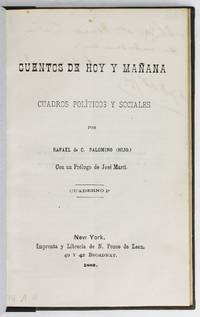
18834665New York: Imprenta y Libreria de N. Ponce de Leon 1883. Very good. vii53pp. Modern quarter calf and marbled boards spine gilt. Inscribed by the author on verso of title page. Manuscript pencil numbering to top corner of each page. Minor foxing. One of the most important and intriguing 19th century Cuban-American imprints featuring two Socialist 'morality tales' that while lauding the quest for social and economic equally also decry the risks posed by human nature and totalitarianism upon the practical application of Marxism. It was written by the prominent Cuban émigré Rafael de Castro Palomino and features a famous prologue by his close friend and colleague José Martí. From the 1870s to 1890s New York City was the heart of the Cuban community in exile. During the Ten Years' War 1868-1878 a wave of Cuban dissidents many being highly educated and with financial resources arrived in New York forming a vibrant and politically active community. There they had almost unfettered freedom to publish raise money and buy arms to support the struggle in the homeland especially at the U.S. Government hoped to exploit instability in Cuba for its own imperialistic advantage. From 1881 until 1895 José Martí 1853-1895 the brilliant author philosopher poet and journalist who was the 'Apostle of Cuban Independence' often made New York his home.<br /> <br /> Upon Martí's arrival in New York in 1881 he was greatly assisted by Rafael de Castro Palomino a long-established Cuban resident of the city. Palomino was a prominent Socialist writer and journalist being the author of numerous articles and short books. Even though his name comes up frequently much of Palomino's biography remains hazy. We do know that he was considerably older than Martí hailed form an affluent Havana family and had been educated in France. Like Martí he was deeply concerned about the potential excesses and pitfalls of Marxism as applied on the real world. Notably Martí and Palomino were close friends of Néstor Ponce de León y de la Guardia 1837-1899. An exiled Cuban lawyer and bibliophile he founded the Imprenta y Librería de N. Ponce de León in the early 1870s a Spanish-language printing house and bookstore that became the intellectual center of the New York Cuban émigré community. As an interesting side note he possessed the largest Spanish language private library in New York featuring more than 1700 titles which he made openly available to his colleagues such as Martí and Palomino. The work is relatively rare and particularly so in commerce. We locate four copies in OCLC at the University of Florida's Cuban collection Harvard Yale and the University of Chicago. An important work from the Cuban exile community. Imprenta y Libreria de N. Ponce de Leon unknown
1807SET23-B-1London : J. Johnson F. C. and J. Rivington et al 1807-9. Leather. Very Good. 12" by 9.5". None. Three scarce complete sets of early nineteenth-century publications of influential Medieval and Early-Modern Era chronicles uniformly and finely bound. Holinshed's Chronicles also known as Holinsheds Chronicles of England Scotland and Ireland is a collaborative work published in several volumes and two editions the first in 1577 and the second in 1587. In 1548 Reginald Wolfe a London printer conceived the idea of creating a "Universal Cosmography of the whole world and there with also certain particular histories of every known nation." He wanted the work to be printed in English and he wanted maps and illustrations in the book as well. Wolfe acquired many of John Leland's works and with these he constructed chronologies and drew maps that were up to date. When Wolfe realised he could not complete this project on his own he hired Raphael Holinshed and William Harrison to assist him. Wolfe died with the work still uncompleted in 1573 and the project changed to a work about just the British Isles was run by a consortium of three members of the London stationers. They kept Raphael Holinshed who employed William Harrison Richard Stanyhurst Edmund Campion and John Hooker. In 1577 the work was published in two volumes after some censorship by the Privy Council of some of Stanyhurst's contribution on Ireland. Shakespeare used the revised second edition of the Chronicles published in 1587 as the source for most of his history plays the plot of Macbeth and for portions of King Lear and Cymbeline. Richard Grafton c. 15111572 was King's Printer under Henry VIII and Edward VI. He was a member of the Grocers' Company and MP for Coventry elected 1562-63. On the accession of Edward VI Grafton was appointed King's Printer and this gave him the sole right to print all Acts and Statutes. He had held the appointment for six years when on the King's death he printed a proclamation of the accession of Lady Jane Grey in which he signed himself "Printer to the Queen." For this he was cast into prison by Mary I. John Cawood became Queen's Printer and Grafton's career as a printer ended. In prison Grafton compiled an Abridgement of the Chronicles of England which he published in 1563. To this he added in 1568 A Chronicle at Large. Enguerrand de Monstrelet c. 1400 20 July 1453 French chronicler belonged to a noble family of Picardy. In 1436 and later he held the office of lieutenant of the gavenier i.e. receiver of the gave a kind of church rate at Cambrai and he seems to have made this city his usual place of residence. He was for some time bailiff of the cathedral chapter and then provost of Cambrai. Little else is known about Monstrelet except that he was present not at the capture of Joan of Arc but at her subsequent interview with Philip the Good duke of Burgundy. Continuing the work of Froissart Monstrelet wrote a Chronique which extends to two books and covers the period between 1400 and 1444 when according to another chronicler Mathieu d'Escouchy he ceased to write. Monstrelet's own writings dealing with the latter part of the Hundred Years' War are valuable because they contain a large number of documents which are certainly and reported speeches which are probably authentic. This publication of Monstrelet's chronicles are the first English translation translated by Thomas Johnes. 'Containing an account of the cruel civil wars between the houses of Orleans and Burgundy; of the possession of Paris and Normany by the English their explusion thense and of other memorable events that happened in the Kindom of France as well as in other countries. A history of fair example and of great profit to the French beginning at the year MCCCC where that of Sir John Froissart finishes and ending at the year MCCCCLXVII and continued by others to the year MDXVI'. Holinshed contains facsimiles of the original 1586 titles and a handwritten 'list of Kings of Scotland from Holinshed's History' loosely inserted. Grafton contains facsimiles of the original 1569 titles and a table to the rear 'declaring the reignes of euerie King of this Realme'. Monstrelet has vignette titles and volume v is made up of 51 plates one folding collate complete. Armorial bookplates of Coulthart of Coulthart and Collyn 'Virtue non Verbis' to front pastedown of every volume. Three sets uniformly bound in decorative full diced calf. Externally very attractive with a lovely patina to the spines. There is some wear and rubbing to the extremities occasioning slight loss to some of the spine leather: very slight to the heads and tails of most volumes and in the cases of volume II of the Holinshed and volume I of the Grafton more loss affecting the gilt lettering.There are a few marks to the boards. Of the twenty-six joints three are starting fifteen are cracked and delicate and four boards are held by the cords only. So in need of osome reinforcement at modest cost for this important set. Internally they are all firmly bound. Generally bright and clean with some instances of age-toning ranging mild to bad occasional off-setting from the text and some intermittent scattered spotting and the odd severely spotted page. The Holinshed set has marks to page V of volume i small spill burns to the gutters of some pages a closed tear to page 3 of volume i dusting and tide marks to volume ii and an ink note to the verso of the front free-endpaper of volume i. Grafton has a few small dustmarks. Monstrelet has some instances of light foxing and ink marks to page 2 of volume III. Some spotting to the bookplates. Very Good J. Johnson, F. C. and J. Rivington et al hardcover
1802B5905Roma: : Work I: Roma: Niccola de Antoni; Work II: Roma: n.p. Work I: c. 1802; Work II: c.1770. . A handsome fine example. Prints are clean and crisp. . Binding: Skillfully rebacked half calf preserving contemporary blue speckled - marbled boards. Spine raised with six 6 bands; compartments elegantly gilt ornamented at borders corners and centres and gilt lettered title on two. Notes: Work I: Raphael 1483-1520 painted the ceilings walls and columns of the Vatican Logge over the two-year period before he would pass away. Together with Michelangelo and Leonardo da Vinci he forms the traditional trinity of great masters of that period. These particular images are renowned for their clarity and accessibility. Much of the subject matter on the columns is traced to Roman iconography. Such items as coins vases sarcophagi and various other items are done with stunning clarity and accuracy. Carlo Lasinio 1759 – 1838 was an Italian engraver who worked chiefly in Florence. Lasinio started as a painter at the Accademia di Belle Arti Venice. He quickly placed more emphasis on printmaking especially after moving to Florence in 1778. He established his reputation with two large series of etchings in 1787 and 1789. Lasinio also taught engraving at the Accademia in Florence becoming a Professor in 1800. <br><br>Work II: A collection of plates from this work with no title page. The Raphael fresco decorations in the Vatican's three-storied balconies known as the 'Logge' quickly became famous and various suites of plates were issued from the 17th century onward. However this set was the first to attempt to show all the decoration of the pilasters and pillars. A set of the present engravings stimulated Catherine the Great to have a replica of the Logge built at the Hermitage in St. Petersburg.<br><br> Size: Folio 621x478mm. Illustration: Illustrated with plates after Raphael: Work I: 14 decorative copper engraved plates; engraved title page by Giovanni Balzar; remaining by Carlo Lasinio after Raphael’s depictions of the Vatican’s loggia and columns. Work II: collection of 31 full page etchings amounting to thirteen 13 pairs or sets of engravings after the Vatican frescoes by Raphael. Volume: Two works in one volume Provenance: Upper pasted endpaper ex libris bookplate marked “Dampierreâ€. All leaves of the first work of wove paper contain the watermark “Pietro Miliani Fabriano.†References: Berlin Kat. 1048 Pages: Work I: illustrated half-title plates numbered figure: II No. I &II III No. III & IV IV No. V& VI V No. VII & VIII VI No. IX&X I No. I&II II No. III&IV III No. V&VI IV No.VII&VIII V No. IX&X dated 1802 VI No.XI&XII VII No.XIII&XIV VIII No.XI&XII ; Work II: plate I-XIII Num I-XIII I-V Category: Book Art Architecture & Design; Book Europe Italy; Book Plate Books General; Work I: Roma: Niccola de Antoni; Work II: Roma: [n.p.] hardcover
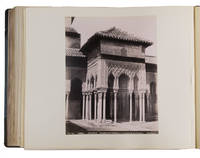
1890ABC_473841890. Half blind-tooled greenish brown calf and grey/green net grained cloth over boards with the title in gold on the front board red edges and decorated endpapers. Large oblong album 32 x 40 cm. 89 original photographs mostly 20 x 26 cm. In 711 a Muslim army led by Tariq ibn Ziyad conquered most of the Iberian Peninsula which was then part of the Visigothic Kingdom. This region became known as Al-Andalus with Cordoba serving as its capital. In 756 Abd ar-Rahman I established the Emirate of Cordoba as an independent state. The present photo album covers in many photographs the magnificent architecture and features of the Great Mosque of Cordoba which is considered one of the most significant architectural monuments of the western Islamic world. Built in 785 the mosque's most notable feature was its enormous hypostyle hall comprised of rows of columns connected by double tiers of arches. The lower tier included horseshoe arches and was constructed with alternating red brick and light-colored stone. Abd ar-Rahman II expanded the mosque's dimensions in 836 while preserving its original design. His successors Muhammad Al-Mundhir and Abdallah also added new features to the mosque. One of the mosque's western gates Bab al-Wuzara' now known as Puerta de San Esteban is a famous prototype of later Moorish architectural forms and motifs featuring horseshoe arches with alternating coloured and decorated voussoirs set within a decorative rectangular frame called an alfiz. At the centre of Garzóns photographic work on Córdoba was the Palace of the Lions also known as the Court of the Lions Patio de los Leones; . Situated in the center of the Alhambra with its ancient citadel consisting of a complex of forts palaces and gardens this is one of the most buildings of the period of Muslim rule. The palace was commissioned by the Nasrid sultan Muhammed V of the Emirate of Granada during the second phase of his reign between 1362 and 1391 AD. The general layout of the Palace of the Lions courtyard comprises an elongated rectangle with two halls facing each other at opposite ends which is a common feature in numerous earlier palaces throughout Al-Andalus including other Nasrid palaces located within the Alhambra such as Comares Palace. Similar designs can even be traced back to the 10th century at Madinat al-Zahra located near Cordoba. What sets the Palace of the Lions apart is the addition of two more halls which face each other across the courtyard's shorter axis. This innovation is accompanied by an extension of the columned portico to encompass all four sides of the courtyard. The four converging water channels within the courtyard's floor are generally believed to be a symbolic representation of Paradise which both Muslim and Christian traditions describe as having four rivers. This arrangement may have drawn inspiration from the Persian chahar bagh tradition which involves a garden divided into four symmetrical parts along its central axis. The Palace of the Lions combines this with the classical peristyle tradition which features a portico or arcade surrounding a courtyard. Other monuments in Al-Andalus and North Africa where they are commonly referred to as a riad or riyad also feature gardens with a chahar bagh-type quadripartite division.Rafael Garzón 1863-1923 was born in Granada became known as one of Spains foremost photographers of the early twentieth century. He owned studios situated inside the Alhambra of Granada and in Seville. His photographic work mainly focused on capturing the landscapes and monuments of Andalucía particularly his photographic portraits which gained him recognition. His studio inside The Alhambra became particularly famous. Upon his arrival in Seville in 1901 he established a studio with an elaborate Arabic theme to enhance his photographs. He photographed the aristocrats of Seville as well as the earliest tourists of the 19th century who visited Andalucía. The spread of his photographs contributed greatly to the rising touristic interest in Spain. Garzón's photography encompassed two distinct styles. His monumental photography of prominent Spanish structures such as the Alhambra the Mosque-Cathedral of Córdoba and the Cathedral and Reales Alcázares of Seville. The other style was a popular type of photography designed to cater to the preconceived notions of foreign visitors seeking classic gypsy portraits from Sacromonte or the Carmenes from Córdoba or Seville. His photographic work was both of high quality and commercially attractive and Garzón distributed them in various formats including postcards collector's items and travel books.The binding shows very slight signs of wear mainly around the foot of the spine the interleaved tissue paper is slightly browned the upper-outer corner of the leaves is occasionally slightly dustsoiled. hardcover