Holbein, HansBiblio.com
679 résultats
1164900838.Gpaperback. Good. Access codes and supplements are not guaranteed with used items. May be an ex-library book. paperback
1437101976.Gpaperback. Good. Access codes and supplements are not guaranteed with used items. May be an ex-library book. paperback
EEZZ7488bKöln u.a. J. M. Heberle H. Lempertz & Comp. 1849. Kl. 8°. 2 Bll. 24 S. 1 Bl. Neuer Pappband mit mont. Orig.-Umschlag mit kleiner mont. Etikette Vortitelbl. alt gestempelt. Erste Ausgabe. Rümann 1521; Oppermann 23. Köln u.a., J. M. Heberle (H. Lempertz & Comp.) 1849. unknown
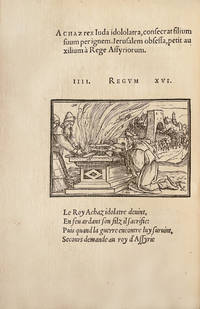
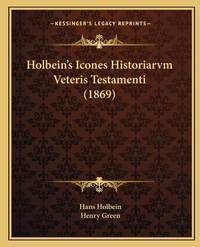
ABAA6<p>Lugduni Apud Ioannem Frellonium1547. </p><p>Small 4to of 52 ll. sign. A-N with 98 woodcuts l. L2 remargined brown Jansenist morocco spine ribbed gilt edges gilt inner border. <em>Chambolle-Duru</em>. </p><p>198 x 135 mm. </p><p>First issue "<em>of this beautiful book</em>" Brunet supplément 647 exceedingly rare with such wide margins height 198 mm; it is taller than the superb copy of <em>James de Rothschild.</em></p><p>Harvard 281; Baudrier vol. 5 p. 209; Rothschild vol. 1 n°16 ; Duplessis op. cit. N°276 p. 60-62 ; Woltmann <em>Holbein</em> vol. 2 p. 172-173 e ; Bouchereaux Corrozet n°127 ; Didot <em>Essai</em> col.73.</p>Each one of the 94 Holbein's engravings occupies a page with Latin <br />text above and French quatrains by <em>Gilles Corrozet</em> below.<p>Didot<em></em> in his <em>Essai sur la gravure sur bois</em> analyzes what he calls a "<em>masterpiece</em>":</p><p><em>"</em><em>The compositions in this masterpiece are of the highest style and as in The Simulacra of Death the expressions of the figures are </em><em>righteous</em><em> and offer a blend of simplicity energy and naivety that characterize Holbein.</em><em>"</em> </p><p>"First edition of 1547. There were two editions of the <em>Icones</em> printed by Frellon in 1547. These are often cited as issues but the text was entirely reset. This edition described by Brunet III 252-253 and others as the earlier may be identified by the fifth line of the title ending in "emenda-" and the first line of the French text on leaf LIr ending in "uices". A distinguishing feature of this edition is the use of v for u at the beginning of words in the Latin text. Brunet initiated a certain amount of controversy by quoting from E. Tross a theory that the second edition of 1547 No. 282 was printed from clichés rather than from the original blocks. Both Hofer op. cit. No. 276 ; p. 166-167 and Davies Murray vol. I no. 244 reject the idea of clichage. On the basis of breaks in the woodblocks Davies reverses Brunet's order of the two editions but evidence is introduced in the Hofer article to indicate that the condition of the blocks is in this case insufficient to prove priority. Aside from the woodcuts the changes in the text support the order of editions given by Brunet. Comparison of the French text of 1539 with that of this 1547 edition shows that out of the ninety-four verses fifty-one have from one to four lines revised. Signatures D and L are the only ones in which the text is unchanged. The text of the other 1547 edition corresponds to this one but has in addition seven of the eight quatrains in signature L revised. "Harvard. <br /></p>Known for their beauty and fine execution these <em>Icones</em> <br />are considered as a significant milestone in the illustrated <br />book of the Renaissance.Superb copy bound in Jansenist morocco by Chambolle-Duru <br />like the copy of James de Rothschild.<br /><br /><p><strong>French</strong></p><p>Lugduni Apud Ioannem Frellonium1547. </p><p>Petit in-4 de 52 ff. non chiffrés sign. A-N avec 98 figures sur bois f. L2 réenmargé maroquin brun janséniste dos à nerfs tranches dorées roulette intérieure dorée. <em>Chambolle-Duru</em>.</p><p>198 x 135 mm.</p><p>Premier tirage "<em>de ce beau livre</em>" Brunet supplément 647 de la plus extrême rareté avec d'aussi grandes marges hauteur 198 mm ; il dépasse le superbe exemplaire <em>James de Rothschild.</em></p><p>Harvard 281 ; Baudrier vol. 5 p. 209 ; Rothschild vol. 1 n°16 ; Duplessis op. cit. N°276 p. 60-62 ; Woltmann <em>Holbein</em> vol. 2 p. 172-173 e ; Bouchereaux Corrozet n°127 ; Didot <em>Essai</em> col.73.</p><p>Chacune des 94 gravures d'Holbein occupe une page avec texte latin au-dessus et quatrains français de <em>Gilles Corrozet</em> au-dessous.</p><p>Didot<em></em> dans son <em>Essai sur la gravure sur bois</em> analyse longuement ce qu'il nomme " <em>chef-d'œuvre</em> " :</p><p>" <em>Les compositions de ce chef-d'œuvre sont du plus haut style et comme dans les Simulachres de la Mort les expressions des figures sont justes et offrent un mélange de simplicité d'énergie et de naïveté qui caractérisent Holbein</em> ".</p><p>"First edition of 1547. There were two editions of the <em>Icones</em> printed by Frellon in 1547. These are often cited as issues but the text was entirely reset. This edition described by Brunet III 252-253 and others as the earlier may be identified by the fifth line of the title ending in "emenda-" and the first line of the French text on leaf LIr ending in "uices". A distinguishing feature of this edition is the use of v for u at the beginning of words in the Latin text. Brunet initiated a certain amount of controversy by quoting from E. Tross a theory that the second edition of 1547 No. 282 was printed from clichés rather than from the original blocks. Both Hofer op. cit. No. 276 ; p. 166-167 and Davies Murray vol. I no. 244 reject the idea of clichage. On the basis of breaks in the woodblocks Davies reverses Brunet's order of the two editions but evidence is introduced in the Hofer article to indicate that the condition of the blocks is in this case insufficient to prove priority. Aside from the woodcuts the changes in the text support the order of editions given by Brunet. Comparison of the French text of 1539 with that of this 1547 edition shows that out of the ninety-four verses fifty-one have from one to four lines revised. Signatures D and L are the only ones in which the text is unchanged. The text of the other 1547 edition corresponds to this one but has in addition seven of the eight quatrains in signature L revised. "Harvard.</p><p>Reconnues pour leur beauté et leur finesse d'exécution ces <em>Icones </em>sont considérés comme un jalon marquant du livre illustré de la Renaissance. </p><p>Superbe exemplaire relié comme l'exemplaire James de Rothschild en maroquin janséniste de Chambolle-Duru.</p> hardcover
0846701472New. paperback. New. Satisfaction Guaranteed or your money back. paperback
1976Q-0846701472Imprint unknown 1976-09-27. Paperback. New. New. In shrink wrap. Looks like an interesting title! Imprint unknown paperback
1947009782Buenos Aires: Laclaustra Y Compania. Very Good. 1947. First Thus. Full-leather. One of eighty copies. This is a facsimile edition of Hans Holbein Le Jeune's 1549 edition as a set of two volumes in a marbled slipcase. The text volume with illustrations is full leather with five bands. Leather along the bands and edges is rubbed with a small crack at the head of the spine. Front endpapers are marbled and rear endpapers are brown suede. The second volume is a folder with a leather spine with spine ends rubbed off over marbled boards. It contains an etched copperplate with image and text. A unique presentation of the work of Hans Holbein the Younger a famous 16th century artist and supporter of the Reformation. ; 10 3/4" x 7 1/2" . Laclaustra Y Compania hardcover
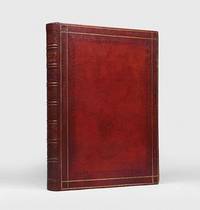
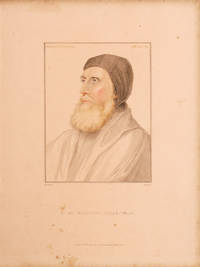
1792160199London: W. Bulmer and Co. Shakespeare Printing-Office 1792-1800. This magnificent work" - Holbein rendered by Bartolozzi First edition of this superlative folio about which the leading authorities are in full agreement: "in every way a splendid book" Abbey and "this magnificent work is surely the finest early example of English colour printing" Ray. This is a most handsome copy in contemporary red morocco. "During his second stay in England 1532-43 Hans Holbein made a series of drawings of sitters connected with the court of Henry VIII that ranks among his finest achievements. Most of these were discovered as a group pasted into an album in a bureau at Kensington Palace by Queen Caroline in 1728 and the majority are now in the Royal Collection Windsor" Oliver et al p. 168. The album had a chequered history passing through several royal and noble hands - Charles I swapped it for a single painting by Raphael - before finding its way into the celebrated collection of Thomas Howard 14th earl of Arundel who "amassed what stands as the first major British art collection" British Library. It then returned to royal ownership a reunion that was recorded in Alexander Browne's Ars Pictoria 1675: "this book has been long a Wanderer but is now most happily fallen into the King's Collection". It then lay undisturbed until Queen Caroline's discovery. Solicitous of artworks in the royal collections she had them removed from their binding individually framed and hung in her country residence of Richmond Lodge. A native of Florence Francesco Bartolozzi 1728-1815 had by the early 1760s established himself as one of the finest engravers in Italy. An invitation to London in 1764 led to his employment to make prints after drawings by Guercino which entered the Royal Collection. He became engraver to the king and was a founder member of the Royal Academy. His imprimatur on an engraving was in high demand and he established "a vogue for dotted prints or 'stipples' and this became his characteristic manner" ODNB. Extensive work for many of the leading London print-sellers followed for which he employed a large studio to cope with commissions. This led to accusations of shoddy workmanship about which Bartolozzi was very sensitive; and yet he continued to attract high-level commissions such as the present work the admirable presswork for which was by the best London printer of the day William Bulmer. It was published under the auspices of the antiquary John Chamberlaine Keeper of George III's drawings with biographical notices provided by Edmund Lodge. Dr Lucy Peltz Head of Collection Displays Tudor to Regency at the National Portrait Gallery notes a contemporary "patriotic fashion for collecting engraved portraits of illustrious figures" ODNB entry for Edmund Lodge. "Published in parts during the years 1792 to 1800. the book evidently had a very considerable success for the plates appear in several states" Abbey. The present copy includes hand-coloured plates on white paper pink paper and trimmed pink paper mounted to white sheets with a double-border in wash. The sitters include Anne Boleyn Edward VI Sir Thomas Eliot Catherine Howard Sir Thomas More Jane Seymour Henry Howard earl of Surrey and Sir Thomas Wyatt. Folio 543 x 400 mm. With 84 colour-printed stipple engravings on 83 sheets all but four by Francesco Bartolozzi after Holbein on white or pink paper some on pink paper mounted on card. Contemporary red straight-grain morocco gilt spine with seven pairs of raised bands gilt lettered direct in second compartment and at foot each compartment filled with decorative blind tooling sides with intersecting gilt frames enclosing blind panels comprising interlocking drawer-handle tools and anthemion rolls 12-point corner rosettes gilt chain-link edge roll gilt rope-twist turn-ins drab bluish green surface-paper endpapers gilt edges. Binding professionally refurbished a few old abrasions to binding front leaves creased one mounted plate with repaired closed tear some foxing to plates on white paper a few captions shaved rear free endpaper sympathetically renewed. A handsome copy. Abbey Life 205 the plates accord with Abbey's states 2 3 and although not examined by him possibly 5; Lowndes I p. 405; Ray The Illustrator and the Book in England from 1790 to 1914 1991 19. Lois Oliver et al "New evidence towards an attribution to Holbein of a drawing in the Victoria and Albert Museum" The Burlington Magazine Vol. 148 No. 1236 March 2006. hardcover
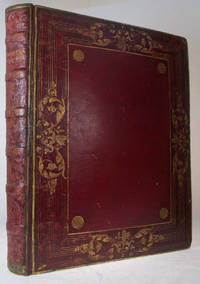
179265216London: W. Bulmer & Co 1792. HOLBEIN Hans; CHAMBERLAINE John. artist. CHAMBERLAINE John. Imitations of Original Drawings by Hans Holbein in the Collection of His Majesty for the Portraits of Illustrious Persons of the Court of Henry VIII. With biographical tracts. Published by John Chamberlaine Keeper of the King's Drawings and Medals and F.S.A. London: W. Bulmer & Co. 1792.<br> <br> First edition of Chamberlaine's magnificent volume of 86 color stipple-engraved plates rarely found complete. Large folio 21 1/4 x 16 1/2 inches; 540 x 415 mm. Complete with the 80 listed plates all of which are mounted frontispiece portraits of Holbein and Holbein's wife and a third frontis of a group portrait two hand-colored miniatures and an additional plate of Henry Howard Earl of Surry engraved by Scriven. An impressive collection of full-page engravings after Holbein's legendary portraits of Jane Seymour Anne Boleyn Sir Thomas More a young Edward VI Anne of Cleves and other court figures with frontispiece portraits of Holbein and his wife. Of the listed plates all but four portraits are engraved by the great Bartolozzi. In total eighty-two plates are in color with four on lavender paper sixty-three on pink thirteen on white/buff inclusive of one sheet with double portrait of Henry and Charles Brandon finished by hand. With one leaf of publisher's advertisements.<br> <br> 19th-century full red morocco rebacked with original spine laid down. Boards elaborately stamped with floral devices and with thirteen gilt rules. Spines elaborately stamped in blind and gilt lettered in gilt. With one-inch gilt dentelles. All edges gilt. Green coated endpapers. Plates exceptionally bright and clean with only very minor instances of foxing. Most foxing is to leaves and not engravings. Title-page with 11/2-inch x 1/2 piece torn from fore-edge and a 2-inch closed tear at fore-edge neither affecting text. Many of the plates are a somewhat wrinkled. The plate of Lord Clinton with a small tear to the pink paper not affecting engraving. Occasional marginal closed tears professionally repaired. Binding a bit rubbed and bumped. Overall a very good copy of a magnificent work.<br> <br> German artist Hans Holbein the Younger ranks "as one of the best portrait-painters in the world. He combined artistic beauty and precision of technical execution with extraordinary truth to nature and power of interpretation of character." Holbein born in 1497 first "arrived in England in the 18th year of the reign of Henry VIII. Sir Thomas More was then Chancellor of the Exchequer and Warham. was Archbishop of Canterbury. Through them Holbein obtained easy access to the leading men of the court" painting portraits of Moore Warham and many others before returning home. He journeyed back to England in 1532 where by 1536 he was in service as "'the king's painter' and in that year he painted the new queen Jane Seymour." In 1539 as a New Year's gift to the king "he gave 'a table of the pictour of the prince's grace' possibly the portrait of the infant Edward VI at Hanover. His portrait of Anne of Cleves perhaps the one now in the Louvre was sufficiently attractive to decide the king in her favour" DNB. The majestic portraiture of Holbein who died in London in 1543 "remains unsurpassed for sureness and economy of statement penetration into character and a combined richness and purity of style" Waterhouse. At the end of the 18th century John Chamberlaine in the court of George III sought to bring together a work to pay tribute to Holbein's magnificent artistry. There had been previous unsuccessful attempts to publish the portraits in engraved reproductions such as a 1792 volume containing 33 plates of poor quality titled The Court of Henry the Eighth. Yet Chamberlain succeeded where others failed for as the king's Keeper of the Drawings he assembled in this Imitations of Original Drawings by Hans Holbein 84 splendid color stipple-engraved full-page portraits of Edward VI Anne Boleyn Thomas More Jane Seymour the Archbishop of Canterbury Anne of Cleves and other major figures of the age.<br> <br> "One of the most magnificent books that we have ever seen and whether we consider the genius of the painter or the talents of the engravers reflects high honor on the age and nation which produced it" London Monthly Review. Sir Walter Scott praised it as "a collection which at once satisfies the imagination and the understanding showing us. how the most distinguished of our ancestors looked moved and dressed and. how they thought acted lived and died" Allibone 1120. Color-inked on the plates these intricate stipple-engraved portraits comprise "inestimable examples of English color printing at its best" Joan Friedman. "This magnificent work is surely the finest early example of English color printing. The reduced reissue of 1812 reprinted in 1828 gives no idea of the book's quality" Ray English 19. "In every way a splendid book" Abbey Life 205.<br> <br> Initially issued serially in 14 parts from 1792-1800. This volume's 86 beautiful portraits were achieved with techniques that admirably succeed in honoring Holbein's portraiture. The plates were etched or engraved in gray or sepia ink with additional colored inks applied a la poupee two hand-colored. Text by Edmund Lodge. Abbey Life 206.<br> <br> Lowndes 1381. Abbey Life 205 206.<br> <br> HBS 65216.<br> <br> $12500. W. Bulmer & Co unknown
1d654Nach Hans Lutzelburger´s Original- Holzschnitten im Dresdner Kabinett zum ersten Mal treu copirt von Heinrich Loedel mit erläuternden Denkversen und einer geschichtlichen Abhandlung über die Todtentänze von Dr. Adolf Ellissen. Verl. der Dieterichschen Buchhandl. Göttingen 1849. 131 S. brosch. ohne Umschlag/locker/einige Seiten unaufgeschnitten/wenige Bleistiftunterstreichungen. unknown
027091448X.Ghardcover. Good. Access codes and supplements are not guaranteed with used items. May be an ex-library book. hardcover
181273585London: John Chamberlaine 1812. Bartolozzi developed his style to imitate the subtleties of renaissance and baroque chalk drawings and became deservedly famous for his stipple engraving. The portraits in this collection show how effective this technique was in reproducing with such incredible fidelity Holbein's original designs. Engraved by BARTOLOZZI Francesco in IMITATIONS OF ORIGINAL DRAWINGS BY HANS HOLBEIN IN THE COLLECTION OF HIS MAJESTY FOR THE PORTRAITS OF ILLUSTRIOUS PERSONS OF THE COURT OF HENRY VIII. WITH BIOGRAPHICAL TRACTS. Stipple engraving. Printed colour. Size: 333 x 250 mm Fine condition. unknown
185617837Paris: Edwin Tross. Very Good. 1856. First Edition Thus. Hardcover. Bright clean red cloth binding with gilt decoration & lettering. Text tight & intact: binding solid. Unpaginated. Written in Latin & French. Various scenes illustrating the universality of death no matter one's station in life are engraved in the historiated woodcut borders & letters. Hans Holbein 1497-1543 created his Alphabet of Death at a time when the Latin alphabet did not distinguish between I and J or U and V. The separation into vowels and consonants came after the Renaissance. De Montaiglon's preface notes that Holbein's alphabet has only twenty-four letters. Early owner's bookplate. Toning on endpapers only. Poetry Art; Large 8vo 9" - 10" tall . Edwin Tross hardcover
1016205848.Ghardcover. Good. Access codes and supplements are not guaranteed with used items. May be an ex-library book. hardcover
8496775372.Gpaperback. Good. Access codes and supplements are not guaranteed with used items. May be an ex-library book. paperback
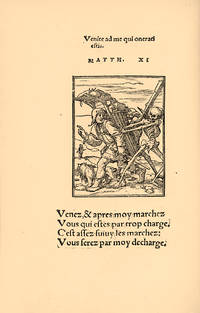
ABAA-75TH-VBF-11<p>Lyon Melchior & Gaspar Trechsel 1538.</p><p>Small 4to of 52 leaves signed A-M4.</p><p>Full brown morocco blind-stamped central fleuron decorated ribbed spine gilt inner border gilt edges. <em>Binding signed Trautz-Bauzonnet circa 1865.</em></p><p>177 x 123 mm.</p><p>" <em>Earliest known edition of this remarkable work with its most fascinating designs of exquisite finish </em>" Murray.</p><p>Brunet III 254 ; Brun <em>Le livre français illustré de la Renaissance</em> p. 222 ; Mortimer 284 ; Murray 247 ; Massmann S. 8 ; Minns 213 ; Holbein-Kat. Basel 1960 nr. 418 ; Woltmann92-149 ; Hollstein XIVa 202 99 ; 247 ; Brunschwig 428 ; Baudrier V 175 ; Rothschild I 15.</p><p><em>'Suite of 41 compositions beautifully engraved after Holbein's drawings. The monogram HL on l. 36 on the duchess's bed is by Hans Lützelbürger plate XX'.</em> Brun.</p><p>First edition of Holbein's Dance of Death whose iconographic influence continues to the present day. " <em>Holbein's contribution to the traditional Dance of Death was a sharpening of the humor and satire and a heightening of the drama so that the customary procession of figures becomes instead under his hand a series of fully realized scenes</em> " Mortimer.</p><p>Erste Druckausgabe von Holbeins Basler Totentanz. " Die Folge besteht aus 51 Bildern von denen 41 beim Tode Lützelburgers vor Johannistag 1526 vollendet waren und in der Ausgabe von 1538 erschienen. Melchior Trechsel hatte die Stöcke direkt bei Lützelburger bestellt und am Johannistag 1526 bezogen ; nach Aussage des Vorworts von 1538 getraute man sich nicht die restlichen Stöcke schneiden zu lassen " Holbein-Kat.</p><p>First printed edition of Holbein's Basel Dance of the Dead. 'The suite consists of 51 images 41 of which were completed at Lützelburger's death before Midsummer 1526 and which were published in the 1538 edition.</p><p><strong>Very rare first issue of this remarkable and famous suite of The Dance of the Dead imagined by Holbein and 'which' according to the bibliographers 'must be ranked among the most beautiful books ever published'. </strong></p><p><strong>This very precious dance of the dead comprises 41 prints engraved by Hanz Lützelburger based on drawings by Hans Holbein.</strong></p><p>The monogram <em>H</em> signs the engraving of the Duchess.</p><p><strong>In 1536 the brilliant artist was chosen as one of Henri VIII's painters.</strong></p><p><strong>In 1538 Holbein left for Belgium and then visited Lyon. This trip coincided with the first publication in that city by Gaspar and Melchior Trechsel of</strong> '<em>Simulacres et Historiées faces de la mort'</em>.</p><p>The 41 woodcuts that adorn the volume had been printed in Basel as early as 1530 but had never been brought together in a collection. Holbein's Basel collaborator Hans Lùtzelburger executed here the engravings from his master's drawings see his monogram 'HL' on f. 36. </p><p><strong>The first series of these chilling yet humorous images gives great importance to what was to become one of the most famous illustrated books of the Renaissance. </strong></p><p>Holbein's last known work was a drawing dated 1543 the year in which the great artist was struck down by a plague epidemic.</p><p><strong>The absolutely remarkable iconography bears witness to Holbein's genius in the originality expression and realism of the scenes evoking the different classes of society as well as in the extreme finesse of the drawing.</strong></p><p><em>'The wonderful pictures of his most facinating designs of exquisite finish'</em> were the source of inspiration for many later artists.</p><p>Each of the engravings is laid out under an extract of 3 Latin lines from the Bible and is accompanied by a quatrain in French.</p><p>All classes of society are represented in this masterly production with its fascinating realism.</p><p>The work was so successful that 12 editions were published between 1538 and 1562.</p><p>The quatrains and epistle in French are attributed to Jean de Vauzelles or Gilles Corrozet.</p><p>The widest copy height: 177 mm recorded on the market for several decades.</p><p>Provenance: the copy comes from the famous library of the entrepreneur philanthropist and bibliophile <em>Charles William Dyson Perrins</em> 1864-1958; <em>Sam Josefowitz Pully </em>- then by descent to the present owners. </p><p>FR</p><p>Lyon Melchior & Gaspar Trechsel 1538.</p><p>Petit in-4 de 52 feuillets signés A-M4.</p><p>Plein maroquin brun fleuron central à froid dos à nerfs orné filets or sur les coupes roulette intérieure tranches dorées. <em>Reliure signée de Trautz-Bauzonnet vers 1865.</em></p><p>177 x 123 mm.</p><p>" <em>Earliest known edition of this remarkable work with its most fascinating designs of exquisite finish </em>" Murray.</p><p>Brunet III 254 ; Brun <em>Le livre français illustré de la Renaissance</em> p. 222 ; Mortimer 284 ; Murray 247 ; Massmann S. 8 ; Minns 213 ; Holbein-Kat. Basel 1960 nr. 418 ; Woltmann92-149 ; Hollstein XIVa 202 99 ; 247 ; Brunschwig 428 ; Baudrier V 175 ; Rothschild I 15.</p><p>"<em>Suite de 41 compositions merveilleusement gravées d'après les dessins d'Holbein. Le monogramme HL qui se voit au f. 36 sur le lit de la duchesse est celui de Hans Lützelbürger planche XX</em> ". Brun.</p><p>First edition of Holbein's Dance of Death whose iconographic influence continues to the present day. " <em>Holbein's contribution to the traditional Dance of Death was a sharpening of the humor and satire and a heightening of the drama so that the customary procession of figures becomes instead under his hand a series of fully realized scenes</em> " Mortimer.</p><p>Erste Druckausgabe von Holbeins Basler Totentanz. " Die Folge besteht aus 51 Bildern von denen 41 beim Tode Lützelburgers vor Johannistag 1526 vollendet waren und in der Ausgabe von 1538 erschienen. Melchior Trechsel hatte die Stöcke direkt bei Lützelburger bestellt und am Johannistag 1526 bezogen ; nach Aussage des Vorworts von 1538 getraute man sich nicht die restlichen Stöcke schneiden zu lassen " Holbein-Kat.</p><p>Première édition imprimée de la danse macabre bâloise de Holbein. "La suite se compose de 51 images dont 41 étaient achevées à la mort de Lützelburger avant la Saint-Jean 1526 et qui ont été publiées dans l'édition de 1538….</p><p><strong>Premier tirage de grande rareté de cette remarquable et célèbre suite de la danse des morts imaginée par holbein et " qui doit " selon les bibliographes " être rangée parmi les plus beaux livres qui aient été publiés ". </strong></p><p><strong>Cette très précieuse danse des morts comprend 41 estampes gravées par hanz lützelburger sur les dessins de hans holbein.</strong></p><p>Le monogramme <em>H</em> signe la gravure de la Duchesse.</p><p><strong>en 1536 le génial artiste est choisi comme l'un des peintres de Henri VIII.</strong></p><p><strong>en 1538 Holbein part pour la Belgique puis visite Lyon. Ce voyage coïncida avec la première publication dans cette ville par Gaspar et Melchior Trechsel des</strong> " <em>Simulacres et Historiées faces de la mort</em> ".</p><p>Les 41 bois gravés qui ornent le volume avaient été tirés à Bâle dès 1530 mais n'avaient jamais été réunis en recueil. Le collaborateur bâlois de Holbein Hans Lùtzelburger exécute ici les gravures d'après les dessins de son maître voir son monogramme "HL" au f. 36. </p><p><strong>La première réunion en série de ces images à la fois glaçantes et teintées d'humour confère toute son importance à ce qui allait devenir l'un des livres illustrés les plus célèbres de la Renaissance. </strong></p><p>Le dernier ouvrage connu d'Holbein fut un dessin daté de 1543 année où le grand artiste fut terrassé par une épidémie de peste.</p><p><strong>L'iconographie absolument remarquable témoigne du génie d'Holbein dans l'originalité l'expression et le réalisme des scènes évoquant les différentes classes de la société ainsi que dans la finesse extrême du dessin.</strong></p><p>" <em>The wonderful pictures of its most facinating designs of exquisite finish</em> " furent la source où plusieurs artistes postérieurs puiseront leur inspiration.</p><p>Chacune des gravures est mise en page sous un extrait de 3 lignes latines de la Bible et est accompagnée d'un quatrain en français.</p><p>Toutes les classes de la société sont réunies dans cette mise en scène magistrale au réalisme fascinant.</p><p>L'ouvrage connut d'ailleurs un tel succès que 12 éditions se succédèrent de 1538 à 1562.</p><p>Les quatrains et épître en français sont attribués à Jean de Vauzelles ou Gilles Corrozet.</p><p>Le plus grand exemplaire hauteur : 177 mm répertorié sur le marché depuis plusieurs décennies.</p><p>Provenance : l'exemplaire provient de la célèbre bibliothèque de l'entrepreneur philanthrope et bibliophile <em>Charles William Dyson Perrins</em> 1864-1958 ; <em>Sam Josefowitz Pully</em> – puis par descendance aux propriétaires actuels. </p> hardcover
0353706043.Ghardcover. Good. Access codes and supplements are not guaranteed with used items. May be an ex-library book. hardcover
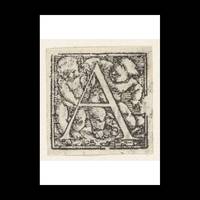
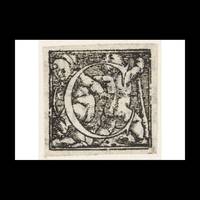
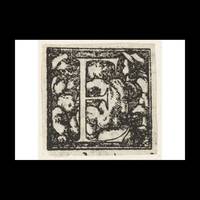
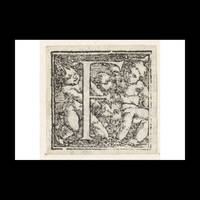
2926192Contentum Ltd. Loose sheet. New. High-quality art print based on an original work from the Rijksmuseum. Created in the 16th century 1522. Professionally printed on premium fine-art paper Museum Etching museum quality in size A3. The artwork is printed with a white border museum-style presentation. Contentum Ltd. unknown
2926202Contentum Ltd. Loose sheet. New. High-quality art print based on an original work from the Rijksmuseum. Created in the 16th century 1522. Professionally printed on premium fine-art paper Museum Etching museum quality in size A3. The artwork is printed with a white border museum-style presentation. Contentum Ltd. unknown
2926212Contentum Ltd. Loose sheet. New. High-quality art print based on an original work from the Rijksmuseum. Created in the 16th century 1522. Professionally printed on premium fine-art paper Museum Etching museum quality in size A3. The artwork is printed with a white border museum-style presentation. Contentum Ltd. unknown
2926222Contentum Ltd. Loose sheet. New. High-quality art print based on an original work from the Rijksmuseum. Created in the 16th century 1522. Professionally printed on premium fine-art paper Museum Etching museum quality in size A3. The artwork is printed with a white border museum-style presentation. Contentum Ltd. unknown
2926232Contentum Ltd. Loose sheet. New. High-quality art print based on an original work from the Rijksmuseum. Created in the 16th century 1522. Professionally printed on premium fine-art paper Museum Etching museum quality in size A3. The artwork is printed with a white border museum-style presentation. Contentum Ltd. unknown
2926249Contentum Ltd. Loose sheet. New. High-quality art print based on an original work from the Rijksmuseum. Created in the 16th century 1522. Professionally printed on premium fine-art paper Museum Etching museum quality in size A3. The artwork is printed with a white border museum-style presentation. Contentum Ltd. unknown
2926274Contentum Ltd. Loose sheet. New. High-quality art print based on an original work from the Rijksmuseum. Created in the 16th century 1522. Professionally printed on premium fine-art paper Museum Etching museum quality in size A3. The artwork is printed with a white border museum-style presentation. Contentum Ltd. unknown
2926291Contentum Ltd. Loose sheet. New. High-quality art print based on an original work from the Rijksmuseum. Created in the 16th century 1522. Professionally printed on premium fine-art paper Museum Etching museum quality in size A3. The artwork is printed with a white border museum-style presentation. Contentum Ltd. unknown