108 résultats
83121 Marseille, Jeanne Laffitte, 19.., in-8° cartonnage éditeur.
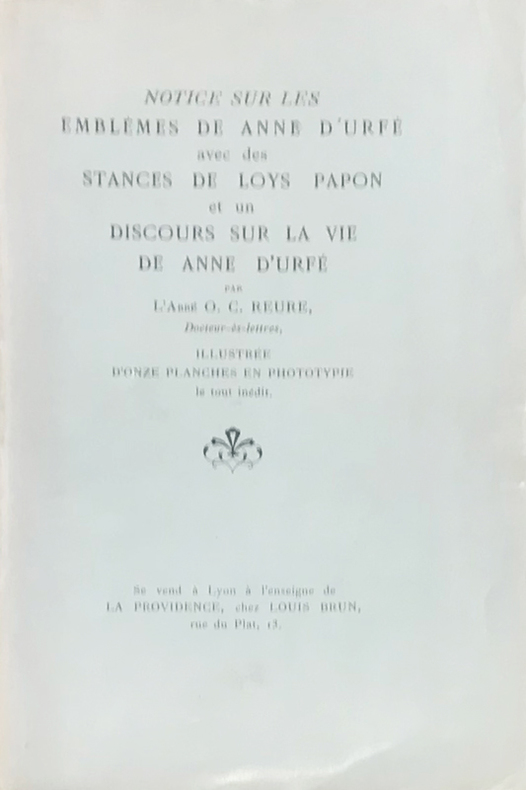
190412180Lyon, La Providence, Louis Brun (Montbrison, Imprimerie d’Eleuthère Brassart), 1904 ; in-8, broché ; 335, (3) pp., 11 planches hors-texte en phototypie à double page, couverture imprimée.
1996B88886Leuven, Peeters 1996 vi + 101pp.with illustrations, in-4, softcover, good condition, B88886
vi + 101pp.with illustrations, in-4, softcover, good condition, B88886
17810041191781 Augsbourg, Frères Klauber, 1781. Grand in-12 (105 X 172 mm) maroquin vieux rouge, plats décorés d'un encadrement de triple filet doré avec fleurette aux coins et fleuron dans les angles, dos lisse, filet doré serti de dents de rat en place des nerfs, compartiments ornés aux petits fers, fleuron central, frise dorée en queue, pièce de titre maroquin vert sapin, coupes et coiffes filetées, chasses ornées d'une roulette dorée, tranches dorées (reliure de l'époque) ; (1) f. blanc, frontispice, titre, 144 pages, 56 planches hors-texte. Petit manque de papier dans l'angle inférieur ou supérieur des pages 7/8 et107/108, sans atteinte au texte.
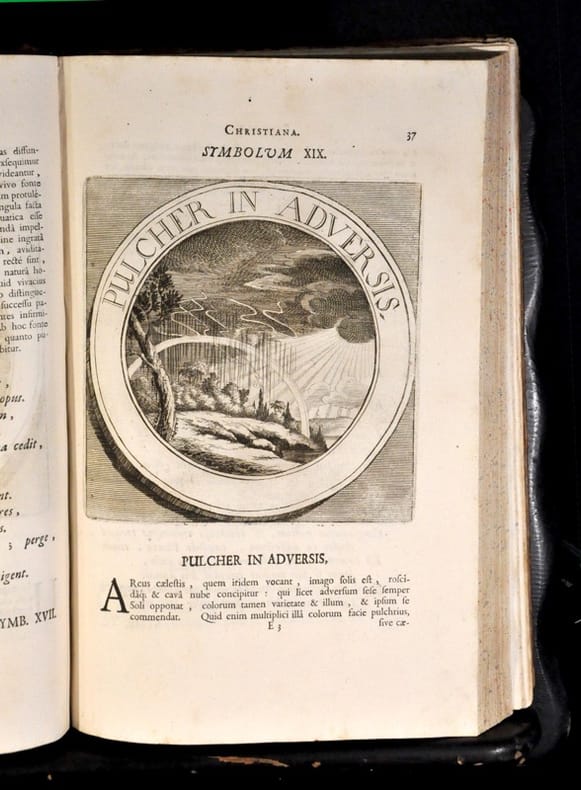
1469Francfort, Johannem Petrum Zubrod, 1677, 2 ff., 5 ff. (vignette de titre gravée et « Lectoribus Salutem »), 204 pp. comprenant 100 emblèmes circulaires gravées sur cuivre in-texte, (2bl). In-4, en pleine basane d'époque, dos muet à 5 nerfs orné de fleurons estampés à froid, coiffes usées.
2642Lyon Petri Guillimin 1679 petit in 12 1 volume reliure pleine basane fauve (reliure XIXe), frontispice gravé, 10 faux-feuillets non chiffrés, 191 pages, 47 figures gravées dans le texte, marge latérale courte. Bon exemplaire
110075A Rennes, chez Nicolas Devaux, sans date, 2 textes reliés ensemble en 1 volume in-12 de : 1. 74 pages (pages découpées et collées sur des feuillets bleus - manque la page 39), pour le premier texte, - 2. Second texte : se vend à Paris, chez N.J.B. P. Poilly, 1 page de titre gravée et 59 emblèmes à pleine page légendés en latin avec quatrain explicatif en français, dans une reliure plein veau marbré fauve, dos lisse portant titres dorés sur pièce ce titre bordeaux, orné de caissons à motifs dorés, gardes marbrées, tranches rouges. Cuir abimé sur le dos, coins émoussés, mors fragiles et en partie fendus, mouillure dans la marge interne sur le second texte.
Napoli, Egido Longo, 1666, 33,5 x 23,5 cm., pergamino, frontis grabado + 3 hojas + 160 págs. + 58 láminas de emblemas grabadas con alegorÃas con el tema de las constelaciones, con pequeños retratos de miembros de la familia de los Habsburgo. (Ejemplar falto de las páginas 53 a 56, de las dos láminas que corresponden a estas páginas, del retrato y de las 2 láminas plegadas que acompañan a esta rara obra).
n.p. 12mo. Original printed wraps. A pamphlet explaining a frieze of printers' devices for the expansion of the Morgan Library. **PRICE JUST REDUCED REF9.
160126584Anvers ( Antwerpen ) Ex Officina Plantiniana 1601 Petit in-4° Suite de 100 planches numérotées de 1 à 100 sans discontinuer. Gravures sur Cuivres contrecollées sur un vergé bleuté et le Frontispice du Chemin de la vie éternelle de Sucquet ( 1622) La légende des vignettes est en trois langues, Latin, Néerlandais et Français. D'après la collation il pourrait s'agir du premier Livre d'Emblèmes du XVIIème siècle Du père Jrean David intitulé veridicus Christianus et non de Sucquet comme induit de façon erronnée le titre du Frontispice ( de 1622 ). La planche 66 reproduite dans Emblèmes Devises Iconologie de la " Librairie Paul Jammes " ( N° 50 Page 40 ) laiise penser que cette suite pourrait constituer les illustrations du livre du Père Jésuite Jean David planches gravées de Galle .( 100 vignettes (18x11 cm) à emblèmes du XVIIe siècle, numérotées de 1 à 100, légendées en latin, flamand et français. La première gravure porte : Ioan Galle excudit. Les suivantes, de facture similaire, ne sont pas signées. Les vignettes sont précédées d'un titre gravé : en Wech des eeuwich levens beschreven int latÿn, door P. Antonius Sucquet, over-gelet door P. Gerardus Zoes,[...] Met Beelden verlicht door Boëtius A. Bolsvert. T'Antwerpen, by Hendrick Aertssens, 1622.
170112371Lyon, Louis Pascal (Imprimerie L. Langlois), 1701 ; petit in-folio, cartonnage rigide de papier marbré rose, tranches marbrées (reliure moderne) ; (2), 52 pp., 1 planche dépliante hors-texte ("Machine du Feu d'artifice").
In-8°; pp. XXXII, 416, con antip. (L. Gimignani del. Io. Nolinus sculp.), e un frontespizio (F. Venturinus) calcografici, 35 incisioni su rame a piena pagina incluse nel testo che raffigurano emblemi. Al front. “pars prima” è stato cancellato, in effetti di quest’opera venne data alle stampe solo questa prima parte. Legatura in piena pergamena rigida più tarda. I personaggi qui rappresentati attraverso gli emblemi e alcuni componimenti in versi sono Innocenzo XI, Francesco Xaverio, Francesco Borgia, Luigi Gonzaga, Stanislaus Kostka, Innocenzo X, Clemente IX, Cristina di Svezia, Alessandro VII, Roberto Bellarmino, Antonio Barberini, G. Paolo Oliva e altri.
Book is in excellent condition. Binding is solid and square, covers have sharp corners, exterior shows no blemishes, text/interior is clean and free of marking of any kind. Dust jacket shows the slightest signs of shelf wear only, no tears, now wrapped in protective clear cover. 432 pages. Illustrations throughout, contents include: Levels of reality, (form and matter, Chhi and Li) Kith and kin, Language and communication, (Semiotics, Science and theology), The principle of requisite diversity, Metaphor and metonymy (The art of blazon, Emblems ), On telling left from right (Coding, Neurons and hormones), etc .
Small format book, with color covers, a great many full page b&w photos illustrating the story. Book shows edge and corner wear, light scuffing to covers. Binding is solid and square, text/interior is clean and free of marking of any kind. Cover depicts small group of Scouts stealing a suitcase of money from Native Americans and committing terrorist acts below the blue and gold B.S. "Approved by" stripe. Possible homosexual troop leaders depicted in text.
166044803Danzig, Georg Förster, 1660. (4), 381, (1) SS. Mit gest. Titel und 20 fast ganzseitigen emblematischen Textkupfern. - (Beigebunden) II: Ders. Monita politico-moralia et icon ingeniorum. Ebda., 1664. (4), 171, (1) SS. Mit gest. Titel und Holzschnittvignette am Schluß. Blindgepr. brauner Lederband der Zeit mit hs. Rückentitel. Dreiseitiger gesprenkelter Rotschnitt. 12mo.
1764R97730Antwerpen, Petrus Joannes Parys 1764-1772 Rare and complete series of 7 emblematical books published by the Flemish Praemonstratensian preacher and poet Jacobus Moons (1639-1721, cannunik and priest at the Praemonstratensian abbey of S. Michael in Antwerp), Uniform contemporary full-leather bindings with 5 raised bands (gilt decorations and title on spines, some traces of use, corners rubbed, some wear and defects at spines and few joints slightly cracked/broken), red edges, text and illustrations are clean and bright, 17cm., text in Flemish (Dutch), rare complete series which is overall in good condition, text and interior in very good condition with only occasional foxing and vague spots, [Detailed content: VOLUME 1: Zedelyk vermaek tonneel vertoonende door zinne-beelden den leerzaemen handel van de onredelyke dieren aen de verkeerde, en beestaerdige wereld Opgeregt van verscheyde zoo Grieksche als Latynsche Schryvers, Antwerpen, P.J. Parys, s.d. [ca. 1765], 2nd impression, [15],436,[4] pp., with engraved title page by P. van Pinxen, engraved Coat of arms and 27 copperplate emblems by P. van Pinxen after G. Bouttats, cfr. Landwehrs Emblem & fable books no.580 // VOLUME 2: Zedelyke lust-warande vertoonende door zinne-beelden den leerzaemen handel van de onredelyke dieren aen de verkeerde, en beestaerdige wereld, Antwerpen, P.J. Parys, s.d. [1764], [6],533[=523],[i] pp., with engraved vignette on title page and 29 copperplate emblems by G. Bouttats, cfr. Landwehr no.581 // VOLUME III: Sedelyken Vreugden-Berg verthoonende door sinne-beelden den leerzamen handel etc., Antwerpen, P.J. Parys, s.d. [ca. 1764], 2nd impression, 495 [=465],[2] pp., with 31 copperplate emblems within borders of varying designs by G. Bouttats, cfr. Landwehr no.582 // VOLUME IV: Sedelyk vreugde-perk vertoonende door zinne-belden den leersamen Handel van de onredelyke dieren aen de verkeerde en beest aerdige wereld, Antwerpen, P.J. Parys, 1772, 590pp., with engraved vignette on title page and 33 copperplate emblems within borders of varying designs by G. Bouttats, cfr. Landwehr no.583 // VOLUME V: Sedelyken Vermaek-Spiegel etc., Antwerpen, P.J. Parys, s.d. [1764], [6] + 384 + [2] pp., cfr. Landwehr no.584 // VOLUME VI: Zedelyk Vermaek-Veld etc., Antwerpen, P.J. Parys, s.d. [1764], 2nd impression, 307 + [1] pp., cfr. Landwehr 585 // VOLUME VII: Sedelyk Vermaek-Troost in alle lyden, soo wel in Peys als in Oorlogs tyden, voor alle Staten van menschen etc. gesogt en gevonden in de schole van verduldigheyd etc., Antwerpen, P.J. Parys, s.d. [1764], 402 [= 400] + [2] pp., frontispiece is missing, contains numerous emblems described, though without illustrations, as edited), cfr. Landwehr 586, this last part also contains Sidronius Hosschius (S.J.) Spiegel van den loop des menschelijck leven (pp.354-402)], R97730
Rare and complete series of 7 emblematical books published by the Flemish Praemonstratensian preacher and poet Jacobus Moons (1639-1721, cannunik and priest at the Praemonstratensian abbey of S. Michael in Antwerp), Uniform contemporary full-leather bindings with 5 raised bands (gilt decorations and title on spines, some traces of use, corners rubbed, some wear and defects at spines and few joints slightly cracked/broken), red edges, text and illustrations are clean and bright, 17cm., text in Flemish (Dutch), rare complete series which is overall in good condition, text and interior in very good condition with only occasional foxing and vague spots, [Detailed content: VOLUME 1: Zedelyk vermaek tonneel vertoonende door zinne-beelden den leerzaemen handel van de onredelyke dieren aen de verkeerde, en beestaerdige wereld Opgeregt van verscheyde zoo Grieksche als Latynsche Schryvers, Antwerpen, P.J. Parys, s.d. [ca. 1765], 2nd impression, [15],436,[4] pp., with engraved title page by P. van Pinxen, engraved Coat of arms and 27 copperplate emblems by P. van Pinxen after G. Bouttats, cfr. Landwehr’s Emblem & fable books no.580 // VOLUME 2: Zedelyke lust-warande vertoonende door zinne-beelden den leerzaemen handel van de onredelyke dieren aen de verkeerde, en beestaerdige wereld, Antwerpen, P.J. Parys, s.d. [1764], [6],533[=523],[i] pp., with engraved vignette on title page and 29 copperplate emblems by G. Bouttats, cfr. Landwehr no.581 // VOLUME III: Sedelyken Vreugden-Berg verthoonende door sinne-beelden den leerzamen handel etc., Antwerpen, P.J. Parys, s.d. [ca. 1764], 2nd impression, 495 [=465],[2] pp., with 31 copperplate emblems within borders of varying designs by G. Bouttats, cfr. Landwehr no.582 // VOLUME IV: Sedelyk vreugde-perk vertoonende door zinne-belden den leersamen Handel van de onredelyke dieren aen de verkeerde en beest aerdige wereld, Antwerpen, P.J. Parys, 1772, 590pp., with engraved vignette on title page and 33 copperplate emblems within borders of varying designs by G. Bouttats, cfr. Landwehr no.583 // VOLUME V: Sedelyken Vermaek-Spiegel etc., Antwerpen, P.J. Parys, s.d. [1764], [6] + 384 + [2] pp., cfr. Landwehr no.584 // VOLUME VI: Zedelyk Vermaek-Veld etc., Antwerpen, P.J. Parys, s.d. [1764], 2nd impression, 307 + [1] pp., cfr. Landwehr 585 // VOLUME VII: Sedelyk Vermaek-Troost in alle lyden, soo wel in Peys als in Oorlogs tyden, voor alle Staten van menschen etc. gesogt en gevonden in de schole van verduldigheyd etc., Antwerpen, P.J. Parys, s.d. [1764], 402 [= 400] + [2] pp., frontispiece is missing, contains numerous emblems described, though without illustrations, as edited), cfr. Landwehr 586, this last part also contains Sidronius Hosschius’ (S.J.) “Spiegel van den loop des menschelijck leven” (pp.354-402)], R97730
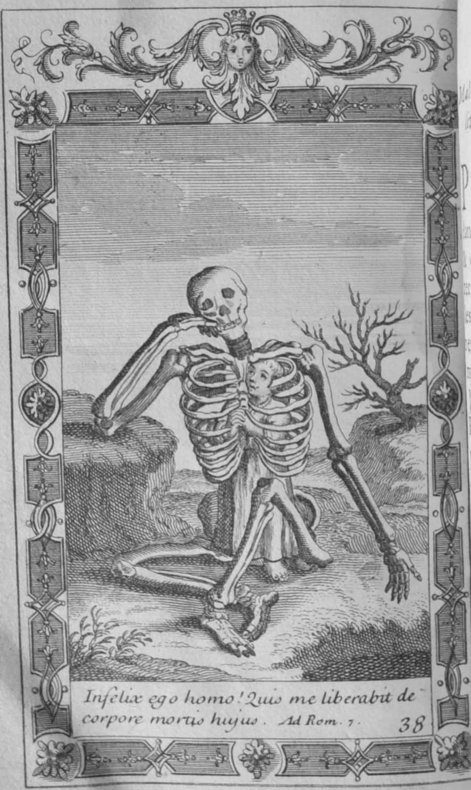
174346404181Paris, Veuve Mazières et J. B. Garnier, 1743 ; in-12, basane brune, dos orné. (Reliure de l’époque) Titre-frontispice gravé (daté 1739), 92 pp., 2 ff. - 45 planches hors-texte.Ce joli livre d’emblèmes mystiques a paru pour la première fois en 1702. Les 45 planches, toutes dans des encadrements variés, mettent en scène des enfants guidés par un angelot. Une planche macabre, montre un enfant enfermé dans le thorax d’un squelette assis.Drouet de Maupertuy (né en 1650) eut une jeunesse dorée et fort dissipée. Après avoir dilapidé son riche patrimoine, il se dégouta du monde à 40 ans, entra dans les ordres et se retira à l’abbaye de Sept-Fons en Bourbonnais. En 1702 il obtint un canonicat à Bourges, le quitta, voyagea en Dauphiné puis se fixa à St. Germain en Laye où il mourut en 1730. Il est l’auteur de nombreux ouvrages de religion.Cioranesco 25423 - Inconnu de Landwehr.Coins et coiffes usés, fente sur 1 planche, qq. mouillures.
In-4°, 68pp, (4cc), legatura in pergamena, buone condizioni, titolo manoscritto al dorso, l’illustrazione alla carta A2 contiene l’emblema dell’Accademia degli Umoristi. Qualche brunitura. L’Aleandro, scolaro a Padova di Guido Panciroli, ebbe, precocissimo, fama di buon poeta latino e italiano, e più tardi nomea d'epistolografo principe in latino; partecipò, in difesa del Marino, alla celebre polemica suscitata dallo Stigliani contro L'Adone; fu tra i fondatori e i sostenitori dell'Accademia degli Umoristi; ma va ricordato soprattutto come antiquario per le sue dissertazioni di archeologia applicata al diritto, alla storia del costume e della religione, solo in parte edite. L'Accademia degli Umoristi, insieme all'Accademia dell'Arcadia e alla splendida ma effimera Accademia delle Notti Vaticane fu una delle principali accademie letterarie romane del Seicento. Grazie all'appoggio e alla protezione che poi ottenne da parte del cardinale Francesco Barberini, divenne un'istituzione semi-ufficiale. Aveva sede a Roma ma vantava aspirazioni cosmopolite. Come tutte le accademie dei secoli XV-XVI-XVII, era presieduta (o governata) da un Principe, che organizzava le sedute, indirizzava i lavori, la rappresentava presso altre Accademie o di fronte alle autorità. La carica aveva durata annuale, ma poteva essere reiterata. I Principi dell'Accademia degli Umoristi furono tra i più prestigiosi e innovatori letterati del Seicento: Giovanni Battista Guarini (1611), Alessandro Tassoni (1606-1607), Giovan Battista Marino (1623). Le leggi dell'accademia degli Umoristi consentivano anche una limitata partecipazione femminile. «Feminis primariis ætate et forma prestantibus earumque viris eam frequentandi veniam dabant leges». L'Accademia, come tutte le consorelle, aveva un simbolo o impresa. Essa è più di un'immagine e di un motto: è l'autorappresentazione che l'Accademia offre di se stessa, ne indica l'identità. L'Impresa degli Umoristi nacque per insistenza di Giovanni Battista Guarini (allora Principe dell'Accademia) nel 1611: ci furono numerosissime proposte e infine fu accettata quella che divenne definitiva: una nuvola dalla quale cade pioggia sulle onde del mare e sotto il verso lucreziano «Redit Agmine Dulci» (Ritorna dal campo di battaglia alla dolcezza). Nel 1717 il pontefice Clemente XI volle ripristinarla e ne nominò principe Alessandro Albani, non ancora cardinale. Il tentativo non ebbe però successo e di lì a poco l'Accademia scomparve definitivamente. In-4 °, 68pp, (4cc), vellum binding, good condition, handwritten title on the spine, the illustration on leaf A2 contains the emblem of the Academy of Humorists. Some brownings. Aleandro, a pupil of Guido Panciroli in Padua, had a very early reputation as a good Latin and Italian poet, and later he became the name of the main epistolograph in Latin; in defense of Marino, he took part in the famous controversy raised by Stigliani against L'Adone; he was among the founders and supporters of the Academy of Humorists; but it must be remembered above all as an antiquarian for his dissertations on archeology applied to law, the history of customs and religion, only partially published. The Academy of Humorists, together with the Academy of Arcadia and the splendid but ephemeral Academy of Vatican Nights was one of the main Roman literary academies of the seventeenth century. Thanks to the support and protection that it then obtained from Cardinal Francesco Barberini, it became a semi-official institution. It was based in Rome but boasted cosmopolitan aspirations. Like all the academies of the XV-XVI-XVII centuries, it was chaired (or governed) by a Prince, who organized the sessions, directed the work, represented it in other Academies or before the authorities. The office had an annual duration, but could be repeated. The Princes of the Academy of Humorists were among the most prestigious and innovative writers of the seventeenth century: Giovanni Battista Guarini (1611), Alessandro Tassoni (1606-1607), Giovan Battista Marino (1623). The laws of the Academy of Humorists also allowed for limited female participation. "Feminis primariis ætate et forma prestantibus earumque viris eam frequentandi veniam dabant leges". The Academy, like all its sisters, had a symbol or company. It is more than an image and a motto: it is the self-representation that the Academy offers of itself, it indicates its identity. The Coat of arms of the Academy was born on the insistence of Giovanni Battista Guarini (then Prince of the Academy) in 1611: there were numerous proposals and finally what became definitive was accepted: a cloud from which rain falls on the waves of the sea and below towards Lucretian motto « Redit Agmine Dulci »(Returns from the battlefield to sweetness). In 1717 Pope Clement XI wanted to restore it and appointed Alessandro Albani as prince, not yet a cardinal. However, the attempt was unsuccessful and shortly thereafter the Academy finally disappeared.
1666ARC-214233Arnheim, 1666. Johann Fridericus Hagius. Petit in-12 [1], 398 pageset 13 feuillets non chiffrés (index). Signatures: *1; A-R(12); S(8). Frontispice et 176 gravures sur cuivre à pleine page.. Plein veau marron, dos orné.
2147Saint-Martin de la Lieue, Verdier, 1990 ; 2 volumes brochés, couvertures illustrées en couleurs. Abondante iconographie, index, chronologie..
16476532Paris, Simon Piget, 1647. 2 parties en un volume in-4 (225 x 164 mm), 14 ff. n. ch., 230 p.- pp. 231-641, 41 pp. n. ch. Maroquin rouge à la Du Seuil, avec larges fleurons en écoinçons et double filet doré encadrant les plats, dos à nerfs orné, tranches dorées, le feuillet e4 et le dernier feuillet, tous deux blancs, sont en déficit, mouillure sur le premier plat de reliure et mouillure angulaire sur les 8 premiers feuillets, petites rousseurs éparses (reliure de l’époque).
198833335Paris Presses Universitaires de France 1988
1733Y91273Amberes [Antwerp], Widow of Hendrik Verdussen 1733 3 parts in 1 volume (with the addenda "Enchiridion de Epicteto and "Tabla de Cebes", [18] 207 [1] & 27 [1bl] & [8] 50 [1] pp., illustrated with engraved printer's mark at title page and 103 large emblems and a double-page engraving with the "Tabula Cebetis", the engraved portrait of Venius is missing, title in red and black, some spots and stains mainly at the last 80 pages text always readible very well), modern binding in fine condition (marbled plates, spine in leather with title in gilt), 39cm., Spanish translation of the French edition "Le theatre moral de la vie humaine" (cfr. PRAZ, Studies in seventeenth-century imagery I pp.523-524 & Peeters Fontainas Bibliographie des impr. espagn. des Pays-Bas mérid. 1275), good copy, Y91273