CollectifLivre Rare Book

105 résultats
1897Arm1011Paris La Plume 1897 In8 - broché - 96 pages - Édition originale de ce numéro entièrement consacré à Alfons Mucha. Nombreuses contributions dont celles de Léon Deschamps, Frantz Jourdain, Sarah Bernhardt, Paul Redonnel, Yvanoé Rambosson, Charles Chincholle , entre autres . Numéro orné de 127 illustrations Noir et blanc d'Alfons Mucha, dont la couverture, et d'un portrait de ce dernier par David Ossipovitch Whidhopff.
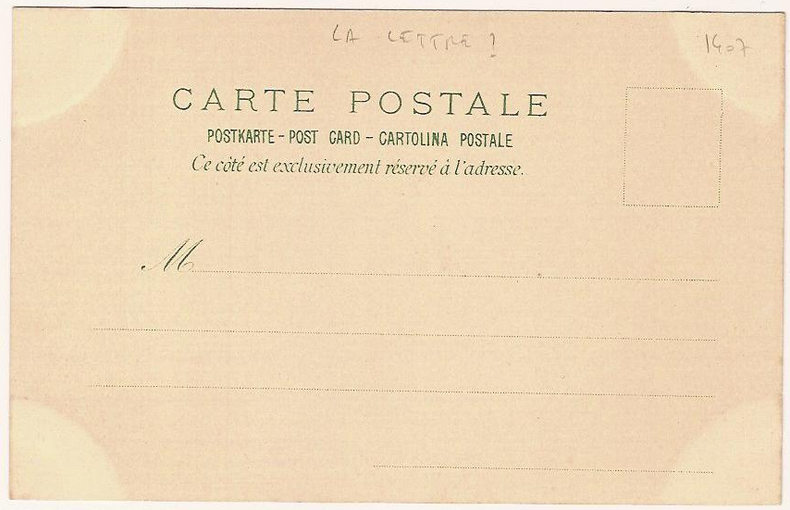
19001400PARIS. CHAMPENOIS. VERS 1900. CARTE POSTALE FORMAT 9 X 14 CENTIMETRES. LITHOGRAPHIE EN COULEURS, SIGNEE DANS LA PLANCHE. LADY SEATED AT TABLE WITH PEN AND PAPER IN HAND. WITH MUCHA'S SIGNATURE (CARDS WERE ISSUED WITH AND WITHOUT MUCHA'S SIGNATURE). VIERGE, NON ECRITE, N'A PAS VOYAGE. QUELQUES FINES ROUSSEURS EPARSES DANS LA PARTIE RESERVEE A LA CORRESPONDANCE, PETITES TRACES HABITUELLES D'ALBUM AUX ANGLES, SINON BEL ETAT.
1896271901896 Paris, Floury, 1896-1897. In-4 broché, couv.generale illustrée et gravée par PEYAT et ANGST, conservée. Collection complète des 12 numéros (décembre 1896 à novembre 1897) de cette belle revue consacrée à l'illustration gravée sur bois avec de nombreuses figures gravées dans et hors texte, certaines originales, par Degas, M. Denis, Van Dongen, Rodin, Pissaro, Mucha, Toulouse-Lautrec, Steinlen, Laboureur, Jongkind, Helleu, Bonnard, Vallotton, etc. Les 12 couvertures illustrées (par MUCHA, DE FEURE, DARBOUR, VERNEUIL, DROGUE, BELLERY DESFONTAINES,BERTON, PROUVÉ, BELLEVILLE, TOULOUSE-LAUTREC, LENOIR) sont presentes. Revue fondée par la corporation française des graveurs sur bois, publiée sous la direction littéraire de Roger Marx et Jules Rais et sous la direction artistique de Tony Beltrand, Auguste Lepère et Léon Ruffe. Textes d'Arsène Alexandre, Barrès, Debussy, R. de Gourmont, P. Louÿs, Mauclair, Mellerio, Rodenbach et Verhaeren, illustrés par Auriol, Cheret, Degas, Denis, Doudelet, Van Dongen, De Feure, Grasset, Lepère, Maillol, Millet, Mucha, Lucien Pissaro, Steinlen, Toulouse-Lautrec, Valloton. Exemplaire complet de cette revue fondée par la jeune corporation française des graveurs sur bois, et publiée par l'éditeur des lithographies de Toulouse-Lautrec (Au pied du Sinaï, Histoires naturelles, Café-Concert). L'Image compte parmi les plus belles réalisations de l'édition d'art ""Fin de Siècle"". Les directeurs de la revue, et notamment le célèbre graveur Auguste Lepère, fondateur de la corporation, tentèrent d'y rassembler et promouvoir, selon l'idée d'Arts and Crafts et de l'Art Nouveau, le savoir-faire des artisans de la gravure sur bois menacé par l'utilisation de procédés plus rapides et de moindre qualité. Cette collection complète réunit les oeuvres de 106 graveurs et de dizaines d'écrivains, faisant d'elle une oeuvre d'une qualité bibliophilique et artistique exceptionnelles..........The first "numéro spécimen" was published in 1896 to encourage people to subscribe to "L'I'mage". 8 pp + 5 hors-texte plates. It features wood-engraved illustrations after Lepère, Willette, De Feure (in color), Merson, Steinlen, Chéret, and others, and A FULL-PAGE HORS-TEXTE WOOD ENGRAVING BY LEPERE ("La prière", Lotz-Brissonneau 254) ?- THESE SPECIMEN ISSUES--ESPECIALLY THE FIRST--ARE VERY RARE, FAR MORE SO THAN THE 12 REGULARLY-PUBLISHED ISSUES.L'Image. Numéro spécimen. Préface d'Anatole France. G. d'Hostingue et R. Blum éditeurs. in-8, en feuilles, 8 pages illustrations in texte et 5 feuilles d'illustrations pleines pages imprimées au recto.Ont collaboré à ce numéro-spécimen.Dessinateurs : Bellery-Desfontaines. Cappiello. Ch. Cottet. G. de Feure. Degas. G. Jeanniot. P. Jouve. B. Naudin. Rodin. D. Vierge. Graveurs : Aubert. Beaujan. E. d'Eté. V. Dutertre. Ch. Guillaume. A. Hoffmann. Jeoffroy. Labat. C. Marx. Mathieu. C. Maylander. L. Perrichon. Revel. L. Ruffe. Vibert.manque au bas de la couverture ,exemplaire défraichi avec les 5 ht .
1896271911896 Paris, G. D. Hostingue et R. Blum éditeurs,(Imprimerie G. Kadar), 1896 in-4to, 32 p. + Planche gravé de Florian 'Portrait' / gravé par Clément Bellenger 'Les adieux de Gil Blas' / par Luc Pissarro 'Roses d'antan' bois original / par Eugène Grasset en couleur 'les petites faunesses' / double planche avec ills. de Mucha et musique de Edmond Missa 'Marquisette Gavotte', brochure originale ill., couverture Mucha avec manque en marge (ne touchant le dessin de Mucha).,bords des pages defraichies,dans l'etat.
1897412Photo relief. Czechoslovakia. June and December 1897. LITHOGRAPH FROM L'ESTAMPE MODERNE. L'Estampe Moderne 1897-1898 a more commercial and later version of L'Estampe Originale was a monthly publication of print portfolios producing twenty-four issues containing four color lithographs each. Only a few prints exhibiting Japanese influence were issued mostly by minor artists yet they were equally as beautiful in image as their predecessors.one of 2000.
189925853Paris Librairie Henri Floury 1899 in-4° on paginé ; Figures contemporaines tirées de l'album Mariani ; soixante-seize biographies, notices, autographes et portraits gravé sur bois par D. Quesnel, A. Brauer, H. Sorensen, A. Prunaire et P. Leyat. Lettre-préface de O. Roty.. bandeaux et cul-de-lampes
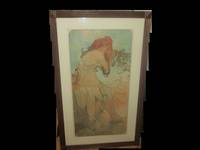
189615844AB1896. Paris F.Champenois 1896. 1003 : 505 cm image Lithograph in colours by Alphonse Mucha. Framed in contemporary wooden frame. Alphonse Mucha's poster "Été" "Summer" is part of his series titled The Seasons created in 1896. This poster captures the essence of summer with its warm golden hues and lush flowing forms. Mucha depicts a young woman draped in a light flowing garment that accentuates the curves of her body embodying the sensuality and warmth of the season. She is surrounded by an abundance of flowers and foliage symbolizing the fullness and fertility of summer. Her hair long and wavy cascades down her back adding to the natural unrestrained feel of the image. Mucha's characteristic use of intricate lines and decorative patterns is evident in the detailed borders and the swirling motifs that frame the central figure. The poster exudes a sense of harmony and beauty typical of Mucha's Art Nouveau style where nature femininity and elegance are central themes. The soft color palette dominated by shades of gold green and soft pastels further enhances the idyllic dream-like quality of the work making "Été" a quintessential representation of summer's warmth and beauty. Alphonse Mucha was known for his distinctive Art Nouveau style characterized by its use of natural forms flowing lines and elaborate decoration. His techniques combined both traditional and innovative approaches contributing to his iconic aesthetic. Here are some of the key techniques and elements in Mucha's work: Line Work: Mucha's use of lines is one of the most defining aspects of his style. He employed fine flowing outlines to create graceful organic shapes that mimic the curves found in nature. His lines were often decorative and stylized contributing to the overall harmony and unity of the composition. Color Palette: Mucha favored a soft pastel color palette often using muted tones of gold green pink and blue. These colors were carefully chosen to create a sense of harmony and to evoke specific moods often reflecting the seasons or the subject matter of the piece. Ornamentation and Patterns: Mucha's works are rich in decorative elements and intricate patterns. He incorporated floral motifs arabesques and geometric designs into his compositions often framing the central figure with these ornate details. This ornamentation was not merely decorative but also served to enhance the thematic elements of the piece. Use of Light and Shadow: Although Mucha's work is more stylized than realistic he employed light and shadow to add depth and dimension to his figures. His approach to light was subtle often using gentle shading rather than harsh contrasts which contributed to the soft ethereal quality of his work. Symbolism: Mucha frequently used symbolic elements in his paintings and posters. For example flowers seasons and zodiac signs often carried deeper meanings related to themes of nature femininity and the passage of time. These symbols were seamlessly integrated into the decorative elements of his work. Composition: Mucha's compositions were carefully balanced often centered around a single idealized figure. He employed symmetry and repetition to create a sense of order and harmony with the figure often surrounded by elaborate circular frames or halos that draw the viewer's eye. Media and Techniques: While Mucha is best known for his posters and prints which were typically lithographs he also worked in a variety of media including painting drawing and jewelry design. His lithographic technique involved multiple layers of color carefully aligned to create richly textured and vibrant images. In his paintings he used traditional techniques such as oil on canvas but applied them with the same decorative and stylized approach as in his graphic works. Mucha's techniques were instrumental in defining the Art Nouveau movement blending fine art with applied arts and his work remains a cornerstone of this decorative style. Alphonse Mucha holds a significant place in the history of art particularly as a leading figure of the Art Nouveau movement. His influence extends beyond his immediate contributions to the art world affecting design advertising and popular culture. Here are some key reasons why Mucha is important in the history of art: 1. Pioneer of Art Nouveau: Mucha is often credited with shaping and popularizing the Art Nouveau style which emerged in the late 19th century. This movement was characterized by its use of organic forms flowing lines and intricate decorative patterns all of which are hallmarks of Mucha's work. His designs especially his posters became synonymous with the Art Nouveau movement defining its aesthetic and helping it gain widespread recognition. 2. Innovative Use of Graphic Design: Mucha was a pioneer in using graphic design as a fine art form. His work in advertising and posters elevated these mediums to a new level blending commercial appeal with artistic integrity. His posters for Sarah Bernhardt the famous actress are particularly notable. They not only promoted her plays but also became collectible works of art in their own right. 3. Influence on Decorative Arts: Mucha's influence extended beyond painting and posters to various decorative arts including jewelry furniture and interior design. His aesthetic principles were applied to everyday objects making art more accessible to the public. This blending of fine art with applied arts helped bridge the gap between high art and popular culture a concept that has continued to evolve in modern design. 4. Impact on Visual Culture: Mucha's style has had a lasting impact on visual culture influencing everything from early 20th-century design to contemporary art and popular media. His work has inspired countless artists and designers in the realms of illustration fashion and graphic design. The Art Nouveau style as epitomized by Mucha has seen periodic revivals and continues to be referenced in various cultural contexts demonstrating its enduring appeal. 5. Symbolism and National Identity: Beyond his contributions to Art Nouveau Mucha was also deeply involved in the promotion of Czech national identity. His later works particularly the Slav Epic reflect his interest in Slavic history and mythology aiming to create a visual narrative that celebrated his cultural heritage. This aspect of his work underscores the role of art in expressing and shaping national and cultural identity adding another layer to his importance as an artist. 6. Legacy in Fine Arts: Mucha's ability to blend aesthetics with practical applications laid the groundwork for future movements in art and design particularly in how art could be integrated into everyday life. His legacy is evident in the continued appreciation and study of his work which remains a significant part of museum collections and exhibitions worldwide. Alphonse Mucha's contributions to the art world go beyond his beautiful and iconic images; he played a crucial role in defining an era shaping modern design and influencing the intersection of art culture and commerce. His work continues to inspire and resonate across disciplines making him a central figure in the history of modern art. The panel 'Ètè' Summer out of the series 'Four Seasons'. Mucha made a panel for each of the four seasons. He represents each season with characteristic flair here the sultry Summer. Four Seasons was Mucha's first series of decorative panels and one of his most popular ones. An classic Art Nouveau piece. A highlight in each Mucha collection. - Here contemporary framed therefore in very good condition. unknown
189615844ABParis, F.Champenois, 1896. 100,3 : 50,5 cm image Lithograph in colours by Alphonse Mucha. Framed in contemporary wooden frame.
189874326Imprimerie Champenois pour CH. Masson H. Piazza | Paris Janvier 1898 | 41 x 56 cm | une feuille
189773995Imprimerie Champenois pour CH. Masson H. Piazza | Paris Décembre 1897 | 41 x 56 cm | une feuille
189773985Imprimerie Champenois pour CH. Masson H. Piazza | Paris Novembre 1897 | 41 x 56 cm | une feuille
189773969Imprimerie Champenois pour CH. Masson H. Piazza | Paris Octobre 1897 | 41 x 56 cm | une feuille
189773955Imprimerie Champenois pour CH. Masson H. Piazza | Paris Septembre 1897 | 41 x 56 cm | une feuille
189773935Imprimerie Champenois pour CH. Masson H. Piazza | Paris Août 1897 | 41 x 56 cm | une feuille
189773920Imprimerie Champenois pour CH. Masson H. Piazza | Paris Juillet 1897 | 41 x 56 cm | une feuille
189974837Imprimerie Champenois pour CH. Masson H. Piazza | Paris Avril 1899 | 41 x 56 cm | une feuille
189974814Imprimerie Champenois pour CH. Masson H. Piazza | Paris Février 1899 | 41 x 56 cm | une feuille
189974618Imprimerie Champenois pour CH. Masson H. Piazza | Paris Janvier 1899 | 41 x 56 cm | une feuille
189874609Imprimerie Champenois pour CH. Masson H. Piazza | Paris Décembre 1898 | 41 x 56 cm | une feuille
189773911Imprimerie Champenois pour CH. Masson H. Piazza | Paris Juin 1897 | 41 x 56 cm | une feuille
189874598Imprimerie Champenois pour CH. Masson H. Piazza | Paris Novembre 1898 | 41 x 56 cm | une feuille
189874589Imprimerie Champenois pour CH. Masson H. Piazza | Paris Octobre 1898 | 41 x 56 cm | une feuille
189874576Imprimerie Champenois pour CH. Masson H. Piazza | Paris Septembre 1898 | 41 x 56 cm | une feuille
189874526Imprimerie Champenois pour CH. Masson H. Piazza | Paris Juillet 1898 | 41 x 56 cm | une feuille
189874390Imprimerie Champenois pour CH. Masson H. Piazza | Paris Mai 1898 | 41 x 56 cm | une feuille