CORNEILLE (Pierre). GRAVELOT. PIERRE. WATELET.Livre Rare Book

65 résultats
176419193Genève Cramer 1764 12 in-16 Genève, Cramer, 1764, 12 volumes in-12, veau fauve, dos fleuronnés sans nerfs, pièces en maroquin rouge, filet sur les coupes, tranches marbrées (reliure de l'époque).
177446402090Paris, Musier fils, 1774 ; 2 vol. in-8, plein maroquin rouge janséniste, encadrement intérieur de guirlandes dorées, tranches dorées. (Reliure du XIXe) fx-titre, VIII pp., 341 pp. - fx-titre, V pp., 328 pp., 2 ff.L’illustration comporte : 2 titres gravés avec fleurons, 2 frontispices allégoriques avec portraits en médaillons du Tasse et de Gravelot, 20 planches hors-texte de Gravelot, 28 culs-de-lampe dont 12 à pleine page et 20 vignettes en tête des portraits des personnages du poème, le tout par Gravelot. Cohen 976 ne signale que 23 culs-de-lampe.La traduction anonyme est de Charles-François LEBRUN (St. Sauveur (Manche) 1739 - Château de Saint-Mesme 1824.) Elle paraît ici en ÉDITION ORIGINALE. - Cioranesco 38122. La préface de cette traduction, dit J. Chanut, est remarquable par l’originalité et la concision. L’élégance et la force de cette belle prose firent attribuer l’ouvrage à Jean-Jacques Rousseau. Le grand homme d’état, futur consul et duc de Plaisance, avait composé cette traduction pendant ses quinze années de retraite dans sa terre de Grillon près de Dourdan, après avoir servi Maupeou qui fut renversé en 1774. Il semblerait que cet ouvrage soit souvent incomplet des 20 gravures hors-texte.Bel exemplaire luxueusement relié à la fin du XIXe siècle par un relieur qui bizarrement n’a pas signé. 2 portraits supplémentaires du Tasse et de Gravelot montés sur vergé ont été reliés en tête du volume.
176717472Paris, Hérissant fils, 1767. Deux tomes en trois volumes in-4 de XVI-686 (numérotées 664)-[22]; [4]-560-[24]; [4]- 408 (numérotées 300-666)-CCLXXXII-[28] pages, plein veau brun havane marbré, dos à nerfs orné de fleuron et petits fers dorés, roulette fleurdelissée dorée à la pièce de tomaison, pièce de titre en maroquin camel, triple filet estampé à froid en encadrement des plats, double filet doré aux coupes.
17401253E002London: H. Lintott C. Hitch J. and R. Tonson C. Corbet R. and B. Wellington J. Brindley and E. New 1740. 2nd Edition . Hardback. Printed pages: 12mo. . Good Plus. 4 x 6.5 inches 10 x 17 cm. Complete eight volume set. Contemporary full calf leather bindings. Spines with five raised bands and gilt ruled compartments. Wear to ends of spines some of the headbands are absent or loose. Rubbing and marking to covers. Cracking to joints but all boards are fully attached. Cracking to some endpaper joints. Marking to endpapers in Volume I. Lacking free endpapers in Volume II. Several volumes have doodles notes and inscriptions to endpapers. Title pages printed in red and black. Portrait frontis to Volume I engraved plate preceding each play by Van der Gucht after Gravelot. Some browning and light marking to the text. Provenance: from the library of Williamstrip Park Coln St. Aldwyns - seat of the Hicks Beach family. Inscription of Michael Hicks Beach to title page of Volume I dated 1797. The second Theobald edition. This edition includes 36 plays omitting the three plays that were not included in the First Folio Pericles; Two Noble Kingsmen and Edward III. Jeffers p499 for the 1733 1st edition: 'An edition of considerable merit'; 'The plates are accepted together with those in Rowe's 1709 edition as the earliest authentic pictures of the contemporary dress of characters.'; 'Theobald's outspoken criticism of Pope's edition earned him a principal part in Pope's Dunciad.' A scarce complete set of this important edition. ESTC: T54701. Overall condition is Good Plus. Size: 4 x 6.5 inches 10 x 17 cm. H. Lintott, C. Hitch, J. and R. Tonson, C. Corbet, R. and B. Wellington, J. Brindley, and E. New hardcover
176416474Paris, Lattré; Buttard, 1764. 2 tomes en un volume in-12 de [8]-213-[1]-10 pages, plein maroquin cerise, dos lisse orné de fleurons et de petits fers dorés, pièces de titre insolée, triple filet doré et écoinçons en encadrement des plats, filet doré aux coupes, roulette dorée aux chasses, tranches dorées.
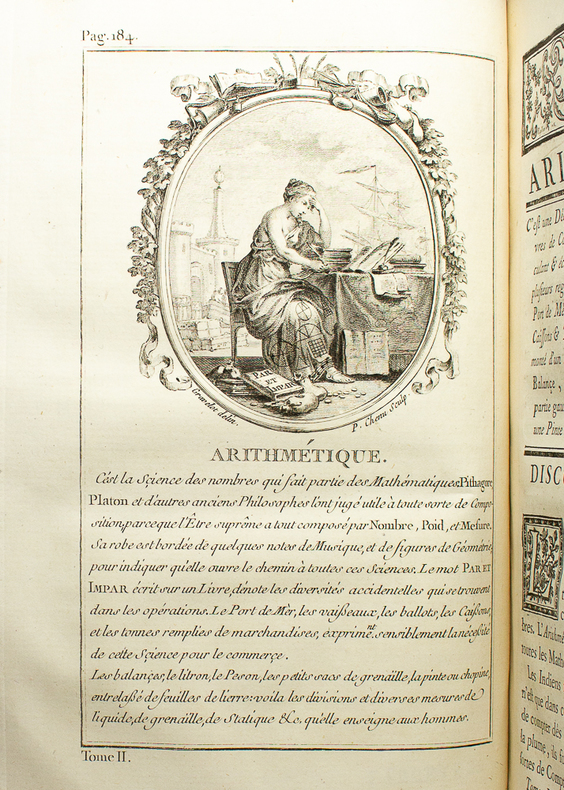
1791737921791. GRAVELOT Hubert Francois and COCHIN Charles Nicolas. Iconologie par Figures ou Complet des Allegories Emblemes &c. Ouvrage Utile aux Artistes aux Amateurs et Peuvant Servir a l'education des Jeunes Personnes. Paris: Lattre 1791. 4 Vols. Engraved portrait frontis. engraved portrait 202 engraved plates 4 engraved title pages. Later 3/4 brown morocco and marbled boards raised spine bands elaborate gilt spines. Every leaf individually mounted. Small amount of faint scattered foxing else very good or better set. A collection of engraved emblematic figures meant as artists' models with accompanying texts. Hubert-Francois Bourguignon known as Gravelot 1699-1773 was a French engraver book illustrator designer and drawing-master. He emigrated to London in 1732 where he quickly became a central figure in the introduction of the Rococo style. After his death in 1773 the work continued with Charles-Nicolas Cochin who also did not live to see this publication he died in 1790. With the bookplates of noted art collector James Hazen Hyde. unknown
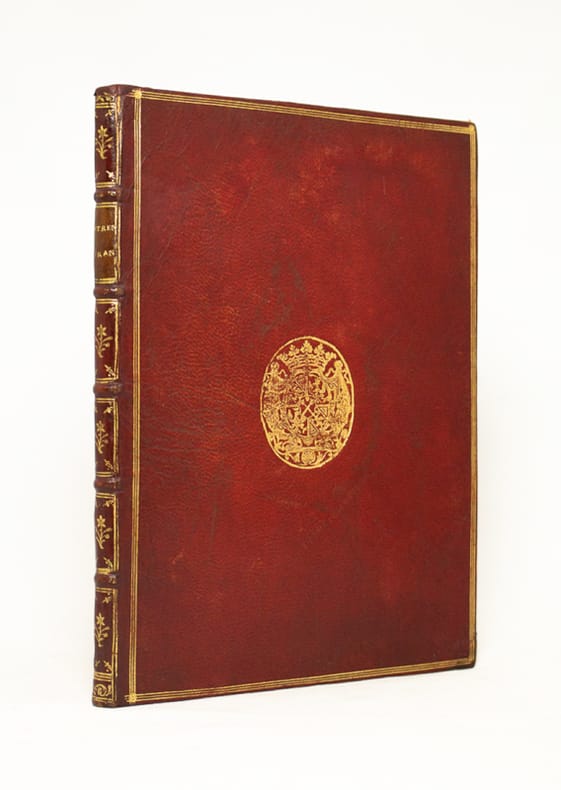
176616530Paris, Pierre-Guillaume Simon, 1766. In-4 de 58 pages (numérotées 68), plein maroquin rouge cardinal, dos à nerfs orné de filets et fleurons dorés, pièce de titre en maroquin olive, triple filet doré en encadrement des plats frappés des armes de Henri Comte de Calenberg.
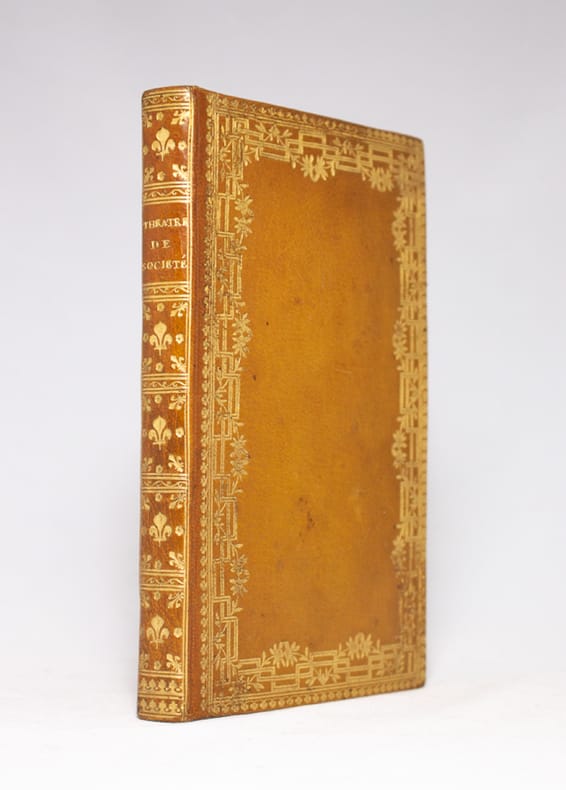
176416516Paris, La Veuve Duchesne; Gueffier, 1764-1766. 3 ouvrages en un volume in-8 de 120-62-80 pages, plein maroquin citron, dos lisse orné de fleurs de lys et petits fers dorés, dentelle géométrique avec des motifs floraux en encadrement des plats, filet doré aux coupes, roulette dorée aux chasses, gardes de tabis rose, tranches dorées.
177438281774 Genève [Berlin, Rotterdam], 1774. Complet en 8 vol. in-4: 20 x 26.5 cm. I/ 1 front., 6 ff., 572 pp. + [4] pl. grav.; II/ 1 f., 526 pp. + [4] pl. grav.; III/ 1 f., 536 pp. + [4] pl. grav.; IV/ 1 f., 581 pp. + [4] pl. grav.; V/ 1 f., 510 pp. + [4] pl. grav.; VI/ 1 f., 607-[3] pp. + [4] pl. grav.; VII/ 1 f., 636-[2] pp. + [6] pl. grav.; VIII/ 1 f., 520-[2] pp. + [4] pl. grav. Réimpression in-4, avec quelques changements et le texte entièrement encadré, de l'édition in-8 publiée par Voltaire en 1764. Elle contient les mêmes gravures, réimposées, auxquelles on a ajouté un encadrement, en raison du format. A savoir: un frontispice par Pierre, gravé par Watelet, représentant le Génie couronnant le buste de Corneille, et 34 figures hors-texte par Gravelot, gravées par Baquoy, Filpart, Lemire, Lempereur, de Longueil, Prévost et Radigues. Reliures de l'époque en veau blond moucheté. Dos à cinq nerfs, avec pièces de titre et pièces de tomaisons en maroquin vert, et caissons à fers dorés ornés d'un trophée en leur centre. Roulettes dorées sur les plats, les coupes ainsi quaux chasses. Gardes recouvertes de papier marbré. Traces de frottements aux reliures. Rares piqûres. Coiffes des tomes 4, 7 et 8 restaurées.
1767111136bailly 1767 4 in-4 A Paris, chez Bailly, rue Saint-Honoré, barriere des Sergens, 1767-1770, 4 volumes in-4 de 260x190 mm environ, Tome 1. 1f.blanc, faux-titre, 3ff. de dédicace gravées, titre en rouge et noir avec vignette, cx-1f. (approbation et privilège)-264 pages, avec les planches numérotése de 1 à 48, 1f.blanc, - Tome 2. 1f.blanc, viij-355 pages, 1f.blanc, Avec les planches numérotées de 49 à 81, - Tome 3. 1f.blanc, viij-360 pages, Avec les planches numérotées de 82 à 118, - Tome 4. 1f.blanc, faux-titre, titre en rouge et noir, 6 (pages d'Explication des vignettes et fleurons de Métamorphoses)-367 pages, 1f.blanc, Avec les planches numérotées de 119 à 140, et une planche : Fin des estampes des Métamorphoses, avec les noms des artistes dans une guirlande de médaillons tenue par un angelot, édition enrichie de 30 vignettes placées à chacun des livres et de 4 fleurons aux titres des 4 volumes, reliures plein granité fauve, dos à nerfs ornés, portant titres et tomaisons dorés sur pièces en maroquin bordeaux, ornés de caissons à fleurons et motifs dorés, plats encadrés d'un triple filet doré, coupes et chasses dorées, gardes de couleurs, tranches dorées. Une coiffe ébréchée, des coins dénudés, début de fente sur un mors, des rousseurs cernes et pages brunies, petits défauts sur le cuir. Texte bilingue Latin avec la traduction en regard.
177116613In Parigi, Apresso Agostino Delalain, Pietro Durand, Gio. Claudio Molini, 1771. 2 volumes grands in-4 de 331; 340 pages, plein maroquin rouge, dos à nerfs ornés de fleurons et petits fers dorés, triple filet doré en encadrement des plats, double filet aux coupes et roulette dorée aux chasses, tranches dorées.
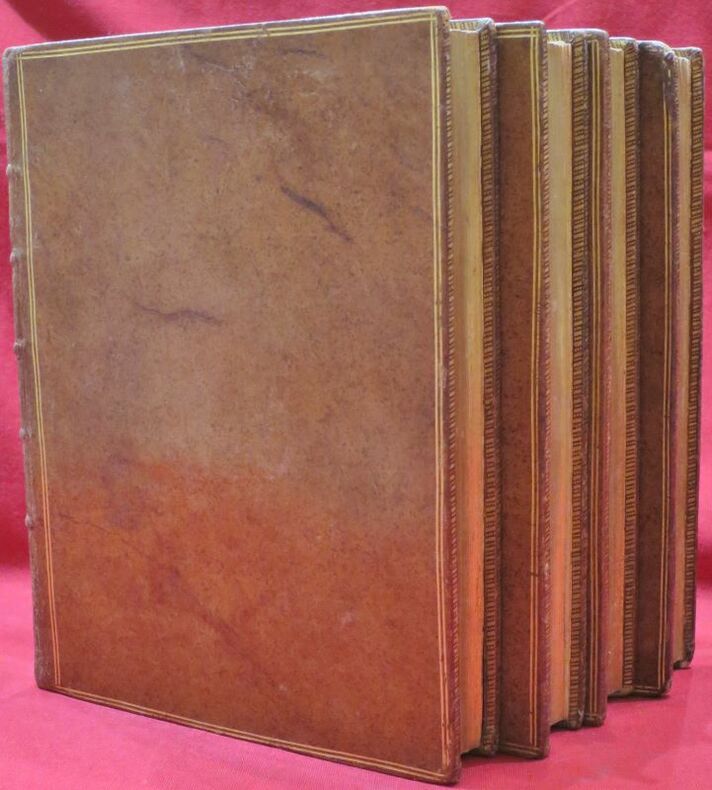
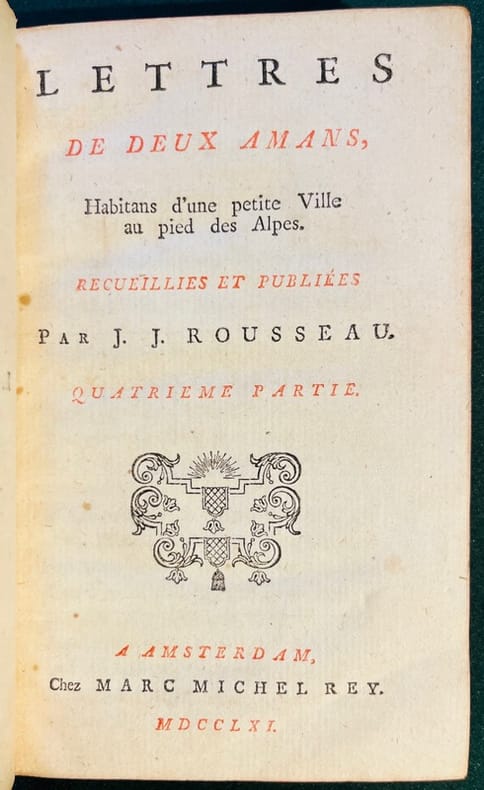
176120433A Amsterdam, chez Marc-Michel Rey, 1761. 6 volume in-12 de [16]-(63-[5]-24)-[16]407-[1]; tome II [4]-319-[1]; tome III [4]-255-[1]; tome IV [4]-331-[1]; tome V [4]-311-[1]; tome VI [4]-312 pages. Plein veau brun raciné, dos à nerfs ornés de filets et fleurons dorés, pièces de titre bordeaux, tranches rouges, gardes de papier marbré.
17689785Genève, [Cramer], 1768-1777. 29 volumes grand in-4, demi-veau blond à coins, dos à 5 nerfs ornés de filets, roulettes, titre, sous-titre et paniers de fleurs surmontés d'un joli chapeau, le tout doré. 23 volumes avec étiquettes de titre rouges et de sous-titre et tomaison caramel, 6 volumes avec étiquettes de titre caramel et de sous-titre et tomaison vertes, plats de joli papier marbré. Non rognés.
176676171766 S.l.: [1766]. 1 f. de titre grav., 10 pl. grav. chiff. II à XI regroupant 36 figures chiff. 1 à 36, 1 pl. grav. dExplication chiff. XII. Précieux recueil composé dun titre-frontispice orné dun portrait en médaillon de Louis XV, dun feuillet dexplication gravé en fin de vol. et de 36 figures militaires de Gravelot gravées par Guillaume de la Haye, montrant des soldats à lexercice de titre, regroupées sur 10 planches dép. Reliure postérieure en veau brun. Dos lisse avec pièce de titre en maroquin rouge et caissons fleur-de-lysés. Deux encadrements de plats, ornés de fleur-de-lys aux angles de lencadrement intérieur. Mouillure en tête de la pl. X. Rare et désirable militaria.
17592999Amsterdam & Paris: chez Prault père and Laurent-Fr. Le Clerc 1759. <p>16mo 113 x 62 mm. viii 97 1 pp. folding table counted as 4 pages. ninety-one etchings after Gravelot including an allegorical frontispiece signed by N. Le Mire and dated 1758 and 90 etched plates of girls and women engaged in various activities of daily life. Text within double rule border throughout. Small marginal loss to pl. 34 pl. 90 with an old crease from paper flaw very occasional slight soiling overall in fine condition. Contemporary French red morocco covers paneled with triple gilt fillets spine gold-tooled and -lettered green gilt dominoté endpapers with repeating star pattern; modern morocco two-part pull-off case by Riviere & Son. Provenance: Sir David Lionel Goldsmid-Stern-Salomons 1851-1925 armorial bookplate.<br /><br />The first French lottery almanac and the most abundantly illustrated of any single eighteenth-century almanac. "One of the loveliest and rarest of all 18th-century almanacs" Savigny de Moncorps this celebrated little book is illustrated with no fewer than ninety-one etchings designed by Gravelot who also wrote the epigrammatic quatrains accompanying each etching. Gravelot's delightful scenes of little girls teenage girls and young women busy with pastimes or chores or shown at moments of emotional intensity were intended as is explained in the preface to represent the spirit of France while encouraging its citizens to play the new national lottery established in 1757 to finance construction of the Ecole royale militaire a military academy founded by Louis XV in 1751 to train 500 young noblemen from impoverished families.<br /><br />Besides the usual calendar and a 12-month table of gains and losses the text contains a history and description of the new lottery and its Italian antecedents explanations of its principles and mechanics and a guide to playing advantageously using "mathematical reasoning." The lottery for which bureaus were to be established throughout France was planned to last for 30 years with monthly drawings. It was an early form of today's Lotto. Tickets containing numbers from 1 to 90 were spun in a "wheel of fortune" pictured in the frontispiece from which five winning tickets were selected. Players were allowed to place bets on up to five numbers at once the variously sized bets being provided with arcane names an extrait for one number ambe for two terne for three etc. <br /><br />The pictures' role was to help the lottery player choose his numbers functioning somewhat in the manner of the traditional Italian smorfia but without the exclusive focus on dreams and portents which are referred to in the preface as an optional method of inspiration. Like the lottery itself the concept of thematic images linked to lottery numbers was based on the Italian model as explained in the preface and the historic chapter but while in Italy each city chose their own motifs - in Rome it was the arts in Naples animals in Genoa flowers and in Venice trades - for France it was decided without hesitation that la galanterie was a natural fit for the nation p. iv. One might read a rather Freudian or Jungian motivation into the presumably subconscious choice by the lottery committee of the very opposite of a warlike theme - sweet young girls domesticity and intimations of intimacy - for the financing of a military school. Whether or not this was Gravelot's idea his contribution was major: as stated in the publishers' preface and in his own Avertissement on the penultimate verso he designed the figures and wrote the verses. The plates were etched by Noël Le Mire 1724-1801 "one of the most prominent engravers of the 18th century . whose best work was in his book illustrations after Boucher Cochin Gravelot Eisen Gravelot Monnet Moreau and others" Thieme-Becker 23:27.<br /><br />The frontispiece depicts blindfolded fate drawing tickets from the "wheel of fortune" and dropping them into a crowd of eager ladies and gentlemen. The first 28 plates portray young girls and the rest adolescents and young women. Each etched scene is set within a gracious rococo frame with cartouches for the title the number and at the foot Gravelot's rhyming quatrain. Shown are girls at play with dolls or heaven forbid spinning tops with the boys Gravelot disapproves learning their ABC's being slapped by their mother or governess for laziness teaching the dog to dance playing badminton alone on a swing pushed by a brother crying as the cat makes off with the pet sparrow painting dreamily at a table and even building a house of cards. As she ages the teenage girl is given more work - she embroiders knits studies but also prepares for parties flirts gossips is jealous. Many of the etchings tell stories. Portraits of the now adult young women include a reader the quatrain warns to choose one's books as one does one's friends: wisely a gambler a coquette a "savante" surrounded by books a dreamer personifications of boredom and religious devotion but also working women shown gardening milking cows harvesting grapes spinning cooking sewing doing hair selling knickknacks etc. On the bottom rung of the social ladder a laundry woman and a maidservant are shown the latter making a bed and admonished to be "flattering supple patient and never to tell certain secrets." The final plate depicts fatefully a wedding and there is nothing left to show the bride having ceased to be the property of la Galante France and become that of her husband.<br /><br />This copy is in very fine condition. The edition is a notorious rarity. There are two copies at the Bibliothèque nationale de France of which at least one is incomplete a defective copy at the Bibliothèque Ste. Genièvieve copies at the Morgan Library Boston Museum of Fine Arts and the British Library. The Morgan also has four of Gravelot's original drawings for the almanac and Houghton Library has six others. The almanac had only this one year of issue. The plates were re-issued once in an edition of Les Jeux de la petite Thalie Paris: Desnos s.d. which is almost as scarce as this volume. Because of its rarity this almanac is far less known than Gravelot's 17-volume Almanach iconologique which contained like most French almanacs 12 plates per volume. John Grand-Carteret who devoted 5 full columns to the edition knew of only the Baron Pichon copy.  The amateur Savigny de Moncorps included this almanac "one of the prettiest and rarest" in his very "choisi" collection of almanacs; and the frères Goncourt called it a trifle condescendingly "un vrai petit bijou et joujou" which perfectly suited Gravelot's talents.<br /><br />Inventaire du fonds français graveurs du XVIIIe siècle vol. 10 Gravelot 983-1073 and vol. 14 Lemire 159-248; Grand-Carteret Les Almanachs français 277; Cohen-de Ricci Guide de l'amateur de livres à gravures du XVIIIe siècle 1912 col. 28-29; Savigny de Moncorps Coup d'oeil sur les almanachs illustrés du XVIIIe siècle 1891 11-12; Savigny de Moncorps Almanachs illustrés du XVIIIe siècle 1909 no. 6 pp. 35-39.</p> chez Prault père [and] Laurent-Fr. Le Clerc unknown books