1 882 résultats
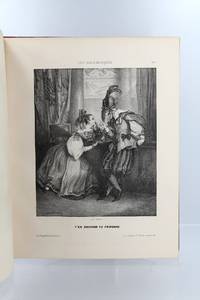
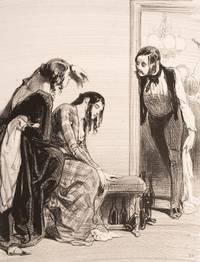
06466Paris: Aubert et Cie. 1839. The Fine Shades of Feeling: Gavarni and the Comedy of Modern Emotion<br /> <br /> GAVARNI Paul pseudonym of Guillaume-Sulpice Chevallier. Nuances du Sentiment. Paris: Aubert et Cie. 1839-1840.<br /> <br /> First edition. Folio 13 1/4 x 10 inches; 336 x 254 mm. Twenty-five lithograph plates. Plate no. 20 with contemporary hand-coloring heightened with gum arabic. Plate no. 10 misnumbered "9" as noted by Armelhault. Plate no. 15 slightly shorter 3/8 inch at lower margin. Some occasional light marginal foxing - most noticeable on plate 1.<br /> <br /> Early twentieth-century blue cloth covers decoratively bordered in blind front cover lettered in gilt expertly rebacked spine lettered in gilt. Aside from the occasional light marginal foxing this is a near fine copy.<br /> <br /> A charming and unusually appealing complete set from one of Gavarni's most perceptive and elegant social suites Nuances du Sentiment turns its attention to the delicate gradations of emotion courtship vanity hesitation disappointment and self-dramatization that animate Parisian life. Few artists of the July Monarchy were better equipped than Gavarni to capture these fleeting psychological states. With his incomparable economy of line and his gift for registering gesture pose and expression he transforms small moments of social comedy into scenes of remarkable acuity.<br /> <br /> The title itself is characteristic: these are not grand passions but subtleties - shades of feeling observed in drawing rooms promenades and private exchanges. Gavarni was among the supreme illustrators of modern manners and in suites such as this one he stands beside Daumier as one of the great visual chroniclers of nineteenth-century French urban life. Yet where Daumier often bites Gavarni more often insinuates; his satire is lighter cooler and at times almost tender though no less exact.<br /> <br /> Particularly attractive is the contemporary hand-coloring of plate 20 heightened with gum arabic a feature that lends that sheet a more finished and decorative quality and offers an appealing reminder of the close relationship between the lithographic satire and the luxury print market of the period. The mis-numbering of plate 10 as "9" recorded by Armelhault is present as expected. <br /> <br /> A quietly sophisticated and genuinely scarce Gavarni suite - and a reminder that the most revealing chronicles of nineteenth-century Paris are often found not in its grand narratives but in its smallest gestures.<br /> <br /> Rare: We have handles over fifty different titles illustrated by Gavarni - we have never seen nor heard of this title before.<br /> <br /> Armelhault and Bocher 877-901. Paris: Aubert et Cie., 1839 unknown
184084312Paris: Léopold Pannier et Cie 1840. Fine. Stunning and rare suite by a great illustrator from the Romantic era Léopold Pannier et Cie Paris s. d. 1840-1850 25.50 x 34.50 cm 25 lithographies reliées en un volume First collective edition of this complete series of 25 original lithographed plates printed on thick vellum. Mounted engravings preceded by a title page bringing together three series: Souvenirs de Carnaval 6 plates Les bals masqués 7 plates Costumes historiques 12 plates. Each of these series first appeared in other journals: under the title 'Souvenirs de Carnaval' in Ritner et Goupil 'Les bals masqués' in La Caricature and 'Costumes historiques' in Charivari. Engravings in third state according to Vicaire. Some foxing. Red half straight-grained morocco Bradel binding smooth spine decoratively tooled and lettered in gilt with a rich ornamentation of repeated floral motifs marbled paper pastedowns and endpapers binding signed Victor Champs. Very rare collection in a deluxe edition printed on thick vellum elegantly bound. Léopold Pannier et Cie hardcover
18452091202133212049J. Hetzel 1845. Soft Cover. Fine. Number of books: 4 books in total J. Hetzel paperback
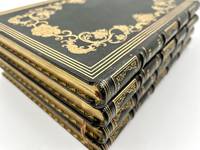
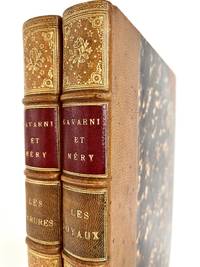
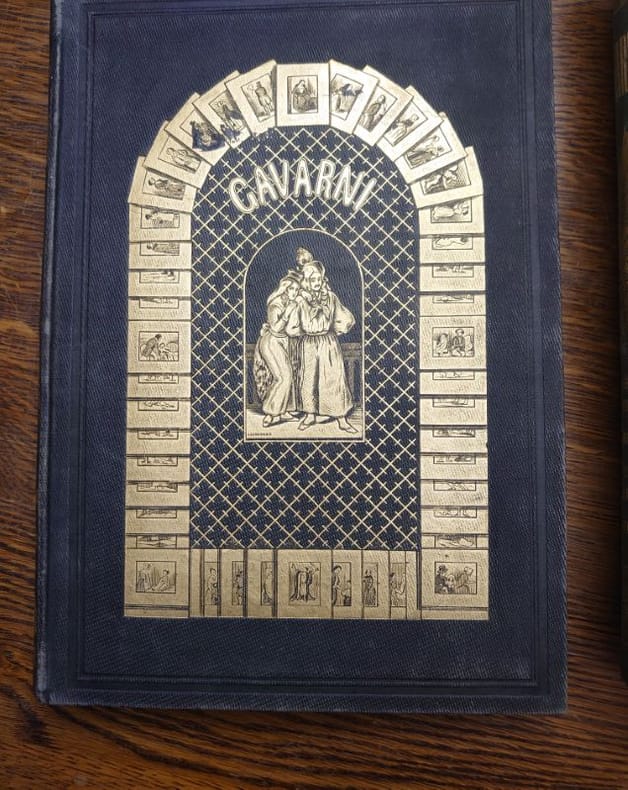
185028101850 Paris, G. de Gonet, Martinon, Vve L. Janet, à Leipzig, chez Ch. Twietmeyer, (1850), (3ff) 300pp & (3ff) 316pp Deux grands volumes in-8 d'une fraiche reliure en pleine percaline marine d'époque aux plats entièrement ornés d'un décor polychrome à fers spéciaux dorés et à froid reproduisant les couvertures, dos lisses ornés de même, tranches dorées (reliures des éditeurs). Quelques rares piqures intérieurs mais exemplaire est dans un etat de conservation excellant (la reliure des parures est légèrement passée en rapport avec le tome des joyaux). Agrémenté d'un frontispice répété et de 30 ravissantes planches gravées sur acier par Geoffroy h. t. d'après Gavarni.
184084312Léopold Pannier et Cie | Paris s. d. [1840-1850] | 25.50 x 34.50 cm | 25 lithographies reliées en un volume
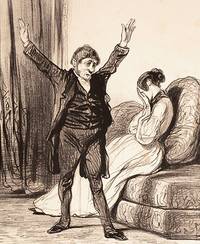
06055Paris: Chez Aubert gal. Véro-Dodat 1837. The Complete Second Series of Fourberies de Femmes<br /> With Fifty-Two Lithograph Plates by Gavarni <br /> <br /> GAVARNI pseudonym of Guillaume Sulpice Chevallier. Fourberies de femmes. Paris: Chez Aubert gal. Véro-Dodat n.d. 1837.<br /> <br /> Second Series Complete. <br /> <br /> Folio 13 1/8 x 9 7/8 inches; 334 x 251 mm. Fifty-two lithograph plates. Eight-page publisher's catalog bound in at end. Plate no. 13 with an expertly and almost invisibly 3 1/8 inches repaired marginal tear. All plates with two small 'unidentified' circular stamps on the lower blank corners. Some occasional light and mainly marginal foxing still an exceptional example.<br /> <br /> Bound ca. 1840 in quarter maroon roan over maroon grained paper boards front cover lettered in gilt smooth spine plain endpapers. Extremities of binding rubbed. A wonderful example. loosely inserted at the end are three duplicate plates nos. 7 23 & 25 all with the same small marginal stamps.<br /> <br /> "In 1837 Gavarni began his connection with Le charivari which did not conclude until 1848. In all he drew 1054 lithographs for his journal.Most of these appeared in series some twenty-five of which extend to ten or more plates and were afterwards published by Aubert in albums. Perhaps the best of these collections are Fourberies de femmes en matière de sentiment Les étudiants de Paris Les débardeurs and Les lorettes; but some of the rest are of hardly inferior interest. Still further series contributed to periodicals other than Le charivari were also issued as albums. Baudelaire had this part of Gavarni's work particularly in mind when he wrote.that 'the true glory and the true mission of Gavarni and Daumier has been to complete Balzac.' Certainly the pictures of Parisian society provided by the two artists perfectly complement each other. Daumier's preoccupation was the working middle class with faces and figures heavily marked by life. Gavarni remained for the most part outside the humdrum bourgeois round. He preferred to show 'youth at the prow and pleasure at the helm.' His pretty girls and sleek young men are bent on enjoyment. They live lives of graceful dissipation with love intrigues and balls on the one hand and pawnbrokers' shops and debtors' prisons on the other. Their motto is carpe diem and they rarely think of the day or reckoning" Ray p. 217. <br /> <br /> "After the initial success of Caricaturana Philipon proposed to Gavarni that he draw 'Mme. Robert Macaire' for Le charivari. He responded with twelve studies of female deception in which he seems to have adopted Vigny's belief that 'A woman more or less is always Delilah.' They made little impression but three years later Gavarni returned to the theme in a subtler and more amiable way with one of his most searching and amusing series. In no. 37 he offers this exchange: 'How did you know papa that I loved Mr. Leon-Because you always talked to me about Mr. Paul.' Gavarni's playful mastery of female psychology is not the only attraction of the series. If Daumier could not draw a pretty woman as is sometimes alleged Gavarni at this period could hardly draw an ugly one" Ray pp. 220-221. <br /> <br /> Armelhault & Bocher 662-702; Ray The Art of the French Illustrated Book 151. Paris: Chez Aubert gal. Véro-Dodat, 1837 unknown
06347Paris: Caboche Grégoire 1837. One of Paul Gavarni's Rarest and Most Famous Series<br /> Thirty-Four Superb Lithographs.<br /> <br /> GAVARNI Paul pseudonym of Guillaume Sulpice Chevallier. La Boite aux Lettres. Paris: Caboche Grégoire et Cie Chez Arnauld de Vresse libraire éditeur 1837-1839.<br /> <br /> Folio 13 1/2 x 10 1/2 inches; 343 x 267 mm. Thirty-four superb lithograph plates with captions of the 'letters' printed below. Bound without the lithograph title-page.<br /> <br /> Bound by Pagnant ca. 1920 in quarter tan morocco over red patterned boards spine with five raised bands lettered in gilt in compartments cockerel endpapers. Joints expertly repaired some light to moderate foxing to several of the plates. Still an excellent example of this rare suite of lithographs.<br /> <br /> The first twelve lithographs were published by Caboche Grégoire et Cie. The following twenty-two lithographs were published by Aubert & Cie. and appeared in the journal Le Charivari between 7 November 1837 and 6 February 1839.<br /> <br /> According to OCLC there is just one copy with all thirty-four plates in libraries and institutions worldwide: The Clark Art Institute MA USA with all thirty-four plates- but lacking the lithographed title-page. Other than that example there are only three individual lithographs at The Getty CA USA numbers 4 8 & 14. The Getty also have a plain example of number 10. <br /> <br /> Paul Gavarni 1804-1866. "A French artist best known for his lithographs Paul Gavarni née Chevalier Suplice Guillaume was born in Paris on January 13 1804. Throughout his lifetime Gavarni produced over 4000 satirical prints for journals and fashion magazines. Both delicately witty and elegantly revealing of human behavior and character Gavarni's genre scenes made him one of the most important and popular nineteenth-century artists. He is often critically paired with Honoré Daumier with whom he and other young printmakers like Jean-Jacques Grandville and Joseph Traviés raised the status and importance of social lithography and printmaking as an art form. In the 1830s he began to work for L'Artiste La Caricature and most importantly Le Charivari. The latter was owned by Charles Philipon and became Gavarni's longest running contract and most important place of publication. Here Gavarni published some of his most famous series including Les Artistes La Boite aux Lettres Clichy inspired by his month-long stay in debtor's prison Les Coulisses Les Enfants Terribles Impressions de Ménage etc. etc." <br /> childsgallery.com<br /> <br /> "Gavarni as Sainte-Beuve puts it set to depicting and silhouetting society in all directions and from top to bottom: the high society the not so high society-all sorts of societies capturing the life of his time. He grabbed modern life by every available handhold imitating no one looking for nothing else swimming in open water and taking us in his wake amidst the stream of the manners of the time. He was Gavarni with an inexhaustible wit who at the bottom of a graceful drawing always interesting thanks to rational observation would write a caption full of subtle humor. It would sometimes unfold like a short comedy or be condensed like a geometrical axiom. Amusing and light-hearted when taken separately Gavarni's captions showed their true color of skeptical melancholy and of deep and powerful meaning when considered as a whole. He could through the accuracy of faces careful rendering of clothes and the precision of poses and bearing unmistakably express the age quality occupation habits manners and ridiculous ways of the characters he depicted. He made them speak a language that was stunning with original exactness feeling and novelty. Gavarni-and that's why he is great-created two genres at once: the pencil-drawn comedy of manners and the caption. His reputation became huge. True enough much of his audience only saw the funny aspect of the genre and called his drawings "caricatures" without noticing any difference with those of Daumier. But all sensitive souls were seduced by their elegance and subtlety and easily perceived their uniqueness." oldbookillustrations.com.<br /> <br /> Armelhault & Bocher pp. 88-95 11 unnumbered 348-368. Not mentioned in Ray.<br /> . Paris: Caboche, Grégoire , 1837 unknown
06002Paris: Bauger et Cie. 1838-42. Gavarni's "Terrible Children"<br /> Fifty Superb Hand Colored Lithographs Including the Pictorial Title-Page<br /> <br /> GAVARNI Paul pseudonym of Guillaume Sulpice Chevallier. Les Enfans terribles. Paris: Bauger et Cie. n.d. 1838-1842.<br /> <br /> First edition. Large quarto 13 11/16 x 10 1/2 inches; 345 x 267 mm. Pictorial lithograph title-page printed in black & blue and forty-nine numbered lithographed plates printed by Aubert & Cie. Imprints vary plate 1 has imprint: Edite par le Charivari; plates 2-5 have imprint: Au Bureau du Charivari; plates 6-13 15-24 and 38-43 have imprint: Chez Bauger; plates 14 and 44-49 have imprint: Chez Bauger & Cie.; plates 25-37 have imprint: Se vend chez Bauger & Cie. Editeurs des Dessins de la Caricature du Figaro et du Charivari; plates 11 44 47 and 49 have additional imprint: Chez Aubert; and plate 25 has no imprint. Bound in at the end is a leaf of advertisement Des Modes Parisiennes verso blank and the sixteen page Aubert et Cie. Livres et Albums. Some light foxing throughout. <br /> <br /> Late nineteenth century quarter red calf over red pebbled cloth boards. Smooth spine elaborately decorated and titled in gilt. Title-page neatly re-inserted with white archival tape. With the bookplates of Bernard Mamy and André Villet on front paste-down. A very good copy of a rare suite of plates. <br /> <br /> "Gavarni's conception of the enfant terrible has passed into a proverb. For all their apparent ingenuousness his appealing children are preternaturally sharp. They see and hear everything in their little world and they are infallible in announcing their discoveries where they will cause the most embarrassment. So a little boy asks a visitor: 'Sir who is it that invented gunpowder.since Papa says it isn't you' no. 10; or a little girl informs a suitor: 'Aunt Amelia says that you are very nice; but it's a pity that you are too stupid' no. 32" Ray The Art of the French Illustrated Book.<br /> <br /> "The forty-nine prints in Gavarni's series Les enfants terribles are among his most popular and well-known works legendary for their witty and memorable captions. Gavarni's enfants terribles are social landmines "holy terrors" who wittingly or unwittingly reveal the pettiness and duplicity of their parents. An illustrator of children's books Gavarni was the father of two children of his own to whom he was very attached. Gavarni loved the spontaneous poses and gestures of children and admired them for their disarming honesty. The term enfants terribles originally reserved for terrifyingly candid children who embarrass their parents came to be used to describe unconventional or unorthodox artists and writers-like Baudelaire and Flaubert-whose works reveal harsh truths about society that are embarrassing to guardians of the status quo." Allen Memorial Art Museum.<br /> <br /> "As the historical antecedent to Dennis the Menace and Calvin and Hobbes Les Enfans terribles was far more incisive and revealing in its social commentary. In its images Gavarni regularly uses the quasi-innocent questions or remarks of children to put the world of the adults around them in disarray. The subject is more often than not the marital or extra-marital situations of the grown-ups" Beatrice Farwell The Charged Image p. 91.<br /> <br /> According to OCLC there is just one example in libraries & institutions worldwide: The Gordon Ray copy at The Morgan Library & Museum NY USA - also apparently without the pictorial hand colored title-page.<br /> <br /> Paul Gavarni 1804-1866. "A French artist best known for his lithographs Paul Gavarni née Chevalier Suplice Guillaume was born in Paris on January 13 1804. Throughout his lifetime Gavarni produced over 4000 satirical prints for journals and fashion magazines. Both delicately witty and elegantly revealing of human behavior and character Gavarni's genre scenes made him one of the most important and popular nineteenth-century artists. He is often critically paired with Honoré Daumier with whom he and other young printmakers like Jean-Jacques Grandville and Joseph Traviés raised the status and importance of social lithography and printmaking as an art form.<br /> <br /> The Plates:<br /> <br /> 1. J'ai assez vu mon Cousin moi! M'man viens tu t'en<br /> 2. Adieu Madame à bientôt puisque vous permettez que je vienne amsi vous ennuyer quelquefois.<br /> 3. Petit Chérubin j'ai apporté du bonbon pour vous: Je vous le donnerai quand je m'en irai.<br /> 4. Monsieur! N'est - ce pas que ça n'est pas vrai quevous n'avez pas les Cheveux peints<br /> 5. Oh! c'est vrai! T'as les yeux comme les lanternes de ton cabriolet.ah bien!.<br /> 6. Grand Papa sa fiche de petite maman parceque petite Maman s'est fait des tetais avec du coton na!<br /> 7. Mère! Est-ce que c'est le crevè de ce matin que t'as dit que ça serit toujours assez bon pour lui<br /> 8. Petit amour comment s'appelle Madame votre maman.<br /> 9. Maman v avenir pas tout de suite: elle est avec Madame Pelet. Vous ne la connaissez pas Madame Pelet.<br /> 10. Qu'est-ce donc qui l'a inventée la poudres Monsieur.que papa dit que ce n'est pas vous.<br /> 11. Après diner Maman n'est ce pas j'ai été bien sage nous irons chez mon bon ami.<br /> 12. N'est-ce pas ma mère que c'est bien vilain de dire: vous m'embêtez Eh! bien ma bonne a dit tout-a-l'heure à mon Papa.<br /> 13. Quand Maman aime bien petit Papa elle appelle petit Papa "ma niniche".<br /> 14. La rose que vous avez donnée à Maman. Ah! oui oui!. que vous avez manque de vous casser le cou pour l'avoir.<br /> 15. N'est-ce pas Maman que le petit peigne à moustaches que Cornelie a trouvé ce matin dans ta chambre c'est pour moi<br /> 16. Maman! Maman! Ce Monsieur du Luxembourg que tu as dit tu sais bien que c'etait nn grand ami de Papa!.<br /> 17. Est-ce que c'est vrai Monsieur le Marquis que vous êtes toujours toujours oblige de regarder en Bourgogne si la Champagne brûle.<br /> 18. C'est vous qu'ètes le grand sec qui vient toujours pour diner. Monsieur Papa n'y est pas.<br /> 19. Ils t'on dit de jouer tant que tu voudras dans la salle à manger> et ta mère!. t'a donné!.<br /> 20. Voyons! Faites attention: Que doit on faire lorsqu'on a pêché.<br /> 21. Monsieur Albert C'est un monsieur du Jardin-des-Plantes qui vient tous les jours pour faire l'explication des bêtes à Maman.<br /> 22. Houp! Houp! Papa.ah! mais tu ne fais pas si bien le cheval que Janisset dam!.<br /> 23. Mais pourquoi donc Mosieu Bachu que tu viens toujours embêter Papa comme ça pour ta mécanique.<br /> 24. Le spectacle etait-ce bien Et à-t-il été raisonnable Lolo - Lolo! Ne m'en parle pas.je dis en entrant.<br /> 25. Ma bonne bisque va M'man de se lever comme ça de bonne heure depuis que l'es revenue.<br /> 26. Que tu es donc godiche Tomon de venir tous les matins comme ça pour que Papa te mette de l'argent dans ton affaire.<br /> 27. Maman c'est Mosieu.tu sais ce Mosieu qui a ce nez.<br /> 28. Maman dit que vous savez tous les secrets de Polichinelle Mosieu d'Alby: qu'est-ce qui peut donc lui avoir abime le nez comme ça.dites!<br /> 29. Tu mettras plus jamais ton chapeau qui sent la pipe n'est pas m'man<br /> 30. Je le dirai!.que t'as encore pris dans le petit pot du rouge que Maman se met.<br /> 31. Papa empèche donc Françoise de se moquer toujours de moi parceque je lui dis que Monsieur Ward a montré l'Anglais à Maman.<br /> 32. Ma tante mélie dit que t'es bien gentil; mais que c'et dommage!.<br /> 33. Tu ne sais pas Petite Papa.cet animal de Maurice il n'a fait que faire pleurer Maman ce matin.<br /> 34. Ma tante Aurélie qui disait l'autre jour à Maman qu'elle t'en ferait voir des grises sit u deviens son mari.<br /> 35. La canne que Papa a trouvée dans l'armoire de Maman le jour qu'il était si en colère elle était bien plus belle que ça!.<br /> 36. Tu ne sais pas ta leçon ta tante va venir: tu seras grondé!.<br /> 37. Est-ce que c'est vrai Mosieu d'Alby que tu couperais des liards en quatres.<br /> 38. Si tu touches encore à la bouteille du vin muscat tu seras bien attrapée parceque papa a fait une marque au bouchon etune marque au goulot.<br /> 39. Un petit de la pension qui disait que t'étais renégat; j'y ai fichu des giffles.n'est ce pas père que t'es catholique<br /> 40. Est-ce que vous payez des impositions comme papa Mosieu Pastorin pour être usurier<br /> 41. Mosieu on ne peut pas voir papa il es ten train de faire faillite.<br /> 42. Cette madame de Lieusaint est-elle bête! Puisque je suis Charles Dubourg et que tu es mon papa.<br /> 43. Dis-donc Miroux.dis-donc Miroux.dequoi donc que madame Miroux te fait porter<br /> 44. Papa voilà ton homme de paille!<br /> 45. Mosieu Belassis moi j'ai pas des jambes en manches de veste.<br /> 46. Décidément mon cher ami vous n'êtes pas de force au piquet: je vous enfonce.<br /> 47. M'man n'y est pas parceque tu rentres avant cinq heures puisque si t'etais pas revenue avant cinq heures.<br /> 48. N'est-ce pas Mosieu Prud homme qu'il ne faut pas mettre un H à omelette.là! vois-tu M'man!<br /> 49. Maman a écrit à mosieu Prosper et papa a vu la lettre. O il était joliment en colère papa.parceque maman avait fait une faute.<br /> <br /> Armelhault & Bocher 565-613; Bobins V 1538; Ray The Art of the French Illustrated Book 152. Paris: Bauger et Cie., 1838-42 unknown
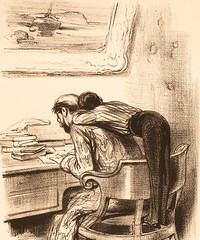
06349Paris: Chez Aubert 1841. Love is their business and they drive hard bargains<br /> They are as luxurious and idle as they are beautiful<br /> Their lives are a tissue of deception and hypocrisy"<br /> <br /> GAVARNI Paul pseudonym of Guillaume Sulpice Chevallier. Les Lorettes. Paris: Chez Aubert June 1841-December 1843. <br /> <br /> Folio 13 1/2 x 9 3/4 inches; 342 x 248 mm. Seventy-six of seventy-nine lithograph plates. All plates mounted on stubs. The three missing plates nos. 68 69 & 70 are supplied with the illustrations that appeared in Charivari with text on verso. In addition there are duplicates of plate nos. 47 48 63 & 73 on "chine applique".<br /> <br /> Late nineteenth century marbled boards with original maroon morocco label lettered and bordered in gilt expertly rebacked and re-cornered with blue cloth spine with black morocco label lettered and ruled in gilt new endpapers.<br /> <br /> One of the rarest of all the Gavarni albums. Originally published from June 1841-December 1843 by Aubert et Cie. with just twenty lithographs. <br /> <br /> These lithographs represent the complete thematic cycle Gavarni created around the "lorette"-the semi-independent fashionable demimondaine of July Monarchy Paris.<br /> <br /> OCLC locates just one example in libraries & institutions worldwide: Clark Art Institute MA US.<br /> There have been just four complete copies at auction since 1901.<br /> <br /> A second series titled Les Lorettes Vieillies appeared in the 1860's. This second series contained thirty hand colored lithographs. OCLC locates just two copies of this rare work - they do not state that the plates are colored: University of Miami FL US & Northwestern University Library IL US.<br /> <br /> "Les Lorettes. This is the most masterly of Gavarni's earlier series. Ladies of the evening of a certain standing had come to be called lorettes because they often lived in the handsome new buildings of the Rue Notre Dame de Lorette. No subject could have been better suited to Gavarni's talents. Indeed Paul de Saint Victor observed preface to D'Après nature II 2 that "the lorette is for him what the actress of the Italian Comedy was for Watteau." Gavarni shows them without malice and without indulgence exactly as they were. The grisette of Les étudiants de Paris was an ingratiating figure; not so the lorette. Love is their business and they drive hard bargains. They are as luxurious and idle as they are beautiful. Their lives are a tissue of deception and hypocrisy. Among themselves their conversation is cynical to the point of brutality. Their men usually twice their age also cut a poor figure. At best these gentlemen command a wry irony which derives from their awareness of being dupes. Gavarni presents these brittle and glittering creatures with great deftness. The packed and subtle dialogue of the legends would not be amiss in a novel by Stendhal. It is difficult to select from his remarkable compositions but one cannot overlook. no. 27 in which a lorette in her bath indulges in a rare moment of speculative conversation with a friend." Ray The Art of the French Illustrated Book pp. 223-224.<br /> Note. Gordon Ray's copy had 73 of the 79 hand colored lithographs - missing nos. 19-24.<br /> <br /> "Lorette was a colloquialism for a new type of prostitute who was kept in relative luxury in the apartment buildings that had been constructed in the Notre-Dame-de-Lorette church. Gavarni's sharp-eyed observations of Parisian society in works like these demonstrate his value as a documentarian of his times." Bobins V p. 64 #1541.<br /> <br /> "In 1837 Gavarni began his connection with Le charivari which did not conclude until 1848. In all he drew 1054 lithographs for his journal.Most of these appeared in series some twenty-five of which extend to ten or more plates and were afterwards published by Aubert in albums. Perhaps the best of these collections are Fourberies de femmes en matière de sentiment Les étudiants de Paris Les débardeurs and Les lorettes; but some of the rest are of hardly inferior interest. Still further series contributed to periodicals other than Le charivari were also issued as albums. Baudelaire had this part of Gavarni's work particularly in mind when he wrote.that 'the true glory and the true mission of Gavarni and Daumier has been to complete Balzac.' Certainly the pictures of Parisian society provided by the two artists perfectly complement each other. Daumier's preoccupation was the working middle class with faces and figures heavily marked by life. Gavarni remained for the most part outside the humdrum bourgeois round. He preferred to show 'youth at the prow and pleasure at the helm.' His pretty girls and sleek young men are bent on enjoyment. They live lives of graceful dissipation with love intrigues and balls on the one hand and pawnbrokers' shops and debtors' prisons on the other.In 1846 Gavarni returned to Le charivari to which he had hardly contributed since 1843. He wished to call the series that ensued Choses de Paris but was persuaded instead to employ the general title Oeuvres nouvelles. Its major albums were Carnaval; Impressions de ménage deuxième série thirty-nine lithographs 1846-1847; and Baliverneries parisiens twenty-four lithographs 1847" Ray The Art of the French Illustrated Book pp. 217-218.<br /> <br /> Armelhault & Bocher 763-841; Beraldi VII p.51 # 107; Bobins V 1541. Paris: Chez Aubert, 1841 unknown
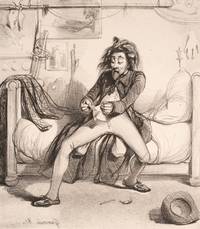
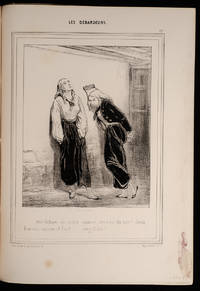
05550Paris: Au Bureau du Charivari 1840. Sixty-Six Lithographed Plates by Gavarni<br /> "Stevedores" at the Carnival of Paris <br /> <br /> GAVARNI pseudonym of Guillaume Sulpice Chevallier. Les Débardeurs. Album Comique par Garvarni. Paris: Au Bureau du Journal Amusant & Petit Journal pour Rire. Chez Bauger 1840-1842.<br /> <br /> Three large quarto volumes 13 1/4 x 10 inches; 337 x 253 mm. Sixty-six numbered lithographed plates. Plates printed by Aubert & Cie. Mixed states of the plates as per Armelhault & Bocher. The first forty-four plates with some occasional marginal staining not affecting images some light foxing affecting just a few plates.<br /> <br /> Publisher's printed green paper wrappers with original glassine wrappers. Front wrappers of parts 1 & 2 with some minor discoloration on foredge. Overall an excellent example - the first that we have seen in the original printed wrappers.<br /> <br /> A series of sixty-six lithographs of which nine first appeared in other journals eight in La Caricature plates 21 23 and 24 under the title "Souvenirs du Carnaval" and 32 44 49 54 and 61 under the title "Les Débardeurs" and one plate 58 in La Mode prior to the publication of the entire series in Le Charivari from 19 January 1840 to 5 February 1842.<br /> <br /> "In Les Débardeurs.a series of sixty-six lithographs published in Le Charivari between 1840 and 1843 Gavarni depicts a variation on the most famous of the costumes he designed for the masquerade balls the débardeur stevedore. The braided wig loose shirt black velvet trousers fastened with brass buttons and tied with a fringed sash are derived from the working costume of the longshoreman or stevedore who unloaded the barges that traveled up the Seine to Paris. As Nancy Olsen points out in Gavarni: The Carnival Lithographs the majority of Gavarni's carnival lithographs reflect his interest in the small groups that drift away from the crowd as a consequence of the romantic liaisons that preoccupied many of the participants at a masked ball. Intrigue was the name of the gave and the information being conveyed in this scene comes in all probability from an agent provocateur" Beatrice Farwell The Charged Image: French Lithographic Caricature 1816-1848 p. 88.<br /> <br /> "This is the most considerable of the several series of lithographs devoted by Gavarni to the balls which were a passion with him. He was an organizer and patron of the more elegant and he found the popular balls at the Opera and elsewhere an attractive subject for his designs. Théophile Gautier who believed that at this period Parisian balls had virtually 'effaced the former carnival of Venice' called Gavarni 'their depicter and historian.' As dancers throw themselves into their round of pleasure 'a man stands with his back against a pillar; he watches he listens he observes.' And the following day on stone 'he lends his own wit to all the masks perhaps stupid in themselves; he sums up in a profound word the chit-chat of the foyer; he translates into a pleasant legend the hoarse excitement of the hall.' Quoted by Lemoisne I 120" Ray The Art of the French Illustrated Book.<br /> <br /> Such elements have made Gavarni's carnival lithographs among his finest most famous and desired works of art.<br /> <br /> Armelhault & Bocher nos. 486-542 307-309 plates 21 23 and 24 259-263 plates 44 49 32 54 and 61 and 1223 plate 58. Ray The Art of the French Illustrated Book 154. Paris: Au Bureau du Charivari, 1840 unknown
06217Paris: Chez Aubert 1846. Three Complete Series by Paul Gavarni<br /> <br /> GAVARNI Paul pseudonym of Guillaume Sulpice Chevallier. Affiches Illustrèes & Gentilhommes Bourgeois & Des Mères de Famille. Paris: Chez Aubert 1846-1848.<br /> <br /> Three complete series bound in one folio volume 13 5/8 x 10 3/8 inches; 345 x 268 mm. Fourteen fine lithograph plates. All plates mounted on stubs and interleaved. The last six plates with a light waterstain on the top blank margin not affecting image.<br /> <br /> Bound by Pagnant ca. 1925 in three-quarter red straight-grain morocco over red diced cloth ruled in gilt. Smooth spine decoratively tooled and lettered in gilt marbled endpapers top edge gilt. Rear cover with waterstain at top.<br /> <br /> The three series are: <br /> <br /> Affiches Illustrèes Illustrated Posters 6 plates complete: Armelhault & Bocher 998-1003 25 June 1844 - 28 May 1846<br /> <br /> Gentilhommes Bourgeois Bourgeois Gentlemen 3 plates complete: Armelhault & Bocher 1087-1089 9 August 1846 - 3 October 1846<br /> <br /> Des Mères de Famille Mothers of the Family 5 plates complete: Armelhault & Bocher 1076-1080 24 November 1847 - 5 February 1848<br /> <br /> Rare: OCLC/KVL locate just one example of Affiches Illustrèes The Morgan Library & Museum NY US.<br /> No examples of Gentilhommes Bourgeois and just one example of Des Mères de Famille Ohio State Univ. OH US<br /> <br /> Armelhault & Bocher 998-1003; 1087-1089 and 1076-1080. Paris: Chez Aubert, 1846 unknown
06216Paris : Au Bureau du Charivari 1846. The Gossip of Paris as depicted by Gavarni<br /> <br /> GAVARNI Paul pseudonym of Guillaume Sulpice Chevallier. Baliverneries Parisiennes Parisian Gossip. Paris: Au Bureau du Charivari 1848. <br /> <br /> First edition complete. Folio 13 x 10 inches; 330 x 254 mm. Twenty-four fine lithograph plates.<br /> <br /> Publisher's yellow wrappers printed in dark brown. Some plates a little foxed one short 7/8 inch tear to outer margin of front wrapper otherwise near fine.<br /> <br /> Baliverneries Parisiennes is a series of lithographs originally issued in the journal Le Charivari between 14 August 1846 and 22 October 1847. The fine plates depict humorous and satirical scenes of everyday life in Paris particularly the city's working class and the social commentary of the time.<br /> <br /> Rare: OCLC/KVK locates just one complete example in libraries and institutions worldwide: The Morgan Library and Museum NY US. <br /> <br /> Armelhault & Bocher 1004-1023 & 1680-1683. Paris : Au Bureau du Charivari, 1846 unknown
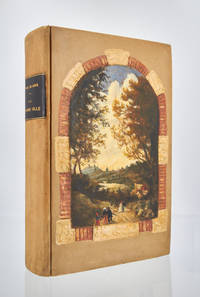
184275626Paris: Au bureau central des publications nouvellesVictor Magen 1842. Fine. Romantic Paris in a painted binding Au bureau central des publications nouvelles Victor Magen Paris 1842 - 1843 16.50 x 26 cm 2 volumes reliés First edition illustrated with wood engravings in the text by Gavarni Daumier D'Aubigny. Bradel binding in full beige percaline smooth spine with a black paper label front cover decorated with an oil painting after the frontispiece signed lower right ""A. Dangleterre d'après document d'époque"". Headcaps and joints skillfully restored. A rare publication on Paris under Louis-Philippe. The work proceeds by subjects and articles: the wet-nurses office flower sellers baths streetlamps pavements theatre outings beards and moustaches the Luxembourg Gardens the Opera Ball the auctioneers hall lorettes and courtesans Alexandre Dumas restaurants and cheap eateries the pawnshop Monographie de la presse parisienne Balzac Jockey Club etc. ""A very important work remarkable for the fine gathering of writers and artists of the Romantic period who contributed to it."" Carteret Le trésor du bibliophile romantique et moderne. Au bureau central des publications nouvellesVictor Magen unknown
183786929Paris: Galerie Vero Dodat 1837. Fine. Galerie Vero Dodat Paris 1837 25.50 x 35.50 cm relié Rare suite of 21 lithographs including the complete set of 18 engravings of the Maris Vengés Avenged Husbands including 3 in double state the second state in colors the third in two states with two different hand-colored printings. In total 8 hand-colored lithographs. To assemble this complete collection of the series the collector naturally took those published only in the periodical Le Charivari nos. 13 14 and 16. All engravings bear the same publisher's address 'Chez Aubert Galerie Vero Dodat'. and are numbered from 1 to 18 except one hand numbered and the last bearing no number. Modern binding lovely imitation of a contemporary binding in half-green cloth the boards of oiled cloth with numerously ruled in blind. Gilt title on spine and upper board. 8 engravings mounted on leaves corresponding to the size of the largest loose engravings. Nos. 1 and 4 show some browning the others quite fresh all on thick paper except for those taken from Le Charivari. A handsome copy. Galerie Vero Dodat hardcover
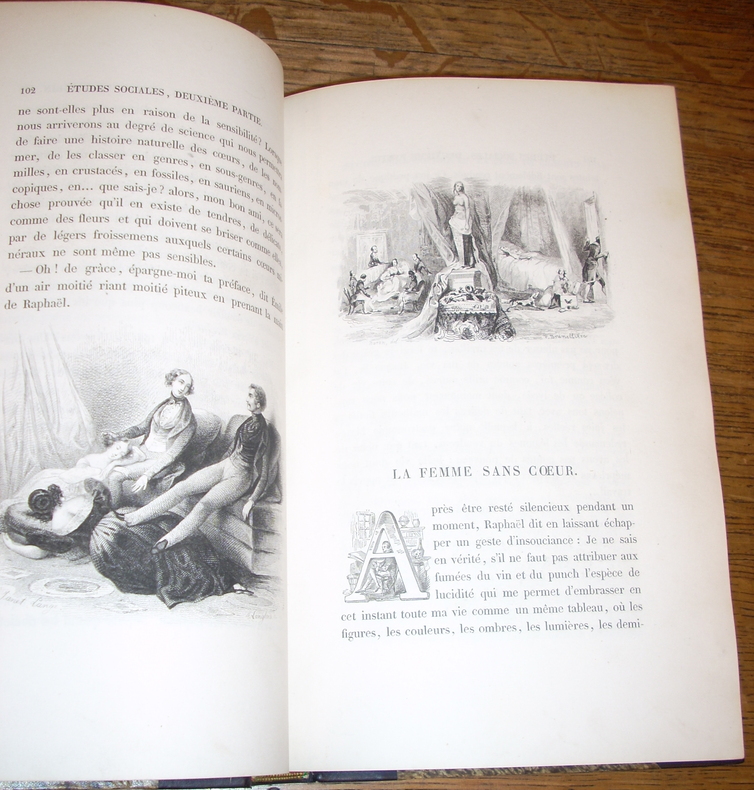
184578015Paris: Hetzel 1845. Fine. Hetzel Paris 1845-1848 17.70 x 26.80 cm 4 volumes reliés First edition and first printing of the engravings. Contributions by Théophile Gautier Laurent-Jan Léon Gozlan Auguste Lireux and Jules Hetzel under the pseudonym P.-J. Stahl among others. Contemporary publisher's binding in full black shagreen. Smooth spine decorated with 3 ornate compartments blind and gilt fillets. Large rocaille composition on boards thick triple fillet frame. Interior frieze. White watered silk endpapers. All edges gilt. Perimeter of watered silk endpapers brown-stained. Tailcap of volume 2 with a loss. Traces of rubbing. Thin scratch on the upper board of volume 1 lower board of volume 2. Some very occasional foxing on clean white paper. The binder inverted volumes 1 and 2 and volumes 3 and 4 the error stemming from the fact that the 4 series are not numbered by volume. Very handsome copy. Work illustrated with a general frontispiece 14 vignettes including one repeated and 320 plates all wood-engraved. References: Vicaire III 953-955; Brivois pp.168-171; Carteret III-260-264: ""Cet ouvrage est fort rare en belle condition."" Remarkable copy of superb freshness in full contemporary Romantic binding. Hetzel hardcover
1838000037Paris H. Delloye, Victor Lecou 1838
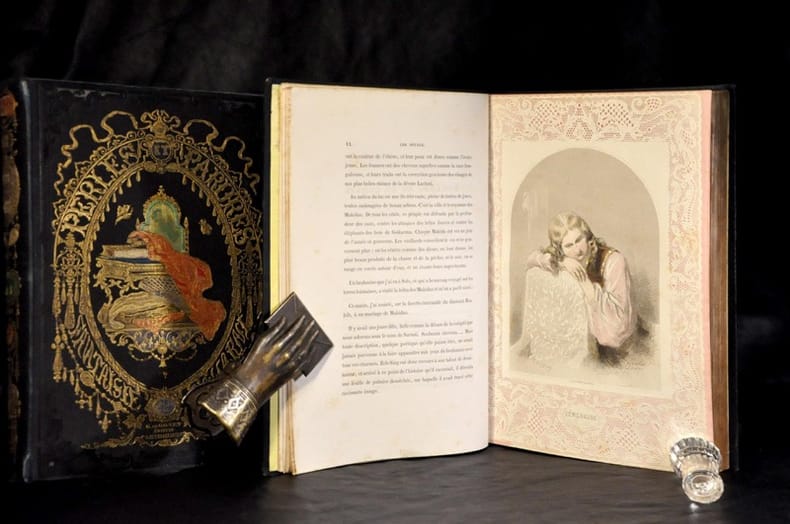
1850WRCLIT46300Paris: G. de Gonet et al.& a Leipzig: Chez Charles Twietmeyer 1850. Two volumes. 4316pp. plus frontis and fifteen plates; 2300pp. plus frontis and fifteen plates. Large octavo 27.5 x 18.7cm. Very handsome 20th century half tan morocco raised bands ruled in blind lettered in gilt and marbled boards t.e.g. others rough-trimmed with the original decorative pictorial rose-on- cream wrappers bound in. Occasional very minor foxing or dust-soiling wrappers a trace soiled with a couple of small edge mends a handful of small creases or snags to the edges of the lace borders see below light rubbing to extremities but a near fine large crisp set. First editions in the most desirable form with the texts printed on vélin and with the frontispieces and plates engraved by Geoffrey after Gavarni delicately hand- colored. The plates are of particular interest because in this format they are printed on sheets with elaborate and delicate stencil-cut lace pattern frames and borders. The plates "are studies of beautiful women fashionably attired for the most part which were drawn in London. Méry wrote the 'fantasy' accompanying them to fit Gavarni's designs.in this special edition.Gavarni's designs become fashion plates of the first order" - Ray. "La réunion des deux ouvrages avec les gravures à marges de dentelles est assez rare à recontrer" - Carteret. RAY FRENCH 209a-210. CARTERET III:460-1. VICAIRE V:770-1. G. de Gonet [et al]...[&] a Leipzig: Chez Charles Twietmeyer hardcover books
06172Paris: Chez Bauger and Chez Aubert 1839. Paris in the Morning" and "Paris at Night"<br /> <br /> GAVARNI pseudonym of Guillaume Sulpice Chevallier. Paris le matin. Paris: Au Bureau du Charivari n.d. 1839. Twelve numbered lithographed plates depicting Parisian life in the morning. Plates printed by Aubert & Cie.<br /> <br /> and<br /> <br /> Paris le soir. Paris: Chez Bauger and Chez Aubert n.d. 1840. Twenty-five numbered lithographed plates depicting Parisian life at night. Plates printed by Aubert & Cie.<br /> <br /> Large quarto 13 3/8 x 10 1/2 inches; 340 x 267 mm. Thirty-seven fine lithographed plates complete. A few plates with light foxing to blank margins.<br /> <br /> Bound by Thierry sc. de Petit-Simier stamp-signed in late nineteenth century quarter red diced calf over marbled boards smooth spine decoratively tooled and lettered in gilt marbled endpapers. Joints expertly repaired. A fine example.<br /> <br /> "In 1837 Gavarni began his connection with Le charivari which did not conclude until 1848. In all he drew 1054 lithographs for his journal.Most of these appeared in series some twenty-five of which extend to ten or more plates and were afterwards published by Aubert in albums. Perhaps the best of these collections are Fourberies de femmes en matière de sentiment Les étudiants de Paris Les débardeurs and Les lorettes; but some of the rest are of hardly inferior interest. Still further series contributed to periodicals other than Le charivari were also issued as albums. Baudelaire had this part of Gavarni's work particularly in mind when he wrote.that 'the true glory and the true mission of Gavarni and Daumier has been to complete Balzac.' Certainly the pictures of Parisian society provided by the two artists perfectly complement each other. Daumier's preoccupation was the working middle class with faces and figures heavily marked by life. Gavarni remained for the most part outside the humdrum bourgeois round. He preferred to show 'youth at the prow and pleasure at the helm.' His pretty girls and sleek young men are bent on enjoyment. They live lives of graceful dissipation" Ray The Art of the French Illustrated Book p. 217.<br /> <br /> Armelhault & Bocher 902-913 & 914-933. Paris: Chez Bauger [and] Chez Aubert, 1839 unknown
185079613Paris: G. de Gonet 1850. Fine. G. de Gonet Paris 1850 S.d 18.80 x 27.80 cm 2 volumes reliés First edition illustrated with a repeated frontispiece and 30 plates by Gavarni engraved on steel by Geoffroy. Printed on fine vellum. Copy from the deluxe issue with plates finely heightened in watercolor; These engravings are presented in very beautiful frames with lace-cut margins. Illustrated orange-tinted covers preserved spine and back covers with advertisements also preserved. Half lemon yellow morocco binding with corners late 19th century. Spine with false raised bands richly decorated with roses in compartments ornamented with stars and other decorations. Red morocco title labels second title labels in soft green shagreen. Some rubbing. Small brown spots on the leather of the upper cover. Uncut copy shorter titles in margins. Some occasional foxing. Handsome copy. Méry's texts are short stories centered around a precious stone or jewel. The engravings illustrate various feminine adornments in the first volume around jewels pearl reliquary pendant rosary sapphire bracelet. in the second volume shawl muff mantilla turban bouquet crown. G. de Gonet hardcover
6080Paris, Hetzel, 1845-1848. 26,8 x 17,7 cm, non paginé. Quatre volumes reliés cartonnages d'éditeur en pleine percaline verte, dos lisse ornés en tête et en queue de figures dorées différentes suivant les volumes, les plats avant et arrière sont ornées de superbes plaques dorées reproduisant des dessins de Gavarni, toutes tranches dorées. reliures légèrement usées, traces de frottements, décharges sur les gardes, frontispice portait de Gavarni avec des rousseurs, sinon bel exemplaire et gravures de toute fraîcheur.Ouvrage illustré d'un frontispice général, de 14 vignettes dont une répétée et 320 planches, l'ensemble gravé sur bois.Édition originale et premier tirage des gravures. Contributions de Théophile Gautier, Laurent-Jan, Léon Gozlan, Auguste Lireux et Jules Hetzel sous le pseudonyme de P.-J. Stahl entre autres.
6080Paris, Hetzel, 1845-1848. 26,8 x 17,7 cm, non paginé. Quatre volumes reliés cartonnages d'éditeur en pleine percaline verte, dos lisse ornés en tête et en queue de figures dorées différentes suivant les volumes, les plats avant et arrière sont ornées de superbes plaques dorées reproduisant des dessins de Gavarni, toutes tranches dorées. reliures légèrement usées, traces de frottements, décharges sur les gardes, frontispice portait de Gavarni avec des rousseurs, sinon bel exemplaire et gravures de toute fraîcheur.Ouvrage illustré d'un frontispice général, de 14 vignettes dont une répétée et 320 planches, l'ensemble gravé sur bois.Édition originale et premier tirage des gravures. Contributions de Théophile Gautier, Laurent-Jan, Léon Gozlan, Auguste Lireux et Jules Hetzel sous le pseudonyme de P.-J. Stahl entre autres.
184275626Au bureau central des publications nouvelles Victor Magen | Paris 1842 - 1843 | 16.50 x 26 cm | 2 volumes reliés
183786929Galerie Vero Dodat | Paris 1837 | 25.50 x 35.50 cm | relié
184578015Hetzel | Paris 1845-1848 | 17.70 x 26.80 cm | 4 volumes reliés
1853IVAllGAV17Paris: Librairie Nouvelle c1853. 1853. folio. modern half pigskin worn joints cracked the lithographs themselves in very good clean condition original illus. wrs. of 6 parts bound in. The Oeuvres Nouvellles was issued in 1853-54 in a series of ten parts of ten lithographs each. This is a grouping of six parts two of which lack one plate each sub-title as given on front wrapper of each part or at head of caption: Les Maris Me Font Toujours Rire 9 plates only numbered from 21-30: lacking no. 22; Histoire De Politiquer 10 plates numbered from 11-20; Piano the sub-title a paste-over in manuscript; 10 plates numbered from 1-10; Bohêmes 10 plates numbered from 11-20; Les Parents Terribles 10 plates numbered from 11-20; Ce Qui Se Fait Dans Les Meilleurs Sociétés the sub-title a printed paste-over numbered from 1-9; lacking no. 10. Each plate has a caption title and heading title Masques Et Visages. Paris: Librairie Nouvelle, [c1853]. unknown