Gill, EricBiblio.com
12 211 résultats
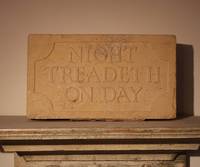
1903487191903. No Binding. Very Good. c. 1903. Ketton Stone. 21.5 x 38 x 9 cm. The most effective way to introduce this remarkably prescient example of "concrete poetry"-now more than a century old-is to draw extensively from some of the catalogue entries referenced below. The words carved here "Night treadeth on day" are taken from William Morris's poem For the Bed at Kelmscott 1891. The poem was embroidered by his daughter May Morris for the bed at Kelmscott Manor the Morris family's country home. This is the third last line in the poem. In 1989 there is the excellent entry by David Cohen in Peter Nahum Gallery's catalogue #4: "This carved inscription considered here was probably made in the first years of the 20th century. It is rare among Gill's inscriptions in that it is carved in relief for his letters are more usually engraved. The letters are not his own designs as far as we know and a few years later in his career Gill would have been too engrossed in commissions for tombstones memorial plaques and ecclesiastical inscriptions to have devoted such effort to a work most likely undertaken for personal pleasure or experiment. For Gill to choose a text by Morris to inscribe was most natural as there was a great affinity between the two men although Morris had died when Gill was still a teenager. Many of Gill's ideas about the evils of industrialism the value of handicraft socialism and medievalism derive closely from Morris. In 1903 Gill paid several visits to the Arts and Crafts Exhibition with which he himself would show from 1906. The Art Workers Guild which he joined in 1905 was deeply influenced by Morris. In later years after his conversion to Catholicism Gill tended to downplay his debt to Morris preferring instead to trace his pedigree to Ruskin.At the time of `Night treadeth on day' however no such theological barrier came between the young Gill and his mentor. This inscription resonates with the romantic fervour of Gill's early attraction to Morris's poetry and politics. Gill was a man for whom the literary and formal aspects of letters were inseparable. It would not be unreasonable perhaps for a contemporary audience familiar with Ian Hamilton Finlay or Tom Phillips to view this Ketton stone carving as an inadvertent precursor of `concrete poetry'. David Cohen August 1989. Peter Nahum Gallery's catalogue #4. Judith Collins notes several observations about the physical characteristics of the relief inscription in entry #102 of the Barbican 1992 Exhibition Catalogue p. 119. The letters are carved in relief standing out from the stone rather than being incised-a technique Eric Gill occasionally preferred between 1903 and 1910. A similar use of relief lettering can be seen in his 1920 Crucifixion panel. Interestingly this particular stone is not included in Evan Gill's Inventory of the Inscriptional Work of Eric Gill 1964 despite its provenance from the artist's own family. The work was exhibited at the following galleries: Anthony D'Offay Gallery London in Eric Gill: Drawings and Carvings A Centenary Exhibition 1982 catalogue no. 53 illustrated on pages 47 and 55; Peter Nahum Gallery London in British Art from the Twentieth Century 1989 catalogue no. 4 illustrated on pages 10-12; and Barbican Art Gallery London in Eric Gill: Sculpture 1992 catalogue no. 102 illustrated on page 119. Provenance: Rene Hague Gill's printer and husband of Joanna Joan Hague the artist's daughter; consigned to Anthony d'Offay Gallery in 1982; then with the Peter Nahum Gallery in 1989; purchased in 1996 from the Peter Nahum Gallery. unknown
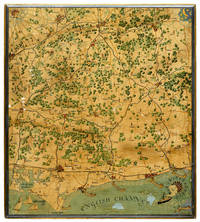
1930NL-02402<p><strong>A rediscovered masterpiece by MacDonald Gill one of the foremost artists of pictorial cartography.</strong></p><p>This remarkable hand-painted panel map is a rediscovered masterpiece by MacDonald "Max" Gill 1884–1947 Britain's preeminent designer of pictorial and architectural maps. Commissioned in 1930 by Edward Hunter the influential head of Sun Engraving the work reflects Gill's signature blend of wit craftsmanship and personalized detail. Only two examples were made; the whereabouts of the second remain uncertain while this one — presumed lost for nearly 60 years — has now resurfaced in private hands.</p><p>Executed with oil paint on a single carved wooden panel the map captures West Sussex and surrounding counties in Gill's playful cartographic language. Coverage extends along the coast of the English Channel between Chichester Harbour near Portsmouth and Shoreham and inland as far as Aldershot and Guildford some 30 miles south of central London. Gill was well-familiar with this area having lived in and around Chichester towards bottom-left here for much of his life. Miniature vignettes of manor houses ships churches and farms accompany towns roads forests railways and landmarks. The piece is richly embellished with a decorative compass rose whose center subtly incorporates the initials "EH" Edward Hunter and opposing sun and moon motifs.</p><p>This panel is more than geographic: it is narrative. Hidden among the place names are personal inscriptions referencing Hunter's family home and legacy. The estate of Mickleham is marked with the initials of Hunter's parents and siblings while two schools — Prior's Field and Bedales — attended by his children are carefully noted. His newly built home "Easeway" in Frensham completed in 1930 is shown with architectural precision and differently colored text further underlining the map's commemorative function.</p><p><strong>Provenance and Parallel Map</strong></p><p>Edward Hunter commissioned two nearly identical panels from Gill in 1930 paying a total of £75 as recorded in Gill's ledger. One hung in his Frensham residence; the other was installed in the home of Prime Minister David Lloyd George in nearby Churt. The George example appeared in a 1938 Country Life article — its presence confirmed by the initials "L.G." and depiction of his Churt estate on the Hunter version. Following Hunter's death in 1965 this map disappeared from public view until its recent rediscovery.</p><p><strong>Significance and Institutional Value</strong></p><p>This map is a masterwork by the most influential British map designer of the English Arts and Crafts movement. It is a historic piece of English cartographic art with documented provenance from the estate of a notable English patron. Original Gill works such as this are extremely scarce and only very occasionally come to market; the last wood panel oil painting map done by Gill came to auction in 2019 and fetched 50000 GBP. Most of Gill's extant originals are held by his descendants or installed as murals and paintings in churches halls and museums.</p><p>Gill's similar cartographic oil paintings on wood include the 1924 'Map of the City of Westminster' held at the City of Westminster Archives Centre the 1930 'Map of the Pytchley Hunt' held at Kelmarsh Hall his undated 'A Map of the Cities of London and Westminster' and 'A Plan of the Houses of Parliament' held in the Parliamentary Art Collection the 1931 'A Map of England Wales and Northern Europe showing all the branches of WH Smith' in private hands the work auctioned in 2019 a 1933 'Map of Worthing' displayed in the Mayor's office in Worthing Town Hall and the undated 'Wind Indicator Map of Holy Island and the Northumberland Coast' installed at the National Trust Lindisfarne Castle.</p><p>This is an extraordinary opportunity to attain a work by one of Britain's greatest cartographic artists of the 20th century.</p><p>Cartographers:</p><p><strong>Leslie MacDonald Gill</strong> October 6 1884 – January 14 1947 professionally known as MacDonald Gill and to friends as 'Max' Gill was an English artist graphic designer architect and cartographer. Born in Brighton Gill's father was a Congregationalist minister who was ordained in the Church of England in 1897 upon which he and the family moved to Chichester before moving again two years later. As a teenager 1901 – 1903 Max was 'articled' interned with an architect in Bognor Regis then spent five years in London working as an assistant for ecclesiastical architects Nicholson & Corlette.</p><p>In 1911 he established an independent architecture firm in London but in fact many of his commissions in the following years were for artistic works including pictorial maps. Both Max and his brother Eric 1882 – 1940 became noted artists of the era with Eric being a leader in the Arts and Crafts Movement who has been dubbed 'the greatest artist-craftsman of the twentieth century' Oxford Dictionary of National Biography. As for Max Gill although he worked in a variety of media he became best known for his rich and stunning pictorial maps including a 1914 map for the London Underground called the 'Wonderground Map' brother Eric had designed the font used in Tube stations signs while Max similarly designed lettering for the Imperial War Graves Commission after World War I.</p><p>Max Gill married Muriel Bennett in 1915 and in 1919 they moved to Chichester. In 1926 they moved to West Wittering in a house Max designed. Gill kept up an impressive output of paintings maps publication cover images furniture graphic design and other works including propaganda works during the Second World War. In recent years his work has been the subject of special exhibitions and retrospectives on both sides of the Atlantic.</p><p>Condition Description</p><p>Paint on wood covered with varnish. Image area and frame are all of a single piece of wood recessed along the 'frame' edge. Areas of surface abrasion where paint and/or varnish have been scraped off. Wear along outside edge/ 'frame'.</p><p>References</p><p>Special thanks to MacDonald Gill expert Caroline Walker for her help in researching this map.</p>
19291071404to. Bristol: Douglas Cleverdon 1929. 4to xii 49 5 pp. With an extra suite of the engravings on Japon wood-engraved self-portrait and 103 plates a few printed in red or red and black additional plates loose as issued in pocket at end. Original de luxe binding of quarter vellum. A very good copy. Bookplate of R.L. Langdon-Down. § Limited to 80 de luxe copies signed by Gill with the extra suite on Japon of all the plates printed from the original blocks from a total edition of 490. The de luxe copy of a scarce title - the first collection of Gill's work including his magnificent illustrations for several Golden Cockerel Press books as well as designs for the St. Dominic's Press and many other ephemeral pieces all printed from the original blocks. Evan Gill 17. Douglas Cleverdon hardcover books
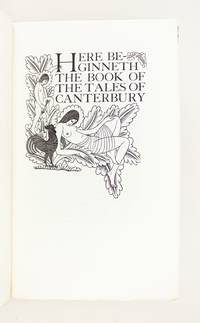
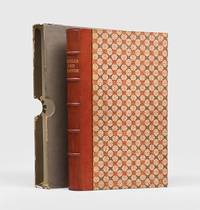
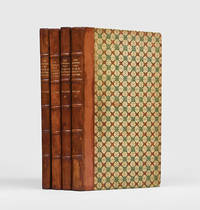
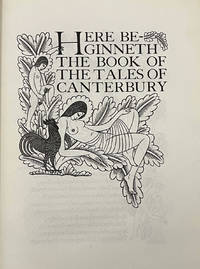
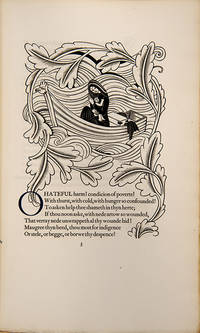
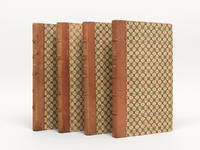
1929ST17611Waltham St. Lawrence: Golden Cockerel Press 1929-31. No. 344 OF 485 COPIES on paper and 15 on vellum. 318 x 197 mm. 12 1/2 x 7 3/4". Four volumes. <br/> Original Niger morocco-backed patterned paper boards by Sangorski & Sutcliffe raised bands gilt titling top edges gilt others untrimmed. The four volumes housed in two burnt orange morocco-backed cloth clamshell boxes with gilt lettering on the backs. Red and blue initials ONE FULL-PAGE AND EIGHT HALF-PAGE WOOD ENGRAVINGS AND 267 VERY PLEASING WOOD-ENGRAVED BORDERS frequently inhabited AND TAILPIECES BY ERIC GILL each border design repeated two to five times so that nearly every page is thus adorned. Chanticleer 63; Gill 281. Spines softly sunned--though uncharacteristically very minor and uniform in the fading; otherwise faultless. AN EXEMPLARY COPY PRISTINE INTERNALLY.<br/> <br/> This is as fine a copy as one could hope to find of one of the best examples in modern fine press work of the successful collaboration of text decoration and typography. With the "Four Gospels" of 1931 and "Troilus and Criseyde" of 1927 it is one of the three greatest Golden Cockerel Press books and according to Cave & Mason its "naughty amusing" engravings make it one of the five "foremost English illustrated books of the 20th century." It was produced at the zenith of the decade-long collaboration between Golden Cockerel Press director and book designer Robert Gibbings 1889-1958 and artist Eric Gill 1882-1940 which in the words of Gill biographer Fiona McCarthy "resulted in some of the classic examples of specialist book production of that period" works that "have a forcefulness and clarity which still excites one." While some squeamish critics deemed Gill's racy engravings inappropriate the bawdy Chaucer would no doubt have been delighted with them and found them most apt. Colin Franklin astutely observed that the "Gill/Gibbings version of 'Canterbury Tales' tackled the problems of illustrating Chaucer IN ALL HIS MOODS. emphasis in original." Cave & Mason report that its publication was "regarded as a literary event" and was widely reported and well received by the press. The book was very profitable grossing some £14000 for the Press. It is to be expected that a major production from a major press like the Golden Cockerel "Tales" would in many cases be very well treated by owners down through the years but copies now are almost never found in the immaculate condition seen here. Golden Cockerel Press unknown
1927180559Waltham St Lawrence: Golden Cockerel Press 1927. A crown jewel of the press First Golden Cockerel Press edition number 129 of 219 copies printed on Kelmscott handmade paper retaining the seldom-seen original slipcase. Loosely inserted is the equally elusive publisher's prospectus for autumn 1926 describing this edition as "a larger and more elaborate volume than has hitherto been attempted." Troilus and Criseyde was one of the first books that Eric Gill illustrated for the Golden Cockerel Press having joined as chief engraver in 1924. Together with The Song of Songs 1925 Canterbury Tales 1925 and The Four Gospels 1931 it is one of "the classic examples of specialist book production of that period. For a while the Golden Cockerel was Eric Gill" MacCarthy p. 187. Gill's artworks "captured the whimsical interplay between words and images displayed in medieval illuminated manuscripts. In Troilus and Cryseide Gill mixed full page illustrations with a combination of black and white lines and a rich assortment of shapes that presented a sense of motion. He created serpentine flora with simple figures to cushion the distinctive text. These border decorations reflect the narrative stanzas in an unassuming manner" Berona p. v. There were also six copies on vellum. Small folio. Woodcut title page 5 full-page woodcut illustrations ornamental borders throughout by Eric Gill. Text printed in black red and blue in Caslon O. F. type. Original quarter niger by Sangorski & Sutcliffe spine with raised bands second compartment lettered in gilt floral patterned paper-covered sides top edge gilt others untrimmed. Housed in the publisher's card slipcase. Publisher's prospectus loosely inserted. Hint of wear to corners otherwise a fine copy in the slipcase a little worn and with short split to one edge. Chanticleer 50; Gill 279. For the prospectus see Cock-A-Hoop P50. David A. Berona Eric Gill's Masterpieces of Wood Engraving: Over 250 Illustrations 213; Fiona MacCarthy Eric Gill 1989. hardcover
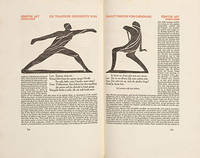
51-6486Weimar: Cranach-Presse für den Insel-Verlag Leipzig und S. Fischer Berlin 1928-1929. Folio 37 x 25 cm. 1 w. Bll. 202 S. Black calf binding with blind-stamped spine title and geometric filet art deco pattern on the front cover. Linen slipcase with black velvet lining. One of 230 numbered copies.OCLC Number / Unique Identifier: 10741559; Rodenberg 493 - Müller-Krumbach 48 - Brinks 76 - Schauer II 74. - Eines von 230 numerierten Exemplaren Druck in Schwarz und Rot auf Maillol-Kesslerschem Bütten GA 255. - Eines der Hauptwerke der Cranach-Presse. "Die Komposition der Seiten mit Textsynopsen in zwei Schriftgrössen Zweifarbendruck und einmontierten Illustrationen in teilweise zweitoniger Drucktechnik beweist ein Höchstmass an Kunstfertigkeit." 100 Jahre Cranach-Presse S. 158. - Sehr schönes Exemplar.One of the Cranach Press's major works. "The composition of the pages with text synopses in two font sizes two-color printing and mounted illustrations in partially two-tone printing techniques demonstrates a high degree of artistry." 100 Years of Cranach Press p. 158. - A very fine copy.Deutsches Buch- und Schriftmuseum der Deutschen Nationalbibliothek Leipzig: The tragic story of Hamlet Prince of DenmarkA masterpiece from the Cranach-Presse printing house 1929: "I believe it the book will become as one says a ‘milestone’ in the history of printing art and everyone who has worked on producing this monumental work can be congratulated.".From a letter written by Edward Johnston to Harry Graf Kessler.Shakespeare’s Hamlet Prince of Denmark printed by Cranach-Presse in Weimar is one of this printing house’s most important works and one of the most important hand-pressed prints in German book art. Harry Graf Kessler was responsible for the type and print of the volume and it was issued by the publishers Insel-Verlag in Leipzig and den S. Fischer Verlag in Berlin. The work was released in 1929 in a translation by Gerhart Hauptmann. The upper case title letters designed in woodcut were produced by graphic designer and typographer Eric Gill 1882-1940. The printed text in red and black is in a font that was designed especially for this work the Hamlet Fraktur which was developed by font artist Edward Johnston 1872-1944. The woodcuts are based on the designs and figurines for stage sets by the director actor and graphic designer Edward Gordon Craig 1872-1966 who used them here for the purposes of book art.Harry Graf Kessler 1868-1937:Diplomat patron of the arts and bibliophile."A book must be like a festival like those of the Greeks or Louis XV light and rich and bright inside and out.":Harry Graf Kessler to Hugo von Hofmannsthal 1905.Diplomat dandy artist sophisticate compulsive diarist alleged illegitimate son of the German Kaiser – Kessler was a dazzling personality in the cultural life of his epoch. He attempted to unite life and art in Germany as William Morris had in England.He conceived the “Großherzog-Wilhelm-Ernst-Ausgabe†Grand Duke Wilhelm Ernst Edition for the Insel publishing house its 1904 debut marking the beginning of Kessler’s collaboration with English book designers. To implement his idea of the book as a gesamtkunstwerk of content typography illustration and materials he established the Cranach-Presse Weimar in 1913. Working with international artists and using specially-designed type paper and woodcuts the press produced artistic book offerings in a European format until 1931. Weimar: Cranach-Presse für den Insel-Verlag, Leipzig und S. Fischer, Berlin, 1928-1929 unknown
1931317876Waltham St. Lawrence: The Golden Cockerel Press 1931. Number 453 of 488 numbered copies printed on Batchelor handmade paper from a total edition of five hundred copies. 64 wood-engraved illustrations and initials printed from the blocks by Eic Gill. 1 vols. Small folio. Three quarter white pigskin and tan polished buckram raised bands t.e.g. by Sangorski & Sutcliffe. Some light soiling and faintest traces of rubbing to spine. Fine copy. Gill Eric. Number 453 of 488 numbered copies printed on Batchelor handmade paper from a total edition of five hundred copies. 64 wood-engraved illustrations and initials printed from the blocks by Eic Gill. 1 vols. Small folio. One of Eric Gill's masterpieces as an illustrator. "Conceived in the fruitful mind of Robert Gibbings this is the Golden Cockerel book usually compared with the Doves BIBLE and the Kelmscott CHAUCER. A flower among the best products of English romantic genius it is also surely thanks to its illustrator . the book among all books in which the Roman type has been best mated with any kind of illustration" Chanticleer. Gill Eric Gill 285; Chanticleer 78; Artist & the Book 122; From Manet to Hockney 89 The Golden Cockerel Press unknown
1931317876n.p. but actually St. Lawrence Waltham: The Golden Cockerel Press 1931. Number 473 of 488 numbered copies printed on Batchelor handmade paper from a total edition of five hundred copies. 64 wood-engraved illustrations and initials printed from the blocks by Eic Gill. 1 vols. Small folio. Three quarter white pigskin and tan polished buckram raised bands t.e.g. by Sangorski & Sutcliffe. Some light soiling and faintest traces of rubbing to spine. Fine copy. Gill Eric. Number 473 of 488 numbered copies printed on Batchelor handmade paper from a total edition of five hundred copies. 64 wood-engraved illustrations and initials printed from the blocks by Eic Gill. 1 vols. Small folio. Gill's Masterpiece. One of Eric Gill's masterpieces as an illustrator. "Conceived in the fruitful mind of Robert Gibbings this is the Golden Cockerel book usually compared with the Doves BIBLE and the Kelmscott CHAUCER. A flower among the best products of English romantic genius it is also surely thanks to its illustrator . the book among all books in which the Roman type has been best mated with any kind of illustration" Chanticleer. Gill Eric Gill 285; Chanticleer 78; Artist & the Book 122; From Manet to Hockney 89 The Golden Cockerel Press unknown books
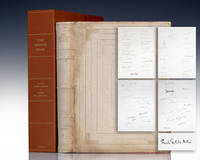
1929149534London: Privately printed by The Curwen Press for H.R.H. The Prince of Wales 1929. First and limited deluxe edition of the monumental Legion Book; one of only one hundred numbered copies printed for private distribution by the Prince of Wales and signed by a remarkable array of British writers and artists as well as four prime ministers. Quarto original publisher's full deluxe pigskin over boards elaborately decorated in blind and gilt top edge gilt tissue-guarded color frontispiece engraved title-page vignette illustrated with 16 captioned tissued-guarded plates in various techniques some signed by the artist and 32 collotypes. One of one hundred numbered copies printed for private distribution by the Prince of Wales and with five pages signed by each of the 89 contributing writers and illustrators as well as four prime ministers three British Prime Ministers: David Lloyd George Stanley Baldwin and Ramsay MacDonald and French Prime Minister Georges Clemenceau including: Winston Churchill who was not yet a Prime Minister Rudyard Kipling P.G. Wodehouse Eric Gill Stanley Spencer Charles Ricketts W. Heath Robinson Laura Knight William Nicholson Paul Nash David Low Rebecca West John Lavery Max Beerbohm Vita Sackville-West Hilaire Belloc Mark Gertler Edith Sitwell Jacob Epstein W.H. Davies and Aldous Huxley among others. This is number 84. The Legion Book was created at the request of H.R.H. The Prince of Wales—who would later become King Edward VIII and following his abdication the Duke of Windsor—as a fundraising initiative for the British Legion. All profits from its sales were intended to support the organization. The book features contributions from 85 distinguished British writers and artists including Winston Churchill Rudyard Kipling P.G. Wodehouse Aldous Huxley Vita Sackville-West G.K. Chesterton Hilaire Belloc Augustus John Eric Kennington and John Nash. It was compiled and edited by James Humphrey Cotton Minchin 1894–1966 a veteran who served with the Cameronians and the Royal Flying Corps during the First World War. While the trade version saw several reprints a special edition of 600 numbered copies was also produced. Of these 500 bore the editor’s signature but “the first 100 were reserved for H.R.H. the Prince of Wales sponsor of the volume in his gift.†According to the note at the conclusion of the Table of Contents “Five pages of contributors’ signatures appear after the Dedication with additional signed pages opposite Collotype No. 3 and Collotype No. 20.†Every contributor signed the book with the sole exception of John Singer Sargent who died in 1925 before the project was completed. In near fine condition with toning to the extremities of the front panel and front hinge. Housed in the original publisher's custom folding cloth clamshell box. An exceptional example of this rare signed limited edition. Formed in the aftermath of a war that had shattered a generation the Royal British Legion emerged in May 1921 as a unified voice for the countless veterans left wounded—physically mentally and economically—by the First World War. The staggering cost of the conflict with nearly 3.2 million British Empire casualties exposed the inadequacy of postwar support. A fully disabled veteran received just 30 shillings a week and any claim had to be made within seven years of discharge. In response to such injustice several ex-servicemen’s groups came together to create the Legion not merely as a charity but as an advocate for those who had borne the brunt of industrialized warfare. From its inception the Legion fought for fair pensions better employment opportunities and meaningful support for both former service members and their families—laying the groundwork for a broader movement of remembrance welfare and national responsibility that continues to this day. Privately printed by The Curwen Press for H.R.H. The Prince of Wales hardcover
19291068034to. Bristol: Douglas Cleverdon 1929. 4to xii 49 5 pp. Frontispiece and 103 plates showing 147 engravings. Original black cloth gilt vignette to upper cover hinges cracked but the covers still firmly attached by the ties. In a new quarter calf folding box. § Limited to 400 copies from a total edition of 490 this copy not numbered. Gill's own copy with his bookplate and filled with corrections and annotations to the List of Engravings plus a marginal note to his Introduction. The Prospectus for this work is loosely inserted with Gill's pencil calculations to the final page as to how much money each variant of the edition will bring in - a total of £3192 plus a press cutting and a couple of other pieces of ephemera inserted as well. The ultimate copy of a scarce title - the first collection of Gill's work including his magnificent illustrations for several Golden Cockerel Press books as well as designs for the St. Dominic's Press and many other ephemeral pieces. Gill's Preface sets out his unique philosophy concluding with two pages of Latin. "Whatever may be said of life it remains that in art desire may be feeble or insufficient but it can never be wrong; it is the intellect that makes mistakes". Next to the sentence "Being a Catholic I naturally accepted the Catholic faith - as one intending to go to Peterborough naturally takes the train there" Gill has written "Why Peterboro' because it was in the train to Peterboro' that this part of this preface was written. EG". The list of engravings has a number of annotations and corrections inserting 6 engravings not mentioned into the list expanding on descriptions and changing some sizes and titles. Evan Gill 17. Douglas Cleverdon hardcover books
1928176203Waltham St Lawrence: Golden Cockerel Press 1928-31. Beautiful Books Limited edition number 135 of 485 copies on handmade paper; a further 15 copies were issued on vellum. The Canterbury Tales was one of the "most important Golden Cockerel editions for which Eric Gill provided the engravings" and showcases his "originality and verve" ODNB. This work was seen as one of the finest books to be produced by the press exhibiting the ideals of the private press movement as if the "author artist and printer have shared one concept and expressed it" Franklin. An announcement of the edition within The Times Literary Supplement on 2 February 1928 noted a publication price of 25 Guineas. It also stated that the vellum copies at 120 Guineas had already been fully subscribed. The publication of the work was a major literary event and was widely covered in the press throughout the four-year publication period. A review within The Times Literary Supplement described the set as "a fine one" and noted that "each page is ornamented at the side with a conventional tree at the top or bottom of which there are usually figures. These figures seems alternately to express an almost frivolous gaiety and a harsh ascetism. Gill portrays these attributes and characteristics of the Middle Ages as if they came down to us from a great distance as pale now romantic shadows of what was once violent and robust. With this mood is at times combined a strain of Post-Impressionism a modern flavour". The review concluded comparing the Golden Cockerel edition to the Kelmscott Chaucer noting that Pre-Raphaelitism was "adaptable to new circumstances". The partners of the Golden Cockerel Press Christopher Sandford Owen Rutter and Anthony Sandford described the set in their bibliography of the press as simply "beautiful books". 4 vols tall octavo. Initials printed in red blue and black. With full-page illustration 29 half-page illustrations decorated borders tailpieces and line fillers all by Gill. Bound for the publishers by Sangorski & Sutcliffe in brown quarter niger spines lettered in gilt patterned paper boards top edge gilt others untrimmed. Some wear to extremities slight colour variance to morocco minor cracking to front joint of vol. 1 minor browning to endpapers as usual: a very good set. Chanticleer 63; Franklin 307; Gill 281. The Times Literary Supplement 2 Feb. 1928 p. 79 & 18 April 1929 p. 310. hardcover
192911973Waltham St Lawrence: printed by Robert and Moira Gibbings at The Golden Cockerel Press 1929<br>. Edited by Walter Skeat M.A. Illustrated by Eric Gill with numerous foliated and peopled borders full- and half-page illustrations and initial letters. Initial letters printed in red and blue. One of 485 copies on paper of a total edition of 500. 4 volumes. Folio bound by Sangorski & Sutcliffe in original niger morocco-backed patterned boards top edges gilt others uncut. Very bright and crisp a little fading and variation in tone of spine between volumes as often slight bumping to corners and rubbing to very edges of boards. The collaboration between Gill and the Gibbings is a rich one. This stands as one of the great works of the Press and of the twentieth century private press movement.<br> A very bright set printed by Robert and Moira Gibbings at The Golden Cockerel Press hardcover
1925140947746Waltham Saint Lawrence in Berkshire: The Golden Cockerel Press 1925. Deluxe Edition. Near Fine. Copy number 24 of the first 30 copies printed on Batchelor handmade papers signed by David Jones; from a limited edition of 450 total. Two volumes; illustrated with 42 woodcuts by David Jones many hand-colored and 27 initials by Eric Gill. Bound in publisher's cream linen cloth with spines lettered in gilt. Near Fine with light edge wear and trace soiling to cloth. Bookplates of former owners at front free pastedowns offsetting at endsheets and light age spotting to preliminaries of Volume II. Light offsetting from plates throughout contents. A beautiful fine press edition of Jonathan Swift's enduring satirical 18th-century novel being the first Golden Cockerel Press book with artist and polymath David Jones' illustrations. The volumes are reproduced from the text of the Henry G. Bohn edition of 1864 under the careful supervision of Robert Gibbings after Hal Taylor's death in 1925. A playful colorful production that charmingly weaves vignettes of the story's protagonist and narrator Gulliver through his several unusual voyages. The Golden Cockerel Press unknown
19151071844to 13 x 10. Ditchling Sussex: Douglas Pepler 1915. 4to 13 x 10.5 inches. Woodcut title-page with triangular device enclosing the letters HDCP EG 1915. Original printed blue paper wrappers slightly soiled and spotted internally perfect. Enclosed in a quarter blue morocco box. § First printing limited edition; this is # 14 of 15 on Japanese paper printed on one side of the leaf only and signed by Eric Gill in pencil. These emblems were engraved for the "Devil's Devices or Control versus Service" a book written by Douglas Pepler HDCP and published at the Hampshire House Workshops Hammersmith London on Saint Thomas' day 1915. Douglas Pepler unknown books
19151071841915. Ditchling Sussex: Douglas Pepler 1915. <br /> <br /> 4to 13 x 10.5 inches. Woodcut title-page with triangular device enclosing the letters HDCP EG 1915. Original printed blue paper wrappers slightly soiled and spotted internally perfect. Enclosed in a quarter blue morocco box.<br /> <br /> § First printing limited edition; this is # 14 of 15 on Japanese paper printed on one side of the leaf only and signed by Eric Gill in pencil. These emblems were engraved for the "Devil's Devices or Control versus Service" a book written by Douglas Pepler HDCP and published at the Hampshire House Workshops Hammersmith London on Saint Thomas' day 1915. unknown
192575578Waltham St. Lawrence:: The Golden Cockerel Press 1925. First edition; No. 18 of 30 copies hand-colored by Eric Gill; signed by Eric Gill and Robert Gibbings. publisher's white cloth in publisher's clear mylar wrapper and a custom slipcase. A beautiful copy. The mylar is a little rippled with a few tiny spots to the rear panel. 4to. See Chanticleer #31. The Golden Cockerel Press, hardcover
109542London The Golden Cockerel Press 1929-31. . Limited edition number 439 of 485 copies on paper from a total edition of 500; 4 vols small folio 31.8 x 20 cm; wood engravings by Eric Gill including one full-page 29 half-page tailpieces initials and decorative borders initials printed in red blue and black; original Niger morocco-backed patterned boards by Sangorski & Sutcliffe gilt lettering to spines top edges gilt others uncut light rubbing to extremities slight toning and soiling to boards some spotting and fading to spines as always; an attractive set.<br /> One of the major titles of the Golden Cockerel Press and an extraordinary collaboration between the press director and book designer Robert Gibbings 1889-1958 and artist Eric Gill 1882-1940. <br /><br />Printing the Canterbury Tales dominated work at the press for two and a half years and relatively few other books were printed during that period. However despite some critics deeming Gill's illustrations risqué and inappropriate the book was a considerable critical and financial success and grossed £14000.<br /> Chanticleer 63; Evan Gill 281. London, The Golden Cockerel Press, 1929-31. hardcover
1929000681<p><strong>One of the most prestigious books published by the Golden Cockerel Press number 80 of a limited edition of 485 copies printed on handmade paper and 15 on vellum. </strong></p><p><strong>Description:</strong> 4 vols. Original quarter niger morocco over patterned papered boards spines with raised bands lettered in gilt bound by Sangorski and Sutcliffe. Quarto: 32 × 20 cm; pp.: vol.i: 4 150 2; vol.ii 4 188 2 vol.iii 4 196 2 vol.iv 2 218 4. With 1 full-page 29 half-page and 269 decorated borders tail-pieces line-fillings and 61 initials engraved on wood by Eric Gill. Printed from 18 pt. Caslon Old Face printed on Batchelor hand-made paper nos. 16–500 in black red and blue. Top edge gilt others trimmed.</p><p><strong>Ref.:</strong> Cave/Manson 63; Chanticleer 63; Gill 281</p><p><strong>Condition:</strong> Binding somewhat bumped and bruised at corners spine occasionally stained as often fore-edges slightly dusty and with single marginal stains interior clean and free of marks.</p><p><strong>Notes:</strong> Eric Gill's woodcuts for the Golden Cockerel Press edition of Geoffrey Chaucer's <em>The Canterbury Tales</em> are celebrated for their artistic and technical mastery. Gill created an impressive array of wood engravings designing them to harmonise with the typography reflecting his expertise as a typeface designer. The engravings complement the text enhancing the reading experience with a seamless blend of visual and literary art rooted in the tradition of illuminated manuscripts. The borders often featuring leaf and stem motifs are inhabited by figures - girls men kings priests and nuns - that interact with or comment on the tales. These range from playful and erotic to solemn mirroring Chaucer's diverse moods and adding narrative depth. Some of the woodcuts are known to have been rather bold in their depictions and have been seen as controversial in their time; however they have since been recognised as being apt and reflective of the spirit of the text. It is therefore fair to conclude that taken as a whole these features make Gill's woodcuts a standout contribution to 20th-century book illustration marrying technical precision with imaginative flair and thus cementing the edition's status as a landmark in private press publishing.</p> Golden Cockerel Press hardcover
19291071401929. Bristol: Douglas Cleverdon 1929. <br /> <br /> 4to xii 49 5 pp. With an extra suite of the engravings on Japon wood-engraved self-portrait and 103 plates a few printed in red or red and black additional plates loose as issued in pocket at end. Original de luxe binding of quarter vellum. A very good copy. Bookplate of R.L. Langdon-Down.<br /> <br /> § Limited to 80 de luxe copies signed by Gill with the extra suite on Japon of all the plates printed from the original blocks from a total edition of 490. The de luxe copy of a scarce title - the first collection of Gill's work including his magnificent illustrations for several Golden Cockerel Press books as well as designs for the St. Dominic's Press and many other ephemeral pieces all printed from the original blocks. Evan Gill 17. unknown
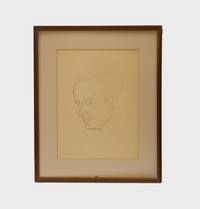
19343757511934. Pencil portrait signed "Eric G" lower right identified and dated lower left. 14 x 10 inches matted. Mounted and framed. Some overall toning. Short closed tear underneath matting which is taped to verso of work. Pencil portrait signed "Eric G" lower right identified and dated lower left. 14 x 10 inches matted. David Pepler 1905-1934 was Eric Gill's son-in-law who married his daughter Betty in 1927 also the son of his partner in the Guild of St. Joseph and St. Dominic Hilary Pepler 1878-1951. Pepler died only a couple of weeks after Gill's return from his transformative trip to Jerusalem and he rode with the body from the hospital in London back to Pigotts. After the mass and requiem Gill spent the morning drawing David's portrait a process he described in his memoirs:<br /> "When the husband of our eldest daughter died she asked me to draw his portrait as he lay in our chapel. For several hours I stood close beside his body looking closely into his face and trying to transcribe his features accurately. That was a revealing experience - before my eyes death took him further from the living world. Even as I watched the bony structure of his face became more sharp and hard; the flesh contracted on his brows and nose and chin. The nobility and patience of his character became more emphatically visible. It was as it were a race between corruption and revelation. On the one hand his spiritual form became more visible as its fleshly shape became more attenuate - on the other the disintegration which death of the body precisely is became more and more woefully and nauseatingly imminent. I was not horrified I was not even astonished; but it was difficult thinking of the lips she had kissed to keep back my tears." Gill Autobiography pp. 237. unknown
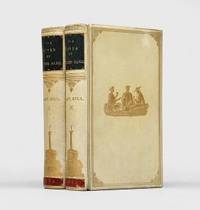
1880157305London: John Murray 1880. Deluxe presentation copy inscribed to the author's sister and ardent supporter Rare publisher's deluxe edition presentation copy of this classic travel narrative touchingly inscribed on the first blank of volume one "Fanny Gill with the best love of her brother William Gill". In 1883 following Gill's premature death in Sinai Frances "Fanny" Gill 1842-1930 was the driving force behind the creation of the RGS's Gill medal and John Murray's publication of a condensed memorial edition of the text. Captain William Gill 1843-1882 who served with the Royal Engineers between 1864 and 1876 was inspired to explore the relatively unknown Chinese hinterland by the earlier travels of Thomas Blakiston and Baron Ferdinand von Richthofen. In July 1876 Gill visited Berlin to consult with von Richthofen about preparations for the journey and then set sail for Asia. After several months spent visiting Peking Shanghai Chengde Jehol and the sea terminus of the Great Wall he began his expedition in 1877 following the Yangtze to the city of Chongqing in the company of Evelyn Colborne Baber. In Sichuan province he ventured into the remote Min mountains - becoming the first European to explore the region - and then undertook a four-month journey westwards with William Mesny to Yunnan and Tibet following the course of the Jinsha "Golden Sand" river the name given to the upper stretches of the Yangtze. "From Tachienlu Dajianlu 8340 feet he ascended to the summit level of the great Tibetan plateau continuing his journey by Litang 18280 feet to Batang 8546 feet in a tributary valley of the Kinsha; and then crossing that river he turned south travelling parallel to the river to Talifu Dalifu the western capital of Yunnan" ODNB. The scientific results from Gill's epic expedition were first made public in 1878 in the Journal of the Royal Geographical Society with Gill awarded the RGS's gold medal the following year and the gold medal of the Paris Geographical Society in 1880. Fittingly Murray's 1883 condensed edition was edited by his fellow traveller Baber by now Chinese Secretary at the British Legation in Peking. While the number of deluxe copies of the first edition is unknown we have traced only one other example which appeared at Sotheby's in 1989 and again in 2014. 2 vols octavo. Engraved frontispieces 2 folding plates including colour illustration not called for after the original brass memorial plaque to Gill Professor Edward Palmer and Lieutenant Harold Charrington installed in the Nelson Chamber in the crypt of St. Paul's Cathedral 8 folding maps linen-backed general map of China showing author's route unfolding to 450 x 452 mm in rear pocket of vol. I engraved vignettes on title pages. With tissue-guarded portrait of Gill after an etching by Theodore Blake Wirgman 1848-1925 sometime extracted from 1883 edition of present work and laid down on vol. I frontispiece verso. Original full vellum black and red spine labels lettered in gilt spines with gilt vignettes of Tibetan monastery and gilt rolls and tools boards with double-ruled gilt frames and gilt corner devices gilt vignettes of two opium smokers and a tea drinker to front covers board edges and turn-ins rolled in gilt combed marbled endpapers edges red. Early 20th-century ownership signature of one J. A. Barnes in both vols. Binding bright with just a little soiling and rubbing internally clean plates and maps well-preserved folding plate in vol. II slightly proud at top edge where sometime carelessly refolded. A handsome near-fine copy. Howgego III Continental G19; Yakushi G57. hardcover
2018__0198428855Oxford University Press 2018. Paperback. New. 27.95x21.26x10.63 inches. Oxford University Press paperback
19586173London: The British Computer Society Ltd 1958. First edition. <p>First edition exceptionally rare separately-paginated offprint inscribed by Gill of "the first paper on parallel programming . Subsequent papers on the subject did not appear for another seven years . A decade later interest in parallel programming had increased dramatically" Dauben. Today "parallel computing has become the dominant paradigm in computer architecture mainly in the form of multi-core processors" Wikipedia.</p>. THE BIRTH OF PARALLEL COMPUTING<br /> EXCEPTIONALLY RARE INSCRIBED OFFPRINT. <p>First edition exceptionally rare separately-paginated offprint inscribed by Gill of "the first paper on parallel programming . Subsequent papers on the subject did not appear for another seven years . A decade later interest in parallel programming had increased dramatically" Dauben p. 361. The origins of parallel programming can be traced to the early 19th century work of Charles Babbage Luigi Menabrea and Ada Lovelace but it was Gill who first formalised the concept on 16 December 1957 in a lecture he delivered to the British Computer Society published as the offered paper. He summarizes the aims of the paper as follows: "By 'parallel programming' is meant the control of two or more operations which are executed virtually simultaneously and each of which entails following a series of instructions. This can be brought about in a single computer either by equipping it with more than one control unit or by allowing time-sharing of one control unit between several activities; the latter case seems of greater practical interest. Some of the advantages to be gained and some of the programming problems to be solved in putting these ideas into practice are discussed." Gill goes on to discuss the meaning problems and potentialities of parallel programming as well as time-sharing and automatic interruption. The paper concludes with comments and questions from the audience in Gill's lecture together with his responses. This prescient article correctly predicted the future importance of parallel computing: "The use of multiple control units within a single machine will enable still higher overall computing speeds to be achieved when the ultimate speed of a single arithmetical unit has been reached" p. 6. In the 1960s and 1970s parallel computing was heavily utilized in industries that relied on large investments for R&D such as aircraft design and defence as well as modelling scientific problems such as meteorology. Parallelism became of central importance in high-performance computing especially with the advent of supercomputers in the late 1960s that employed multiple physical CPUs on nodes with their respective memory networked together in a hybrid-memory model. Today "parallel computing has become the dominant paradigm in computer architecture mainly in the form of multi-core processors" Wikipedia. Multi-core processors are used not only in modern supercomputers but also in desktop PCs for example Intel's Core Duo was the CPU for the first-generation Apple MacBook Pro. Stanley Gill was one of the most important early computer scientists. From 1946-48 he was employed at the National Physical Laboratory on punch card computing and the design of the Pilot ACE a cut down version of Alan Turing's full ACE design and one of the world's first stored-program computers. From 1952 to 1955 he was a Research Fellow at St John's College Cambridge working in a team led by Maurice Wilkes on the EDSAC the first full-size stored-program computer. With Wilkes and David Wheeler Gill co-authored The Preparation of Programs for an Electronic Digital Computer 1951 "the first book on computer programming" Tomash & Williams. We have been unable to locate any other copy of this offprint either in institutional collections or in commerce.</p> <br /> <p>Provenance: Stanley Gill 1926-75 computer pioneer inscribed on front wrapper 'With the author's compliments S. G.'.</p> <br /> <p>"Parallel processing is information processing that uses more than one computer processor simultaneously to perform work on a problem. This should not be confused with multitasking in which many tasks are performed on a single processor by continuously switching between them a common practice on serial machines. Computers that are designed for parallel processing are called parallel processors or parallel machines. Many parallel processors can also be described as supercomputers a more general term applied to the class of computer systems that is most powerful at any given time.</p> <br /> <p>"The need to coordinate the work of the individual processors makes parallel processing more complex than processing with a single processor. The processing resources available must be assigned efficiently and the processors may need to share information as the work progresses. Parallel processors are used for problems that are computationally intensive that is they require a very large number of computations. Parallel processing may be appropriate when the problem is very difficult to solve or when it is important to get the results very quickly.</p> <br /> <p>"Some examples of problems that may require parallel processing are image processing molecular modeling computer animations and simulations and analysis of models to predict climate and economics. Many problems such as weather forecasting can be addressed with increasingly complex models as the computing power is developed to implement them so there is always an incentive to create newer more powerful parallel processors. Although early work in parallel processing focused on complex scientific and engineering applications current uses also include commercial applications such as data mining and risk evaluation in investment portfolios. In some situations the reliability added by additional processors is also important.</p> <br /> <p>"Parallel processors are one of the tools used in high-performance computing a more general term that refers to a group of activities aimed at developing and applying advanced computers and computer networks. In 1991 a U.S. federal program the HPCC High Performance Computing and Communications program was introduced to support the development of supercomputing gigabit networking and computation-intensive science and engineering applications. The HPCC program uses the term 'Grand Challenges' to identify computationally intensive tasks with broad economic and scientific impact that will only be solved with high performance computing technologies.</p> <br /> <p>"As of 2002 most of the world's fastest computers are parallel processors. The number of processors may be from fewer than fifty to many thousands. Companies manufacturing these machines include IBM SGI Cray Hitachi and Fujitsu .</p> <br /> <p>"The two main categories of parallel processor are SIMD and MIMD. In a SIMD Single Instruction Multiple Data machine many processors operate simultaneously carrying out the same operation on many different pieces of data. In a MIMD Multiple Instruction Multiple Data machine the number of processors may be fewer but they are capable of acting independently on different pieces of data .</p> <br /> <p>"Different parallel architectures have varying strengths and weaknesses depending on the task to be performed. SIMD machines usually have a very large number of simple processors. They are suited to tasks that are massively parallel in which there are relatively simple operations to be performed on huge amounts of data. Each data stream is assigned to a different processor and the processors operate in lockstep synchronously each performing the same operation on its data at the same time. Processors communicate to exchange data and results either through a shared memory and shared variables or through messages passed on an interconnection network between processors each of which has its own local memory .</p> <br /> <p>"There is greater variety in the design of MIMD machines which operate asynchronously with each processor under the control of its own program. In general MIMD machines have fewer more powerful processors than SIMD machines. They are divided into two classes: multiprocessors also called tightly coupled machines which have a shared memory and multicomputers or loosely coupled machines which operate with an interconnection network. Although many of the earlier high-performance parallel processors used in government research were very large highly expensive SIMD machines MIMD machines can be built more easily and cheaply often with off-the-shelf components. Many different experimental designs have been created and marketed.</p> <br /> <p>"In a serial algorithm each step in the algorithm is completed before the next is begun. A parallel algorithm is a sequence of instructions for solving a problem that identifies the parts of the process that can be carried out simultaneously. To write a program for a parallel processor the programmer must decide how each sub-task in the algorithm will be assigned to processors and in what order the necessary steps will be performed and at what points communication is necessary. There can be many algorithms for a particular problem so the programmer needs to identify and implement the one best suited for a particular parallel architecture.</p> <br /> <p>"Sometimes 'software inertia' the cost of converting programming applications to parallel form is cited as a barrier to parallel processing. Some systems automatically adapt a serial process for parallel processing but this may not result in the best performance that can be obtained for that problem. In general it is difficult to write parallel programs that achieve the kind of high-speed performance of which parallel processors are theoretically capable. Programming languages have been developed specifically for use on parallel processors to handle parallel data structures and functions scheduling and memory management .</p> <br /> <p>"The speedup that can be obtained on a parallel machine depends on the number of processors available and also on the size of the problem and the way in which it can be broken into parts. Ideally speedup would be linear so that five processors would give a speedup of five or ten processors a speedup of ten. However a number of factors contribute to sub-linear speedup including additional software overhead in the parallel implementation load balancing to prevent idle processors and time spent communicating data between processors. A critical limitation is the amount of parallel activity that the problem allows. Gene Amdahl's Law says that the speedup of a parallel algorithm is limited by the fraction of the problem that must be performed sequentially" Edie Rasmussen .</p> <br /> <p>"The systems with multiple cores and processors were no longer just the domain of supercomputing but rather ubiquitous. The new laptops and even mobile phones contain more than one processing core. The mainstream adoption of parallel computing is a result of the cost of components dropping due to Moore's law that the number of transistors on a microchip doubles every two years though the cost of computers halved . The manufacturers such as Dell and Apple have produced even faster machines for the home market that easily outperform the supercomputers of old that once took a room to house. Devices that contain multiple cores allow us to explore parallel-based programming on a single machine" . </p> <br /> <p>Since the 1990s many neuroscientists have argued that the human brain must function by means of parallel computation. Neurons are much slower than silicon-based components of digital computers. For this reason neurons could not execute serial computation quickly enough to match rapid human performance in perception linguistic comprehension decision-making etc. The only viable solution seems to be to replace serial computation with a "massively parallel" computational architecture in brain simulation models. It follows that artificial intelligence which aims to replicate human intelligence in certain areas will also make use of parallel processing. "There are several aspects of artificial intelligence which suggest that the application of some form of parallel computation and distributed systems might be appropriate" Roosta p. 501.</p> <br /> <p>"Stanley Gill was born 26 March 1926 in Worthing West Sussex England. He was educated at Worthing High School for Boys and was during his schooldays a member of an amateur dramatic society. In 1943 he was awarded a State Scholarship and went to St John's College Cambridge where he read Mathematics/Natural Sciences. He graduated BA in 1947 and MA in 1950. </p> <br /> <p>"Gill worked at the National Physical Laboratory from 1947 to 1950 where he met his wife Audrey Lee whom he married in 1949. From 1952 to 1955 he was a Research Fellow at St John's working in a team led by Maurice Wilkes; the research involved pioneering work with the EDSAC computer in the Cavendish Laboratory. In 1952 he developed a very early computer game. It involved a dot termed a sheep approaching a line in which one of two gates could be opened. The game was controlled via the lightbeam of the EDSAC's paper tape reader. Interrupting it such as by the player placing their hand in it would open the upper gate. Leaving the beam unbroken would result in the lower gate opening.</p> <br /> <p>"He gained a PhD in 1953 and following a year as Visiting Assistant Professor at the University of Illinois Urbana joined the Computer Department at Ferranti Ltd. In the UK in 1963 he was appointed Professor of Automatic Data Processing UMIST Manchester and following various consultancies including International Computers Ltd he was appointed in 1964 to the newly created Chair of Computing Science and Computing Unit at Imperial College University of London. This was later merged into the Imperial College Centre for Computing and Automation of which Gill became director whilst he worked as a consultant to the Ministry of Technology .</p> <br /> <p>"Gill travelled widely and advised on the establishment of departments of computing in several universities around the world. He was also President of the British Computer Society from 1967 to 1968" Wikipedia.</p> <br /> <p>Dauben Abraham Robinson: The Creation of Non-Standard Analysis 1995. Roosta 'Artificial Intelligence and Parallel Processing' pp. 501-534 in: Parallel Processing and Parallel Algorithms 2000.</p> <br/> <br/> 4to 280 x 210 mm pp. 9 3 blank journal pagination 2-10. Original buff printed wrappers very minor creasing. The British Computer Society Ltd unknown
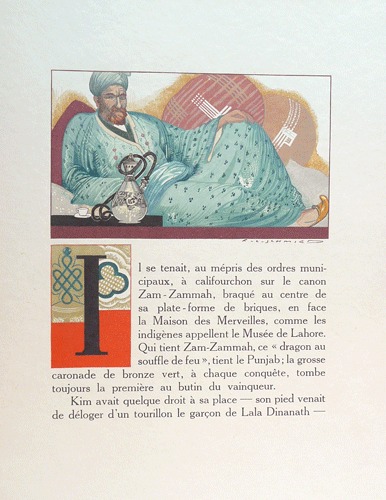
19300028631930 Lausanne, Gonin et Cie, 1930. Trois volumes dont deux grand in-quarto (252 X 314 mm) en feuilles sous couverture blanche illustrée d'un bois gravé en couleurs sur le premier plat, chemise demi-toile grise, vignette de titre au dos, étui de l'éditeur et un volume grand in-quarto de 15 planches sous chemise papier à rabats, chemise demi-toile grise de l'éditeur. Tome I : 267 pages, (1) page, (1) f. blanc, (1) f. de table des illustrations, (2) ff. blancs ; Tome II : 263 pages, (1) page, (1) f. blanc, (2) ff. de table des illustrations et achevé d'imprimer, (1) f. blanc [&] suite de 15 planches. Petit manque de papier sur un plat de la chemise de la suite.
16195791Ditchling: Saint Dominic's Press Ditchling 1916-1923. First Edition. Hardcover. Very good. This is Eric Gill's personal set bound for him as two volumes and with his bookplate in the first book. All thitry-four issues with pagination per the bibliography by Taylor & Sewell pp. 143-44. Complete with wrappers where called for and including the calligraphy item by Edward Johnston in the Christmas 1916 issue. Volumes 1-4 bound in full leather with Gill's bookplate and pencil signature. Volumes 5-7 bound in quarter leather over plain black paper boards. Title page gathering for issue 33 is neatly inserted likely an error at binding. The second book is signed in pencil by Gill and dated 1925 with his note "bound by DA". Books free of markings inside except that Gill has added some changes to his essay "The Control of Industry" in the first issue and a few minor alterations in other issues. All issues complete and untrimmed only minor ordinary wear from being handled by Gill. The plain bindings are secure with spines faded. These were obviously intended to be working books. The Game was the house magazine for one of the great artistic communities of the 20th century. The magazine powerfully expressed the Catholic distributist ideas that were dear to Gill and other Ditchling members. A wonderful and unique set. <br/><br/> Saint Dominic's Press Ditchling hardcover