4 641 résultats
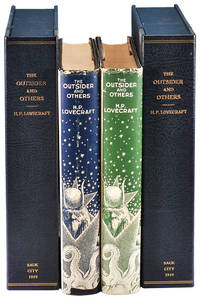
19395219Sauk City WI: Arkham House 1939. First Editions. The first major collection of Lovecraft's weird fiction and the first production by the legendary Arkham House - a landmark in 20th century genre publishing. The 32 stories written for various pulp magazines were gathered and preserved by Lovecraft's friends August Derleth and Donald Wandrei who founded Arkham House in 1939 to preserve and publish the best of Lovecraft's fiction. The stories "range from early exercises in Dunsanian pastiche to the mature and highly distinctive tales of the Cthulhu Mythos which construct a horrific cosmological and historical context for human history. Luckless protagonists who stumble upon various dire intrusions of Cthulhu and his kin or who unwisely pursue dangerous inquiries in the appropriate revelatory tomes are inevitably brought to repulsively stick ends. Lovecraft became the consummate master of the confirmatory ending in which what has been suspected all along finally becomes manifest" Barron Horror Literature: A Reader's Guide 3-132. It took Derleth and Wandrei nearly five years to sell through the modest print run and The Outsider has not been reprinted since. <br /> <br /> Enclosed with the present copies are a five letters written between May 10 1937 - November 26 1939 between the Arkham House principals detailing both the publication history of The Outsider as well revelatory background information concerning the dustjacket design by Virgil Finlay 1914-1971. In his time Finlay was among the most in-demand illustrators of fantasy science fiction and horror literature in the United States and his panoramic composition for The Outsider's dustjacket remains among the best executed and most desirable examples in the genre. According to a letter to Derleth from Adolph J. Hyson of the George Banta Publishing Company proofs for the dustjacket were struck in three colors - black bronze blue and a dark olive green. Both the black and green versions of the dustjacket were vetoed by all involved - the black on account of having "a strangely flat and monotonous effect without depth or life. Second and more important certain of the figures such as the monkey-like and ass-like creatures to the right of the topmost star containing the woman's figure behind the lettering "By" faded away to almost absolute imperceptibility in black but stood out with fairly well defined clarity in the blue" DW to VF Nov.14 1939. The green jacket was dismissed right out and described by Wandrei as being "a peculiarly detestable and odious color." It is not clear how many examples of either the black or green trial state dustjackets survived after being scrapped though all of the predictably few extant examples originated with the personal collection of Donald Wandrei sold close to four decades ago. Joshi 15. First Printings one of 1268 copies. Two octavo volumes 24cm; black cloth with titles stamped in gilt on spines; dustjackets; xiv5535pp. The present offering consists of two unique copies:<br /> <br /> - Copy 1: Trivial wrinkling to cloth at crown else Fine. Dustjacket is unclipped priced $5.00 gently spine-sunned and lightly edgeworn with shallow loss to base of spine and some light dust-soil and waviness to rear panel; Very Good. Inscribed vertically along the left margin of the rear flap by dustjacket designer Virgil Finlay: "This jacket is a photographic composite of early Weird Tales drawings probably only one or two were for HPL stories - I wish I might have found time for more of his work which I did admire / Virgil Finlay." Housed in a custom half-morocco clamshell case. <br /> <br /> - Copy 2: Trivial wear to lower board edges faint dust-soil to upper edge of textblock with mild offsetting and some faint scattered foxing to endpapers; Near Fine. Inscribed by Arkham House co-founder Donald Wandrei on front endpaper: "For Priscilla - and the goon - Donald Wandrei / Christmas 1939." In the apparently unique trial dustjacket printed in green instead of blue with the flaps and rear panel without text; light wear and a few tiny tears to extremities hint of sunning to spine with a faint vertical fold along rear joint and some mild dust-soil to rear panel; holograph printer's measurements in ink across base of spine panel; Very Good. For the sake of completion offered together with a Fine copy of the replica dustjacket produced in the 1970's by specialty publisher and collector Gerry de le Ree from Finlay's original plates. Folded and laid into this copy are examples of the publisher's original prospectus measuring 7.25" x 7.75" as well as an earlier mimeographed announcement letter measuring 8.5" x 11". Housed in a custom half-morocco clamshell case. Arkham House unknown
201351839Halifax NS Canada: NSCAD Press et al 2013. A comprehensive collection of publications and other documents from the Nova Scotia College of Art and Design NSCAD an unexpected yet tremendously important center of conceptual art and postminimalism throughout the 1970s. Beginning as a nondescript art school in 1887 nothing about this small Halifax institution presaged the enormous international influence that the school would exert when Garry Neill Kennedy took over as NSCAD's president in 1967 at age 32. The school's subsequent and unprecedented creative direction must be credited to Kennedy who with a budget of $62000 turned the school away from its previous provincialism toward the influential international posture it would maintain for the next decades. This stature was due in no small part to the faculty and visiting artists that Kennedy brought to the school including Vito Acconci Sol LeWitt Dan Graham Martha Rosler Jenny Holzer Daniel Buren Hans Haacke Yvonne Rainer Robert Frank Robert Morris Dara Birnbaum Seth Seibelaub Lucy Lippard Robert Smithson Gerhard Richter Eric Fischl Lawrence Weiner Joseph Beuys and Claes Oldenburg among many others. The geographical location of NSCAD on the transatlantic route between New York and Europe aided in its access to the international scene. This brought many visiting artists who instead of appearing only for a talk or lecture used the opportunity for longer residencies exhibitions and collaborations with the school. Notably Joseph Beuys's first trip to North America was not to New York but to Halifax as a visiting artist at NSCAD. <br /> <br /> During its heyday between the late '60s and '70s NSCAD's teaching philosophy radically changed. Starting with the removal of a lettered grading system NSCAD became the first degree-granting art school in Canada advocating an intense engagement on all ends of the art-making spectrum between professional and student artists. NSCAD also documented its own significance through the publications of its press as well as the numerous invitations and catalogues produced by its galleries in conjunction with the shows and exhibitions it mounted during this period. This combination of publications exhibitions and collaborations generated by the school in many ways made it a contemporary Black Mountain College - and its subsequent influence has proved no less significant. Indeed in 1973 ART IN AMERICA proclaimed NSCAD "the best art school in North America" and thirty-five years later a major exhibition at the Art Gallery of Nova Scotia and publication by MIT Press wryly celebrated NSCAD as "The Last Art College." <br /> <br /> The NSCAD Press began operations in 1972. Initially led by Kaspar Koenig and then by Benjamin Buchloh the Press published 26 titles between 1982 and 1987 including now rare and important works by Jenny Holzer Steve Reich Michael Snow Donald Judd Dan Graham Martha Rosler Gerhard Richter Carl Andre Lawrence Weiner and others. All are present in this collection - many in their rare hardcover editions. <br /> <br /> The collection also documents two other canonical aspects of NSCAD. The first the "Projects Class" was developed by David Askevold one of Kennedy's new young hires. In the spirit of the school's new direction of dismantling traditional teaching methods the class invited artists to submit proposals for students to undertake under the artists' guidance. A rare complete set of cards documenting the first instantiation of this class from 1969 is present in its original envelope and includes submissions from artists Robert Barry Mel Bochner James Lee Byars Jan Dibbets Dan Graham Douglas Huebler Joseph Kosuth Sol LeWitt Lucy R. Lippard and Robert Smithson among others. <br /> <br /> The collection also includes materials from the Lithography Workshop under the direction of Gerald Ferguson who had insisted on hiring Askevold. The workshop's goal was not only to train students in printmaking but to produce prints for renowned artists both local and international. It allowed a space for NSCAD students to develop alongside professional artists taking their printmaking from initial concept to final execution. The workshop encouraged exploration of mediums and invited not only visual artists but performers writers dancers musicians and other famous and emerging creatives to make one-off projects. More than half a dozen pieces explicitly attributed to the workshop are present including work from Emmett Williams Huebler and Lawrence Weiner. <br /> <br /> But perhaps the most significant components of this collection are the ephemeral documents invitations flyers postcards posters catalogues produced by NSCAD's legendary Mezzanine Gallery which operated between 1970 and 1973 under the directorship of Charlotte Towsend-Gault. This remarkable program produced ground-breaking contemporary art projects exhibitions events and residencies by such artists as Bas Jan Ader Dan Graham John Baldessari "I Will Not Make Any More Boring Art" Tony Shafrazi Eleanor Antin Charlotte Moorman Sol LeWitt Martha Rosler Donald Judd On Kawara Martha Wilson and many others. These are almost to an item uncommon with most scarce and many quite rare. As a group the roughly 90 Mezzanine Gallery items included here would be virtually impossible to reassemble now. In 2006 Printed Matter NYC presented an exhibition of this material under the curatorship of AA Bronson. The present collection includes not only all of the material shown in that exhibition but other documents acquired subsequent to it. <br /> <br /> The collection also includes later ancillary and reference materials. Taken as a whole it documents all aspects of the most critical years at a key institution that served as both incubator and promoter for some of the most important and influential art in the second half of the 20th century. Some 155 items in all. Generally very good or better overall with most of the ephemera near fine or better. All carefully and neatly housed in a series of archival enclosures. A complete inventory is available. (NSCAD Press, et al) hardcover
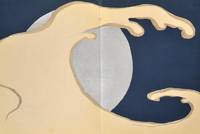
1909908701909. DESIGN Kamisaka SEKKA artist. MOMOYOGUSA. Kyoto: Unsodo Meiji 42-43 1909-10. 3 volumes. 30.1 X 22.5 cm. Most consider it the finest Japanese design book of all time this exquisite suite of 60 double-page color-printed woodblocks is printed and overprinted using opaque and metallic inks to produce a sumptuous surface. This is an early impression with woodgrain showing in a few prints. The condition is internally superb with almost none of the gutter fading and metallic ink transfer common to this work. One of the finest printings we have seen. Volume one has been meticulously restored. Some paper fill-in and other work has been so successfully accomplished as to be unnoticeable. Some paper overlay is chipped away on the front covers of volumes one and three though they retain the original printed titles and the paper overlay on the back of one volume is restores/replaced. A complete copy of this cornerstone of any Japanese design collection. unknown
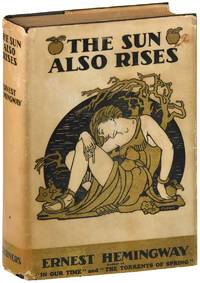
19267284New York: Charles Scribner's Sons 1926. Hemingway's first novel synonymous with the Lost Generation in which "the post-war disillusion and the post-war liberation are united in the physical enjoyment of living and the pains of love" Connolly p.53. The novel portrays a group of English and American expatriates frequenting the cafés of Paris who travel along the Camino de Santiago to the Fiesta de San Fermín in Pamplona where they watch the running of the bulls. Basis for Henry King's 1957 film adaptation starring Tyrone Power and Ava Gardner. Uncommon in dustjacket. Grissom A.6.1b. Hanneman 6A; Connolly 100. Second printing one of 1970 copies with the typographical error on p.181 line 26 "stoppped" for "stopped" in the corrected state. Octavo 19.75cm; black cloth with printed gold paper title labels mounted to spine and front cover; dustjacket; viii23-2591pp. Early ownership markings to front endpaper mild softening to spine ends gentle sunning to spine with some trivial dust-soil to upper edge of textblock and some darkening and pinpoint wear to title labels; contents clean; Very Good. In the correct second state dustjacket unclipped priced $2.00 with the typographical error in "In Our Times" in the corrected state along the lower front panel; spine and panels gently sunned and lighty dust-soiled some moderate external wear with a few small nicks and closed tears particularly at base of spine and a few faint scattered stains; still a presentable example unrestored Very Good or better. Housed in a custom clamshell case. Charles Scribner's Sons unknown
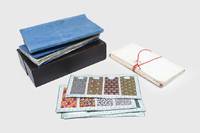
1820181123Likely Norwich: c.1820s. An eye-catching and infectious spectacle A prepossessing collection of textile swatches for clothing or furnishing likely produced in Norwich for selling to the German market. Using the whole spectrum of colours the designs incorporate stripes geometric shapes diaper patterns zigzags and chevrons floral and foliate motifs and ikat designs. The samples are arranged by pattern under titles in German and at times French and Italian. These include for example Weisbodige Croisé white strips and colour chevron-pattern stripes Rothbodige Köper thick red stripes alternating with those of other colours and Cuttni multicolour swatches with fine diaper or lozenge patterning. The samples are woven from wool a factor - together with their design - that points to their origin in Norfolk. "The presentation of choice in the books of samples from Norwich is literally fascinating with some pages so stunning and dazzling in their effect and we might argue that it could be the effect of the whole page that seduces the buyer rather than the individual sample. The almost infinite variations of colour and pattern accentuated in their intensity in the context of a book or card create an eye-catching and infectious spectacle" Mitchell. Accompanying these books are two other unrelated sets of several dozen samples both dating from later in the 19th century and at least one from France. Provenance: Cora Ginsburg 1910-2002 the expert in fine textiles purchased by her in England in 1962 - Stephen C. Massey. 2 vols tall octavo 260 x 150 mm. With 1063 unique samples of varying sizes mounted on rectos of 125 leaves printed in ornamental blue 2 folding at fore edge manuscript titles and numbers direct to leaves or on labels. Contemporary blue paper wrappers manuscript number or label on inner front covers. Housed in 19th-century calf pull-off box green lining and gilt decoration. Within custom blue cloth box with red label by James Brockman. Samples fine and bright wrappers creased pull-off box worn: a well-preserved collection. Victoria Mitchell "A Marketplace in Miniature: Norwich Pattern Books as Cultural Agency." hardcover
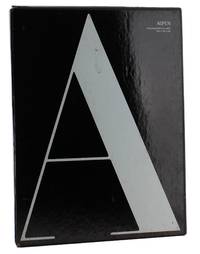
2615New York: Aspen 1971. Box enclosures vary in condition from fair---for issues #s 7 & 10----to very good with most being in good or better condition. Contents are all in very good or better condition unless otherwise noted in catalog entry. Issue #6a not photographed for lack of enclosure---or any other contents---can be photographed upon requests. Aspen was conceived by perennial editor and publisher Phyllis Johnson as a challenge to traditional magazine design offering a multimedia landscape in each issue with sections that were individuated and independent necessitating interaction that was often sensory and unbound featuring records 3-d models sewing patterns postcards a flip book and even ads were segregated to defy convention. In each issue the contents and enclosures were designated as ‘sections’ and labeled as such with issue-specific numbers which have been herein assigned with corresponding numerical bullets and entries for each issue where section assignments are absent. <br /> <br /> Each issue’s sections were housed in a section-numbered box which varied in size and design throughout the publication’s run 1965-1971. All 10 issues are thematically independent and by design they all featured a different set of editors. <br /> <br /> Only six sections missing from the entirety of those composing issues No. 1 - 10. These include the Something Else Press newsletter from Aspen No. 4; the illustrated content-enclosing envelope from Aspen No. 6a which is commonly missing; subscription forms from Aspen Nos. 7 8 & 9; and the to-date unknown section #13 from Aspen No. 10. All sections in very good condition unless otherwise noted. <br /> <br /> Issue #3 has signatures. The most prominent being the vertical signature by Warhol to upper fore edge of enclosure cover. Contents of Issue #3 including the James Rosenquist pop art post card is inscribed to Ted Joans and the Jasper Johns piece Black Map is also signed. <br /> <br /> All 10 issues have been fully cataloged please e-mail if interested in the 10-page entry which provides details for each issue and a complete inventory of their contents plus more detailed condition points. Aspen unknown
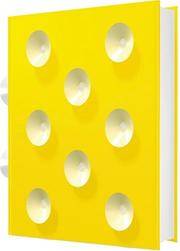
2003023864D&AD British Design & Art Direction 2003. Hardcover. Near Fine. A very unusual design - large plastic-covered book with 8 suckers to both the front and back covers and 2 suckers to the spine. The book is in excellent condition and comes in a polystyrene case which unfortunately has some damage. Photos available on request. Next day dispatch by Royal Mail in sturdy recyclable packaging. 1000's of satisfied customers! Please contact us with any enquiries. HEAVY ITEM - UK DELIVERY ONLY <br/> <br/> D&AD (British Design & Art Direction) hardcover
1903911311903. DESIGN UNSODO 芸艸堂 Publisher. BIJUTSUKAI 美術海. Kyoto Unsodo 24.0 x 16.3 cm 61 numbers of the 70 numbers printed in the BIJUTSUKAI design series Numbers 1 thru 61 Originally issued in 70 volumes in the early 1900s. Number one was published on January 1st Meiji 36 1903 Number 61 in 1905. Over 1200 color woodblock printed designs. A remarkable achievement by most of the important designers of the day. Bijutsukai printing is always good the early printings here are extraordinary In very good condition though number one is a bit tired. Enclosed in an old clasped chitsu case. There is quite a bit of confusion about this series BIJUTSUKAI and the SHIN-BIJUTSUKAI series which followed it. They are two different sets of design. The BIJUTSUKAI was printed under the general rubric of Shinbijutsukai but they are two different works pubished with two different series titles and numbering. Early printings of the BIJUTSUKAI have become unusual such a long run of the individual issues unheard of. unknown
1932058083London Uk: Emery Walker Wilfrid Merton And Bruce Rogers 1932. First Edition Thus . Hardcover. Near Fine. One Of The Most Famously Well Produced Books Of The 20Th Century. Unpaginated One Of 530 Copies Only. Bound In Full Black Niger Morocco With Top Edges Gilts And Gilt Spine Lettering Deckled Edges. Printed On Special Paper Made By J. Barcham Greem & Son In 16-Point Monotype Centaur. There Are 26 Decorations Of Homeric Figures From Greek Vase-Paintings That Are Printed In Black On Roundels Of Gold Leaf That At The Head Of Each Book And On The Title Page. Several Of The Original Loose Tissue Guards Are Present. Lacking The Slipcase. Slight Usage To Covers. Endpapers Darkened In Half-Inch Strips Along Edges From Turns As Usual. <br/> <br/> Emery Walker, Wilfrid Merton And Bruce Rogers hardcover
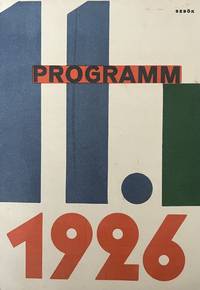
19263163Dresden 1926. Mint condition. Fold out. Stefan Sebok was a Hungarian-born architect who worked with Walter Gropius in Dessau and Berlin in the late 1920s and then with fellow Hungarian emigré László Moholy-Nagy on his famous Light Prop and later moved to the Soviet Union to work with the constructivist architects Moisei Ginzbrug El Lissitzky and the Vesnin brothers. In between he carried out numerous projects of his own and found himself central to a key generation of emerging modern architects in Dresden Berlin and Moscow. Life and work<br /> He was accepted in Dresden in 1921 at the Hochbau Architecture faculty at the Sächsiche Technische Hochschule opting for the science oriented course but chose art for his optional subject. The university records show him as a highly achieving student and he was given the opportunity to do a research project on Viennese Baroque which he presented in 1925 as an illustrated public lecture at the Dresden Kupferstichkabinett.<br /> <br /> In 1926 he submitted his Diploma work a project for the design of the Tanztheater Dresden probably inspired by the presence of the famous dancer Gret Palucca in Dresden at the time. The work had many innovative features aiming to minimise the interface between stage and spectators.<br /> He received his diploma Dip. Ing. Arch. in March 1927. Although he already had a firm position offered by Erich Mendelsohn at the time he decided to join Walter Gropius in Dessau. The main attraction for Sebök was the recently commissioned revolutionary theatre by Erwin Piscator. Although the theatre did not materialise at the time the concept of the possible use of films the stage and roof design was reworked by Sebök in several drawings over the years and it found its continuation also in a plan worked out by Gropius and Sebök in 1930 for a theatre for Kharkov for mass performances for which many of Sebök’s annotated preliminary sketches have survived.<br /> In 1928 Sebök briefly returned to Dresden probably to re-work his Tanztheater for the Internationales Problem Theater. From 1928 till 1931 Sebök rejoined Gropius in Berlin participating in numerous projects. Sebök also collaborated closely with László Moholy-Nagy on the Kinetisch-konstruktives System Kinetic Constructive System and the Light space modulator. The collages for these are marked durchconstruirt constructed by Sebök and the technical drawings for the latter bear his signature. During 1929 he was also involved with Moholy-Nagy in various stage designs for Erwin Piscator. unknown
11222Santa Monica & Minneapolis: Danger! Books & Indulgence Press 2004. Deluxe/Limited Editions. Various. Fine. Deluxe/Limited Editions. Various. Moody's short story Surplus Value Books #13 is a comic parody of a bookseller's modern rare book catalogue. The story unfolds as the galley proofs of the involved book catalogue where the prices accorded the items for sale are contrasted with the personal and idiosyncratic values assigned to them by the bookseller.<br /> <br /> "This intricate collaboration is an expanded treatment of a text originally published by Rick Moody and David Ford as an artist's book in 1999. Taking the form of a bookseller's catalogue Moody's novella which is also reprinted in his 2000 collection Demonology lays bare the fragile psyche of its narrator whose fractured and overwrought book descriptions often veer into personal territory returning particularly to his obsession with a college classmate Anna Feldman.<br /> <br /> The deluxe edition includes corrected page proofs of the text complete with "hand corrections" by the author reproduced typographically by Wilbur "Chip" Schilling and sections that appear to have been manually "whited out." Each item in the portfolio supports the text of the story-from the straightjacket that holds the book and the narrator's "release papers" from a private mental hospital to the a collection of objects that relate directly to the entries including a Star Wars action figure Scrabble tiles and a baseball card.<br /> <br /> The text is aptly described by Hadley-based bookseller Ken Lopez: "Moody has created a hilarious and touching self-contained world where the values accorded to the items for sale dollars and the values inherent in them significance artistry passion are in running comic contrast." Exhibition statement Smith College<br /> <br /> The overall design and printing was undertaken by Wilbur "Chip" Schilling Daniel Kelm and David Ford Kelm with assistance from "other mechanics" at the Wide Awake Garage. In creating the OCD-adjacent box Kelm created a void filled with a blank because "any obsessive would want to have the regular edition too." He then noted laughing that would leave no place for the blank and wondered what would be done with that. While not called for a standard issue of the limited first edition one of 700 copies is included. Tight bright and unmarred. Folio resin coated cloth box mixed media including vinyl plastic cloth metal paper wood leather etc. fo 49x23x10cm. Numbered limited editions. Danger! Books & Indulgence Press unknown
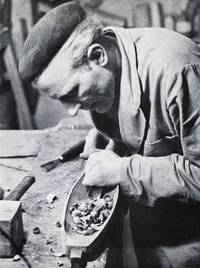
196548080Arnsberg and Dortmund Germany: Arbeitsgemeinschaft Gestaltendes Handwerk 1965. First edition. Hardcover. Near fine condition. Duodecimo 6 1/8 x 8 1/2". Unpaginated app. 100 leaves each three volumes. Original screw-bolted brown cloth with gray lettering on spines. Text printed to handmade paper in variant colors: black brown gray blue cream yellow green burnt Sienna and umbra photographs printed to glossy white paper. With lists of full and associate members of the workshop at front printed in white on black paper.<br /> <br /> Complete catalog of "Werkstattporträt Workshop Portrait" in three volumes a joint venture of the Project Group Creative Crafts for the Districts of Arnsberg and Dortmund Germany from 1961 to 1965. Participants of this project included craftsmen and women from the fields of pottery weaving embroidery bookbinding lathe work carpentry photography painting and sculpting. An extraordinary project presenting a state-of-the-art view of craftsmanship and art in Eastern Westfalia in the 1960s illustrated with 309 b/w photographs.<br /> <br /> Albert Renger-Patzsch participated in this project not only as a photographer see portrait 10 but provided one-hundred and forty-five of the three hundred and eleven photographs of works of other participants including portrait photographs for the catalogs "Werkstattportrait." Renger-Patzsch had worked as press photographer for the Chicago Tribune before publishing his title 'Crassula" with the Auriga-Verlag in the series 'Die Welt der Planze' in 1924. He had his first museum exhibition in 1927. His second book "Die Welt ist schön" became his best-known publication. During the 1930s he remained in Germany and made photographs for the German industy and in advertising. His archive was destroyed during W.W.II. In 1944 he moved to Wamel North Rhine-Westfalia and lived there for the rest of his life.<br /> <br /> The catalog is structured in twenty-nine chapters 0-271 introducing artists and craftsmen and women including one introductory chapter with eight photographs and a final chapter with six photographs. The object of the project was to further the exchange of knowledge and experience collaboration in research shared leisure time and visits of the workshops and studios of participants. Regional and national exhibitions and publications were arranged to help find buyers for the created work. The introductory chapter includes lists of full members and associate members.<br /> <br /> Each of the twenty-seven workshop portraits includes an introductory leaf for the respective participant describing the workshop or studio and the career including particulars about the techniques and material used by the artist with captions on the objects captured in eight b/w offset reproductions of photographs by Albert Renger-Patzsch and others on verso. Each set of photographs includes a portrait of the respective artist. Following each set of photographs a page with contact information of the artist and photo-credits for the work displayed.<br /> <br /> The final chapter is entitled "Workshop Portrait." It includes a brief description of the workshop taking place from April 1961 to December 1965 six b/w photographs of workshop exhibits and a list of all participants with contact information. The last page of this chapter an address by Walter Römhildt states the conclusion of this project and announces the continuation of publications of the series "werkstattforum" at his new office the "Beratungsstelle für Handwerksform bei der Handwerkskammer Hannover." Participants of the project "werkstattportait" will automatically receive those publications. <br /> <br /> Content with participating artists:<br /> <br /> portrait 0: Introduction of the project with photos by Renger-Patzsch 9 <br /> portrait 1: Hildegard Bäumer weaver Siegen photos by Renger-Patzsch 6 and Foto-Besser Siegen 3<br /> portrait 2: Ignatius Geitel Glass painter Bochum with Klischees by Titze & Lorenz Gelsenkirchen 9<br /> portrait 3: Karl Josef Hoffmann sculptor Attendorn with photos by Renger-Patzsch 9<br /> portrait 4: Anneliese Kretschmer photographer Dortmund photos by Anneliese Kretschmer 9<br /> portrait 5: Udo Dickerhoff carpenter Bochum photos by Renger-Patzsch 8 Sabine Renger 1 and Christian Bathe Münster 1; with two transparencies.<br /> portrait 6: Ingeborg and Bruno Asshoff potters Bochum photos by Renger-Patzsch 10 Dagmar Korn Düsseldorf 2 and Helmut Hering Dortmund 2<br /> portrait 7: Martha Wurm embroider Wattenscheid photos by Photo-Soeding J. Müller Soest 11<br /> portrait 8: Otto Pickhan turner Mollseifen photos by Renger-Patzsch 9<br /> portrait 9: Irmgard Timmermann weaver Soest photos by Photo-Soeding J. Müller Soest 9 H. Musmann Lage 1 and Renger-Patzsch 1<br /> portrait 10: Albert Renger-Patzsch photographer Wamel photos by Sabine Renger Wamel 1 Renger-Patzsch 11 Klischees by Titze & Lorenz Gelsenkirchen; <br /> portrait 11: Andrea Böhm picture weaver Lüdenscheid w/o photo-credits 10<br /> portrait 12: Päule Jelich goldsmith Iserlohn photos by Schmidt Lueg Iserlohn 11 and Foto Melchers Herne 1 <br /> portrait 13: Wolfgang Kruse turner Hamm photos by Schmidt Lueg Iserlohn 10<br /> portrait 14: Wolfgang Kreutter sculptor Dödesberg photos by Bert Brösel Siegen 1 Heidersberger Wolfsburg 2 Schmidt Lueg Iserlohn 9 <br /> portrait 15: Marianne Proll bookbinder Hagen photos by A. Bach Hagen 6 Renger-Patzsch 8 <br /> portrait 16: Heinz Abendroth metal smith Dortmund photos by Rolf Schmieding Dortmund 9 Dinstühler Dortmund 1; <br /> portrait 17: Liesel Bellmann sculptor Dortmund photos by Gerd Schlitzer Dortmund 4 W. von Frankenberg Dortmund 1 Rolf Schmieding Dortmund 3 and Heller Telgte 1 w/o credit 3<br /> portrait 18: Karl Jlling metal smith Mallar photos by Renger-Patzsch 10 <br /> portrait 19:Dieter Pieper goldsmithLüdenscheid photos by Werkstätten Carl Golderer Pforzheim 24 <br /> portrait 20: Marieluise Quade painter and graphic designer Lüdenscheid photos by Carl Huth Lüdenscheid 2 w/o credits 7<br /> portrait 21: Waldemar Wien sculptor Kierape 1 photos by Renger-Patzsch 13<br /> portrait 22: Christel Humpert potter Bochum photos by Renger-Patzsch10<br /> portrait 23: W. K. A. Weisheit carpenter Plettenberg-Oesterau photos by Renger-Patzsch 9<br /> portrait 24: Günter Hülshoff potter Rosemarie Hülshoff batik both Wangern photos by Renger-Patzsch 14<br /> portrait 25: Josef Severin metal smith Anröchte/Krs. Lippstadt photos by Renger-Patzsch 6 and Sabine Renger 4 <br /> portrait 26: Gisela Lohse weaver Hagen photos by Renger-Patzsch 11 <br /> portrait 27: Johannes Scharfenstein carpenter Meschede photos by Renger-Patzsch 10 and Foto-Zwietasch Kornwestheim 1<br /> "werkstattportrait" with Klischees by Tietze & Lorenz Gelsenkirchen 6<br /> <br /> Text in German. Minor wear overall with some red underlining of text in Römhildt address on last page. Translation of werkstattportrait 10: <br /> <br /> "Albert Renger-Patzsch born on June 22m 1897 graduated at the Humanistic Gymnasium studied chemistry until the preliminary examination after that he became the head of the photography department of the Folkwang Publisher in Hagen and Darmstadt. Since 1925 independent photographer in Bad Harzburg; first exhibition at Kestner-Gesellschaft in Hannover in 1925; first publication: "Die Halligen" in 1927 worked from 1929–1944 in Essen after that in Wamel near Soest. Following his title "Die Welt ist schön" he published monographs of cities and architecture books on marked-off landscapes and other topics. Renger=Patzsch works are in the collections of the MOMA New York the Eastman House in Rochester the Gernsheim Collection in London the Copper-Engraving Collection of the National Library in Paris and the Photo-Museum in Dresden. He was awarded the David Octavius Hill Medal of the G.D.L. in 1957 the Culture-Award of the German Society for Photography Cologne in 1960 and the Golden Society Medal of the Vienna Photographic Society in 1961. Renger-Patzsch is seen as the father of "Neue Sachlichkeit" in photography. In his book "Die Welt ist schön" he introduces a program with the goal to deter photography from engaging in a race with painting and reflect on its own medium. His notion that photography based on its mechanical structure is better suited to do justice to an object portrait it as an artistic individual pertains to large fields of photography today. Arbeitsgemeinschaft Gestaltendes Handwerk hardcover
1920140553Munich: Dreilander Verlag 1920. Collection of 38 issues of the landmark Weimar-era periodical highlighting fantasy horror and early science fiction stories. Text in German. <br /> <br /> One of the world's first fantasy periodicals alongside the Swedish "Hugin" "Der Orchideengarten" featured a mix of new German stories alongside translations of foreign literature largely French including works by Victor Hugo Guy de Maupassant Voltaire Charles Dickens Edgar Allan Poe Joseph Capek H.G. Wells and many others. The magazine also made forays into the proto-science fiction genre as seen in Vol. 2 No. 4 entitled "Phantastik der Technik." <br /> <br /> A true product of the Weimar era's cultural blossoming the magazine also features stunning illustrations both with its two- and three-color cover art and its woodcut reproductions throughout: sinister yet elegant visions of anthropomorphic flowers religious idols Grim Reapers and gory deaths. "Der Orchideengarten" featured the work of Gustave Dore Otto Linnekogel Karl Ritter Alfred Kubim Carl Rabus Otto Nuckel and many more. <br /> <br /> This archive contains the following largely sequential issues: Vol.1 Nos.1-18 16 and 17 published as a combined issue; Vol.2 Nos.1-6 8 10-16 18-24. <br /> <br /> 9 x 12 inches saddle stapled. Very Good to Near Fine condition. In a custom quarter leather clamshell box. Dreilander Verlag unknown
1909912721909. DESIGN Kamisaka SEKKA artist. MOMOYOGUSA. Kyoto: Unsodo Meiji 42 1909. Volume one of three. 30.1 X 22.5 cm. Most consider it the finest Japanese design book of all time this exquisite suite of double-page color-printed woodblocks is printed and overprinted using opaque and metallic inks to produce a sumptuous surface. This is an early impression. The condition is internally quite good with almost none of the gutter fading and metallic ink transfer common to this work. One of the better printings we have seen. Complete as issued with all 20 prints from volume one included. Has the original printed title label The mica patterning from the front cover is gone. unknown
195562463New York NY Kansas City MO & Carmel Santa Barbara & San Francisco CA: Marian Ross Mizelle Madrigal 1955-1974. Four Vols. and original Store Sign for Carmel CA boutique. Folio. 2 - 12 x 15.25 in. & 2 - 13 x 19 in. 48; 48; 48; 48 pp unpaginated. all w/ mylar sleeves archival black paper insert backings with 151 original designs in gouache watercolour chalk and pen & ink 38 in pen & ink or pencil sized from 7 x 11 in. up to 10 x 15 in. and nearly all signed by Marian Ross three feature original fabric sample swatches affixed to them including one w/ pencil MS “Winner†and mimeographed description affixed to verso several of them are translucent pochoir stapled to backing paper many are on thick stiff studio board while others on assorted textured paper stock. In addition there are three newspaper and magazine clippings 1966 & 2013 a photostat copy of early Ross Mizelle “Mod†fashion designs and original black & white silver gelatin photo of young Marian Ross modeling a wedding dress. All are preserved in flexible vinyl portfolios printed labels on spines some minor scuffing & shelfwear to portfolios occasional very minor closed tears or edgewear to the designs a few w/ minor holes from removed staples still an exemplary archive of designs together with the original Madrigal signboard sized 16 x 27 in. from their Carmel CA store. This sensational archive of original fashion designs for Kansas City MO based department store suppliers by Marian Ross Mizelle before her move to California in the 1970’s to establish the Madrigal boutique with her husband Elliot A. Mizelle 1916-2007. These vividly reveal the Mid-20th-Century fashion trends following World War II. Many of the designs in this collection reflect the transition from the late 1950’s elegance and emphasis on Dior’s “New Look†highlighting femininity and opulent use of fabrics towards the more youthful designs emerging out of Swinging London which were a slimming down beginning to raise hemlines with short skirts bolero tops and increasing influence of Pierre Cardin Andre Courreges and Givenchy. The Mid-20th-Century saw a tremendous upsurge in marketing slimmer lines tighter fitting bodices and fashions emerging from such cultural events as Audry Hepburn in her iconic 1961 “Breakfast at Tiffany’s†film which heavily influenced a generation of young women.Young Marian Ross b. 1936 after completing her Fashion Academy certificate in 1955 free-lanced and worked in the New York fashion industry before landing with the influential and hot-selling Gay Gibson label with Gernes Garment Co. in 1961. The Gernes Garment Co. had been originally founded in 1928 by Sara Desaix Gernes 1896-1978 and her husband Alexander Gernes 1882-1947 to market her groundbreaking fashion designs targeting everyday fashion for young women juniors and teens. Her designs proved very popular as she initiated and fashioned sizing and dresses and clothing for teenagers through young college-age women and her designs proved very successful and were marketed through Chicago’s Marshall Field’s department store. By 1961 the Gernes Garment Co. moved their design and pattern making department to New York to capture young fashion designers such as Marian Ross as well as be closer to the influential couturier houses in New York & Paris. The Gay Gibson label was marketed in Mademoiselle Seventeen Glamour and Vogue magazines with Twiggy often modeling Gay Gibson dresses in the 1960’s. Marian’s designs were inventive playful and emphasizing movement as well as comfort. Many of the fashion patterns depict her models in flats ballet flats or even shoeless while dressed in elegant evening or formal dress. Also depicted are designs such as billowing harem pants modified and sleek upscale poodle skirts and Tartan patterned capes pockets dresses and accessories. Others encompass swimwear ski wear as well as the emphasized and often enforced domesticity of the late 1950’s to 1960’s with stylish plaid house-dresses in the kitchen and bar as well as frequent use of lace. The Gay Gibson label maintained a showroom at 1407 Broadway on the 39th Floor in New York ad held over 24 showings from 1961-1969 including Junior Dresses Summer Collections Spring Junior Collections as well as Holiday and Resort collections. By the early 1970’s the label was having financial difficulties and the popularity began to drop with the company run by Desaix Gernes her mother and husband Paul before folding a few years after Sara Desaix Gernes’ death. Marian and Elliot Mizelle established Madrigal Inc. name chosen because of the seductive chic of Manhattan’s Le Madrigal restaurant and grew into a legendary luxury boutique at one point operating store fronts in Santa Barbara downtown San Francisco and Carmel CA. In her 2015 interview for “Women in Business†with the Carmel Pine Cone Marian stated she “wanted to be an actress but it didn’t work out that way. I used to sketch a lot so I studied design instead. Everything I touched while was designing worked. I got a lot of jobs and was featured on a lot of Seventeen magazine covers.†This cataloguer could find not similar extant archive of original designs for the 1960’s period of the Gay Gibson label or for Marian Ross Mizelle; See: Interview with Desaix Gernes Garment Industry Oral History Collection The Kansas City Public Library Jan. 14 2005 SC229 Series 2 2024; Gay Gibson Vintage Fashion Guild 2025; Donnelly Garment Company vs. International Ladies Garment Workers Union et al Photographs Clothing Demonstration The Pendergast Years Kansas City in the Jazz Age & Great Depression 2025. Marian Ross Mizelle, Madrigal, hardcover
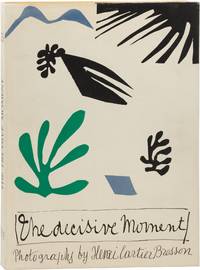
1952165340New York: Simon and Schuster 1952. First Edition. First Edition. Board and jacket design by Henri Matisse. Original "captions" booklet laid in as issued. <br /> <br /> One of the most influential collections of twentieth century street photography a testament to Henri Cartier-Bresson's unique and discerning eye and his ability to capture the emotive nature of his subjects. <br /> <br /> Near Fine in a spectacular Near Fine dust jacket. In a custom green clamshell box with a black leather label on the spine also Fine. The best copy of this title we have ever seen.<br /> <br /> Oversize volume shipping billed at cost. Simon and Schuster unknown
19281723681928. SOVIET PROPAGANDA DESIGN. Za oboronu SSSR For Defence of the USSR. 48 pp. illustrated with 32 full page plates printed in red and black. Small folio 275 x 200 mm. bound in publisher's wrappers illustrated by Czech artist P. Skala. Moscow: Izdatel'stvo AKHRR: Shkola FZU pri 1-i Obraztsovoi tipografii 1928. A remarkable collection of Soviet imagery intended as instruction for decorating workers' clubs reading huts and use during rallies. The illustrations include fully decorated interiors concepts for 'hands-on' attractions such as a 'rayok' or Russian peep show shooting galleries and quiz shows. Most of the imagery is in the constructivist style but also includes numerous caricatures of western fat cats fascists and even a Ku Klux Klan member which would have been inspiration for costume design. Rare OCLC finds just one copy at the Bibliotheque Nationale de France. The leaves with illustrations have an even toning from the printing process else a fine copy with the errata slip and unusually printed on fine thick paper. unknown
19304317Chicago: Beardslee Chandelier Manufacturing Company 1930. No Binding. Very Good. Chicago 1930s A remarkable archive of 52 original designs for light fixtures executed in watercolor ink and graphite on heavy card stock. Most sheets measure approximately 20 × 13 inches with one large folding drawing included. Each design bears the distinctive Beardslee blindstamp. Some sheets show minor surface smudging and light edge wear consistent with age and use. The Beardslee Chandelier Manufacturing Company based in Chicago Illinois was a leading producer of high-quality gas and electric light fixtures in the early 20th century. The company originated as the W.S. Edwards Manufacturing Co. but in 1901 under the leadership of George Murray Beardslee b. 1868 it was renamed and expanded its operations. Beardslee who had joined the firm in 1890 served as both treasurer and vice president. Rogers Park/West Ridge Historical Society HistoryWiki One of Beardslee's key designers was Anton Dvorak b. 1888 a graduate of both the Chicago Institute of Art and the Lewis Institute of Chicago. Dvorak began his career at the Chicago Gas and Electric Fixture Co. 1904-1914 before joining Beardslee where he eventually became vice president. Between 1921 and 1930 he filed six patents with the U.S. Patent Office contributing significant innovations in lighting design. Encyclopedia of Bohemian and Czech-American Biography Vol. 1 Miloslav Rechigl Jr. Beardslee specialized in stylish yet affordable lighting fixtures for banks churches retail stores and offices. By the mid-1920s the firm had earned a national reputation described as "one of the largest and best known lighting equipment companies in the Midwest." Wisconsin Rapids Daily Tribune September 30 1925 This collection reflects the elegance and precision of Art Deco design. Each drawing is meticulously labeled with a model number and scale and many include notes specifying their intended installation locations-such as "2nd hall" "men's room" "civic room" "safe deposit" "main stairs" "main lounge" and "parlour." The set may have been commissioned for a major architectural project possibly the Biltmore Hotel in Oklahoma City. Beardslee Chandelier Manufacturing Company unknown
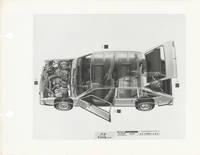
158941Detroit MI: General Motors 1980. Substantial archive of over 750 General Motors GM design assembly and advertising photographs 23 contact sheets of vehicles and parts photographs and 100 print advertising proofs and mockups from the Chevrolet Motor Division of General Motors dating from 1973 through 1980. Nearly all the materials in the archive are overlaid with Campbell Ewald Advertising Agency watermarks or bear GM Photographic stamps on the bottom margins or versos. Materials also frequently note catalog numbers and dates in manuscript pencil and ink.<br /> <br /> Detailed inventory and additional images available upon request. Please contact us directly.<br /> <br /> A vast and insightful archive of distinctly 1970s GM automotive design and marketing. The photographic prints in the archive include approximately 550 photographs and design renderings of vehicles parts and accessories as well as emblems and logos with material relating to the Bel Air Camaro Caprice Chevelle Chevette Citation Impala Malibu Monte Carlo Monza Nova and Vega models. Of particular note are 100 proofs and mockups for print advertisements for various Chevrolet vehicles markedly reflecting the era's fuel crisis and imposing international compact car market.<br /> <br /> Photographs largely 11 x 8.5 inches with some photographs 10 x 8 inches. Advertising proofs and mockups are all on standard letter-size paper. Near Fine overall with some light edgewear and light creasing at the corners. General Motors unknown
OB557<p>London: William Pickering 1843 Chiswick: C. Whittingham. Hard Cover. Volume One only of two: 38 color plates; 29 cm. Added title-page: Dresses and Decorations of the Middle Ages from the Seventh to the Seventeenth Centuries. With descriptions by Thomas Wright. The plates are hand-colored copper and polychrome wood engravings. Shaw's most ambitious work described by Ruari McLean as having "a considerable claim to be called the most handsome book created in the whole of the nineteenth century." Victorian Book Design p. 48. Ray 102. This copy has the bookplate of actor Edwin Booth 1833-1893 with his signed inscription to Jervis McEntee 1828-1891 a landscape painter of the Hudson Valley School and Booth's friend of many years. It was Booth's gift in anticipation of a commission for McEntee to paint portraits of the actor in his famous roles. This copy loaned to Historic Kingston featured in a McEntee exhibition and was noticed in a New York Times review. Alice Beckwith Victorian Bibliomania n. 38. Stock#OB557 oversize. Some foxing; rebound in half leather; good.</p> London: William Pickering, 1843 (Chiswick: C. Whittingham) hardcover
193855160МоÑква Moscow: Музеиа-Ð’Ñ‹Ñтавки Охраны МатеринÑтва и МладенчеÑтва Museums and Exhibitions of Motherhood and Childhood Protection 1938. First edition. Hardcover. g to vg-. Folio. Unpaginated 113 double-sided leaves. Original blue cloth with gilt lettering and yellow circular embossed bas-relief on the front cover designed by Anna Yuzhakova. Spine with blind-stamped illustration and lettering. Binding protected in modern mylar. Housed in its original blue cloth slipcase with a circular windowed cutout for the bas-relief. Photo-illustrated endpapers. The title page is a double-page spread with modernist typography and title text appearing in 10 additional languages including Ukrainian Belorussian Bulgarian Armenian Georgian Turkmen Azerbaijani Uzbek and others.<br /> <br /> Following the title page are four pages of introductory text and then a fold-out with woodcut illustrations in black by Nikolai Piskarev 1892-1959 showing images of the Russian revolution revealing photographic portraits of Lenin and Stalin when opened. The work is profusely illustrated throughout with countless photographic images beautifully printed in b/w and sepia-toned gravure. The book's overall design and layout was the work of Yakov Babushkin b.1907 which displays a wide variety of artistic and conceptual flourishes. Throughout the book are many smaller half-width multipage inserts artistic insets and fold-outs as well as extensive photomontages and large double-page spreads. Final leaf contains extensive contributor's credits.<br /> <br /> The publication features the work of a long list of contributors including noted photographers such as Olga Ignatovich 1905-1984 and Elizaveta Ignatovich 1903-1983 - both sister of pioneering Soviet photographer and photojournalist Boris Ignatovich cinematographer and filmmaker Alexander Frolov 1904-1962 and Solomon Tules among many others.<br /> <br /> This lavishly produced piece of Soviet photo-propaganda praising the state's maternity and child-care institutions and services. Published on the 20th anniversary of the establishment of the department for the Protection of Motherhood and Infancy Okhrana Materinstva i Mladenchestva or OMM the book showcases the state's initiatives to support mothers and and their young children in the and promote the importance of Motherhood as a vital role within Soviet society. Documented are women's centers hospitals early childhood education and summer camps among countless other state-controlled entities from across many different republics of the Soviet Union Russia Ukraine Belarus Georgia Azerbaijan Armenia Kazakhstan Kyrgyzstan Uzbekistan and Tajikistan. The work one of 5 notable Soviet photo-books issued between 1933 and 1938 focussing on women and women's issues in the USSR.<br /> <br /> Binding with light bumping and rubbing to extremities including some light abrading to the very bottom of the front cover. Interior with starting at the interior front cover. Sporadic light staining to the endpapers and interior covers. Persistent light stain along the bottom of the book block visibly affecting the bottom of most pages throughout. Images are otherwise still mostly clean and vibrant. Binding fairly tight overall. Binding and interior in good to very good- condition overall. Scarce. Bibliographic reference: Heiting and Karasik The Soviet Photobook 1920-1941 p. 380.<br /> <br /> A scarce work with only 6 known copies woldwide on OCLC. Музеиа-Ð’Ñ‹Ñтавки Охраны МатеринÑтва и МладенчеÑтва (Museums and Exhibitions of Mother hardcover
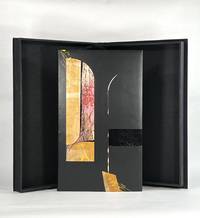
10427Berkeley CA: Editions Koch 2003. Full Leather. Fine binding. Folio. 44 pp. frontis plates. Limited edition one of 120 copies this copy out of series; there are also 26 lettered deluxe copies with a suite of 10 engravings. All are signed by Bringhurst Wagener and Peter Koch at the colophon. Bound by Camille Botelho in black box calf with inlays and onlays of dyed calf vinyl snakeskin painted paper mylar laminates and a porcupine quill; hand embroidered endbands; vinyl snakeskin doublures. A fine copy in clamshell box. <br /> <br /> True to form Peter Koch has produced a marvelous edition of what remains of Parmenides's poem "On Nature." The fragments of the poem are rendered in this opposite page bilingual edition with the Greek on the left and Bringhurst's English translation on the right. The poetry is brilliantly accompanied by Wagner's striking engravings a frontispiece and 4 additional wood engravings in red and orange. <br /> <br /> Given it survives only in fragments there is some debate as to the "meaning" of the symbolism of Parmenides's poem making it a work ripe for interpretation. But at base his view of reality is one of stasis unchangeable. And while that enduring Greek logic marks the work Wagener introduces remarkably abstract and kinetic illustrations printed in an urgent deep red and orange—projecting anything but stasis. It is the discord between the logical understanding or reality and the emotional understanding of it that spoke to Botelho and informed her design of this incredible binding. She writes: "In the design I thought of Parmenides looking out past shadowy arches from within a dark room to find total chaos beyond. The curve of the Mylar inlay and the curve of the porcupine quill mimic a column marking a threshold beyond which is uncontrolled noise and movement and mess. I wanted the disparity between the smoothness of the box calf and the chaos of the inlays and yellow foiling to be a comment on how frightening examining one's reality can be." Magnificently achieved Botelho has created an exceptional binding that bridges Parmenides and Wagener giving voice to the paradox she sees in this metaphysical conversation on the nature of reality. Editions Koch unknown
1920186580Tokyo: Rinshikin Shukai 1920-34. The birth of the matchbox-collecting movement A vibrant collection containing pre-war matchbox labels produced by the Rinshikin Shukai Japan's first society for matchbox collectors. The boldly coloured designs show kabuki actors geisha Buddhist deities baseball players famous ukiyo-e prints vistas of capital cities and even wartime propaganda. Matchbox labels became popular in the late-19th and early-20th centuries in Japan as an opportunity for striking and individualistic graphic design. This album opens with 100 labels on untrimmed sheets each one submitted by an individual member of the Rinshikin Shukai. The labels are then divided into sets usually of 12 as per traditional Japanese artistic conventions. Many are after famous prints by the likes of Kitagawa Utamaro and Sharaku but the majority are fresh designs. One charming set is titled "Sports in the Afterlife" showing silver skeletons playing a variety of sports. The wartime labels are particularly striking showing cartoon soldiers firing missiles piloting aircraft and wading through rivers. One set commemorates the "Three Brave Bombers" a group of soldiers who were lionized for breaking through the Chinese lines during the Shanghai Incident and setting off suicide bombs to allow the Japanese army to advance. The Rinshin Shukai was formed in 1903 by Fukuyama Hekisui 1876-1934 as a society for those interested in collecting designing and distributing matchbox labels. It quickly grew in popularity as branches were established all over Japan and in 1907 it held a sponsored display at the Tokyo Industrial Exhibition where thousands of labels designed by Hekisui were given out. Over the following 30 years Hekisui's personal collection grew to exceed 200000 examples designed by prominent members such as Furuya Rankei Hasegawa Giichiro Ogawa Saku and Oda Shuichi. Upon his death in 1934 the society produced a commemorative label which is pasted at the front of this album. Quarto concertina-style. With 1323 colour woodblock matchbox labels 60 x 42 mm to 117 x 78 mm 100 on tipped-in and untrimmed sheets 2 loosely inserted 10 letterpress labels mounted on recto and verso of 26 leaves 2 sides blank; many printed on mica-speckled paper text in Japanese. Original brown thick card boards original manuscript paper label on front board. Labels bright a couple with loss a few seemingly missing boards rubbed 2 joints repaired with Japanese tissue: a well-preserved collection. hardcover
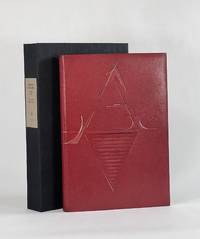
19279186New York: Printed by William Edwin Rudge for the Grolier Club 1927. Full Leather. Very Good binding. Quarto. 6 xxiii 1 208 2 pp. illus. Limited edition one of 390 copies. This copy bound by Don Glaister in full crimson goatskin with typographic design referencing Rogers's type design throughout the volume—a stylized A on the front cover and Z on the rear tooled in blind and gold transitioning to painted lines. Glaister employs slightly raised and recessed areas beneath the leather with occasional light sanding all to offer subtle dimensionality a suggestive nod to the raise aspects of type. Crimson cork endpapers gold and crimson silk headbands accent the original gold top-edge. Signed in blind on the rear pastedown with date and gold dot "Donald Glaister 2025." Fine in clamshell.<br /> <br /> This edition designed by Bruce Rogers is the first English translation of Tory's landmark work begun in 1523 and published 1529. Tory's influence on 16th century typography was immeasurable—moving French printing away from gothic types towards the roman faces a movement that would define modern typography. D. B. Updike calls Tory's Champ Fleury "one of the important books in the history of letter design" I p. 188. A beautiful edition that took decades for Rogers to bring from a proposal to the Grolier Club to a printed edition. And of all he designed it was among Rogers's favorite #24 in BR Thirty. Tory's groundbreaking and forward-looking work had long been a classic text by the time Rogers designed this edition 400 years later. Now 100 years further on Glaister adds his voice to this typographic tradition and in his distinct style takes these now-classic letterforms and nudges them into modernity. Haas 413. Grolier 361. Updike Daniel Berkeley. Printing Types. 3rd ed. 1966. Printed by William Edwin Rudge for the Grolier Club unknown
9402New York: Caliban Press 2020. Full Leather. Fine binding. Tall octavo. 3 blanks 44 2 prospectus 3 blanks ll. Limited edition number 5 of 100 copies signed by McMurray. Originally issued by McMurray in a spiral binding with heavy printed wrappers; the printer notes that this was "printed on various scrap papers found at Caliban Press over time. Canada China England France Germany India Japan Mexico Nepal and Spain are all represented—including Papeterie St-Armand." It includes fold-outs a volvelle and slide-outs. This copy is finely bound by Donald Glaister in full goat skin with onlays of laminated mylar and sanded and painted aluminum on the front and back boards. There are also recessed areas on both boards with acrylic painted lines at some perimeter edges. Polished top-edge with silk endbands; painted cork endpapers. The leaves original covers and prospectus have been mounted on guards with a portion of the perforations from the spiral binding still visible with intention a way in which Glaister is engaging with McMurray's style and playfulness that present throughout this specimen book. Even the clamshell box holding the book has a compartment containing the original red spiral a toy begging to be played with. <br /> <br /> McMurray describes this type specimen of numerals as a way to document a collection of more than 4 dozen cases and around 75 fonts. It became evident that a complete catalogue was far too expansive for a single volume so this the first volume was just numerals. Far from a straightforward specimen book McMurray's playfulness and humor engage the viewer throughout. And engaged Glaister in his design. He writes in his artist’s statement: "Mark McMurray has compiled a wonderfully designed collection of families of numbers from his collection. The is almost without words only numbers . . . The design for the binding is as simple and as complicated as the binary system. A '1' and a '0' on each cover is all there is. However these numbers are presented differently subtly richly and with great care as to their design and positions. These forms and qualities are a mirror of the text within." A wonderful book beautifully bound by one of the premier designer bookbinders in the country. Caliban Press unknown