[MOSAIC FLOORS].Biblio.com
7 527 résultats
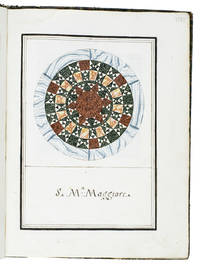
168222076Rome 1682. Contemporary boards covered with later ca. 1840 Storemont on shell marbled paper. Small folio 26 x 19.5 cm. 40 ink and watercolour drawings 28 round and 12 square each ca. 11 x 11 cm showing the decorative patterns and coloured marbles from the floors of 5 churches. Each has a triple-rule border in black ink with a panel at the foot containing the name of the church. A book of 40 detailed colour drawings showing the elaborate patterns in the mosaic marble tile floors of five different churches with eight examples from each church: Santa Maria Maggiore 1-8 Santi Giovanni e Paolo 9-16 San Marco 17-24 Sant' Alessio 25-32 and Sant' Ivo 33-40. All probably refer to the Roman churches of these names though the Basilica di San Marco in Venice also has elaborate mosaic floors. Some of the mosaics are in the Mediaeval Italian style called Cosmatesque but some may date from the Renaissance. Besides a wide variety of triangular square rectangular diamond hexagonal and octagonal tiles there are many cut with circular edges and a few irregular quadrilaterals. Some are assembled to form stars in a hexagonal grid round sunburst patterns and an endless variety of other patterns. All patterns show a rotational symmetry around the centre point or a repeating pattern in a square or hexagonal grid. The colouring of many of the tiles shows various styles and colours of marble veins.The drawings are difficult to date exactly. The leaves used for the drawings show a single paper stock very close to Piccard VI watermarks V.423 & V.424 Rome 1662. The drawings could have been made as early as ca. 1662 but the lettering of the names of the churches seems more likely to date from the 18th century. In 1752 Monsignor Giuseppe Alessandro Furietti a prelate from Bergamo published an illustrated book on mosaics from classical Rome to his own day: De Musivis Rome 1752. This marked a new interest in such antiquities but he illustrates mainly earlier examples and we find little link with the present examples which were probably drawn before his book appeared. With smudges on a few pages one slightly affecting the edge of one drawing but otherwise in very good condition with only a light marginal water stain in the last few leaves. The front hinge is broken and the spine and edges of the binding are somewhat tattered. Since many floor mosaics have been destroyed or damaged over the centuries the present book provides a unique historical record of some of the designs. hardcover
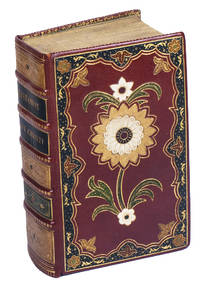
1696ABC_48370Antwerp 1696. 8vo. Hieronymus Verdussen for Niclaes Braau in Haarlem Exquisite 18th-century gold-tooled multi-colour morocco mosaic binding. The basis of the binding is red morocco the boards show a large flower executed in gold-tooled white green yellow and black morocco onlays with small brown morocco leaf shaped corner pieces within a cusped and scalloped gold-tooled double fillet frame. The outer frame is a gold-tooled black morocco onlay with detailed floral and leaf shaped gold-tooled brown and green morocco onlays. The binding is sewn on 5 supports with corresponding raised bands on the spine. The six compartments are beautifully decorated with gold-tooled yellow 1st 4th and 6th compartment black 2nd and 3rd and green 5th morocco onlays with the title lettered in gold on the black morocco of the 2nd and 4rd compartments the other compartments are show detailed gold-tooling and a small green or red morocco small circular onlay. Further with gold-tooling on the raised bands the head and foot of the spine the board edges and the turn-ins. Gilt edges and green silk covered end papers. With 39 detailed woodcut illustrations in the text and woodcut decorated initials and small printed manicules. The text is set in a Gothic letter with incidental use of Roman type. 1 1 blank 14 837 27 pp. Very rare late-17th-century Antwerp edition of the New Testament edited by Henricus van den Leemputte 1588-1657 in a magnificent 18th-century mosaic binding. The binding is made by or in the style of the French Parisian binders Le Monnier. "The delicate construction finesse of tooling and delineation and the fantasy of these bindings render them veritable jewels." see The History of bookbinding 525-1950 A.D. no. 456.Van den Leemputte was a highly educated cleric from a noble family in the Southern Netherlands. He held high offices within the diocese bishopric of 's Hertogenbosch. Aside from the present version of the New Testament first published in 1622 he wrote several treatises on the Holy Sacraments published 1624 and edited two works one manual for explaining the Holy Scripture and one defence of the Catholic church against the Reformed church.From the library of Carlo de Poortere 1917-2002 a director of the family tapestry business and a Belgian bibliophile with a large collection of 17th- and 18th-century book bindings and illustrated books from the 16th-20th centuries. It had previous been part of the collection of English Baptist minister and book collector Andrew Gifford 1700-1784. The "of the Museum" below his name in the engraved bookplate seems to refer to his position as assistant keeper of books and manuscript at the British Museum from 1757 until his death. Curiously he bequeathed his collection of books manuscripts pictures and other curiosities not to the British Museum but to the Bristol Baptist College. In the 1970s the Trustees of this college decided to sell all copies of the Gifford collection to pay for renovations to the chapel.With the gold-tooled red morocco bookplate of Carlo de Poortere on the verso of the blank fly leaf and a near contemporary engraved paper bookplate on the verso of the title-page possibly of Andrew Gifford 1700-1784. The binding shows minor signs of wear at the outer corners of the boards and spine otherwise it is in fine condition. The bottom outer corner of the first blank flyleaf and the title-page have been restored a slight water stain in the bottom margin of the first half of the work some occasional slight browning. Quire 24 has been mis-bound at the end of the work in quire 3H4 but the collation is complete. Otherwise in very good condition. A very rare late 17th-century edition of the New Testament in an exquisite 18th-century mosaic binding.l STCV 12918655 1 copy; USTC 1535523 1 copy same as STCV; WorldCat 66131050 4 copies including the STCV copy; cf. The history of bookbinding 525-1950 A.D. An exhibition held at the Baltimore Museum of Art November 12 1957 to January 12 1958 no. 456 plate XC. ABE CAT Art History ABE CAT Bibles Sermons & Psalmbooks hardcover
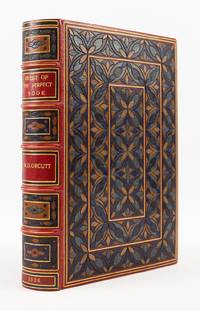
1926ST20086Boston: Little Brown & Co 1926. First Trade Edition. 228 x 160 mm. 9 x 6 1/4". 8 p.l. 316 pp. 1 leaf. <br/> SPECTACULAR MOSAIC MOROCCO BY CURTIS WALTERS signed in gilt on rear turn-in covers with animated repeating ogival pattern inlaid in several hues of morocco black navy blue light blue light brown and orange separated into three panels by thin strips of red morocco and gilt rules THE COVERS WITH APPROXIMATELY 662 INLAYS IN TOTAL raised bands spines compartments ruled in gilt and inlaid with a similar design gilt titling NAVY BLUE MOROCCO DOUBLURES bordered with strips of eggplant and red morocco and four gilt rules navy blue watered silk endleaves top edge gilt others trimmed on the rough. Housed in a marbled paper chemise with red morocco back and matching slightly worn slipcase.<br /> With color frontispiece and printed tissue guard 48 black & white plates one double-page specimen reproduction and numerous in-text illustrations and specimen page reproductions. With tipped-in "Compliments of the Author" leaf SIGNED by Orcutt. Clizbee "Curtis Walters American Binder" in "The American Book Collector" August September 1932 pp. 124-34 this binding pictured in the second plate. Copy included with this item. Very slight offsetting from plates and the odd trivial imperfection internally otherwise a fine copy IN AN IMMACULATE BINDING.<br/> <br/> This splendid mosaic binding is a tour-de-force of design and craftsmanship from an underappreciated American binder who specialized in this technique. The foreword to the 10 December 1957 sale catalogue of his bindings at Parke Bernet says that they "constitute a splendid group of American mosaic bindings such as have never been offered for sale before. . . . The description of bindings is always a difficult matter; it becomes practically impossible when one is faced by the stunning variety of complex patterns of colored mosaic inlays which Mr. Walters has assembled with infinite patience extraordinary skill and sophisticated taste . . . He has invented and brought to perfection a new technique whereby the most intricate inlaid designs can be achieved by a few simple tools without the use of dies or punches; gilt dots circlets and fillets are generally applied with restraint. . . . It need hardly be added that all of Mr. Walters' bindings are made of the very finest leathers available and that their workmanship reveals consummate craftsmanship down to the smallest detail." The present item was lot #25 in that sale. Walters became interested in bookbinding around 1900 and studied with such prestigious workshops as William Matthews the Club Bindery and Henry Stikeman. In "Hand Bookbinding in the United States Since the Civil War" Thompson tell us of Walters' work: "The infinite variety of design permitted by mosaic work is combined with Walters' marvelous delicacy in color schemes finely conceived geometric patterns and tasteful use of gold leaf to produce books that no Americans save perhaps the artists of the Club Bindery could have matched. The utter simplicity of Walters' methods he used but four tools belies his perseverance and devotion to his art. Only infinite patience and consummate skill could have produced Walters' bindings." The article by Azalea Clizbee in the accompanying copy of "The American Book Collector" describes Walters' technique for creating his mosaic bindings using only the simplest tools with plates depicting eight of his bindings including this one. Although very secondary here the text is appropriately a celebration of book arts--printing binding and illustration--by William Dana Orcutt 1870-1953 typographer printer and book designer. After graduating from Harvard in 1892 he went to work for the University Press there. He created several typefaces most notably "Humanistic" based on the humanist hand of 15th century scribe Antonio Sinibaldi. With Daniel Updike and Bruce Rogers he established the Boston Society of Printers in 1905. He was the author of several works on printing typography and the making of beautiful books. Little, Brown & Co unknown
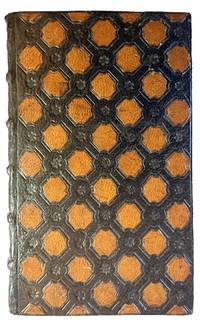
17083219Paris: Jacques Vincent for Jacques Estienne 1708. 2 parts in one 12mo binding 137 x 85 mm. 16 284 4 252 12 pages. Woodcut head- and tail-pieces and initial. Ruled in red throughout. At the end is a 4-page catalogue of books sold by Jacques Estienne. Bifolium g6-7 in part 2 bound in reverse order. Mosaic binding of black morocco probably ca. 1725-1735 covers with an all-over design of repeated concave-cornered lozenges of onlaid light brown morocco within a blind-tooled lattice design of double fillets and tiny six-petalled blossoms spine in six compartments five similarly decorated each with one onlaid lozenge second compartment with onlaid silver-tooled brown morocco lettering-piece doublures of dark brown morocco with silver-tooled arabesque roll border edges gilt over marbling rehinged upper joint chipping; modern suede-lined morocco folding box. Provenance: Paul-Louis Weiller 1893-1993 bookplate his sale Paris 30 Nov 1998 lot 32; modern booklabel “non nove sed nova" initials CL.<br /> <br /> A mosaic “tile†or tessellated binding attributable to Antoine-Michel Padeloup on a popular Jansenist devotional text. This unusual binding reverses the usual color scheme of the small corpus of similar known bindings providing a sober yet striking cover for the book.<br /> <br /> “Around 1707 mosaic work . began to be used in binding as it did in furniture and became the leading element in the design. These designs were now provided by onlay as opposed to the sixteenth-century use of paint and wax. Such mosaic work was either in a new form of the all-over semis now incorporating a framed structure so that it often resembled a tessellated pavement and was sometimes termed à répétition or with free-hand floral or other asymmetric realistic work†Barber Rothschild Waddesdon Manor catalogue p. 201. <br /> <br /> Tile-patterned mosaic bindings were usually used on small format books. Their invention is credited to the binder Antoine-Michel Padeloup or Padeloup le jeune 1685-1758 who bound for the entourage of the Regent Philippe II d’Orléans d. 1723. The height of the fashion for this style was probably the late 1720s and 1730s Barber p. 226. This style of decoration had the advantage of requiring little materiel. While “very labour-intensive the tile pattern style requires only a few tools all being common lines and curves `gouges’ and hardly any `figure’ that is expensive engraved tools. It would as such have suited under-capitalised younger binders. But such designs “clearly required careful planning and doubtless the preparation of a scaled plan based on both the exact size of the book and on the tools to be used†loc. cit. The present binding contains only one tool on the outer covers the small fleuron Waddesdon catalogue p. 384 fig. 11 and one roll which was also apparently used only on doublures Waddesdon catalogue I p. 436 RBT 8. <br /> <br /> Other tessellated mosaic bindings in this style all attributed to Padeloup are known: five of which three using the same tools are described and illustrated in the Waddesdon catalogue; another was reproduced by Michon and in the Esmérian catalogue. Those bindings use black or dark mororcco lozenges gold-tooled on a citron or light brown morocco ground with gold-tooled lattice-work creating a luminous effect. In contrast to those bindings here Padeloup reversed the color scheme: a black ground with restrained silver and blind tooling serves as background for the tile design of unadorned brown morocco lozenges. While visually striking the effect enhanced by the silver-bordered doublures is one of restraint no doubt intentional to reflect the book’s Jansenist content. <br /> <br /> Barbier Anonymes IV: 814. Giles Barber The James A. de Rothschild Bequest at Waddesdon Manor The National Trust: Printed Books and Bookbindings 2 vols. 2013; see nos. 90 91 92 93 and 572. Cf. Louis Michon Les reliures mosaïquées du XVIIIe siècle no. 89 = Bibliothèque Raphaël Esmérian II no. 89.<br /> <br /> <br /> (Jacques Vincent for) Jacques Estienne unknown
1901101718London: Printed by Edward Arnold for the Essex House Press under the care of C. R. Ashbee 1901. No. 229 of 250 copies. 12mo 6 x 4-1/2 inches. Title-page woodblock by T. Sturge Moore engraved initials. xiv 257 1 pp. text in black and red. Fine mosaic binding covers and four spine panels filled by a complex pattern of curved morocco inlays in four colors t.e.g. doublures with gilt-ruled inlaid borders silk endleaves by Curtis Walters signed on rear turn-in; fine in a custom half morocco chemise and morocco-tipped slipcase some old tape-strengthening to slipcase. A stunning perfectly preserved mosaic binding by the American binder Curtis Walters who specialized in such intricate and colorful mosaic bindings executed with an astonishing level of precision. This is one of a group of such bindings consigned by Walters to Parke Bernet and sold there 10 December 1957 lots 13-35 this lot 27.From the Park Bernet catalogue: "Mr. Walters was influenced to take up bookbinding around 1900 by the late George D. Smith eminent bookseller. Later he studied with Matthews the Club Bindery and Stikeman. He conceived his ideas about mosaic bindings as early as 1904 but between 1907 and 1928 he remained inactive. He has invented and brought to perfection a new technique whereby the most intricate inlaid designs can be achieved by a few simple tools without the use of dies or punches; gilt dots circlets and fillets are generally applied with restraint. Mr. Walters work has received wide recognition. Some of his early bindings are included in the Henry W. Poor collection and almost all of those offered for sale here have been exhibited in Paris 1930 New York Columbia University 1935 Hamburg Kunstgewerbeschule 1933-36 and Berlin 1936." Lawrence Thompson heaps further praise on Walters from "Hand Bookbinding in the United States Since the Civil War": "The infinite variety of design permitted by mosaic work is combined with Walters' marvelous delicacy in color schemes finely conceived geometric patterns and tasteful use of gold leaf to produce books that no Americans save perhaps the artists of the Club Bindery could have matched. The utter simplicity of Walters' methods he used but four tools belies his perseverance and devotion to his art. Only infinite patience and consummate skill could have produced Walters' bindings."Walter's bindings appear infrequently on the market this is a choice example of his artistry. Printed by Edward Arnold for the Essex House Press, under the care of C. R. Ashbee unknown
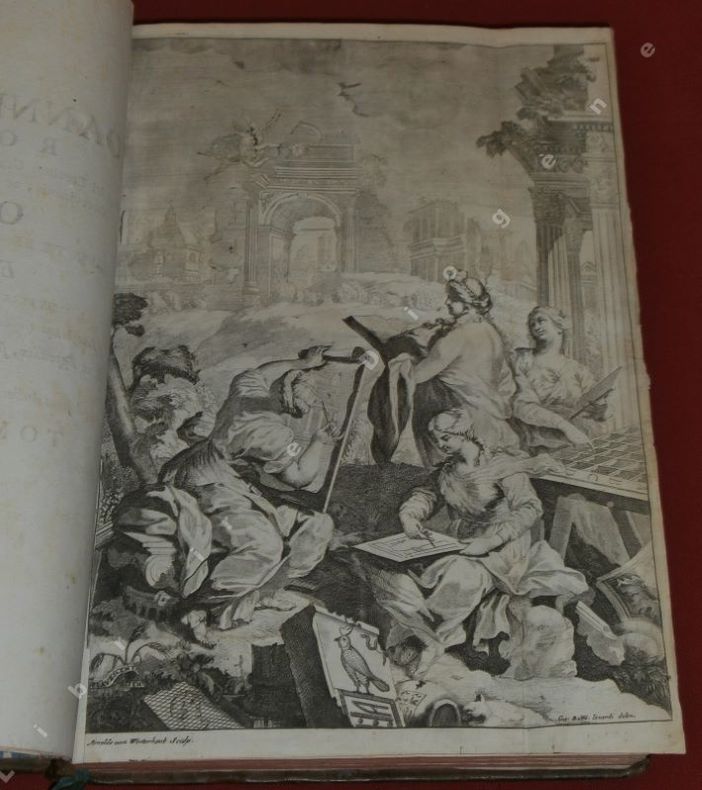
96513Romae, Sumptibus Caroli Giannini, Librorum Summi Pontificis, Ex Typographia Komareck, 1747, 3 volumes in-folio de 335x230 mm environ, Tome I : (1) f., xxxv pages avec frontispice+ 1 portrait de l'auteur, xxii pages +1 portrait, 276 pages, (7) ff. (index), (1) f., contient 77 planches numérotées de I à LXXVII - Tome II : (2) ff., xvi pages avec frontispice, 194 pages, (1) f., contient 57 planches numérotées de I à LVIII (la planche LVI n'existe pas, erreur de pagination), la planche XXVII est décomposée en 5 parties - Tome III : (1) f., xvi pages avec frontipice, 258- xii-48 pages (avec une partie double), (1) f. contient 35 planches, plein veau cognac marbré, dos à 6 nerfs portant titres et tomaisons dorés sur pièces fauves, ornés de caissons à motifs doréscoupes dorées, gardes marbrées, tran ches rouges. 2 coiffes ébréchées (tome III), frottements et épidermures sur les plats, 2 mors fendus sur 3 cm, quelques rousseurs, et petits défauts de marges, erreurs de pagination (87 au lieu de 95 (tome I) petite restauration ancienne sur cette même page, bordures des quelques planches brunies et fendillées, sinon bon état. Texte latin.
1961014593Alès PAB 1961 In-8 carré Pleine reliure d'époque Signé par l'auteur et l'illustrateur
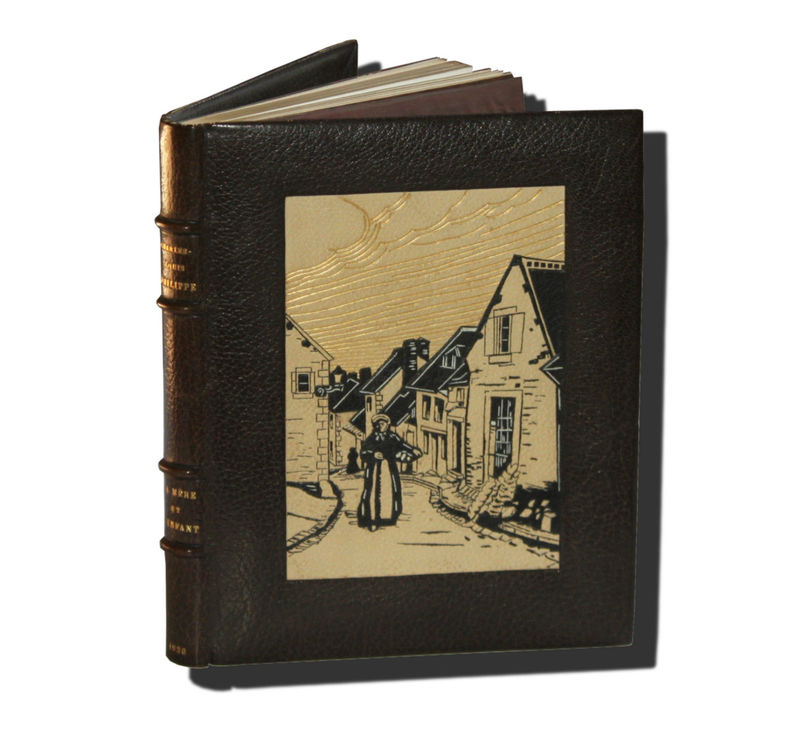
1920AMO-1249Éditions de La Nouvelle Revue Française, Paris, 1920 1 volume in-4 (24,5 x 20 cm) de 47 feuillets non chiffrés (94 pages). Le dernier feuillet est blanc. Reliure de l'époque plein maroquin marron foncé, dos à quatre nerfs saillants sautés, auteur et titre dorés dans les entre-nerfs, date dorée en queue. Le premier plat est illustré d'une belle plaque de maroquin ivoire mosaïqué de maroquin noir et blanc, et doré (17,3 x 12,5 cm) reproduisant un des grands bois gravé hors-texte (le premier). Toutes tranches dorées, encadrement intérieur de maroquin (largeur : 25 mm.) souligné par un filet gras doré, doublure centrale et première garde de tabis marron, gardes de papier décoré fait main. Couvertures conservées. Emboîtage bordé de maroquin. (reliure signée Jean LAMBERT). Parfait état. TIRAGE A 300 EXEMPLAIRES. Notre exemplaire bien que faisant partie du tirage n'a pas été numéroté. (exemplaire de passe ou de collaborateur). Volume achevé d'imprimer le 16 avril 1920 sur les presses de R. et L. Coulouma, imprimeurs à Argenteuil, sous la direction de H. Barthélémy. L'illustration se compose de 1 vignette de couverture, 1 vignette pour la justification du tirage, 4 grands hors-texte, 4 grands bandeaux, 4 lettrines, 3 culs-de-lampe, 1 vignette pour l'achevé d'imprimer, soit 18 très jolis bois gravés par l'artiste Deslignères. « Je crois être en France le premier d’une race de pauvres qui soit allée dans les lettres », écrivait Charles-Louis Philippe (1874-1909). Fils d’un sabotier, issu d’un milieu très pauvre, il poursuit ses études grâce à une bourse. Au début de l’année 1908, il appartient au mouvement qui décide de créer La Nouvelle Revue française. L'auteur de Bubu de Montparnasse était né à Cérilly dans le Bourbonnais (Allier) et sa vie fut brève puisqu'il mourut à peine âgé de 35 ans d'une fièvre typhoïde compliquée en méningite. Dans La Mère et l'Enfant il propose un mélange d'hommage à la figure maternelle empreint d'autobiographie. Le texte recèle quelques belles formules. L'écrivain retrace par ce biais des moments de sa propre vie, son entrée au lycée, où il a dû vivre comme en exil, il y était interne. La Mère et l'enfant n'a strictement rien de drôle, ce texte se trouve tout empli de la vie tumultueuse, chamboulée, de l'écrivain dont le trajet sur la Terre aura été bref mais jalonné de bien des événements. Même si La Mère et l'enfant a été publié en 1900, la montée des détresses, des dislocations sociales, des exclusions qui s'emballent, ces facteurs empêchent ce texte d'apparaître daté. Rien de suranné là-dedans." (source internet). « Lorsque j’avais deux ans, maman, tu étais forte comme une force de Dieu, tu étais belle de toutes sortes de beautés naturelles, tu étais douce et claire comme une eau courante. Tu ressembles à la terre facile et calme de chez nous qui s’en va, coteaux et vallons, avec des champs et des prés de verdure… Tu es le ciel qui s’étend au-dessus de nous, frère bleu de la plaine… Tu étais surtout, maman, un large fleuve tranquille qui se promène entre deux rives de feuillages, sous des cieux calmés. J’étais une barque neuve qui s’abandonne au beau fleuve et qui a l’air de lui dire : Emmène-moi, beau fleuve, où tu voudras… Mais surtout maman, tu étais ma citadelle. Magnifique et calme, tu te tiens debout sur la colline, et ton enfant n’a pas peur lorsqu’il va dans la vallée… » (extrait) Les superbes illustrations gravées sur bois par André Deslignères (1880-1968), lui-même enfant du pauvre pays voisin de Morvan (il était né à Nevers), lui aussi fils de sabotier, font écho au texte de Charles-Louis Philippe. Ce sont les mots et les images de la terre, des gens simples et du peuple qui dialoguent ici entre eux. La magnifique reliure signée Jean Lambert, en reproduisant en mosaïque avec la plus grande habileté l'un des grands bois de Deslignères, vient ajouter de la beauté à l'ensemble. Les reliures de Jean Lambert sont assez rares. Il était installé au 50 de la rue Sainte-Anne puis au 38 de la rue l'Arcade à Paris. Il a exercé de 1935 à 1955. Ancien élève de l'Ecole Estienne il eut notamment Robert Bonfils comme professeur. Fléty indique que ses débuts dans la profession furent assez prometteur mais que sa personnalité ne parvint pas cependant à s'imposer nettement et qu'il abandonna le métier. (Fléty, 103) PARFAIT EXEMPLAIRE SOMPTUEUSEMENT RELIÉ.
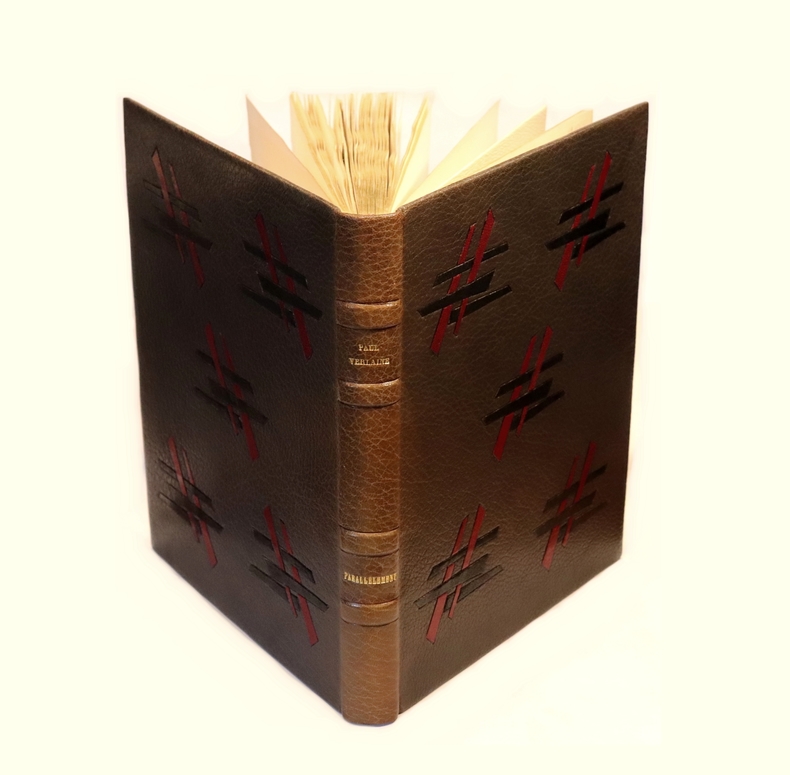
1949AMO-2192Georges Guillot, Paris, 1949 1 volume in-folio (33,5 x 27 cm) de 105-(1) pages et 15 pointes sèches de Mariette Lydis. Reliure plein maroquin anthracite mosaïqué sur les deux plats de barres parallèles noires et rouges entrecroisées (reliure allusive), dos à quatre faux-nerfs, doublure et gardes de moire rouge sang, tête dorée, relié sur brochure, couvertures conservées. La reliure n’est pas signée mais de très bonne facture. Dos de la reliure passé uniformément viré au marron. Intérieur parfait. Tirage à 565 exemplaires. Celui-ci un des exemplaires sur Rives blanc à la forme comprenant l’état définitif en noir relié dans le volume, avec en plus 5 planches non retenues inédites et une suite en noir des 15 pointes sèches de l'ouvrage. La superbe suite de pointes sèches de Mariette Lydis illustre parfaitement les poésies de Verlaine. On y trouve un érotisme délicat et la gravité nécessaire aux textes sombres de l’auteur. Superbe exemplaire.
1775(LCPCRELI-0006)("Les Princes agissent comme Ministres de Dieu, & ses Lieutenans sur la Terre; c'est par eux qu'il exerce son Empire... Il paraît de tout cela, que la Personne des Rois est sacrée, & qu'attenter sur eux, c'est un sacrilège...") PETITY Jean-Raymond DE (abbé). (Saint-Paul-Trois-Châteaux, 1724 - Paris, 1780) "SAGESSE DE LOUIS XVI, MANIFESTEE DE JOUR EN JOUR, ENSEIGNEE A SES PEUPLES, FONDEE SUR LES PREMIERS PRINCIPES DE TOUTE VERITE". 1775, Paris, Gueffier. 2 volumes in-8° (198x130 mm) (dimensions pages 193x121 mm) I: LXXX (faux-titre, titre, explication de l'allégorie, préface, explication), 502 pp.; II: (2) ff. (faux-titre et titre), XCVI, 461, (1) pp. 1 frontispice gravé d'après un dessin de l'auteur et 4 figures allégoriques (Sagesse, Sagesse Humaine, Sagesse Mondaine et Fausse Sagesse) par Gravelot. (a-e8, A-Y8, Z4, Aa-Ii8; a-f8, A-Z8, Aa-Ee8, Ff6) Séduisantes reliures en maroquin rouge mosaïqué et décoré de l'époque. Encadrements avec triple roulette dorée sur les plats et fleurons dorés; petites pièces de maroquin vert aux angles internes des encadrements. Dos lisses divisés en compartiments avec fleurons dorés et faux nerfs en maroquin vert avec décorations dorées; pièces de titre et de tomaison en maroquin vert et citron. Filet doré sur les coupes. Tranches dorées. Gardes de papier décoré. Edition Originale, rare, de ce texte philosophique et moral sur la Sagesse et qui célèbre aussi l'avènement du jeune Louis XVI (1754-1793). Superbe exemplaire en maroquin mosaîqué du temps. Monté au trône en 1774, à dix-neuf ans, et sacré dans la Cathédrale de Reims le 11 juin 1775, presque cinquante-trois ans après le Sacre de son grand-père Louis XV, le nouveau Roi représente toute l'attente et l'espoir de renouvellement et de changement, après un règne marqué par de nombreux scandales. L'auteur, prédicateur de la pieuse Reine Marie Leczinska, a inventé le frontispice, dessiné par Moitte fils et gravé par Moitte père, dans lequel le Roi est représenté de profil sous l'Oeil de Dieu, accompagné par la Sagesse. Provenance: Etiquette de papier avec ex libris manuscrit du temps gratté (Mlle ...?) au verso des premiers plats. (Cohen, 793; Cioranescu, 49699) (LCPCRELI-0006) (2.300,00 €)
A beautiful livre d'artiste, illustrated with 64 ORIGINAL ETCHINGS BY HUNGARIAN JEWISH ARTIST LASZLO BARTA. Edition limited to 210 numbered copies, of which this is 140 printed on fine Rives wove paper. Folio. BEAUTIFULLY BOUND IN FULL MOROCCO BRIGHTLY DECORATED IN MOSAIC ON BOTH COVERS, DEPICTING CHARACTERS FROM VILLON'S POEMS. Top edge gilt, other edges uncut. Patterned endpapers. Tiny crack to upper joint, else FINE AND BRIGHT, INSIDE AND OUT. Laid in is the original prospectus, as well as a HANDWRITTEN CERTIFICATE FROM BARTA, dated September 20, 1932 and signed, declaring that he executed the mosaic decoration on the binding, that the binding is unique, and that the design will not be used again. A unique and utterly charming book.
Palermo, PALAZZO DEI NORMANNI. A cura di Brenk B. Testo Italiano e Inglese. Modena, 2010; 4 voll., ril. in cofanetto, pp. 1650, 200 ill. b/n, 1333 ill. col., cm 24x31. (Mirabilia Italiae. 17).
In-4°; pp. (8), una testatina, capolettera e finalino incisi su legno; dedica al card. Francesco Barberini. Raro libello in cui Suares fornisce notizie biografiche su Giotto, e dettagli sul Mosaico della Navicella commissionato dal cardinal Gaetano Stefaneschi.
1929UDG-11Paris, Ernest Flammarion, 1929. In-8, édition originale du premier ouvrage de l'auteur publié chez Flammarion. Tirage limité à 1200 exemplaires numérotés, celui-ci n°16, un des 25 sur papier Japon. Exemplaire enrichi d'un envoi autographe signé de l'auteur. Reliure plein box blanc ornée d'une mosaïque de quadrilatères de box et maroquin gris, bleus, violets et roses, contreplats de box bleu-gris, gardes de box mauve, tranche de tête dorée, couvertures et dos conservés, sous chemise et emboîtage. Superbe reliure signée de Maud Spira, relieuse suisse ayant participé à de nombreux salons et concours internationaux.
188622369Paris Librairie L. Conquet 1886 -in-8 demi-Maroquin 2 volumes, reliure demi-maroquin cerise in-octavo à coins (half morocco binding in-8 with corners) (21 x 14 cm), reliure d'Epoque non-signée mais superbe (elle le mériterait largement), dos à nerfs (spine with raised band), décoré or et à froid (gilt and blind stamping decoration), titre frappé "or" avec un double filet "or" en encadrement, filet perlé "or" en place des nerfs avec un filet à froid de part et d'autre des nerfs, entre-nerfs à fleuron "or" au fer plein mosaïqué de cuir vert dans un encadrement d'un double filet "or", date "or" en pied dans un encadrement d'un double filet "or", plats décorés "or" d'un filet "or" au mors et aux coins, papier peigné vieux rose et vert aux plats, tête lisse dorée, gouttière et tranche de queue non-rognées, couverture crème imprimée en noir conservée, Édition unique, Tirage limité à 500 exemplaires (planches détruites), Un des 350 exemplaires numérotés sur vélin du Marais à la forme (seul tirage après 150 exemplaires sur Japon) (N° 193), Illustré d'un frontispice et de 30 compositions dessinés et gravés à l'eau-forte en noir avec serpente par Ed. RUDAUX, Gravées par Chardon aîné, 184 et 195 pages, 1886 Paris, Librairie L. Conquet Editeurs,
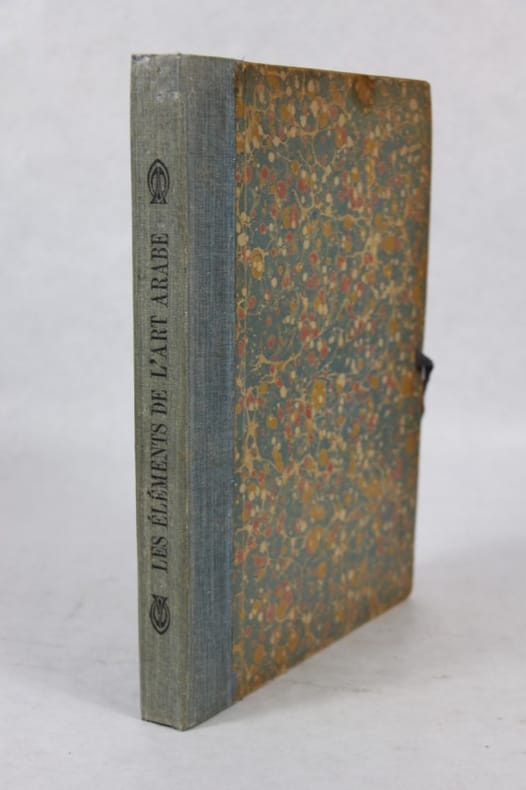
1879138020Firmin-didot, Paris, 1879 1879 In-4 en feuilles, sous chamise cartonnée à lacets, 47 pages de texte non coupé, 190 figures Au trait d'entrelacs et d'arabesques sur papier mince & 10 chromolithographies..
189522405Paris Librairie L. Conquet 1895 -in-8 demi-Maroquin 1 volume, reliure demi-maroquin bleu roi in-octavo à coins (half morocco binding in-8 with corners) (20,6 x 13,8 cm), RELIURE D'EPOQUE non-signée mais superbe (elle le mériterait largement), dos à nerfs (spine with raised band), décoré or et à froid (gilt and blind stamping decoration), titre frappé "or" avec un filet "or" en encadrement, filet perlé "or" en place des nerfs avec un filet à froid de part et d'autre des nerfs, entre-nerfs à fleuron "or" au fer plein mosaïqué de cuir parme dans un encadrement d'un double filet "or" avec rinceaux aux angles, date "or" en pied dans un encadrement d'un filet perlé "or" et d'un filet "or", plats décorés "or" d'un filet "or" au mors et aux coins, papier peigné vieux rose, bleu-clair, bleu-foncé et "or" aux plats, tête lisse dorée, gouttière et tranche de queue non-rognées, couverture crème imprimée en noir et illustré d'une eaux-forte en bleu pat l'auteur conservée, Édition unique, Tirage limité à 500 exemplaires (planches détruites), Un des 350 exemplaires numérotés sur vélin du Marais à la forme (seul tirage après 150 exemplaires sur Japon) (N°347) justifié de façon manuscrite à l'encre brune avec les initiales autographes manuscrites de l'Editeur, Illustrée par l'auteur de 8 eaux-fortes originales, dont une pour la couverture, un portrait-frontispice, 3 en-têtes et 3 culs-de-lampe, 47 pages, 1895 Paris, Librairie L. Conquet Editeurs,
192522426Paris Cité des Livres 1925 -in-8 demi-Maroquin 1 volume, reliure demi-maroquin chocolat noir et mosaïqué de rouge et parme in-octavo à coins (half morocco binding in-8 with corners) (19,7 x 15 cm), RELIURE D'EPOQUE MOSAÏQUEE, signée : AD LAVAUX Rel., dos long (spine without raised band), décoré or et mosaïqué de maroquin rouge et parme (gilt decoration), titre frappé "or" dans un encadrment d'un filet "or", avec de part et d'autre un decor à fleurons à froid sur cuir maroquin parme "feuille" mosaïqué (2 mosaïque pour la partie basse et une pour la partie haute)au centre, enveloppés d'un décor de rinceaux "or" et noir à froid, date "or" en pied avec de part et d'autre une roulette "or" sur une bande de cuir mosaïquée rouge bordée de part et d'autre d'un filet noir à froid et d'un filet "or" dans un encadrement général d'un filet "or", roulette "or" sur une bande de cuir mosaïquée rouge bordée de part et d'autre d'un filet noir à froid et d'un filet "or" en tête, plats décorés d'un double filet à froid aux mors et aux coins, papier marbré vert, marron et "or" aux plats, tête lisse dorée, gouttière et tranche de queue non-rognées, dos et couverture marron imprimés en noir et ornés d'une vignette "marque de l'Editeur" "au chat" en noir conservés, Tirage limité à 1595 Exemplaires, un des 1500 Exemplaires sur Vergé d'Arches, numérotés de 71 à 1570 (N°1434), sans illustrations (no illustration), , 281 pages, 1925 Paris, Cité des Livres Editeur,
In -4° grande; pp. XVI, 130, 4 belle tavole f.t. incise su rame, di cui 3 grandi ripiegate (in questo esemplare mancano le tavv. 4 e 5); nel testo graziose testatine, finalini e capilettera incisi su rame; front. stampato in rosso e nero, con stemma pontificio inciso su rame; legatura in piena pergamena (macchie di inchiostro, al piatto inferiore anche di umidità). Gora di umidità alle ultime carte. Altrimenti bella copia, marginosa. Edizione originale. Opera fondamentale per la storia dell’arte e della tecnica del mosaico dall’antichità al Settecento, divenuto un classico per l’argomento. Tra le illustrazioni, quella delle colombe che si abbeverano, descritta da Plinio (dove basin). Furietti scavò e studiò le rovine di villa Adriana.
192723663Bruxelles Aux Editions du Nord 1927 -in-8 demi-Maroquin 1 volume, reliure demi-maroquin caramel in-octavo à coins (half morocco binding in-8 with corners) (21 x 15,6 cm), RELIURE D'EPOQUE non-signée mais superbe (elle le mériterait largement), dos à nerfs (spine with raised band), décoré "or" et à froid (gilt and blind stamping decoration), titre et Auteur frappés "or" dans un encadrement d'un filet "or", tête; partie centrale et pied "mosaïqués" de maroquin rouge cerné de filets droits et courbes à froid, de filets "or" et filets perlés "or" dans un encadrement d'un filet "or", date "or" en pied, filet perlé "or" en place des nerfs avec un filet à froid de part et d'autre des nerfs, plats décorés à froid d'un filet à froid aux mors et aux coins, papier fantaisie marron clair, marron plus foncé et vert aux plats, tête lisse dorée, gouttière et tranche de queue non-rognées, Ex-Libris illustré en couleurs : Maurice LEMAINQUE (Aquarelliste, peintre de paysages et illustrateur), dos et couverture illustrée en couleur par Henri CASSIERS conservée, Tirage limité à 1076 Exemplaires, un des 1000 Exemplaires (Numérotés du N°77 à 1076) sur Papier Vélin Pur ESPARTO (N°897), contenant un état des 26 aquarelles in et hors-texte en couleurs de Henri Cassiers, 164 pages + tables,1927 Bruxelles Aux Editions du Nord Editeur,
2 voll. pp. 325, 528, cm 30x21, rilegatura editoriale, illustrazioni in nero e a colori, La Mosaique Greco-Romaine VIII. Nuovo.
In 12°, XIV, (2), 183 (1) pp. Brossura editoriale con titolo in bianco e nero, entro cornice, al piatto anteriore. Esemplare appartenuto a celebre chimico italiano, noto per essere stato tra i fondatori, con lo scozzese Thomas Graham, della chimica dei colloidi, Francesco Selmi (Vignola, 7 aprile 1817 - Vignola, 13 agosto 1881) come attesta la dedica autografa di Gaetano Milanesi al margine alto del piatto anteriore. Uscita nella collana di "Scelta di curiose letterarie inedite o rare" pubblicata da Romagnoli a metà ottocento, nella quale vennero per la prima volte presentate opera rare e curiose tratte da manoscritti inediti. Quest'edizione venne tirata in soli 202 esemplari. Opera in buone-ottime condizioni di conservazione. Edizione originale di queste tre operette che forniscono preziose notizie sulle pratiche seguite dagli antichi maestri nell'esercizio dell'arte della creazione dei vetri e dei vetri per mosaico. Seppur le opere sono anonime, il noto storico dell'arte Gaetano Milanesi (Siena, 9 settembre 1813 - Firenze, 11 marzo 1895), sostiene che la prima e l'ultima opera che trattano prettamente dei segreti dell'arte vetraria con le ricette per la produzione dei vetri, sono scritte da autori sicuramente fiorentini. La seconda opera, invece è attribuita da Milanesi, con una certa sicurezza a Benedetto Ubriachi. Milanesi, "fratello di Carlo, laureatosi in legge nel 1834, si dedicò alla paleografia e agli studi di storia diventando un celebre esperto in ricerche di archivio fra i più importanti del suo tempo". RIf. Bibl.: Schlosser, 32.
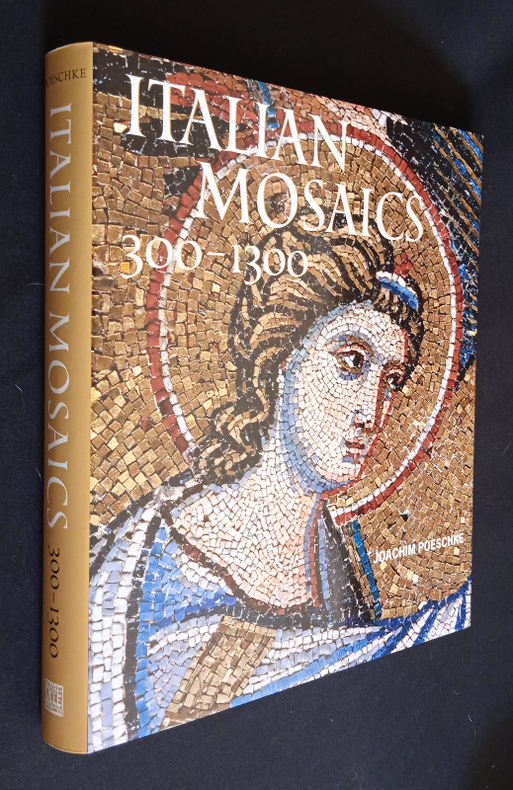
2010kk2691Abbeville press Cartonné avec jaquette 2010 Texte en anglais. In-4 (33 x 27,5 cm), relié, couverture cartonné avec jaquette en couleurs, 431 pages, iconographie en couleurs hors-texte ; très bon état général. Très bel exemplaire. Livraison a domicile (La Poste) ou en Mondial Relay sur simple demande.
66181aafUnesco, 1963, in-folio, 22 p. + XXXII colour plates, orig. half-cloth, with DJ.
19603729British Columbia: B.C. Hydro 1960. Sheet Map. At Least Very Good. Sheet No. 7 - with "Hunting Survey Corporation Limited / West Coast Division" printed at lower left margin - in B.C. Hydro's Columbia River Developments : Arrow Lakes series having "Date of Photography June-July 1960" stated at bottom right hand corner. Large photo map has a scale of 1 inch to 200 feet so offers an excellent view of the properties about to be flooded near Robson B.C. Note that the "Columbia River" is now designated as Lower Arrow Lake on most maps. A circa 1960 Aerial Photo-Map of Robson B.C. measuring overall 26 inches tall x 35-3/8 inches wide the printed area within the single border/neat line measures 25 inches tall x 24-1/4 inches wide. Map with light edge wear and a few short closed tears else clean and unmarked. Previously rolled. This aerial photo was produced by BC Hydro prior to the construction of the Hugh Keenleyside Dam originally named the High Arrow Dam the photos were then made into maps showing predicted flood elevations propertry lines and where the flood levels would rise to after closing the gates. A large historic aerial photo that allows many family properties to be seen prior to being submerged. "Originally two lakes 14 miles apart the Arrow Lakes became one 230 km long lake due to the reservoir created by the 1960s construction of the Keenleyside Dam; at low water the two lakes remain distinct connected by a fast-moving section known as the Narrows. Damming the Lower Arrow Lake resulted in water rising 12 metres above natural levels. As a result of higher water the valley lost 2/3 of its arable land. Thousands of people relocated." wiki accessed 04/21. B.C. Hydro unknown
_2.jpg)