[MOSAIC FLOORS].Biblio.com
34 résultats
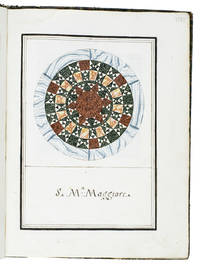
168222076Rome 1682. Contemporary boards covered with later ca. 1840 Storemont on shell marbled paper. Small folio 26 x 19.5 cm. 40 ink and watercolour drawings 28 round and 12 square each ca. 11 x 11 cm showing the decorative patterns and coloured marbles from the floors of 5 churches. Each has a triple-rule border in black ink with a panel at the foot containing the name of the church. A book of 40 detailed colour drawings showing the elaborate patterns in the mosaic marble tile floors of five different churches with eight examples from each church: Santa Maria Maggiore 1-8 Santi Giovanni e Paolo 9-16 San Marco 17-24 Sant' Alessio 25-32 and Sant' Ivo 33-40. All probably refer to the Roman churches of these names though the Basilica di San Marco in Venice also has elaborate mosaic floors. Some of the mosaics are in the Mediaeval Italian style called Cosmatesque but some may date from the Renaissance. Besides a wide variety of triangular square rectangular diamond hexagonal and octagonal tiles there are many cut with circular edges and a few irregular quadrilaterals. Some are assembled to form stars in a hexagonal grid round sunburst patterns and an endless variety of other patterns. All patterns show a rotational symmetry around the centre point or a repeating pattern in a square or hexagonal grid. The colouring of many of the tiles shows various styles and colours of marble veins.The drawings are difficult to date exactly. The leaves used for the drawings show a single paper stock very close to Piccard VI watermarks V.423 & V.424 Rome 1662. The drawings could have been made as early as ca. 1662 but the lettering of the names of the churches seems more likely to date from the 18th century. In 1752 Monsignor Giuseppe Alessandro Furietti a prelate from Bergamo published an illustrated book on mosaics from classical Rome to his own day: De Musivis Rome 1752. This marked a new interest in such antiquities but he illustrates mainly earlier examples and we find little link with the present examples which were probably drawn before his book appeared. With smudges on a few pages one slightly affecting the edge of one drawing but otherwise in very good condition with only a light marginal water stain in the last few leaves. The front hinge is broken and the spine and edges of the binding are somewhat tattered. Since many floor mosaics have been destroyed or damaged over the centuries the present book provides a unique historical record of some of the designs. hardcover
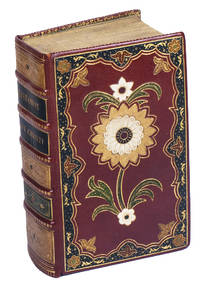
1696ABC_48370Antwerp 1696. 8vo. Hieronymus Verdussen for Niclaes Braau in Haarlem Exquisite 18th-century gold-tooled multi-colour morocco mosaic binding. The basis of the binding is red morocco the boards show a large flower executed in gold-tooled white green yellow and black morocco onlays with small brown morocco leaf shaped corner pieces within a cusped and scalloped gold-tooled double fillet frame. The outer frame is a gold-tooled black morocco onlay with detailed floral and leaf shaped gold-tooled brown and green morocco onlays. The binding is sewn on 5 supports with corresponding raised bands on the spine. The six compartments are beautifully decorated with gold-tooled yellow 1st 4th and 6th compartment black 2nd and 3rd and green 5th morocco onlays with the title lettered in gold on the black morocco of the 2nd and 4rd compartments the other compartments are show detailed gold-tooling and a small green or red morocco small circular onlay. Further with gold-tooling on the raised bands the head and foot of the spine the board edges and the turn-ins. Gilt edges and green silk covered end papers. With 39 detailed woodcut illustrations in the text and woodcut decorated initials and small printed manicules. The text is set in a Gothic letter with incidental use of Roman type. 1 1 blank 14 837 27 pp. Very rare late-17th-century Antwerp edition of the New Testament edited by Henricus van den Leemputte 1588-1657 in a magnificent 18th-century mosaic binding. The binding is made by or in the style of the French Parisian binders Le Monnier. "The delicate construction finesse of tooling and delineation and the fantasy of these bindings render them veritable jewels." see The History of bookbinding 525-1950 A.D. no. 456.Van den Leemputte was a highly educated cleric from a noble family in the Southern Netherlands. He held high offices within the diocese bishopric of 's Hertogenbosch. Aside from the present version of the New Testament first published in 1622 he wrote several treatises on the Holy Sacraments published 1624 and edited two works one manual for explaining the Holy Scripture and one defence of the Catholic church against the Reformed church.From the library of Carlo de Poortere 1917-2002 a director of the family tapestry business and a Belgian bibliophile with a large collection of 17th- and 18th-century book bindings and illustrated books from the 16th-20th centuries. It had previous been part of the collection of English Baptist minister and book collector Andrew Gifford 1700-1784. The "of the Museum" below his name in the engraved bookplate seems to refer to his position as assistant keeper of books and manuscript at the British Museum from 1757 until his death. Curiously he bequeathed his collection of books manuscripts pictures and other curiosities not to the British Museum but to the Bristol Baptist College. In the 1970s the Trustees of this college decided to sell all copies of the Gifford collection to pay for renovations to the chapel.With the gold-tooled red morocco bookplate of Carlo de Poortere on the verso of the blank fly leaf and a near contemporary engraved paper bookplate on the verso of the title-page possibly of Andrew Gifford 1700-1784. The binding shows minor signs of wear at the outer corners of the boards and spine otherwise it is in fine condition. The bottom outer corner of the first blank flyleaf and the title-page have been restored a slight water stain in the bottom margin of the first half of the work some occasional slight browning. Quire 24 has been mis-bound at the end of the work in quire 3H4 but the collation is complete. Otherwise in very good condition. A very rare late 17th-century edition of the New Testament in an exquisite 18th-century mosaic binding.l STCV 12918655 1 copy; USTC 1535523 1 copy same as STCV; WorldCat 66131050 4 copies including the STCV copy; cf. The history of bookbinding 525-1950 A.D. An exhibition held at the Baltimore Museum of Art November 12 1957 to January 12 1958 no. 456 plate XC. ABE CAT Art History ABE CAT Bibles Sermons & Psalmbooks hardcover
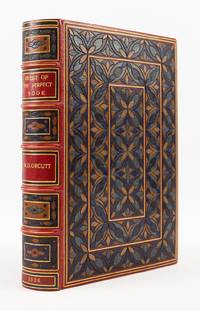
1926ST20086Boston: Little Brown & Co 1926. First Trade Edition. 228 x 160 mm. 9 x 6 1/4". 8 p.l. 316 pp. 1 leaf. <br/> SPECTACULAR MOSAIC MOROCCO BY CURTIS WALTERS signed in gilt on rear turn-in covers with animated repeating ogival pattern inlaid in several hues of morocco black navy blue light blue light brown and orange separated into three panels by thin strips of red morocco and gilt rules THE COVERS WITH APPROXIMATELY 662 INLAYS IN TOTAL raised bands spines compartments ruled in gilt and inlaid with a similar design gilt titling NAVY BLUE MOROCCO DOUBLURES bordered with strips of eggplant and red morocco and four gilt rules navy blue watered silk endleaves top edge gilt others trimmed on the rough. Housed in a marbled paper chemise with red morocco back and matching slightly worn slipcase.<br /> With color frontispiece and printed tissue guard 48 black & white plates one double-page specimen reproduction and numerous in-text illustrations and specimen page reproductions. With tipped-in "Compliments of the Author" leaf SIGNED by Orcutt. Clizbee "Curtis Walters American Binder" in "The American Book Collector" August September 1932 pp. 124-34 this binding pictured in the second plate. Copy included with this item. Very slight offsetting from plates and the odd trivial imperfection internally otherwise a fine copy IN AN IMMACULATE BINDING.<br/> <br/> This splendid mosaic binding is a tour-de-force of design and craftsmanship from an underappreciated American binder who specialized in this technique. The foreword to the 10 December 1957 sale catalogue of his bindings at Parke Bernet says that they "constitute a splendid group of American mosaic bindings such as have never been offered for sale before. . . . The description of bindings is always a difficult matter; it becomes practically impossible when one is faced by the stunning variety of complex patterns of colored mosaic inlays which Mr. Walters has assembled with infinite patience extraordinary skill and sophisticated taste . . . He has invented and brought to perfection a new technique whereby the most intricate inlaid designs can be achieved by a few simple tools without the use of dies or punches; gilt dots circlets and fillets are generally applied with restraint. . . . It need hardly be added that all of Mr. Walters' bindings are made of the very finest leathers available and that their workmanship reveals consummate craftsmanship down to the smallest detail." The present item was lot #25 in that sale. Walters became interested in bookbinding around 1900 and studied with such prestigious workshops as William Matthews the Club Bindery and Henry Stikeman. In "Hand Bookbinding in the United States Since the Civil War" Thompson tell us of Walters' work: "The infinite variety of design permitted by mosaic work is combined with Walters' marvelous delicacy in color schemes finely conceived geometric patterns and tasteful use of gold leaf to produce books that no Americans save perhaps the artists of the Club Bindery could have matched. The utter simplicity of Walters' methods he used but four tools belies his perseverance and devotion to his art. Only infinite patience and consummate skill could have produced Walters' bindings." The article by Azalea Clizbee in the accompanying copy of "The American Book Collector" describes Walters' technique for creating his mosaic bindings using only the simplest tools with plates depicting eight of his bindings including this one. Although very secondary here the text is appropriately a celebration of book arts--printing binding and illustration--by William Dana Orcutt 1870-1953 typographer printer and book designer. After graduating from Harvard in 1892 he went to work for the University Press there. He created several typefaces most notably "Humanistic" based on the humanist hand of 15th century scribe Antonio Sinibaldi. With Daniel Updike and Bruce Rogers he established the Boston Society of Printers in 1905. He was the author of several works on printing typography and the making of beautiful books. Little, Brown & Co unknown
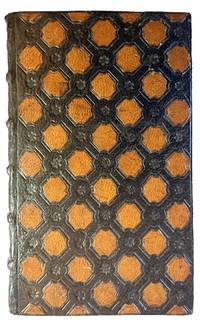
17083219Paris: Jacques Vincent for Jacques Estienne 1708. 2 parts in one 12mo binding 137 x 85 mm. 16 284 4 252 12 pages. Woodcut head- and tail-pieces and initial. Ruled in red throughout. At the end is a 4-page catalogue of books sold by Jacques Estienne. Bifolium g6-7 in part 2 bound in reverse order. Mosaic binding of black morocco probably ca. 1725-1735 covers with an all-over design of repeated concave-cornered lozenges of onlaid light brown morocco within a blind-tooled lattice design of double fillets and tiny six-petalled blossoms spine in six compartments five similarly decorated each with one onlaid lozenge second compartment with onlaid silver-tooled brown morocco lettering-piece doublures of dark brown morocco with silver-tooled arabesque roll border edges gilt over marbling rehinged upper joint chipping; modern suede-lined morocco folding box. Provenance: Paul-Louis Weiller 1893-1993 bookplate his sale Paris 30 Nov 1998 lot 32; modern booklabel “non nove sed nova" initials CL.<br /> <br /> A mosaic “tile†or tessellated binding attributable to Antoine-Michel Padeloup on a popular Jansenist devotional text. This unusual binding reverses the usual color scheme of the small corpus of similar known bindings providing a sober yet striking cover for the book.<br /> <br /> “Around 1707 mosaic work . began to be used in binding as it did in furniture and became the leading element in the design. These designs were now provided by onlay as opposed to the sixteenth-century use of paint and wax. Such mosaic work was either in a new form of the all-over semis now incorporating a framed structure so that it often resembled a tessellated pavement and was sometimes termed à répétition or with free-hand floral or other asymmetric realistic work†Barber Rothschild Waddesdon Manor catalogue p. 201. <br /> <br /> Tile-patterned mosaic bindings were usually used on small format books. Their invention is credited to the binder Antoine-Michel Padeloup or Padeloup le jeune 1685-1758 who bound for the entourage of the Regent Philippe II d’Orléans d. 1723. The height of the fashion for this style was probably the late 1720s and 1730s Barber p. 226. This style of decoration had the advantage of requiring little materiel. While “very labour-intensive the tile pattern style requires only a few tools all being common lines and curves `gouges’ and hardly any `figure’ that is expensive engraved tools. It would as such have suited under-capitalised younger binders. But such designs “clearly required careful planning and doubtless the preparation of a scaled plan based on both the exact size of the book and on the tools to be used†loc. cit. The present binding contains only one tool on the outer covers the small fleuron Waddesdon catalogue p. 384 fig. 11 and one roll which was also apparently used only on doublures Waddesdon catalogue I p. 436 RBT 8. <br /> <br /> Other tessellated mosaic bindings in this style all attributed to Padeloup are known: five of which three using the same tools are described and illustrated in the Waddesdon catalogue; another was reproduced by Michon and in the Esmérian catalogue. Those bindings use black or dark mororcco lozenges gold-tooled on a citron or light brown morocco ground with gold-tooled lattice-work creating a luminous effect. In contrast to those bindings here Padeloup reversed the color scheme: a black ground with restrained silver and blind tooling serves as background for the tile design of unadorned brown morocco lozenges. While visually striking the effect enhanced by the silver-bordered doublures is one of restraint no doubt intentional to reflect the book’s Jansenist content. <br /> <br /> Barbier Anonymes IV: 814. Giles Barber The James A. de Rothschild Bequest at Waddesdon Manor The National Trust: Printed Books and Bookbindings 2 vols. 2013; see nos. 90 91 92 93 and 572. Cf. Louis Michon Les reliures mosaïquées du XVIIIe siècle no. 89 = Bibliothèque Raphaël Esmérian II no. 89.<br /> <br /> <br /> (Jacques Vincent for) Jacques Estienne unknown
1901101718London: Printed by Edward Arnold for the Essex House Press under the care of C. R. Ashbee 1901. No. 229 of 250 copies. 12mo 6 x 4-1/2 inches. Title-page woodblock by T. Sturge Moore engraved initials. xiv 257 1 pp. text in black and red. Fine mosaic binding covers and four spine panels filled by a complex pattern of curved morocco inlays in four colors t.e.g. doublures with gilt-ruled inlaid borders silk endleaves by Curtis Walters signed on rear turn-in; fine in a custom half morocco chemise and morocco-tipped slipcase some old tape-strengthening to slipcase. A stunning perfectly preserved mosaic binding by the American binder Curtis Walters who specialized in such intricate and colorful mosaic bindings executed with an astonishing level of precision. This is one of a group of such bindings consigned by Walters to Parke Bernet and sold there 10 December 1957 lots 13-35 this lot 27.From the Park Bernet catalogue: "Mr. Walters was influenced to take up bookbinding around 1900 by the late George D. Smith eminent bookseller. Later he studied with Matthews the Club Bindery and Stikeman. He conceived his ideas about mosaic bindings as early as 1904 but between 1907 and 1928 he remained inactive. He has invented and brought to perfection a new technique whereby the most intricate inlaid designs can be achieved by a few simple tools without the use of dies or punches; gilt dots circlets and fillets are generally applied with restraint. Mr. Walters work has received wide recognition. Some of his early bindings are included in the Henry W. Poor collection and almost all of those offered for sale here have been exhibited in Paris 1930 New York Columbia University 1935 Hamburg Kunstgewerbeschule 1933-36 and Berlin 1936." Lawrence Thompson heaps further praise on Walters from "Hand Bookbinding in the United States Since the Civil War": "The infinite variety of design permitted by mosaic work is combined with Walters' marvelous delicacy in color schemes finely conceived geometric patterns and tasteful use of gold leaf to produce books that no Americans save perhaps the artists of the Club Bindery could have matched. The utter simplicity of Walters' methods he used but four tools belies his perseverance and devotion to his art. Only infinite patience and consummate skill could have produced Walters' bindings."Walter's bindings appear infrequently on the market this is a choice example of his artistry. Printed by Edward Arnold for the Essex House Press, under the care of C. R. Ashbee unknown
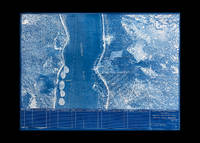
19603729British Columbia: B.C. Hydro 1960. Sheet Map. At Least Very Good. Sheet No. 7 - with "Hunting Survey Corporation Limited / West Coast Division" printed at lower left margin - in B.C. Hydro's Columbia River Developments : Arrow Lakes series having "Date of Photography June-July 1960" stated at bottom right hand corner. Large photo map has a scale of 1 inch to 200 feet so offers an excellent view of the properties about to be flooded near Robson B.C. Note that the "Columbia River" is now designated as Lower Arrow Lake on most maps. A circa 1960 Aerial Photo-Map of Robson B.C. measuring overall 26 inches tall x 35-3/8 inches wide the printed area within the single border/neat line measures 25 inches tall x 24-1/4 inches wide. Map with light edge wear and a few short closed tears else clean and unmarked. Previously rolled. This aerial photo was produced by BC Hydro prior to the construction of the Hugh Keenleyside Dam originally named the High Arrow Dam the photos were then made into maps showing predicted flood elevations propertry lines and where the flood levels would rise to after closing the gates. A large historic aerial photo that allows many family properties to be seen prior to being submerged. "Originally two lakes 14 miles apart the Arrow Lakes became one 230 km long lake due to the reservoir created by the 1960s construction of the Keenleyside Dam; at low water the two lakes remain distinct connected by a fast-moving section known as the Narrows. Damming the Lower Arrow Lake resulted in water rising 12 metres above natural levels. As a result of higher water the valley lost 2/3 of its arable land. Thousands of people relocated." wiki accessed 04/21. B.C. Hydro unknown
Annette Damm, edNot in perfect condition. unknown
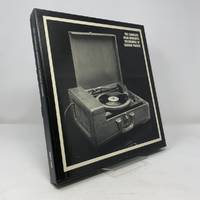
1990360366Mosaic Records 1990. FIRST EDITION. Paperback. Very Good/No Jacket. First Edition First Printing. Published by Mosaic Records 1990. Folio. Three CDs in box. Book is very good with brochure catalog #18 and booklet left inside. Great copy of this CD and catalog set on music. 100% positive feedback. 30 day money back guarantee. NEXT DAY SHIPPING! Excellent customer service. Please email with any questions. All books packed carefully and ship with free delivery confirmation/tracking. All books come with free bookmarks. Ships from Sag Harbor New York. Mosaic Records paperback
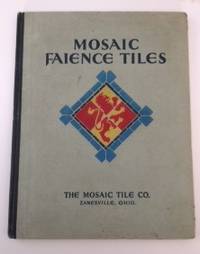
28547Zanesville OH: The Mosaic Tile Co. 1929. Small 4to. cloth backed decorative boards hardcover; 79 pages; 20 pages in color and 50 pages in black and white; edgeworn covers else a very good tight clean copy. <br/><br/> Zanesville, OH: The Mosaic Tile Co. (1929) hardcover
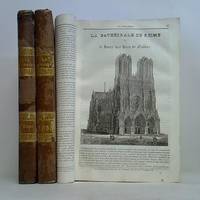
5L1307Decourchant Paris 1833-1836. Seite 17-418/416 Seiten 28 Seiten fehlen/5 408 Seiten mit zahlreichen Illustrationen in Holzstich Halbleder-Einbände der Zeit mit goldgeprägtem Rückentitel quart ein Rücken stark berieben und angeplatzt sowie mit Fehlstellen/sonst berieben und fleckig/Band 1 Seite 1-16 fehlt/Band 2 Seiten 57/58 99-143 155/160 179/180 und 227/228 fehlen. - sonst altersgemäße Exemplare / Text französisch / 1833 erschien die erste Ausgabe von "La Mosaique - Livre de tout le monde et tout le pays". Die kommerziellen Erfolge in England und Frankreich auf dem Sektor der Pfennigpresse ermutigten den Pariser Buchhändler und Verleger Martin Bossange Père 1766-1865 in Leipzig ein deutsches Pendant zu gründen zumal Bossange in der Messestadt bereits eine Niederlassung unterhielt die von J. J. Weber geleitet wurde. Im Mai 1833 erschien die erste Ausgabe des deutschen "Pfennig-Magazins". 1855 wurde das Magazin eingestellt - unknown
48198504like new. unknown
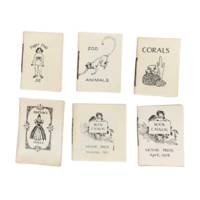
19836681Cincinnati: Mosaic Press 1983. First editions. 6 Vols miniatures generally 2.5x2cm various paginations. Illustrations in each. Bound with a single staple in illustrated wraps. Fine condition. <br /> <br /> Nice set of early titles from the Mosaic Press of Cincinnati publishers of fine miniatures which was founded in 1977 by Miriam Owen Irwin. Each is charmingly illustrated and with text legible by magnifying glass. Mosaic Press unknown
2090502113702571Not Available N.A. Soft Cover. Fine. The book is in fine condition. Not Available paperback
1998DBS-9780138885533Prentice Hall 1998. 2nd. Hardcover. New. Prentice Hall hardcover
1998DBS-9780138885533Prentice Hall 1998. 2nd. Hardcover. New. Prentice Hall hardcover
2009125223MSSX 2009-06-22. audioCD. Like New. 5x5x1. 3 cd set with booklet in slip case. Please email for photos. MSSX unknown
1999SKU1020230Moses Brown School 1999. Hardcover. Very Good. Moses Brown School; Providence 1999. Hardcover. Near Fine tight binding interior and extremities tidy minimal use/handling marks without Dust wrapper. A nice clean and unmarked copy. 4toquarto or approx. 9.5 x 12 inches 160pp. color and b&w illustrations. We pack securely and ship daily with delivery confirmation on every book. The picture on the listing page is of the actual book for sale. Additional Scans are available for any item please inquire. Moses Brown School hardcover
2007SONG0742540138Rowman & Littlefield Publishers 2007-12-07. paperback. Used: Good. 6.05x0.58x9.00. Buy with confidence. Excellent Customer Service & Return policy. Rowman & Littlefield Publishers paperback
2007DADAX0742540138Rowman & Littlefield Publishers 2007-12-07. paperback. New. 6.05x0.58x9.00. Buy with confidence. Excellent Customer Service & Return policy. Rowman & Littlefield Publishers paperback
2300030225.Gpaperback. Good. Access codes and supplements are not guaranteed with used items. May be an ex-library book. paperback
0428130089.Gpaperback. Good. Access codes and supplements are not guaranteed with used items. May be an ex-library book. paperback
2009251024011MSSX 2009-06-22. audioCD. Good. 5x5x1. VG Complete set. Slight wear on the box MSSX unknown
5L1306Philippe Libraire Paris 1838. 412 Seiten mit einem Frontispiz und über 200 Illustrationen in Holzstich Halbleder-Einband mit goldgeprägtem Rückentitel quart Einband berieben/Frontispiz mit kleinen Fehlstellen und ebenso wie die ersten fünf Seiten wasserrandig/fünf Seiten mit kleinen Wurmspuren ohne Textverlust/Seite 105/106 mit kleinem Ausriß und geringem Textverlust/durchgehend kleine Stockflecken. - sonst altersgemäßes Exemplar / Text französisch / 1833 erschien die erste Ausgabe von "La Mosaique - Livre de tout le monde et tout le pays". Die kommerziellen Erfolge in England und Frankreich auf dem Sektor der Pfennigpresse ermutigten den Pariser Buchhändler und Verleger Martin Bossange Père 1766-1865 in Leipzig ein deutsches Pendant zu gründen zumal Bossange in der Messestadt bereits eine Niederlassung unterhielt die von J. J. Weber geleitet wurde. Im Mai 1833 erschien die erste Ausgabe des deutschen "Pfennig-Magazins". 1855 wurde das Magazin eingestellt - unknown
0365750646.Gpaperback. Good. Access codes and supplements are not guaranteed with used items. May be an ex-library book. paperback
0282927875.Gpaperback. Good. Access codes and supplements are not guaranteed with used items. May be an ex-library book. paperback