411 résultats
Axel Steensberg and GrithNot in perfect condition. unknown
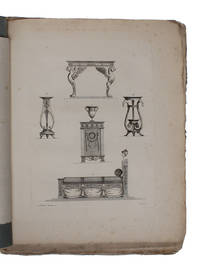
18903212Paris 1890. Oblong folio 395 x 260 mm. 135 drawings of ornate furniture in lead and watercolor highlighted in gum arabic on 104 leaves of heavy paper later pencil foliation including four mounted drawings on tinted paper and two smaller loose drawings one of the latter signed A. Archambaut del. both with notes of measurements and pattern or stock numbers the second with specifications of colors and material. No. 93 a bed apparently unfinished. Foxing and soiling to first and last leaves occasional light foxing elsewhere marginal soiling especially to first few leaves fol. 104 detached two drawings on fols. 15 and 25 with small abraded areas 5 other drawings with tiny abrasions or white flecks the rest of the drawings in fine condition. The drawings on guards bound in half shagreen and pebble-grained cloth rubbed spine gilt lettered “Album Meubles Fantaisies.â€<br /> <br /> A spectacular manuscript album of watercolor designs of colorfully decorated painted and inlaid furniture in Louis XV Louis XVI and Second Empire styles by a female artist and furniture designer.<br /> <br /> Depicted are commodes large and small tables desks cabinets wardrobes sideboards dressers armchairs mirrored stands stands holding manicure sets multi-drawered sécrétaires beds clocks and even bellows and brooms for the chimney. Most are highly ornate and include colorful painted or inlaid decoration meticulously rendered often in minute detail by the artist-designer. With their cabriole legs serpentine curves and lavish inlay and marquetry these delightful creations express to a sometimes impractical degree the late 19th-century vogue for Louis XV and Louis XVI-style furniture. <br /> <br /> The artist can be identified as Aline Anne Archambault née Carrausse 1847-1908 thanks to the one signed drawing  loosely inserted which matches stylistically those of the album. The only child of the Paris furniture designer Jean Marie Carrausse Archambault moved in artistic and artisanal circles: in 1877 she married Arthur Eugène Archambaut a graveur ciseleur or engraver of luxury metalwork; the four witnesses at their marriage were his uncle a sculptor; his cousin a printer; and two friends identified respectively as a printer and a furniture maker this information from Geneanet.org. The Victoria and Albert Museum holds six furniture drawings by her also signed with her first initial and last name and a few lithographs after her one of the drawings V&A accession number E.284-1952 has an additional printed signature “P. Levant Carrausse del.†clearly a member of her family. Since Aline was married and died in the 4th arrondissement in Paris it is likely that this album was created there. <br /> <br /> The title on the binding “Album of Furniture Fantasies†implies that at least some of the pieces were not intended to be built: they abound in bright colors and witty details such as the tree-branches wrapping around two basket stands fol. 17 or the wildly ornate bed with which the album ends. While the element of fantasy in these accomplished paintings is thus clear many probably did function as specimens of furniture that could be ordered from members of the artist’s entourage of furniture makers. This is evident from the two inserted drawings both of chests of drawers which have measurement notes and stock numbers. One has the inkstamped name “G. Cauvet†on the verso.<br /> <br /> The archival records indicate that Aline lost a daughter in infancy in 1877 when she was 30. She had no other children. The ebullient drawings in this album betray no hint of tragedy and it is tempting to view them as a work of youth before shadows arrived to dim the joy of creation.<br /> <br /> “The best known of the nineteenth-century revivals was that for Louis XV and Louis XVI furniture. The Louis XV revival intensified during the Second Empire when it departed so much from the 18th-c. prototype that it is best called `Rococo’.†H. Osborne ed. The Oxford Companion to the Decorative Arts 1988 p. 359 unknown
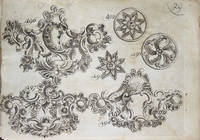
17402420Augsburg: Johann Jacob Haid & son 1740. Six tall narrow folio-sized engravings with etching platemarks 400 x 207 mm. sheets 435 x 277 mm. deckle edges unsigned but by Jacop Wangner after Watteau numbered 1-6 in the plate at lower right imprint at lower right I. Haid et filius excudit A. V. Augustae Vindelicorum. Upper edges archivally tipped to mats. Fine.<br/> <br/> A perfectly preserved suite of six large rococo engravings reproducing Watteau's paintings for a folding screen intended to be cut out by ladies for use in furniture decoration. <br /> <br /> Watteau's influence on 18th-century decorative arts throughout Europe by way of the many engravings after his work published by Gersaint has long been recognized but the use of the engravings as actual sheets to be cut up and applied to household objects has garnered little attention until recently. The vogue for decoupage probably first appeared in the late seventeenth century and by the 1720s the hobby of cutting out colored prints for application to various household objects and pieces of furniture was all the rage in France Germany and beyond. The process which remained a favorite pastime throughout the eighteenth century was known as la découpure in French as Ausschneidekunst in German and as lacca contrafatta or lacca povera in Italian although "the latter term appears to be a true misnomer considering the amount of minute work involved" Kisluk-Grosheide p. 83. It consisted of neatly cutting out hand-colored engraved or woodcut motifs or figures applying them to a textile or sometimes cardboard ground and varnishing them. These creations were applied to furniture as well as to "screens folding screens wall hangings ceilings the tops of coaches and sedan chairs" loc. cit. affording a passable imitation of Asian lacquer. The craze which created a goldmine for certain print publishers reached the point that bibliophiles and collectors were warned to keep a vigilant eye on their most precious books prints and paintings lest eager young ladies attack them with scissors. <br /> <br /> In 1728 six engravings after Watteau's paintings for a folding screen were commissioned by the art collector Jean de Julienne as part of a vast program of reproductions of Watteau's painted oeuvre. They were engraved by Louis Crépy fils and published by the Paris marchand-mercier art dealer and print publisher Edmé-François Gersaint. An announcement of their upcoming publication in the November 1727 Mercure de France explicitly described them and two other Crépy-Watteau engravings as "marvelously appropriate for decoupages with which ladies these days make such pretty furniture" Crépy grave actuellement six morceaux en hauteur . d'après un Paravant peint par Watau dont les compositions sont très-galantes. De pareils sujets peints sur des fonds blancs conviennent à merveille aux découpures dont les Dames font aujourd'hui de si jolis meubles Mercure de France 1 Novembre 1727 p. 2492 digitized on Gallica. Indeed the publisher himself highlighted this usage in his own note in a later issue of the Mercure cited by Glorieux p. 212: pointing out that all of the decorative motifs in the Watteau engravings were "most useful for painters fan-makers sculptors goldsmiths tapestry-weavers embroiderers etc." he added that "all these ornaments can be perfectly used in decoupage" tous ces ornements réussissent parfaitement en découpure. <br /> <br /> These and other rococo engravings were quickly taken up by German publishers especially in Augsburg Metken p. 102. This paravent folding screen suite was one of the first of the Watteau engravings to be copied in Germany. The present very close reverse copies of Crépy's six plates appeared in Augsburg only a few months after their publication in June 1728 in Paris: engraved by Jacob Wangner or Wagner ca. 1703-1781 they were published by the heirs of Jeremias Wolff in 1729. This set is an otherwise unrecorded reissue of the Wangner copperplates. A lavishly decoupage-decorated secretary in the collections of the Metropolitan Museum of Art includes cutouts that were almost certainly from these Augsburg plates as they are from "reverse copies of the prints by Crépy" Kisluk-Grosheide p. 88 noting other examples of Augsburg copies of Watteau prints used on the same secretary. Her assertion that "it has not been shown that these engravings were actually used for this purpose" p. 84 is only applicable to the French plates. Indeed other examples of lacca povera objects described in her article point to the German production of copies of French rococo prints as the main source for decoupage at this time on pieces produced throughout Europe including in Italy and in France itself. <br /> <br /> The general title appears at the foot of the first plate. Each engraving presents a central figure or scene set within a frame of delicate rococo arabesques and ornaments. Three show the Comédie italienne figures of Pierrot Harlequin and Colombine a woman playing the lute on a rug-bedecked stage a pair of allegorical figures flanking an awning above and at bottom the smiling visage of a Commedia dell'Arte character of the opposite sex. The remaining pastoral scenes of courtship or douceur de vie are set within naturalistic elements two with streams flowing over a dripping shell-shaped basin or ledge under which a ghostly face can be dimly discerned. Watteau's designs were based on earlier designs by Claude III Audran decorative painter for Louis XIV at Versailles and Fontainebleau to whom Watteau had apprenticed. "After joining forces with ornamentalist Claude III Audran about 1708 he Watteau began inserting figures in Comédie-Italienne costumes into Audran's trademark arabesques" Judy Sund "Watteau's Pierrots Why so Sad" The Art Bulletin vol. 98 no. 3 2016 p. 325 reproducing the Pierrot panel from the present series. <br /> <br /> OCLC locates a single copy of the Wolff issue at the Bibliothèque nationale de France reproduced in Gallica. In the present issue of which I locate no other copies the engraver's signatures were removed. <br /> <br /> On the Wolff issue cf. W. Augustyn "Augsburger Buchillustration im 18. Jahrhundert" in Augsburger Buchdruck und Verlagswesen von den Anfangen bis zur Gegegenwart 1997 p. 820 citing E. Isphording Gottfried Bernhard Göz 1708-1774 1997 pp. 35 ff.; Thieme Becker 35:150. On the Crépy engravings cf. Guilmard Maitres ornemanistes p.145; Dacier & Vauflart Jean de Julienne et les graveurs de Watteau au XVIII. siècle 159-163; E. de Goncourt Catalogue Raisonné de l'Oeuvre . d'Antoine Watteau 1875 p. 224 nos. 309-314; G. Glorieux À l'enseigne de Gersaint: Edme-François Gersaint marchand d'art sur le Pont Notre Dame Paris 2002 pp. 189-192; Mark Millard Collection: French Books no. 170.35 5 of the 6 plates. On the use of these engravings for decoupage see: D. O. Kisluk-Grosheide "'Cutting up Berchems Watteaus and Audrans': A Lacca Povera Secretary at The Metropolitan Museum of Art" Metropolitan Museum Journal 31 1996 pp. 81-97; and S. Metken Geschnittenes Papier Munich 1978 pp. 101-2 & 113. Johann Jacob Haid & son unknown
1775315877Birmingham 1775. 92 copper plates of which four are folding on laid paper with crown and "GR" i.e. George Rex watermark some numbered in the plate with breaks from 2 to 145 prices in ink in manuscript. 1 vols. 4to. Some edge wear chipping. Housed n a quarter brown morocco clamshell box and chemise. 92 copper plates of which four are folding on laid paper with crown and "GR" i.e. George Rex watermark some numbered in the plate with breaks from 2 to 145 prices in ink in manuscript. 1 vols. 4to. A rare collection of copper plates of brass hardware for furniture likely manufactured in Brimingham in the last quarter of the 18th century. Includes doorknobs drawer-pulls hinges keyholes etc. in the rococo style. unknown
1830315876Birmingham 1830. 163 engraved plates irregularly numbered 1 to 278. 1 vols. Oblong 4to 13 x 9 inches. Quarter brown leather and boards with the same printed index B-W on front and back pastedowns. worn. 163 engraved plates irregularly numbered 1 to 278. 1 vols. Oblong 4to 13 x 9 inches. Rare engraved early nineteenth century brassfounder's trade catalogue with the manufacturer's name given usually not noted in such a work. While the actual catalogue appears to be ca. 1820-1830 some of the actual copper plates would appear to have been engraved somewhat earlier ca. 1800-1810<br /> <br /> Plates present :<br /> 111 17 19 26 29 31 33 37. 39 41 47 59 65 66 74 75 7980 84 86 90 9899 101 102 105111 112 116 117 118 125 128 129 130 131 132 134 136 137 138 140 141 142 143 145 147 149 152 163-190 192-196 199-203 205-222 224 226 227 230 230A 231 232 234 235 240 241 242 242A 243-248 248A 249 250 253 254-265 267-278. unknown
1519FURNITUR011798Eget F�rlag G�teborg. 1915-1916. First edition. Small quarto. Four volumes: 196 23 adverts; 198 23 adverts; 192 27 adverts; 192 31 adverts. Almost all the pages are devoted to photographs of the hugely prolific Otto Schultz's distinctive furniture designs which seem to take elements from the Arts and Crafts movement and blend them with the latest Art Deco ideas. Each volume has a short introduction by Schultz. Text in Swedish. Original hessian bindings stamped with titles in art deco type. Laid into the third and fourth volumes are eight-page pamphlets giving the dimensions of the various items. Otto Schultz went on to found the Boet interior design store in Gothenburg and ran the influential magazine of the same name.Ownership signatures on front endpapers of first volume. Titles on covers slightly flaking. A very good set indeed. Very scarce. Eget F�rlag, G�teborg. unknown
192046296Newton Highlands Massachusetts approx. 1920-1923. original three-ring binder. Some photographs detached from their mounts etc; some minor edgewear; binder dusty. 8-1/2 x 11 inches. Riley worked for the Heywood-Wakefield Company from approximately 1920-1923. He invented the "Riley Fibre Loom" and after selling the use of the loom for paper and reed fabric based applications to Heywood-Wakefield left in 1923 to form his own venture pursuing the technology with stranded metal applications. Included in the archive are copies of contracts agreements and licenses; numerous samples of various types of wicker weave and reinforced fabric for furniture; photographs of the inventor machinery looms and factories; and related drawings and other materials. unknown
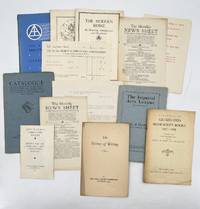
19008941<p>London: Various 1900. 50 books and pamphlets from the personal library of the furniture designer and high-end London shop-keeper Sir Ambrose Heal which reflect his love for the Arts and Crafts movement and his passion as a pioneer and champion of design. The collection reveals Heal's connections with many of the leading figures of the time with inscribed copies from his fellow furniture designer Hamilton Smith review copies of works by William Lethaby and his own copies of early publications by the Designs and Industries Committee which he had helped found. There are polemics by Clough Williams Ellis as well as obscure exhibition catalogues and reports several unrecorded from organisations that he supported and helped to run. Altogether a fascinating insight into the life of an influential taste-maker and businessman in England in the first half of the century who ran Heal and Son on Tottenham Court Road for 40 years and played an active role in cultural life in London and further afield. The collection includes: BOOKS 1 'The Caliph's Design Architects ! Where is Your Vortex' by Wyndham Lewis. First edition. First Impression. Scarce one of only 1000 copies produced. A printed label to the front cover. Original blue marbled wrappers over card worn away to spine panel. Internally in very good condition. Published by The Egoist Ltd. 2019. Laid in is a printed invitation from the Royal Society of British Artists requesting the company of Mr A Heal dated March 29th 1930. 2 GIFT TO HEAL FROM A FURNITURE DESIGNER 'The People's Album of London Statues'. Described by Osbert Sitwell. Drawn by Nina Hammett. Published by Duckworth London 1928. Ambrose Heal book plate to front paste down. Hand written pencil note to front free end paper reads 'Given to me by Hamilton Smith Christmas 1928' - Hamilton Temple Smith was a fellow furniture designer with whom Heal shared a patent. Brown cloth boards with decorative embossing to front in good condition. Contains black and white illustrations throughout. Clean pages and illustrations with light tanning and mild foxing. 3 'England and the Octopus' by Clough Williams Ellis. 1928. Boards and internally in good condition. All that remains of dust jacket is front cover which has been excised neatly and laid in. An influential polemic against urban sprawl. 'Heal' inscribed in pencil to front paste down. 4 'Britain Must Rebuild A Policy for Regional Planning' by Frank Pick. Published by Kegan Paul. In good condition. 'Ambrose Heal' written in pencil across front board. Front free end paper inscribed 'Ambrose Heal Nov '41'. 5 GIFT TO HEAL 'Henry Irving'. The Vellum Parchment Shilling Series. No III. Published by Field & Tuer. By William Archer. In good condition. Annotated 'HH from C.C.B. '92'. 6 'Guinevere' by Alfred Lord Tennyson. Illustrated by Byam Shaw. Published by TC & EC Jack. Pocket book. Inlaid decorative gift card reads 'From Philip Carr To Mr Ambrose Heal'. 7 'Cosmic Vision' by TJ Cobden Sanderson. First Edition 1922. Blue cloth covered boards a little worn to edges end papers and text clean. b/w frontispiece protected by dust sheet in very good condition overall throughout. 8 'Lettering in Ornament' by Lewis F Day. First Edition 1902. Good copy in the original title-blocked cloth. 218 pp. 9 'William Richard Lethaby 1857-1931'. Published by Central School of Arts and Crafts 1957. First Edition. Hardcover. Boards a little discoloured. Text block sound overall in good condition. 86 pp. Laid in is a compliments slip from the Principal of London County Council. 10 REVIEW COPY 'Art and Handicraft' by John D Sedding. First Edition 1893. Green cloth covered boards with gold titles. Edges and spine sunned /darkened but in very sound condition. End papers clean some foxing text clean throughout. Inlaid is a printed note from Kegan Paul Trench Trubner & Co. To the reverse is a faint pencil drawn sketch of a building with tree in foreground. 11 'Handicrafts and Reconstruction. Notes by Members of the Arts & Crafts Exhibition Society'. Published for John Hogg. 1919. 139 pp. Original green cloth boards frayed to edges. Internally in good condition leaves age toned throughout. 12 'The Attribute Proper to Art: Pure Art Value' by Thomas Henry Lyon M.A. Brown card wrappers in good condition. Front free end paper inscribed 'Ambrose Heal from J H Lyons. April 20th 1932' presumably a family member related to the Cambridge architect and designer Thomas henry Lyon. PAMPHLETS AND BOOKLETS DESIGN & INDUSTRIES JOURNAL: Heal co-founded the Design and Industries Association which aimed to encourage greater design values within industrial production. 15x DIA journals news sheets and lecture booklets dated variously between 1919 1927. Includes Booklet Number One 'The Future Of Industrial Design' by Herbert Read with other contributions by Anthony Bertram and John Grey and William Lethaby's Art and Workmanship - all very scarce. Laid in is an overdue subscription reminder payable to The Design & Industries Association dated July 1925 made out in hand to Mr Ambrose Heal who in 1915 had helped to found the Association DIA 2 'A Note Regarding Script Types' by Douglas C McMurtie. Published by Press of Ars Typographica New York 1925.32 pp. In very good condition throughout. Ambrose Heal book plate to inner front wrapper. 3 Annual Reports of the Committee of the Art-Workers' Guild dated 1926 1929 & 1935. In very good condition. 4 3x pamphlets published by The Civic Arts Association dated 1927. Titled 'On Medals On Inscriptions Lest We Forget'. In good condition. 5 'The Future of the Past by John Leighton'. Programme for a production dated AWG Revels 1924. Card wrappers darkened and bumped to edges Text clean and unmarked. Catalogue for a production of 'The Statue of Artemis' signed 'with compliments from John Leighton'. Card wrappers. In fair condition. 6 2x pamphlets titled 'The History of Writing' from The Ideal Home Exhibition Olympia 1934. In good condition. 7 Oxford Copy Books x2 unused. 8 Mermaid Society 1903 programme for a production of 'Comus'. Card wrappers bound by orange string to spine. Age worn leaves foxed overall in good condition. Unrecorded programme for a performance in Regent's Park which included Mrs Beerbohm Tree in the cast. 9 Der Zwiebelfisch x2 dated 1909. In good conditiom. 1 x Kultur des handwerks Dec 1926. 10 'Undescribed Copy Books in the Ekstrom Collection Svenska Skolmuseet Stockholm' by Carl Bjorkbom. Inscribed to front ' With compliments from the author'. Inlaid is a signed letter to Mr Heal from Carl Bjorkbom. 11 The Statue of Artemis Shrovetide Revels Art Workers' Guild 1919 inscribed 'With Compliments John Leighton' - Master of the Art Workers' Guild. 12 Catalogue of a Book Exhibition at the Central School LCC 1912 elaborately annotated by Heal to the rear. A further collection of pamphlets which include exhibitions members lists Imperial Arts League 1915 listing Heal's membership annual reports and catalogue lists for various societies and arts organisations. Please contact Christian White Rare Books Ltd for more information or images of this item 1900</p> Various hardcover
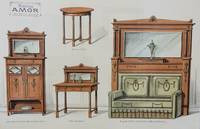
19123220206<p><em>Oblong folio 318 x 472 mm 88 chromolithograph illustrated pages; only occasional light spotting; original cloth-backed flexible boards imitating cloth front cover printed in bronze colour; spine worn a few marks.</em></p><p>The furniture house Grocholesky situated in a small town near Hildesheim in Lower Saxony offered entire suites for living- dining- and bedrooms mainly in art nouveau style however still including the odd piece of historicist design for the more conservative buyer.</p><p>The large and beautiful illustrations show suites of furniture with the measurements on each page; the furniture suitably decorated with modernist vases and mantelpiece decorations on display on dressers shelves and cupboards to give customers an idea of design potential.</p><p>gProvenanceg: Inscribed on the rear inside cover by a citizen of Bockenem at a later date and with stamp and release stamp by a local museum.</p> Bockenem: Grocholesky, Printed by H. W. & C., Berlin.
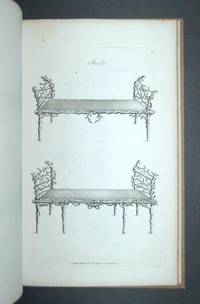
39829London: Printed for I. & J. Taylor at the Architectural Library 1793. 8vo 227 x 140 mm etched throughout 25 plates including pictorial title which is slightly spotted 7 of the plates have some minor purple crayon over colouring or lettering modern boards endpapers renewed. Often credited to William Wrighte due to his earlier publication of 1767 entitled Grotesque Architecture although there is no evidence for his authorship. The vogue for this style of garden furniture designed to resemble tree roots or entwined branches began in the 1750's but it was first made truly practical at the time of this issue with the introduction of decorative cast iron. This rare pattern-book being the only one wholly devoted to the rustic styles depicting chairs benches tables mirrors and chimney-pieces. RIBA 3932; ESTC locates copies at BL RIBA National Trust V&A and Massachusetts Institute of Technology. London: Printed for I. & J. Taylor, at the Architectural Library, [1793?] hardcover
189356869Salem OR: Buren & Hamilton 1893-1904. 4to. 90 mylar sleeve leaves unnumbered. containing 403 invoices shipping & waybills TLS ALS TL copy letters and more many of which appear on steel-engraved letterhead many printed on colour-tinted paper often shipping and weight bills still retaining original stamps a few mailing envelopes a number of check receipts many w/ manuscript and stamped autographs others w/ corrections and/or annotations in ink or pencil; also included are actual samples of velvet fabrics wallpapers and textured colour sample papers printing sample for perforated business card. All preserved in recent 3-ring cloth binder stamping on front cover. An exceptional archive of original letters invoices waybills business cards and receipts all documenting the thriving business of Buren & Hamilton at the end of the Gilded Age and beginning of the Progressive Era in Salem Oregon in the aftermath of the 1893 economic crash. Drawing from suppliers in California just a few years before the San Francisco Earthquake & Fire the company also sourced from Seattle WA New York and Chicago. Portland was the manufacturing and industrial hub of Oregon as can be seen in these invoices and receipts: such companies as The Columbia Chair Company Dealers who sold chairs office chairs and rockers from 309-311 Front St. shipped rocking chairs and office chairs to Salem in 1903; Henry Jenning & Sons located at 172-174 First St. shipped a load of leather oak chairs in 1903; J.G. Mack & Co. located at 86 & 88 Third St. in Portland supplied velvet rugs oil cloths and lamp shades in 1903; while the A. Merle Co. and McCord & Work located on Water St. supplied brass and iron bed frames the same year. Buren & Hamilton also sourced mattresses and sacks of recycled denim cotton “Shoddy†from Peters & Roberts Furniture Co. for mattresses; and purchased often from the Portland Mattress & Upholstery Co. at 18-20 Front St. which supplied wool-combed coverings mattresses mattress tops from 1900-1904 -- their factory would be gutted by fire in 1907. Many of the items were shipped down the Willamette River on the Oregon City Transportation Co. ships with a note from 1904 indicating the company had completed a sale of odd sized mattresses to them; numerous Southern Pacific Oregon Division freight bills; as well as a shipment on the SS Oregonian via the American-Hawaiian Steamship Co. of five crates of chair seats from Marshall Field & Co.In addition it appears that Oregonians in and around Salem purchased heavily from the store luxury goods such as beveled mirrors framed artwork sleek wallpapers velvet fabrics tapestries oriental rugs and more. Many of the invoices letters waybills and documents record many items supplied by the storied W.P. Fuller & Co. of San Francisco & Sacramento CA as well as their subsidiary in Portland OR. They were main suppliers of beveled and mirrored glass on the Pacific Coast which often had to be imported from England into the U.S. and several of the orders in 1899-1901 note that the company was having issues supplying such pieces to Buren & Hamilton due to labor difficulties finally sourcing mirrors from Pilkington Bros. English Picture Glass. They occasionally canceled orders and the Fuller Co. writes in 1901 over a canceled order of “deadening felt.†The W.P. Fuller Co. explain that “your reasons for wishing to cancel your order are not considered sufficient to justify us in doing so . . . †and that they were aware that “some of our competitors are circulating unjust and untrue reports concerning us all the time.†Included amongst these letters are samples of cotton backing for carpets and even three original samples of wallpaper. There are also present a number of letters and invoices from the firm of Tozer & Son which took over the W.P. Fuller Wallpaper division about 1901 with letters present making that announcement. Of additional interest are the many invoices letters and waybills back and forth with the storied Schussler Bros. on 119-121 Geary St. Star King Building in San Francisco detailing many of the popular framed and matted photographs and images for Salem shoppers. These encompassed the “Lone Indian†which were often reproductions of the iconic End of the Trail sculpture by James Earle Fraser; Athletes Dutch Windmills Shakespeare prints of assorted types and sizes Lone Arab a Chinese print a boxing series of matted “Deal of a Fellow†Madonna Artotypes -- typically reproductions of Raphael’s Madonna and Taber art photos. Many of the letters bill heads and invoices sport steel engraved architectural vignettes documenting buildings which would be destroyed in the 1906 San Francisco Earthquake & Fire as well as many of the business records for those companies. One of the freight bills bears the photographic letterhead of the Chicago & North-Western Railway Co. dated 1904. Another significant supplier was the D.N. & E. Walter & Co. of San Francisco which supplied linoleum flooring fabrics and more for Buren & Hamilton from 1899-1904 and even includes in one of the letters a piece of the red velvet fabric they no longer carried.Buren & Hamilton was originally founded in the late 1880’s by A.T. Yeaton as a furniture/undertaker business later sold to A.B. Buren and finally sold to Max O. Buren and Clarence Hamilton who operated at three locations along Commercial St. including Greenbaum’s Building at 298 Commercial the building at 136 Commercial 340 Court St. now Sid’s Furniture. Clarence bought out Max Buren’s shares in 1916 becoming the C.S. Hamilton Furniture Co. and operating until it was sold to Rubenstein’s in the 1960’s. See: Norma Hamilton Cochran Historic Businesses -- Hamilton Furniture Salem History Matters March 17 2017; New Stationery Department of Schussler Brothers San Francisco The American Stationer Vol. LIV 1903 pp. 4-5; John Caldbick Panic of 1893 and its Aftermath HistoryLink Essay 20874 Oct. 1 2019. Buren & Hamilton, hardcover
60314Leipzig Industrie-Comptoir 1810. 4to 330 x 265 mm. Two hefts both uncut in the original printed wrappers with publisher's titel-label pasted on to front wrapper. Wear to extremities and Heft 11 missing spine and front wrappers detached and back wrapper partly detached. Internally with light brownspotting throughout. Heft 10: 1 pp. 10 plates; Heft 11: 1 pp. 9 plates. <br/><br/><em>First edition Heft 10 and 11 being the last two in the series of this exceedingly rare work with illustrations on furniture of all kinds. Only one complete copy is known In the Victoria and Albert Musem </em> unknown
1920H16553Kiel & Milwaukee WI: Kiel Furniture Co 1920. Near Fine. 5 catalogs oblong quarto wraps each about 13 x 10 inches very good plus to near fine condition 64 to 96 pp. each illustrated throughout some in subtle browntone occasional plates in color with occasional price lists and inserts. Products include dining room suites tables library tables desks stools tabourettes pedestals and "novelties." The Kiel Furniture company was founded in 1882 and employed German-American immigrants in the small town of Kiel and has been in business ever since now under the name A. A. Laun Furniture Company named for the younger brother of J. B. Laun one of the original presidents of the company who took over as vice president and general manager in 1916. The types of products featured in these catalogs reflects both the tastes of their clientele mainly middle-income Midwestern households but also reflects the Stickleyesque influence of Arts & Crafts and Mission style furniture. Searching the OCLC database we could find NO copies of any of these particular Kiel Furniture catalogs in institutions; the earliest Kiel catalog we could find institutionally is a 1925 catalog of furniture a single example of which is in the Wisconsin state historical archives. Lightest wear and soil. Kiel Furniture Co unknown
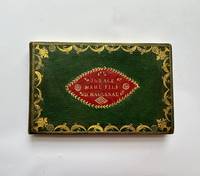
18074044<p>A charming book toy where an early user has converted a book into a book box housing a secret compartment for notes and correspondence. The compartment houses eight blank sheets which have been cut to size and then had their edges gilded. Any sent letters are by definition no longer present but nor alas are any billet doux received. The binding itself itself is dated 1807 and the supralibris gives the ownership of the book as 'Ignace Mehl fils d'Haguenau'.</p>
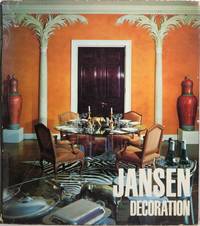
197119316Paris: Société d'études et de publications économiques 1971. 1st. Hardcover. Very Good/Very Good. 11.2x10.0x1.0in. dust jacket with tear to front panel. Dust jacket in clear protector. <br>The first monograph on this Parisian design house. Illustrations in color and in black and white. Text in French and English. <br>240pp 3.65lb 11.2x10.0x1.0in Société d'études et de publications économiques hardcover
200429353Paris: Éditions de la Réunion des Musées Nationaux 2004. 1st. Soft cover. Near Fine. 10.6x8.3x1.1in. faint stain on top edge of text block. <br>The catalogue of the First Empire furniture in the Museum at Fontainebleau. 410 objects are described and almost all are illustrated in black and white in some cases with additional photographs. In addition 16 of the objects are illustrated by full-page color plates. Text in French. <br>458pp 3.46lb 10.6x8.3x1.1in Éditions de la Réunion des Musées Nationaux paperback
200722366London: Christie's 2007. 1st. Soft cover. New. 11.7x9.0x2.0in. 2 volumes. <br>The catalogues for an auction that didn't take place when Prince Charles raised the money to buy the collection for the nation. A superb reference for authentic Chippendale furniture in two volumes: 368 pages in volume 1 and 346 pages in volume 2. 634 lots are described and illustrated in color. <br>714pp 9.26lb 11.7x9.0x2.0in <br>EXTRA SHIPPING CHARGES NECESSARY Christie's paperback
199214255Paris: Michel Aveline Editor 1992. 1st. Hardcover. New/New. 13.2x9.5x1.1in. in shrinkwrap. <br>Alberto Pinto 1945-2012 was a French interior designer of considerable acclaim. This is the first monograph on Pinto highlighting the first 20 years of his work. Exquisite photographs illustrate some of the sumptuous interiors he created including his own apartment in Paris. <br>301pp 4.74lb 13.2x9.5x1.1in Michel Aveline Editor hardcover
193449765Tokyo æ±äº¬: Koyosha Henshubu 洪洋社. 編輯部 1934. First edition. Spiral_bound. vg- to vg. Quarto. 3pp. 20pp. 2. Spiral-bound illustrated red black and white wrappers. Volume 13 of the scarce series of Japanese photographic surveys on modernist furniture. At least 16 volumes were known to have been published between 1932 and 1934. This volume is the second part following vol.11 which focuses on the furniture and decorative furnishings from Japanese cafes during the early 1930s. The first three pages contain text captions in numerical order followed by 20 plates of beautifully printed b/w photogravure images of the furniture. The final two pages contain publishers advertisements.<br /> <br /> Text throughout in Japanese.<br /> <br /> Wrappers with some light staining and smudges to the wrappers. Light rubbing to extremities. Back cover with chipping to the bottom left corner as well as some small closed tears along the spiral binding and the left side. Interior with some light smudging and some sporadic minor to light water stains throughout mostly in the margins with images mostly still clean and bright. Wrappers and in very good- interior in very good condition overall. Koyosha Henshubu (洪洋社. 編輯部) unknown
1816315888Paris: Hamelin-Bergeron 1816. Second expanded edition. xxxii-50 i.e. 509; xi-1-542 pp. Atlas: first 8 plates with 9 hand-coloured figures per plate of wood grains; IX-XXXIX; Atlas Tome II LVII plates some folding. 96 plates in all. 3 vols. 4to atlas; 8vo text. Contemporary quarter tan calf rubbed. Signed by the publisher opposite opposite title page of volume 1 and along title page margin as receipt of purchase for 60 fr. Text and plates clean and fresh. Atlas vol. rebacked preserving spine. Second expanded edition. xxxii-50 i.e. 509; xi-1-542 pp. Atlas: first 8 plates with 9 hand-coloured figures per plate of wood grains; IX-XXXIX; Atlas Tome II LVII plates some folding. 96 plates in all. 3 vols. 4to atlas; 8vo text. Second edition of the definitive contemporary work on the lathe originally published in 1792-96. The illustrations show wood turning machinery and tools finished products and hand-colored depictions of 72 varieties of wood grain. Brunet I-785; Ogden Bibliography of Turning item 27 Hamelin-Bergeron unknown
189852137North La Crosse WI; Chicago IL; Detroit MI; Blawnox PA; Cambridge MA; Grand Rapids MI; Augusta ME: A.F. Spettel 806 Caledonia St.; Perkins 125 South 4th Street for the North La Crosse Reed & Rattan Works La Crosse Reed Furniture Works; Ford & Johnson Co.; Wolverine Reed Co.; Fibre Furniture; J.L. Hammett Co.; Grand Rapids Fibre Cord Company; Needlecraft Publishing Co. 1898-1929. First -- 11 sepia-tinted cabinet photos 2 albumen 9 photos of printed images embossed photographer’s name at lower edge of cabinet card a few w/ pencil & ink pricing & inventory information on backs minor dustsoiling edgewear; 2nd -- 25 original linen-backed photographs some sepia-tinted sized from 5 x 7 in. up to 6.5 x 8.5 in. nearly all the larger size nearly all w/ pencil & ink pricing annotations furniture descriptions and a few w/ La Crosse Reed Furniture Work stamp on verso soiling edgewear some creasing minor fraying; 3rd -- Oblong 8vo. 95 1 pp. photo plates throughout burgundy-coloured softcovers gilt lettering stamped on front chipping head & foot of spine soiling edgewear wear to corners preserving part of original mailing envelope dated 1910 to North La Crosse Reed & Rattan Works; 4th -- 8vo. 78 pp. Photo-illustrated throughout w/o self-printed softcovers some soiling edgewear; 5th -- Oblong 8vo. 64 pp unpaginated with photo illustrations throughout beige printed softcovers lettering in gray & black on front cover soiling edgewear rubbing wear to corners; 6th -- 8vo. 40 pp. photo plates & text illustrations beige softcovers printed in decorative red black & orange on front cover minor dustsoiling edgewear thumbing; 7th -- 4to. 48 pp. Photo-illustrated title photo text illustrations throughout decorative printed borders Beige softcovers yapp edges Arts & Crafts cover art in gray green & brown on front cover lettering in black silver & red minor shelfwear rubbing preserving original price list and order forms in rear; 8th -- 4to. 23 1 pp. text and photo illustrations throughout self-printed colour-illustrated softcovers minor tear head of spine edgewear creasing still G copy stapled as issued all from the collection of Erma Wilson Multhauf of Cedar Falls IA and noted rattan furniture restorer who purchased the material from the La Crosse Reed Furniture Works when it went out of business after World War II. This amazing salesman sample photo archive for the North La Crosse Reed & Rattan Works and the La Crosse Reed Furniture Works provide an indispensable visual record of reed and rattan wicker furniture produced and sold in Wisconsin during the Arts & Crafts era. Wicker furniture experienced a tremendous rise in popularity during the last decades of the 19th century with many manufacturers producing items in Wisconsin and other Midwest States and the domestic reeds used by American manufacturers proved especially flexible and were more capable of being painted or stained while Rattan was harder to weave and could only be shellacked. The cabinet photos by Spettel and Perkins include images of high-backed fancy Victorian rockers a foot stool magazine rack sewing basket a Turkish chair a round table and several other wicker rocking chairs. Spettel 1866-1935 was brought into his brother Clement Spettel’s photography studio in 1886 because his business was so popular and they would thrive in North La Crosse WI until 1906 when Aloysius moved his business to North Dakota. The business location on 806 Caledonia was established by the brothers in 1888 and was initially called the New Gallery then the National Art Studio and sometime around 1897-98 it was simply A.F. Spettel while Clement worked at 320 North 4th on the City’s south side. Of particular interest is the “Perkins†Studio Cabinet photo as there is no known other example of a Perkins photographer at that location although that studio location served eight other known photographers between 1888 and 1900. The collection of factory linen-backed photographs depict a wide variety of Victorian rattan furniture including wing-back chairs & rockers stacking children’s stools children’s high chair rocker sewing baskets waste baskets and more. Nearly all of them have inventory numbers and prices on verso some individually priced others priced by the dozen ranging from $ 2.75 to $ 8.50. The Ford & Johnson Fiber-Rush and Malacca furniture catalogue includes a wide range of Mission-style and Arts & Crafts period furnishings including tables library tables settees rockers and more. The Art Fibre Weaving catalogue not only includes excellent photographic images of wicker furniture but also images of fibre art weaving classes schools and equipment. See: Edwin L. Hill A History of Photography in La Crosse Wisconsin 1853-1930 pp. 160-170 175; Raether Wisconsin Family Albums & Photographers’ Imprints and Biographies 1800s to early 1900s pp. 315-316; George M. Brown The White Directory of Manufactures of Furniture and Kindred Goods of the United States pp. 20-21; Tracing the Trends of Wicker Furniture Through History Patio Productions 2014. A.F. Spettel, 806 Caledonia St.; Perkins, 125 South 4th Street for the North La Crosse Reed & Rattan Works, La Crosse Reed Furni paperback
200924684Oslo: H. Aschehoug & Co 2009. 1st. HC. New/New. 13.4x11.1x1.2in. Helene Hennie is one of Norway's most successful interior architects. In 2007 she was elected Designer of the Year by the internationally renowned magazine Andrew Martin Interior Design Review. <br>6.03lb 13.4x11.1x1.2in <br>EXTRA SHIPPING CHARGES NECESSARY H. Aschehoug & Co hardcover
187858315Paris: V.L. Quetin ca. 1878. Oblong 4to. 11.5 x 7.75 in. 1 leaf lithograph title 94 i.e. 110 lithographed plates 1 leaf of index on blue-tinted paper stock. Quarter-green leather over pebbled green cloth raised bands embossed borders in blind gilt lettering on spine minor scuffing & wear rubbing bumping & wear to couple corners w/o ffep. still VG- copy w/ bright plates from the library of Victor Colas 256 13d Voltaires Paris notation on front marbled pastedown. A well-illustrated printer’s specimen book issued to depict the varieties of Second Empire French furniture featuring styles such as Louis XV Louis XVI and the decorative styles of Napoleon III’s designers. Victor Joseph Quetin 1822-1877 was an entrepreneurial printer who began producing these Furniture style books for Parisian craftsmen cabinetmakers and would sell these volumes of specimen sheets to manufacturers to show their prospective clients. The furnishings shown in these leaves encompass tables chairs toilettes some with bidets built in many with attached mirrors bed frames armoires buffets desks and desks with built-in bookcases. The index which is often missing provides an excellent quick reference to the styles types of furnishings as well as the specific plate. Demand increased as Paris & France underwent tremendous renovations and progress during the Second Empire and many of the furnishings inspired by the designs of Carlin Weisweiler and Riesener were presented to the public at the 1867 Exposition Universelle. His son Victor Leon Quetin b. 1852 would later in the 1870’s take up the family business released the albums under a new imprint of “V.L. Quetin†and also began issuing colour chromolithograph specimen catalogues of elaborate draperies bed curtains window treatments and casements. Also issued was a newspaper Journal le magasin de meubles†which offered details of the specimen catalogues he would assemble subscriptions and pricing with details on colour lithography and hand-colouring as well. His designs were dependent upon using a specialized machine which would enlarge reduce or even alter lithographic designs for clients. See: Victor Quetin De la papeterie a la lithographie D’Avoise a Meung-sur-Loire en passan par les Moulins de Paillard 16e-18e siecle; Alfred Lemercier La lithographie francaise de 1796 a 1896 et les arts qui s’y rattachent: manuel pratique p. 344. V.L. Quetin, hardcover
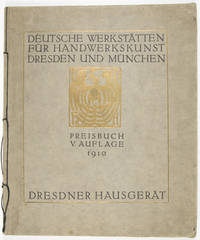
190922111Preisbuch V. Auflage 5. Auflage 12.-17. Tausend Fifth edition 12th-17th thousand 1909. Softcover. vg. 4to. 1002pp. Gold-stamped wraps with decoration string protected in modern mylar. Title-page with emblem of the "Deutsche Werkstätten für Handwerkskunst." Rare work on "Dresdner Hausgerät" a cost-effective program designed to manufacture furniture which was easy to assemble in a variety of shapes and forms. Each plate with exact measurements of the pieces depicted. Most of the furniture shown after designs by Prof. Richard Riemerschmid and Prof. Adelbert Niemeyer. Also includes price list with difference in cost depending on type of wood used. Price list loose as issued. Creasing and minor staining on wraps. Top right corners of title-page and third page expertly repaired. Some numbers handwritten in pencil by previous owner to margin of some pages. Text in German. Wraps in good interior in very good condition. Scarce. Preisbuch V. Auflage, 5. Auflage, 12.-17. Tausend (Fifth edition, 12th-17th thousand) unknown
1905002413Chicago: A. J. Johnson & Sons Furniture Company 1905. First Edition. Very good. Trade catalog n. d. ca 1905; oblong folio 18 1/4 x 13; pp. 58 recto only; textured olive wraps 1/4 cloth and large rivets as published; a small cut to cloth on spine; wraps with a few spots to margins and nicks and cuts along edges of paper; faint vertical crease; numerous sepia-tone illustrations; very good condition. A beautiful lavish trade catalog for the A. J. Johnson & Sons Furniture Company - established in 1869 and known for manufacturing luxury furniture. Each page featured an entire suite ie. beds bureau chifforette vanity foot stool etc. the materials the pieces were made of Mahogany Walnut the style of the furniture Queen Anne Hepplewhite William and Mary and the dimensions. A. J. Johnson & Sons Furniture Company hardcover