8 853 résultats
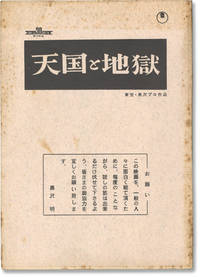
1962160922Tokyo: Toho / Kurosawa Productions 1962. Draft script for the 1963 Japanese film. Text and titles in Japanese.<br /> <br /> A legendary Japanese noir based on American author Ed McBain's 1959 novel "King's Ransom." A wealthy industrialist is contacted by a gang of crooks who inform him that they have kidnapped his son and are holding him hostage in exchange for an enormous ransom. The industrialist soon realizes however that the boy they have taken is in fact the son of his chauffeur-and must decide whether he will bankrupt himself and his family in order to save a child that is not his own. A nuanced portrait of a man facing the potential destruction of his future further elevated by morally ambiguous characters and the gritty realism of its world. The fifteenth and penultimate film that leading actor Toshiro Mifune would make with director Akira Kurosawa and one of the highest grossing Japanese films of 1963 breaking Kurosawa's box office record for the third time.<br /> <br /> Shot on location in Kanagawa Japan. <br /> <br /> White titled perfect-bound wrappers dated 1962 with a protective titled dust jacket. Approximately 94 leaves with last page of text numbered e-37. Mimeograph duplication printed on rectos and versos. Pages Very Good plus wrapper Very Good plus with light foxing on the top and bottom page edges. Jacket Very Good with moderate foxing on the extremities.<br /> <br /> Criterion Collection 24. Grant Japan. Selby Japan. Spicer Japan. Toho / Kurosawa Productions unknown
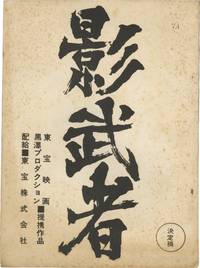
157439Yokohama Kanagawa: Kurosawa Production Co 1980. Draft script for the 1980 Japanese film. <br /> <br /> The story of a low-class criminal taught to be the decoy or kagemusha of a dying feudal lord based on the historical daimyo Takeda Shingen and depicting the 1575 Battle of Nagashino in the cinematic climax. <br /> <br /> When Toho Studios could not afford to complete the film George Lucas and Francis Ford Coppola convinced Twentieth Century Fox to cover the shortfall in exchange for international distribution rights recieving credits as executive producers on the finished film. Nominated for two Academy Awards including Best Foreign Language Film and winner of the Palme d'Or at the 1980 Cannes Film Festival. <br /> <br /> Set in Sengoku period shot on location in Iga Ueno Castle Himeji Castle Kumamoto Castle Yuhara Plain Hokkaido Japan. <br /> <br /> White perfect-bound wrappers. Rubber stamped copy No. 74 at the top right corner of the front wrapper. 166 leaves with last page of text numbered "146." Mimeograph duplication. Pages Near Fine with light toning wrapper Very Good with foxing overall and age toning to the page edges. <br /> <br /> Criterion Collection 267. Kurosawa Production Co unknown
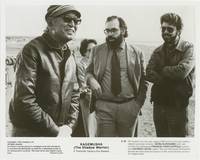
1980163675N.p.: Toho Company 1980. Three vintage photographs from the 1980 film two film still photographs and a photograph of director Akira Kurosawa on the set with executive producers Francis Ford Coppola and George Lucas. <br /> <br /> The story of a low-class criminal taught to be the decoy or kagemusha of a dying feudal lord based on the historical daimyo Takeda Shingen and depicting the 1575 Battle of Nagashino in the cinematic climax. <br /> <br /> When Toho Studios could not afford to complete the film Coppola and Lucas convinced Twentieth Century Fox to cover the shortfall in exchange for international distribution rights receiving credits as executive producers on the finished film. Nominated for two Academy Awards including Best Foreign Language Film and winner of the Palme d'Or at the 1980 Cannes Film Festival. <br /> <br /> Set in Sengoku period shot on location in Iga Ueno Castle Himeji Castle Kumamoto Castle Yuhara Plain Hokkaido Japan. <br /> <br /> 8 x 10 inches. Near Fine. <br /> <br /> Criterion Collection 267. Toho Company unknown
1992148720Tokyo: Dentsu Music and Entertainment 1992. Draft script for the 1993 film.<br /> <br /> Based on essays by Hyakken Uchida. Following World War II a retired professor finds late in life that his quality of life is greatly reduced in war-torn Tokyo. Denying despair he pursues writing and celebrates his birthday with a group of his adoring students. <br /> <br /> Yellow titled wrappers perfect-bound dated 1992.11.5. 107 leaves with last page of text numbered 197. Xerographic duplication printed on rectos and versos. Pages Fine wrapper Near Fine. Dentsu Music and Entertainment unknown
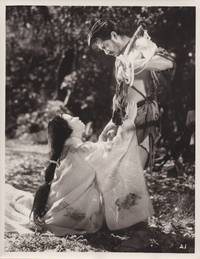
1950166097N.p.: N.p. 1950. Four vintage double weight satin-finish reference photographs from the 1950 Japanese film. Provenance labels and annotations in manuscript ink and pencil on the verso.<br /> <br /> Few foreign language films have made such a lasting impact on American audiences as director Akira Kurosawa's "Rashomon" a revolutionary cinematic work in terms of style and substance that challenged audiences about the nature of subjective experience. Winner of an honorary 1951 Academy Award for Most Outstanding Foreign Language Film Released in the United States and credited for being the reason the Academy created the "Best Foreign Film" category. <br /> <br /> Shot on location in Kyoto Nara and Tokyo Japan. <br /> <br /> 10 x 8 inches. Near Fine. <br /> <br /> Criterion Collection 138. Grant Japan. Ebert II. Vogel Film as a Subversive Art. N.p. unknown
1963148710Tokyo: Kurosawa Production Co 1963. Draft script for the 1965 Japanese film preceding the release by nearly two years. Text and titles in Japanese. <br /> <br /> Based on Shugoro Yamamoto's short story collection "Akahige Shinryotan." Toshiro Mifune's final film with director Akira Kurosawa considered one of the director's masterpieces following a small-town doctor and his new intern a highly educated arrogant young man. <br /> <br /> Set in the Edo district of Koishikawa.<br /> <br /> White titled wrappers with a blue titled dust jacket. Title page present dated 1963. 65 leaves with last page of text numbered g-17. Mimeograph duplication rectos only. Pages Very Good plus wrapper Very Good plus with light foxing to the rear wrapper with perfect binding. Jacket is Very Good plus with light foxing to the fore-edges and rear panel. Kurosawa Production Co unknown
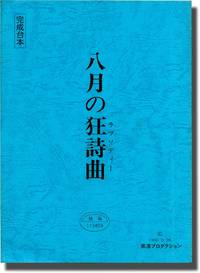
143465Tokyo: Shochiku Films 1990. Draft script for the 1991 film dated May 28 1990 about a year before its release. <br /> <br /> A tale of three generations in a postwar Japanese family and their responses to the atomic bombing of Japan. When the film played at the Tokyo Film Festival critics of Japanese militarism said Kurosawa had ignored the historical facts leading up to the bomb. Kurosawa's response was simple: he wanted his film to say that war was between governments not people. Richard Gere plays one of the family's Asian-American cousins a decision falling somewhere between stunt casting and commentary. <br /> <br /> Set in Nagasaki and shot on location there. <br /> <br /> Blue titled wrappers dated 5.28.1990. Title page present. 166 leaves with last page of text numbered 150. Mechanical duplication. Pages Near Fine wrapper Near Fine. <br /> <br /> Rosenbaum 1000. Shochiku Films unknown
1949143058Tokyo: Film Art Association 1949. First Draft script for the 1949 Japanese film noir. Manuscript ink and pencil annotations from production on two leaves. Text in Japanese. <br /> <br /> Generally considered to be the greatest film noir made in Japan and hugely influential on American film noir of the 1950s and 1960s. <br /> <br /> White titled wrappers. 96 leaves with last page of text numbered 96. Mechanical duplication. Toning due to aging throughout wrapper split at spine with mild foxing otherwise Good condition. <br /> <br /> BFI 534. Criterion Collection 233. Grant Japan. Selby Japan. Spicer Japan Classic Noir. Film Art Association unknown
19621487061962. Draft script for the 1963 film. Text and titles in Japanese.<br/><br/>A legendary Japanese noir based on American author Ed McBain's 1959 novel "King's Ransom." A wealthy industrialist is contacted by a gang of crooks who inform him that they have kidnapped his son and are holding him hostage in exchange for an enormous ransom. The industrialist soon realizes however that the boy they have taken is in fact the son of his chauffeur-and must decide whether he will bankrupt himself and his family in order to save a child that is not his own. A nuanced portrait of a man facing the potential destruction of his future further elevated by morally ambiguous characters and the gritty realism of its world. The fifteenth and penultimate film that leading actor Toshiro Mifune would make with director Akira Kurosawa and one of the highest grossing Japanese films of 1963 breaking Kurosawa's box office record for the third time.<br/><br/>Shot on location in Kanagawa Japan. <br/><br/>White perfect bound wrappers dated 1962 with a protective titled dust jacket. 189 leaves with last page of text numbered e-37. Mimeograph duplication printed on rectos and versos. Book Very Good plus with light foxing to the page edges and light offsetting to the front and rear wrapper. Jacket Very Good plus with light foxing to the extremities and two small nicks to the spine ends.<br/><br/>Criterion Collection 24. Grant Japan. Selby Japan. Spicer Japan. unknown books
1948151633Tokyo: Toho Company 1948. Draft script for the 1948 Japanese film. Text and titles in Japanese.<br/><br/>The first of sixteen film collaborations between director Akira Kurosawa and actor Toshiro Mifune. Kurosawa's seventh film saw him exploring the inter workings and motivations of the yakuza and machismo. Censorship was tight regarding the occupation forbidding American criticism leading Kurosawa to slip in references to the US presence in Japan satirizing jazz "pan pan" girls unlicensed prostitutes catering to American soldiers and Western clothing and hairstyles.<br/><br/>Set in the slums of postwar Japan.<br/><br/>White titled wrappers. Approximately 40 leaves with last page of text numbered 79. Mimeograph duplication printed on rectos and versos. Pages Very Good plus wrapper Very Good plus covered in a protective plastic wrapping from when the script was used during filming side stapled. <br/><br/>BFI 638. Criterion Collection 413. Grant Japan. Toho Company unknown books
1990143465Tokyo: Shochiku Films 1990. Draft script for the 1991 film dated May 28 1990 about a year before its release. <br/><br/>A tale of three generations in a postwar Japanese family and their responses to the atomic bombing of Japan. When the film played at the Tokyo Film Festival critics of Japanese militarism said Kurosawa had ignored the historical facts leading up to the bomb. Kurosawa's response was simple: he wanted his film to say that war was between governments not people. Richard Gere plays one of the family's Asian-American cousins a decision falling somewhere between stunt casting and commentary. <br/><br/>Set in Nagasaki and shot on location there. <br/><br/>Blue titled wrappers dated 5.28.1990. Title page present. 166 leaves with last page of text numbered 150. Mechanical duplication. Pages Near Fine wrapper Near Fine. <br/><br/>Rosenbaum 1000. Shochiku Films unknown books
1980143208Yokohama Kanagawa: Kurosawa Production Co 1980. Draft script for the 1980 Japanese film. Holograph pencil annotations throughout regarding casting including the use of professional or amateur actors as well as a notation regarding lead actor Katsu Shintaro who was fired on the first day of shooting. <br/><br/>The story of a low-class criminal taught to be the decoy or kagemusha of a dying feudal lord based on the historical daimyo Takeda Shingen and depicting the 1575 Battle of Nagashino in the cinematic climax. <br/><br/>When Toho Studios could not afford to complete the film George Lucas and Francis Ford Coppola convinced 20th Century Fox to cover the shortfall in exchange for international distribution rights receving credits as executive producers on the finished film. Nominated for two Academy Awards including Best Foreign Language Film and winner of the Palme d'Or at the 1980 Cannes Film Festival. <br/><br/>Set in Sengoku period shot on location in Iga Ueno Castle Himeji Castle Kumamoto Castle Yuhara Plain Hokkaido Japan. <br/><br/>Criterion Collection 267. Kurosawa Production Co unknown books
1963148710Tokyo: Kurosawa Production Co 1963. Draft script for the 1965 Japanese film preceding the release by nearly two years. Text and titles in Japanese. <br/><br/>Based on Shugoro Yamamoto's short story collection "Akahige Shinryotan." Toshiro Mifune's final film with director Akira Kurosawa considered one of the director's masterpieces following a small-town doctor and his new intern a highly educated arrogant young man. <br/><br/>Set in the Edo district of Koishikawa.<br/><br/>White titled wrappers with a blue titled dust jacket. Title page present dated 1963. 65 leaves with last page of text numbered g-17. Mimeograph duplication rectos only. Pages Very Good plus wrapper Very Good plus with light foxing to the rear wrapper with perfect binding. Jacket is Very Good plus with light foxing to the fore-edges and rear panel. Kurosawa Production Co unknown books
1949143058Tokyo: Film Art Association 1949. First Draft script for the 1949 Japanese film noir. Holograph ink and pencil annotations on two leaves. Text in Japanese. <br/><br/>Generally considered to be the greatest film noir made in Japan and hugely influential on American film noir of the 1950s and 1960s. <br/><br/>White titled wrappers. 96 leaves with last page of text numbered 96. Mechanical duplication. Toning due to aging throughout wrapper split at spine with mild foxing otherwise Good condition. <br/><br/>BFI 534. Criterion Collection 233. Grant Japan. Selby Japan. Spicer Japan Classic Noir. Film Art Association unknown books
1952149482Tokyo: Toho 1952. Collection of four vintage oversize borderless reference photographs and one vintage reference photograph from the 1952 Japanese film. One with a stamp noting the name of actor Takashi Shimura to the bottom right corner of the verso. <br/><br/>A mid-level government bureaucrat discovers he has terminal cancer and decides to try to find meaning in life before his death. The first collaboration between director Akira Kurosawa and screenwriter Hideo Oguni beginning a decade-long involvement which would produce among many others "Seven Samurai" 1954 "Throne of Blood" 1957 and "The Hidden Fortress" 1958.<br/><br/>Set and shot on location in Tokyo. <br/><br/>Four photographs 10 x 8 inches one photograph 6.5 x 5 inches. Very Good plus one photograph with light foxing on the verso. <br/><br/>BFI 591. Criterion Collection 221. Ebert I. Rosenbaum 1000. Toho unknown books
1952149622Tokyo: Toho 1952. Vintage oversize reference photograph from the 1952 Japanese film showing director Akira Kurosawa adjusting the lid of a teapot while actors Takashi Shimura and Miki Odagiri look on. With the stamps of Forum Film and Israel Film Archive on the verso.<br/><br/>A mid-level government bureaucrat discovers he has terminal cancer and decides to try to find meaning in life before his death. The first collaboration between director Akira Kurosawa and screenwriter Hideo Oguni beginning a decade-long involvement which would produce among many others "Seven Samurai" 1954 "Throne of Blood" 1957 and "The Hidden Fortress" 1958.<br/><br/>Set and shot on location in Tokyo. <br/><br/>11 x 9 inches. Very Good with light scuffing and edgewear throughout.<br/><br/>BFI 591. Criterion Collection 221. Ebert I. Rosenbaum 1000. Toho unknown books
1970148810Tokyo: Toho 1970. Draft script for the 1970 Japanese film. With holograph ink and pencil annotations to the rear wrapper and throughout the text. Included with the script is a mimeographed shooting schedule. Text and titles in Japanese. <br/><br/>Annotations relate to the following: a names of the chosen cast members b set rehearsals and camera rehearsals c times for shooting e.g. Morning Afternoon Evening and Night phone numbers for production personnel d names of potential and/or hired camera assistants e names of potential and/or hired actors f indication of the production company chosen Toho Corporation as well as film stock and lense sizes to be used g additional notes regarding location of some settings h changes to dialogue and action and h some final post-production notes.<br/><br/>Director Akira Kurosawa's first color film based on Shugoro Yamamoto's 1962 novel "Kisetsu no nai machi" A City Without Seasons. A series of vignettes about a slum in the suburbs of Tokyo and its impoverished inhabitants. Nominated for an Academy Award for Best Foreign Film.<br/><br/>Set and shot on location in Tokyo.<br/><br/>Script:<br/><br/>White titled wrappers. Title page present. 90 leaves with last page of text numbered d-37. Mimeograph duplication printed on rectos and versos. Pages Very Good plus wrapper Very Good with perfect binding.<br/><br/>Schedule:<br/><br/>White titled wrappers. 13 leaves with last page numbered 23. Mimeograph duplication printed on rectos and versos. Pages Very Good plus wrapper Very Good with a faintly toned spine and very faint foxing to the fore-edge side-stapled with two staples.<br/><br/>Detailed notes with translation of annotations noted above with accompanying images are provided with the script. Toho unknown books
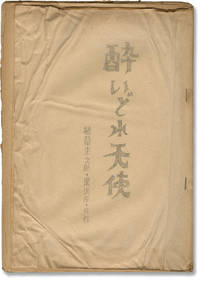
1992148720Tokyo: Dentsu Music and Entertainment 1992. Draft script for the 1993 film.<br/><br/>Based on essays by Hyakken Uchida. Following World War II a retired professor finds late in life that his quality of life is greatly reduced in war-torn Tokyo. Denying despair he pursues writing and celebrates his birthday with a group of his adoring students. <br/><br/>Yellow titled wrappers perfect bound dated 1992.11.5. 107 leaves with last page of text numbered 197. Xerographic duplication printed on rectos and versos. Pages Fine wrapper Near Fine. Dentsu Music and Entertainment unknown books
1960143066Tokyo: Kurosawa Production Company 1960. Shooting script for the legendary 1961 Japanese film. Working copy belonging to Omura Senkichi who played a small role as a traveling servant in the film with his name on the front wrapper and his annotations throughout. <br/><br/>Though not credited as such based thematically on Dashiell Hammett's 1929 novel "Red Harvest" and subsequently the basis for many other films including "A Fistful of Dollars" Sergio Leone 1964 "Django" Sergio Corbucci 1966 and "Last Man Standing" Walter Hill 1996. Director Kurosawa has been quoted as saying that many plot elements from another Hammett novel "The Glass Key" make up the film. <br/><br/>All titles and text in Japanese. <br/><br/>White perfect bound wrappers with purple and black titles. 164 pages printed on recto and verso right to left in the Japanese style with last page numbered "d-33." Mechanical duplication. Light foxing and age toning to both pages and wrapper else Very Good condition. <br/><br/>BFI 505. Criterion Collection 52. Ebert III. Grant Japan. Kurosawa Production Company unknown books
1985149056New York: Greenwich Film Productions 1985. Draft script for the 1985 film. With holograph pencil annotations throughout. Text titles and annotations in Japanese.<br/><br/>Based on Shakespeare's play "King Lear." An elderly warlord in medieval Japan divides his vast empire among his three sons. The power corrupts them and turns them on each other as well as their father. Nominated for four Academy Awards including Best Director for Kurosawa winning one. <br/><br/>Set in medieval Japan shot on location in Kumamoto Shizuoka Himeji Oita Aichi Yamagata and Tokyo Japan. <br/><br/>Bright blue titled wrappers. Title page present. 96 leaves with last page of text numbered 176. Xerographic duplication printed on rectos and versos. Pages Very Good plus wrapper Very Good plus with a lightly faded spine perfectly bound. Greenwich Film Productions unknown books
049457Istanbul. Soft cover. Very Good. Original autograph letter signed as 'Sadi' sent to Vasfi Riza Zobu. 1 p. In Ottoman script. Letterhead 'Ferah: Sinema-varyete-tiyaro'. Dated 31-12-1929 Istanbul. It starts as 'Muhterem Vasfi Riza bey'. Used black ink with fountain pen. It's a letter of appeal. Vasfi Riza Zobu was born on December 5 1902 in Constantinople Ottoman Empire. He was an actor known for Karim beni aldatirsa 1933 Ankara postasi 1928 and Milyon avcilari 1934. He died on November 23 1992 in Istanbul Turkey. Aktör Sadi started his art career as a theater actor. He appeared on the stage at school along with Muvahhit actor husband of paintress Bedia Muvahhit writer Refik Halit Karay and Refi 'Cevat Ulunay. After the proclamation of the Second Constitutional Monarchy he started the professional theater company which was founded by Resat Ridvanand the playwright Ibnürrefik Ahmet Nuri Sekizinci. Bican Efendi series in which he played the title role after the WW 1 was accepted from the first comedy of Turkish cinema history. <br/> <br/> paperback
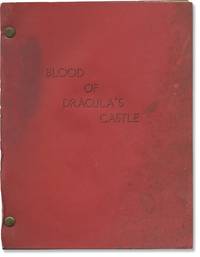
1969167422Los Angeles: Paragon Pictures 1969. Draft script for the 1969 film.<br /> <br /> Count Dracula and his wife are alive or undead and well in modern-day Arizona where they use their hunchbacked butler to capture and kill young girls allowing them to drink their victims' blood in martini glasses as Bloody Marys. A humorously campy entry in the Dracula canon produced by noted exploitation studio Crown International Pictures.<br /> <br /> Set in Arizona shot on location in Lancaster California. <br /> <br /> Red titled wrappers. Title page present undated. 93 leaves with last page of text numbered 92. Mimeograph duplication rectos only. Pages Very Good wrapper Good moderately soiled and dampstained on the left and right sides bound with two gold brads. Paragon Pictures unknown
1956150115Los Angeles: Paramount Pictures 1956. Vintage promotional reference photograph of Al Capp from the 1956 film. "Culver Pictures Inc." and "131242" stamps and two later date "Culver Pictures Inc." labels on verso.<br /> <br /> Based on the 1954 Broadway play "King of Hearts" by Jean Kerr.<br /> <br /> Al Capp famed cartoonist for his long-running satirical comic strip "Li'l Abner" portrays himself in a cameo role as well as providing promotional art for the film.<br /> <br /> Divorced comic strip cartoonist Francis X. Dignan Bob Hope is hired as a ghost-writer for the pompous fiance George Sanders of his ex-wife Eva Marie Saint. <br /> <br /> Set in Port Huron Michigan and New York City. <br /> <br /> 8 x 10.25 inches. Very Good with creasing primarily to margin. Paramount Pictures unknown
1956150115Los Angeles: Paramount Pictures 1956. Vintage promotional reference photograph of Al Capp from the 1956 film. "Culver Pictures Inc." and "131242" stamps and two later date "Culver Pictures Inc." labels on verso.<br/><br/>Based on the 1954 Broadway play "King of Hearts" by Jean Kerr.<br/><br/>Al Capp famed cartoonist for his long-running satirical comic strip "Li'l Abner" portrays himself in a cameo role as well as providing promotional art for the film.<br/><br/>Divorced comic strip cartoonist Francis X. Dignan Bob Hope is hired as a ghost-writer for the pompous fiance George Sanders of his ex-wife Eva Marie Saint. <br/><br/>Set in Port Huron Michigan and New York City. <br/><br/>8 x 10.25 inches. Very Good with creasing primarily to margin. <br/><br/>Complete collation details available on request. Paramount Pictures unknown books
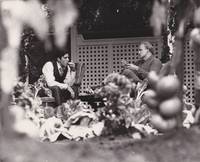
1972170735N.p.: N.p. 1972. Vintage borderless reference photograph from the 1972 film the final outdoor scene with Marlon Brando and Al Pacino. Annotations in manuscript ink in French on the verso. <br /> <br /> Based on the 1969 novel by Mario Puzo who co-wrote the screenplay with director Francis Ford Coppola. Widely considered one of the finest films ever made and an inescapable influence on the portrayal of organized crime in film and television. Nominated for eleven Academy Awards winning for Best Picture Best Adapted Screenplay and Best Actor for Marlon Brando. <br /> <br /> Set in New York New Jersey Los Angeles Las Vegas Sicily and Cuba shot on location in New York New Jersey Los Angeles Las Vegas Sicily and the Dominican Republic. <br /> <br /> 10 x 8 inches. About Near Fine lightly edgeworn.<br /> <br /> National Film Registry. Ebert I. Penzler 101. Schrader Canon Fodder 16. Sight and Sound 2022. N.p. unknown