8 861 résultats
1958145327Mexico: Producciones Barbachano Ponce 1958. Draft script for the 1959 film. Presentation copy belonging to director Luis Bunuel and SIGNED by Bunuel on the front wrapper. Also laid in is a program from the film's American premiere on May 18 1960 also SIGNED by Bunuel. Blue ink holograph annotations in the same hand to the verso of the last page of the script. Also laid in are two vintage photographs: one of Bunuel getting a haircut on the set of the film and another with Bunuel seated next to cinematographer Gabriel Figueroa composing a shot in his viewfinder. All items housed in a red quarter-leather clamshell box with gilt titles. <br/><br/>Based on the 1895 novel by Benito Perez Galdos. A priest with radical but very philosophical notions leaves his order to go on a pilgrimage learning much about the nature of human suffering as his life mimics that of Jesus Christ all the way through to his untimely end. One of the mostly highly regarded films from Bunuel's Mexican period one of director Andrei Tarkovsky's ten favorite films and one of 15 religious films selected by the Vatican for their list of 45 great films celebrating the 100th anniversary of cinema. Nominated for the Palme d'Or.<br/><br/>Set in Mexico and shot there on location. <br/><br/>Green titled wrappers dated 1958 with credits for screenwriters Luis Bunuel and Julio Alejandro novelist Benito Perez Galados and director Luis Bunuel. Title page present noted as copy No. 3 in holograph pencil dated 1958 with credits for screenwriters Bunuel and Alejandro novelist Perez Galados and director Bunuel. 106 leaves with last page of text numbered 105. Mimeograph duplication rectos only. Pages Fine wrapper Very Good plus housed in a Near Fine red leather presentation binding with a few tiny bruises at the extremities.<br/><br/>Photograph 8 x 10 inches archive stamp and several holograph annotations to the verso. Near Fine.<br/><br/>Rosenbaum 1000. Producciones Barbachano Ponce unknown books
1962147016N.p.: N.p. 1962. Draft script for the 1962 film. With director Luis Bunuel's holograph pencil and ink annotations throughout noting changes and additions to dialogue and the name of Russian-American director Victor Stoloff in holograph ink to the front of the folder housing the script. Stoloff was associated with Bunuel during Bunuel's brief sojourn in America and is interviewed in the 2000 documentary "Bunuel in Hollywood." <br/><br/>Included with the script is an English translation of Bunuel's revisions.<br/><br/>An impossibly rare script for Bunuel's masterpiece and the penultimate film the director made in Mexico. An incisive eerie surrealist comedy about a group of bourgeois guests at a dinner party who realize they inexplicably cannot leave the house. Nominated for the Palme d'Or at Cannes.<br/><br/>Set and shot on location in Mexico.<br/><br/>Tall lacking wrappers and title page housed in a light blue folder. 94 leaves with last page of text numbered 94. Mimeographed rectos only. Pages Near Fine very lightly foxed to the first leaf unbound.<br/><br/>Criterion Collection 459. Ebert I. Rosenbaum 1000. N.p. unknown books
1935124528Beverly Hills CA: Metro-Goldwyn-Mayer MGM 1935. Dashiell Hammett's original submitted Treatment script for the first sequel to "The Thin Man" here referred to only as "Thin Man Sequel" and ultimately titled "After the Thin Man." With a single manuscript correction by Hammett and letter of provenance from Hammett's daughter Josephine Hammett Marshall regarding the discovery of the treatment in the family's estate. <br /> <br /> The first "Thin Man" film released in 1934 and based on Hammett's novel was a smash hit and is today a key film in the American screwball comedy cycle. Five sequels were made between 1936 and 1947 all starring the original acting team of William Powell and Myrna Loy and this previously unknown attempt at a sequel by Hammett was clearly commissioned by MGM but never produced making this script an entire unpublished Hammett work. The story is a completely original one never reworked for the other films very much written in Hammett's trademark style and reading a bit more like a story treatment i.e. a novel than a final screenplay which is likely as far as the story got on the road to production. <br /> <br /> The piece is dated Sept. 17 1935 at the lower right corner of the front panel along with Hammett's name and Hammett's name is noted in pencil next to the title label though not in Hammett's hand. There is only one single-word correction to the entire text at page 83 in Hammett's hand where the word "compact" is replaced with "cigarette case." <br /> <br /> Accompanying the screenplay is a typed letter signed from Hammett's daughter who edited a recently published collection of Hammett's letters on her personal stationery stating that the screenplay was discovered by Hammett's wife in 1980 and that it had been a part of the family's estate until that time. Probably one of only 2-3 copies that could have been produced and very possibly the only copy extant. To our knowledge no other copy of this story in any form has ever been recorded at auction or sold on the market. <br /> <br /> Light blue titled wrappers with the white MGM studio label present manuscript pencil notation of Hammett's name secretarial rubber-stamped COMPLETE dated September 17 1935 with a single credit for Hammett. 115 leaves mimeograph duplication. Pages and wrapper Very Good plus bound with two gold brads. In a custom clamshell box. <br /> <br /> Full pagination available upon request. Metro-Goldwyn-Mayer [MGM] unknown
1965149987N.p.: N.p. 1965. Final Draft script for the legendary 1966 film under the original Swedish title "Kinematografi." In Swedish.<br/><br/>"Persona" was in 2020 called "the greatest film ever made" by filmmaker and essayist Paul Schrader a distinction he has considered probably as thoroughly as any cinema thinker of his generation. Schrader went on to note the ." . . the stunning feminine politics and the visual genius" of the film.<br/><br/>Two known copies of this script exist: one at the Svensk Film Institute and one at the University of San Francisco Archives. This version of the script was called Script II by Bergman was retitled Kinematografi by him and has a prefatory note by him that is not included in the published screenplay for the film a later revision the content of which differs substantially from this example.<br/><br/>Some notable distinctions between this draft and the final script the filmed version include:<br/><br/>1 A prologue consisting of only a short film strip with rapidly shifting images of nature clouds trees moon landscape followed by atmospheric sounds of words after which Nurse Alma's face emerges followed by the main narrative.<br/><br/>2 There is no boy and no hospital morgue <br/>where he wakes up and the script does not mention the famous merging of Alma's and Elisabeth's face.<br/><br/>3 There is no reference later on in the script that the film breaks during the confrontation between Alma and Elisabeth though there is a meta-filmic insert just before the two women move to the doctor's house in Scene 13.<br/><br/>4 Additional dialogue notably a fairly long passage in which Elisabeth talks about her happy and hermetically close relationship with her husband.<br/>The final script a revision that followed the one offered here was published in several languages in 1966 and has been reprinted in various forms in perpetuity ever since. This draft remains unpublished.<br/><br/>Criterion Collection 701. Ebert I. Rosenbaum 1000. Godard Histoires du cinema. Schrader Canon Fodder 9. Vogel "Film as a Subversive Art. N.p. unknown books
1946147477Culver City CA: RKO Radio Pictures 1946. Estimating script for the 1947 film dated April 3 1946. James M. Cain's ultimately uncredited rewrite of Geoffrey Homes' early draft based on Homes' 1946 novel "Build My Gallows High" which was at that time still unpublished. <br/><br/>A rare script which confirms a claim still listed as unsubstantiated by the AFI Catalog which notes: "The working title of this film was Build My Gallows High. In September 1945 RKO outbid Warner Bros. for the rights to Geoffrey Homes' . unpublished novel according to a Los Angeles Times article. . Modern sources also claim that James M. Cain rewrote Homes' script with Frank Fenton. Fenton is credited as a contributing writer by SAB but Cain's contribution has not been confirmed by contemporary sources."<br/><br/>Ultimately sole credit for the script went to Homes who would make a permanent switch from novels to screenplays after the success of the film later under his real name Daniel Mainwaring. Cain would also spend many years in Hollywood though he only received screenwriting credits on two films "Stand Up and Fight" 1939 and "Gypsy Wildcat" 1944. <br/><br/>A former private detective lives a quiet life in a small town until his past catches up with him forcing him to return to the world of crime. An unimpeachable high spot of the genre. <br/><br/>Set in Bridgeport California shot in the High Sierra Mountains of Nevada and Reno as well as locations throughout California. <br/><br/>Red titled wrappers noted as ESTIMATING SCRIPT on the front wrapper rubber-stamped copy No. 1495 dated April 3 1946 with credits for screenwriter Cain and novelist Homes. Title page integral with front wrapper. 120 leaves with last page of text numbered 120. Carbon typescript on onionskin stock. Pages Near Fine wrapper Very Good plus bound with two gold brads. <br/><br/>National Film Registry. Grant US. Hardy The BFI Companion to Crime. Selby Masterwork. Silver and Ward Classic Noir. Spicer US Classic Noir. RKO Radio Pictures unknown books
1989148416N.p.: Untitled Productions 1989. Draft script for the 1989 film belonging to and heavily annotated throughout by actor Martin Landau here under the working title "Brothers." Bound in a spring binder with "Kraft Music Hall" and Landau's name in gilt on front "The Kraft Music Hall" was a revival of the NBC variety television show with various hosts and performers from 1967 to 1971 which Landau and Woody Allen had both appeared on. <br/><br/>Front wrapper has Landau's name boldly written and whimsically illustrated with "Filmed New York CIty" and shooting months and re-shooting months all written in holograph marker and pen. Title page has Landau's name ornately illustrated at top margin followed by credits for Allen working title and cast all in holograph marker with "Release Title: Oct 13th 1989 'Crimes and Misdemeanors'" below in holograph ink all in Landau's hand. Script contains copious annotations of strikes character motivations and dialogue changes on nearly every page of dialogue or action of Landau's character Judah. Following script is a six page cast list annotated in holograph pencil.<br/><br/>Laid in are 32 pages of script revisions six of which contain annotations striking scenes dating when scenes were shot as well as character motivations by Landau in holograph ink. <br/><br/>Also laid in is Landau's contract with Untitled Productions for "Woody Allen Fall Project 1988" signed and dated March 3 1989 by Landau in holograph ink with a cover sheet dated March 1 1989 signed by associate producer Helen Robin. Lastly laid in are two call sheets with annotations in holograph ink and marker a four page Reshoot Schedule annotated in holograph marker and a five page Crew List lightly annotated in holograph marker.<br/><br/>From the estate of Martin Landau. <br/><br/>One of Allen's finest films a dark drama with comic elements interweaving two opposing stories. In one ophthalmologist Judah Rosenthal's Landau mistress Angelica Huston threatens to reveal their affair unless he leaves his wife Miriam Claire Bloom. Responding to the threat his gangster brother Jack Jerry Orbach offers to have her killed. In the other documentary filmmaker Clifford Stern Allen is hired by his pompous television producer brother-in-law Alan Alda to make a documentary about him and begins to fall in love with producer Halley Reed Mia Farrow.<br/><br/>Nominated for three Academy Awards including Best Director Best Screenplay and Best Supporting Actor for Martin Landau. <br/><br/>Set in and shot on location in New York and New Jersey. <br/><br/>Blue untitled wrappers. Title page present with a credit for screenwriter Woody Allen. 108 leaves with last page of text numbered 100. Xerographic duplication rectos only with blue and pink revision pages throughout dated 1/9/89. Pages Near Fine with silverfish damage to right side of title page wrapper Very Good plus bound with two gold brads.<br/><br/>Spring binder 10.5 x 12.5 inches Near Fine.<br/><br/>Laid in Revisions Contract and Call Sheets 8.5 x 11 inches Very Good plus to Near Fine six revision leaves extremely faded with bright holograph annotations to four.<br/><br/>Schrader Canon Fodder 39. Ebert III. Untitled Productions unknown books
1958147154Beverly Hills CA: Metro-Goldwyn-Mayer MGM 1958. Draft script for the 1959 film belonging to actor Martin Landau with his signature in holograph pencil on top of first page and annotations in holograph ink and pencil throughout primarily making note of action and dialogue for Landau's character Leonard. <br/><br/>Martin Landau's second film role and a memorable early one as James Mason's sadistic henchman.<br/><br/>Considered to be one of Hitchcock's best films the last of four the director made with Cary Grant with a score by Bernard Hermann and a famous title sequence by Saul Bass. Nominated for three Academy Awards including Best Original Screenplay. <br/><br/>Shot in Hollywood and in various locations across the United States. <br/><br/>Title page integral with first page dated 8-12-58. 174 leaves with last page of text numbered 179. Mimeographed rectos only with pink revision pages throughout dated variously between 8-27-58 and 10-27-58. Pages very good plus with some creasing chipping and closed tears to first page and eight 10-27-58 revision pages which appear to have been originally paper clipped and later bound in.<br/><br/>National Film Registry. Godard Histoires du cinema. Grant US. Rosenbaum 1000. Penzler 101. Metro-Goldwyn-Mayer [MGM] unknown books
1981142842N.p.: N.p. 1981. Handmade vernacular conceptual journal documenting the shooting of Robert Frank's 1981 film "Energy and How to Get It" circa 1980-1981. <br/><br/>Includes tipped in ephemera drawings business cards and 46 Polaroids of Wurlitzer Robert Frank June Leaf and "Lightning" Bob. Annotations and captions throughout by Wurlitzer. Also included are 4 reference photos all likely unique from the shooting of the film: two showing both Wurlitzer and Frank one showing Wurlitzer and one of the "Enola Gay" aircraft in the film. <br/><br/>Mead Memo notebook spiral bound. Green wrappers. 4.25 x 6 inches Very Good overall tipped in photos Near Fine. Reference photos 8 x 10 inches Near Fine. N.p. unknown books
1960143066Tokyo: Kurosawa Production Company 1960. Shooting script for the legendary 1961 Japanese film. Working copy belonging to Omura Senkichi who played a small role as a traveling servant in the film with his name on the front wrapper and his annotations throughout. <br/><br/>Though not credited as such based thematically on Dashiell Hammett's 1929 novel "Red Harvest" and subsequently the basis for many other films including "A Fistful of Dollars" Sergio Leone 1964 "Django" Sergio Corbucci 1966 and "Last Man Standing" Walter Hill 1996. Director Kurosawa has been quoted as saying that many plot elements from another Hammett novel "The Glass Key" make up the film. <br/><br/>All titles and text in Japanese. <br/><br/>White perfect bound wrappers with purple and black titles. 164 pages printed on recto and verso right to left in the Japanese style with last page numbered "d-33." Mechanical duplication. Light foxing and age toning to both pages and wrapper else Very Good condition. <br/><br/>BFI 505. Criterion Collection 52. Ebert III. Grant Japan. Kurosawa Production Company unknown books
142842N.p.: N.p. 1981. Handmade vernacular conceptual journal documenting the shooting of Robert Frank's 1981 film "Energy and How to Get It" circa 1980-1981. <br /> <br /> Includes tipped in ephemera drawings business cards and 46 Polaroids of Wurlitzer Robert Frank June Leaf and "Lightning" Bob. Annotations and captions throughout by Wurlitzer. Also included are 4 reference photos all likely unique from the shooting of the film: two showing both Wurlitzer and Frank one showing Wurlitzer and one of the "Enola Gay" aircraft in the film. <br /> <br /> Mead Memo notebook spiral bound. Green wrappers. 4.25 x 6 inches Very Good overall tipped in photos Near Fine. Reference photos 8 x 10 inches Near Fine. N.p. unknown
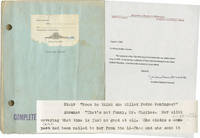
1994140620Burbank CA: Fox Broadcasting Company / Warner Brothers Television / Sweet Freedom Productions / Main Sequence Productions 1994. Archive of original scripts for all 27 episodes of "The George Carlin Show" which ran on Fox for two seasons in 1994 and 1995 with multiple drafts of each episode totaling 196 scripts. Also included are several key pieces of ephemera relating to the development and writing of the show. Altogether a thoroughly comprehensive and researchable archive detailing a writing process that attempted to digest and reconstruct the persona of one of the most iconoclastic and influential not to mention foul mouthed standup comics for mainstream viewing. From the estate of series co-creator Sam Simon. <br/><br/>One of the most important and influential television producers and directors of the last 30 years Sam Simon is best known along with Matt Groening and James L. Brooks as the co-creators of "The Simpsons." Simon won a remarkable nine Emmy Awards seven for "The Simpsons" and two for "The Tracy Ullman Show" and was nominated another ten times for his work on both those shows as well as his contributions to "Cheers" "Taxi" and "The Gary Shandling Show." <br/><br/>Created by Simon and George Carlin "The George Carlin Show" ran for two seasons on Fox from 1994 to 1995. Carlin played New York cabbie George O'Grady who when not haranguing fares spent most of his time at a bar modeled on Carlin's real life Morningside Heights haunt haranguing his fellow patrons which characteristically of the post-"Seinfeld" boom in sitcoms created around standup comics allowed the writers to incorporate elements of Carlin's stage routines into the show. In his posthumously published autobiography "Last Words" Carlin said of the show "I had a great time. I never laughed so much so often so hard as I did with the cast members" but did not get along with co-creator Simon a view Simon attributed in an interview to the show's "cancellation affecting George's attitude towards the work in retrospect" and he considered the show "a very special period of my life."<br/><br/>The majority of scripts are housed in 27 generic black ring binders with one binder per episode each containing between three and nine scripts. Binders for each episode may contain First or Writer's Drafts Table Read scripts Blue Pink Yellow Green and Goldenrod revised scripts Final Collated scripts compiled from the various revisions and As Broadcast scripts reflecting the script as it aired. <br/><br/>Also included are 18 scripts for various episodes many of which are working copies with holograph annotations edits and corrections throughout including a script for an unproduced episode co-written by cast member Anthony Starke and most importantly six drafts of the pilot episode dating from 1993 with holograph annotations and changes in several hands throughout including Carlin's giving a detailed look at the development of the pilot. <br/><br/>Several pieces of ephemera also related to the writing of the show are also part of the archive including five pages of typed and holograph notes dated 3/16/93 a Treatment script for Season One Episode Eight "George Destroys a Way of Life" dated 9/17/93 with substantial holograph annotations a treatment dated 9/17/93 for an unproduced episode titled "George Proves Something" with holograph annotations and three pages of ideas for episodes none of which were produced from staff writers Darrell Vickers and Andrew Nicholls dated 7/5/94. <br/><br/>Also included are a fax from fellow comedian Richard Lewis to Carlin dated 4/14/92 recommending two writers for the show a faxed noted signed from Carlin to Sam Simon followed by faxed two typed pages of thoughts on "creeping niceness" which Carlin has circled the "most useful" portions two packets of photocopied press clippings about the show assembled by Warner Brothers Television dated 2/1/94 and 6/6/94 respectively several holograph marker draft sketches of the show's logo and a one page faxed memo from Standards and Practices at Fox to Simon regarding the Season One episode "George Speaks His Mind" here and elsewhere in the archive referred to by the working title "George Says Fuck" an episode built around Carlin's famous "Seven Words You Can Never Say on Television" routine. <br/><br/>Finally the archive contains several pieces of physical media including five U-matic and one D2 video cassettes for various aspects of post-production on five episodes including a "Fuck Beep Test" reel from the "George Speaks His Mind" episode a one inch reel-to-reel video tape labeled "George Carlin Buttefly Logo" a 1/2 inch reel-to-reel audio tape DAT transfer of music and audio cues and a laser disc of Season One Episode Two "George Sees an Airplane" produced by Main Sequence Productions likely made to promote the show to affiliates or advertisers. <br/><br/>For further details please inquire. Provenance available on request. <br/><br/>Scripts and other paper material generally Near Fine or better. Scripts are first generation photocopies with no copied holes. Physical media appearing Fine on visual inspection. Fox Broadcasting Company / Warner Brothers Television / Sweet Freedom Productions / Main Sequence Productions unknown books
1946149446Culver City CA: RKO 1946. Revised Final Script for the 1946 film with stamps "Revised Final Script" "Please Return to RKO Story Files" and production number "1838" on front wrapper. Carbon typescript on onionskin.<br/><br/>Based on Philip Van Doren Stern's 1943 short story "The Greatest Gift" about a man at the end of his rope during Christmas. Generally considered one of the greatest films ever made and nominated for five Academy Awards including Best Picture. <br/><br/>Shot on location in California. <br/><br/>Pink titled wrappers noted as REVISED FINAL SCRIPT on the front wrapper rubber-stamped production No. 1838 with credits for Frank Capra. 167 pages onionskin stock with last page of text numbered 167. Carbon typescript rectos only. Pages Near Fine wrappers Very Good plus bound with three gold brads with washers. RKO unknown books
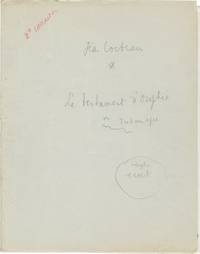
1958167441N.p.: N.p. 1958. Vintage ribbon copy typescript treatment for the 1960 French film. With substantive annotations in director Jean Cocteau's hand throughout noting deletions and amending dialogue. <br /> <br /> Full provenance available. <br /> <br /> The final film in Cocteau's "Orphic" trilogy following "The Blood of a Poet" 1930 and "Orphee" 1950. The only film in the trilogy featuring Cocteau himself as an aging poet who knows he is dying as indeed he was his greatest desire being to experience rebirth so that he can qualify for celestial immortality. <br /> <br /> With cameos by Pablo Picasso Charles Aznavour bullfighter Luis Miguel Dominguen and Yul Brynner. A few seconds of color are spliced in at one point a surreal effect used prior to this film in "Portrait of Jennie" 1948 and later in Samuel Fuller's "Shock Corridor" 1963. <br /> <br /> Having run out of funds in mid-production Cocteau was given money to complete filming by François Truffaut who used the prize money he had won at Cannes for "Les Quatre Cents Coups" 1959. <br /> <br /> Unbound housed in a gray paper folder. Title and Cocteau's name in manuscript pencil on the front of the folder. 31 leaves with last page of text numbered 28. Ribbon copy typescript on onionskin stock rectos only. Pages Fine unbound. N.p. unknown
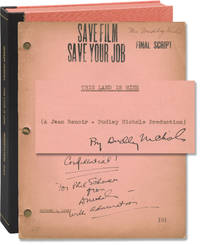
1942151348Santa Ana CA: RKO Radio Pictures 1942. Final Draft screenplay for the 1942 film. Copy belonging to legendary screenwriter Dudley Nichols inscribed by Nichols to Los Angeles Times film critic Phil Scheuer on the title page: "By Dudley Nichols / Confidential! / For Phil Scheuer from D. Nichols-with admiration." Nichols' ownership name is also in holograph pencil at the top right corner.<br/><br/>Renoir's second American feature an antifascist propaganda film following a meek schoolteacher in a German-occupied European country who is falsely accused of murder and forced to take a stand against the Nazis and their collaborators. <br/><br/>At the peak of his career Nichols worked with many key Golden Age directors including John Ford George Cukor Howard Hawks Fritz Lang and of course Jean Renoir. He was a founding member of the Screen Writers Guild and is best remembered for "The Informer" 1935 for which Nichols won an Academy Award "Bringing Up Baby" 1938 "Stagecoach" 1939 "For Whom the Bell Tolls" 1943 "Scarlet Street" 1945 "And Then There Were None" 1945 "The Bells of St. Mary's" 1945 and "The Tin Star" 1957. He continued to write prolifically for film up until the time of his death in 1960. <br/><br/>Housed in a custom quarter-leather clamshell box. <br/><br/>Pink titled wrappers noted as FINAL on the front wrapper rubber-stamped copy No. 104 dated OCTOBER 2 1942 with credits for director Jean Renoir and screenwriter Dudley Nichols. Distribution page present with receipt removed. Title page integral with the front wrapper. 169 leaves with last page of text numbered 162. Mimeograph duplication rectos only. Pages Near Fine wrapper Near Fine bound with three gold brads. RKO Radio Pictures unknown books
1960145469London: Warwick Film Productions 1960. First Draft script for the 1960 UK film. File copy belonging to the film's director Ken Hughes with a typescript note tipped on to the title page requesting its return to the director and noting it is the only script in existence for the film. <br/><br/>Peter Finch delivers a strong performance as the inimitable author Oscar Wilde in this film about Wilde's sodomy trial after his affair with Lord Alfred Douglas lifted in large part from the historical court records. One of two films about Wilde released in May of 1960 the other being director Gregory Ratoff's "Oscar Wilde." In order to compete with the other Wilde film production on "The Trials of Oscar Wilde" was made in only nine weeks from start to finish with filming wrapping a mere two weeks before the London opening. Composer Ron Goodwin was recording music before scenes were filmed most scenes were filmed in one take and four editing rooms were set up working in parallel during principal photography in order to deal with the rushed timeline. <br/><br/>Shot on location in England. <br/><br/>Green wrappers with a typescript title label. Title page present dated 28th January 1960 noted in holograph ink as First Screenplay. 210 leaves with last page of text numbered 208. Mimeograph duplication rectos only. Pages Very Good plus wrapper Very Good bound internally with two spring binder clips. Warwick Film Productions unknown books
1959133731Burbank CA: Warner Brothers 1959. Draft script for the 1960 film "Ocean's Eleven" seen here as "Oceans Eleven or And the Angels Sing." Copy belonging to actor Peter Lawford with his name to the front wrapper and his holograph annotations throughout. Lawford owned the rights to the film and accompanying this script is a signed note written on his wife's stationery that reads: "Oceans 11 / $10000 / 50-50- / P. Lawford" a copy of a contract between Lawford and talent agent Milton Ebbins and a clipping of a full-page advertisement for the film from "Variety" magazine. <br/><br/>A classic and well-loved heist film "Ocean's Eleven" is the quintessential Rat Pack picture in which a group of World War II veterans attempts a series of high-profile casino robberies in Las Vegas on New Year's Eve. Steven Soderbergh directed a popular 2001 remake of the film with two sequels starring George Clooney Brad Pitt and Matt Damon. <br/><br/>Set in Las Vegas and Los Angeles and shot on location in both cities. <br/><br/>Pale blue titled wrappers. Title page present. 162 leaves mimeograph duplication with white undated revision pages throughout labeled REVISED. Pages about Fine wrapper about Fine bound internally with three gold brads.<br/><br/>Lee The Heist Film. Warner Brothers unknown books
1972145005Burbank CA: Warner Brothers 1972. Original maquette demonstrating an early poster design for the 1973 film featuring a vintage silver gelatin photograph of the legendary streetlit scene of Father Merrin's first arrival to Georgetown in the film mounted to the poster.<br/><br/>A minimal design without the credits information seen in the completed original "purple style" poster variant and with a proposed but ultimately unrealized release date of Christmas Day shown at the bottom margin. This maquette compares both to the "purple style" poster in its use of said purple text but also to the original black and white "special poster" design both in size and compositional austerity. The "special poster" measured 25 x 19 inches as opposed to the standard 27 x 41 inches for the one sheet and stated nothing but the film's title and the stark photo of Father Merrin. <br/><br/>Based on the 1971 novel by William Peter Blatty and written for the screen by Blatty. One of the great genre films of the 1970s that accomplished the uncommon feat of being an over-the-top sensation upon its release and gaining subsequent status as a classic with a strangeness and depth supplied by Ellen Burstyn and Max von Sydow that only increases with repeated viewings. Another distinction was that it walked away with two Oscars including Best Screenplay for Blatty along with eight nominations including Best Picture a feat nearly unheard for a horror film. <br/><br/>Set in Washington DC and shot on location in Washington DC notably Georgetown University New York City and Mosul Iraq. <br/><br/>18 x 12.5 inches mounted on a 30 x 20 inch mat. Black with the vintage black and white photo of Father Merrin affixed at the center and a hand painted release date. Title letters are hand cut from purple paper and affixed in place. Good condition with water damage to the bottom three inches of the mat and with soil and loss of glue adhesion to the white mat. Archivally matted and framed in a museum-quality frame with UV glass.<br/><br/>National Film Registry. Clover "Men Women and Chainsaws. Warner Brothers unknown books
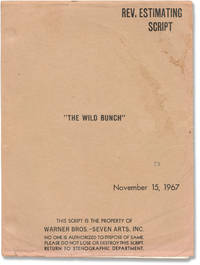
1967160830Burbank CA: Warner Brothers / Seven Arts 1967. Revised Estimating script for the 1969 Western film.<br /> <br /> Sam Peckinpah's classic revisionist Western of nearly inestimable importance and violence made at the peak of his career and which-along with "Straw Dogs" 1971-remains the lasting testament to his vision. A major contributor to the "end of the West" theme so prevalent of the genre in the 1970s and one of the earliest New Hollywood Westerns. <br /> <br /> Set in Mexico shot on location in Mexico and Spain. <br /> <br /> Beige titled Warner Brothers wrappers dated November 15 1967 noted as Rev. Estimating Script and stamped copy No. 75. Title page present dated 11/15/67 with credits for screenwriters Wallen Green and Sam Peckinpah and story credit for Roy Sickner. 125 leaves with last page of text numbered 123. Mimeograph duplication rectos only. Pages about Fine wrapper Very Good plus bound internally with two gold brads. <br /> <br /> National Film Registry. Ebert I. Hardy US. Pitts 4934. Rosenbaum 1000. Schrader Canon Fodder 28. Warner Brothers / Seven Arts unknown
1949143058Tokyo: Film Art Association 1949. First Draft script for the 1949 Japanese film noir. Holograph ink and pencil annotations on two leaves. Text in Japanese. <br/><br/>Generally considered to be the greatest film noir made in Japan and hugely influential on American film noir of the 1950s and 1960s. <br/><br/>White titled wrappers. 96 leaves with last page of text numbered 96. Mechanical duplication. Toning due to aging throughout wrapper split at spine with mild foxing otherwise Good condition. <br/><br/>BFI 534. Criterion Collection 233. Grant Japan. Selby Japan. Spicer Japan Classic Noir. Film Art Association unknown books
1942151348Santa Ana CA: RKO Radio Pictures 1942. Final Draft screenplay for the 1942 film. Copy belonging to legendary screenwriter Dudley Nichols inscribed by Nichols to Los Angeles Times film critic Phil Scheuer on the title page: "By Dudley Nichols / Confidential! / For Phil Scheuer from D. Nichols-with admiration." Nichols' ownership name is also in manuscript pencil at the top right corner.<br /> <br /> Renoir's second American feature an anti-fascist propaganda film following a meek schoolteacher in a German-occupied European country who is falsely accused of murder and forced to take a stand against the Nazis and their collaborators. <br /> <br /> At the peak of his career Nichols worked with many key Golden Age directors including John Ford George Cukor Howard Hawks Fritz Lang and of course Jean Renoir. He was a founding member of the Screen Writers Guild and is best remembered for "The Informer" 1935 for which Nichols won an Academy Award "Bringing Up Baby" 1938 "Stagecoach" 1939 "For Whom the Bell Tolls" 1943 "Scarlet Street" 1945 "And Then There Were None" 1945 "The Bells of St. Mary's" 1945 and "The Tin Star" 1957. He continued to write prolifically for film up until the time of his death in 1960. <br /> <br /> Housed in a custom quarter-leather clamshell box. <br /> <br /> Pink titled wrappers noted as FINAL on the front wrapper rubber-stamped copy No. 104 dated OCTOBER 2 1942 with credits for director Jean Renoir and screenwriter Dudley Nichols. Distribution page present with receipt removed. Title page integral with the front wrapper. 169 leaves with last page of text numbered 162. Mimeograph duplication rectos only. Pages Near Fine wrapper Near Fine bound with three gold brads. RKO Radio Pictures unknown
1971147168Beverly Hills CA: E-K-Corporation / United Artists 1971. First draft script for the 1973 film written nine months before the production began.<br/><br/>From the estate of film producer Elliott Kastner whose best known credits include "The Missouri Breaks" Arthur Penn 1976 and "Heat" Michael Mann 1996.<br/><br/>Based on Chandler's 1953 novel the sixth and penultimate Philip Marlowe book. Screenwriter Leigh Brackett who also co-wrote the screenplay for "The Big Sleep" 1946 updated not just the setting from the 1950s to the 1970s but the attitudes themes and relationships as well. The result was less of a straight adaptation than it was a satire of the traditional detective story a New Hollywood classic. <br/><br/>Shot on location in Los Angeles Malibu Hollywood and Mexico<br/><br/>Black titled Studio Duplicating Service Inc. wrappers. Title page present dated September 1971 noted as First Draft with credits for screenwriter Leigh Brackett. 109 leaves with last page of text numbered 108. Mimeographed rectos only. Pages Near Fine wrapper Near Fine bound with two gold brads.<br/><br/>Grant US. Hardy BFI Companion to Crime. Silver Classic Noir. Spicer US. E-K-Corporation / United Artists unknown books
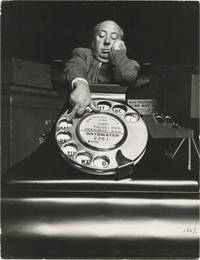
1954153634N.p.: N.p. 1954. Archive of five vintage borderless oversize photographs of director Alfred Hitchcock with various cast and crew members on the set of the 1954 film noir. Manuscript ink and pencil annotations to the verso including layout annotations "FILE" stamps and the stamp of photographer Sanford H. Roth. Four photographs with printed mimeo snipes affixed to the verso and four photographs with manuscript annotations noting their appearance in the May 24 1954 issue of Life magazine. <br /> <br /> Brooklyn-born photojournalist Sanford Roth was best known for his portrait photography capturing intimate and now iconic images of artists and actors throughout his decades-long career including Marc Chagall Joan Crawford Albert Einstein Henri Matisse and Elizabeth Taylor among many others. <br /> <br /> Based on the 1952 play by Frederick Knott who also wrote the screenplay about a tennis player who arranges to have his wife framed for murder after discovering her infidelity. The only Hitchcock film to be shot in 3D although the format would ultimately be discarded for theatrical release and the first of three Hitchcock films to feature actress Grace Kelly followed by "Rear Window" 1954 and "To Catch a Thief" 1955. <br /> <br /> One photograph features Hitchcock leaning over a giant rotary dial a prop made as a result of Warner Brothers' proprietary 3D camera rig. Hitchcock wanted the first shot of the film to feature a finger pressing the letter M on a rotary dial telephone but the specialized 3D camera was unable to focus the close-up correctly leading the director to order a giant finger made from wood and a proportionally large dial in order to achieve the effect. <br /> <br /> Four photographs 10 x 13.5 inches one photograph 9.5 x 13.5 inches. Lightly edgeworn else generally Near Fine. <br /> <br /> Grant US. Selby US. Spicer US. N.p. unknown
1986132794Universal City CA: Universal Pictures 1986. Archive of three title card maquettes hand lettered by Harold Adler for the 1963 film. Also included are two fascinating autograph letters both elaborately designed and executed in a calligraphic style from Adler to author illustrator and editor Fridolf Johnson relating to Adler's work with Hitchcock. <br/><br/>Harold Adler was a calligrapher who created hand lettered titles on over 100 films worked frequently with Alfred Hitchcock and was a favorite of legendary title sequence designers Saul Bass and Pablo Ferro. In addition to "The Birds" 1963 his credits include "Comanche!" 1956 "The Man with the Golden Arm" 1955 "The Seven Year Itch" 1955 "Carmen Jones" 1954 "Psycho" 1960 "In the Heat of the Night" 1967 and "Justine" 1969. <br/><br/>In 2012 an exhibition of Adler's work was organized by noted typographer and design historian Jill Bell at the American Advertising Federation Kansas City. <br/><br/>In the first letter dated May 16 1986 Adler describes after touching on other topics meeting Hitchcock and then presenting him with layout ideas for the titles. He then goes into detail regarding his answer to a question about the techniques of artist Eric Gill stating that Hitchcock "was amazed" by this answer and after that would "request 'to be sure to bring that nice young man along" meaning Adler whenever he had a job for Adler's firm. <br/><br/>The second letter dated June 10th 1986 focuses almost exclusively on Adler's work on "The Birds" going into some detail regarding both the creative and technical processes of producing hand lettered titles for films. He also describes Hitchcock as "an unusual person to work with. He was a master at what he did knew what he wanted and smoked the finest cigars." He then concludes the letter with some brief remarks on how his approach to title lettering evolved over the course of his career. <br/><br/>The letters themselves are works of art executed in a variety of inks in Adler's detailed penmanship with Johnson's name on each in particular receiving full calligraphic treatment. <br/><br/>Also included are draft title cards for the film stylistically similar to each other but much different from the titles used in the finished film. Two of the cards are marked as "camera ready" in holograph colored pencil with titles executed in white paint on black board. The third card photo stat on black paper which accompanied the June 10th letter has been annotated by Adler on both the recto and verso explaining the in more detail the technical process of putting the lettering on film. <br/><br/>Overall a significant collection of material illuminating a little explored aspect of film design with a direct and significant connection to a seminal work by a director known for personally overseeing all aspects of production. <br/><br/>Each letter 19 x 24 inches single leaf rectos only. May 16th letter folded twice for mailing June 10th letter folded. Two long diagonal creases to the May 16th letter else both are Fine. Original mailing envelope for the May 16th letter included. <br/><br/>"Camera ready" title cards 22 x 14 inches. Lightly rubbed and about Near Fine. Third card 18 x 4 inches. Near Fine. Universal Pictures unknown books
1949143058Tokyo: Film Art Association 1949. First Draft script for the 1949 Japanese film noir. Manuscript ink and pencil annotations from production on two leaves. Text in Japanese. <br /> <br /> Generally considered to be the greatest film noir made in Japan and hugely influential on American film noir of the 1950s and 1960s. <br /> <br /> White titled wrappers. 96 leaves with last page of text numbered 96. Mechanical duplication. Toning due to aging throughout wrapper split at spine with mild foxing otherwise Good condition. <br /> <br /> BFI 534. Criterion Collection 233. Grant Japan. Selby Japan. Spicer Japan Classic Noir. Film Art Association unknown
1932136754Culver City CA: RKO Radio Pictures 1932. Screenplay archive for the 1932 film. Archive consists of a Revised Final script and a typescript rewrite of the film's opening sequence onboard a yacht. The rewrite credits an unknown screenwriter named "Eliscu." Based on the Richard Connell short story first published in "Colliers" in 1924. <br/><br/>A rare set of scripts for a groundbreaking film. A deranged millionaire living on an island arranges for a yacht to be shipwrecked on his shores whereupon he arranges for the survivors to be hunted. Decades ahead of its time and almost iconoclastic in the cynicism of its subtext Pichel and Schoedsack used ideas from their film "Gow the Headhunter 1931 and predicted their classic "King Kong" 1933 and dozens of other films that would follow using a theme of man being the hunted rather than the hunter. <br/><br/>Revised Final script:<br/><br/>Tan titled wrappers noted as REVISED FINAL SCRIPT on the front wrapper rubber-stamped PLEASE RETURN TO STORY DEPT. / RKO STUDIOS Inc. / WEST COAST" dated May 13 1932 with credits for story writer Conell and screenwriter Creelman. Title page integral with first page of text with credits for Connell and Creelman. 123 leaves with last page of text numbered 123. Mimeograph duplication on onionskin stock some leaves tan and others white. Pages Near Fine wrapper about Near Fine bound with three gold brads. <br/><br/>Opening Yacht Sequence script:<br/><br/>Blue titled wrappers noted as OPENING YACHT SEQUENCE on the front wrapper rubber stamped "Property of RKO STUDIOS Inc. / Return to Scenario Dept. Files" dated July 2 1932 with credits for story writer Conell and screenwriter Creelman further noted as ELISCU CHANGES / Ciopied by RKO Stenographic Dept." Title page integral with first page of text with credits for Connell and Creelman. 15 leaves with last leaf of text number 123. Typescript on onionskin stock. Pages Near Fine. A few small chips to the edges fragile wrapper else about Near Fine. <br/><br/>Criterion Collection 46. RKO Radio Pictures unknown books