567 résultats
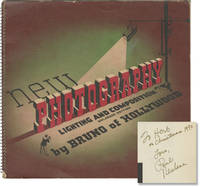
1950161662New York: Visual Art Publications 1950. Limited Edition noted as "Enlarged Edition" on the front wrapper. INSCRIBED by Paul Reubens-better known as Pee-wee Herman-on the title page: "To Herb / on Christmas 1990 / Love Paul Reubens." <br /> <br /> A instructional volume regarding lighting and composition of pin-up photography. <br /> <br /> Very Good plus in spiral-bound wrappers with page 30 removed from the binding and altered with a small clipping from the page laid in. Visual Art Publications unknown
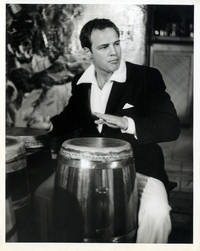
1950WALTER-FILM005325<p><i>Set of eight 8 vintage original 7 1/4 x 9″ 23 x 18 cm. black-and-white print still photos JUST ABOUT FINE.</i></p><p>A set of portraits of Marlon Brando. Stamps and date stamps on the back of a couple indicate that this photo shoot was used for <i>Hear Hollywood</i> magazine. Two photos show him by his bongo drum which in a 1955 <i>Person to Person</i> broadcast on CBS he was also shown playing.</p> Hear Hollywood
199325288ELos Angeles: Butterfield & Butterfield 1993 & 1994. First Editions. Lavishly illustrated catalogues with many black & white and color photographs. This set of presents costumes and memorabilia from such diverse films as Gone With The Wind Planet of the Apes Big Orson Welles’ crown from Macbeth Bruce Lee costumes and promotional material George Hamilton’s costume pieces from Zorro The Gay Blade a photograph collection of Sarah Bernhardt Elvis Presley’s costumes and signed photograph Tyrone Powers’ suit from The Razor’s Edge Billy Crystal’s vest from City Slickers dresses from The Sound of Music scripts from Star Trek and much more. Part I is 79 pages plus index Part II is 178 pages and has the prices realized sheet laid in and Part III is 167 pages plus an index. All copies are fine in glossy printed wrappers. Butterfield & Butterfield unknown
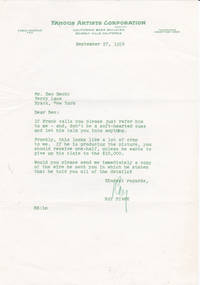
195435897Beverly Hills California September 27 1954 through January 14 1955. 1954. 1954. Fine. - Five signed letters typed in green ink on Ray Stark's 10-5/8 inch high by 7-1/4 inch wide "Famous Artist's Corporation Agency" stationery with the firm's logo embossed in green at the top of creamy white paper. In his first letter of approximately 90 words dated September 27 1954 Ray Stark acting as Ben Hecht's agent writes to him about Frank Rosenberg's deal regarding "Miracle in the Rain". Stark pleads with Hecht to not "be a soft-hearted cuss and let him talk you into anything." He goes on to write that "Frankly this looks like a lot of crap to me. If he is producing the picture you should receive one-half unless he wants to give up his claim to the $10000." and closes by requesting that Hecht send him "a copy of the wire" in which Rosenberg claims to have told him of the details. Signed "Ray" in green ink.<p>In a retained carbon copy of his letter of the same date addressed to Frank Rosenberg Stark sets the scene for what he clearly sees unfolding. He writes Rosenberg that "I am still rather confused about the exact details of the sale of Miracle in the Rain to Warner Brothers" and inquires as to whether this is a definite sale or contingent upon the selection of a director. He then goes on to question Rosenberg's deal with Warner: "It is difficult for me to understand how you can be under contract to Warner's as a producer be assigned MIRACLE IN THE RAIN as your first picture and yet as you stated to me this morning consider the producer deal separate." He then urges that Rosenberg have his agent acquaint him with the details.<p>In a 114-word typed letter to Ben Hecht dated October 5th Ray Stark indicates that he's been in touch with Frank Rosenberg's agent Arthur Parks of MCA. Parks claims that Rosenberg's "producing at Warner Brothers is completely separate from the possible sale of the screenplay." Looking to make sure that Ben Hecht is protected in this deal he writes: "I told Parks that the only thing you and I wanted was the producer's salary he is now receiving to even out the $10000 that you have received -- and that if it didn't sell by January the we would have a chance to put it together." Signed "Ray" in blue ink.<p>In typed letter of over 140 words to Ben Hecht dated October 20 1954 Ray Stark inquires about "the Saltzman thing" Harry Saltzman's first film based on Ben Hecht's script "Not for Money" which was contentiously released as "The Iron Petticoat" in 1956. Mentioning that other projects were still "on the fire" he mentions that "Kirk Douglas is really really excited about the play and it would help very much if you could send him any portion of it that you are satisfied with. He has told me that if he liked the play he would rather do it than any of the films which are on tap for the next several months." Kirk Douglas had starred in the 1954 film "Ulysses" the script of which was co-written by Ben Hecht and subsequently co-produced and starred in the 1955 Western "The Indian Fighter" for which Ben Hecht wrote the screenplay from a story by Robert L. Richards. Here Stark is referring to Hecht's play "Not for Money" which was eventually released as "The Iron Petticoat" starring Bob Hope and Katharine Hepburn. Ray Stark concludes his letter to Hecht which he neglets to sign with a 14 word autograph note penned in blue ink "And please don't get involved privately with the play until you check with me".<p>A retained carbon copy of a letter to Ray Stark from MCA's Arthur L. Park Jr. acknowledges receipt of Stark's letter and that he Park will advise him as soon as the contract for "Miracle in the Rain" is signed. He goes on to say that "Incidentally Mr. Rosenberg has advised me that he discussed the Warner Bros. deal in detail with Mr. Hecht personally before accepting it and that Mr. Hecht had voiced his complete approval."<p>In a 241 word Typed Letter Signed dated October 25 1954 Ray Stark writes to Ben Hecht expressing his excitement at talking with him "this morning about the play." "I know how very rarely you are enthusiastic - at least this enthusiastic about your projects so I am really sitting on the edge of my chair waiting to read it." He further pens the following note at the end of this paragraph: "I hope you've sent act one". Going on to discuss other matters he writes: "I am also so very happy that you like Saltzman. He is a tough business man and this is good. Also I think he is a very honest guy - as well as a very good promoter. Once again Ben I just hope you don't sign any papers unless you send them through me." Stark goes on to write extensively about the need to protect Hecht's interests in these deals and then excitedly tells him that "There are still a number of assignments including the Barrymore story the Kirk Douglas Japanese story and others which I have been holding in abeyance for you." Signed "Ray" in blue ink.<p>In a retained carbon copy of a letter written by Stark to Harry Saltzman on the same day Stark writes that "I am very excited over the fact that you and Ben have formed a partnership on his new play. I would appreciate your sending me copies of any contracts which Ben may be requested to sign -- or which he may have signed since Ben in general is rather forgetful of these things. . Also as I told Ben if Kirk Douglas likes the play there is a very good chance of a big investment on his part."<p>Predictably on January 14 1955 Ray Stark has typed over 540 words on two pages this time addressed to "Rosie" Mrs. Ben Hecht: "I am answering your very sweet letter of January 9th. However I have to admit that I have taken a day to simmer down. I can't tell you how angry I was when I read of this swindle that Mr. Rosenberg had pulled. . Ben promised me that he would not deal with those guys and as I told Ben I would have been very happy to have the agency advance the money he needed against this contract. I just think it's a shame and a ruthless hunk of chicanery to have screwed Ben like this." The paragraph which follows speaks volumes as to Ray Stark's character waving the commission owed by the struggling Hechts: "It is very sweet Rosie that you mention the commission due me in reference to the Saltzman and other situations. However forget about it. It's more important that you people get into some kind of a liquid position." He goes on to mention Hecht's script "NOT FOR MONEY" and urges her to "persuade Ben to really keep me advised of all the various things that are happening. I have a couple of jobs possibilities for him when he is finishes with his present assignment." Signed "Ray" in blue ink. In a post script Stark states that he's enclosing a copy of a letter he will send to Frank Rosenberg with two corrections in his hand and the addition of a brief note penned in ink requesting that she "First let me have Ben's okay".<p>The carbon copy of Stark's angry letter to Frank Rosenberg dated January 14 1954 is included. Stark angrily denounces Rosenberg's actions: "For a long long time I thought that both Harold and yourself were two of the most ethical guys in this very unethical town. However after the bit of chicanery that either you or both Harold and yourself accomplished together in reference to the Ben Hecht situation I can't help but tell you how very strongly I feel about this fancy bit of mis-dealing." He goes on to list the mis-deeds the last being: ". the fact that you thought you had pulled a fast one at Warner's by having a separate producer contract etc. should all add up to many sleepless nights for you Frank."<p>All five of Ray Stark's original letters are in very good condition folded for mailing. The onion skin carbon copies are clear and legible but worn. <p>"Miracle in the Rain" was Ben Hecht's adaptation of his novella of the same name. The film is a World War II romance between a happy-go-lucky soldier played by Van Johnson and a lonely office worker played by Jane Wyman who meet on the streets of New York City during a downpour.<p>Ben Hecht's play "Not for Money" a British Cold War comedy was released as "The Iron Petticoat". The play was written by Ben Hecht from a story by Harry Saltzman who produced the film. It was intended as a vehicle for Katherine Hepburn. Major stars such as Carey Grant William Holden and James Stewart balked at playing second fiddle to Hepburn and the studio finally settled on reworking the film with Bob Hope as the leading man. Turning up in London at the last minute Hope threatened to pull out unless the film was re-written to his liking striking out many of Hepburn's scenes. The title was then changed and Hecht removed his name from the credits.<p>A man of many talents Ben Hecht 1894-1864 was an American journalist screenwriter producer director playwright and novelist. The author of 35 books he wrote screenplays for nearly 70 films. Among his most noted are "The Front Page" "Underworld" "Scarface" "Angels Over Broadway" "It's A Wonderful World" Hitchcock's "Spellbound" and "Notorious" etc.<p>One of the most successful independent Hollywood producers Ray Otto Stark 1915-2004 was Ben Hecht's agent through his "Famous Artists Corporation". His early experience as a literary and theatrical agent set the stage for his successful career as the producer of some of the most dynamic film of the latter part of the twentieth century. Among the most memorable films that he produced are: "West Side Story" "The Misfits" "Lolita" "The Night of the Iguana" "Reflections in a Golden Eye" "Funny Girl" "The Goodbye Girl" "Annie" and "Steel Magnolias". Beverly Hills, California, September 27, 1954 through January 14, 1955. [1954]. unknown
194916360JBeverly Hills: Roland Reed Productions 1949. Original 120 page mimeographed screenplay custom hardbound in full textured maroon cloth with gilt-stamping. This script was screenwriter Jesse Lasky Jr.’s own personal copy with his name stamped on the cover. Lasky has signed the script on the title page writing: “Produced by the Lutheran Church for showing in their schools universities and laymen groups and churches Jesse Lasky Jr.†The Sickle or the Cross is a 1949 American drama film directed by Frank Strayer which stars Kent Taylor Gloria Holden and Gene Lockhart. The screenplay was written by Jesse L. Lasky Jr. Produced and distributed by the Lutheran Laymen's League with the production filmed at the Hal Roach Studio in Hollywood it had its world premiere in Burbank California on July 1 1949. In 1952 Astor Pictures Corporation and RKO Pictures bought rights to the picture and distributed it to theaters across America retitling it - Seeds of Destruction. Reverend John Burnside American missionary in the Far East prepares to return home after twenty years to take up the fight against Communism. The Chinese Communists imprison him and send in his place a spy who is his double but who is instructed to come out for Communism. The spy is accepted in Burnside’s home town and he reports to local Communist headquarters where James John prominent local businessman but in reality a Red agent has instructions to assist him in all details of his mission. He does a series of personal appearances and radio interviews and talk shows using an anti-Communist approach. Meanwhile he is getting the chance to see how Americans live and the part that religion plays in their lives and there is also a slight romance between him and Burnside's former sweetheart Louise Cannon who thinks he is the man she knew twenty-years previously. Then comes the night when he is scheduled to go on the air on an international hook-up at which time he is do an about-face and speak on the virtues of Communism. Instead he tears up his pro-Communist speech and denounces Communism. Red agents kill him and they are rounded up by the FBI. The real Burnside in a North Korean prison hears the broadcast. About fine with just a hint of edge wear. Roland Reed Productions hardcover
26988'Fox Film Comp. / California'. 9 August 1932. Fox agreed to the film on condition that von Stroheim was limited to shooting 85000 feet of film around an hour and a half of screen time. The studio was pleased when he brought it in on time he tied a thread around lead actor James Dunn’s genitals and tugged on it every time he wanted him to show emotion and on budget but a screening left them appalled at the morbid content. Von Stroheim was sacked and the film was rewritten and renamed ‘Hello Sister!’ with three-quarters of the original retained. It was a flop and von Stroheim chose never to direct again. 168pp 4to with four pages of prelims followed by script paginated 1-157 with seven added pages 6A 28A 42A 65a 76A 133a 147A. A mimeographed copy on rectos of leaves only. In good condition lightly aged held together with slightly rusted staples. In brittle and worn green card wraps with edges chipping. The first page reproduces the stamps of the 'Fox Film Comp.' of California with the item described as a 'Mimeo' and dated '8/9/32'. The title page that follows reads: ' "WALKING DOWN BROADWAY" / Story and Continuity / by / Erich von Stroheim. / Based upon the Play by Dawn Powell. / Dialogue by Erich von Stroheim -- / Leonard Spiegelgass and / Geraldine Nomis / An Inconsequential Story / concerning small people / along / THE GREAT WHITE WAY.' 'Fox Film Comp. / California'. 9 August 1932. paperback
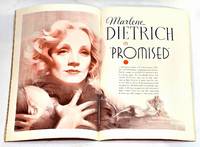
1932104552Hollywood: Paramount. 1932. Folio original printed wraps with cloth spine 435 x 298 mm. Unpag 108 pp mainly printed in shades of red and black. Some light wear to wraps and edges lower corner of rear wrap creased. A mark to a Maurice Chevalier image some red in the margin last page otherwise very clean. Very good condition. Scarce. A large illustrated compendium advertising forthcoming Paramount films aimed at cinema exhibitors. The long roll call of films and stars includes Harold Lloyd the Marx Brothers Marlene Dietrich "Blonde Venus" the Ernst Lubitsch production "Not Married" now known as "Design for Living" Cecil B. DeMille's "The Sign of the Cross" Maurice Chevalier Gary Cooper Helen Hayes Talullah Bankhead "The Glass Key" "If I Had a Million" "Lives of a Bengal Lancer" "The Lusitania Secret" "The Song of Songs" "Girl Without a Room" "No Bed of Her Own" and many more. Other advertisements splash only the title and that the actors will be "chosen from" a given list of stars an artefact of the studio system of signing actors. The images are very striking: for example a full-page illustration of Marlene Dietrich signed Hans Flato for a film called "Promised" and an array of vampish women handsome men historical heroes and crime capers. Each advertisement is lavishly illustrated often with a double page colour spread. Interestingly some of the films announced appear to have never been made at least in that form: for example 'Blood and Sand' set in Spain and starring Cary Grant and Tallulah Bankhead or "The West Pointer" starring "handsome he-man Cary Grant" as "a famous Indian ! athlete". These advertisements show a glimpse into an alternative history one for example with what would have been the first filmed adaptation of Karel Capek's play "R.U.R." about robots directed by Rouben Mamoulian or which would have given Dorothy Arzner an additional directing credit for "The Mirrors of Washington" never filmed. Apart from the advertisements there is also a section dedicated to photographs and a brief biography e.g. Marlene Dietrich Gary Cooper Carole Lombard Sylvia Sidney Miriam Hopkins Randolph Scott and Cary Grant. and section about the studio and highlighting promotions available to Paramount film exhibitors. An important and scarce slice of early movie history 1st Edition. Pictorial Wraps. Paramount paperback
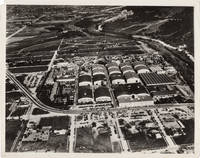
1936157965N.p.: N.p. 1936. Collection of six vintage photographs of Hollywood studios circa 1936. Includes three double weight and three single-weight photographs. Two photographs with the stamp of Holly Photo Service on the verso. <br /> <br /> One photograph shows an aerial view of Warner Brothers First National and Cosmopolitan studios in Burbank. One photograph shows Columbia Studios with an annotation in manuscript pencil on the verso noting the year as 1936. One photograph shows Republic Studios. Finally three double weight photographs show aerial views of what appears to be the burgeoning Warner Brothers lot from different angles.<br /> <br /> 10 x 8 inches. Very Good plus with pinholes at the corners. N.p. unknown
560Original. Wooden Frame. Fine Condition. Wm Hollywood. unknown
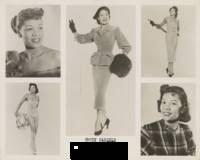
1960List3205New York City: Bruno of Hollywood and other uncredited photographers 1960. Photo album measuring 9 ¼ x 11 ¼ inches containing forty-seven photographs mainly 4 x 5 inches and smaller with some 8 x 10. Most photos loosely affixed with some having detached. Overall excellent. An album of photographs of African American models from the 1950s and 1960s many with stamps verso from Ophelia DeVore’s Grace del Marco Modeling Agency. DeVore’s was among the first agencies for African American models and was highly influential with talent including the first Black supermodel Helen Williams Shaft actor Richard Roundtree and pioneering actresses Diahann Carroll and Cicely Tyson. Identified models in this album include Trudy Daniels Haynes and Lourdes “Lulu†Guerrero. Guerrero was a cover girl for Ebony and Jet magazines and had a role on The Jackie Gleason Show in 1958 making her one of the first Black women to have a role as a regular performer on national television. Trudy Haynes had a brief modeling career before becoming the first African American TV weather reporter working with WXYZ-TV in Detroit in 1963. There is also a photograph of radio DJ Pat Connell; though not a fashion model Connell was the first African American hired as a staff announcer by CBS. Of interest to historians of African American fashion and media. Bruno of Hollywood and other uncredited photographers unknown
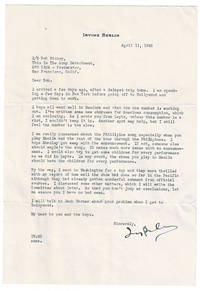
1945100362<p>April 11 1945. 1945. Very good. - Over 250 words typed on his personal 10-1/2 inch high by 7-1/4 inch wide embossed watermarked linen stationery. Irving Berlin writes to Bob Sidney the choreographer of his important World War II musical "This Is the Army" concerning new music he created for the show's tour of the Philippines. He writes that "I hope all went well in Mendora Mindora and that the new number is working out.As I wrote you from Leyte unless this number is a riot I wouldn't keep it in. Another spot may help but I still feel the number is too slow." Berlin had introduced his new song "Heaven Watch the Philippines" during a ceremony in Leyte in March of 1945 singing the song with a chorus of Filipino girls and the cast of the play "This Is the Army". He wrote the song as a tribute to the Filipino people and their resilience during World War II. In his letter to Bob Sidney he expresses his concern that the song will be misunderstood. "I am really concerned about the Philippine song especially when you play Manila and the rest of the tour through the Philippines. I hope Shanley Pvt. Robert Shanley got away with the announcement. If not someone else should explain the song. It makes much more sense with an announcement. I would also try to get some children for every performance as we did in Leyte. In any event the shows you play in Manila should have the children for every performance." Signed in full "Irving Berlin". Folded for mailing with some light creases. Near fine.</p><p>Originally composed as a Broadway Musical Irving Berlin's "This is the Army" was staged as a morale-boosting revue to raise money for the troops. The musical opened on Broadway on July 4 1942 during the Second World War with a cast consisting of 300 uniformed soldiers. The show was so successful that it was followed by a national and international tour playing in the European Far East and Pacific Theaters of War. Irving Berlin designed the show so that he could insert new songs depending on the location of the performances. "My British Buddy" was composed for the English performances and "Heaven Watch the Philippines" for Pacific Island shows. The song "Heaven Watch the Philippines" was written as a tribute to the Filipino people's resilience during the war and as a benefit to aid in the recovery following the war. Dedicated to General Douglas MacArthur Berlin sang the song with a chorus of Filipino girls and the cast of the musical in a presentation ceremony in Philippine city of Leyte in March 1945. He subsequently donated the song to the country with proceeds to go to the Boy & Girl Scouts of the Philippines.</p><p>The Russian-born American composer and songwriter Irving Berlin 1888-1989 wrote an estimated 1500 songs including scores for 20 Broadway musicals and 15 Hollywood movies. His music forms a large part of the Great American Songbook.</p><p>The American choreographer Robert Sidney 1909-2008 was self-taught as a dancer. He made his Broadway debut in "On Your Toes" in 1936 and appeared in George Balanchine's "Keep Off the Grass". Assigned to the Special Services Division during the Second World War he was the principal choreographer for Irving Berlin's musical "This Is The Army" and was later involved in the movie version starring Ronald Reagan. He choreographed many Broadway shows and worked with Bing Crosby Rita Hayworth Nancy Walker Jackie Gleason Cyd Charisse Debbie Reynolds and Mitzi Gaynor. He also went on to work in television choreographing for "The Dean Martin Show" television versions of musicals and 4 Academy Awards shows.</p> April 11, 1945.
192225341ELos Angeles 1922. Original Typed Letter Signed by Harold Lloyd to Hollywood producer William E. Keefe. Single sheet 7 inches by 10 1/8 inches. Signed “Harold Lloyd†in black fountain pen ink on his pictorial orange and silver Harold Lloyd letterhead dated “August 17 1922â€. The letter reads in full: “My dear Mr. Keefe:- I want to offer you my sincere thanks for the very kind manner in which you handled GRANDMA’S BOY. It was indeed mighty nice of you and I deeply appreciate it. With my most sincere good wishes Harold Lloydâ€. Very good with two old mailing folds and some minor soiling to the back side. At the time of this letter Lloyd had two films released: the first of which was his favorite film titled Grandma’s Boy directed by Fred C. Newmeyer written by Hal Roach Sam Taylor and Jean C. Havez with Mildred Davis and Anna Townsend and Dr. Jack with Mildred Davis and John T. Prince. Harold Lloyd was one of the biggest stars during Hollywood’s Golden Age of silent film comedy. Some of his most memorable films include Safety Last! 1923 Girl Shy 1924 The Freshman 1925 The Kid Brother 1927 and Speedy 1928. unknown
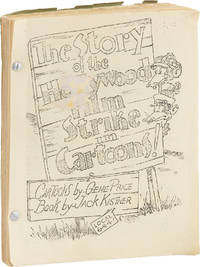
80599Los Angeles: Local 644 International Motion Picture Painters Union 1945. First Edition. Sole printing. Quarto 11" x 8-1/2". 189 unnumbered mimeographed sheets including title page and introduction printed recto-only chiefly illustrations; post-bound at left margin. Unprinted card rear cover wrapper possibly later; no front cover wrapper else complete and probably as issued. Minor edge-creasing and wear; faint marginal stain to final 15 leaves well away from printed area; evidence of old adhesion to cover page not affecting legibility; Very Good and quite well-preserved especially considering the volume's inherent fragility. <br /> <br /> A bound volume presumably one of very few produced collecting all of the circa 185 issues of "The Picket Line" a cartoon broadside distributed daily to striking workers during the 1945 Hollywood Film Strike which began in March 1945 following a walkout by the Hollywood local of the International Set Decorators Union. A number of sympathetic locals joined the strike but others - including the International Alliance of Theatrical Stage Employees and the Screen Office Employees' Guild - refused to honor the picket line leading to a lockout that lasted more than five months. <br /> <br /> The cartoons draw on topical events often commenting humorously on developments of the day before. A recurring comic character is a sardonic rat an avatar for the union scabs who refused to join the strike weakening the position of labor and paving the way to the violent events of October 5 1945 the so-called "Hollywood Black Friday" when strikebreakers were brought in to violently suppress the strike fire-hosing and clubbing dozens of strikers in front of the gates of Warner Brothers Studios. All of these events are pictured here with the upbeat mood of the drawings growing increasingly dark following the events of Black Friday. The cartoons are preceded by a one-page introduction giving the background of the strike and tracing its history through its conclusion which came when the strikers finally called a truce on October 31st. A rarely-seen relic of one of the darkest incidents in Hollywood labor history. Rare: OCLC notes three copies MSU UM and UCLA; not generally seen in commerce. unknown
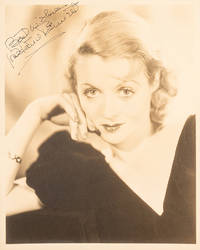
06014Various Places: 1930-2000. A Vivid Gallery of Hollywood History <br /> From Silent-Era Pioneers to Golden Age Stars<br /> <br /> HOLLYWOOD ICONS. A Collection of Twenty-Eight Original Signed and Inscribed Photographs.<br /> Various places various dates ca. 1930s-1970s.<br /> <br /> Twenty-eight black-and-white photographs sizes ranging from 5 x 7 in. to 10 x 8 in. each boldly signed or inscribed by leading actors actresses directors producers and musicians of Hollywood's Golden Age and beyond. All items in near-fine or better condition many with personalized inscriptions.<br /> <br /> A remarkable assembly of signed portraits representing the glamour and breadth of twentieth-century cinema and stage including Academy Award winners legendary directors pioneering producers and iconic performers.<br /> <br /> Together these images form a vivid gallery of Hollywood history: from silent-era pioneers Anna May Wong Raoul Walsh Fay Wray to Golden Age stars Tyrone Power Joan Fontaine Olivia de Havilland Janet Gaynor Rosalind Russell and from influential directors and producers John Ford William Wyler King Vidor Billy Wilder Otto Preminger Hal Wallis Joe Pasternak to cross-disciplinary figures such as Leonard Bernstein. The inscriptions many personalized add a layer of provenance and human connection to these iconic names. <br /> <br /> The Photographs:<br /> Constance Bennett - Signed 10 x 8 in. photograph.<br /> Joan Bennett - Signed 9½ x 8 in. photograph.<br /> Leonard Bernstein - Signed 10 x 8 in. portrait.<br /> Madeleine Carroll - Signed 7 x 5 in. photograph.<br /> Joan Fontaine - Signed 10 x 8 in. portrait.<br /> John Ford - Signed 9 x 8 in. photograph.<br /> Janet Gaynor - Inscribed 7 x 10 in. photograph dated 1937.<br /> Helen Hayes - Signed 10 x 8 in. portrait.<br /> Jennifer Jones - Signed 10 x 8 in. photograph.<br /> Elia Kazan - Signed 10 x 8 in. photograph.<br /> Herbert Marshall - Inscribed 10 x 8 in. photograph dated 1938.<br /> Mike Nichols - Signed 9 x 7 in. photograph.<br /> Olivia de Havilland - Signed 10 x 8 in. portrait dated August 1971.<br /> Joe Pasternak - Inscribed 9½ x 7 in. photograph.<br /> Tyrone Power - Signed 10 x 8 in. portrait.<br /> Otto Preminger - Signed 10 x 7 in. photograph dated 1972.<br /> Dolores del Río - Signed 10 x 8 in. photograph.<br /> Rosalind Russell - Signed 10 x 8 in. portrait.<br /> Budd Schulberg - Inscribed 10 x 8 in. photograph.<br /> Lupe Vélez - Signed 9½ x 7 in. photograph.<br /> Hal B. Wallis - Inscribed 10 x 8 in. portrait.<br /> Raoul Walsh - Inscribed 10 x 8 in. photograph.<br /> Billy Wilder - Signed 9¾ x 7¾ in. photograph.<br /> Anna May Wong - Inscribed 10 x 8 in. portrait with Chinese characters dated 1932.<br /> Fay Wray - Signed 7 x 5 in. photograph.<br /> William Wyler - Inscribed 10 x 8 in. photograph.<br /> King Vidor - Signed 10 x 8 in. photograph dated 1972.<br /> Loretta Young - Inscribed 9½ x 7¾ in. photograph. Various Places: , 1930-2000 unknown
1942267081942 SIGNED B/W Original Wedding Portrait Photograph 13 7/8 X 11 inchesProtected in Stiff Clear Plastic & BoardMinor Wear SIGNATURES GUARANTEED AUTHENTIC VG Quickly they Were Nicknamed Cash & Cary Signed photograph of them together is as Scarce as Hens Teeth Cary lived 1904-1986 & Hutton lived 1912-1979. Signed by Author. 1st Edition. Unbound. Very Good/No Jacket.
193015984JNew York: Vanguard Press 1930. First Edition First Printing. Signed by the authors: "Carroll and Garrett Graham June 19 1930". On the front pastedown is the engraved theatrical scene bookplate of Fritz Tidden who was the Hollywood publicist for great silent film director Erich von Stroheim and is known to have been one of only 12 people at a special screening who was shown the complete Greed Von Stroheim’s 1924 massive uncut 42 reel film masterpiece before it was dramatically cut by the studio to only 10 reels. A few small stains to cloth otherwise very good in a very good dust jacket with a few small chips and tears with the words office file copy stamped in a blank space on the rear panel. The front cover colorful artwork depicts a scantily clad beautiful actress posed in recline on a film set with a director and film crew photographing her. Queer People is considered one of the true landmarks in the continuous evolution of the Hollywood novel. The novel’s take of the bizarre and seamy side of the life of Hollywood during its golden age is like no other work of fiction. In the 1976 reprint edition Budd Schulberg wrote “.in Queer People we have if not THE Hollywood novel - at least a truly seminal work on Hollywood in which may be found the seeds of at least three of the longer-lived Hollywood novels The Day of the Locust What Makes Sammy Run and The Last Tycoon.†The book was a scandalous sensation when published and went through numerous printings very quickly. At publication multi-millionaire film producer Howard Hughes bought the film rights to the novel. He hired Leo McCarey to direct and Ben Hecht to write the screenplay. Hughes biggest problem turned out to be that stars were extremely reluctant to appear in a film that attacked the Hollywood studio system. Hughes initially wanted to cast Jack Oakie and William Haines but Paramount and MGM refused to loan them out. Unable to secure a significant cast Hughes ended the production after spending over $100000 of 1930s dollars in its preparation. Vanguard Press hardcover
194428504<p>New York: Scribner's 1944. SIGNATURE GUARANTEED AUTHENTIC Personally SIGNED BY RAYMOND CHANDLER & DATED on Blank Endpapers Hollywood MARCH 30 1944 IN FRONT OF BOOK Written BY BEN HECHT A Guide for the Bedeviled <strong>Chandler also added "From // Dr. Sam Hirshfeld" on Endpapers </strong>BOOK Written BY BEN HECHT HARDBACK NODustjacket NOJACKET BK GOOD CONDITION 1944 SIGNED BY RAYMOND CHANDLER & DATED Hollywood MARCH 30 1944 IN FRONT OF BOOK BY BEN HECHT A Guide for the Bedeviled GREEN CLOTH LIGHT RUB WEAR Hirshfeld was a Hollywood physician active in the 1940's and a good friend of Hecht's & CHANDLER - he is mentioned in "Harpo Speaks" as attending a Marx dinner with Hecht and Hecht gave his funeral oratory. The cloth boards are worn and the dust jacket is missing. Interior sound. BOOK Written BY BEN HECHT . Signed by Author. Hard Cover. Good/No Jacket.</p> New York: Scribner's hardcover