576 résultats
194516426JMoscow: Goskinoisdat 1945. First Edition. Text and inscription in Russian. Signed presentation copy from film director Sergei Eisenstein to film sound engineer Boris Alexeivich Volsky inscribed in Russian which translated reads: “I am asking my friend Volsky to take this modest gift as a token of admiration With Love Sergei Eisenstein 2nd part of Ivan the Terrible 1/46â€. Very good in decorated stamped cloth. A very rare book printed while the Russians were fiercely battling the Nazis this book was printed in very small quantities. Volsky recorded the sound for Eisenstein’s Ivan the Terrible Part One which was being filmed at this time. Original stamped decorative cloth. Very good. Boris Volsky recorded the sound for Eisenstein’s Alexander Nevsky 1938 Ivan the Terrible Part One 1948 and Ivan the Terrible Part Two 1958. Eisenstein’s autograph is a legendary rarity. Goskinoisdat hardcover
194416424JMoscow: Goskinoisdat 1944. First Edition. Text and inscription in Russian. Signed presentation copy from film director Sergei Eisenstein to film sound engineer Boris Alexeivich Volsky inscribed in Russian which translated reads: “To dear Boris Alexeivich on a day of joy which I hope will change the misery. With love Sergei Eisenstein December 44â€. Very good in decorated stamped cloth. A very rare book printed while the Russians were fiercely battling the Nazis this book was printed in very small quantities. Volsky recorded the sound for Eisenstein’s Ivan the Terrible Part One which was being filmed at this time. Original stamped decorative cloth. Very good. Boris Volsky recorded the sound for Eisenstein’s Alexander Nevsky 1938 Ivan the Terrible Part One 1948 and Ivan the Terrible Part Two 1958. Eisenstein’s autograph is a legendary rarity. Goskinoisdat hardcover
193916425JMoscow: Goskinoisdat 1939. First Edition. Text and inscription in Russian. Signed and inscribed by film director Sergei Eisenstein to film sound engineer Boris Alexeivich Volsky inscribed in Russian which translated reads: “To the former “remarkable’ sound engineer page 25 who took care of Alexander Nevsky ‘with shining mastery page 28 with love Sergei Eisenstein Moscow June 14 1940â€. Eisenstein praises Volsky in the printed text of the two pages he has indicated. Additionally the book is signed again in pencil with Eisenstein using his cursive Arabic handwriting siganture while the signature in the inscription to Volsky is his Cyrillic Russian signature. Original green cloth. Very good. Boris Volsky recorded the sound for Eisenstein’s Alexander Nevsky 1938 Ivan the Terrible Part One 1948 and Ivan the Terrible Part Two 1958. Eisenstein’s autograph is a legendary rarity. Goskinoisdat hardcover
2015111344Gallery. New. 2015. Hardcover. 0300207220 . FREE UPGRADE to Courier/Priority Shipping Upon Request - IN STOCK AND IMMEDIATELY AVAILABLE FOR SHIPMENT - Flawless copy brand new pristine never opened - -- with a bonus offer-- . Gallery hardcover
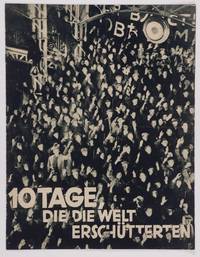
192854894Berlin: Film-Kurier/ Prometheus-Film 1928. First edition. Softcover. vg- to near fine. Quarto 11 3/4 x 9". 8pp. Original photo-illustrated wraps with white lettering on cover protected by modern mylar. <br /> <br /> A scarce issue of Illustrierter Film-Kurier the of the photo-illustrated promotional supplement to the German weekly Film-Kurier issued to coincide with the Berlin premiere of the influential Soviet film "October: Ten Days That Shook The World" directed by Sergei Eisenstein and Grigori Aleksandrov. Profusely illustrated throughout with fine b/w photogravure images showing striking scenes from the film. Limited crew and studio credits on the interior front cover with text in German. <br /> <br /> The film which depicts the 1918 October Revolution had a screenplay by developed by Eisenstein and Alexandrow based on John Reed's book of the same title 1919. Through his work in the film Sergei Eisenstein was able to further develop and refine his technique and theory montage. The film was produced by Sovkino in Russian and distributed in Germany by Prometheus-Film having its German premiere in April of 1928.<br /> <br /> Wrappers with minor to light rubbing to extremities. Light folding creases. Library ink stamp at the top of the back cover. Wrappers in very good- interior in very good to near fine condition overall. Protected in modern mylar. Quite scarce. Alternate title: 10 Tage Die Die Welt Erschütterten. Film-Kurier/ Prometheus-Film unknown
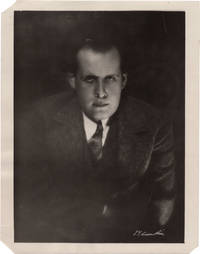
1928159783Beverly Hills CA: United Artists 1928. Vintage portrait photograph of Russian director Sergei Eisenstein circa 1928. Printed mimeo snipe affixed to the verso noting Eisenstein as having secured a contract with Joseph M. Schenck President of United Artists. <br /> <br /> United Artists stars Douglas Fairbanks and Mary Pickford traveled to Moscow after seeing Eisenstein's acclaimed 1925 film "Battleship Potemkin" in Berlin. Fairbanks offered the director a contract an invitation renewed a year later by Schenck. After visiting Hollywood the director would sign a contract with Paramount with several projects slated for production including adaptations of H.G. Wells' "War of the Worlds" and Theodore Dreiser's "An American Tragedy." Ultimately however no films would be made the result of public pressure against Eisenstein's Communist politics. On October 23 1930 by "mutual consent" Paramount and Eisenstein declared their contract null and void ending the director's short-lived career in American cinema. <br /> <br /> 8 x 10 inches. Very Good plus slightly creased with chips at three corners. United Artists unknown
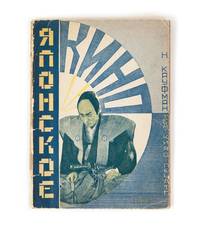
1929F-40<p>Russian constructivist advertising booklet with photomontage cover. There is an autograph on the title which by the nature of the handwriting can be identified as belonging to the famous director Sergei Eisenstein who wrote the afterword to the book.</p><p>First edition of the book. The author is a film critic Naum Osipovich Kaufman. In the form of an afterword on 20 pages the article by Sergei Mikhailovich Eisenstein 1898-1948 "Behind the Scenes" is published. Contents: Preface "The Spectator" Ginza Street. Jin Tan. Asakusa. Cinema "Denki-Kan" Plot Historical films "Jidai-Geki". Adventurous films "Chambara". Modern films "Gendai-Geki" Production "Nikkatsu" and "Sociku" Eisenstein. Behind the scenes. Index of drawings: 20 illustrations including 16 full-page and 4 in the text in Eisenstein's article. Sergei Mikhailovich Eisenstein 1898 Riga- 1948 Moscow was a Soviet theater and film director artist screenwriter art theorist and teacher. Author of fundamental works on the theory of cinema. Thanks to the film "Battleship Potemkin" his name became synonymous with Soviet cinema. In 1958 as a result of a survey of film critics from 26 countries at the World Exhibition in Brussels "Battleship Potemkin" was recognized as "the best film of all time".</p> Tea-Kino-Pechat paperback
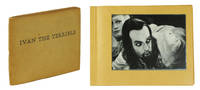
SKB-17767n.p.: Privately published by Larry Jordan 1959. Oblong 16mo. Sewn in brown paper covers. Frontis drawing by Sergei Eisenstein. Limited to 100 copies handprinted by Larry Jordan. Features 31 mounted gelatin silver print movie stills from Sergei Eisenstein's film "Ivan the Terrible." Jordan was among the preeminent underground filmmakers of the period and part of Berman's circle of artists and writers that included Bruce Conner Jess Robert Duncan Philip Lamantia and others. Eisenstein was the greatest Russian movie director and "Ivan the Terrible" was his last film. Cover reattached and a bit toned else fine 4" x 5". Rare. n.p.: Privately published by Larry Jordan, [1959]. unknown
196888914Philadelphia: Pilgrim Press 1968. First Edition. First printing. Quarto 38cm x 27cm. Folding box printed in colors housing the title volume and 34 offset-printed color posters loosely inserted as issued. Most measuring 14" x 10" or the reverse a few folded the largest opening to approximately 28" x 20". The included monograph bound in black cloth-covered boards titled in white on spine and front cover; 80pp; illus including complete catalogue of Sister Corita's prints produced from 1952 to 1967. Discreet professional repair to box hinge; slight external aging and soil; contents Fine. <br /> <br /> An uncommon complete copy of a work that's most often found missing one or two or three or four of the posters - which after all were intended to be hung on walls! Noted American Catholic artist-activist Mary Corita Kent 1918-1986 for many years Director of the Art Department at Immaculate Heart College is known for her bold and colorful graphic compositions which combined a Sixties pop-art sensibility with declarative often politically-charged texts. This portfolio gives an excellent cross-section of Sister Corita's work through the mid-1960s. The posters all reproducing original silkscreens by the artist are well-printed on heavy coated paper. The enclosed monograph in addition to a substantial autobiographical statement by the artist includes an illustrated catalogue raisonné of her graphic work from 1952 through 1967 229 works pictured. Pilgrim Press unknown
2018Manohar-9780857424884Seagull Books 2018. Paperback. New. Seagull Books paperback
BN97435Proceedings of the Fourth International Conference on Numerical Methods in Geomechanics Edmonton Canada May 31 - June 4 1982. <br/><br/>Proceedings of the Fourth International Conference on Numerical Methods in Geomechanics Edmonton Canada May 31 - June 4 1982. unknown
1995BN126419Okt 18 1995. 1995. Softcover. Oeuvres /par S.M. Eisenstein Tome 2: La Non-indifférente nature <br/><br/>Oeuvres /par S.M. Eisenstein Tome 2: La Non-indifférente nature Sergueï Eisenstein Okt 18 paperback
19581249441958. San Francisco: Larry Jordan c. 1958. <br /> <br /> Oblong 12mo with a b/w frontispiece drawing by Eisenstein and 31 black and white photographs of scenes from the film. Original buff printed wrappers browned and with the bottom wrapper trimmed below the imprint possibly removing an inscription or mark of ownership.<br /> <br /> § Limited to 100 copies printed in San Francisco by Larry Jordan born 1934 the renowned California experimental filmmaker known for his use of animation. His most famous film was Our Lady of the Sphere which followed a boy a deep-sea diver and a mystical lady with an orbital head on a surrealist dream-like journey.<br /> <br /> Ivan the Terrible 1944 was a two-part biopic of Ivan IV of Russia starring Nikolay Cherkasov. It was Eisenstein's final film and was said to have been commissioned by Joseph Stalin who admired and identified with Ivan. Part 1 was released in 1944; Part 2 should have been released in 1946 however Stalin was so displeased by the depiction of Ivan that he banned the film and it did not appear until 1958 years after Stalin's death. Part I has the uncommon accolade of have been included in both The Fifty Worst Films of All Time by Medved and Lowell and Scheider's 1001 Movies You Must See Before You Die. This tribute by Larry Jordan is further testament to the film's cult status. unknown
1992BN129093Complexe 1992. 1992. Softcover. Cinematisme : peinture et cinema : textes inédits Editions Complètes <br/><br/>Cinematisme : peinture et cinema : textes inédits Editions Complètes Eisenstein S.M. Complexe paperback
1968032678Pilgrim Press 1968. First edition 1968. "Sister Corita" Hardcover without dust jacket as issued. Slim Elephant Folio with 80 pages. Signed on the front free end paper "Corita with a little heart." The book is in good condition. Some wear and rubbing to edges and corners. Interior is clean and tight. Profusely illustrated. The book itself is complete it contains pictures of every print done from 1952 to 1967 229 prints in black & white. The "Art D'Eglise: Serigraphs" by Sister Corita. 1966. Included is "daisy with all the petals yes" a 44 page large booklet. The booklet is in good condition with some slight faint staining to back cover. Pictures available upon request. "The 1960's modern art by Corita Kent is stunningly beautiful positive and light." Black spine/White text. #032678. Signed. 1st Edition. Hardcover. Good/No DJ as Issued. Elephant Folio. Art / Design. Pilgrim Press Hardcover
19732091502133540542Kinema Junposha 1973. Soft Cover. Fine. Number of books: 5 Kinema Junposha paperback
184448885Berlin G. Reimer 1844. 4to. In contemporary half cloth. In "Journal für die reine und angewandte Mathematik" 27. band Heft 1-4 1844. Entire volume 27 offered. A small library stamp to lower part of p. 1 and a white label pasted on to upper part of spine. Light occassional brownspotting otherwise fine and clean. <br/><br/><em>First printing of these influential papers by the German mathematics prodigy Eisenstein. Even though he died prematurely at the age of 29 he managed to prove Cubic reciprocity presented in the present papers biquadratic reciprocity Quartic reciprocity to be imprisoned by the Prussian army for revolutionary activities in Berlin and making Gauss state that: "There have been only three epoch-making mathematicians: Archimedes Newton and Eisenstein". Alexander von Humboldt then 83 accompanied Eisenstein's remains to the cemetery. The papers presented in the present issue is among his most prominent and made him famous throughout the mathematical world. James Driven to innovate P. 88. "The twenty-seventh the present and most extensive and twenty-eighth volumes of Crelle's Journal published in 1844 contained twenty-five contributions by Eisenstein. These testimonials to his almost unbelievable explosively dynamic productivity rocketed him to fame throughout the mathematical world. They dealt primarily with quadratic and cubic forms the reciprocity theorem for cubic residues fundamental theorems for quadratic and biquadratic residues cyclotomy and forms of the third degree plus some notes on elliptic and Abelian transcendentals. Gauss to whom he had sent some of his writings praised them very highly and looked forward with pleasure to an announced visit. In June 1844 carrying a glowing letter of recommendation from Humboldt Eisenstein went off to see Gauss. He stayed in Göttingen fourteen days. In the course of the visit he won the high respect of the "prince of mathematicians" whom he had revered all his life. The sojourn in Göttingen was important to Eisenstein for another reason: he became friends with Moritz A. Stern-the only lasting friendship he ever made. While the two were in continual correspondence on scientific matters even Stern proved unable to dispel the melancholy that increasingly held Eisenstein in its grip. Even the sensational recognition that came to him while he was still only a third-semester student failed to brighten Eisenstein's spirits more than fleetingly. In February 1845 at the instance of Ernst E. Kummer who was acting on a suggestion from Jacobi possibly inspired by Humboldt Eisenstein was awarded an honorary doctorate in philosophy by the School of Philosophy of the University of Breslau.Eisenstein soon became the subject of legend and the early literature about him is full of errors. His treatises were written at a time when only Gauss Cauchy and Dirichlet had any conception of what a completely rigorous mathematical proof was. Even a man like Jacobi often admitted that his own work sometimes lacked the necessary rigor and self-evidence of methods and proofs." DSB. </em> hardcover
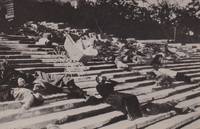
1925168469N.p.: N.p. 1925. Nine reference photographs from the 1925 Soviet silent film seven borderless and two bordered struck and issued by Cinémathèque Française circa 1936. <br /> <br /> All seven borderless photographs with the stamp of Archives Cinémathèque Française on the verso.<br /> <br /> A dramatization of a real-life mutiny which occurred on the Russian battleship Potemkin in 1905. The film's violence led to it being banned in West Germany and the UK until 1954 and even after that given an X rating until 1978. It was shown in a much-edited form in East Germany though the US premiere in December 1926 was shown unedited. A written introduction by Leon Trotsky at the beginning of the film was cut from later Soviet prints due to Trotsky running afoul of Stalin. <br /> <br /> The film's famous sequence showing a massacre by Tsarist soldiers of civilians on the Odessa Steps is considered the first example of a montage sequence in cinema. <br /> <br /> All photogaphs 5 x 3.5 inches. Generally Near Fine.<br /> <br /> BFI 1494. Godard Histoires du cinema. Rosenbaum 1000. N.p. unknown
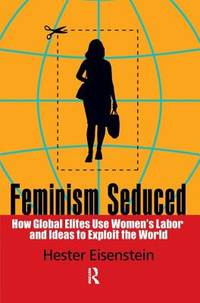
2009DADAX1594516596Routledge 2009-05-30. 1. hardcover. New. 6.25x1.00x9.00. Buy with confidence. Excellent Customer Service & Return policy. Routledge hardcover
184445139Berlin G. Reimer 1844. 4to. In "Journal für die reine und angewandte Mathematik 28 Band 1 Heft 1844". In the original printed wrappers without backstrip. Fine and clean. Eisenstein: Pp. 28-35; Pp. 36-43; Pp. 44-48; Pp. 49-52; Pp. 53-67. Entire issue: IV 96 2 pp. 2 folded plates. <br/><br/><em>First printing of six exceedingly influential papers by the German mathematics prodigy Eisenstein. Even though he died prematurely at the age of 29 he managed to prove biquadratic reciprocity Quartic reciprocity Presented in the present: "Lois de réciprocité" Cubic reciprocity Presented in the present: "Nachtrag zum cubischen Reciprocitätssatze." to be imprisoned by the Prussian army for revolutionary activities in Berlin and making Gauss state that: "There have been only three epoch-making mathematicians: Archimedes Newton and Eisenstein". Alexander von Humboldt then 83 accompanied Eisenstein's remains to the cemetery. The papers presented in the present issue is among his most prominent and made him famous throughout the mathematical world. James Driven to innovate P. 88. "The twenty-seventh and twenty-eighth volumes of Crelle's Journal published in 1844 contained twenty-five contributions by Eisenstein. These testimonials to his almost unbelievable explosively dynamic productivity rocketed him to fame throughout the mathematical world. They dealt primarily with quadratic and cubic forms the reciprocity theorem for cubic residues fundamental theorems for quadratic and biquadratic residues cyclotomy and forms of the third degree plus some notes on elliptic and Abelian transcendentals. Gauss to whom he had sent some of his writings praised them very highly and looked forward with pleasure to an announced visit. In June 1844 carrying a glowing letter of recommendation from Humboldt Eisenstein went off to see Gauss. He stayed in Göttingen fourteen days. In the course of the visit he won the high respect of the "prince of mathematicians" whom he had revered all his life. The sojourn in Göttingen was important to Eisenstein for another reason: he became friends with Moritz A. Stern-the only lasting friendship he ever made. While the two were in continual correspondence on scientific matters even Stern proved unable to dispel the melancholy that increasingly held Eisenstein in its grip. Even the sensational recognition that came to him while he was still only a third-semester student failed to brighten Eisenstein's spirits more than fleetingly. In February 1845 at the instance of Ernst E. Kummer who was acting on a suggestion from Jacobi possibly inspired by Humboldt Eisenstein was awarded an honorary doctorate in philosophy by the School of Philosophy of the University of Breslau.Eisenstein soon became the subject of legend and the early literature about him is full of errors. His treatises were written at a time when only Gauss Cauchy and Dirichlet had any conception of what a completely rigorous mathematical proof was. Even a man like Jacobi often admitted that his own work sometimes lacked the necessary rigor and self-evidence of methods and proofs." DSB </em> unknown
BN264615Klima <br/><br/>Klima Charles Eisenstein unknown
185047093Berlin G. Reimer 1850. 4to. Bound in later marbled wrappers as extracted from "Journal für die reine und angewandte Mathematik 28 Band 4. Heft 1844". Very fine and clean. Pp. 160-179; Pp. 224-274; Pp. 275-287 Entire issue: 289-380 2 folded plates. <br/><br/><em>First publication of lemniscate function and Eisenstein's Criterion one of the best known irreducibility criteria of polynomials. It is often seen referred to as the Schönemann-Eisenstein. Euler had introduced and studied the arc length of the lemniscate in the 18th century this work laying the ground work for the later development of elliptic functions. The lemniscate function expresses the parameter of the lemnicate in terms of its arc-length. It can be extended to complex values of the parameter and it then makes sense to ask for the points which divide the lemniscate into m equal parts where m is a Gaussian integer a complex number. Abel had shown that the determination of these points reduced to finding the roots of a certain polynomial equation. A crucial point in Eisenstein's extension of Abel's work described in the present papers was to prove that this polynomial is irreducible. Eisenstein developed his eponymous criterion to establish this although today it is most familiar when applied to the more elementary case of a polynomial with ordinary integer coefficients. </em> unknown
2009x-1594516596Paradigm Pub 2009. Hardcover. New. 272 pages. 9.10x6.00x0.90 inches. Paradigm Pub hardcover
19683115550London: Dennis Dobson Ltd. Fine in Fine dust jacket. 1968. First Edition; First Printing. Hardcover. First British edition. SIGNED by Jay Leyda with comment on front end-paper. Mr. Leyda has initialed the front jacket flap noting the cover photo was taken by him. From the library of noted producer/director Fletcher Markle with his bookplate on front end-paper. Fine in fine dust jacket uncommon signed by Leyda. ; 5 3/4" x 7 3/4"; 220 pages . Dennis Dobson Ltd. hardcover