120 346 résultats
150839970Paris, Udalricus Gering & Bertholdus Remboldt, 1508, March 8. (Colophon). 4to-format (recte 8vo). Later nice full calf binding (ab. 1900) with richly gilt spine and gilt borders to boards. Scratches to front board. Title-page repaired at margin (with very minor loss to ab. two letters on both recto and verso). Folio VIII and first leaf of index repaired at margin with early 16th century printed paper (no loss). Title-page and index-leaf with fairly heavy dampstaining, otherwise mostly faint dampstaining. Large beautiful woodcut printer's device and many beautiful woodcut initials throughout (the first depicting Adam and Eve).
170162765Frankfurt am Main, Zunner, 1701. 4to. In contemporary full mottled calf with five raised bands and richly gilt spine. A few scratches to boards and spine-ends slightly chipped. Leather on spine cracked. “ex dono Prof. B. Thorlacii” in contemporary hand to front free end-paper - likely referring to the Danish classical scholar and theologian Børge Thorlacius (1775–1829), professor at the University of Copenhagen and Secretary of the Royal Danish Academy of Sciences.Title page in red and black with the first three lines in Ethiopic. Last 10 ff. with hole in outer margin, not touching text, otherwise internally a nice and clean copy. (8), 427, (1) pp.
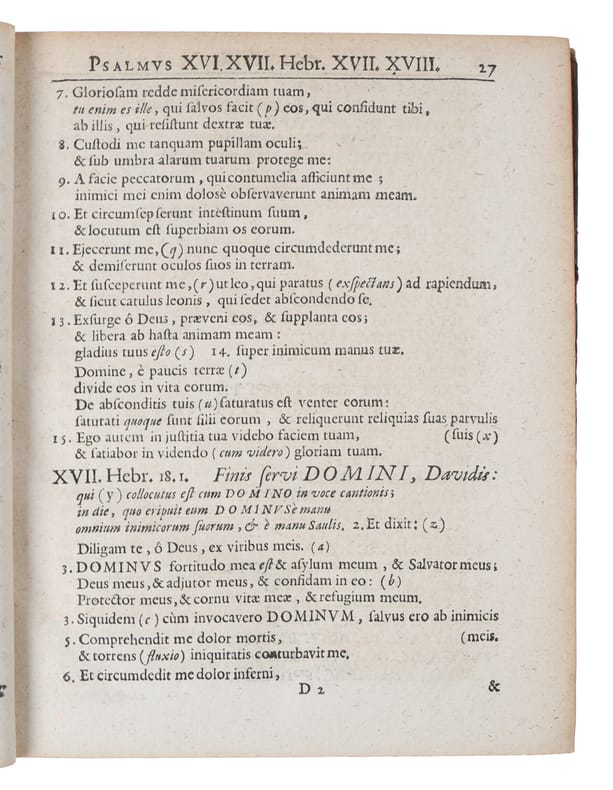
171660836A Liege, 1716 (Petitpied) & 1714 (Maigrot). 8vo. In a very nice Cambridge-style mirror binding with five raised bands and richly gilt spine. Small paper-label pasted on to top of spine. Back board with scracth with loss of leather. Edge of back board with small tear showing the wooden board. Front free end-paper with a few annotation, otherwise a nice and clean copy. XXI, (1), 539 pp. + folded plate (8), 184 pp.
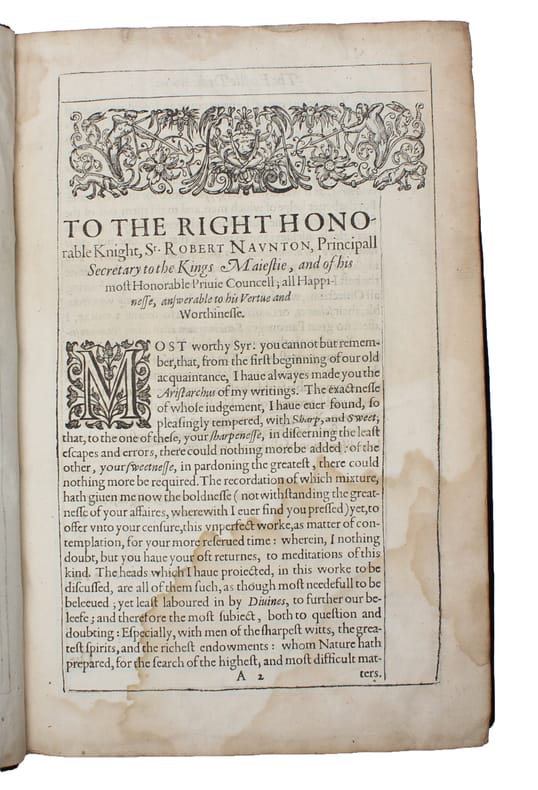
162260959London, Nicholas Okes, 1622. Folio. In contemporary full calf with five raised bands to spine. Boards with triple blind rule to boarders. Traces from paper-label to upper compartment of spine. Title-page soiled and with waterstain throughout, primarily affecting first and last leaves. (XXXVI), 68, 99-362 pp.
166961260Utrecht, Waesberge, 1648,1655, 1659 & 1669. 4to. Uniformly bound in four contemporary full vellum binding with yapp edges and author in contemporary hand to spine. Small paper-label pasted on to top of spine. Bindings with light soiling and a few dots and marks. Two stamps to each title-page. Vol. 1 and 5 internally fine and clean. Vol. 2 and 3 with dampstain to upper half of first and last leaves. (46), 1172, (56) pp. + frontispiece. (8), 1278, (26) pp. + 3 folded plates (12), 1418, (24) pp. (8), 763, (5), 243, (53) pp.
Paris, Udalricus Gering & Bertholdus Remboldt, 1508, March 8. (Colophon). 4to-format (recte 8vo). Later nice full calf binding (ab. 1900) with richly gilt spine and gilt borders to boards. Scratches to front board. Title-page repaired at margin (with very minor loss to ab. two letters on both recto and verso). Folio VIII and first leaf of index repaired at margin with early 16th century printed paper (no loss). Title-page and index-leaf with fairly heavy dampstaining, otherwise mostly faint dampstaining. Large beautiful woodcut printer's device and many beautiful woodcut initials throughout (the first depicting Adam and Eve).
Wittemberg, Nickel Schirlentz, 1539. 4to. In a later paper binding. Blank white paper label pasted on to spine. Woodcut title-page depicting Herod's guest with Salome and the decapitated John the Baptist. Woodcut-initials in text. Two stamps to verso of title-page. Small paper mark pasted on to lower outer margin on title-page. Title-page with light soiling and last 30 ff. with dampstain to upper and lower outer corner. 120 ff. + 1 blank (H4) (Complete).
Hernösandesne, Carolen G. Nordinen Trykkeriast, 1811. 8vo. In modest contemporary half calf over marbled boards. Repair to hinges and head of spine. Ex-libris pasted on to verso of front board. Stamp to title-page and last leaf of text. Internally very fine and clean. A fine copy. (2), 687, (1) pp.
1606024589Antverpiae ex officina Plantiniana apud Joannem Moretum, Antwerpen 1606. Leder Sehr gut
133289aaf1606, 15 x 18.5 cm. (images), Au total: 4 titres ill. + 107 planches gravées, taches et rousseurs par-ci, par-là, traces d’usage généralisées, cartonnage simple ancien. (Usé). (20x28 cm). (La feuille: 25x19 cm).
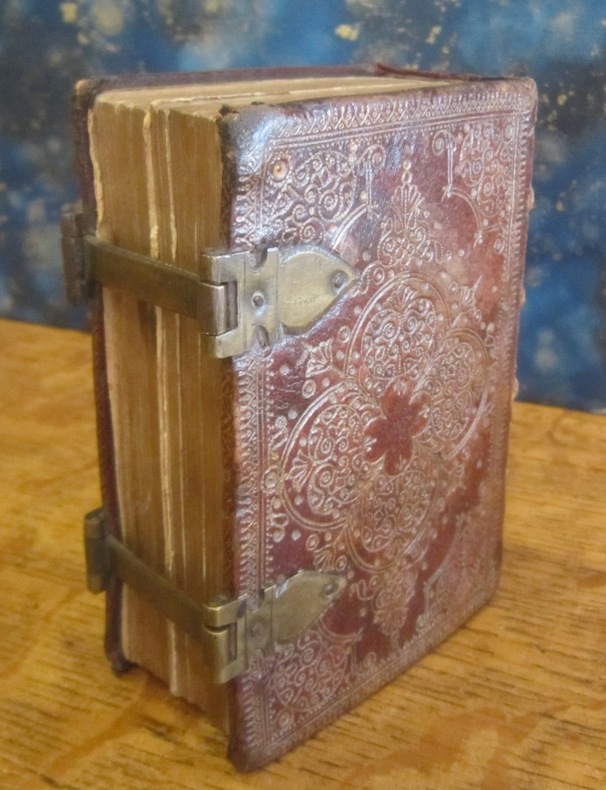
160822587London: Robert Barker. Very Good. 1608. First Edition. Hardcover. New spine with original boards and clasps. The book has been carefully repaired with several of the first pages conserved at the corners. The Old Testament Apocrypha and New Testament which title page is also dated 1608 take up 450 pages followed by "The Order of the Yeeres from Pauls Conversion." 2pp "A briefe Table of the Interpretation of proper names." 7pp "A Table of the principall things that are conteined in the Bible after the order of the Alphabet" 14pp dated 1608 by Barker "The Whole Book of Psalmes: collected in to English Meeter by Thomas Sternhold etc. " dated 1608 100pp. In a custom clamshell case. ; 16mo 6" - 7" tall; 450 pages . Robert Barker hardcover
35600988, (Paris), 1733; in-folio, veau fauve marbré, dos à six nerfs ornés de guirlandes dorées, médailles et chiffres royaux dorés alternés au dos, quadruples filets dorés entourant les plats, rosaces aux angles, grandes armes dorées couronnées de l’emblème du Saint Esprit aux centres des plats, dentelles dorées sur coupes, tranches dorées. (Reliure de l’époque). 2 ff. ( faux titre et titre), 376 pp. Nombreux blasons gravés précédant les généalogies des membres de cet Ordre. Un certain nombre de ces blasons ont été coloriés anciennement . Vignette en-tête gravée par Cochin d’après Cazes. Ouvrage très rare. Le dernier ex. est passé en vente à Paris en 1984. Petit manque au haut de la coiffe et menus défauts sans gravité( coins frottés, petites épidermures et fentes aux charnières) facilement restaurables, sinon bel exemplaire dans sa première reliure aux grandes armes royales. (Saffroy I, 4962).
It is a biography of Guru Nanak Devji in Murals that depicts the entire life of Nanak Devji. The book is profusely illustrated with pictures. These pictures/murals drawn on the walls, a rare and precious history of the Sikhs which are painted on the walls of the historic building of Baba Atal, Sri Amritsar Saheb. The other half of the book gives a brief and concise history of the Gurus, the Sikhs and Sikhism, the Khals and the Panth and of the embodiment of SHABAD and the BANI. Contents:- Guru Nanak’s Philosophy. • Birth: Divine Light emerging from Sachkhand • BediannouncingBirthofa Son • Bedi distributing sweets • Beth showing child to Devtas • School Days : Aged 5, to study Sanskrit and Hindi with Pandit • Aged 7, to study Pharsee with Mullah • Childhood : Aged 9, Sacred Thread ceremony : Janju-dharna • Giving discourses to children • Home atTalwandi : Aged 10, grazing cattle• Complaints about loss of wheat • Inspection of loss by officials •Sarap Chhaya • Work: Sacha Sauda, as trader • After Sacha Sauda • Sultanpur : Work atModikhana, aged 17 • Complaints about accounts • Marriage: Sagan ceremony • Kurmai-engagement • Bath:Mai-yan • Barat leaving for Batala • Nanaki demands her dues from brother • Barat arrived at Batala • Barat is having Feast • Lavan : marriage ceremony • DoliretumstoTalwandi • Mata Tripta : Pani-Vama ceremony • Birth of Sri Chand • Helped a devotee and Dassi illumined • First Sachkhand Visit: Bein experience • Modikhana: Lutauna, left work • Encounter with Tn-laws • First Udassi : Emnabad Bhai Lab • Returned from Enmabad • Farincla and Heavenly Rabab • Kartarpur: With Karoria • With Family • Discourses with Sangat • Udassis of East : Patna with Saks Rai. Encounter with Kauda • Arti Sohilla at Pun • Udassis of the West : Notes • Crossed Ocean on the back of a Dolphin • Europe : Nankendorf • King Sukhsen (Sachsen) • King Kobelnains at Koblenz • King Madarben at Madrid • Afar Desh :Africa • King Devloot of Nigura Desh • Cosmotrons : Met Megh-javis • Encounters : A Daint • A Sikh about his parents • Second Sachkhand Visits : Dhruv • Sacbkhand with Nirankan • PraIila • Datta Trey • Kag Bhasund • Arctic • Middle-east: Cairo Mecca • Back to Nanaki • Himalayas : Sidhas • Bhutan • Assam, Mardana exorcized • Kashmir: encounter with an Ayali • Encounters : with a Sikh • A Daint • Dethi : Elephant re-surrected • Encounters : A Lady in the forest • With Thugs • ADhani(richperson) • A Sikh • AFox • Panja Sahib: Vali Kandhari • Encounter with a Sikh • Kurukshetra:Eclipse • Discourses with Sangat • A Leper • KaliyugVarta • Udassis to South • Khurrum: Death of Mardana • Babar Shah pays his respects to Baba and recieves Patshaliis • Bhai Lehna Milap : First encounter• Tests of Guniship • Guita given (Gum-initiation) • Last Days at Kartarpur • Sathkhand Visits • Bedi Lineage : KalyanRai • MataTriptaji • MataSulakhni • BebeNanaki • JaiRamPalta • Sri ChandandLakhnii Chand • BalaSandhu • Granthji : Compilation • Gurta • As Embodiment of the Gurus (Deh-roop) • Appendix 1 :BirthofKhalsa • Appendix 11: Nirankar Lineal • The THIJ1VIB at Mamnad • Appendix 111: SatgumLinea • Nanak 11 Gum Angad Devji • Nanak 111 : GuruAmarDasji • Nanak 1V : GuruRamDasji • Nanak V : GumAijanDevji • NanakVl : Gurullargobindji • Nanak V : GumHarRaiji •NanakVlll: GuiyllarKishanji • Nanak l GuruTegBahaduiji • Nanak X : GumGobindSinghji • Sahibzada AjitSinghji • Sahibzada JujharSin • Sahibzada ZoravarSinghji • Sahibzada : Fateh Singjhji • Appendix 1V Authoritative Seats of Sikhism: Notes • Varsity:SnDamdamaSahib • Sri Harmandar Sahib • Takhats: SriAkal Takhat Sahib • Harmandar Sri Patna Sahib •Sri Keshgarh Sahib • Sachkhand Sri Hazur Sahib • PanchKhalsaDiwan • Asans • Appendix V: Vardans to Sukhsen • To Babar Shah • Appendix V 1 : Dust Daman • Appendix V 11 : Sri Bhagautiji • Sri Bhagautiji: Kharag Lineal • Khanda • Appendix 111 : Portraitures of Khalsa • Of Singhs and Singhnis • Baba Atal Raiji: Depiction of Murals at • Glossary of Words • Index. The Title 'Guru Nanak Devji and Sikh History in Murals written/authored/edited by S. S. Khalsaji', published in the year 2004. The ISBN 9788178352725 is assigned to the Hardcover version of this title. This book has total of pp. 243 (Pages). The publisher of this title is Kalpaz Publications. This Book is in English. The subject of this book is History / Archaeology / RELIGION / PHILOSOPHY. Size of the book is 22.59 x 28.94 cms
1646000266Paris 1646
97431 Tirage limité à 310 exemplaires numérotés : celui-ci, le n° VI, signé par l'artiste, enrichi d'une suite en noir, de 4 aquarelles signées et d'un cuivre. La justification indique 20 ex. sur Japon impérial avec une suite en noir des 8 hors-texte et deux dessins originaux ; 280 sur vélin ; et pour l'artiste 10 exemplaires sur Japon supernacré. S.l., s.n. [chez l'artiste], s.d. [ca 1940], gd in-4° non paginé, relié demi-maroquin rouge à coins, titre or sur dos à 5 nerfs, tête dorée, couvertures et dos conservés, la première imprimée illustrée, la deuxième et le dos muets. Reliure de Bernasconi.
- Robert Estienne, Paris 1546, in-16 (7x11,5cm), a-p8 : [120 f.], relié. - Daniel & Esdras [& Nehemiah] [BIBLE IN HEBREW] [ESTIENNE] Robert Estienne, Paris 1546, 16°(7x11,5cm), a volume in brown morocco. First 16° edition in Hebrew by Robert Estienne. This pocket edition was printed in 17 volumes between 1544 and 1546, after the success of the four-volume quarto edition printed from 1539 to 1544. Each individual volume could be acquired separately and considered complete in itself. Printer's woodcut device on each title page with book titles set within woodcut cartouche head-pieces. Only the title page is in Latin-Hebrew. "This little edition, said to be very accurate, is a true typographical jewel, and perhaps the most beautiful one ever printed in the Hebrew language." "Cette petite édition que l'on dit fort exacte, est vraiment un bijou typographique, et peut-être ce qui a jamais été imprimé de plus beau en langue hébraïque" (A. A. Renouard, Annales de l'imprimerie des Estienne) Contemporary binding in full brown morocco, smooth spine, gilt tooled boards, all edges gilt. This Book of Daniel edition by François Vatable is based on the Hebrew Soncino princeps edition published in 1488. The text in Hebrew follows the Masoretic tradition and presents diacritics that facilitate its vocalization. Talented scholar François Vatable (1495-1547) procured in his early years new Latin translations and editions of Aristotle as an assistant to Jacques Lefèvre d'Étaples. After founding the Collège de France in 1530, King Francis I appointed him chair of Hebrew studies. As a Royal lecturer he actively participated ten years later in a Hebrew edition of the Books of the Bible with Robert Estienne (1503-1559) - printer to the King in Latin and Hebrew. This edition was certainly intended for scholarly use, given its small format sold in separate individual volumes, published after a first lavish quarto edition. The presence of numerous contemporary marginal notes further indicates its educational purpose, as is the numbering of lines of several pages in some of our volumes. A very beautiful and scarce collaborative work by two of the greatest figures of Parisian humanist scholarship - a fine example of the renewed interest in classical texts. Provenance: library of Charles John Dimsdale (1801-1872), fifth baron of the Russian Empire, with his bookplate on each pastedown endpaper. [FRENCH VERSION FOLLOWS] Première édition hébraïque in-16 de ce livre de la Bible par Robert Estienne. A la suite du succès de l'édition en 4 volumes in-4 dont l'impression s'étala de 1539 à 1544, cette édition miniature constituée de dix-sept parties fut publiée entre 1544 et 1546 ; chaque volume pouvait être acquis séparément car complet en soit. Belle marque d'imprimeur ainsi qu'un encadrement gravé. Seule la page de titre est bilingue (latin-hébreu). « Cette petite édition que l'on dit fort exacte, est vraiment un bijou typographique, et peut-être ce qui a jamais été imprimé de plus beau en langue hébraïque. » (A. A. Renouard, Annales de l'imprimerie des Estienne) Reliure postérieure (1590-1615) en plein maroquin brun, dos lisse orné de filets dorés, plats encadrés de doubles filets et poinçons dorés, toutes tranches dorées. Légers frottements. Un travail de ver portant atteinte à quelques lettres en fin de volume. Ce livre des Daniel et Ezra s'appuyant sur l'édition princeps hébraïque publiée par Soncino en 1488, est l'uvre de François Vatable, pionnier des études hébraïques de la Renaissance et lecteur d'hébreu au Collège royal sous François Ier. Le texte, intégralement en hébreu, suit la tradition massorétique et présente des diacritiques facilitant sa vocalisation. Exégète de talent, le jeune François Vatable (1495-1547) travailla d'abord pour Jacques Lefèvre d'Étaples avec lequel il traduisit les uvres d'Aristote du latin au grec ; François Ier, à la fondation du Collège de France en 1530 lui confia la chaire d'hébreu. Près de dix ans plus tard, et t
- Robert Estienne, Paris 1544, in-16 (7x11,5cm), A-P8 : [120 f.], relié. - Duodecim Prophetae [BIBLE IN HEBREW] [ESTIENNE] Robert Estienne, Paris 1544, 16°(7x11,5cm), a volume bound in brown morocco. First 16° edition in Hebrew by Robert Estienne. This pocket edition was printed in 17 volumes between 1544 and 1546, after the success of the four-volume quarto edition printed from 1539 to 1544. Each individual volume could be acquired separately and considered complete in itself. Printer's woodcut device on each title page with book titles set within woodcut cartouche head-pieces. Only the title page is in Latin-Hebrew. "This little edition, said to be very accurate, is a true typographical jewel, and perhaps the most beautiful one ever printed in the Hebrew language." "Cette petite édition que l'on dit fort exacte, est vraiment un bijou typographique, et peut-être ce qui a jamais été imprimé de plus beau en langue hébraïque" (A. A. Renouard, Annales de l'imprimerie des Estienne) Contemporary binding in full brown morocco, smooth spine, gilt tooled boards, all edges gilt. This Twelve Prophets edition by François Vatable is based on the Hebrew Soncino princeps edition published in 1488. The text in Hebrew follows the Masoretic tradition and presents diacritics that facilitate its vocalization. Talented scholar François Vatable (1495-1547) procured in his early years new Latin translations and editions of Aristotle as an assistant to Jacques Lefèvre d'Étaples. After founding the Collège de France in 1530, King Francis I appointed him chair of Hebrew studies. As a Royal lecturer he actively participated ten years later in a Hebrew edition of the Books of the Bible with Robert Estienne (1503-1559) - printer to the King in Latin and Hebrew. This edition was certainly intended for scholarly use, given its small format sold in separate individual volumes, published after a first lavish quarto edition. The presence of numerous contemporary marginal notes further indicates its educational purpose, as is the numbering of lines of several pages in some of our volumes. A very beautiful and scarce collaborative work by two of the greatest figures of Parisian humanist scholarship - a fine example of the renewed interest in classical texts. Provenance: library of Charles John Dimsdale (1801-1872), fifth baron of the Russian Empire, with his bookplate on each pastedown endpaper. [FRENCH VERSION FOLLOWS] Première édition hébraïque in-16 de ce livre de la Bible par Robert Estienne. A la suite du succès de l'édition en 4 volumes in-4 dont l'impression s'étala de 1539 à 1544, cette édition miniature constituée de dix-sept parties fut publiée entre 1544 et 1546 ; chaque volume pouvait être acquis séparément car complet en soit. Belle marque d'imprimeur ainsi qu'un encadrement gravé. Seule la page de titre est bilingue (latin-hébreu). Microscopiques notes marginales en latin. « Cette petite édition que l'on dit fort exacte, est vraiment un bijou typographique, et peut-être ce qui a jamais été imprimé de plus beau en langue hébraïque. » (A. A. Renouard, Annales de l'imprimerie des Estienne) Reliure postérieure (1590-1615) en plein maroquin brun, dos lisse orné de filets dorés, plats encadrés de doubles filets et poinçons dorés, toutes tranches dorées. Légers frottements. Ce livre des Douze Prophètes s'appuyant sur l'édition princeps hébraïque publiée par Soncino en 1488, est l'uvre de François Vatable. Le texte, intégralement en hébreu, suit la tradition massorétique et présente des diacritiques facilitant sa vocalisation. Exégète de talent, le jeune François Vatable (1495-1547) travailla d'abord pour Jacques Lefèvre d'Étaples avec lequel il traduisit les uvres d'Aristote du latin au grec ; François Ier, à la fondation du Collège de France en 1530 lui confia la chaire d'hébreu. Près de dix ans plus tard, et toujours en qualité de professeur d'hébreu, il travailla aux côtés de Robert Estienne (1503-1559) - éditeur du Roi pour le latin et l'héb
- Robert Estienne, Paris 1544, in-16 (7x11,5cm), A-S8 T6 + 2 bl. [150 f.], relié. - Iosue & Iudices [BIBLE IN HEBREW] [ESTIENNE] Robert Estienne, Paris 1544, 16°(7x11,5cm), a volume bound in brown morocco. First 16° edition in Hebrew by Robert Estienne. This pocket edition was printed in 17 volumes between 1544 and 1546, after the success of the four-volume quarto edition printed from 1539 to 1544. Each individual volume could be acquired separately and considered complete in itself. Printer's woodcut device on each title page with book titles set within woodcut cartouche head-pieces. Only the title page is in Latin-Hebrew. "This little edition, said to be very accurate, is a true typographical jewel, and perhaps the most beautiful one ever printed in the Hebrew language." "Cette petite édition que l'on dit fort exacte, est vraiment un bijou typographique, et peut-être ce qui a jamais été imprimé de plus beau en langue hébraïque" (A. A. Renouard, Annales de l'imprimerie des Estienne) Contemporary binding in full brown morocco, smooth spine, gilt tooled boards, all edges gilt. This Book of Joshua and Judges edition by François Vatable is based on the Hebrew Soncino princeps edition published in 1488. The text in Hebrew follows the Masoretic tradition and presents diacritics that facilitate its vocalization. Talented scholar François Vatable (1495-1547) procured in his early years new Latin translations and editions of Aristotle as an assistant to Jacques Lefèvre d'Étaples. After founding the Collège de France in 1530, King Francis I appointed him chair of Hebrew studies. As a Royal lecturer he actively participated ten years later in a Hebrew edition of the Books of the Bible with Robert Estienne (1503-1559) - printer to the King in Latin and Hebrew. This edition was certainly intended for scholarly use, given its small format sold in separate individual volumes, published after a first lavish quarto edition. The presence of numerous contemporary marginal notes further indicates its educational purpose, as is the numbering of lines of several pages in some of our volumes. A very beautiful and scarce collaborative work by two of the greatest figures of Parisian humanist scholarship - a fine example of the renewed interest in classical texts. Provenance: library of Charles John Dimsdale (1801-1872), fifth baron of the Russian Empire, with his bookplate on each pastedown endpaper. [FRENCH VERSION FOLLOWS] Première édition hébraïque in-16 de ce livre de la Bible par Robert Estienne. A la suite du succès de l'édition en 4 volumes in-4 dont l'impression s'étala de 1539 à 1544, cette édition miniature constituée de dix-sept parties fut publiée entre 1544 et 1546 ; chaque volume pouvait être acquis séparément car complet en soit. Belle marque d'imprimeur ainsi qu'un encadrement gravé. Seule la page de titre est bilingue (latin-hébreu). « Cette petite édition que l'on dit fort exacte, est vraiment un bijou typographique, et peut-être ce qui a jamais été imprimé de plus beau en langue hébraïque. » (A. A. Renouard, Annales de l'imprimerie des Estienne) Reliure postérieure (1590-1615) en plein maroquin brun, dos à quatre nerfs soulignés de filets dorés, plats encadrés de doubles filets et poinçons dorés, toutes tranches dorées. Un travail de ver sur toute la marge basse du volume, sans atteinte au texte. Mors de tête du plat inférieur légèrement fendu et quelques frottements. Ce livre de Josué et des Juges s'appuyant sur l'édition princeps hébraïque publiée par Soncino en 1488, est l'uvre de François Vatable. Le texte, intégralement en hébreu, suit la tradition massorétique et présente des diacritiques facilitant sa vocalisation. Exégète de talent, le jeune François Vatable (1495-1547) travailla d'abord pour Jacques Lefèvre d'Étaples avec lequel il traduisit les uvres d'Aristote du latin au grec ; François Ier, à la fondation du Collège de France en 1530 lui confia la chaire d'hébreu. Près de dix ans plus tard, et toujours en qual
- Robert Estienne, Paris 1545, in-16 (7x11,5cm), A-Z8 [184 f.], relié. - Liber Paralipomenon [BIBLE IN HEBREW] [ESTIENNE] Robert Estienne, Paris 1545, 16°(7x11,5cm), a volume bound in brown morocco. First 16° edition in Hebrew by Robert Estienne. This pocket edition was printed in 17 volumes between 1544 and 1546, after the success of the four-volume quarto edition printed from 1539 to 1544. Each individual volume could be acquired separately and considered complete in itself. Printer's woodcut device on each title page with book titles set within woodcut cartouche head-pieces. Only the title page is in Latin-Hebrew. "This little edition, said to be very accurate, is a true typographical jewel, and perhaps the most beautiful one ever printed in the Hebrew language." "Cette petite édition que l'on dit fort exacte, est vraiment un bijou typographique, et peut-être ce qui a jamais été imprimé de plus beau en langue hébraïque" (A. A. Renouard, Annales de l'imprimerie des Estienne) Contemporary binding in full brown morocco, smooth spine, gilt tooled boards, all edges gilt. This Paralipomena edition by François Vatable is based on the Hebrew Soncino princeps edition published in 1488. The text in Hebrew follows the Masoretic tradition and presents diacritics that facilitate its vocalization. Talented scholar François Vatable (1495-1547) procured in his early years new Latin translations and editions of Aristotle as an assistant to Jacques Lefèvre d'Étaples. After founding the Collège de France in 1530, King Francis I appointed him chair of Hebrew studies. As a Royal lecturer he actively participated ten years later in a Hebrew edition of the Books of the Bible with Robert Estienne (1503-1559) - printer to the King in Latin and Hebrew. This edition was certainly intended for scholarly use, given its small format sold in separate individual volumes, published after a first lavish quarto edition. The presence of numerous contemporary marginal notes further indicates its educational purpose, as is the numbering of lines of several pages in some of our volumes. A very beautiful and scarce collaborative work by two of the greatest figures of Parisian humanist scholarship - a fine example of the renewed interest in classical texts. Provenance: library of Charles John Dimsdale (1801-1872), fifth baron of the Russian Empire, with his bookplate on each pastedown endpaper. [FRENCH VERSION FOLLOWS] Première édition hébraïque in-16 de ce livre de la Bible par Robert Estienne. A la suite du succès de l'édition en 4 volumes in-4 dont l'impression s'étala de 1539 à 1544, cette édition miniature constituée de dix-sept parties fut publiée entre 1544 et 1546 ; chaque volume pouvait être acquis séparément car complet en soit. Belle marque d'imprimeur ainsi qu'un encadrement gravé. Seule la page de titre est bilingue (latin-hébreu). « Cette petite édition que l'on dit fort exacte, est vraiment un bijou typographique, et peut-être ce qui a jamais été imprimé de plus beau en langue hébraïque. » (A. A. Renouard, Annales de l'imprimerie des Estienne) Reliure postérieure (1590-1615) en plein maroquin brun, dos lisse orné de filets dorés, plats encadrés de doubles filets et poinçons dorés, toutes tranches dorées. Mors, coins et coiffes habilement restaurés. Ce livre des Paralipomènes s'appuyant sur l'édition princeps hébraïque publiée par Soncino en 1488, est l'uvre de François Vatable. Le texte, intégralement en hébreu, suit la tradition massorétique et présente des diacritiques facilitant sa vocalisation. Exégète de talent, le jeune François Vatable (1495-1547) travailla d'abord pour Jacques Lefèvre d'Étaples avec lequel il traduisit les uvres d'Aristote du latin au grec ; François Ier, à la fondation du Collège de France en 1530 lui confia la chaire d'hébreu. Près de dix ans plus tard, et toujours en qualité de professeur d'hébreu, il travailla aux côtés de Robert Estienne (1503-1559) - éditeur du Roi pour le latin et l'hébreu - sur les textes hé
- Robert Estienne, Paris 1543, in-16 (7x11,5cm), aa-ss8 [136 f.], relié. - Prophetia Ezechielis [BIBLE IN HEBREW] [ESTIENNE] Robert Estienne, Paris 1543, 16°(7x11,5cm), a volume bound in brown morocco. First 16° edition in Hebrew by Robert Estienne. This pocket edition was printed in 17 volumes between 1544 and 1546, after the success of the four-volume quarto edition printed from 1539 to 1544. Each individual volume could be acquired separately and considered complete in itself. Printer's woodcut device on each title page with book titles set within woodcut cartouche head-pieces. Only the title page is in Latin-Hebrew. "This little edition, said to be very accurate, is a true typographical jewel, and perhaps the most beautiful one ever printed in the Hebrew language." "Cette petite édition que l'on dit fort exacte, est vraiment un bijou typographique, et peut-être ce qui a jamais été imprimé de plus beau en langue hébraïque" (A. A. Renouard, Annales de l'imprimerie des Estienne) Contemporary binding in full brown morocco, smooth spine, gilt tooled boards, all edges gilt. This edition of the Book of Ezekiel by François Vatable is based on the Hebrew Soncino princeps edition published in 1488. The text in Hebrew follows the Masoretic tradition and presents diacritics that facilitate its vocalization. Talented scholar François Vatable (1495-1547) procured in his early years new Latin translations and editions of Aristotle as an assistant to Jacques Lefèvre d'Étaples. After founding the Collège de France in 1530, King Francis I appointed him chair of Hebrew studies. As a Royal lecturer he actively participated ten years later in a Hebrew edition of the Books of the Bible with Robert Estienne (1503-1559) - printer to the King in Latin and Hebrew. This edition was certainly intended for scholarly use, given its small format sold in separate individual volumes, published after a first lavish quarto edition. The presence of numerous contemporary marginal notes further indicates its educational purpose, as is the numbering of lines of several pages in some of our volumes. A very beautiful and scarce collaborative work by two of the greatest figures of Parisian humanist scholarship - a fine example of the renewed interest in classical texts. Provenance: library of Charles John Dimsdale (1801-1872), fifth baron of the Russian Empire, with his bookplate on each pastedown endpaper. [FRENCH VERSION FOLLOWS] Première édition hébraïque in-16 de ce livre de la Bible par Robert Estienne. A la suite du succès de l'édition en 4 volumes in-4 dont l'impression s'étala de 1539 à 1544, cette édition miniature constituée de dix-sept parties fut publiée entre 1544 et 1546 ; chaque volume pouvait être acquis séparément car complet en soit. Belle marque d'imprimeur ainsi qu'un encadrement gravé. Seule la page de titre est bilingue (latin-hébreu). « Cette petite édition que l'on dit fort exacte, est vraiment un bijou typographique, et peut-être ce qui a jamais été imprimé de plus beau en langue hébraïque. » (A. A. Renouard, Annales de l'imprimerie des Estienne) Reliure postérieure (1590-1615) en plein maroquin brun, dos lisse orné de filets dorés, plats encadrés de doubles filets et poinçons dorés, toutes tranches dorées. Légers frottements. Ce livre d'Ezechiel s'appuyant sur l'édition princeps hébraïque publiée par Soncino en 1488, est l'uvre de François Vatable. Le texte, intégralement en hébreu, suit la tradition massorétique et présente des diacritiques facilitant sa vocalisation. Exégète de talent, le jeune François Vatable (1495-1547) travailla d'abord pour Jacques Lefèvre d'Étaples avec lequel il traduisit les uvres d'Aristote du latin au grec ; François Ier, à la fondation du Collège de France en 1530 lui confia la chaire d'hébreu. Près de dix ans plus tard, et toujours en qualité de professeur d'hébreu, il travailla aux côtés de Robert Estienne (1503-1559) - éditeur du Roi pour le latin et l'hébreu - sur les textes hébraïques de la B
- Robert Estienne, Paris 1545, in-16 (7x11,5cm), a-x8 [168 f.], relié. - Prophetia Ieremiae [BIBLE IN HEBREW] [ESTIENNE] Robert Estienne, Paris 1545, 16°(7x11,5cm), a volume bound in brown morocco. First 16° edition in Hebrew by Robert Estienne. This pocket edition was printed in 17 volumes between 1544 and 1546, after the success of the four-volume quarto edition printed from 1539 to 1544. Each individual volume could be acquired separately and considered complete in itself. Printer's woodcut device on each title page with book titles set within woodcut cartouche head-pieces. Only the title page is in Latin-Hebrew. "This little edition, said to be very accurate, is a true typographical jewel, and perhaps the most beautiful one ever printed in the Hebrew language." "Cette petite édition que l'on dit fort exacte, est vraiment un bijou typographique, et peut-être ce qui a jamais été imprimé de plus beau en langue hébraïque" (A. A. Renouard, Annales de l'imprimerie des Estienne) Contemporary binding in full brown morocco, gilt raised bands, gilt tooled boards, all edges gilt. Some wormholes on the fifth volume, not affecting the text. Numerous contemporary Latin marginalia, mainly in the first two volumes. This edition of the Book of Jeremiah by François Vatable is based on the Hebrew Soncino princeps edition published in 1488. The text in Hebrew follows the Masoretic tradition and presents diacritics that facilitate its vocalization. Talented scholar François Vatable (1495-1547) procured in his early years new Latin translations and editions of Aristotle as an assistant to Jacques Lefèvre d'Étaples. After founding the Collège de France in 1530, King Francis I appointed him chair of Hebrew studies. As a Royal lecturer he actively participated ten years later in a Hebrew edition of the Books of the Bible with Robert Estienne (1503-1559) - printer to the King in Latin and Hebrew. This edition was certainly intended for scholarly use, given its small format sold in separate individual volumes, published after a first lavish quarto edition. The presence of numerous contemporary marginal notes further indicates its educational purpose, as is the numbering of lines of several pages in some of our volumes. A very beautiful and scarce collaborative work by two of the greatest figures of Parisian humanist scholarship - a fine example of the renewed interest in classical texts. Provenance: library of Charles John Dimsdale (1801-1872), fifth baron of the Russian Empire, with his bookplate on each pastedown endpaper. [FRENCH VERSION FOLLOWS] Première édition hébraïque in-16 de ce livre de la Bible par Robert Estienne. A la suite du succès de l'édition en 4 volumes in-4 dont l'impression s'étala de 1539 à 1544, cette édition miniature constituée de dix-sept parties fut publiée entre 1544 et 1546 ; chaque volume pouvait être acquis séparément car complet en soit. Belle marque d'imprimeur ainsi qu'un encadrement gravé. Seule la page de titre est bilingue (latin-hébreu). Microscopiques notes marginales en latin. « Cette petite édition que l'on dit fort exacte, est vraiment un bijou typographique, et peut-être ce qui a jamais été imprimé de plus beau en langue hébraïque. » (A. A. Renouard, Annales de l'imprimerie des Estienne) Reliure postérieure (1590-1615) en plein maroquin brun, dos à cinq nerfs orné de filets dorés, plats encadrés de doubles filets et poinçons dorés, toutes tranches dorées. Légers frottements. Ce livre de Jérémie s'appuyant sur l'édition princeps hébraïque publiée par Soncino en 1488, est l'uvre de François Vatable. Le texte, intégralement en hébreu, suit la tradition massorétique et présente des diacritiques facilitant sa vocalisation. Exégète de talent, le jeune François Vatable (1495-1547) travailla d'abord pour Jacques Lefèvre d'Étaples avec lequel il traduisit les uvres d'Aristote du latin au grec ; François Ier, à la fondation du Collège de France en 1530 lui confia la chaire d'hébreu. Près de dix ans plus tar
- Robert Estienne, Paris 1545, in-16 (7x11,5cm), A-Q8 R4 [132 f.], relié. - Prophetia Isaiae [BIBLE IN HEBREW] [ESTIENNE] Robert Estienne, Paris 1545, 16°(7x11,5cm), a volume bound in brown morocco. First 16° edition in Hebrew by Robert Estienne. This pocket edition was printed in 17 volumes between 1544 and 1546, after the success of the four-volume quarto edition printed from 1539 to 1544. Each individual volume could be acquired separately and considered complete in itself. Printer's woodcut device on each title page with book titles set within woodcut cartouche head-pieces. Only the title page is in Latin-Hebrew. "This little edition, said to be very accurate, is a true typographical jewel, and perhaps the most beautiful one ever printed in the Hebrew language." "Cette petite édition que l'on dit fort exacte, est vraiment un bijou typographique, et peut-être ce qui a jamais été imprimé de plus beau en langue hébraïque" (A. A. Renouard, Annales de l'imprimerie des Estienne) Contemporary binding in full brown morocco, gilt raised bands, gilt tooled boards, all edges gilt. This Book of Isaiah edition by François Vatable is based on the Hebrew Soncino princeps edition published in 1488. The text in Hebrew follows the Masoretic tradition and presents diacritics that facilitate its vocalization. Talented scholar François Vatable (1495-1547) procured in his early years new Latin translations and editions of Aristotle as an assistant to Jacques Lefèvre d'Étaples. After founding the Collège de France in 1530, King Francis I appointed him chair of Hebrew studies. As a Royal lecturer he actively participated ten years later in a Hebrew edition of the Books of the Bible with Robert Estienne (1503-1559) - printer to the King in Latin and Hebrew. This edition was certainly intended for scholarly use, given its small format sold in separate individual volumes, published after a first lavish quarto edition. The presence of numerous contemporary marginal notes further indicates its educational purpose, as is the numbering of lines of several pages in some of our volumes. A very beautiful and scarce collaborative work by two of the greatest figures of Parisian humanist scholarship - a fine example of the renewed interest in classical texts. Provenance: library of Charles John Dimsdale (1801-1872), fifth baron of the Russian Empire, with his bookplate on each pastedown endpaper. [FRENCH VERSION FOLLOWS] Première édition hébraïque in-16 de ce livre de la Bible par Robert Estienne. A la suite du succès de l'édition en 4 volumes in-4 dont l'impression s'étala de 1539 à 1544, cette édition miniature constituée de dix-sept parties fut publiée entre 1544 et 1546 ; chaque volume pouvait être acquis séparément car complet en soit. Belle marque d'imprimeur ainsi qu'un encadrement gravé. Seule la page de titre est bilingue (latin-hébreu). Mors, coins et coiffes habilement restaurés. « Cette petite édition que l'on dit fort exacte, est vraiment un bijou typographique, et peut-être ce qui a jamais été imprimé de plus beau en langue hébraïque. » (A. A. Renouard, Annales de l'imprimerie des Estienne) Reliure postérieure (1590-1615) en plein maroquin brun, dos à cinq nerfs orné de filets dorés, plats encadrés de doubles filets et poinçons dorés, toutes tranches dorées. Légers frottements. Ce livre d'Isaïe s'appuyant sur l'édition princeps hébraïque publiée par Soncino en 1488, est l'uvre de François Vatable. Le texte, intégralement en hébreu, suit la tradition massorétique et présente des diacritiques facilitant sa vocalisation. Exégète de talent, le jeune François Vatable (1495-1547) travailla d'abord pour Jacques Lefèvre d'Étaples avec lequel il traduisit les uvres d'Aristote du latin au grec ; François Ier, à la fondation du Collège de France en 1530 lui confia la chaire d'hébreu. Près de dix ans plus tard, et toujours en qualité de professeur d'hébreu, il travailla aux côtés de Robert Estienne (1503-1559) - éditeur du Roi pour le latin et l'hé
- Robert Estienne, Paris 1544, in-16 (7x11,5cm), AA-NN8 O10 [114 f.], relié. - Proverbia Salomonis & Iob [BIBLE IN HEBREW] [ESTIENNE] Robert Estienne, Paris 1544, 16°(7x11,5cm), a volume bound in brown morocco. First 16° edition in Hebrew by Robert Estienne. This pocket edition was printed in 17 volumes between 1544 and 1546, after the success of the four-volume quarto edition printed from 1539 to 1544. Each individual volume could be acquired separately and considered complete in itself. Printer's woodcut device on each title page with book titles set within woodcut cartouche head-pieces. Only the title page is in Latin-Hebrew. "This little edition, said to be very accurate, is a true typographical jewel, and perhaps the most beautiful one ever printed in the Hebrew language." "Cette petite édition que l'on dit fort exacte, est vraiment un bijou typographique, et peut-être ce qui a jamais été imprimé de plus beau en langue hébraïque" (A. A. Renouard, Annales de l'imprimerie des Estienne) Contemporary binding in full brown morocco, smooth spine, gilt tooled boards, all edges gilt. This Book of Proverbs edition by François Vatable is based on the Hebrew Soncino princeps edition published in 1488. The text in Hebrew follows the Masoretic tradition and presents diacritics that facilitate its vocalization. Talented scholar François Vatable (1495-1547) procured in his early years new Latin translations and editions of Aristotle as an assistant to Jacques Lefèvre d'Étaples. After founding the Collège de France in 1530, King Francis I appointed him chair of Hebrew studies. As a Royal lecturer he actively participated ten years later in a Hebrew edition of the Books of the Bible with Robert Estienne (1503-1559) - printer to the King in Latin and Hebrew. This edition was certainly intended for scholarly use, given its small format sold in separate individual volumes, published after a first lavish quarto edition. The presence of numerous contemporary marginal notes further indicates its educational purpose, as is the numbering of lines of several pages in some of our volumes. A very beautiful and scarce collaborative work by two of the greatest figures of Parisian humanist scholarship - a fine example of the renewed interest in classical texts. Provenance: library of Charles John Dimsdale (1801-1872), fifth baron of the Russian Empire, with his bookplate on each pastedown endpaper. [FRENCH VERSION FOLLOWS] Première édition hébraïque in-16 de ce livre de la Bible par Robert Estienne. A la suite du succès de l'édition en 4 volumes in-4 dont l'impression s'étala de 1539 à 1544, cette édition miniature constituée de dix-sept parties fut publiée entre 1544 et 1546 ; chaque volume pouvait être acquis séparément car complet en soit. Belle marque d'imprimeur ainsi qu'un encadrement gravé. Seule la page de titre est bilingue (latin-hébreu). Microscopiques notes marginales en latin ainsi qu'une manicule. « Cette petite édition que l'on dit fort exacte, est vraiment un bijou typographique, et peut-être ce qui a jamais été imprimé de plus beau en langue hébraïque. » (A. A. Renouard, Annales de l'imprimerie des Estienne) Reliure postérieure (1590-1615) en plein maroquin brun, dos lisse orné de filets dorés, plats encadrés de doubles filets et poinçons dorés, toutes tranches dorées. Légers frottements. Ce livre des Proverbes s'appuyant sur l'édition princeps hébraïque publiée par Soncino en 1488, est l'uvre de François Vatable. Le texte, intégralement en hébreu, suit la tradition massorétique et présente des diacritiques facilitant sa vocalisation. Exégète de talent, le jeune François Vatable (1495-1547) travailla d'abord pour Jacques Lefèvre d'Étaples avec lequel il traduisit les uvres d'Aristote du latin au grec ; François Ier, à la fondation du Collège de France en 1530 lui confia la chaire d'hébreu. Près de dix ans plus tard, et toujours en qualité de professeur d'hébreu, il travailla aux côtés de Robert Estienne (1503-1559) - éditeur d
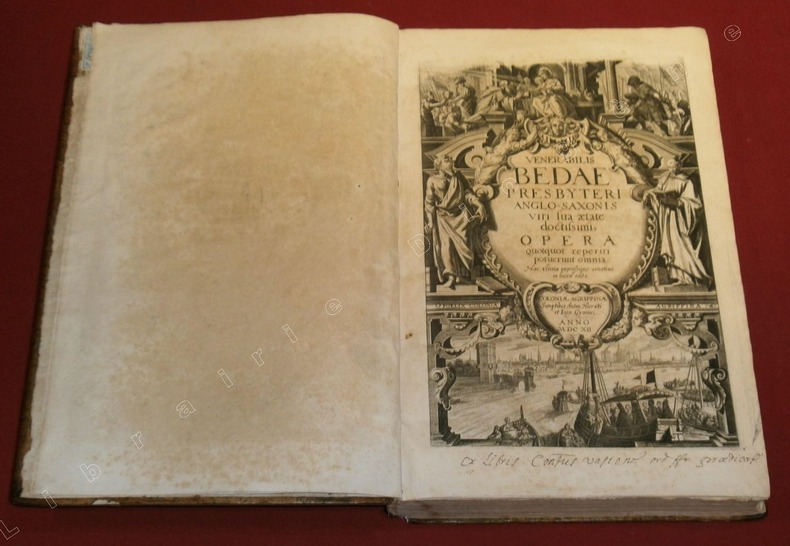
81318Coloniae Agrippinae : sumptibus Antonij Hieratus Gymnici, 1612, 8 tomes reliés en 4 volumes de 250x390 mm environ, Volume 1, tome I. (7) ff. (page de titre gravée, vie de Bède, table), 452 pages ; tome II. Philosophie, (1)f. (page de titre), 238 pages, (1)f., - Volume 2, tome III. Histoire, (3) ff. (titre, table, au Roi, au lecteur), 500 pages, (1) f. ; tome IV. Commentaires Ancien Testament, (2) ff. (titre, table), 916 pages, (1) f., - Volume 3, tome V. (1) f. (titre), 816 pages annoncées (erreurs de pagination, 855 pages) ; tome VI. (1) f. (titre), 852 pages, (1) f., - Volume 4, tome VII. (2) ff. (titre, table) 486 pages ; tome VIII. Ancien Testament, (2) ff. (titre, table), 968 pages, (64) ff. (index), (1) f., reliures plein cuir granité brun, dos à 6 nerfs portant titres et tomaisons dorés, sur pièces de titre en veau fauve, ornés de caissons à riches motifs dorés, tranches mouchetées de rouge. Avec de nombreuses figures, tableaux, diagrammes, calendriers. Ex-libris manuscrits sur les page de titre. Fréquentes erreurs de pagination, le nombre de pages annoncés est parfois erroné, mais ces volumes sont bien complet avec pagination des cahiers cohérente, rousseurs mouillures, des pages brunies, léger manque de papier sur la dernière page du tome II, épidermures, frottements, coiffes ébréchées avec début de fente sur les mors, des tampons de bibliothèque, bon état pour le reste.
- Apud Ambrosium Girault et In aedibus Claudii Chevallon, Parisiis (Paris) 1539 et 1536, in-folio (22x33,5cm), (12f.n.c.) CCCXXVII ff. [Sig (a)-(b)?, a-z?, I? L2?, A-S? (-S8)] et (8f.n.c.) et CCCLXXXIII ff., deux volumes reliés en un. - Quatrième édition réalisée par Lodoycus Tiletanus pour le premier texte ; cette édition ayant été partagée entre de multiples imprimeurs-libraires à Paris. Marque de l'imprimeur en page de titre. Lettrines. Colophon : Parisiis, Excudebat Iohannes Lodoycus Tiletanus. M. D. XXXIX. Non répertorié dans Adams. Edition que l'on trouve plusieurs fois au catalogue de la British Library mais chez différents imprimeurs. Le second ouvrage semble avoir paru pour la première fois en 1532. Magnifique page de titre gravée sur bois, avec la marque de l'imprimeur Claude Chevallon, le Christ en gloire et une nativité avec la Vierge et les rois mages, images symboliques figurant la position de la veuve de Claude Chevallon. Lettrines. On ne trouve pas cette édition dans les catalogues anglais ; un exemplaire à la BNF à la date de 1536 chez Gilles de Gourmont. Reliure en pleine basane brune XVIIIe. Dos à six nerfs ornés de caissons, d'arabesques et de petits fleurons dorés. Coupes et coiffes soulignées d'une roulette dorée. Toutes tranches mouchetées rouge. Un petit manque au niveau du mors du second plat et de l'une des coupes. Épidermures. Quelques petits trous de vers. Nombreuses notes manuscrites sur les deux textes, qui ont été rognées au moment où l'ouvrage fut relié à nouveau au XVIIIe siècle. Deux très pâles mouillures marginales portant atteinte à quelques pages, sinon bel exemplaire. 65 lignes par page. Les écrits scripturaires de Denys le Chartreux ont été publiés dès 1530 et comprennent 14 livres, les deux ouvrages que nous proposons concernent deux textes fondamentaux de la Bible : les psaumes de David et les quatre évangiles, deux ensembles, l'un de l'Ancien testament, le second du Nouveau, tout à fait emblématiques de la lecture par l'Eglise catholique de l'église du Christ. Ces commentaires, firent autorité dès leur publication (Denys meurt en 1471) car ils rassemblent l'ensemble des opinions des pères de l'église et des théologiens de son temps. La multiplication des éditions de Denys dans les années trente repose sur le vaste mouvement de contre-réforme engagé par l'Eglise. Le protestantisme reposait en effet primordialement sur la lecture de la Bible, et l'Eglise catholique se devait, en puisant dans son histoire, d'en avoir le monopole exégétique. En outre, l'Eglise s'appuyait ainsi avec Denys le Chartreux sur une grande figure mystique et philosophique participant au renouveau spirituel et chrétien, de plus une figure canonique (la position doctrinale de Denys étant médiane, entre Aristote, Platon, et Saint Augustin), laquelle s'opposait directement à celle de Luther, excommunié en 1521 et mis au ban de l'Empire peu après. Un ex-libris du XIXe siècle sur l'une des gardes, ainsi que plusieurs autres non-identifiables à la fin du premier texte et sur la page de titre du second. [ENGLISH DESCRIPTION ON DEMAND]