1 275 résultats
197410320Paris, Fayard, coll. "Documents spirituels". 1974. In-8°, 150 pp., qqs. Ill. dans le texte. Br., couv. à rabats (bon état).
167pp. + 4 plates out-of-text, 22cm., 2nd ed., softcover, dustwrapper, VG, X71405
1969X71405Roma, Ubaldini 1969 167pp. + 4 plates out-of-text, 22cm., 2nd ed., softcover, dustwrapper, VG, X71405
1961110464London Rieder 1961 1 vol. relié in-8, cartonnage de l'éditeur, IX + 146 pp. (sans la jaquette). Première édition anglaise. Bon exemplaire.
1952100148611Adrien-Maisonneuve 1952 in8. 1952. Broché. Cette publication présente la traduction et l'édition de quatre Upanishads (Atharvasira Brahmabindupanisad Kaivalyopanisad Sarvasaropanisad) par Bernadette Tubini. L'ouvrage s'inscrit dans la collection Upanishad de l'éditeur Adrien Maisonneuve et aborde des concepts védantiques centrés sur la nature de l'âtman-brahman et la libération spirituelle
247pp., 27cm., publisher's hardcover in blue cloth (corners slightly bumped) with gilt lettering on spine, text clean and bright, good condition, published in the series "The Toyo Bunko Eonso. Series A" volume XXXIII (33), [Text in Japanese, with an English summary (on pp.181-247)], X103736
1952X103736Tokyo, The Toyo Bunko 1952 247pp., 27cm., publisher's hardcover in blue cloth (corners slightly bumped) with gilt lettering on spine, text clean and bright, good condition, published in the series "The Toyo Bunko Eonso. Series A" volume XXXIII (33), [Text in Japanese, with an English summary (on pp.181-247)], X103736
in-8 broche de 123 pages, Figures et planches, couverture a rabats. Bel exemplaire. [TX-17]
1978175168Flammarion 1978 in8. 1978. Broché.
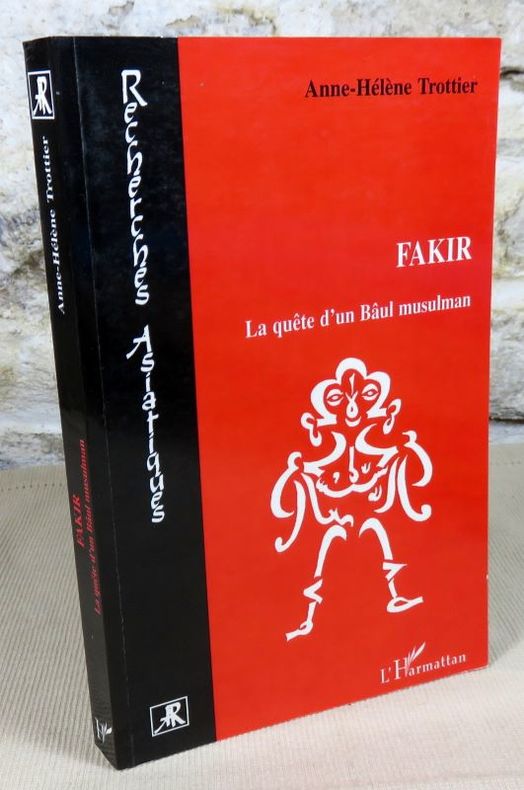
16712Broché, 21X14 cm, 2000, 275 pages, L'Harmattan. Très bon état.
1996100138327OUP India 1996 212 pages 13 97x21 844x2 54cm. 1996. Cartonné jaquette. 212 pages.
The Title 'Symbolism of Hinduism: a Hermeneutic Approach written/authored/edited by Tribhuwan Kapur', published in the year 2018. The ISBN 9788121202459 is assigned to the Hardcover version of this title. This book has total of pp. 130 (Pages). The publisher of this title is Gyan Publishing House. This Book is in English. The subject of this book is Hinduism / Religion. Size of the book is 14.34 x 22.59 cms Vol:-
About The Book: The Ramayana of Tulsi Das; On comparing the above sketch with my translation of the corresponding portion of the Hindi poem, it will be seen that the two agree only in the broadest outline. The episodes so freely introduced by both poets are, for the most part, entirely dissimilar; and even in the main narrative some of the most important incidents, such as the breaking of the bow and the contention with Parasuram, are differently placed and assume a very altered complexion. In other passages where the story follows the same lines, whatever Valmiki has condensed as, for example, the description of the marriage festivities Tulsi Das has expanded and wherever the elder poet has lingered longest, his successor has hastened on most rapidly. About The Translator: Frederic Salmon Growse CIE (1836 – 19 May 1893) was a British civil servant of the Indian Civil Service (ICS), Hindi scholar, archaeologist and collector, who served in Mathura and Bulandshahr in the North-Western Provinces during British rule in India. He studied Indian literature and languages, and founded the Catholic Church of the Sacred Heart and the Government Museum, both at Mathura. Between 1876 and 1883, he published in series, the first English translation of the Ramayana of Tulsidas. He also wrote Mathura: A district memoir (1880) and a description of the district of Bulandshahr (1884) and of its new architecture (1886). Described as "never a persona grata to his superiors", he was nonetheless gazetted CIE in 1879. At Bulandshahr between 1878 and 1884 he caused a number of buildings to be constructed using local designs and craftsmen. In 1882, he donated a collection of Indian pottery to the British Museum. In Mathura, he became intrigued by the popularity among its ordinary people of the Ramayana of Tulsidas. In 1876 he published his translation into English of the original text by Tulsidas. Growse published a revised version in 1880 as a four-volume second edition and published a full version in 1883. It was the first illustrated version of the complete English translation of the Ramcharitmanas, which he completed in Bulandshahr. He writes in the introduction that the epic Sanskrit Ramayana of Valmiki had been translated into several languages including English, but the more popular Hindi version, a retelling of Rama's life, titled Ramcharitmanas by Tulsidas, previously had not been translated into English.

1979133358Gallimard 1979 In-8 broché, 280 pages. Marques adhésives au titre.
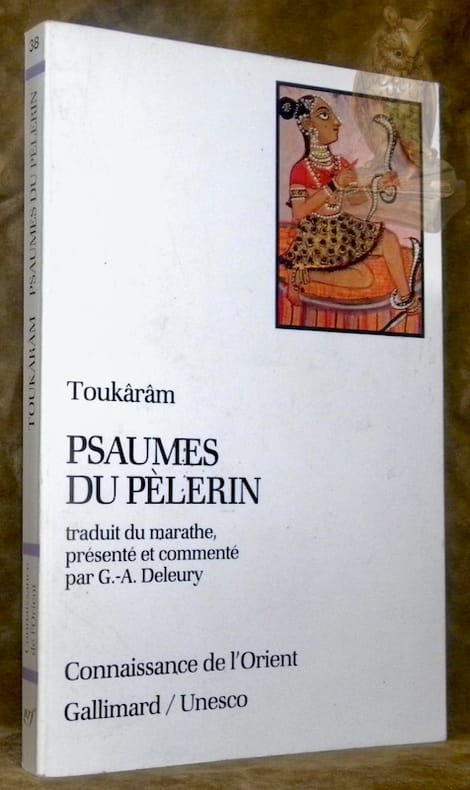
1956106701Paris Gallimard, coll. "Connaissance de l'Orient" 1956 1 vol. broché in-8, broché, non coupé, 220 pp. Exemplaire du premier tirage en service de presse avec le prière d'insérer joint. Toukaram vécut entre 1598 et 1650. Faisant partie de la caste la plus défavorisée des Choudras, il était analphabète et s'exila en pleine forêt, apprenant par coeur les 36 000 vers du Jnanechvari (glose du Baghavat). Exemplaire provenant de la bibliothèque de Georges Bataille avec tampon à l'encre noire sur le premier feuillet "Bibliothèque de Georges Bataille".
119019Paris, Gallimard Unesco 1956, 190x125mm, 220pages, broché. Bel exemplaire.
3359Traduction, introduction et commentaires de G. A. Deleury, Gallimard, Conaissance de l'Orient, collection UNESCO d'oeuvres représentatives, Série Indienne, 1956, mention de 4ème édition, , 220 pp., broché, pliures au dos, couverture un peu défraîchie, rousseurs sur les tranche, état correct.
Traduction, introduction et commentaires de G. A. Deleury, Gallimard, Conaissance de l'Orient, collection UNESCO d'oeuvres représentatives, Série Indienne, 1956, mention de 4ème édition, , 220 pp., broché, pliures au dos, couverture un peu défraîchie, rousseurs sur les tranche, état correct.
... Trade paperback, very good conditon, w. ltly rubbed wraps, a few lt marks. Ltly tanned p. edges, sm stain nr sp top. Pencilled number on ffep, o/w cln, tight, unmarked.
1810PHO-1157Paris: Arthus Bertrand, 1810. — Atlas in-4, (295x200) (2 ff.), 18 cartes et planches , la plupart dépliantes ,relié demi veau ,dos lisse avec fers de navire , manque au dos .
19845078Paris Editions du Centre National de la Recherche Scientifique 1984 in-4 cartonnage éditeur Paris, Editions du Centre National de la Recherche Scientifique, 1984. Coll. "Cahiers népalais". 28 x 22 cm, in-4, 688 (3) pp., 1 carte dépliante et une abondante iconographie en noir, cartonnage éditeur de pleine toile bleue pressée à froid, jaquette illustrée en couleurs.