Dibdin, The Reverend Thomas FrognallBiblio.com
640 résultats
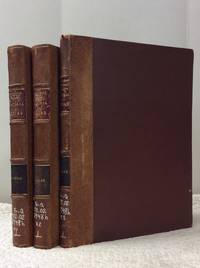
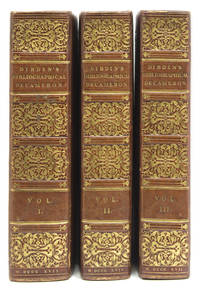
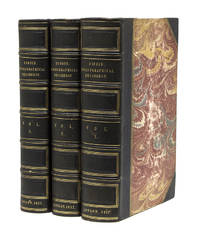
1817261849London: Printed for the author by W. Bulmer and Co. Shakespeare Press 1817. First edition with half-titles and errata. Hundreds of engravings and examples of type etc. some tinted in red and blue and slip of gold printing with directions to binder slip at vol. II p. 417. 3 vols. Imperial 8vo 9-3/4 x 6 inches. Bound in contemporary three quarters blue pebbled morocco spine gilt and marbled boards and edges. Fine small bump to some pages in Vol. I. Bookplate of The Right Hon. Charles Abbot prob. Charles Abbot 1st Baron Colchester in Vols II & III. First edition with half-titles and errata. Hundreds of engravings and examples of type etc. some tinted in red and blue and slip of gold printing with directions to binder slip at vol. II p. 417. 3 vols. Imperial 8vo 9-3/4 x 6 inches. Windle & Pippin A28; Jackson no.40; Hart no.186; Bigmore and Wyman pp. 169-70 Printed for the author by W. Bulmer and Co. Shakespeare Press unknown
1880130343Mexico: J. M. Andrade 1880. First edition. 535p; 177p; 65p Complete set with the third volume being the complete atlas volume of 66 engraved plates. Ex-library: numbers painted on spines; bookplates; library stamps on endpapers - title pages - foredges. Bound with leather spines and cloth boards. Corners of covers worn; leather spine labels wearing off slightly. Pages of Vols. I-II are yellowed but otherwise unmarked and clean. Volume III shows evidence of water damage and many pages have a severe dark stain. Three pages have some loss to the margins but the images of the plates are completely intact. A history of Indians of the new world detailing their life and culture at the time of the Spanish Conquest. A classic and important study of Native American culture and offered here in a damaged but still useful example of the rare first edition. J. M. Andrade unknown
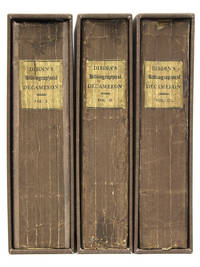
1817306781London: Printed for the author by W. Bulmer and Co. Shakespeare Press 1817. First edition. Hundreds of engravings and examples of type etc. Slip announcing vol. IV of Typographical Antiquities inserted before half title of Vol. I. 3 vols. Imperial 8vo. Original drab boards printed spine labels untrimmed. Old clean repairs to the joints of vol. I; joints of vol. III a bit rubbed. Ownership signature of Mary Curteis Dec. 29 1817 on pastedown in each volume; bookplate of Charles Sarolea and his signature on title page; small morocco label; printed label of Claude Smith on flyleaf. Very good. Cloth slipcases. First edition. Hundreds of engravings and examples of type etc. Slip announcing vol. IV of Typographical Antiquities inserted before half title of Vol. I. 3 vols. Imperial 8vo. Windle & Pippin A28; Jackson no.40; Hart no.186; Bigmore and Wyman pp. 169-70 Printed for the author by W. Bulmer and Co. Shakespeare Press unknown books
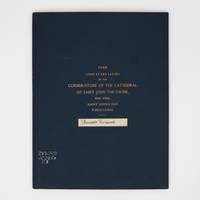
1892376201New York: Feast of Saint John the Evangelist 1892. Printed on pure vellum. Title page with seal printed in red. Vignette of eagle at head of first page of service. Artist's rendering of the cathedral on last page. 6 pp. Printed by the DeVinne Press. 1 vols. 4to. Blue cloth upper cover titled in gilt with paper label for J. Roosevelt Roosevelt lower cover with eagle in blind a.e.g. Fine. Bookplate of General Theological Seminary. Printed on pure vellum. Title page with seal printed in red. Vignette of eagle at head of first page of service. Artist's rendering of the cathedral on last page. 6 pp. Printed by the DeVinne Press. 1 vols. 4to. Order of service for the start of the construction of the New York City landmark. <br /> Just a few copies were printed on vellum.<br /> With a presentation inscription from the original owner "To the Rev. Howard C. Robbins Dean of the Cathedral of St. John the Divine J. Roosevelt Roosevelt May 16 1922"<br /> James Roosevelt Roosevelt 1854-1927 was half brother of Franklin Delano Roosevelt.<br /> Uncommon and beautiful. Feast of Saint John the Evangelist unknown
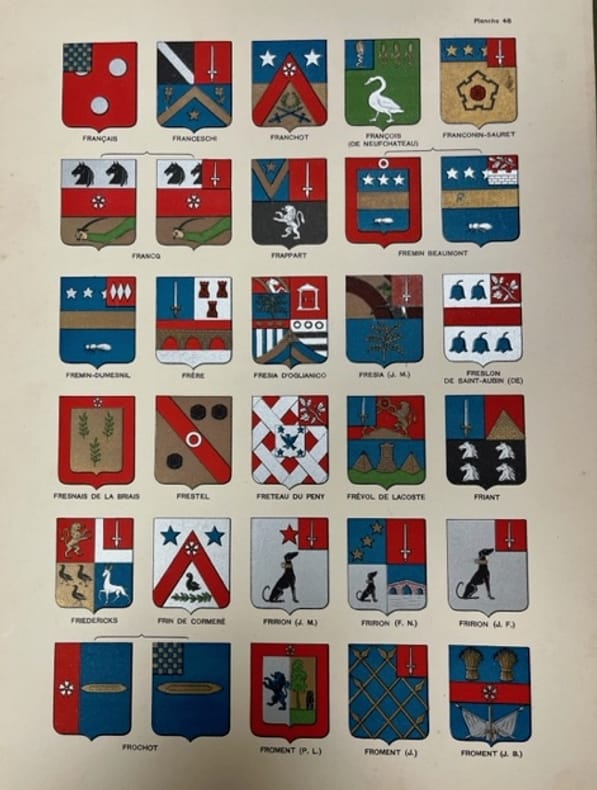
1894572637Paris, Champion, 1894-1911. 1894 12 vol. in-4, rel. pleine toile vert d'eau, (demi-basane de même couleur pour les 2 derniers vol.), titre doré, tête dorée, couv. conservées + Album in-folio, en feuilles, sous chemise à lacets de l'éditeur, (20 pp. de texte et 117 pl. de blasons chromolithographiés).
1894593545Paris, Champion, 1894-1911. 1894 6 vol. in-4, rel. de l'ép. demi-chagrin chocolat, dos lisse, titre doré, couv. conservées (sign. Franz) + Album in-folio, demi-chagrin de même couleurs, dos à nerfs finement orné aux fers dorés, tête dorée ; 20 pp. de texte, [11]+117 pl. de blasons chromolithographiés, le tout monté sur onglet. Ex-libris gravés.
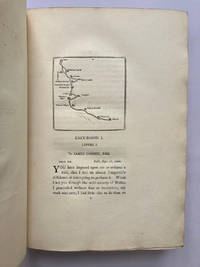
18013865<p>A scarce book of country excursions taking in some of the most striking landscapes and great houses within a day's journey of Bath. Three excursions are presented in the course of four letters with each excursion illustrated with a small part-page engraved map. The author describes in detail the landscapes cities and great houses along the way with plentiful information about the history of the towns gardens and architecture visited. Of particular note are Longleat Stourhead Fonthill and Wardour Castle. 'I am now to introduce you to one of the most splendid mansions in the kingdom Fonthill the seat of Mr. Beckford; where expence has reached its utmost limits in furniture and ornaments; where every room is a gold mine and every apartment a picture-gallery' p. 119. The description of Beckford's library is alas rather brief: 'The library is a large room filled with choice and expensive books; and decorated with appropriate paintings on the ceiling' p. 126.</p><p>Warner also visits 'new' Wardour Castle - it was built in the 1770s - and gives a room by room commentary of the architecture furniture and paintings. Or particular interest is his description of the chapel: 'From this apartment we are carried into the western gallery of the <em>chapel</em>; a structure that displays superlative taste and magnificence. Crimson furniture and gilded ornaments produce an immediate striking <em>coup d' œil; </em>but when the decorations are examined individually the splendour and expence become more perceptible. Three immense pictures by Rubens cover the southern wall of the chapel; and one by this artist and another by Guido of the same majestic size are their opposite companions. The altar-piece is a Dead Christ by Cades. A large gallery is constructed at the western end superbly fitted up for Lord Arundel and his party; a second at the east end of the north side for the choir; and a third at the east end of the north side for the accommodation of visiters sic. Benches occupy the middle of the chapel for the reception of the domestics and such of the villagers as profess the Romish faith; for there is a Catholic seminary here the pupils of which punctually attend at morning and evening prayers. The eastern end of the chapel recedes into a semi-circular form through the windows of which light is admitted; but as these are placed high and consist of coloured glass the effect is extremely striking and solemn. The central window exhibits Angels and the awful Tetragrammaton from which is an emanation of glory. Brought forward from the eastern end sufficiently to allow the processions around it stands the Altar a most costly piece of workmanship fixed on a splendid sarcophagus of ebony; and constructed of porphyry agate and amber. A magnificent crucifix of silver surmounts the altar; and two censers of solid gold embossed with silver suspended over it pour through the chapel odiferous clouds of ever-burning frankincense. Every thing around indeed evinces that the Romish ritual is observed here with the utmost vigour and magnificence; and doubtless the celebration of its higher offices amid such seducing objects must act with infinite force upon the imagination. The effect produced by the <em>externals</em> of worship every man experiences who attends our Cathedral service which has not been stripped of so much of its <em>lace</em> as the common parochial ritual; how much then must this be increased when aided by exquisite examples of sculpture and painting; amid the strains of angelical music the glare of unnumbered lights and the Hallelujahs of numerous multitudes! The tamest fancy must be roused by such a scene and the coldest heart warmed into transport … It is but proper to add that the attendance of strangers at the service in Wardour chapel is considered as a compliment and every convenience provided for their accommodation' pp. 137-141.</p><p>Richard Warner was an antiquary and an Anglican clergyman originally from the coastal town of Lymington in Hampshire. He became curate to Wililam Gilpin whose influence can be clearly seen in the present work dedicated to walking and the natural beauties of the west country. Warner obtained his first position in Bath in 1794 and remained there for some years writing a number of topographical works and a gothic novel <em>Netley Abbey</em> 1795 inspired by local ruins. He was a friend of Wordsworth who collected Warner's picturesque writings alongside those of Gilpin and who is known to have dined with him in Bath. In his lifetime Warner was mostly known for his controversial pacifist sermons and writings: it is thought that Blake was referring to Warner in the lines 'ask him if he is Bath or if he is Canterbury' in Jerusalem as claimed by David Erdman.</p><p>Although this copy is in a later nineteenth century binding and was bound without the half-title a previous owner - possibly from the 1840s or 1850s perhaps contemporaneous with the binding and the newspaper cutting - has added an engraved portrait a Latin celebration of Bath an engraving of Farleigh Castle and a newspaper cutting referring to Paul Methuen of Corsham.</p><p>OCLC lists BL University of Edinburgh the Natural History Museum and the Rubenianum in Antwerp only.</p> Crutwell & G.G. and J. Robinson
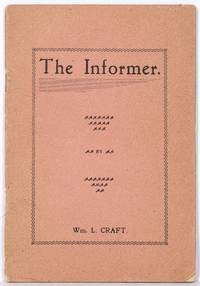
1900592001Savannah 1900. Softcover. Very Good/Near Fine. First edition. Frontispiece portrait of Craft. 16mo. 24pp. With five illustrations. Stapled in rose-colored printed wrappers. Loose chip from one rear corner laid in light wear at the edges including a few shallow chips and light creases. A pamphlet published by Rev. William L. Craft field secretary of The National Baptist Young Peoples Union Board used for recruitment efforts in the early 1910s. It provides a brief history of the church from its foundation as the Negro Baptist Church by George Leile in 1777 to the then present day under the leadership of Rev. Richard Henry Boyd; lists the organization's various presidents board members and officers; provides an overview of domestic and international missionary work; and prints a selection of various "don'ts" from spreading gossip and chewing tobacco to casting judgment and harming others. Also of interest is a small section on the importance of the number seven "a mystical and symbolic number in the Bible" likely to attract the attention of fellow African descendants who still retained spiritual belief in numerology. A rare pamphlet that we've not seen before. OCLC locates no copies. unknown
1817306787London: Printed for the author by W. Bulmer and Co. Shakespeare Press 1817. First edition with half-titles and errata. Hundreds of engravings and examples of type etc. some tinted in red and blue. 3 vols. Imperial 8vo. Contemporary straight-grained red morocco by Charles Smith covers gilt ruled with gilt side-pieces along central panel spines in six compartments with elaborate gilt scrollwork gilt turn-ins blue silk doublures with gilt cornerpieces duplicated on silk free endpapers a.e.g. Foxed minor rubbing to boards an attractive copy. First edition with half-titles and errata. Hundreds of engravings and examples of type etc. some tinted in red and blue. 3 vols. Imperial 8vo. Bound by Charles Smith. Dibdin's lavish work in an ornate binding by Charles Smith one of the more active and competent binders in London of the 1810s-'30s with his "13 Church St Soho" ticket in volume 1. Windle & Pippin A28; Jackson no.40; Hart no.186; Bigmore and Wyman pp. 169-70. Provenance: R.P. Hooper bookplate Printed for the author by W. Bulmer and Co. Shakespeare Press unknown books
18240009038MANCHESTER UK ROTTERDAM HAGUE NETHERLANDS HOLLAND. Good. 1824. On offer is a short but fascinating travel book of one wealthy young Englishmans journey to Rotterdam and The Hague Holland in 1824. It is a unique and rare look at the travel of English aristocracy in the first half of the 19th century the last great age of the English landed gentry. The book is 30 pages in length of which writing is on every single page. Every page is filled with excursions observations and examples of lavish living for William Money his father and his cousin as they travel first to Rotterdam and then spend over a month in The Hague living at quite a fancy hotel exploring the city itself and taking day trips to landmarks around the country. The little book also includes descriptions of lavish dinners and days being waited on driven and doted on by servants and friends. It begins in the Summer 1824: June 25 1824. To commence my narrative I will give a short account of the two last days before our embarkation to Holland. I went to bed rather late on Sunday and was very tired. I had been running about Town the whole day had my teeth filed By the abominable dentist which is one of the Miserries of human life. My head was distracted in short I was a picture of misery.; June 26. The servants awoke me rather early this morning about five OClock however I was much refreshed and went to work like one who had done nothing but I forgot to state that I went to dine at a Gentlemans house on Friday and after all when I came home I had to prepare my things for Holland. Well to go on with my story we get off from No. 9 Manchester Street Manchester Square at 6 oclock this was Saturday morning June 26th 1824 our Party consisted of three my precious Father my cousin and myself. We had a gentleman's carriage to take us about town and a hackney coach to carry our luggage to the Tower that place which has executed French of the greatest and has been destroyed with Royal blood by the hoards of unnatural rebellion. The next day they are on a sailboat going from the East Coast of England and then landing in the Netherlands the next day: June 27th. Went on deck. I was expecting to see nothing but blue skies and the watery ocean but was pleasantly astonished at seeing land all around. This was lacey land I Know it by that name because the Dutch gobble so. We soon got into the river Maas after a fine voyage. We then eat our hearty breakfast.We here took up a pistol and tacked along at a fine rate saw plenty of Tony-legged bison which they called Storks. We got to Rotterdam at 12. From the instant of arrival Money is taken aback by how clean and orderly the Dutch cities are and how kind and lovely the Dutch people are as well. The layout of the cities with the canals and bridges also is commented on quite frequently. June 28th1824. We took Breakfast at Home. we went out with with and enjoyed the town. It is an elegant clean looking place. Trees shaded the walk from the burning sun and canals divide the Principal Streets. However we saw nothing no hous as they call it but came home to dinner at 4. Here we had a bottle of Mousel for dinner we went out again so that I was very tired we then came home and had tea at Mr. Mackplats where we had another Prayer and a delightful conversation. He accompanied us home where I soon got to bed and fast asleep.; After two days in Rotterdam it is off to the Hague where Money and his father and cousin will spend the rest of their time in Holland. Drove off to the Hague with which Place we are most highly delighted. I the beauty of it. It far surpassed my places that I have seen. We walked everywhere the People the PLace and all are so clean. We came to the Hotel de Belle where we have so very nice rooms that had attendance the man who drove us here cheated as that. We were not long here before . Of the gentleman who got these rooms for Papa he took us out to Table d`ote d`hotewhere we dined . This was 4 oclock and had an excellent dinner and a bottle of vin ordinaire called Bordeau.after dinner we went to Mr. Ls house to get him to show us the Place. He showed us everything in the wood.` The `wood` is most probably the Haagse Bos a rectangular neighbourhood and forest in the Haagse Hout district of The Hague Netherlands. This was simply called Die Hout The Woods Mr. L.made a capital bargain with the man only one Golden to go to that sweet Ducking Place the old man of the Place has fishing boats to go over to England for something or other. We came back after a good bathe.We then came home and prepared for dinner and went to Table Doht d`hote and after that we came back and then went to the Wood where we had tea.; After early June there are no entries until late July. July 23 1824. We got up at seven and had breakfast. We set off at 8 in a caravan with Mr. London and Mr. Tosc. We reached Leyden at 9 very much interested.We first went to the University where we saw all of plenty Indians what from all parts of the globe. We saw there a tree which was brought from Egypt in 1573 just about the time when Leyden was besieged. It was made a present by William the first and planted there We then went to the museum and saw curious specimens of all types. Mr. London went to the Anatomy Hall to gut us to see a Head. He came back saying we could only see one which was most beautiful all the views of the Head Neck and parts of the body it was very interesting.; Money also has a deep regard for the engineering works of the day and has a special fascination for the canals and waterways of Holland. We had dinner and then went to to see the sluis the most Beautiful work I ever saw. It was begun in 1784 and finished in 1787. The whole country was inundated by the overflowing of the Bacchus of the Nile. It was like a sea but now these are houses where there was formerly nothing but water. This formed so when the sea is very boisterous there's a good deal of sand connected to the side of the gate so that it is had to clear away as it is on the sea side. The way they do it is the precipe overflows then they lift the gates all of a sudden which goes with such force that it forces the sand away.`` This is accompanied by a page-length drawing of the canal with it`s locks and steps and houses on each sides. The drawing is amateur but well done. The book is in very good shape structurally. The writing is clear and concise script done in black ink. A few pages have some smudging and one page in particular has a good bit of ink fading but which impedes legibility but does not make it impossible. The front cover of the journal states: `Short account of a holiday spent in The Hague by William Money later Rev. William in the summer of 1824 when he was 22 years old.` This is not in Money`s handwriting and was added later by an unknown person.; Manuscript; 8vo - over 7¾" - 9¾" tall; KEYWORDS: HISTORY OF REVEREND WILLIAM MONEY ENGLISH GENTLEMAN LANDED GENTRY 19TH CENTURY ROTTERDAM MANCHESTER ENGLAND UNITED KINGDOM THE HAGUE DEN HAAG DIE HOUT LEYDEN LEIDEN THE NETHERLANDS HOLLAND CANALS IN THE NETHERLANDS FLOOD CONTROL EXTRAVAGANT TRAVEL TABLE DHOTE SLUICE GATE AGE OF BRITISH NOBILITY COLONIAL ERA ENGLAND BRITANNICA HANDWRITTEN MANUSCRIPT DOCUMENT LETTER AUTOGRAPH WRITER HAND WRITTEN DOCUMENTS SIGNED LETTERS MANUSCRIPTS HISTORICAL HOLOGRAPH WRITERS AUTOGRAPHS PERSONAL MEMOIR MEMORIAL ANTIQUITÉ CONTRAT VÉLIN DOCUMENT MANUSCRIT PAPIER ANTIKE BRIEF PERGAMENT DOKUMENT MANUSKRIPT PAPIER OGGETTO DANTIQUARIATO ATTO VELINA DOCUMENTO MANOSCRITTO CARTA ANTIGÜEDAD HECHO VITELA DOCUMENTO MANUSCRITO PAPEL . unknown
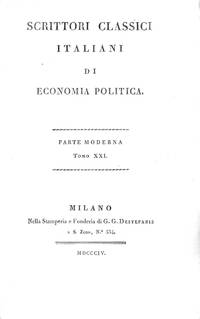
180323804Milano: De Stefanis 1803-1805. In-8 p. mm. 221x146 brossura originale 50 volumi. Importante collana di economia curata da Pietro Custodi e composta di due serie: "Parte Antica" tomi I-VII - "Parte Moderna" tomi I-XLI 1 volume di Supplimento n. IL 1 volume di Indici generali n. L. E' questa la prima raccolta completa di notizie e studi sull'economia l'agricoltura i tributi e la moneta nonchè appendici legislative del Sette e Ottocento.La "Parte antica" raccoglie i seguenti autori: Serra Turbolo 1 volume - Davanzati Scaruffi 1 volume - Montanari 1 volume - Broggia 2 volumi - Neri 2 volumi.La "Parte moderna": Bandini Algarotti 1 volume - Belloni Pagnini 1 volume - Galiani 4 volumi - Genovesi 4 volumi - Beccaria 2 volumi - Carli 2 volumi - Verri 3 volumi - Zanon 2 volumi - Paoletti 1 volume - Ortes 7 volumi - Briganti 2 volumi - D'Arco 2 volumi - Filangeri 1 volume - Vasco 3 volumi - Mengotti 1 volume - Palmieri 2 volumi - Delfico Coriani Solera 1 volume - Cantalupo Caracciolo Scrofani 1 volume - Ricci 1 volume.Cfr. "Catalogo della Biblioteca Einaudi"5193.Nel ns. esemplare una ventina di brossure con piccoli strappi o piccole mancanze un volume ingiallito e con aloni sulle ultime 18 carte altrimenti tutti i testi con barbe sono ben conservati. De Stefanis, unknown
1809120049NY: E. Sargeant Printed by Opposite Trinity Church.by D&G.Bruce. Good. 1809. First Edition. Hardcover. 5x8". GOOD CONDITION. Front endpapers gone missing.Opens to title page.Otherwise quite nice.lite foxing to pages. Name in pencil inner back cover "Arthur Smith" ; .bright fully readable Gold spine titles on smooth brown leather spine strip. Marbled brown paper covered hard boards. smooth brown leather tips.showing minor rubs to oints & spine ends. not worn. Hinges showing at inner gutters. Text block is solidly bound.Text paper has pliable feel cleanly inked type and not at all brittle. Clean foredges. ; 387xvi pages pages; This might make a nice gift for a member of the CHARLESTON SOUTH CAROLINA FIRST SCOTS PRESBYTERIAN CHURCH IN THE LOW COUNTRY .WHICH STILL IS A THRIVING INSTITUTION.; Signed by Author . E. Sargeant Printed by Opposite Trinity Church.by D&G.Bruce hardcover
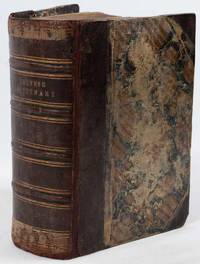
1865219705Shanghae sic & London.: London Mission Press and Trubner & Co. 1865. Two volumes in one: <br>Volume I. ii Title i-x Advertisement Preface 762 pp including Index of Chinese characters pp 1-99 pagination duplicated for pp 224 & 239. <br>Volume II. ii Title 724pp iv List of the Radicals of the Chinese Language. <br> <br>22 x 15 cms contemporary half calf spine gilt between raised bands expertly rebacked mounting the original spine numerous annotations and underlinings in pencil a handful in ink at the head the final blanks with notes and translation age-toned and worn boards rubbed but a good complete copy of the scarce reprint. <br> <br>Provenance: <br>With the early inked signature of "Hugh Wadell Newchwang 1869" the pioneering missionary whose work laid the foundation for the Irish Presbyterian Church's long-term presence in East Asia. In 1869 Waddell 1839–1901 landed at Newchwang now Yingkou where he established a mission station that included a church school and dispensary. His daughter was Helen Waddell poet scholar and theological novelist. <br> <br>Recent signature of A. Allan Shearer Wellington. Scarce reprint of the second part of Morrison's Dictionary first published between 1815 and 1823 with a notable provenance. The 1865 reprint was issued as a single volume combining the second part of the dictionary with an index of characters arranged according to the Kangxi radicals. <br> <br>"The Second Part of Morrison's Dictionary has been generally commended by experienced Sinologues as the most perfect and useful of the whole. The present is merely a reprint of it with such slight modifications as are mentioned at the close of the original preface." Preface <br>Löwendahl 1334 . London Mission Press [and] Trubner & Co. hardcover
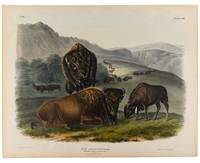
184942915New York: John James Audubon 1849. First edition hand-colored lithograph by John T. Bowen of Philadelphia after John James Audubon. An iconic image of Western Americana from the folio first edition of Audubon's "Quadrupeds of North America" the greatest work of natural history illustration produced in America during the nineteenth century: "As long as our civilization lasts America will be in debt to this genius." Peterson<br/> <br/> This fine plate is from the folio edition of Audubon's The Viviparous Quadrupeds of North America which was produced entirely in the United States. The work was Audubon's last and by 1846 he had to hand over the drawing of the final fifty plates to his sons John Woodhouse and Victor Audubon. The production of the Quadrupeds was begun by Audubon and his sons at about the same time as the commercially-successful octavo edition of The Birds of America. Unlike the double-elephant folio the Quadrupeds was produced entirely in the United States. Reese notes that "By 1843 the Audubon family business was a well-oiled machine involving John James his two sons and various in-laws and friends. The octavo Birds was still in production when Bowen began to produce the plates for the folio edition of the Quadrupeds the largest successful color-plate book project of 19th-century America. It took the family five years to publish 150 plates in thirty parts. The massive project was a commercial success thanks to the close management of Victor. There were about three hundred subscribers." Reese Like Birds of America the Viviparous Quadrupeds was intended to be a comprehensive visual catalog of North America animalia with Audubon's focus here shifting from birds to four-legged land mammals. Accompanying each image was correlating didactic text written primarily by Bachman that informed the reader of the animal's habits diet habitat and gestational period. Totaling 150 prints the project was rushed to completion as Audubon's health declined. Emerging in the shadow of its acclaimed predecessor Birds of America the Viviparous Quadrupeds has not received the adequate attention nor recognition it so richly deserves. This image is of a family of American buffalo the most iconic animal indigenous to North America whose presence was integral for Native American life and whose near-extinction spurred on the conservation movement in the US. The buffalo is today the state animal of Kansas Oklahoma and Wyoming.<br/> <br/> Bennett p.5. Peterson Birds of America passim. Reese Stamped with a National Character 36. Sabin 2367. Wood p.209. John James Audubon unknown
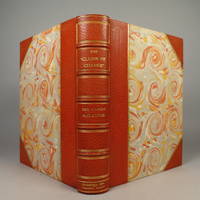
18765071First edition in English of the I-Ching the ancient Chinese book of divination sometimes attributed to Confucius but actually much earlier possibly with origins in the second millennium and so the most ancient text of Chinese Civilization. OCLC lists but eight copies worldwide. In McClatchie's view Qian and Kun represented the "God of Heathendom. Qian or his Male portion… and Kun or his Female portion …. These two he goes on to say "are enclosed in the circle or ring… known as the Supreme Ultimate or Great One from which all things are generated." His contemporaries "ridiculed this decidedly sexual view Shchutskii described it as the product of "pseudoscientific delirium" but recent work by other scholars suggests its essential validity. Richard J. Smith "How the Book of Changes arrived in the West". This copy very handsomely bound by Bennett of New York about seventy years ago in grained sienna morocco with title & author in double gilt ruled spine compartments; tooled hubs; top edge gilt. "Shanghai 1876" and owner's name to foot of spine. Preliminaries slightly foxed. xiii vii -xiii of which are platesixvii455 i errata. Chinese and English on opposite pages. "Shanghai Nov. 1876" in light pencil to front fly. Slight loss of paper to front board. Please see images. American Presbyterian Mission Press, Trubner & Co. hardcover books